Mahout Scala and Spark Bindings:
Bringing algebraic semantics
Dmitriy Lyubimov
2014
Requirements for an ideal ML Environment
Wanted:
1. Clear R (Matlab)-like semantics and type system that covers
 Linear Algebra, Stats and Data Frames
2. Modern programming language qualities
 Functional programming
 Object Oriented programming
 Sensible byte code Performance
 A Big Plus: Scripting and Interactive shell
3. Distributed scalability
with a sensible performance
4. Collection of off-the-shelf building blocks
and algorithms
5. Visualization
Mahout Scala & Spark Bindings aim to address (1-a), (2), (3),
(4).
Scala & Spark Bindings are:
1. Scala as programming/scripting environment
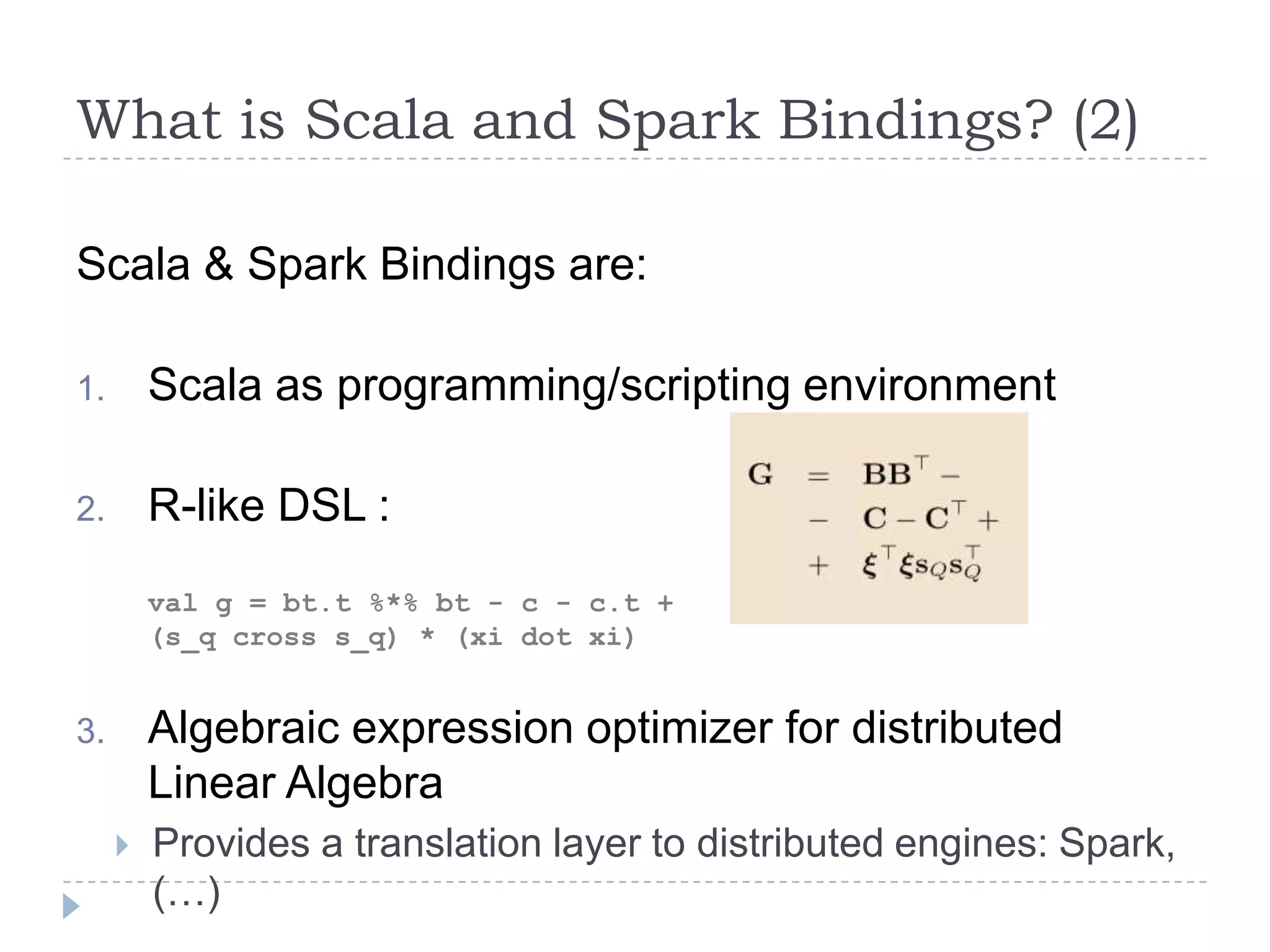
2. R-like DSL :
val g = bt.t %*% bt - c - c.t +
(s_q cross s_q) * (xi dot xi)
3. Algebraic expression optimizer for distributed
Linear Algebra
 Provides a translation layer to distributed engines: Spark,
(…)
What is Scala and Spark Bindings? (2)
What are the data types?
1. Scalar real values (Double)
2. In-core vectors (2 types of sparse, 1 type of dense)
3. In-core matrices: sparse and dense
 A number of specialized matrices
4. Distributed Row Matrices (DRM)
 Compatible across Mahout MR and Spark solvers via
persistence format
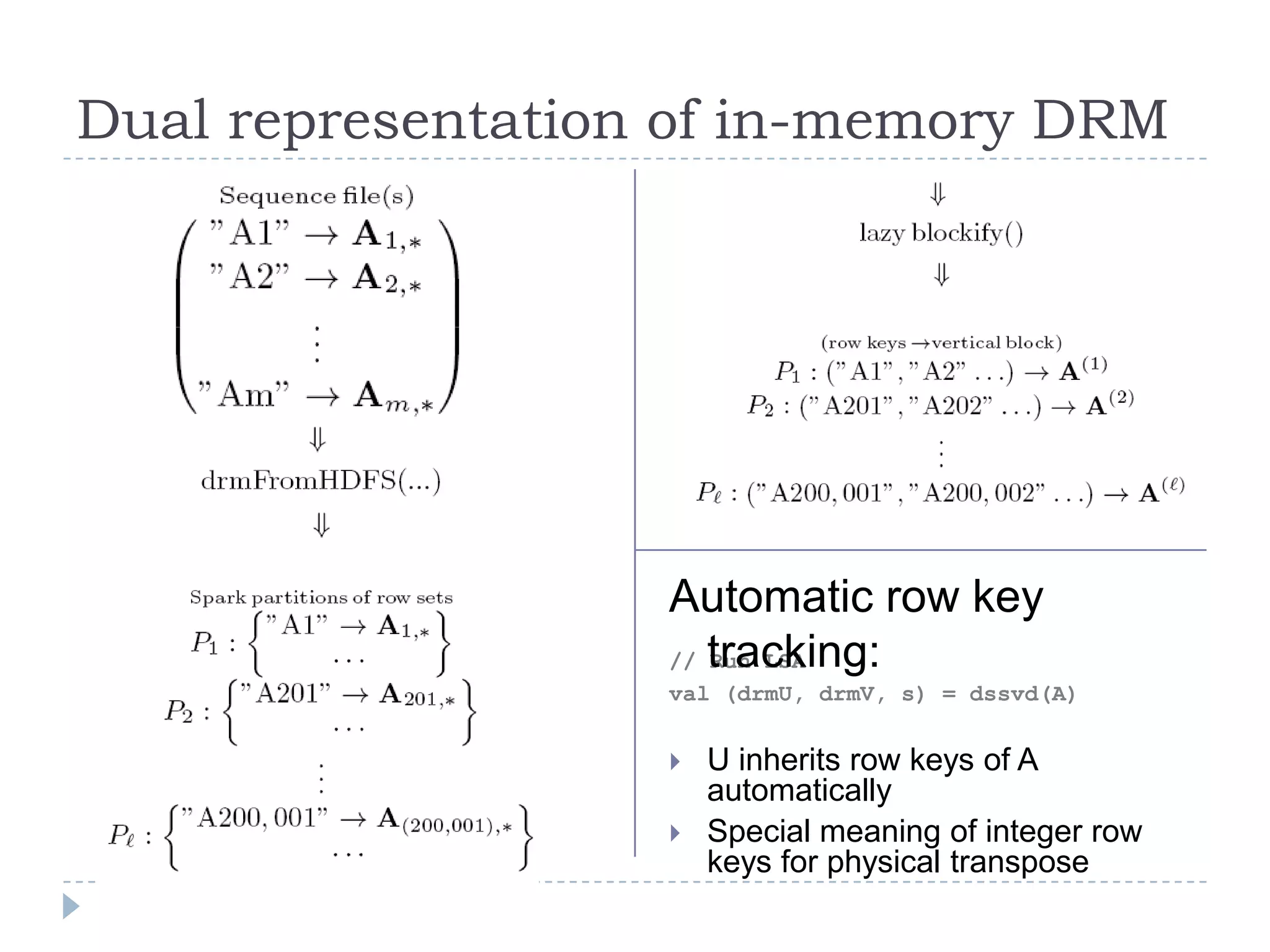
Dual representation of in-memory DRM
// Run LSA
val (drmU, drmV, s) = dssvd(A)
 U inherits row keys of A
automatically
 Special meaning of integer row
keys for physical transpose
Automatic row key
tracking:
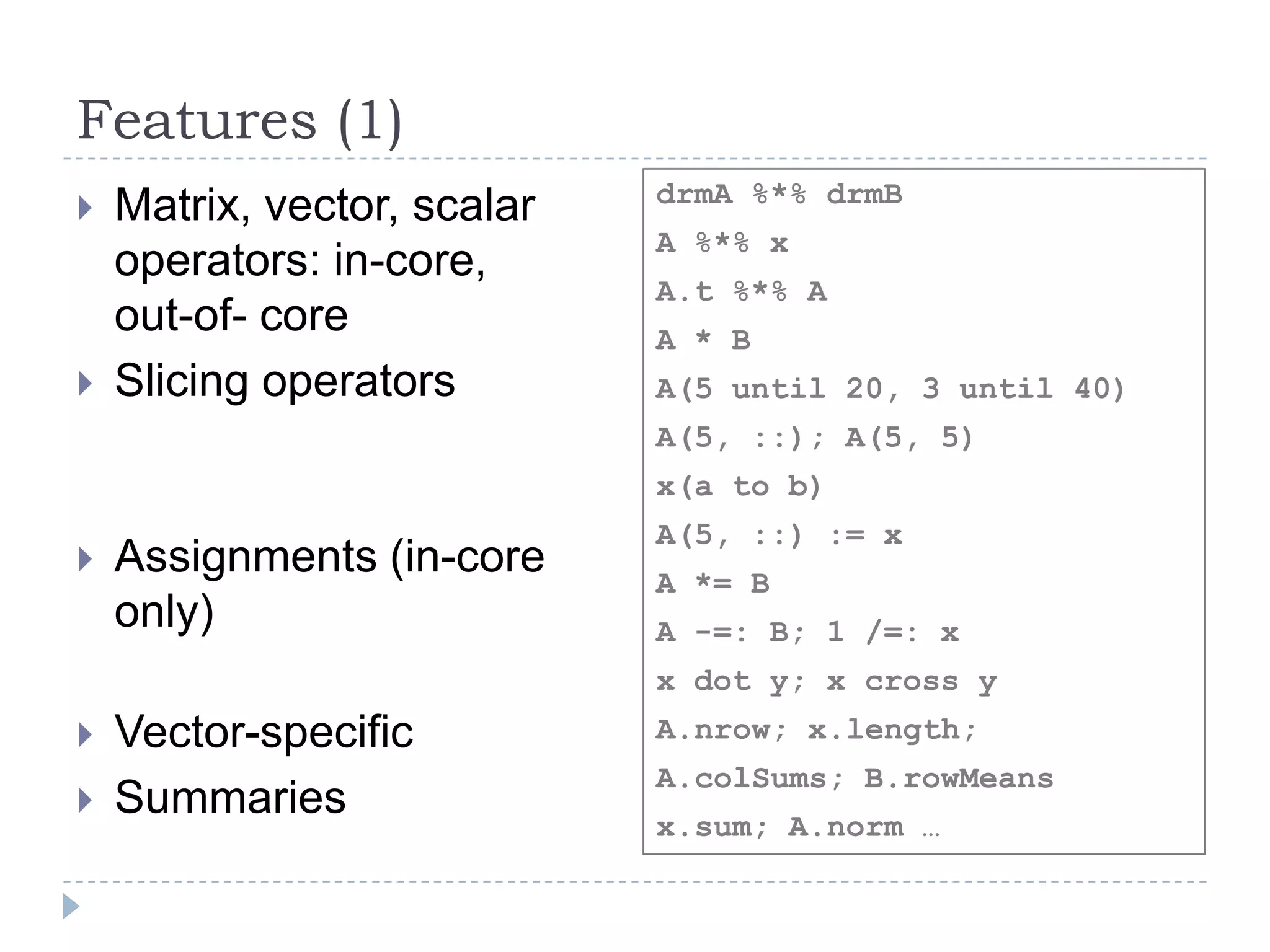
Features (1)
 Matrix, vector, scalar
operators: in-core,
out-of- core
 Slicing operators
 Assignments (in-core
only)
 Vector-specific
 Summaries
drmA %*% drmB
A %*% x
A.t %*% A
A * B
A(5 until 20, 3 until 40)
A(5, ::); A(5, 5)
x(a to b)
A(5, ::) := x
A *= B
A -=: B; 1 /=: x
x dot y; x cross y
A.nrow; x.length;
A.colSums; B.rowMeans
x.sum; A.norm …
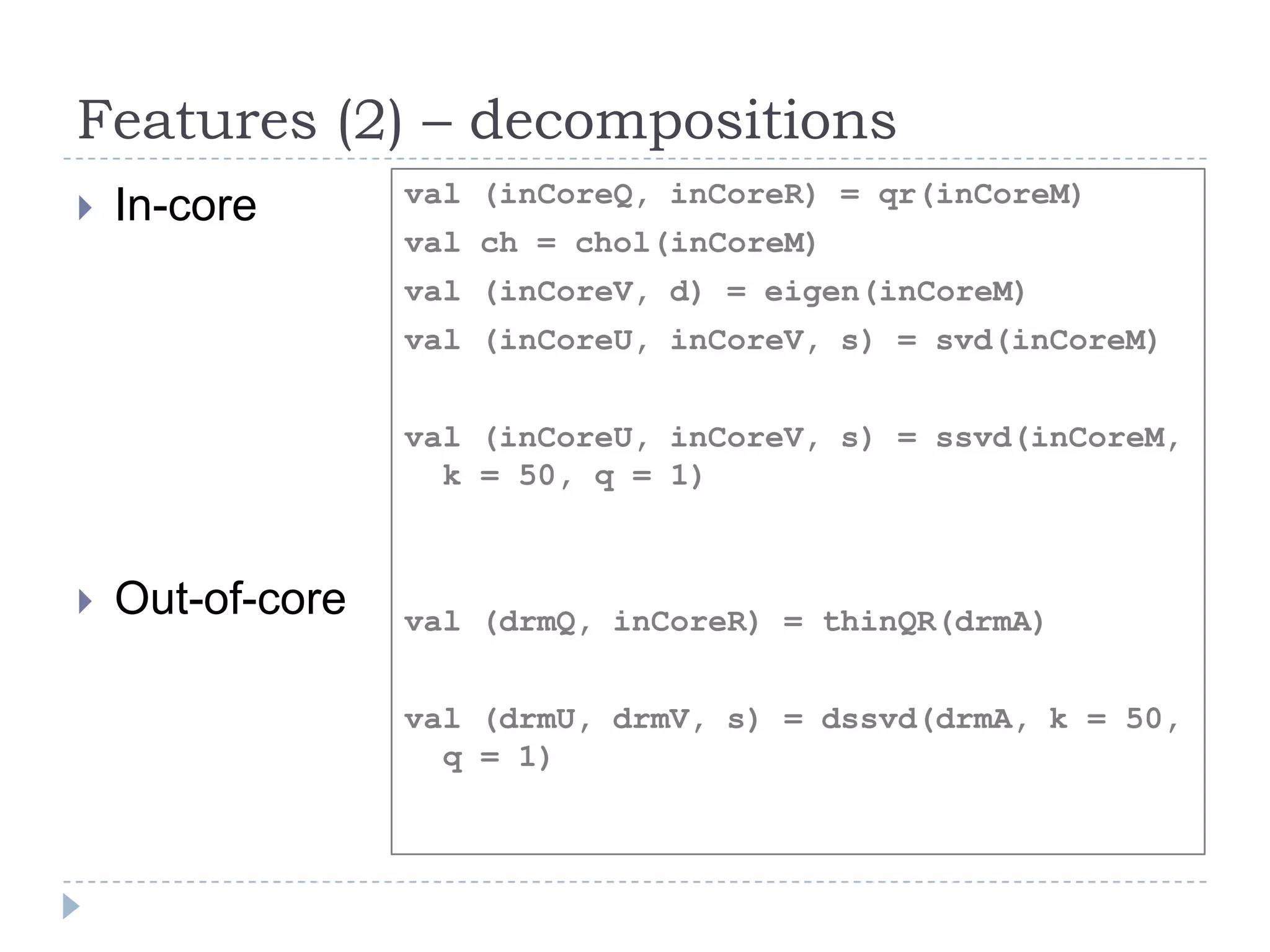
Features (2) – decompositions
 In-core
 Out-of-core
val (inCoreQ, inCoreR) = qr(inCoreM)
val ch = chol(inCoreM)
val (inCoreV, d) = eigen(inCoreM)
val (inCoreU, inCoreV, s) = svd(inCoreM)
val (inCoreU, inCoreV, s) = ssvd(inCoreM,
k = 50, q = 1)
val (drmQ, inCoreR) = thinQR(drmA)
val (drmU, drmV, s) = dssvd(drmA, k = 50,
q = 1)
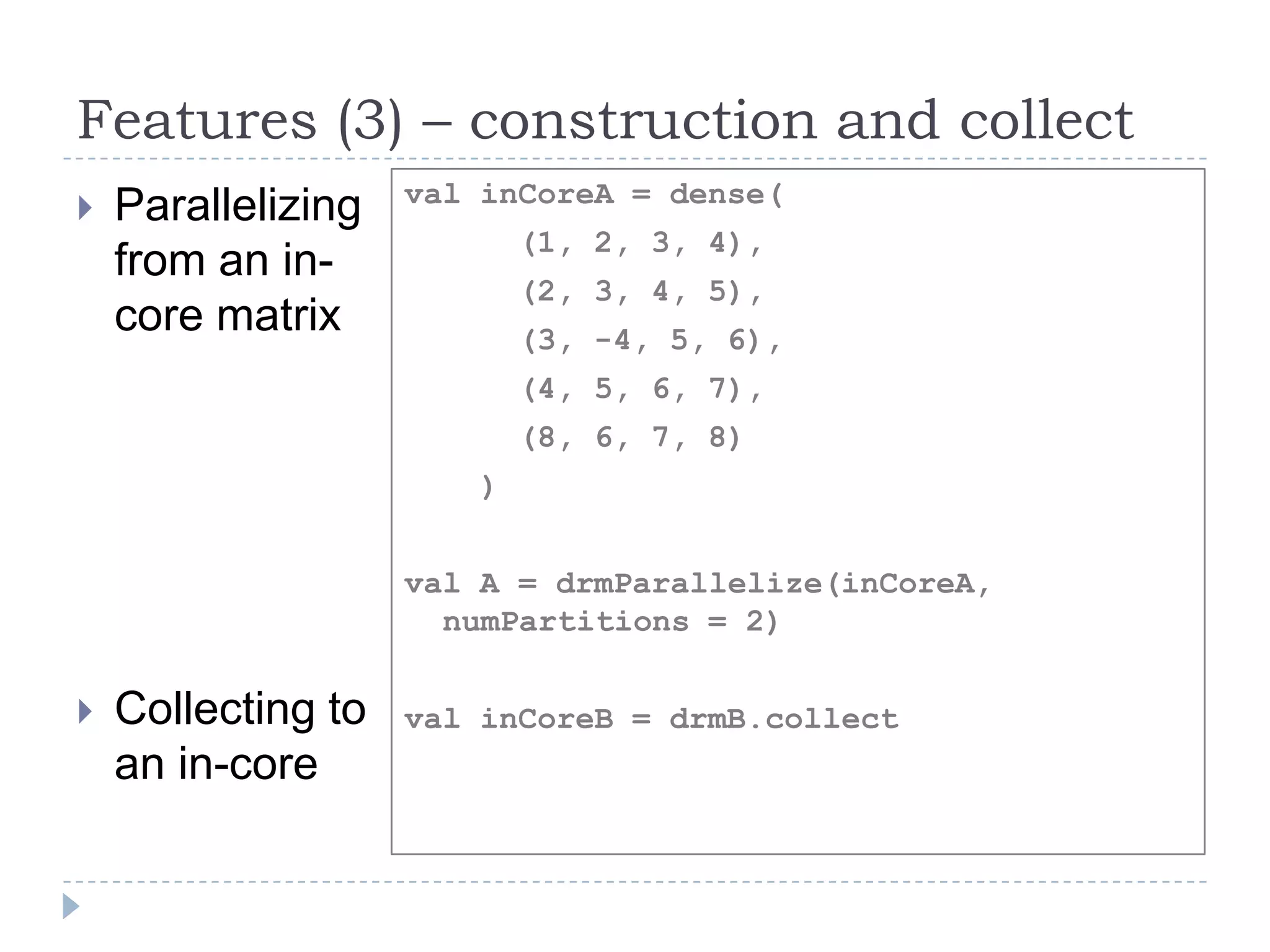
Features (3) – construction and collect
 Parallelizing
from an in-
core matrix
 Collecting to
an in-core
val inCoreA = dense(
(1, 2, 3, 4),
(2, 3, 4, 5),
(3, -4, 5, 6),
(4, 5, 6, 7),
(8, 6, 7, 8)
)
val A = drmParallelize(inCoreA,
numPartitions = 2)
val inCoreB = drmB.collect
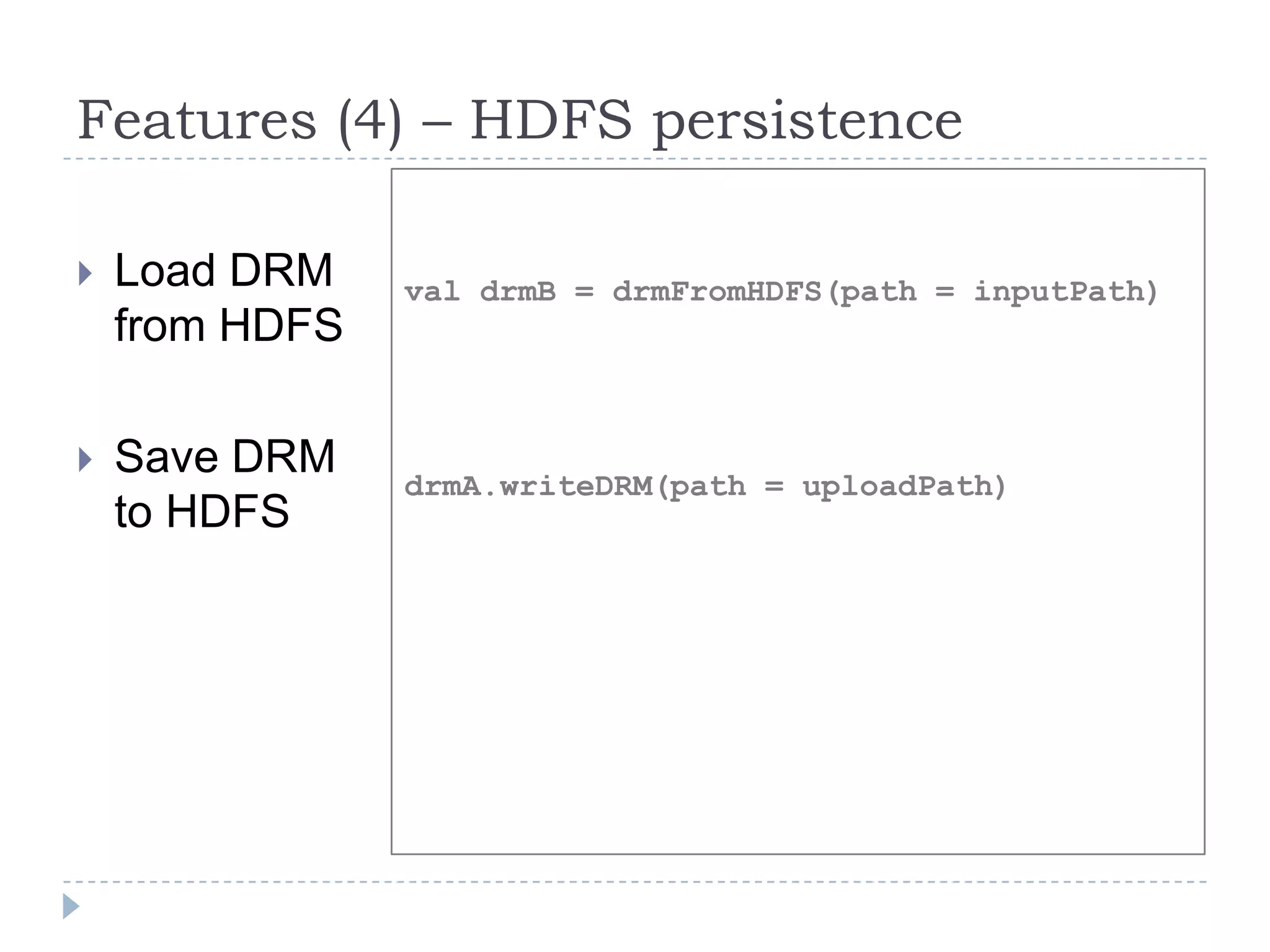
Features (4) – HDFS persistence
 Load DRM
from HDFS
 Save DRM
to HDFS
val drmB = drmFromHDFS(path = inputPath)
drmA.writeDRM(path = uploadPath)
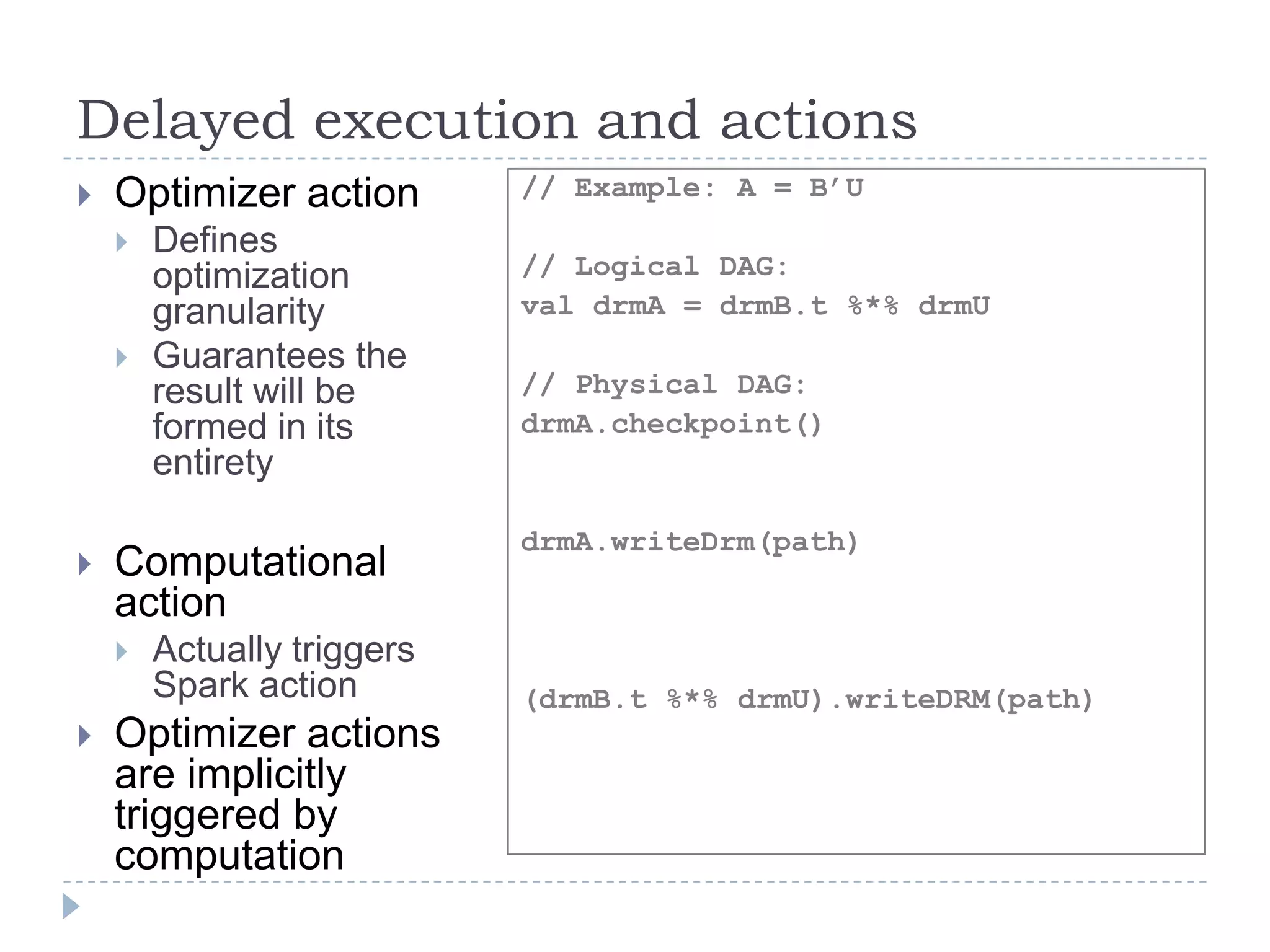
Delayed execution and actions
 Optimizer action
 Defines
optimization
granularity
 Guarantees the
result will be
formed in its
entirety
 Computational
action
 Actually triggers
Spark action
 Optimizer actions
are implicitly
triggered by
computation
// Example: A = B’U
// Logical DAG:
val drmA = drmB.t %*% drmU
// Physical DAG:
drmA.checkpoint()
drmA.writeDrm(path)
(drmB.t %*% drmU).writeDRM(path)
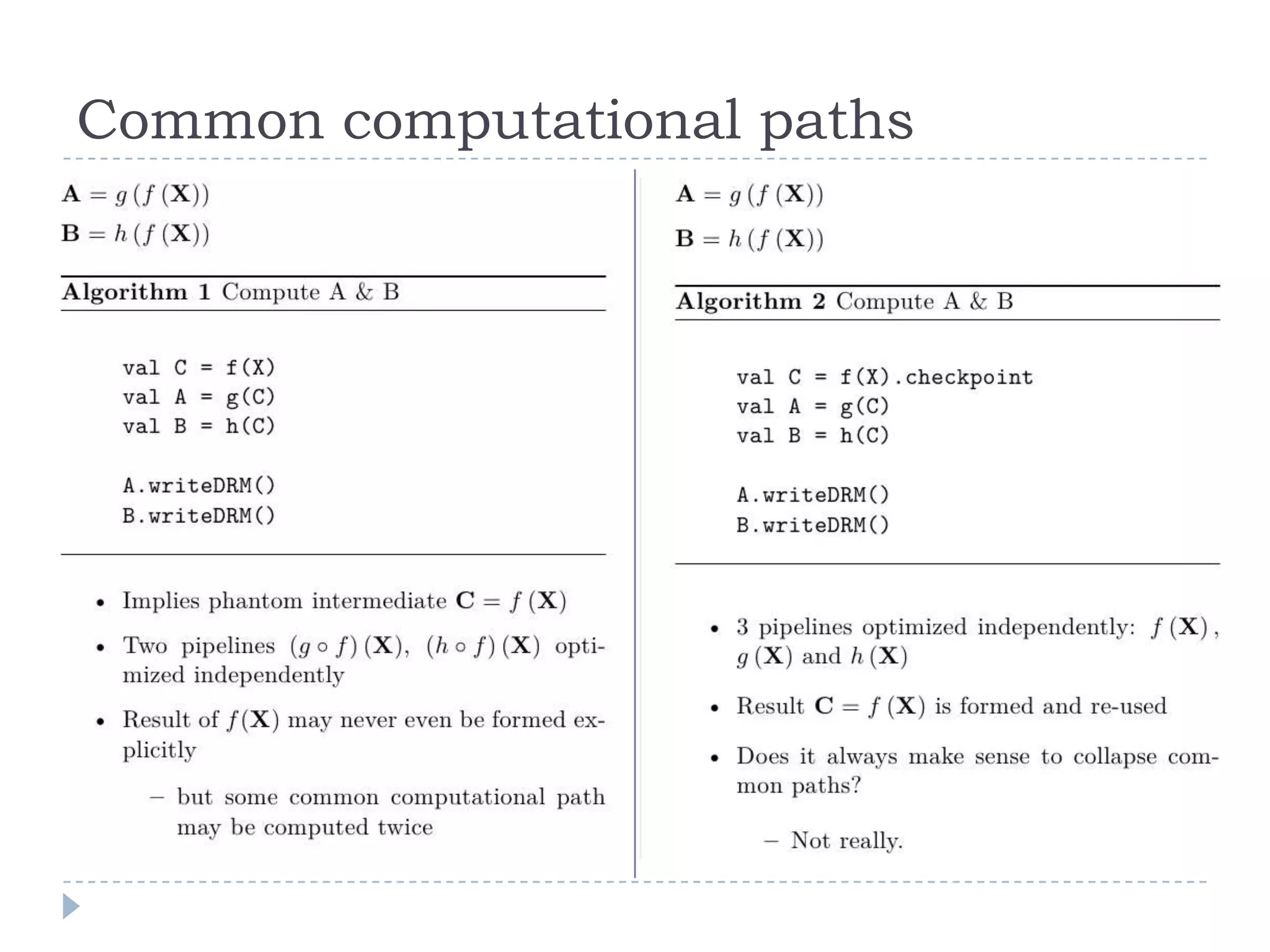
Common computational paths
Checkpoint caching (maps 1:1 to Spark)
 Checkpoint caching is a combination of None | in-
memory | disk | serialized | replicated options
 Method “checkpoint()” signature:
def checkpoint(sLevel: StorageLevel =
StorageLevel.MEMORY_ONLY): CheckpointedDrm[K]
 Unpin data when no longer needed
drmA.uncache()
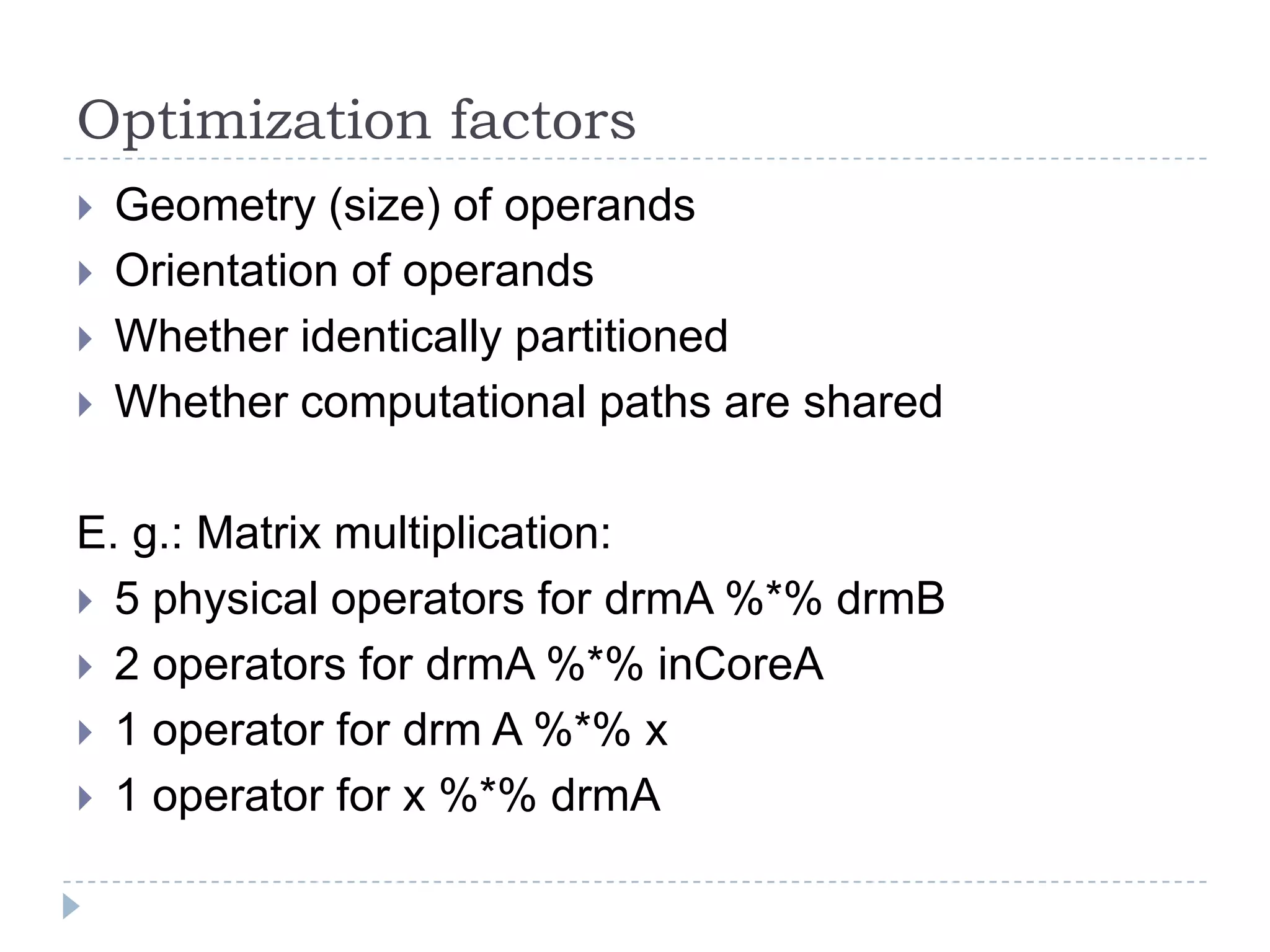
Optimization factors
 Geometry (size) of operands
 Orientation of operands
 Whether identically partitioned
 Whether computational paths are shared
E. g.: Matrix multiplication:
 5 physical operators for drmA %*% drmB
 2 operators for drmA %*% inCoreA
 1 operator for drm A %*% x
 1 operator for x %*% drmA
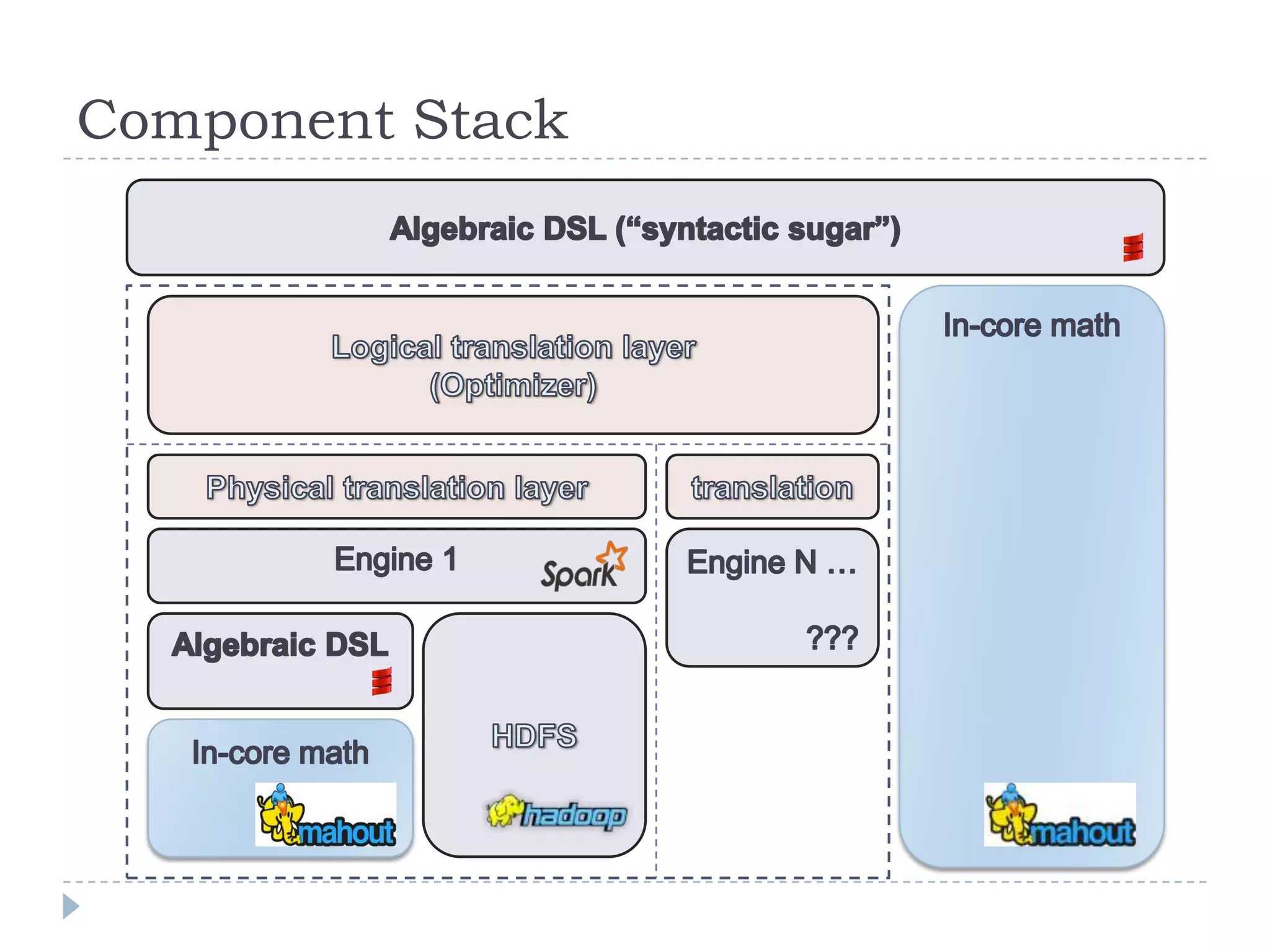
Component Stack
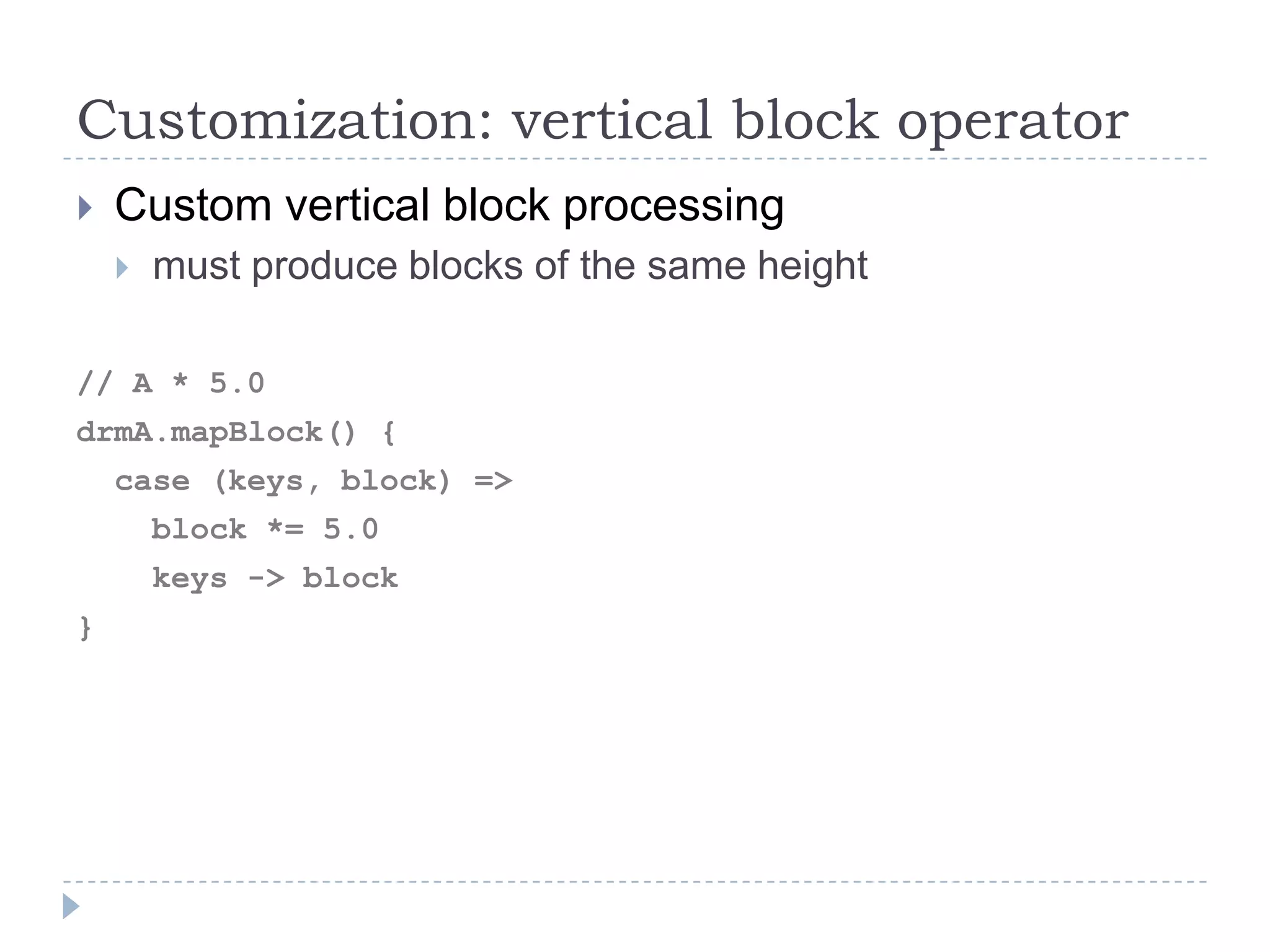
Customization: vertical block operator
 Custom vertical block processing
 must produce blocks of the same height
// A * 5.0
drmA.mapBlock() {
case (keys, block) =>
block *= 5.0
keys -> block
}
Customization: Externalizing RDDs
 Externalizing raw RDD
 Triggers optimizer checkpoint implicitly
val rawRdd:DrmRDD[K] = drmA.rdd
 Wrapping raw RDD into a DRM
 Stitching with data prep pipelines
 Building complex distributed algorithm
val drmA = drmWrap(rdd = rddA [, … ])
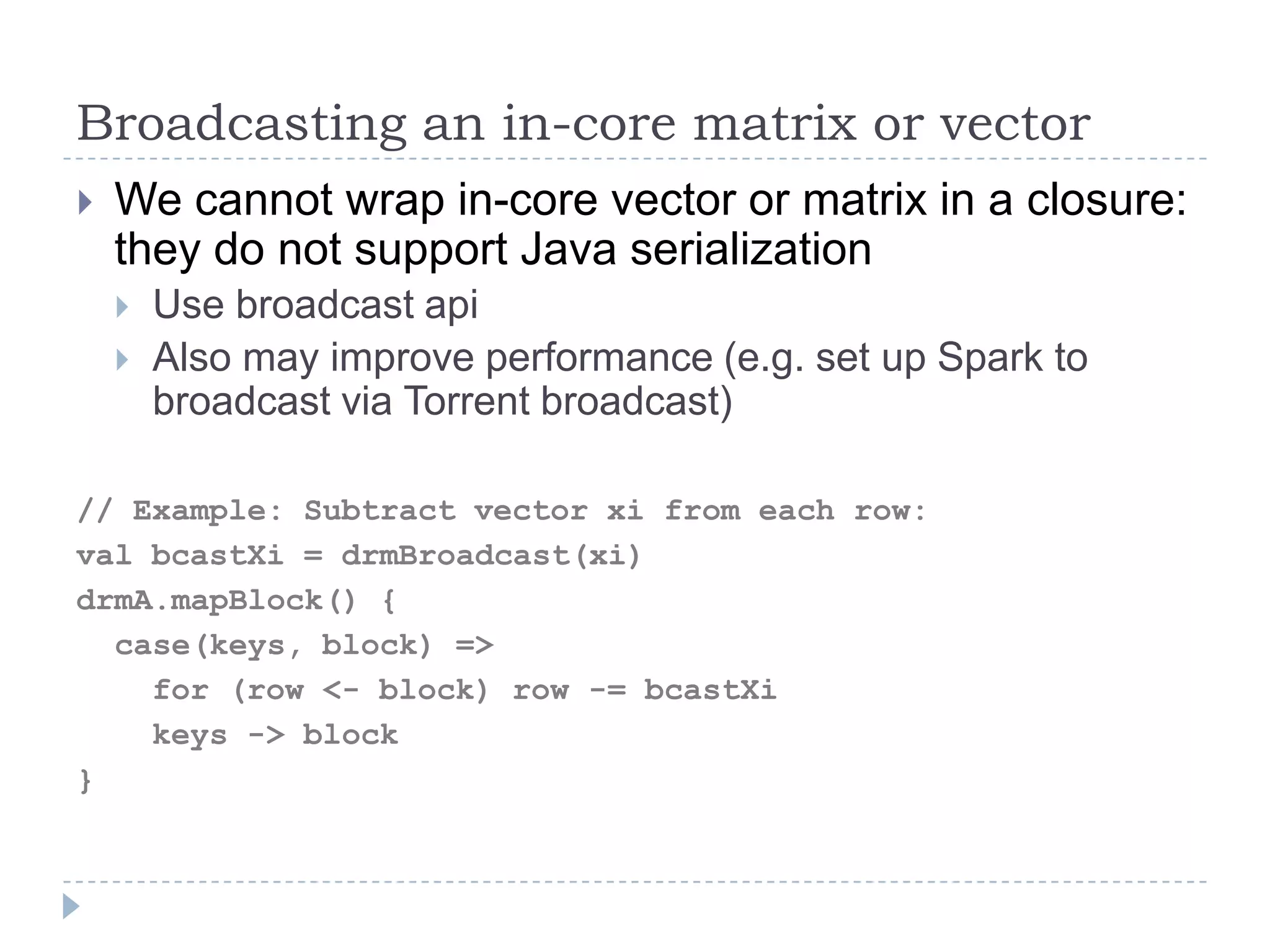
Broadcasting an in-core matrix or vector
 We cannot wrap in-core vector or matrix in a closure:
they do not support Java serialization
 Use broadcast api
 Also may improve performance (e.g. set up Spark to
broadcast via Torrent broadcast)
// Example: Subtract vector xi from each row:
val bcastXi = drmBroadcast(xi)
drmA.mapBlock() {
case(keys, block) =>
for (row <- block) row -= bcastXi
keys -> block
}
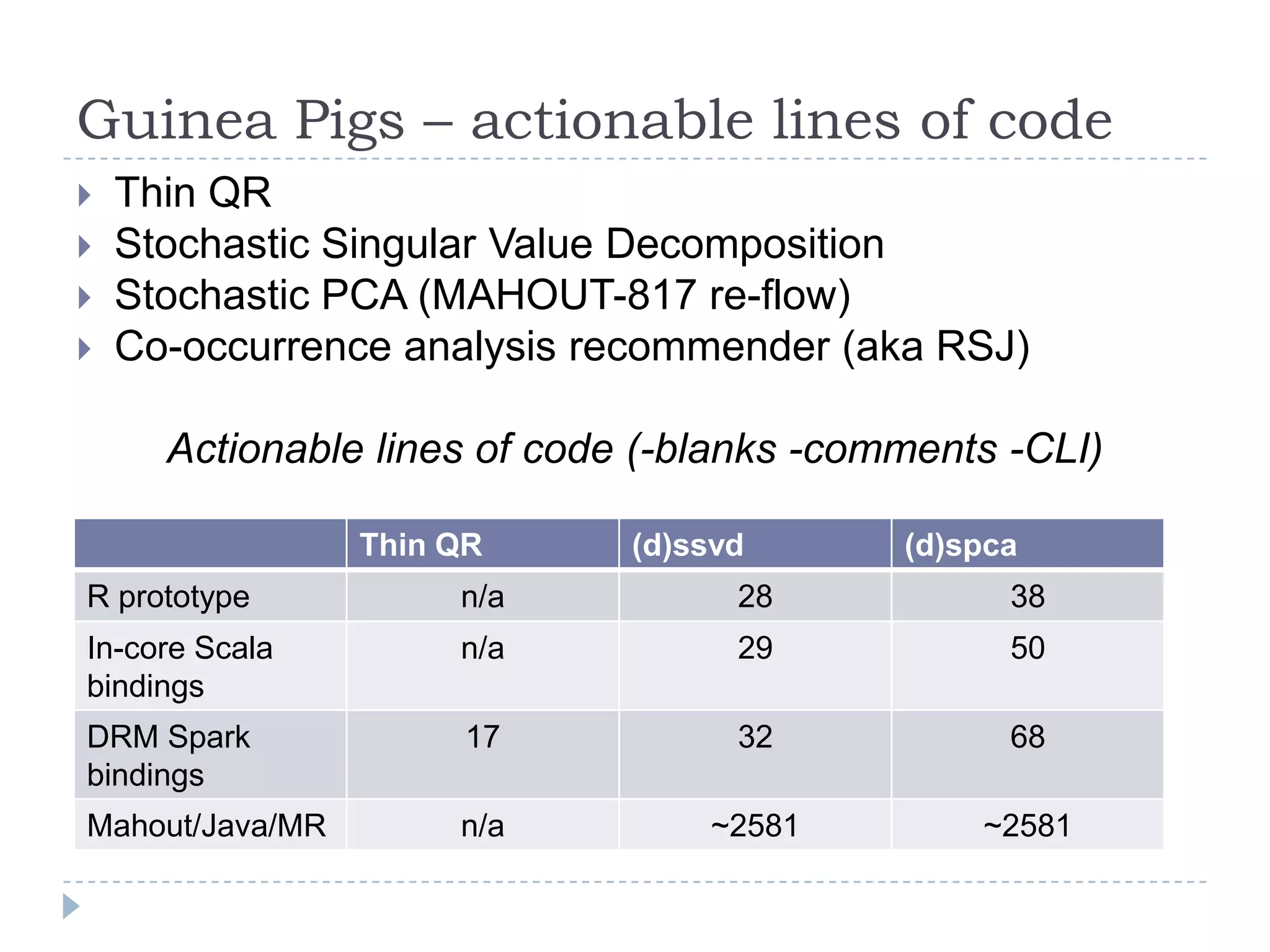
Guinea Pigs – actionable lines of code
 Thin QR
 Stochastic Singular Value Decomposition
 Stochastic PCA (MAHOUT-817 re-flow)
 Co-occurrence analysis recommender (aka RSJ)
Actionable lines of code (-blanks -comments -CLI)
Thin QR (d)ssvd (d)spca
R prototype n/a 28 38
In-core Scala
bindings
n/a 29 50
DRM Spark
bindings
17 32 68
Mahout/Java/MR n/a ~2581 ~2581
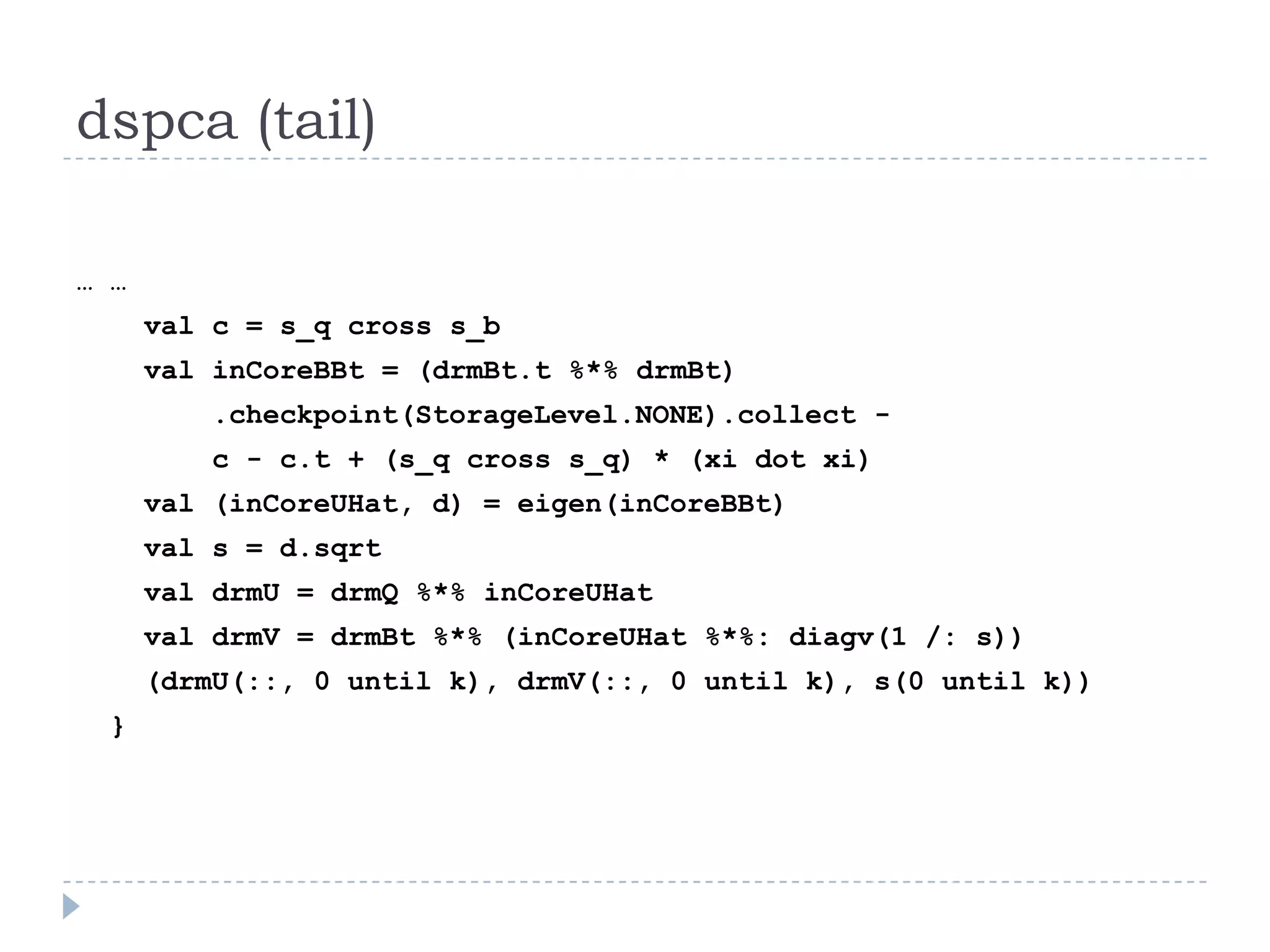
dspca (tail)
… …
val c = s_q cross s_b
val inCoreBBt = (drmBt.t %*% drmBt)
.checkpoint(StorageLevel.NONE).collect -
c - c.t + (s_q cross s_q) * (xi dot xi)
val (inCoreUHat, d) = eigen(inCoreBBt)
val s = d.sqrt
val drmU = drmQ %*% inCoreUHat
val drmV = drmBt %*% (inCoreUHat %*%: diagv(1 /: s))
(drmU(::, 0 until k), drmV(::, 0 until k), s(0 until k))
}
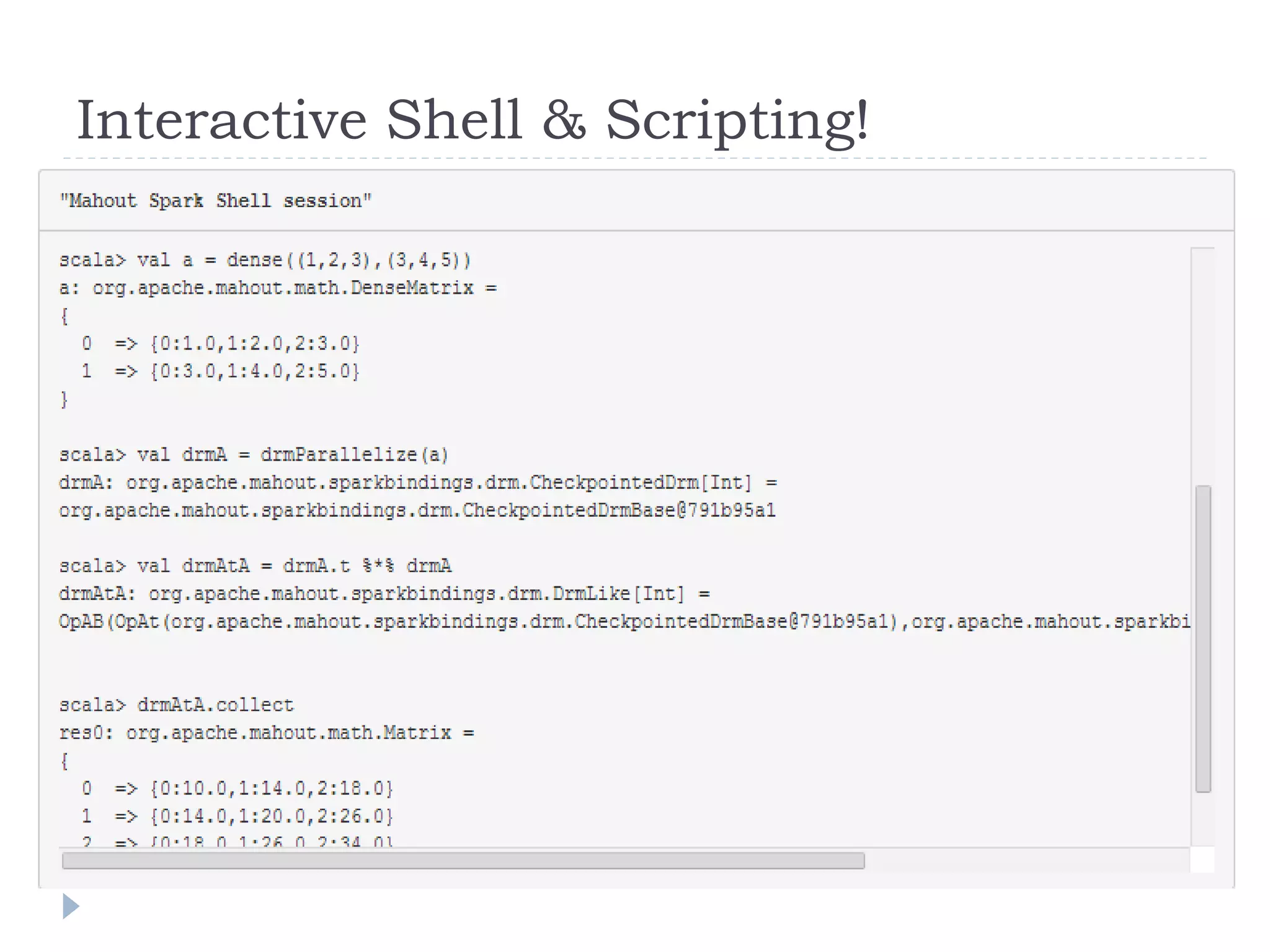
Interactive Shell & Scripting!
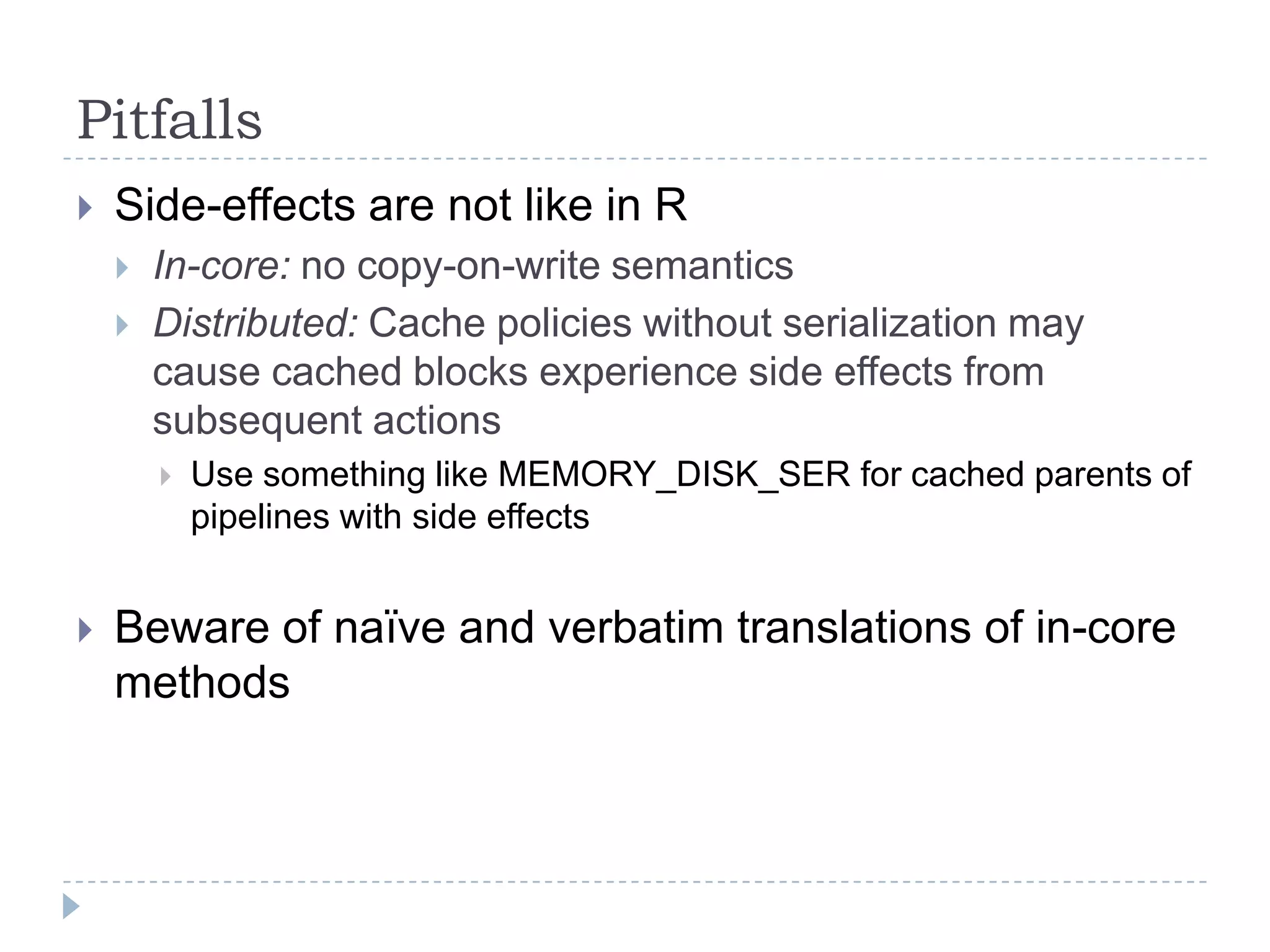
Pitfalls
 Side-effects are not like in R
 In-core: no copy-on-write semantics
 Distributed: Cache policies without serialization may
cause cached blocks experience side effects from
subsequent actions
 Use something like MEMORY_DISK_SER for cached parents of
pipelines with side effects
 Beware of naïve and verbatim translations of in-core
methods
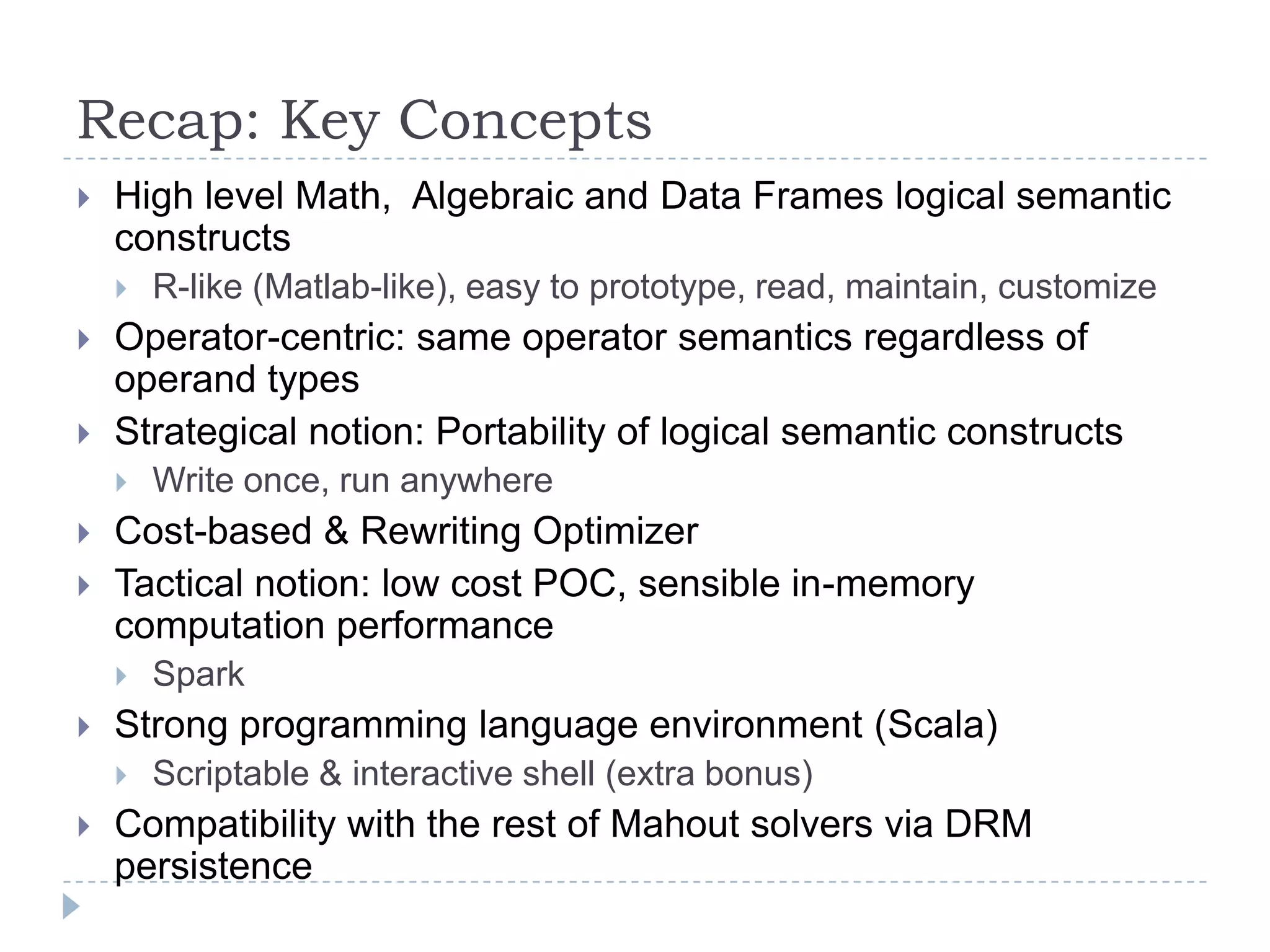
Recap: Key Concepts
 High level Math, Algebraic and Data Frames logical semantic
constructs
 R-like (Matlab-like), easy to prototype, read, maintain, customize
 Operator-centric: same operator semantics regardless of
operand types
 Strategical notion: Portability of logical semantic constructs
 Write once, run anywhere
 Cost-based & Rewriting Optimizer
 Tactical notion: low cost POC, sensible in-memory
computation performance
 Spark
 Strong programming language environment (Scala)
 Scriptable & interactive shell (extra bonus)
 Compatibility with the rest of Mahout solvers via DRM
persistence
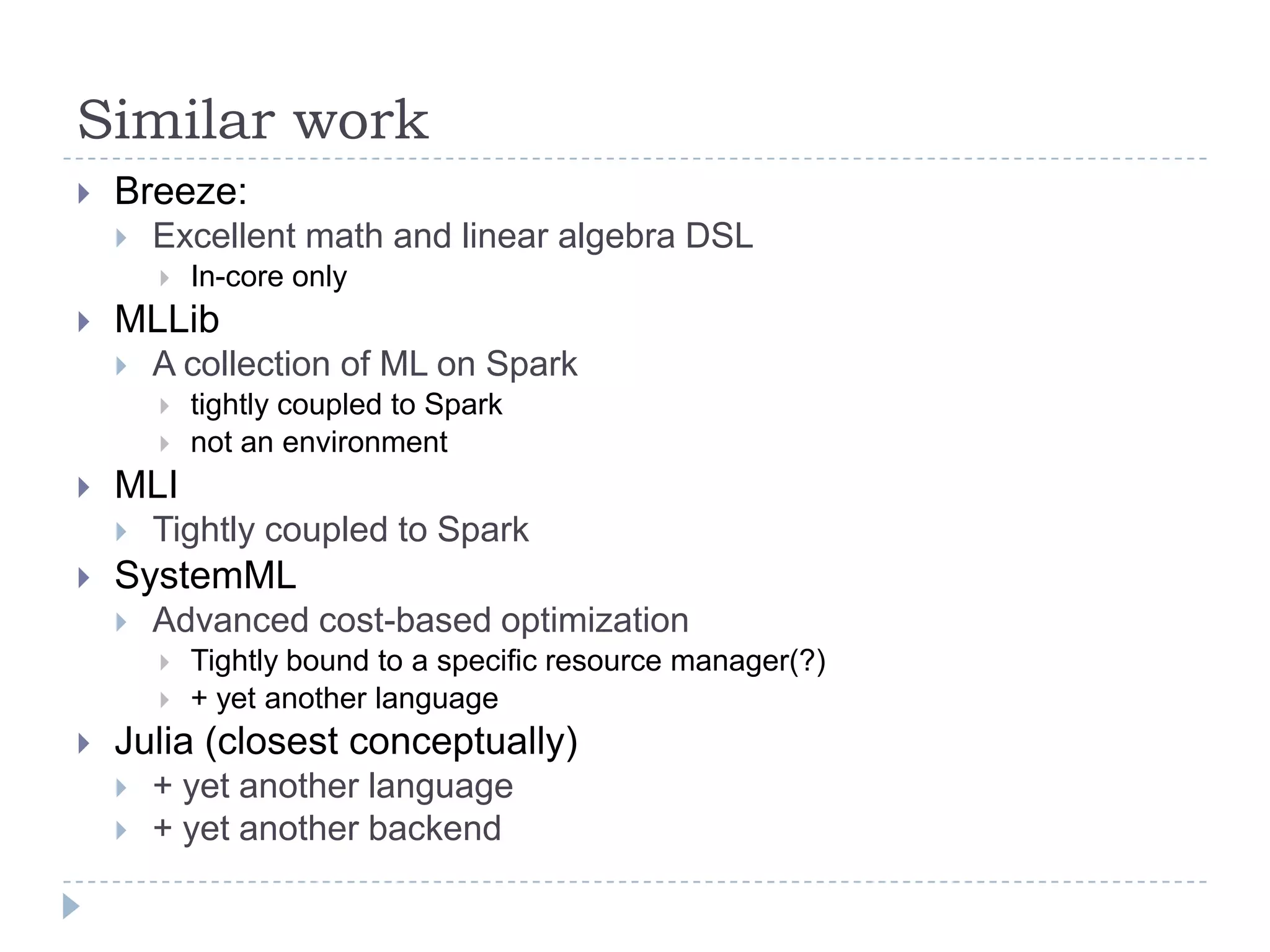
Similar work
 Breeze:
 Excellent math and linear algebra DSL
 In-core only
 MLLib
 A collection of ML on Spark
 tightly coupled to Spark
 not an environment
 MLI
 Tightly coupled to Spark
 SystemML
 Advanced cost-based optimization
 Tightly bound to a specific resource manager(?)
 + yet another language
 Julia (closest conceptually)
 + yet another language
 + yet another backend
Wanted and WIP
 Data Frames DSL API & physical layer(M-1490)
 E.g. For standardizing feature vectorization in Mahout
 E.g. For custom business rules scripting
 “Bring Your Own Distributed Method” (BYODM) –
build out ScalaBindings’ “write once – run
everywhere” collection of things
 Bindings for http://Stratosphere.eu
 Automatic parallelism adjustments
 Ability scale and balance problem to all available
resources automatically
 For more, see Spark Bindings home page
Links
 Scala and Spark Bindings
http://mahout.apache.org/users/sparkbindings/home.
html
 Stochastic Singular Value Decomposition
http://mahout.apache.org/users/dim-
reduction/ssvd.html
 Blog http://weatheringthrutechdays.blogspot.com
Thank you.

Mahout scala and spark bindings

  • 1.
    Mahout Scala andSpark Bindings: Bringing algebraic semantics Dmitriy Lyubimov 2014
  • 2.
    Requirements for anideal ML Environment Wanted: 1. Clear R (Matlab)-like semantics and type system that covers  Linear Algebra, Stats and Data Frames 2. Modern programming language qualities  Functional programming  Object Oriented programming  Sensible byte code Performance  A Big Plus: Scripting and Interactive shell 3. Distributed scalability with a sensible performance 4. Collection of off-the-shelf building blocks and algorithms 5. Visualization Mahout Scala & Spark Bindings aim to address (1-a), (2), (3), (4).
  • 3.
    Scala & SparkBindings are: 1. Scala as programming/scripting environment 2. R-like DSL : val g = bt.t %*% bt - c - c.t + (s_q cross s_q) * (xi dot xi) 3. Algebraic expression optimizer for distributed Linear Algebra  Provides a translation layer to distributed engines: Spark, (…) What is Scala and Spark Bindings? (2)
  • 4.
    What are thedata types? 1. Scalar real values (Double) 2. In-core vectors (2 types of sparse, 1 type of dense) 3. In-core matrices: sparse and dense  A number of specialized matrices 4. Distributed Row Matrices (DRM)  Compatible across Mahout MR and Spark solvers via persistence format
  • 5.
    Dual representation ofin-memory DRM // Run LSA val (drmU, drmV, s) = dssvd(A)  U inherits row keys of A automatically  Special meaning of integer row keys for physical transpose Automatic row key tracking:
  • 6.
    Features (1)  Matrix,vector, scalar operators: in-core, out-of- core  Slicing operators  Assignments (in-core only)  Vector-specific  Summaries drmA %*% drmB A %*% x A.t %*% A A * B A(5 until 20, 3 until 40) A(5, ::); A(5, 5) x(a to b) A(5, ::) := x A *= B A -=: B; 1 /=: x x dot y; x cross y A.nrow; x.length; A.colSums; B.rowMeans x.sum; A.norm …
  • 7.
    Features (2) –decompositions  In-core  Out-of-core val (inCoreQ, inCoreR) = qr(inCoreM) val ch = chol(inCoreM) val (inCoreV, d) = eigen(inCoreM) val (inCoreU, inCoreV, s) = svd(inCoreM) val (inCoreU, inCoreV, s) = ssvd(inCoreM, k = 50, q = 1) val (drmQ, inCoreR) = thinQR(drmA) val (drmU, drmV, s) = dssvd(drmA, k = 50, q = 1)
  • 8.
    Features (3) –construction and collect  Parallelizing from an in- core matrix  Collecting to an in-core val inCoreA = dense( (1, 2, 3, 4), (2, 3, 4, 5), (3, -4, 5, 6), (4, 5, 6, 7), (8, 6, 7, 8) ) val A = drmParallelize(inCoreA, numPartitions = 2) val inCoreB = drmB.collect
  • 9.
    Features (4) –HDFS persistence  Load DRM from HDFS  Save DRM to HDFS val drmB = drmFromHDFS(path = inputPath) drmA.writeDRM(path = uploadPath)
  • 10.
    Delayed execution andactions  Optimizer action  Defines optimization granularity  Guarantees the result will be formed in its entirety  Computational action  Actually triggers Spark action  Optimizer actions are implicitly triggered by computation // Example: A = B’U // Logical DAG: val drmA = drmB.t %*% drmU // Physical DAG: drmA.checkpoint() drmA.writeDrm(path) (drmB.t %*% drmU).writeDRM(path)
  • 11.
  • 12.
    Checkpoint caching (maps1:1 to Spark)  Checkpoint caching is a combination of None | in- memory | disk | serialized | replicated options  Method “checkpoint()” signature: def checkpoint(sLevel: StorageLevel = StorageLevel.MEMORY_ONLY): CheckpointedDrm[K]  Unpin data when no longer needed drmA.uncache()
  • 13.
    Optimization factors  Geometry(size) of operands  Orientation of operands  Whether identically partitioned  Whether computational paths are shared E. g.: Matrix multiplication:  5 physical operators for drmA %*% drmB  2 operators for drmA %*% inCoreA  1 operator for drm A %*% x  1 operator for x %*% drmA
  • 14.
  • 15.
    Customization: vertical blockoperator  Custom vertical block processing  must produce blocks of the same height // A * 5.0 drmA.mapBlock() { case (keys, block) => block *= 5.0 keys -> block }
  • 16.
    Customization: Externalizing RDDs Externalizing raw RDD  Triggers optimizer checkpoint implicitly val rawRdd:DrmRDD[K] = drmA.rdd  Wrapping raw RDD into a DRM  Stitching with data prep pipelines  Building complex distributed algorithm val drmA = drmWrap(rdd = rddA [, … ])
  • 17.
    Broadcasting an in-corematrix or vector  We cannot wrap in-core vector or matrix in a closure: they do not support Java serialization  Use broadcast api  Also may improve performance (e.g. set up Spark to broadcast via Torrent broadcast) // Example: Subtract vector xi from each row: val bcastXi = drmBroadcast(xi) drmA.mapBlock() { case(keys, block) => for (row <- block) row -= bcastXi keys -> block }
  • 18.
    Guinea Pigs –actionable lines of code  Thin QR  Stochastic Singular Value Decomposition  Stochastic PCA (MAHOUT-817 re-flow)  Co-occurrence analysis recommender (aka RSJ) Actionable lines of code (-blanks -comments -CLI) Thin QR (d)ssvd (d)spca R prototype n/a 28 38 In-core Scala bindings n/a 29 50 DRM Spark bindings 17 32 68 Mahout/Java/MR n/a ~2581 ~2581
  • 19.
    dspca (tail) … … valc = s_q cross s_b val inCoreBBt = (drmBt.t %*% drmBt) .checkpoint(StorageLevel.NONE).collect - c - c.t + (s_q cross s_q) * (xi dot xi) val (inCoreUHat, d) = eigen(inCoreBBt) val s = d.sqrt val drmU = drmQ %*% inCoreUHat val drmV = drmBt %*% (inCoreUHat %*%: diagv(1 /: s)) (drmU(::, 0 until k), drmV(::, 0 until k), s(0 until k)) }
  • 20.
  • 21.
    Pitfalls  Side-effects arenot like in R  In-core: no copy-on-write semantics  Distributed: Cache policies without serialization may cause cached blocks experience side effects from subsequent actions  Use something like MEMORY_DISK_SER for cached parents of pipelines with side effects  Beware of naïve and verbatim translations of in-core methods
  • 22.
    Recap: Key Concepts High level Math, Algebraic and Data Frames logical semantic constructs  R-like (Matlab-like), easy to prototype, read, maintain, customize  Operator-centric: same operator semantics regardless of operand types  Strategical notion: Portability of logical semantic constructs  Write once, run anywhere  Cost-based & Rewriting Optimizer  Tactical notion: low cost POC, sensible in-memory computation performance  Spark  Strong programming language environment (Scala)  Scriptable & interactive shell (extra bonus)  Compatibility with the rest of Mahout solvers via DRM persistence
  • 23.
    Similar work  Breeze: Excellent math and linear algebra DSL  In-core only  MLLib  A collection of ML on Spark  tightly coupled to Spark  not an environment  MLI  Tightly coupled to Spark  SystemML  Advanced cost-based optimization  Tightly bound to a specific resource manager(?)  + yet another language  Julia (closest conceptually)  + yet another language  + yet another backend
  • 24.
    Wanted and WIP Data Frames DSL API & physical layer(M-1490)  E.g. For standardizing feature vectorization in Mahout  E.g. For custom business rules scripting  “Bring Your Own Distributed Method” (BYODM) – build out ScalaBindings’ “write once – run everywhere” collection of things  Bindings for http://Stratosphere.eu  Automatic parallelism adjustments  Ability scale and balance problem to all available resources automatically  For more, see Spark Bindings home page
  • 25.
    Links  Scala andSpark Bindings http://mahout.apache.org/users/sparkbindings/home. html  Stochastic Singular Value Decomposition http://mahout.apache.org/users/dim- reduction/ssvd.html  Blog http://weatheringthrutechdays.blogspot.com Thank you.

Editor's Notes

  • #2 On the right side is the picture called “Statue of a miner”. I snapped it inKuntaHora, Czech Repulbic about 10 years ago. More specifically, it is a statute of a miner mining for sivler for a state mint. It was a heavy