Five Kingdoms ofLiving
Things
Created by Stella Thalluri 2014
www.beaconmedia.com.au
2.
Five Kingdoms ofLiving Things
• God’s benevolence is attested to by His
abundant provision for the needs of His
creatures and in His constant sustaining of
the cosmos.
• God is the Creator of all things (Genesis
1:1, Exodus 20:11, Ecclesiastes 11:5;
Romans 1:20).
3.
Five Kingdoms ofLiving Things
• God preserves and controls His creation
so that it continues to function as He
planned (Genesis 1; Nehemiah 9:6; Job
9:5-7; Amos 4:6-10).
• God uses the creation to reveal His
existence and character (Romans 1:20;
Hebrews 3:3-4).
4.
Five Kingdoms ofLiving Things
• Classification is simply a way to put an
order to God's creation.
• Biologists have taken an enormous
amount of data and have arranged it into
five kingdoms of living things.
• These classification systems allow us to
see the similarities and relationships that
exist between organisms in creation.
• The five kingdom classification is the most
important contribution biologists have
made in understanding God’s creation.
5.
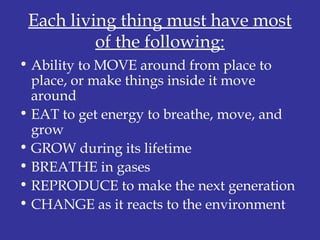
Each living thingmust have most
of the following:
• Ability to MOVE around from place to
place, or make things inside it move
around
• EAT to get energy to breathe, move, and
grow
• GROW during its lifetime
• BREATHE in gases
• REPRODUCE to make the next generation
• CHANGE as it reacts to the environment
6.
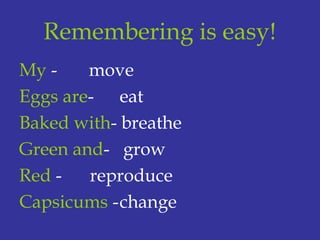
Remembering is easy!
My- move
Eggs are- eat
Baked with- breathe
Green and- grow
Red - reproduce
Capsicums -change
7.
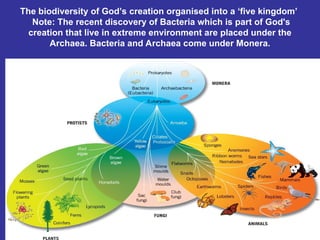
The biodiversity ofGod’s creation organised into a ‘five kingdom’
Note: The recent discovery of Bacteria which is part of God's
creation that live in extreme environment are placed under the
Archaea. Bacteria and Archaea come under Monera.
8.
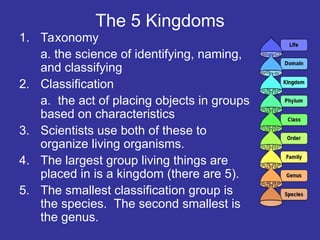
The 5 Kingdoms
1.Taxonomy
a. the science of identifying, naming,
and classifying
2. Classification
a. the act of placing objects in groups
based on characteristics
3. Scientists use both of these to
organize living organisms.
4. The largest group living things are
placed in is a kingdom (there are 5).
5. The smallest classification group is
the species. The second smallest is
the genus.
9.
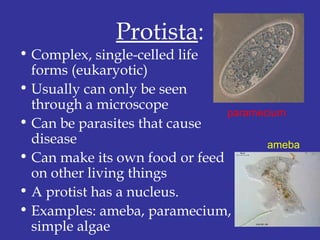
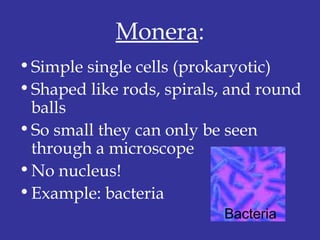
Protista:
• Complex, single-celledlife
forms (eukaryotic)
• Usually can only be seen
through a microscope
• Can be parasites that cause
disease
• Can make its own food or feed
on other living things
• A protist has a nucleus.
• Examples: ameba, paramecium,
simple algae
paramecium
ameba
10.
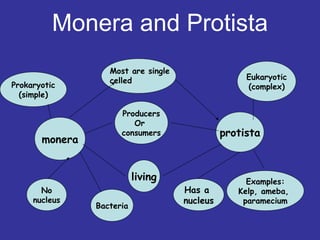
Monera:
•Simple single cells(prokaryotic)
•Shaped like rods, spirals, and round
balls
•So small they can only be seen
through a microscope
•No nucleus!
•Example: bacteria
Bacteria
Fungi:
•Many-celled organisms
•Absorb foodfrom living or dead things
(consumers).
•Parasitic “plants” (They are not true
plants because they do not have
chlorophyll to make their own food.)
•Examples: mushrooms, bread mold,
penicillin, mildew, and yeast
13.
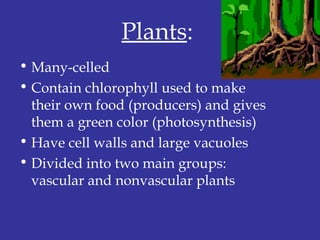
Plants:
• Many-celled
• Containchlorophyll used to make
their own food (producers) and gives
them a green color (photosynthesis)
• Have cell walls and large vacuoles
• Divided into two main groups:
vascular and nonvascular plants
14.
I. Two majorgroups of plants:
A. Vascular plants:
1. Have conducting tissues (xylem
and phloem), leaves, stems and roots.
2. Have a root system for anchoring
the plant and absorbing water and
nutrients from the soil.
3. Have vessels that make tubes for
moving water throughout the plant.
15.
B. Non-vascular plants
1.Do not have conducting tissues,
leaves and roots. They are small.
2. Require water for fertilization so
they must grow in moist habitats.
3. Reproduce by spores.
4. Have rhizoids that hold them in
place.
16.
Vascular and Nonvascular
•Tall
• Has roots, root hairs,
stems, tubes
• Some have flowers, fruit,
seeds
• Chlorophyll
• Some reproduce by
spores
• Have a cell wall
• Need water, air, sunlight
• Short
• Do not have roots,
leaves, flowers, root
hairs, stems, fruit, tubes,
seeds
• Chlorophyll
• Reproduce by spores
• Have a cell wall
• Need water, air, sunlight
• Have rhizoids that hold
them in place but do not
absorb water or nutrients
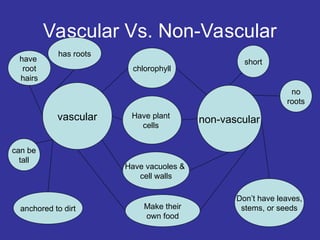
17.
Vascular Vs. Non-Vascular
vascularnon-vascular
chlorophyll
Have plant
cells
Have vacuoles &
cell walls
Make their
own food
has roots
anchored to dirt
have
root
hairs
can be
tall
short
no
roots
Don’t have leaves,
stems, or seeds
18.
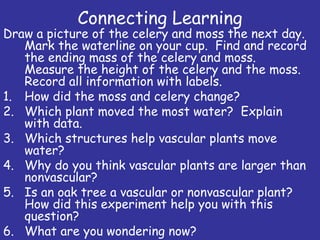
Connecting Learning
Draw apicture of the celery and moss the next day.
Mark the waterline on your cup. Find and record
the ending mass of the celery and moss.
Measure the height of the celery and the moss.
Record all information with labels.
1. How did the moss and celery change?
2. Which plant moved the most water? Explain
with data.
3. Which structures help vascular plants move
water?
4. Why do you think vascular plants are larger than
nonvascular?
5. Is an oak tree a vascular or nonvascular plant?
How did this experiment help you with this
question?
6. What are you wondering now?
19.
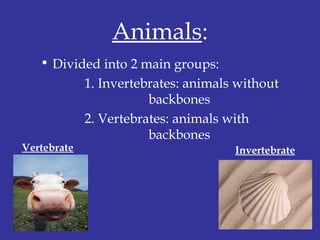
Animals:
• Divided into2 main groups:
1. Invertebrates: animals without
backbones
2. Vertebrates: animals with
backbones
Vertebrate Invertebrate
20.
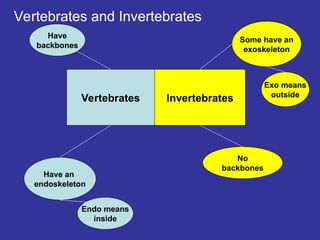
Vertebrates and Invertebrates
VertebratesInvertebrates
Have an
endoskeleton
Endo means
inside
Have
backbones
No
backbones
Some have an
exoskeleton
Exo means
outside
21.
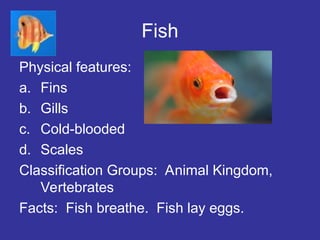
Fish
Physical features:
a. Fins
b.Gills
c. Cold-blooded
d. Scales
Classification Groups: Animal Kingdom,
Vertebrates
Facts: Fish breathe. Fish lay eggs.
22.
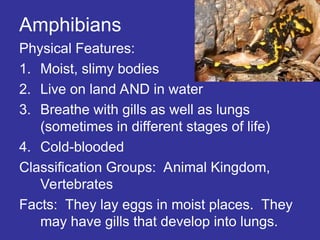
Amphibians
Physical Features:
1. Moist,slimy bodies
2. Live on land AND in water
3. Breathe with gills as well as lungs
(sometimes in different stages of life)
4. Cold-blooded
Classification Groups: Animal Kingdom,
Vertebrates
Facts: They lay eggs in moist places. They
may have gills that develop into lungs.
23.
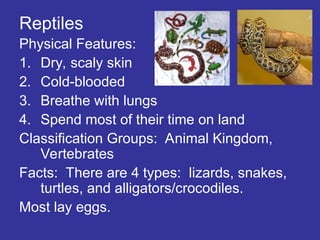
Reptiles
Physical Features:
1. Dry,scaly skin
2. Cold-blooded
3. Breathe with lungs
4. Spend most of their time on land
Classification Groups: Animal Kingdom,
Vertebrates
Facts: There are 4 types: lizards, snakes,
turtles, and alligators/crocodiles.
Most lay eggs.
24.
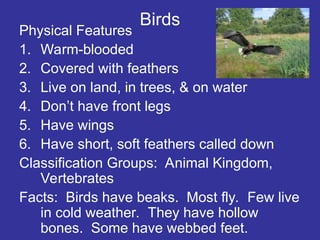
Birds
Physical Features
1. Warm-blooded
2.Covered with feathers
3. Live on land, in trees, & on water
4. Don’t have front legs
5. Have wings
6. Have short, soft feathers called down
Classification Groups: Animal Kingdom,
Vertebrates
Facts: Birds have beaks. Most fly. Few live
in cold weather. They have hollow
bones. Some have webbed feet.
25.
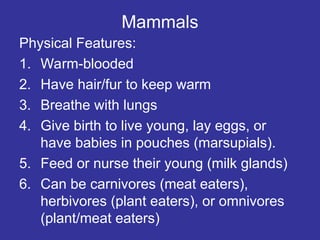
Mammals
Physical Features:
1. Warm-blooded
2.Have hair/fur to keep warm
3. Breathe with lungs
4. Give birth to live young, lay eggs, or
have babies in pouches (marsupials).
5. Feed or nurse their young (milk glands)
6. Can be carnivores (meat eaters),
herbivores (plant eaters), or omnivores
(plant/meat eaters)
26.
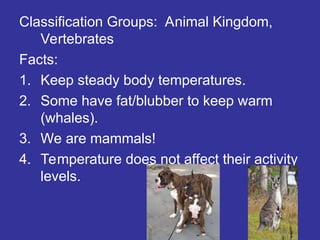
Classification Groups: AnimalKingdom,
Vertebrates
Facts:
1. Keep steady body temperatures.
2. Some have fat/blubber to keep warm
(whales).
3. We are mammals!
4. Temperature does not affect their activity
levels.
27.
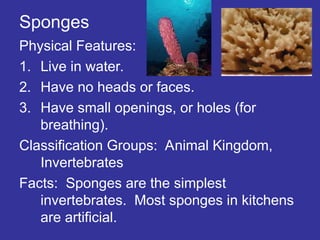
Sponges
Physical Features:
1. Livein water.
2. Have no heads or faces.
3. Have small openings, or holes (for
breathing).
Classification Groups: Animal Kingdom,
Invertebrates
Facts: Sponges are the simplest
invertebrates. Most sponges in kitchens
are artificial.
28.
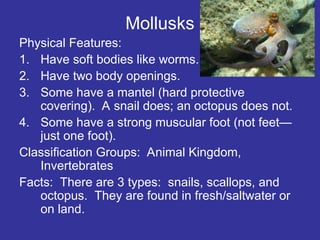
Mollusks
Physical Features:
1. Havesoft bodies like worms.
2. Have two body openings.
3. Some have a mantel (hard protective
covering). A snail does; an octopus does not.
4. Some have a strong muscular foot (not feet—
just one foot).
Classification Groups: Animal Kingdom,
Invertebrates
Facts: There are 3 types: snails, scallops, and
octopus. They are found in fresh/saltwater or
on land.
29.
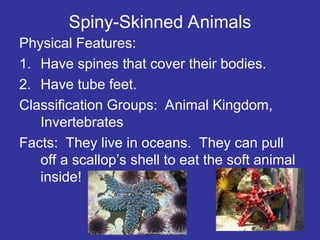
Spiny-Skinned Animals
Physical Features:
1.Have spines that cover their bodies.
2. Have tube feet.
Classification Groups: Animal Kingdom,
Invertebrates
Facts: They live in oceans. They can pull
off a scallop’s shell to eat the soft animal
inside!
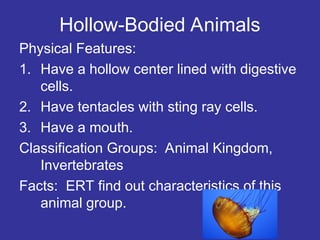
30.
Hollow-Bodied Animals
Physical Features:
1.Have a hollow center lined with digestive
cells.
2. Have tentacles with sting ray cells.
3. Have a mouth.
Classification Groups: Animal Kingdom,
Invertebrates
Facts: ERT find out characteristics of this
animal group.
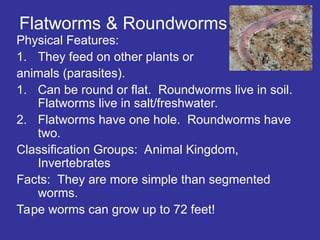
31.
Flatworms & Roundworms
PhysicalFeatures:
1. They feed on other plants or
animals (parasites).
1. Can be round or flat. Roundworms live in soil.
Flatworms live in salt/freshwater.
2. Flatworms have one hole. Roundworms have
two.
Classification Groups: Animal Kingdom,
Invertebrates
Facts: They are more simple than segmented
worms.
Tape worms can grow up to 72 feet!
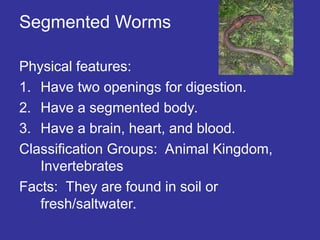
32.
Segmented Worms
Physical features:
1.Have two openings for digestion.
2. Have a segmented body.
3. Have a brain, heart, and blood.
Classification Groups: Animal Kingdom,
Invertebrates
Facts: They are found in soil or
fresh/saltwater.
33.
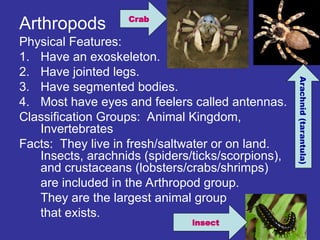
Arthropods
Physical Features:
1. Havean exoskeleton.
2. Have jointed legs.
3. Have segmented bodies.
4. Most have eyes and feelers called antennas.
Classification Groups: Animal Kingdom,
Invertebrates
Facts: They live in fresh/saltwater or on land.
Insects, arachnids (spiders/ticks/scorpions),
and crustaceans (lobsters/crabs/shrimps)
are included in the Arthropod group.
They are the largest animal group
that exists.
insect
Arachnid
(tarantula)
Crab
34.
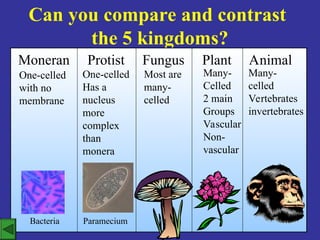
Can you compareand contrast
the 5 kingdoms?
Moneran Protist Fungus Plant Animal
One-celled
Has a
nucleus
more
complex
than
monera
Most are
many-
celled
Many-
celled
Vertebrates
invertebrates
Many-
Celled
2 main
Groups
Vascular
Non-
vascular
Bacteria Paramecium
One-celled
with no
membrane