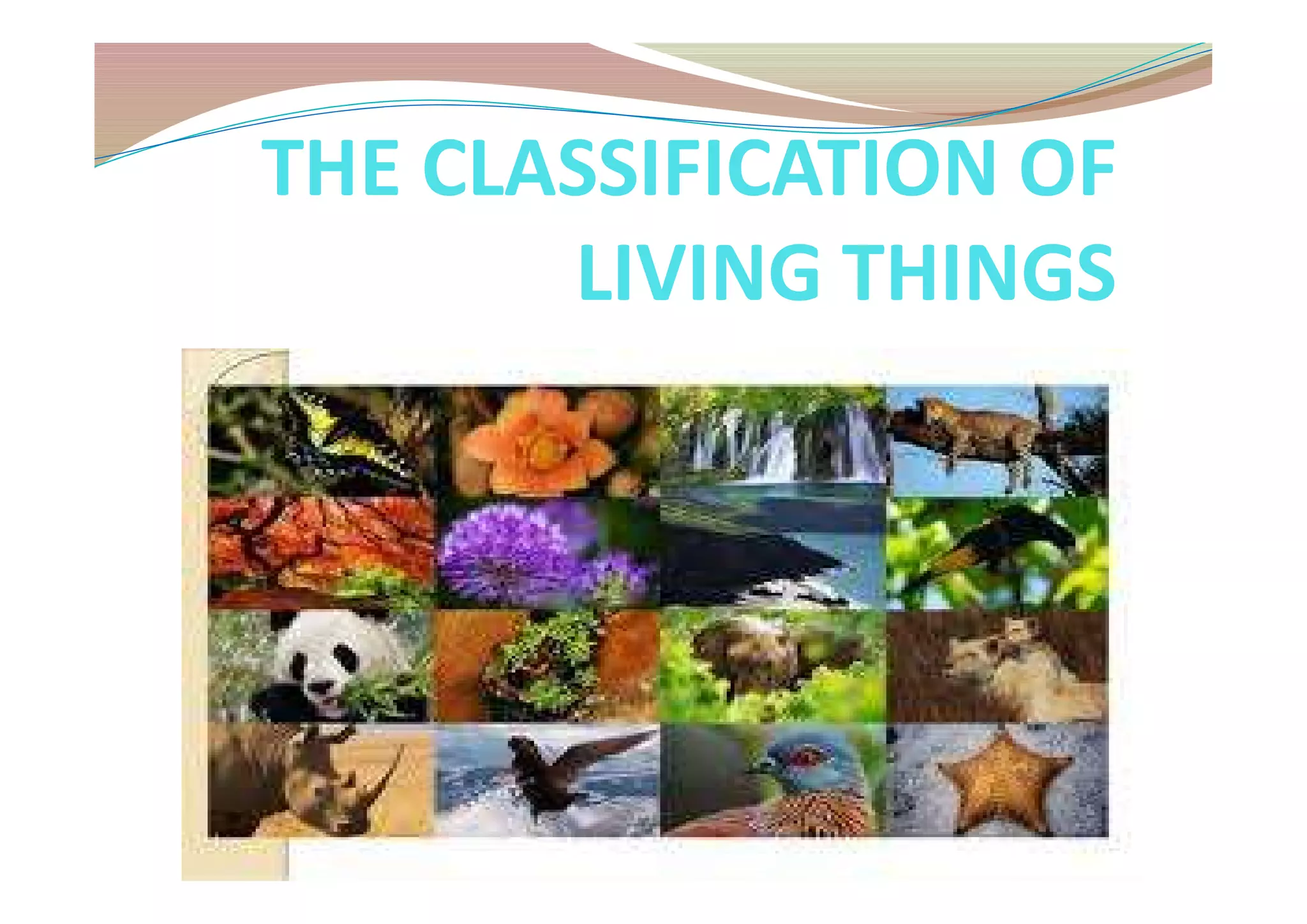
THE CLASSIFICATION OF
LIVING THINGS
KINGDOMS OF LIVING THINGS
 Living things are classified into groups called
kingdoms.
 Living things from the same kingdom share
(compartir) similar characteristics.
 There are five kingdoms:
 -Animal kingdom
 -Plant kingdom
 -Fungi kingdom
 -Protist kingdom and
 -Monera kingdom
ANIMAL KINGDOM
 Animal are multicellular.
 They feed on other living things.
 Most animals can move about.
PLANT KINGDOM
 Plants are multicellular.
 They make their own food.
 Plants cannot move about because they are fixed by
roots.
FUNGI KINGDOM
 Fungi can be unicellular or multicellular.
 They feed on other living things and cannot move
about.
PROTISTA KINGDOM
 Protists can be unicellular or multicellular.
 Some protists, like algae, can make their own food.
MONERA KINGDOM
 Monerans are unicellular.
 This kingdom includes bacteria.
 Some bacteria can make their own food.
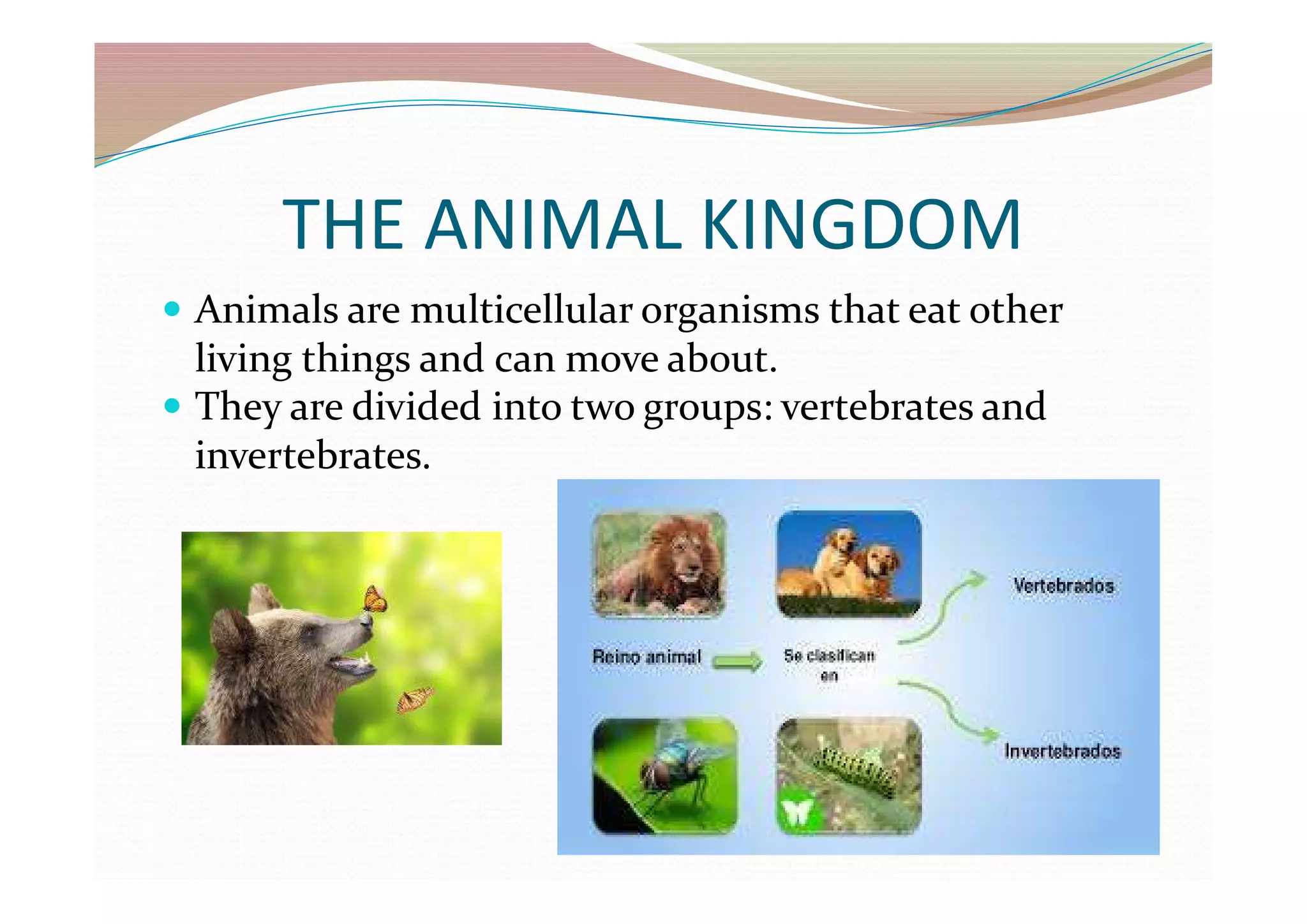
THE ANIMAL KINGDOM
 Animals are multicellular organisms that eat other
living things and can move about.
 They are divided into two groups: vertebrates and
invertebrates.
VERTEBRATES
 All vertebrates have an internal skeleton made up of
bones.
 This skeleton includes a backbone, which consists of
ring-like bones called vertebrae.
 They can be:
- Mammals
- Birds
- Reptiles
- Amphibians and
- Fish
Mammals
 They are viviparous.
 Their bodies are covered with fur or hair.
 They breathe with lungs.
 Most mammals have legs.
Birds
 They are oviparous.
 Their bodies are covered with feathers.
 They breath with lungs.
 They have two legs and two wings.
Reptiles
 They are oviparous.
 Their skin is covered with scales.
 They breath with lungs.
 Most reptiles have legs.
Amphibians
 They are oviparous.
 They breath through gills (branquias) when they are
young, and with lungs when they are adults.
 Adult amphibians have legs.
Fish
 They are oviparous.
 Their bodies are covered with scales.
 They breath through gills.
 They have fins (aletas).
INVERTEBRATES
 Invertebrates do not have an internal skeleton made
up of bones, so they do not have a backbone.
 Most invertebrates are oviparous.
 Invertebrates are classified into six groups:
-Sponges
-Cnidarians
-Worms
-Molluscs
-Echinoderms and
-Arthropods
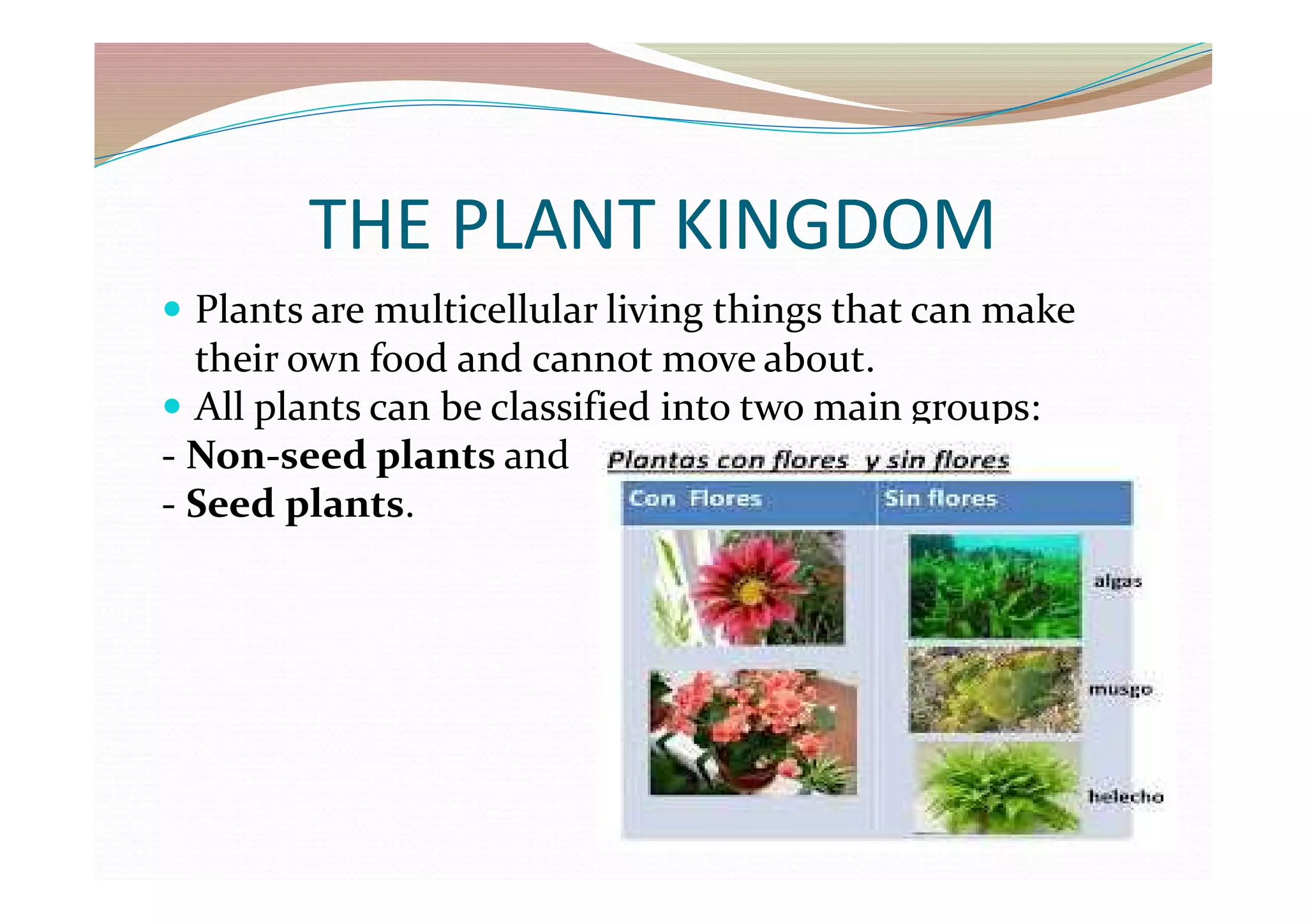
THE PLANT KINGDOM
 Plants are multicellular living things that can make
their own food and cannot move about.
 All plants can be classified into two main groups:
- Non-seed plants and
- Seed plants.
Non-seed plants
 Non-seed plants do not produce flowers and seeds.
 They reproduce with spores.
 Spores can form new plants.
 There are two types of non-seed plants: Mosses and
ferns.
Mosses
 Mosses are very small plants.
 They live in humid and shady places, and grow on
rocks, tree trunks and in the ground.
 They have tiny stems and leaves.
Ferns
 Ferns are much larger than mosses.
 They also live in humid and shady places.
 They have large leaves called fronds.
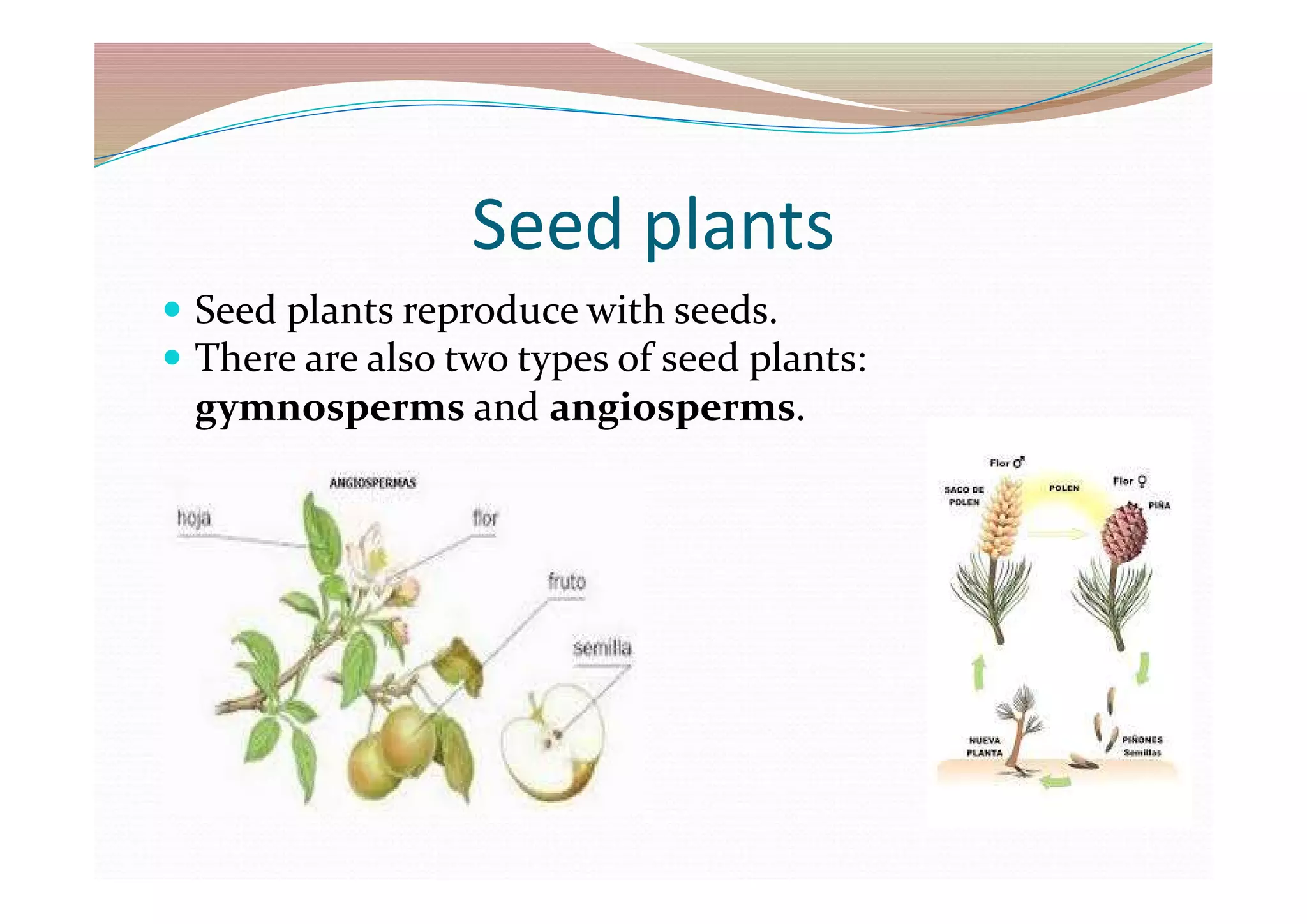
Seed plants
 Seed plants reproduce with seeds.
 There are also two types of seed plants:
gymnosperms and angiosperms.
Gymnosperms
 Gymnosperms produce seeds, wich are grouped
together in cones.
 They are evergreen trees and shrubs with needle or
scale-shaped leaves.
 Pine trees and firs are gymnosperms.
Angiosperms
 Angiosperms produce flowers and fruits which contain
seeds.
 They can be deciduous or evergreen trees, shrubs or
grasses.
 Some examples are apple trees, lavender, grass and
poppies (amapolas).
THE FUNGI KINGDOM
 Fungi are different living things from plants and
animals.
 Like plants, they cannot move about and many of
them grow in soil.
 Like animals, fungi cannot make their own food.
 Fungi can feed on other organisms or their remains.
 Therefore, they can be found not only on the ground,
but also on pieces of wood or on decomposing food.
 Fungi are classified into two groups:
 Unicellular fungi, like yeasts (levaduras).
 Multicellular fungi, like mushrooms and moulds
(moho).
Many fungi are beneficial to people but others can be
harmful.
Beneficial fungi:
 Some fungi can produce edible (comestible)
mushrooms.
 Some medicines, like penicillin, are produced by fungi.
Harmful fungi:
Some fungi can produce poisonous mushrooms.
Athlete´s foot is an infection caused by a fungus.
THE PROTISTA KINGDOM
 Protists include two very different types of organisms:
Algae and protozoa.
Algae
 Algae are aquatic living things that can be unicellular
or multicellular.
 They can make their own food.
 Some multicellular marine algae can grow to a very
large size.
 Algae are very nutritius, so they are used as food in
many countries. They are also used as fertilizer and to
produce cosmetics.
Protozoa
 Protozoa are unicellular living things that live in
aquatic environments.
 They feed on other organisms.
 Some protozoa can cause diseases, like malaria.
THE MONERA KINGDOM
 Monerans are unicellular living things.
 This kingdom includes bacteria, the most abundant of
all living things.
Bacteria
 Bacteria are the smallest and the simplest living things,
and can only be seen through a microscope.
 Most bacteria feed on other organisms, but some
bacteria make their own food.
 Bacteria can be found everywhere in the world.
 They can live in all kinds of environments: in water,
soil, air or inside other living things.
 Some bacteria are helpful, like the ones used to make
yoghurt, but others are harmful, like the ones that
causes cholera.

Classification of living things

  • 1.
  • 2.
    KINGDOMS OF LIVINGTHINGS  Living things are classified into groups called kingdoms.  Living things from the same kingdom share (compartir) similar characteristics.  There are five kingdoms:  -Animal kingdom  -Plant kingdom  -Fungi kingdom  -Protist kingdom and  -Monera kingdom
  • 3.
    ANIMAL KINGDOM  Animalare multicellular.  They feed on other living things.  Most animals can move about.
  • 4.
    PLANT KINGDOM  Plantsare multicellular.  They make their own food.  Plants cannot move about because they are fixed by roots.
  • 5.
    FUNGI KINGDOM  Fungican be unicellular or multicellular.  They feed on other living things and cannot move about.
  • 6.
    PROTISTA KINGDOM  Protistscan be unicellular or multicellular.  Some protists, like algae, can make their own food.
  • 7.
    MONERA KINGDOM  Moneransare unicellular.  This kingdom includes bacteria.  Some bacteria can make their own food.
  • 8.
    THE ANIMAL KINGDOM Animals are multicellular organisms that eat other living things and can move about.  They are divided into two groups: vertebrates and invertebrates.
  • 9.
    VERTEBRATES  All vertebrateshave an internal skeleton made up of bones.  This skeleton includes a backbone, which consists of ring-like bones called vertebrae.  They can be: - Mammals - Birds - Reptiles - Amphibians and - Fish
  • 10.
    Mammals  They areviviparous.  Their bodies are covered with fur or hair.  They breathe with lungs.  Most mammals have legs.
  • 11.
    Birds  They areoviparous.  Their bodies are covered with feathers.  They breath with lungs.  They have two legs and two wings.
  • 12.
    Reptiles  They areoviparous.  Their skin is covered with scales.  They breath with lungs.  Most reptiles have legs.
  • 13.
    Amphibians  They areoviparous.  They breath through gills (branquias) when they are young, and with lungs when they are adults.  Adult amphibians have legs.
  • 14.
    Fish  They areoviparous.  Their bodies are covered with scales.  They breath through gills.  They have fins (aletas).
  • 15.
    INVERTEBRATES  Invertebrates donot have an internal skeleton made up of bones, so they do not have a backbone.  Most invertebrates are oviparous.  Invertebrates are classified into six groups: -Sponges -Cnidarians -Worms -Molluscs -Echinoderms and -Arthropods
  • 16.
    THE PLANT KINGDOM Plants are multicellular living things that can make their own food and cannot move about.  All plants can be classified into two main groups: - Non-seed plants and - Seed plants.
  • 17.
    Non-seed plants  Non-seedplants do not produce flowers and seeds.  They reproduce with spores.  Spores can form new plants.  There are two types of non-seed plants: Mosses and ferns.
  • 18.
    Mosses  Mosses arevery small plants.  They live in humid and shady places, and grow on rocks, tree trunks and in the ground.  They have tiny stems and leaves.
  • 19.
    Ferns  Ferns aremuch larger than mosses.  They also live in humid and shady places.  They have large leaves called fronds.
  • 20.
    Seed plants  Seedplants reproduce with seeds.  There are also two types of seed plants: gymnosperms and angiosperms.
  • 21.
    Gymnosperms  Gymnosperms produceseeds, wich are grouped together in cones.  They are evergreen trees and shrubs with needle or scale-shaped leaves.  Pine trees and firs are gymnosperms.
  • 22.
    Angiosperms  Angiosperms produceflowers and fruits which contain seeds.  They can be deciduous or evergreen trees, shrubs or grasses.  Some examples are apple trees, lavender, grass and poppies (amapolas).
  • 23.
    THE FUNGI KINGDOM Fungi are different living things from plants and animals.  Like plants, they cannot move about and many of them grow in soil.  Like animals, fungi cannot make their own food.  Fungi can feed on other organisms or their remains.  Therefore, they can be found not only on the ground, but also on pieces of wood or on decomposing food.
  • 24.
     Fungi areclassified into two groups:  Unicellular fungi, like yeasts (levaduras).  Multicellular fungi, like mushrooms and moulds (moho).
  • 25.
    Many fungi arebeneficial to people but others can be harmful. Beneficial fungi:  Some fungi can produce edible (comestible) mushrooms.  Some medicines, like penicillin, are produced by fungi. Harmful fungi: Some fungi can produce poisonous mushrooms. Athlete´s foot is an infection caused by a fungus.
  • 26.
    THE PROTISTA KINGDOM Protists include two very different types of organisms: Algae and protozoa.
  • 27.
    Algae  Algae areaquatic living things that can be unicellular or multicellular.  They can make their own food.  Some multicellular marine algae can grow to a very large size.  Algae are very nutritius, so they are used as food in many countries. They are also used as fertilizer and to produce cosmetics.
  • 28.
    Protozoa  Protozoa areunicellular living things that live in aquatic environments.  They feed on other organisms.  Some protozoa can cause diseases, like malaria.
  • 29.
    THE MONERA KINGDOM Monerans are unicellular living things.  This kingdom includes bacteria, the most abundant of all living things.
  • 30.
    Bacteria  Bacteria arethe smallest and the simplest living things, and can only be seen through a microscope.  Most bacteria feed on other organisms, but some bacteria make their own food.  Bacteria can be found everywhere in the world.  They can live in all kinds of environments: in water, soil, air or inside other living things.  Some bacteria are helpful, like the ones used to make yoghurt, but others are harmful, like the ones that causes cholera.