Cell Transport

Movement of substances in and out of
               cells
Substances move in and out of cells by:

1. Passive transport

2. Active transport
Passive Transport
No energy (ATP) is required to move gas or liquid
 molecules from one place to another!
(Is this an example of a “free lunch” or perpetual motion?… imagine if our cars
    worked like this….)


Need to understand concepts of :
• Diffusion,
• Osmosis,
• Concentration gradient,
• Net movement
Diffusion
• The random movement of molecules from
  an area of high concentration to an area of
  low concentration.
• Down the concentration gradient.
•   Animation
•   Animation2   Conc. Grad
Rate (speed) of diffusion depends on:

           »                  fast      slow
  Size of molecules
  Temperature
  State of matter
  Concentration gradient
Osmosis
• Net movement of water molecules from an
  area of high water concentration to an
  area of low water concentration, through a
  semi-permeable membrane.
•   Animation   Animation2

• Hypertonic – more solute and less water
• Hypotonic – less solute and more water
• Isotonic – same conc. of solute and water
Think (don’t write)
• Most marine fish die if
  transferred to freshwater.
• When a drop of blood is
  mixed with distilled water, the
  blood cells burst.
• Living plant tissues that had
  lost water become firm when
  supplied with water.
Net movement
The overall movement of all molecules of a
 substance back and forward along the
 concentration gradient.

e.g. when oxygen or water molecules diffuse
  into a cell, some molecules move out at
  the same time. Overall more are moving
  inwards than outwards so the net
  movement is………..
Osmoregulation
• The control of water in a cell.
• Plasmolysis –
  – Water leaves cell and membrane shrinks from
    wall.
  – Cell becomes flaccid.
  – Full plasmolysis is irreversible.
  Animation
• Turgor
  – Water enters cell causing it to swell
  – Cell becomes turgid
  – Cell wall prevents rupture


• Animation
Active Transport
Energy (ATP) is required for:
Endocytosis (phago- and pino-),
Exocytosis,
Ion pumps

• e.g. re-absorption of glucose by kidney,
  salt uptake by the roots of plants, amino
  acid uptake by fungi
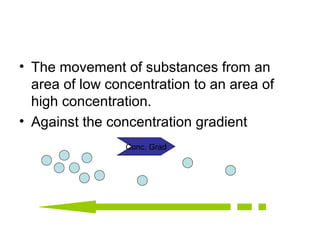
• The movement of substances from an
  area of low concentration to an area of
  high concentration.
• Against the concentration gradient
                 Conc. Grad
Cytosis
            1.Endocytosis
• Movement in (enter) to a cell
• Phagocytosis – cell eating – forms a food
  vacuole.
• e.g. Lysosomes fuse to enable digestion.
• Pinocytosis – cell drinking – forms a
  vesicle
• e.g. Amoeba and white blood cells (WBC)
  – pseudopodia
• Animation
2.Exocytosis
• Movement out (exit)
• Vesicles bud off from golgi apparatus or
  ER, vacuole fuses with cell membrane and
  expels contents
• Secretions e.g. digestive enzymes
  released, glands
• Animation
Ion Pumps
• Proteins in the cell membrane can actively
  accumulate specific ions on one side of
  the membrane to control the amount
• Animation
• Animation2

Cell transport

  • 1.
    Cell Transport Movement ofsubstances in and out of cells
  • 2.
    Substances move inand out of cells by: 1. Passive transport 2. Active transport
  • 3.
    Passive Transport No energy(ATP) is required to move gas or liquid molecules from one place to another! (Is this an example of a “free lunch” or perpetual motion?… imagine if our cars worked like this….) Need to understand concepts of : • Diffusion, • Osmosis, • Concentration gradient, • Net movement
  • 4.
    Diffusion • The randommovement of molecules from an area of high concentration to an area of low concentration. • Down the concentration gradient. • Animation • Animation2 Conc. Grad
  • 5.
    Rate (speed) ofdiffusion depends on: » fast slow Size of molecules Temperature State of matter Concentration gradient
  • 6.
    Osmosis • Net movementof water molecules from an area of high water concentration to an area of low water concentration, through a semi-permeable membrane. • Animation Animation2 • Hypertonic – more solute and less water • Hypotonic – less solute and more water • Isotonic – same conc. of solute and water
  • 7.
    Think (don’t write) •Most marine fish die if transferred to freshwater. • When a drop of blood is mixed with distilled water, the blood cells burst. • Living plant tissues that had lost water become firm when supplied with water.
  • 8.
    Net movement The overallmovement of all molecules of a substance back and forward along the concentration gradient. e.g. when oxygen or water molecules diffuse into a cell, some molecules move out at the same time. Overall more are moving inwards than outwards so the net movement is………..
  • 9.
    Osmoregulation • The controlof water in a cell. • Plasmolysis – – Water leaves cell and membrane shrinks from wall. – Cell becomes flaccid. – Full plasmolysis is irreversible. Animation
  • 10.
    • Turgor – Water enters cell causing it to swell – Cell becomes turgid – Cell wall prevents rupture • Animation
  • 11.
    Active Transport Energy (ATP)is required for: Endocytosis (phago- and pino-), Exocytosis, Ion pumps • e.g. re-absorption of glucose by kidney, salt uptake by the roots of plants, amino acid uptake by fungi
  • 12.
    • The movementof substances from an area of low concentration to an area of high concentration. • Against the concentration gradient Conc. Grad
  • 13.
    Cytosis 1.Endocytosis • Movement in (enter) to a cell • Phagocytosis – cell eating – forms a food vacuole. • e.g. Lysosomes fuse to enable digestion. • Pinocytosis – cell drinking – forms a vesicle • e.g. Amoeba and white blood cells (WBC) – pseudopodia • Animation
  • 14.
    2.Exocytosis • Movement out(exit) • Vesicles bud off from golgi apparatus or ER, vacuole fuses with cell membrane and expels contents • Secretions e.g. digestive enzymes released, glands • Animation
  • 15.
    Ion Pumps • Proteinsin the cell membrane can actively accumulate specific ions on one side of the membrane to control the amount • Animation • Animation2