Table of Contents

Chapter: Cell Processes

Section 1: Chemistry of Life

Section 2: Moving Cellular Materials


Section 3: Energy for Life
Chemistry of Life
1
      The Nature of Matter
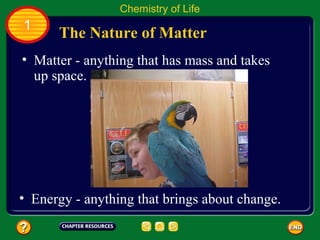
• Matter - anything that has mass and takes
  up space.


• Energy - anything that brings about change.
Chemistry in Life
1
       Atoms
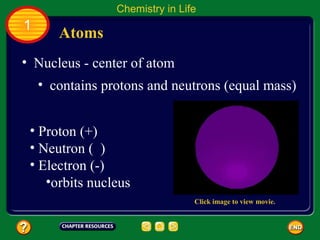
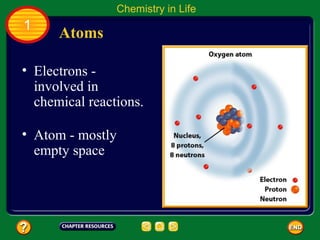
• Nucleus - center of atom
    • contains protons and neutrons (equal mass)


 • Proton (+)
 • Neutron ( )
 • Electron (-)
    •orbits nucleus
                                 Click image to view movie.
Chemistry in Life
1
      Atoms

• Electrons -
  involved in
  chemical reactions.

• Atom - mostly
  empty space
Chemistry in Life
1
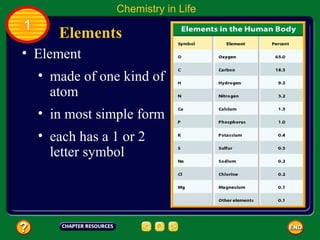
       Elements
• Element
    • made of one kind of
      atom
    • in most simple form
    • each has a 1 or 2
      letter symbol
Chemistry in Life
1
       Elements
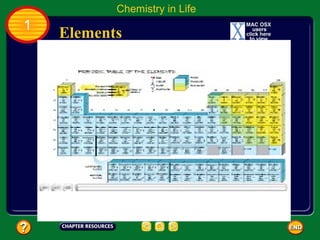
• Periodic table
    • Mass
    • # of Protons
    • Symbol
Chemistry in Life
1
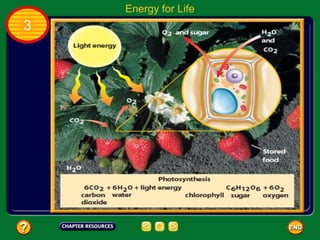
    Elements
Chemistry in Life
1
     Compounds and Molecules
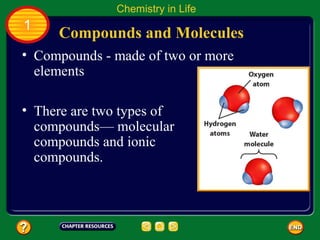
• Compounds - made of two or more
  elements

• There are two types of
  compounds— molecular
  compounds and ionic
  compounds.
Chemistry in Life
1
       Molecular Compounds
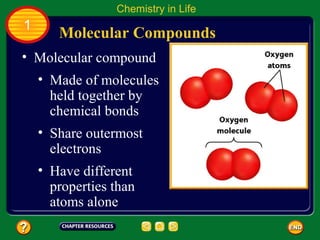
• Molecular compound
    • Made of molecules
      held together by
      chemical bonds
    • Share outermost
      electrons
    • Have different
      properties than
      atoms alone
Chemistry in Life
1
       Molecular Compounds
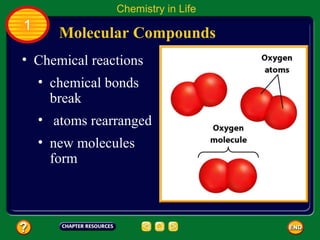
• Chemical reactions
    • chemical bonds
      break
    • atoms rearranged
    • new molecules
      form
Chemistry in Life
1
         Ions
• Ions
    • Electrically charged atoms
    • Formed when atoms combine after
      becoming (+) or (-)
Chemistry in Life
1
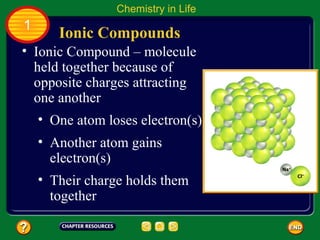
       Ionic Compounds
• Ionic Compound – molecule
  held together because of
  opposite charges attracting
  one another
    • One atom loses electron(s)
    • Another atom gains
      electron(s)
    • Their charge holds them
      together
Chemistry in Life
   1
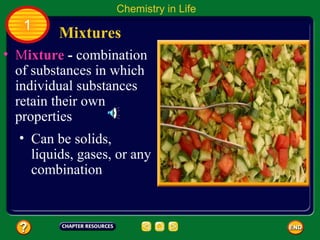
         Mixtures
• Mixture - combination
  of substances in which
  individual substances
  retain their own
  properties
  • Can be solids,
    liquids, gases, or any
    combination
Chemistry in Life
1
       Mixtures
• Solution - 2 or more substances mixed
  evenly
• Suspension
    • substance evenly spread throughout
    • Will sink to bottom after time
Chemistry in Life
1
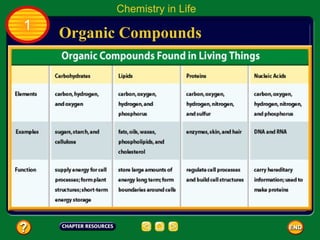
       Organic Compounds
• Organic Compounds
    • always contain carbon and hydrogen
    • usually are associated with living things.


• Inorganic Compounds
   • make up nonliving things
Chemistry in Life
1
    Organic Compounds
Chemistry in Life
1
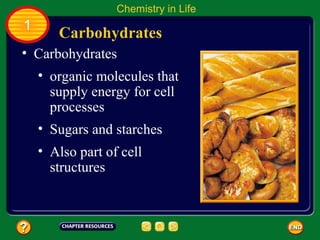
       Carbohydrates
• Carbohydrates
    • organic molecules that
      supply energy for cell
      processes
    • Sugars and starches
    • Also part of cell
      structures
Chemistry in Life
  1
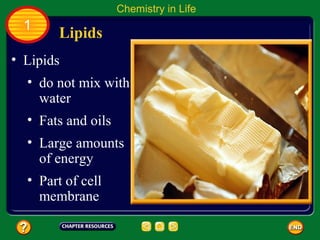
       Lipids
• Lipids
  • do not mix with
    water
  • Fats and oils
  • Large amounts
    of energy
  • Part of cell
    membrane
Chemistry in Life
1
       Proteins
• Proteins
    • made of amino acids
    • building blocks of cellular structure

• Enzymes
    • Proteins that regulate chemical reactions
Chemistry in Life
  1
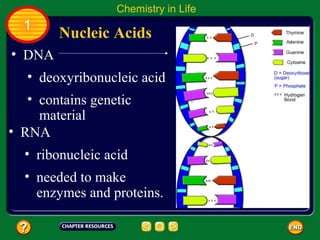
        Nucleic Acids
• DNA
   • deoxyribonucleic acid
   • contains genetic
     material
• RNA
  • ribonucleic acid
  • needed to make
    enzymes and proteins.
Chemistry in Life
1
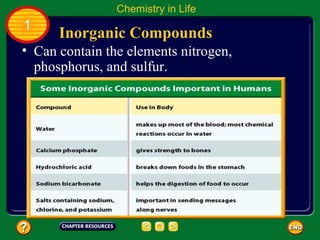
      Inorganic Compounds
• Can contain the elements nitrogen,
  phosphorus, and sulfur.
Chemistry in Life
 1
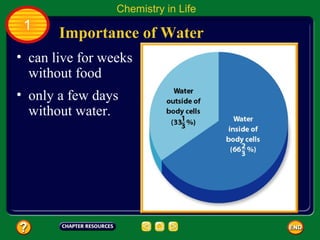
       Importance of Water
• can live for weeks
  without food
• only a few days
  without water.
Chemistry in Life
1
      Importance of Water

• all the chemical reactions in living things
  take place in water solutions
• most organisms use water to transport
  materials
Chemistry in Life
1
      Characteristics of Water
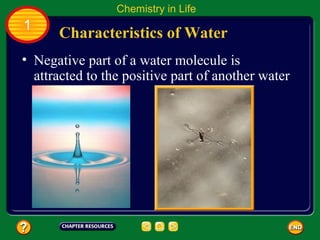
• Negative part of a water molecule is
  attracted to the positive part of another water
  molecule
Chemistry in Life
1
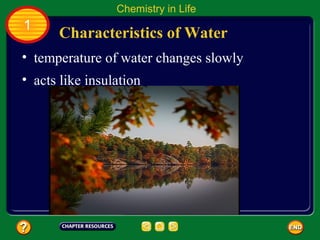
      Characteristics of Water
• temperature of water changes slowly
• acts like insulation
Chemistry in Life
1
      Characteristics of Water
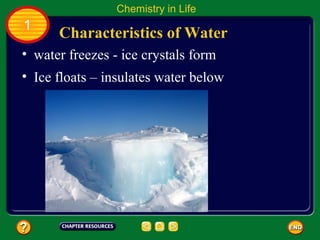
• water freezes - ice crystals form
• Ice floats – insulates water below
Section Check
1
       Question 1
_______ is anything that has mass and takes
up space.


       Answer
The answer is Matter. Everything in your
environment is made of matter.
Section Check
1
       Question 2
A(n) _______ is made up of only one kind of
atom.


       Answer
The answer is element. An element can’t be
broken down into a simpler form by chemical
reactions.
Section Check
1
       Question 3
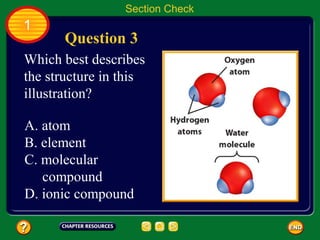
Which best describes
the structure in this
illustration?

A. atom
B. element
C. molecular
   compound
D. ionic compound
Section Check
1
      Answer
The answer is C. Molecular compounds form
when different atoms share their outermost
electrons.
Moving Cellular Materials
  2
        Passive Transport
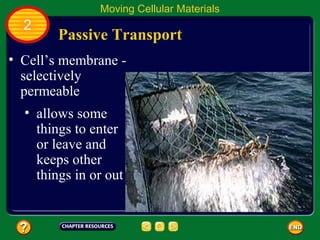
• Cell’s membrane -
  selectively
  permeable
  • allows some
    things to enter
    or leave and
    keeps other
    things in or out
Moving Cellular Materials
2
        Passive Transport
 • Passive transport - movement of substances
   through the cell membrane without the use of
   energy
• 3 Types
    • Diffusion
    • Osmosis
    • Facilitated diffusion
Moving Cellular Materials
 2
      Diffusion
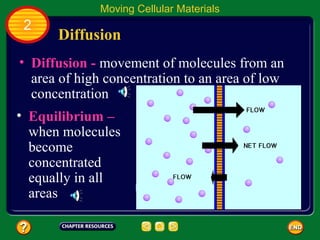
• Diffusion - movement of molecules from an
  area of high concentration to an area of low
  concentration
• Equilibrium –
  when molecules
  become
  concentrated
  equally in all
  areas
Moving Cellular Materials
2
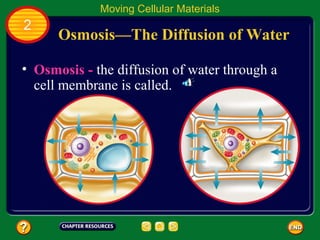
      Osmosis—The Diffusion of Water

• Osmosis - the diffusion of water through a
  cell membrane is called.
Moving Cellular Materials
  2
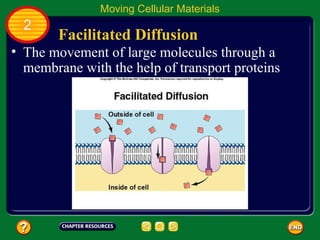
        Facilitated Diffusion
• The movement of large molecules through a
  membrane with the help of transport proteins
Moving Cellular Materials
  2
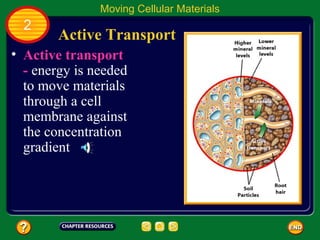
        Active Transport
• Active transport
  - energy is needed
  to move materials
  through a cell
  membrane against
  the concentration
  gradient
Moving Cellular Materials
2
      Endocytosis and Exocytosis
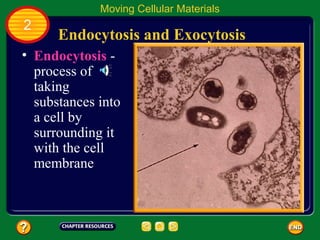
• Endocytosis -
  process of
  taking
  substances into
  a cell by
  surrounding it
  with the cell
  membrane
Moving Cellular Materials
   2
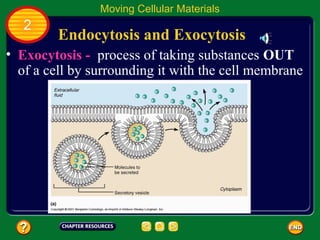
         Endocytosis and Exocytosis
• Exocytosis - process of taking substances OUT
  of a cell by surrounding it with the cell membrane
Section Check
2
       Question 1
What is diffusion?


       Answer
Diffusion is the type of passive transport in
which molecules in a more dense area
randomly move to an area that is less dense
until equilibrium is reached.
Section Check
2
       Question 2
_______ is the diffusion of water through a
cell membrane.

       Answer
The answer is osmosis. Cells contain water
and are surrounded by water. These water
molecules move by diffusion into and out of
cells.
Section Check
2
      Question 3
Which carries oxygen throughout your body?


A. red blood cells
B. white blood cells
C. sex cells
D. none of the above
Section Check
2
       Answer
The answer is A. Oxygen molecules from the
lungs diffuse into red blood cells which carry
oxygen throughout your body.
Energy for Life
  3
       Trapping and Using Energy
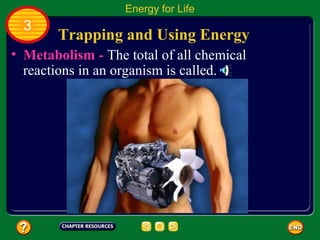
• Metabolism - The total of all chemical
  reactions in an organism is called.
Energy for Life
  3
       Trapping and Using Energy
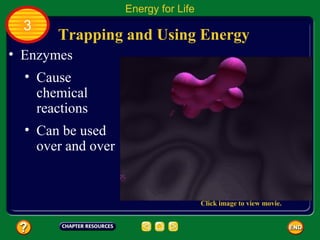
• Enzymes
  • Cause
    chemical
    reactions
  • Can be used
    over and over


                                      Click image to view movie.
Energy for Life
3
      Photosynthesis
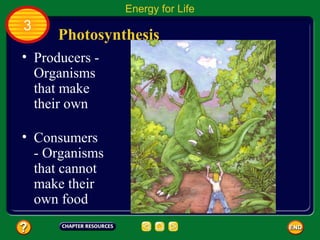
• Producers -
  Organisms
  that make
  their own

• Consumers
  - Organisms
  that cannot
  make their
  own food
Energy for Life
 3
       Photosynthesis
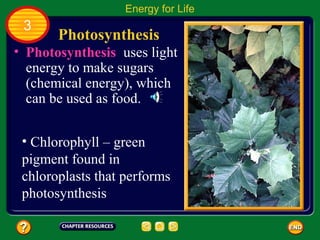
• Photosynthesis uses light
  energy to make sugars
  (chemical energy), which
  can be used as food.


 • Chlorophyll – green
 pigment found in
 chloroplasts that performs
 photosynthesis
Energy for Life
3
Energy for Life
3
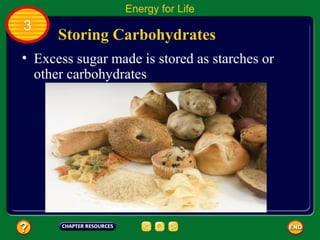
      Storing Carbohydrates
• Excess sugar made is stored as starches or
  other carbohydrates
Energy for Life
3
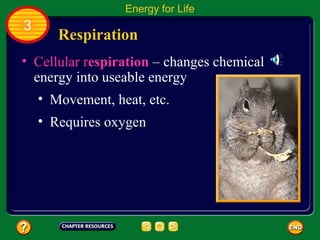
       Respiration
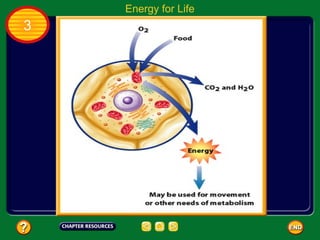
• Cellular respiration – changes chemical
  energy into useable energy
    • Movement, heat, etc.
    • Requires oxygen
Energy for Life
3
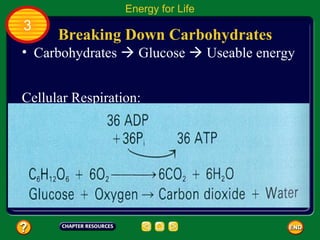
      Breaking Down Carbohydrates
• Carbohydrates  Glucose  Useable energy


Cellular Respiration:
Energy for Life
3
Energy for Life
  3
        Fermentation
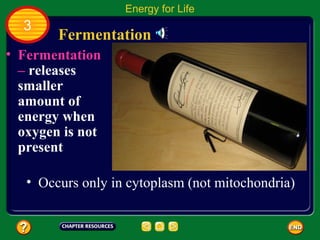
• Fermentation
  – releases
  smaller
  amount of
  energy when
  oxygen is not
  present

   • Occurs only in cytoplasm (not mitochondria)
Section Check
3
       Question 1
_______ is the total of all chemical reactions
in an organism.

       Answer
The answer is metabolism. All of the
activities of an organism involve chemical
reactions in some way.
Section Check
3
      Question 2
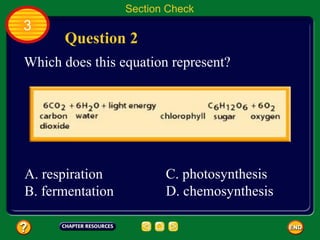
Which does this equation represent?


A. respiration           C. photosynthesis
B. fermentation          D. chemosynthesis
Section Check
3
       Answer
The answer is C. During photosynthesis, plants
take in carbon dioxide and water and combine
it with light energy to make sugars, which they
use for food.
Section Check
3
       Question 3
_______ is the type of food molecules most
easily broken down by cells.

       Answer
The answer is carbohydrates. As
carbohydrates are broken down, energy is
released.
Help

To advance to the next item or next page click on any
of the following keys: mouse, space bar, enter, down or
forward arrow.
Click on this icon to return to the table of contents

Click on this icon to return to the previous slide

Click on this icon to move to the next slide

           Click on this icon to open the resources file.

 Click on this icon to go to the end of the presentation.
End of Chapter Summary File

Science Book A: Chapter 3

  • 2.
    Table of Contents Chapter:Cell Processes Section 1: Chemistry of Life Section 2: Moving Cellular Materials Section 3: Energy for Life
  • 3.
    Chemistry of Life 1 The Nature of Matter • Matter - anything that has mass and takes up space. • Energy - anything that brings about change.
  • 4.
    Chemistry in Life 1 Atoms • Nucleus - center of atom • contains protons and neutrons (equal mass) • Proton (+) • Neutron ( ) • Electron (-) •orbits nucleus Click image to view movie.
  • 5.
    Chemistry in Life 1 Atoms • Electrons - involved in chemical reactions. • Atom - mostly empty space
  • 6.
    Chemistry in Life 1 Elements • Element • made of one kind of atom • in most simple form • each has a 1 or 2 letter symbol
  • 7.
    Chemistry in Life 1 Elements • Periodic table • Mass • # of Protons • Symbol
  • 8.
  • 9.
    Chemistry in Life 1 Compounds and Molecules • Compounds - made of two or more elements • There are two types of compounds— molecular compounds and ionic compounds.
  • 10.
    Chemistry in Life 1 Molecular Compounds • Molecular compound • Made of molecules held together by chemical bonds • Share outermost electrons • Have different properties than atoms alone
  • 11.
    Chemistry in Life 1 Molecular Compounds • Chemical reactions • chemical bonds break • atoms rearranged • new molecules form
  • 12.
    Chemistry in Life 1 Ions • Ions • Electrically charged atoms • Formed when atoms combine after becoming (+) or (-)
  • 13.
    Chemistry in Life 1 Ionic Compounds • Ionic Compound – molecule held together because of opposite charges attracting one another • One atom loses electron(s) • Another atom gains electron(s) • Their charge holds them together
  • 14.
    Chemistry in Life 1 Mixtures • Mixture - combination of substances in which individual substances retain their own properties • Can be solids, liquids, gases, or any combination
  • 15.
    Chemistry in Life 1 Mixtures • Solution - 2 or more substances mixed evenly • Suspension • substance evenly spread throughout • Will sink to bottom after time
  • 16.
    Chemistry in Life 1 Organic Compounds • Organic Compounds • always contain carbon and hydrogen • usually are associated with living things. • Inorganic Compounds • make up nonliving things
  • 17.
    Chemistry in Life 1 Organic Compounds
  • 18.
    Chemistry in Life 1 Carbohydrates • Carbohydrates • organic molecules that supply energy for cell processes • Sugars and starches • Also part of cell structures
  • 19.
    Chemistry in Life 1 Lipids • Lipids • do not mix with water • Fats and oils • Large amounts of energy • Part of cell membrane
  • 20.
    Chemistry in Life 1 Proteins • Proteins • made of amino acids • building blocks of cellular structure • Enzymes • Proteins that regulate chemical reactions
  • 21.
    Chemistry in Life 1 Nucleic Acids • DNA • deoxyribonucleic acid • contains genetic material • RNA • ribonucleic acid • needed to make enzymes and proteins.
  • 22.
    Chemistry in Life 1 Inorganic Compounds • Can contain the elements nitrogen, phosphorus, and sulfur.
  • 23.
    Chemistry in Life 1 Importance of Water • can live for weeks without food • only a few days without water.
  • 24.
    Chemistry in Life 1 Importance of Water • all the chemical reactions in living things take place in water solutions • most organisms use water to transport materials
  • 25.
    Chemistry in Life 1 Characteristics of Water • Negative part of a water molecule is attracted to the positive part of another water molecule
  • 26.
    Chemistry in Life 1 Characteristics of Water • temperature of water changes slowly • acts like insulation
  • 27.
    Chemistry in Life 1 Characteristics of Water • water freezes - ice crystals form • Ice floats – insulates water below
  • 28.
    Section Check 1 Question 1 _______ is anything that has mass and takes up space. Answer The answer is Matter. Everything in your environment is made of matter.
  • 29.
    Section Check 1 Question 2 A(n) _______ is made up of only one kind of atom. Answer The answer is element. An element can’t be broken down into a simpler form by chemical reactions.
  • 30.
    Section Check 1 Question 3 Which best describes the structure in this illustration? A. atom B. element C. molecular compound D. ionic compound
  • 31.
    Section Check 1 Answer The answer is C. Molecular compounds form when different atoms share their outermost electrons.
  • 32.
    Moving Cellular Materials 2 Passive Transport • Cell’s membrane - selectively permeable • allows some things to enter or leave and keeps other things in or out
  • 33.
    Moving Cellular Materials 2 Passive Transport • Passive transport - movement of substances through the cell membrane without the use of energy • 3 Types • Diffusion • Osmosis • Facilitated diffusion
  • 34.
    Moving Cellular Materials 2 Diffusion • Diffusion - movement of molecules from an area of high concentration to an area of low concentration • Equilibrium – when molecules become concentrated equally in all areas
  • 35.
    Moving Cellular Materials 2 Osmosis—The Diffusion of Water • Osmosis - the diffusion of water through a cell membrane is called.
  • 36.
    Moving Cellular Materials 2 Facilitated Diffusion • The movement of large molecules through a membrane with the help of transport proteins
  • 37.
    Moving Cellular Materials 2 Active Transport • Active transport - energy is needed to move materials through a cell membrane against the concentration gradient
  • 38.
    Moving Cellular Materials 2 Endocytosis and Exocytosis • Endocytosis - process of taking substances into a cell by surrounding it with the cell membrane
  • 39.
    Moving Cellular Materials 2 Endocytosis and Exocytosis • Exocytosis - process of taking substances OUT of a cell by surrounding it with the cell membrane
  • 40.
    Section Check 2 Question 1 What is diffusion? Answer Diffusion is the type of passive transport in which molecules in a more dense area randomly move to an area that is less dense until equilibrium is reached.
  • 41.
    Section Check 2 Question 2 _______ is the diffusion of water through a cell membrane. Answer The answer is osmosis. Cells contain water and are surrounded by water. These water molecules move by diffusion into and out of cells.
  • 42.
    Section Check 2 Question 3 Which carries oxygen throughout your body? A. red blood cells B. white blood cells C. sex cells D. none of the above
  • 43.
    Section Check 2 Answer The answer is A. Oxygen molecules from the lungs diffuse into red blood cells which carry oxygen throughout your body.
  • 44.
    Energy for Life 3 Trapping and Using Energy • Metabolism - The total of all chemical reactions in an organism is called.
  • 45.
    Energy for Life 3 Trapping and Using Energy • Enzymes • Cause chemical reactions • Can be used over and over Click image to view movie.
  • 46.
    Energy for Life 3 Photosynthesis • Producers - Organisms that make their own • Consumers - Organisms that cannot make their own food
  • 47.
    Energy for Life 3 Photosynthesis • Photosynthesis uses light energy to make sugars (chemical energy), which can be used as food. • Chlorophyll – green pigment found in chloroplasts that performs photosynthesis
  • 48.
  • 49.
    Energy for Life 3 Storing Carbohydrates • Excess sugar made is stored as starches or other carbohydrates
  • 50.
    Energy for Life 3 Respiration • Cellular respiration – changes chemical energy into useable energy • Movement, heat, etc. • Requires oxygen
  • 51.
    Energy for Life 3 Breaking Down Carbohydrates • Carbohydrates  Glucose  Useable energy Cellular Respiration:
  • 52.
  • 53.
    Energy for Life 3 Fermentation • Fermentation – releases smaller amount of energy when oxygen is not present • Occurs only in cytoplasm (not mitochondria)
  • 54.
    Section Check 3 Question 1 _______ is the total of all chemical reactions in an organism. Answer The answer is metabolism. All of the activities of an organism involve chemical reactions in some way.
  • 55.
    Section Check 3 Question 2 Which does this equation represent? A. respiration C. photosynthesis B. fermentation D. chemosynthesis
  • 56.
    Section Check 3 Answer The answer is C. During photosynthesis, plants take in carbon dioxide and water and combine it with light energy to make sugars, which they use for food.
  • 57.
    Section Check 3 Question 3 _______ is the type of food molecules most easily broken down by cells. Answer The answer is carbohydrates. As carbohydrates are broken down, energy is released.
  • 58.
    Help To advance tothe next item or next page click on any of the following keys: mouse, space bar, enter, down or forward arrow. Click on this icon to return to the table of contents Click on this icon to return to the previous slide Click on this icon to move to the next slide Click on this icon to open the resources file. Click on this icon to go to the end of the presentation.
  • 59.
    End of ChapterSummary File