IBS Statistics Year 1 Dr. Ning DING [email_address] I007, Friday & Monday
Table of content Chapter 1: What is statistics? Why study statistics? What is meant by statistics? Types of statistics Types of variables Levels of measurement Norminal-Level Data Ordinal-Level Data Interval-Level Data Ethics and Statistics Chapter 2: Describing data Frequency tables Frequency distributions Graphic presentation
Learning Goals Chapter 1: What is statistics? Understand why we study statistics Explain what is meant by  descriptive  and  inferential  statistics Distinguish between a  qualitative  and  quantitative  variable Describe how a  discrete  variable is different from a  continous  variable Distinguish among the  nominal ,  ordinal ,  interval  and  ratio  levels of measurement Chapter 2: Describing data Organize qualitative data into a  frequency table Present a frequency table as a  bar chart  or a  pie chart Organize quantitative data into a  freqency distribution Present a frequency distribution for quantitative data using  histograms ,  frequency polygons , and  cumulative frequency polygons .
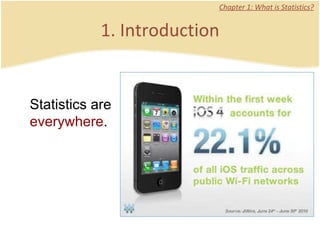
1. Introduction Chapter 1: What is Statistics? Statistics are  everywhere .
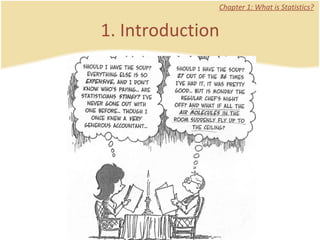
1. Introduction Chapter 1: What is Statistics?
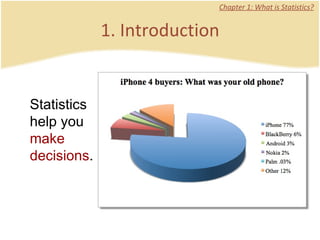
1. Introduction Chapter 1: What is Statistics? Statistics help you  make decisions .
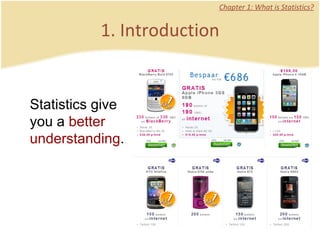
1. Introduction Chapter 1: What is Statistics? Statistics give you a  better   understanding .
1. Introduction Chapter 1: What is Statistics? 1. Adequate information? Additional information? 2. No misleading information? 3. Summarize the information. 4. Analyze available information. 5. Conclusions!
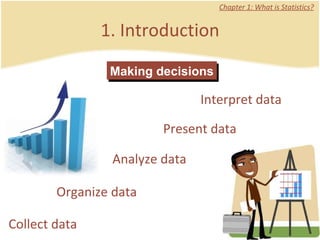
1. Introduction Chapter 1: What is Statistics? Statistics :  The science of  collecting ,  organizing ,  presenting ,  analyzing  and  interpreting  data to assist in making more effective decisions.
1. Introduction Collect data Chapter 1: What is Statistics? Interpret data Analyze data Organize data Present data Making decisions
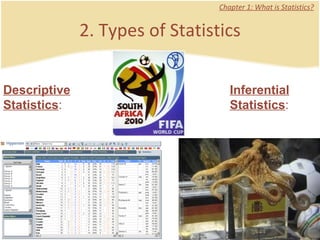
2. Types of Statistics Chapter 1: What is Statistics? Descriptive Statistics :  Methods of organizing, summarizing and presenting data in an informative way.  Inferential Statistics :  Methods used to estimate a property of a  population  on the basis of a  sample .
2. Types of Statistics Chapter 1: What is Statistics? Descriptive Statistics :  Inferential Statistics :
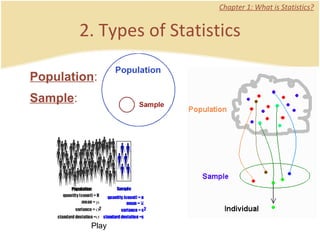
2. Types of Statistics Chapter 1: What is Statistics? Population :  The entire set of individual or objects of interest or the measurements obtained from all individuals or objects of interest.  Sample :  A portion, or part, of the population of interest.
2. Types of Statistics Chapter 1: What is Statistics? Population :  Sample :  Play
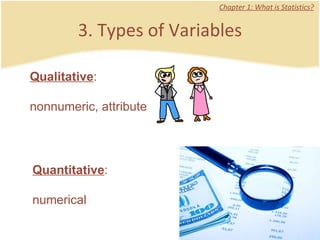
3. Types of Variables Chapter 1: What is Statistics? Qualitative :  nonnumeric, attribute Quantitative :  numerical
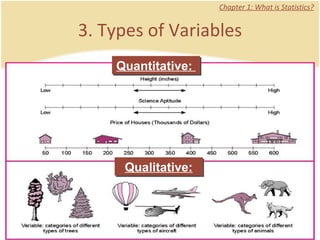
3. Types of Variables Chapter 1: What is Statistics? Qualitative: Quantitative:
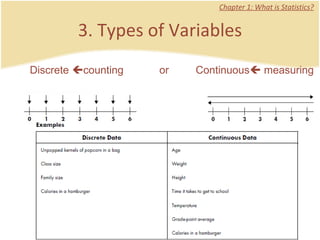
3. Types of Variables Chapter 1: What is Statistics? Discrete   counting  or  Continuous   measuring
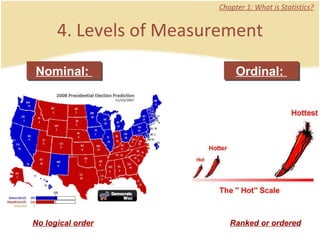
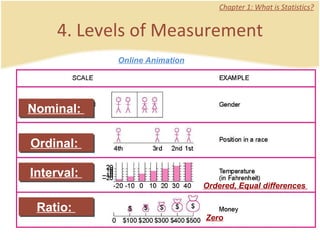
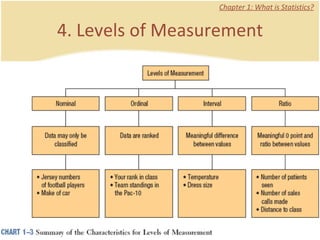
4. Levels of Measurement Chapter 1: What is Statistics? Nominal :  Data categories are represented by labels or names. Even when the labels are numerically coded, the data categories have  no logical order .  Example: Eye colour, gender, religious affiliation Ordinal :  Data classifications are represented by sets of labels or names (high, medium, low) that have relative values. Because of the relative values, the data classified can be  ranked or ordered .  Example: During a taste test of 4 soft drinks, Mellow Yellow was ranked number 1, Sprite number 2, Seven-up number 3, and Orange Crush number 4.
4. Levels of Measurement Chapter 1: What is Statistics? Nominal:  Ordinal:  No logical order Ranked or ordered
4. Levels of Measurement Chapter 1: What is Statistics? Interval :  Similar to the ordinal level, with the additional property that meaningful amounts of differences between data values can be determined.  There is no natural zero point.  Example: Temperature on the Fahrenheit scale.  Ratio :  The interval level with an  inherent zero  starting point.  Differences and ratios are meaningful for this level of measurement.  Examples: Monthly income; distance travelled by manufacturer’s representatives per month.
4. Levels of Measurement Chapter 1: What is Statistics? Interval:  Ratio:  Ordered, Equal differences  Zero Nominal:  Ordinal:  Online Animation
4. Levels of Measurement Chapter 1: What is Statistics?
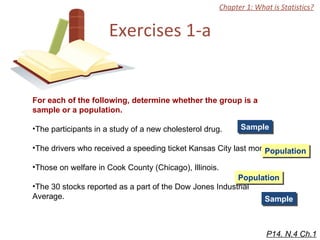
Exercises 1-a Chapter 1: What is Statistics? For each of the following, determine whether the group is a sample or a population.  The participants in a study of a new cholesterol drug. The drivers who received a speeding ticket Kansas City last month. Those on welfare in Cook County (Chicago), Illinois.  The 30 stocks reported as a part of the Dow Jones Industrial Average.  Sample Sample Population Population P14. N.4 Ch.1
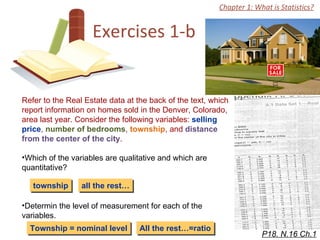
Exercises 1-b Chapter 1: What is Statistics? Refer to the Real Estate data at the back of the text, which report information on homes sold in the Denver, Colorado, area last year. Consider the following variables:  selling price ,  number of bedrooms ,  township , and  distance from the center of the city .  Which of the variables are qualitative and which are quantitative? Determin the level of measurement for each of the variables.  P18. N.16 Ch.1 township Township = nominal level all the rest… All the rest…=ratio
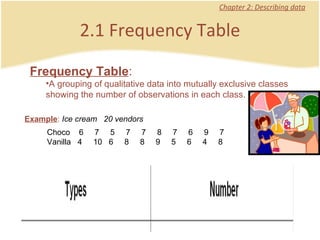
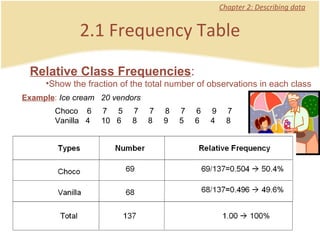
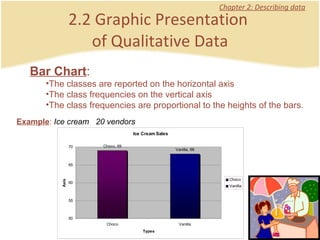
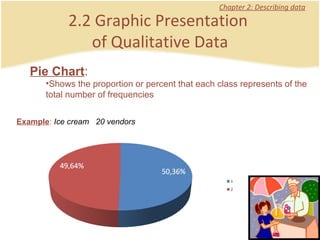
2.1 Frequency Table Chapter 2: Describing data Frequency Table :  A grouping of qualitative data into mutually exclusive classes showing the number of observations in each class.  Example :  Ice cream  20 vendors      Choco  6     7     5     7     7     8     7     6     9     7    Vanilla  4     10   6     8     8     9     5     6     4     8
2.1 Frequency Table Chapter 2: Describing data Relative Class Frequencies :  Show the fraction of the total number of observations in each class     Choco  6     7     5     7     7     8     7     6     9     7    Vanilla  4     10   6     8     8     9     5     6     4     8  Example :  Ice cream  20 vendors
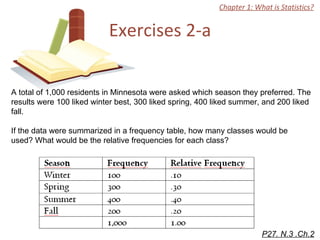
Exercises 2-a Chapter 1: What is Statistics? A total of 1,000 residents in Minnesota were asked which season they preferred. The results were 100 liked winter best, 300 liked spring, 400 liked summer, and 200 liked fall. If the data were summarized in a frequency table, how many classes would be used? What would be the relative frequencies for each class? P27. N.3 .Ch.2
2.2 Graphic Presentation  of Qualitative Data Chapter 2: Describing data Bar Chart :  The classes are reported on the horizontal axis The class frequencies on the vertical axis The class frequencies are proportional to the heights of the bars. Example :  Ice cream  20 vendors
Chapter 2: Describing data Pie Chart :  Shows the proportion or percent that each class represents of the total number of frequencies Example :  Ice cream  20 vendors  2.2 Graphic Presentation  of Qualitative Data
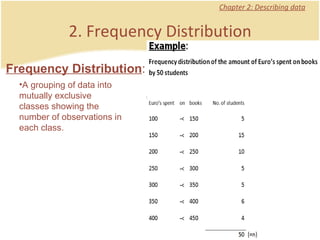
Chapter 2: Describing data Frequency Distribution :  2. Frequency Distribution A grouping of data into mutually exclusive classes showing the number of observations in each class.
Chapter 2: Describing data Frequency Distribution :  A grouping of data into mutually exclusive classes showing the number of observations in each class. 2. Frequency Distribution
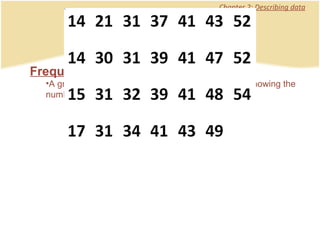
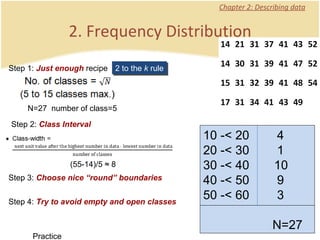
Chapter 2: Describing data 2. Frequency Distribution Step 3:  Choose nice “round” boundaries  Step 4:  Try to avoid empty and open classes (55-14)/5 ≈ 8 Practice Step 2:  Class Interval Step 1:  Just enough  recipe 2 to the  k  rule N=27  number of class=5 10 -< 20  4 20 -< 30  1 30 -< 40   10 40 -< 50  9 50 -< 60  3 N=27
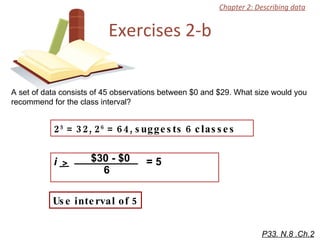
Exercises 2-b A set of data consists of 45 observations between $0 and $29. What size would you recommend for the class interval? P33. N.8 .Ch.2 2 5  = 32, 2 6  = 64, suggests 6 classes Chapter 2: Describing data Use interval of 5 i   = 5 > $30 - $0 6
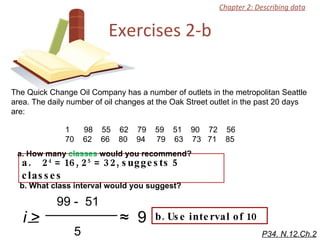
Exercises 2-b The Quick Change Oil Company has a number of outlets in the metropolitan Seattle area. The daily number of oil changes at the Oak Street outlet in the past 20 days are: P34. N.12.Ch.2 a.  2 4  = 16, 2 5  = 32, suggests 5 classes Chapter 2: Describing data 98  55  62  79  59  51  90  72  56 70  62  66  80  94  79  63  73  71  85 b. Use interval of 10 a. How many  classes  would you recommend? b. What class interval would you suggest? i  >  ≈  9 99 -  51 5
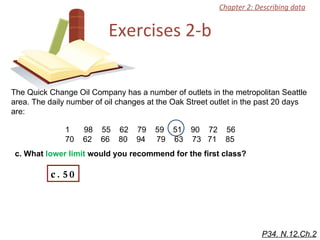
Exercises 2-b The Quick Change Oil Company has a number of outlets in the metropolitan Seattle area. The daily number of oil changes at the Oak Street outlet in the past 20 days are: P34. N.12.Ch.2 Chapter 2: Describing data 98  55  62  79  59  51  90  72  56 70  62  66  80  94  79  63  73  71  85 c. 50 c. What  lower limit  would you recommend for the first class?
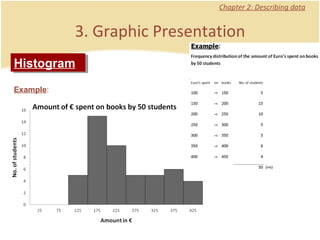
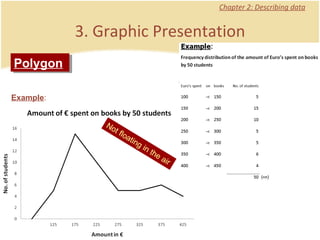
Chapter 2: Describing data 3. Graphic Presentation Histogram The classes are marked on the horizontal axis The class frequencies on the vertical axis The class frequencies are represented by the heights of the bars and the bars are adjacent to each other.  Polygon :  The shape of a distribution Similar to a histogram
Chapter 2: Describing data Example : 3. Graphic Presentation Histogram
Chapter 2: Describing data Example : 3. Graphic Presentation Polygon Not floating in the air
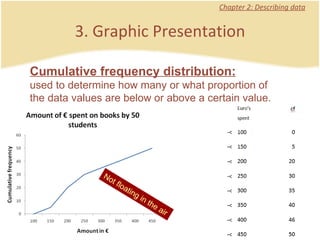
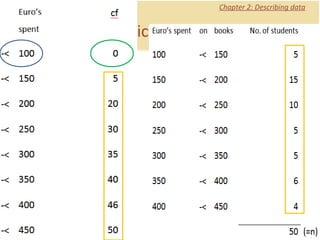
Chapter 2: Describing data 3. Graphic Presentation Cumulative frequency distribution: used to determine how many or what proportion of the data values are below or above a certain value. Not floating in the air
Chapter 2: Describing data 3. Graphic Presentation
Summary Chapter 1: What is statistics? Understand why we study statistics Explain what is meant by  descriptive  and  inferential  statistics Distinguish between a  qualitative  and  quantitative  variable Describe how a  discrete  variable is different from a  continous  variable Distinguish among the  nominal ,  ordinal ,  interval  and  ratio  levels of measurement Chapter 2: Describing data Organize qualitative data into a  frequency table Present a frequency table as a  bar chart  or a  pie chart Organize quantitative data into a  freqency distribution Present a frequency distribution for quantitative data using  histograms ,  frequency polygons , and  cumulative frequency polygons .  Chapter 1: What is Statistics?
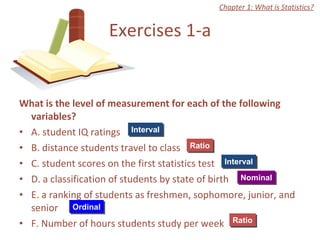
What is the level of measurement for each of the following variables? A. student IQ ratings  B. distance students travel to class C. student scores on the first statistics test D. a classification of students by state of birth E. a ranking of students as freshmen, sophomore, junior, and senior F. Number of hours students study per week  Exercises 1-a Interval Ratio Interval Nominal Ordinal Ratio Chapter 1: What is Statistics?
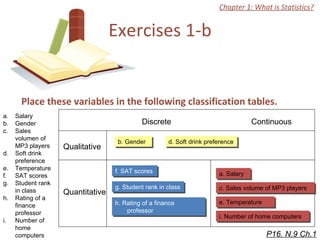
Exercises 1-b Place these variables in the following classification tables.  Qualitative Quantitative Salary Gender Sales volumen of MP3 players Soft drink preference Temperature SAT scores Student rank in class Rating of a finance professor Number of home computers Discrete Continuous b. Gender d. Soft drink preference f. SAT scores g. Student rank in class h. Rating of a finance professor a. Salary  c. Sales volume of MP3 players e. Temperature i. Number of home computers Chapter 1: What is Statistics? P16. N.9 Ch.1
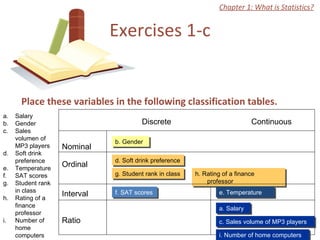
Exercises 1-c Place these variables in the following classification tables.  Nominal Ordinal Salary Gender Sales volumen of MP3 players Soft drink preference Temperature SAT scores Student rank in class Rating of a finance professor Number of home computers Discrete Continuous b. Gender d. Soft drink preference f. SAT scores g. Student rank in class h. Rating of a finance professor a. Salary  c. Sales volume of MP3 players e. Temperature i. Number of home computers Interval Ratio Chapter 1: What is Statistics?
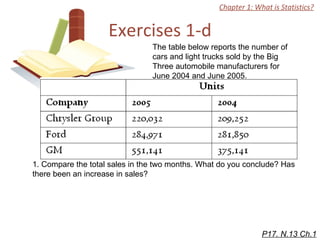
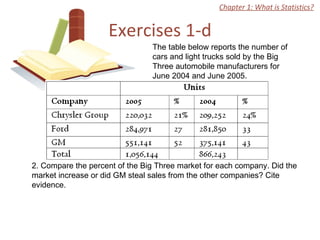
Exercises 1-d Chapter 1: What is Statistics? The table below reports the number of cars and light trucks sold by the Big Three automobile manufacturers for June 2004 and June 2005.  1. Compare the total sales in the two months. What do you conclude? Has there been an increase in sales? P17. N.13 Ch.1
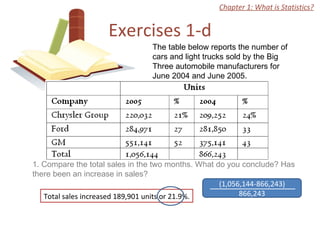
Exercises 1-d Chapter 1: What is Statistics? The table below reports the number of cars and light trucks sold by the Big Three automobile manufacturers for June 2004 and June 2005.  1. Compare the total sales in the two months. What do you conclude? Has there been an increase in sales? Total sales increased 189,901 units or 21.9%. (1,056,144-866,243) 866,243
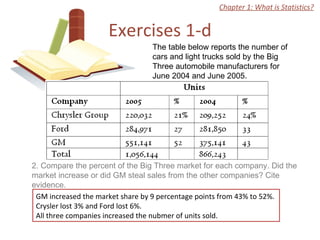
Exercises 1-d Chapter 1: What is Statistics? The table below reports the number of cars and light trucks sold by the Big Three automobile manufacturers for June 2004 and June 2005.  2. Compare the percent of the Big Three market for each company. Did the market increase or did GM steal sales from the other companies? Cite evidence.
Exercises 1-d Chapter 1: What is Statistics? The table below reports the number of cars and light trucks sold by the Big Three automobile manufacturers for June 2004 and June 2005.  2. Compare the percent of the Big Three market for each company. Did the market increase or did GM steal sales from the other companies? Cite evidence.  GM increased the market share by 9 percentage points from 43% to 52%.  Crysler lost 3% and Ford lost 6%.  All three companies increased the nubmer of units sold.
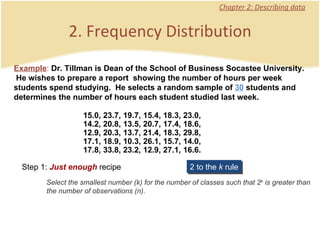
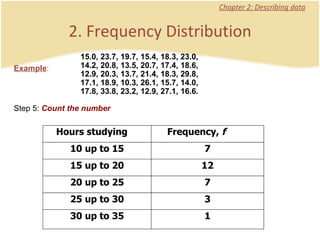
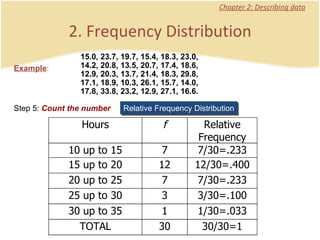
Chapter 2: Describing data Example :  Dr. Tillman is Dean of the School of Business Socastee University.  He wishes to prepare a report  showing the number of hours per week students spend studying.  He selects a random sample of  30  students and determines the number of hours each student studied last week.   2. Frequency Distribution Step 1:  Just enough  recipe 2 to the  k  rule 15.0, 23.7, 19.7, 15.4, 18.3, 23.0, 14.2, 20.8, 13.5, 20.7, 17.4, 18.6, 12.9, 20.3, 13.7, 21.4, 18.3, 29.8, 17.1, 18.9, 10.3, 26.1, 15.7, 14.0, 17.8, 33.8, 23.2, 12.9, 27.1, 16.6. Select the smallest number (k) for the number of classes such that 2 k  is greater than the number of observations (n).
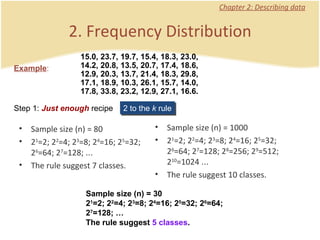
Chapter 2: Describing data Example : 2. Frequency Distribution Step 1:  Just enough  recipe 2 to the  k  rule 15.0, 23.7, 19.7, 15.4, 18.3, 23.0, 14.2, 20.8, 13.5, 20.7, 17.4, 18.6, 12.9, 20.3, 13.7, 21.4, 18.3, 29.8, 17.1, 18.9, 10.3, 26.1, 15.7, 14.0, 17.8, 33.8, 23.2, 12.9, 27.1, 16.6. Sample size (n) = 80 2 1 =2; 2 2 =4; 2 3 =8; 2 4 =16; 2 5 =32; 2 6 =64; 2 7 =128;  … The rule suggest 7 classes. Sample size (n) = 1000 2 1 =2; 2 2 =4; 2 3 =8; 2 4 =16; 2 5 =32; 2 6 =64; 2 7 =128; 2 8 =256; 2 9 =512; 2 10 =1024  … The rule suggest 10 classes. Sample size (n) = 30 2 1 =2; 2 2 =4; 2 3 =8; 2 4 =16; 2 5 =32; 2 6 =64; 2 7 =128; … The rule suggest  5 classes .
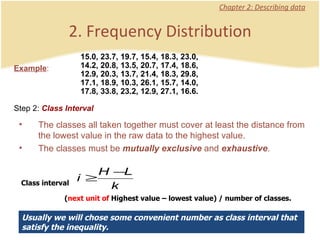
Chapter 2: Describing data Example : 2. Frequency Distribution 15.0, 23.7, 19.7, 15.4, 18.3, 23.0, 14.2, 20.8, 13.5, 20.7, 17.4, 18.6, 12.9, 20.3, 13.7, 21.4, 18.3, 29.8, 17.1, 18.9, 10.3, 26.1, 15.7, 14.0, 17.8, 33.8, 23.2, 12.9, 27.1, 16.6. The classes all taken together must cover at least the distance from the lowest value in the raw data to the highest value. The classes must be  mutually exclusive  and  exhaustive . Class interval ( next unit of  Highest value – lowest value) / number of classes. Usually we will chose some convenient number as class interval that satisfy the inequality. Step 2:  Class Interval
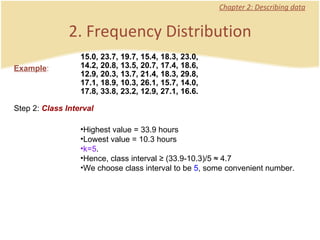
Chapter 2: Describing data Example : 2. Frequency Distribution 15.0, 23.7, 19.7, 15.4, 18.3, 23.0, 14.2, 20.8, 13.5, 20.7, 17.4, 18.6, 12.9, 20.3, 13.7, 21.4, 18.3, 29.8, 17.1, 18.9, 10.3, 26.1, 15.7, 14.0, 17.8, 33.8, 23.2, 12.9, 27.1, 16.6. Step 2:  Class Interval Highest value = 33.9 hours Lowest value = 10.3 hours k=5 . Hence, class interval ≥ (33.9-10.3)/5 ≈ 4.7 We choose class interval to be  5 , some convenient number.
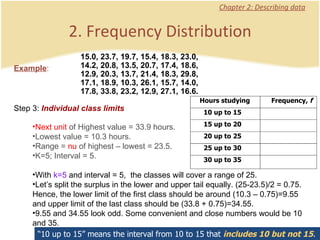
Chapter 2: Describing data Example : 2. Frequency Distribution 15.0, 23.7, 19.7, 15.4, 18.3, 23.0, 14.2, 20.8, 13.5, 20.7, 17.4, 18.6, 12.9, 20.3, 13.7, 21.4, 18.3, 29.8, 17.1, 18.9, 10.3, 26.1, 15.7, 14.0, 17.8, 33.8, 23.2, 12.9, 27.1, 16.6. Step 3:  Individual class limits Next unit  of Highest value = 33.9 hours. Lowest value = 10.3 hours. Range =  nu  of highest – lowest = 23.5. K=5; Interval = 5.  With  k=5  and interval = 5,  the classes will cover a range of 25.  Let’s split the surplus in the lower and upper tail equally. (25-23.5)/2 = 0.75.  Hence, the lower limit of the first class should be around (10.3 – 0.75)=9.55 and upper limit of the last class should be (33.8 + 0.75)=34.55.  9.55 and 34.55 look odd. Some convenient and close numbers would be 10 and 35. “ 10 up to 15” means the interval from 10 to 15 that  includes 10 but not 15 .
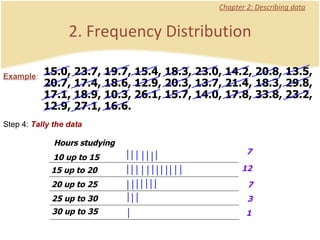
Chapter 2: Describing data Example : 2. Frequency Distribution Step 4:  Tally the data 10 up to 15 Hours studying 15 up to 20 20 up to 25 25 up to 30 30 up to 35 15.0, 23.7, 19.7, 15.4, 18.3, 23.0, 14.2, 20.8, 13.5, 20.7, 17.4, 18.6, 12.9, 20.3, 13.7, 21.4, 18.3, 29.8, 17.1, 18.9, 10.3, 26.1, 15.7, 14.0, 17.8, 33.8, 23.2, 12.9, 27.1, 16.6. 7 12 7 3 1
Chapter 2: Describing data Example : 2. Frequency Distribution 15.0, 23.7, 19.7, 15.4, 18.3, 23.0, 14.2, 20.8, 13.5, 20.7, 17.4, 18.6, 12.9, 20.3, 13.7, 21.4, 18.3, 29.8, 17.1, 18.9, 10.3, 26.1, 15.7, 14.0, 17.8, 33.8, 23.2, 12.9, 27.1, 16.6. Step 5:  Count the number
Chapter 2: Describing data Example : 2. Frequency Distribution 15.0, 23.7, 19.7, 15.4, 18.3, 23.0, 14.2, 20.8, 13.5, 20.7, 17.4, 18.6, 12.9, 20.3, 13.7, 21.4, 18.3, 29.8, 17.1, 18.9, 10.3, 26.1, 15.7, 14.0, 17.8, 33.8, 23.2, 12.9, 27.1, 16.6. Step 5:  Count the number Relative Frequency Distribution
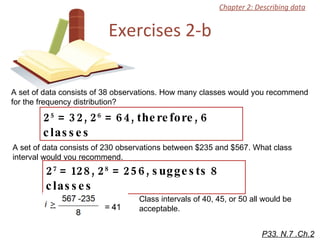
Exercises 2-b A set of data consists of 38 observations. How many classes would you recommend for the frequency distribution? P33. N.7 .Ch.2 2 5  = 32, 2 6  = 64, therefore, 6 classes Chapter 2: Describing data A set of data consists of 230 observations between $235 and $567. What class interval would you recommend.  2 7  = 128, 2 8  = 256, suggests 8 classes Class intervals of 40, 45, or 50 all would be acceptable.

001

  • 1.
    IBS Statistics Year1 Dr. Ning DING [email_address] I007, Friday & Monday
  • 2.
    Table of contentChapter 1: What is statistics? Why study statistics? What is meant by statistics? Types of statistics Types of variables Levels of measurement Norminal-Level Data Ordinal-Level Data Interval-Level Data Ethics and Statistics Chapter 2: Describing data Frequency tables Frequency distributions Graphic presentation
  • 3.
    Learning Goals Chapter1: What is statistics? Understand why we study statistics Explain what is meant by descriptive and inferential statistics Distinguish between a qualitative and quantitative variable Describe how a discrete variable is different from a continous variable Distinguish among the nominal , ordinal , interval and ratio levels of measurement Chapter 2: Describing data Organize qualitative data into a frequency table Present a frequency table as a bar chart or a pie chart Organize quantitative data into a freqency distribution Present a frequency distribution for quantitative data using histograms , frequency polygons , and cumulative frequency polygons .
  • 4.
    1. Introduction Chapter1: What is Statistics? Statistics are everywhere .
  • 5.
    1. Introduction Chapter1: What is Statistics?
  • 6.
    1. Introduction Chapter1: What is Statistics? Statistics help you make decisions .
  • 7.
    1. Introduction Chapter1: What is Statistics? Statistics give you a better understanding .
  • 8.
    1. Introduction Chapter1: What is Statistics? 1. Adequate information? Additional information? 2. No misleading information? 3. Summarize the information. 4. Analyze available information. 5. Conclusions!
  • 9.
    1. Introduction Chapter1: What is Statistics? Statistics : The science of collecting , organizing , presenting , analyzing and interpreting data to assist in making more effective decisions.
  • 10.
    1. Introduction Collectdata Chapter 1: What is Statistics? Interpret data Analyze data Organize data Present data Making decisions
  • 11.
    2. Types ofStatistics Chapter 1: What is Statistics? Descriptive Statistics : Methods of organizing, summarizing and presenting data in an informative way. Inferential Statistics : Methods used to estimate a property of a population on the basis of a sample .
  • 12.
    2. Types ofStatistics Chapter 1: What is Statistics? Descriptive Statistics : Inferential Statistics :
  • 13.
    2. Types ofStatistics Chapter 1: What is Statistics? Population : The entire set of individual or objects of interest or the measurements obtained from all individuals or objects of interest. Sample : A portion, or part, of the population of interest.
  • 14.
    2. Types ofStatistics Chapter 1: What is Statistics? Population : Sample : Play
  • 15.
    3. Types ofVariables Chapter 1: What is Statistics? Qualitative : nonnumeric, attribute Quantitative : numerical
  • 16.
    3. Types ofVariables Chapter 1: What is Statistics? Qualitative: Quantitative:
  • 17.
    3. Types ofVariables Chapter 1: What is Statistics? Discrete  counting or Continuous  measuring
  • 18.
    4. Levels ofMeasurement Chapter 1: What is Statistics? Nominal : Data categories are represented by labels or names. Even when the labels are numerically coded, the data categories have no logical order . Example: Eye colour, gender, religious affiliation Ordinal : Data classifications are represented by sets of labels or names (high, medium, low) that have relative values. Because of the relative values, the data classified can be ranked or ordered . Example: During a taste test of 4 soft drinks, Mellow Yellow was ranked number 1, Sprite number 2, Seven-up number 3, and Orange Crush number 4.
  • 19.
    4. Levels ofMeasurement Chapter 1: What is Statistics? Nominal: Ordinal: No logical order Ranked or ordered
  • 20.
    4. Levels ofMeasurement Chapter 1: What is Statistics? Interval : Similar to the ordinal level, with the additional property that meaningful amounts of differences between data values can be determined. There is no natural zero point. Example: Temperature on the Fahrenheit scale. Ratio : The interval level with an inherent zero starting point. Differences and ratios are meaningful for this level of measurement. Examples: Monthly income; distance travelled by manufacturer’s representatives per month.
  • 21.
    4. Levels ofMeasurement Chapter 1: What is Statistics? Interval: Ratio: Ordered, Equal differences Zero Nominal: Ordinal: Online Animation
  • 22.
    4. Levels ofMeasurement Chapter 1: What is Statistics?
  • 23.
    Exercises 1-a Chapter1: What is Statistics? For each of the following, determine whether the group is a sample or a population. The participants in a study of a new cholesterol drug. The drivers who received a speeding ticket Kansas City last month. Those on welfare in Cook County (Chicago), Illinois. The 30 stocks reported as a part of the Dow Jones Industrial Average. Sample Sample Population Population P14. N.4 Ch.1
  • 24.
    Exercises 1-b Chapter1: What is Statistics? Refer to the Real Estate data at the back of the text, which report information on homes sold in the Denver, Colorado, area last year. Consider the following variables: selling price , number of bedrooms , township , and distance from the center of the city . Which of the variables are qualitative and which are quantitative? Determin the level of measurement for each of the variables. P18. N.16 Ch.1 township Township = nominal level all the rest… All the rest…=ratio
  • 25.
    2.1 Frequency TableChapter 2: Describing data Frequency Table : A grouping of qualitative data into mutually exclusive classes showing the number of observations in each class. Example : Ice cream 20 vendors    Choco 6     7     5     7     7     8     7     6     9     7    Vanilla 4     10   6     8     8     9     5     6     4     8
  • 26.
    2.1 Frequency TableChapter 2: Describing data Relative Class Frequencies : Show the fraction of the total number of observations in each class    Choco 6     7     5     7     7     8     7     6     9     7    Vanilla 4     10   6     8     8     9     5     6     4     8 Example : Ice cream 20 vendors
  • 27.
    Exercises 2-a Chapter1: What is Statistics? A total of 1,000 residents in Minnesota were asked which season they preferred. The results were 100 liked winter best, 300 liked spring, 400 liked summer, and 200 liked fall. If the data were summarized in a frequency table, how many classes would be used? What would be the relative frequencies for each class? P27. N.3 .Ch.2
  • 28.
    2.2 Graphic Presentation of Qualitative Data Chapter 2: Describing data Bar Chart : The classes are reported on the horizontal axis The class frequencies on the vertical axis The class frequencies are proportional to the heights of the bars. Example : Ice cream 20 vendors
  • 29.
    Chapter 2: Describingdata Pie Chart : Shows the proportion or percent that each class represents of the total number of frequencies Example : Ice cream 20 vendors 2.2 Graphic Presentation of Qualitative Data
  • 30.
    Chapter 2: Describingdata Frequency Distribution : 2. Frequency Distribution A grouping of data into mutually exclusive classes showing the number of observations in each class.
  • 31.
    Chapter 2: Describingdata Frequency Distribution : A grouping of data into mutually exclusive classes showing the number of observations in each class. 2. Frequency Distribution
  • 32.
    Chapter 2: Describingdata 2. Frequency Distribution Step 3: Choose nice “round” boundaries Step 4: Try to avoid empty and open classes (55-14)/5 ≈ 8 Practice Step 2: Class Interval Step 1: Just enough recipe 2 to the k rule N=27 number of class=5 10 -< 20 4 20 -< 30 1 30 -< 40 10 40 -< 50 9 50 -< 60 3 N=27
  • 33.
    Exercises 2-b Aset of data consists of 45 observations between $0 and $29. What size would you recommend for the class interval? P33. N.8 .Ch.2 2 5 = 32, 2 6 = 64, suggests 6 classes Chapter 2: Describing data Use interval of 5 i = 5 > $30 - $0 6
  • 34.
    Exercises 2-b TheQuick Change Oil Company has a number of outlets in the metropolitan Seattle area. The daily number of oil changes at the Oak Street outlet in the past 20 days are: P34. N.12.Ch.2 a. 2 4 = 16, 2 5 = 32, suggests 5 classes Chapter 2: Describing data 98 55 62 79 59 51 90 72 56 70 62 66 80 94 79 63 73 71 85 b. Use interval of 10 a. How many classes would you recommend? b. What class interval would you suggest? i > ≈ 9 99 - 51 5
  • 35.
    Exercises 2-b TheQuick Change Oil Company has a number of outlets in the metropolitan Seattle area. The daily number of oil changes at the Oak Street outlet in the past 20 days are: P34. N.12.Ch.2 Chapter 2: Describing data 98 55 62 79 59 51 90 72 56 70 62 66 80 94 79 63 73 71 85 c. 50 c. What lower limit would you recommend for the first class?
  • 36.
    Chapter 2: Describingdata 3. Graphic Presentation Histogram The classes are marked on the horizontal axis The class frequencies on the vertical axis The class frequencies are represented by the heights of the bars and the bars are adjacent to each other. Polygon : The shape of a distribution Similar to a histogram
  • 37.
    Chapter 2: Describingdata Example : 3. Graphic Presentation Histogram
  • 38.
    Chapter 2: Describingdata Example : 3. Graphic Presentation Polygon Not floating in the air
  • 39.
    Chapter 2: Describingdata 3. Graphic Presentation Cumulative frequency distribution: used to determine how many or what proportion of the data values are below or above a certain value. Not floating in the air
  • 40.
    Chapter 2: Describingdata 3. Graphic Presentation
  • 41.
    Summary Chapter 1:What is statistics? Understand why we study statistics Explain what is meant by descriptive and inferential statistics Distinguish between a qualitative and quantitative variable Describe how a discrete variable is different from a continous variable Distinguish among the nominal , ordinal , interval and ratio levels of measurement Chapter 2: Describing data Organize qualitative data into a frequency table Present a frequency table as a bar chart or a pie chart Organize quantitative data into a freqency distribution Present a frequency distribution for quantitative data using histograms , frequency polygons , and cumulative frequency polygons . Chapter 1: What is Statistics?
  • 42.
    What is thelevel of measurement for each of the following variables? A. student IQ ratings B. distance students travel to class C. student scores on the first statistics test D. a classification of students by state of birth E. a ranking of students as freshmen, sophomore, junior, and senior F. Number of hours students study per week Exercises 1-a Interval Ratio Interval Nominal Ordinal Ratio Chapter 1: What is Statistics?
  • 43.
    Exercises 1-b Placethese variables in the following classification tables. Qualitative Quantitative Salary Gender Sales volumen of MP3 players Soft drink preference Temperature SAT scores Student rank in class Rating of a finance professor Number of home computers Discrete Continuous b. Gender d. Soft drink preference f. SAT scores g. Student rank in class h. Rating of a finance professor a. Salary c. Sales volume of MP3 players e. Temperature i. Number of home computers Chapter 1: What is Statistics? P16. N.9 Ch.1
  • 44.
    Exercises 1-c Placethese variables in the following classification tables. Nominal Ordinal Salary Gender Sales volumen of MP3 players Soft drink preference Temperature SAT scores Student rank in class Rating of a finance professor Number of home computers Discrete Continuous b. Gender d. Soft drink preference f. SAT scores g. Student rank in class h. Rating of a finance professor a. Salary c. Sales volume of MP3 players e. Temperature i. Number of home computers Interval Ratio Chapter 1: What is Statistics?
  • 45.
    Exercises 1-d Chapter1: What is Statistics? The table below reports the number of cars and light trucks sold by the Big Three automobile manufacturers for June 2004 and June 2005. 1. Compare the total sales in the two months. What do you conclude? Has there been an increase in sales? P17. N.13 Ch.1
  • 46.
    Exercises 1-d Chapter1: What is Statistics? The table below reports the number of cars and light trucks sold by the Big Three automobile manufacturers for June 2004 and June 2005. 1. Compare the total sales in the two months. What do you conclude? Has there been an increase in sales? Total sales increased 189,901 units or 21.9%. (1,056,144-866,243) 866,243
  • 47.
    Exercises 1-d Chapter1: What is Statistics? The table below reports the number of cars and light trucks sold by the Big Three automobile manufacturers for June 2004 and June 2005. 2. Compare the percent of the Big Three market for each company. Did the market increase or did GM steal sales from the other companies? Cite evidence.
  • 48.
    Exercises 1-d Chapter1: What is Statistics? The table below reports the number of cars and light trucks sold by the Big Three automobile manufacturers for June 2004 and June 2005. 2. Compare the percent of the Big Three market for each company. Did the market increase or did GM steal sales from the other companies? Cite evidence. GM increased the market share by 9 percentage points from 43% to 52%. Crysler lost 3% and Ford lost 6%. All three companies increased the nubmer of units sold.
  • 49.
    Chapter 2: Describingdata Example : Dr. Tillman is Dean of the School of Business Socastee University. He wishes to prepare a report showing the number of hours per week students spend studying. He selects a random sample of 30 students and determines the number of hours each student studied last week. 2. Frequency Distribution Step 1: Just enough recipe 2 to the k rule 15.0, 23.7, 19.7, 15.4, 18.3, 23.0, 14.2, 20.8, 13.5, 20.7, 17.4, 18.6, 12.9, 20.3, 13.7, 21.4, 18.3, 29.8, 17.1, 18.9, 10.3, 26.1, 15.7, 14.0, 17.8, 33.8, 23.2, 12.9, 27.1, 16.6. Select the smallest number (k) for the number of classes such that 2 k is greater than the number of observations (n).
  • 50.
    Chapter 2: Describingdata Example : 2. Frequency Distribution Step 1: Just enough recipe 2 to the k rule 15.0, 23.7, 19.7, 15.4, 18.3, 23.0, 14.2, 20.8, 13.5, 20.7, 17.4, 18.6, 12.9, 20.3, 13.7, 21.4, 18.3, 29.8, 17.1, 18.9, 10.3, 26.1, 15.7, 14.0, 17.8, 33.8, 23.2, 12.9, 27.1, 16.6. Sample size (n) = 80 2 1 =2; 2 2 =4; 2 3 =8; 2 4 =16; 2 5 =32; 2 6 =64; 2 7 =128; … The rule suggest 7 classes. Sample size (n) = 1000 2 1 =2; 2 2 =4; 2 3 =8; 2 4 =16; 2 5 =32; 2 6 =64; 2 7 =128; 2 8 =256; 2 9 =512; 2 10 =1024 … The rule suggest 10 classes. Sample size (n) = 30 2 1 =2; 2 2 =4; 2 3 =8; 2 4 =16; 2 5 =32; 2 6 =64; 2 7 =128; … The rule suggest 5 classes .
  • 51.
    Chapter 2: Describingdata Example : 2. Frequency Distribution 15.0, 23.7, 19.7, 15.4, 18.3, 23.0, 14.2, 20.8, 13.5, 20.7, 17.4, 18.6, 12.9, 20.3, 13.7, 21.4, 18.3, 29.8, 17.1, 18.9, 10.3, 26.1, 15.7, 14.0, 17.8, 33.8, 23.2, 12.9, 27.1, 16.6. The classes all taken together must cover at least the distance from the lowest value in the raw data to the highest value. The classes must be mutually exclusive and exhaustive . Class interval ( next unit of Highest value – lowest value) / number of classes. Usually we will chose some convenient number as class interval that satisfy the inequality. Step 2: Class Interval
  • 52.
    Chapter 2: Describingdata Example : 2. Frequency Distribution 15.0, 23.7, 19.7, 15.4, 18.3, 23.0, 14.2, 20.8, 13.5, 20.7, 17.4, 18.6, 12.9, 20.3, 13.7, 21.4, 18.3, 29.8, 17.1, 18.9, 10.3, 26.1, 15.7, 14.0, 17.8, 33.8, 23.2, 12.9, 27.1, 16.6. Step 2: Class Interval Highest value = 33.9 hours Lowest value = 10.3 hours k=5 . Hence, class interval ≥ (33.9-10.3)/5 ≈ 4.7 We choose class interval to be 5 , some convenient number.
  • 53.
    Chapter 2: Describingdata Example : 2. Frequency Distribution 15.0, 23.7, 19.7, 15.4, 18.3, 23.0, 14.2, 20.8, 13.5, 20.7, 17.4, 18.6, 12.9, 20.3, 13.7, 21.4, 18.3, 29.8, 17.1, 18.9, 10.3, 26.1, 15.7, 14.0, 17.8, 33.8, 23.2, 12.9, 27.1, 16.6. Step 3: Individual class limits Next unit of Highest value = 33.9 hours. Lowest value = 10.3 hours. Range = nu of highest – lowest = 23.5. K=5; Interval = 5. With k=5 and interval = 5, the classes will cover a range of 25. Let’s split the surplus in the lower and upper tail equally. (25-23.5)/2 = 0.75. Hence, the lower limit of the first class should be around (10.3 – 0.75)=9.55 and upper limit of the last class should be (33.8 + 0.75)=34.55. 9.55 and 34.55 look odd. Some convenient and close numbers would be 10 and 35. “ 10 up to 15” means the interval from 10 to 15 that includes 10 but not 15 .
  • 54.
    Chapter 2: Describingdata Example : 2. Frequency Distribution Step 4: Tally the data 10 up to 15 Hours studying 15 up to 20 20 up to 25 25 up to 30 30 up to 35 15.0, 23.7, 19.7, 15.4, 18.3, 23.0, 14.2, 20.8, 13.5, 20.7, 17.4, 18.6, 12.9, 20.3, 13.7, 21.4, 18.3, 29.8, 17.1, 18.9, 10.3, 26.1, 15.7, 14.0, 17.8, 33.8, 23.2, 12.9, 27.1, 16.6. 7 12 7 3 1
  • 55.
    Chapter 2: Describingdata Example : 2. Frequency Distribution 15.0, 23.7, 19.7, 15.4, 18.3, 23.0, 14.2, 20.8, 13.5, 20.7, 17.4, 18.6, 12.9, 20.3, 13.7, 21.4, 18.3, 29.8, 17.1, 18.9, 10.3, 26.1, 15.7, 14.0, 17.8, 33.8, 23.2, 12.9, 27.1, 16.6. Step 5: Count the number
  • 56.
    Chapter 2: Describingdata Example : 2. Frequency Distribution 15.0, 23.7, 19.7, 15.4, 18.3, 23.0, 14.2, 20.8, 13.5, 20.7, 17.4, 18.6, 12.9, 20.3, 13.7, 21.4, 18.3, 29.8, 17.1, 18.9, 10.3, 26.1, 15.7, 14.0, 17.8, 33.8, 23.2, 12.9, 27.1, 16.6. Step 5: Count the number Relative Frequency Distribution
  • 57.
    Exercises 2-b Aset of data consists of 38 observations. How many classes would you recommend for the frequency distribution? P33. N.7 .Ch.2 2 5 = 32, 2 6 = 64, therefore, 6 classes Chapter 2: Describing data A set of data consists of 230 observations between $235 and $567. What class interval would you recommend. 2 7 = 128, 2 8 = 256, suggests 8 classes Class intervals of 40, 45, or 50 all would be acceptable.