Land Preparation
Crop Science 2
Alminda M. Fernandez, Ph.D.
University of Southeastern Philippines
Tagum – Mabini Campus
Land preparation
• is a combination of tillage practices that
places the soil in the best physical condition
for plant establishment and crop growth.
• covers a range of soil disturbances from zero-
tillage, which minimizes soil disturbance
through to a totally ‘puddled’ soil, which
actually destroys soil structure.
Aims of Land preparation
• Loosen the soil to facilitate the penetration of
plant roots
• Improve aeration (N, O)
• Increase infiltration of water
• Reduce evaporation
• Destroy or control weeds and soil pests
• Incorporate crop residues and manures into
the soil
Aims of Land preparation
• Prepare the site for seeds and seedlings
• Repair soil compaction caused by previous
activities
• Decrease ped or clod size
• Reduce wind and water erosion by leaving a
rough surface
• Stimulate microbial activity
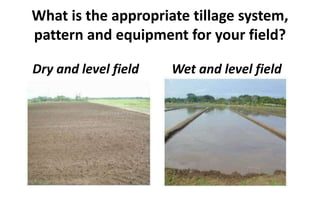
What is the appropriate tillage system,
pattern and equipment for your field?
Dry and level field Wet and level field
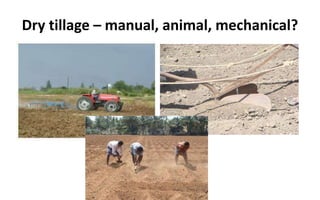
Dry tillage – manual, animal, mechanical?
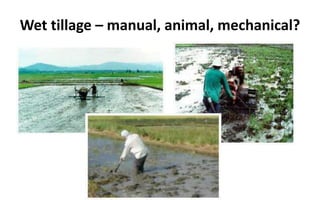
Wet tillage – manual, animal, mechanical?
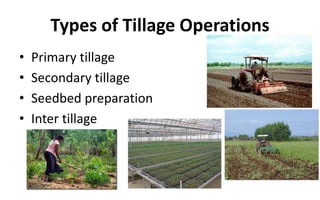
Types of Tillage Operations
• Primary tillage
• Secondary tillage
• Seedbed preparation
• Inter tillage
Primary tillage
• the most aggressive tillage operation
• undertaken when the soil is wet enough to allow
the field to be ploughed and strong enough to
give reasonable levels of traction
• after the crop harvest or at the beginning of the
next wet season
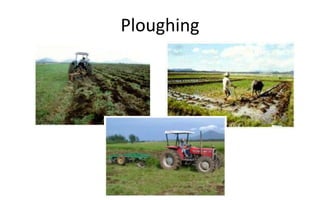
• includes the ploughing operation which is
opening of the compacted soil with the help of
different ploughs
Ploughing
objectives of primary tillage
• Open the hard soil
• Separate the top soil from lower layers
• Invert the soil whenever necessary
• Till the soil to attain a reasonable depth (10-
15cm ) with varying clod sizes
• Kill weeds by burying or cutting and exposing
the roots
• Soil aeration and water accumulation
• Chop and incorporate crop residues
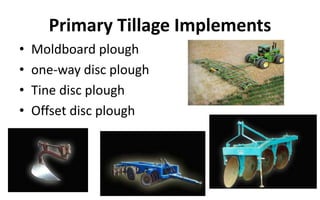
Primary Tillage Implements
• Moldboard plough
• one-way disc plough
• Tine disc plough
• Offset disc plough
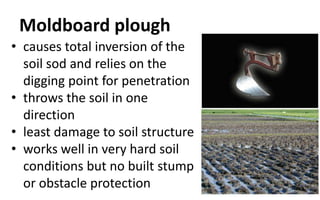
Moldboard plough
• causes total inversion of the
soil sod and relies on the
digging point for penetration
• throws the soil in one
direction
• least damage to soil structure
• works well in very hard soil
conditions but no built stump
or obstacle protection
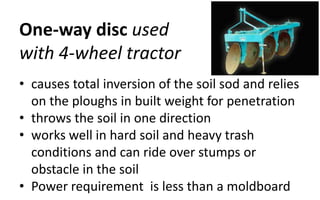
One-way disc used
with 4-wheel tractor
• causes total inversion of the soil sod and relies
on the ploughs in built weight for penetration
• throws the soil in one direction
• works well in hard soil and heavy trash
conditions and can ride over stumps or
obstacle in the soil
• Power requirement is less than a moldboard
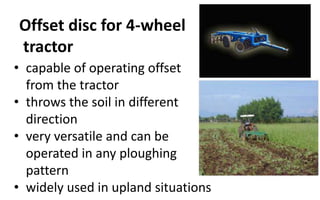
Offset disc for 4-wheel
tractor
• capable of operating offset
from the tractor
• throws the soil in different
direction
• very versatile and can be
operated in any ploughing
pattern
• widely used in upland situations
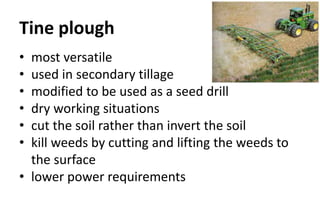
Tine plough
• most versatile
• used in secondary tillage
• modified to be used as a seed drill
• dry working situations
• cut the soil rather than invert the soil
• kill weeds by cutting and lifting the weeds to
the surface
• lower power requirements
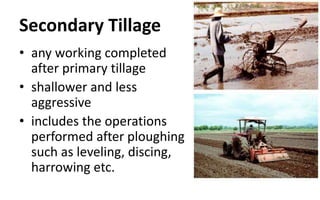
Secondary Tillage
• any working completed
after primary tillage
• shallower and less
aggressive
• includes the operations
performed after ploughing
such as leveling, discing,
harrowing etc.
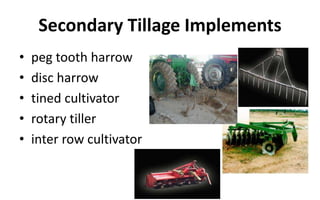
Secondary Tillage Implements
• peg tooth harrow
• disc harrow
• tined cultivator
• rotary tiller
• inter row cultivator
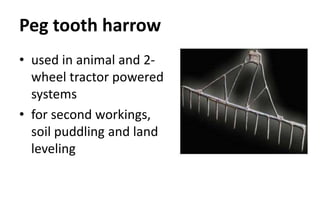
Peg tooth harrow
• used in animal and 2-
wheel tractor powered
systems
• for second workings,
soil puddling and land
leveling
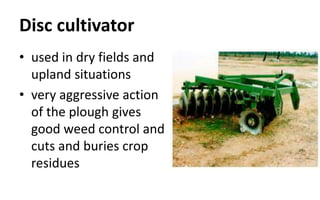
Disc cultivator
• used in dry fields and
upland situations
• very aggressive action
of the plough gives
good weed control and
cuts and buries crop
residues
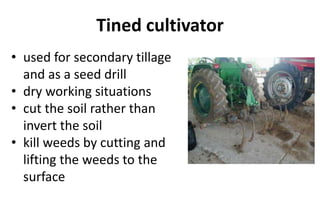
Tined cultivator
• used for secondary tillage
and as a seed drill
• dry working situations
• cut the soil rather than
invert the soil
• kill weeds by cutting and
lifting the weeds to the
surface
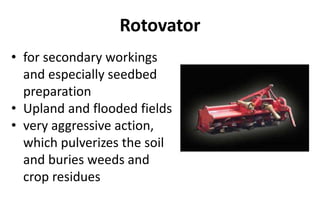
Rotovator
• for secondary workings
and especially seedbed
preparation
• Upland and flooded fields
• very aggressive action,
which pulverizes the soil
and buries weeds and
crop residues
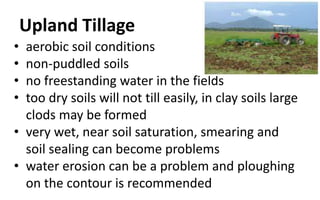
Upland Tillage
• aerobic soil conditions
• non-puddled soils
• no freestanding water in the fields
• too dry soils will not till easily, in clay soils large
clods may be formed
• very wet, near soil saturation, smearing and
soil sealing can become problems
• water erosion can be a problem and ploughing
on the contour is recommended
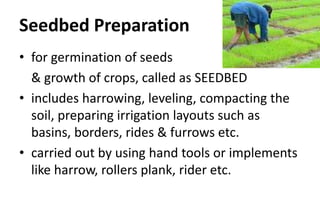
Seedbed Preparation
• for germination of seeds
& growth of crops, called as SEEDBED
• includes harrowing, leveling, compacting the
soil, preparing irrigation layouts such as
basins, borders, rides & furrows etc.
• carried out by using hand tools or implements
like harrow, rollers plank, rider etc.
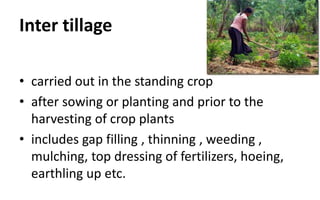
Inter tillage
• carried out in the standing crop
• after sowing or planting and prior to the
harvesting of crop plants
• includes gap filling , thinning , weeding ,
mulching, top dressing of fertilizers, hoeing,
earthling up etc.
Tillage Patterns
• reduces the time spent in non-productive
work
• minimize the number of turns and maximize
the length of the tillage runs
• circuitous, up and back or headland and
working in lands
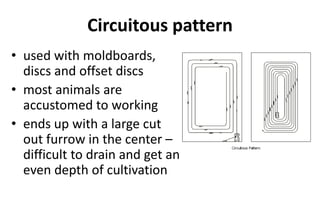
Circuitous pattern
• used with moldboards,
discs and offset discs
• most animals are
accustomed to working
• ends up with a large cut
out furrow in the center –
difficult to drain and get an
even depth of cultivation
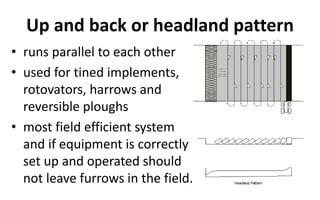
Up and back or headland pattern
• runs parallel to each other
• used for tined implements,
rotovators, harrows and
reversible ploughs
• most field efficient system
and if equipment is correctly
set up and operated should
not leave furrows in the field.
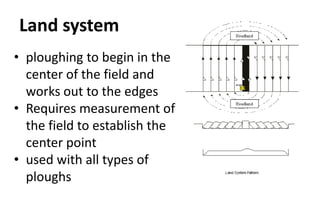
Land system
• ploughing to begin in the
center of the field and
works out to the edges
• Requires measurement of
the field to establish the
center point
• used with all types of
ploughs
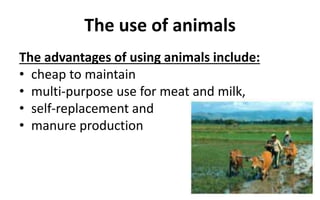
The use of animals
The advantages of using animals include:
• cheap to maintain
• multi-purpose use for meat and milk,
• self-replacement and
• manure production
The use of animals
Disadvantage of using animals include:
• have limited daily working hours
• need feeding
• need protection against pests and disease.
• slow
• high person to power ratio
• limited range of working conditions
• require training
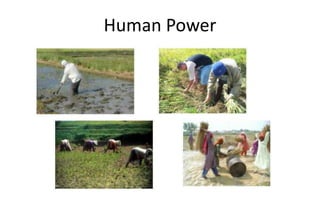
The use of human power
Tasks undertaken include:
• land preparation including ploughing, soil
leveling and constructing levees and drains
• plant establishment
• pest control
• crop harvesting and transporting
• grain processing
Human Power
The use of Machines
The advantages
• multi-purpose vehicle
• operate in harder
conditions than animals
or humans
• operate in both wet and
dry conditions
• fairly simple mechanical
design
The disadvantages
• cost of owning
and operating
• operator fatigue,
although ride-on
versions are now
available.
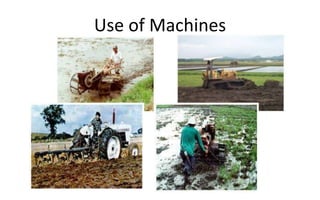
Use of Machines
CONSERVATION VERSUS CONVENTIONAL TILLAGE
Conventional tillage:
• Mechanized
systems
• Traditional tillage
Conservation tillage:
• no-tillage (slot planting),
• mulch tillage,
• strip or zonal tillage,
• ridge till (including no-till
on ridges)
• reduced or minimum
tillage.
Conventional tillage system
Mechanized system
• mechanical soil
manipulation of an
entire field,
• by ploughing
followed by one or
more harrowings
Traditional tillage
• manual labour, using
native tools (cutlass
and hoe )
• clearing is non-
exhaustive, leaving
cover on the soil and
the root system
No tillage
• one-pass planting and fertilizer operation
• soil and the surface residues are minimally
disturbed (Parr et al. 1990)
• eliminate all preplanting mechanical seedbed
preparation
• only opening of a narrow (2-3 cm wide) strip or
small hole in the ground for seed placement to
ensure adequate seed/soil contact
No tillage
• Weed control thru herbicides and crop
rotation
• soil surface is covered by crop residue mulch
or killed sod
• appropriate for Luvisols in the humid tropics
• Wheat, coffee, others in some parts of USA
• Slow adoption
No tillage
Advantage
• more effective control
of soil erosion
• increased water
storage
• lower energy costs per
unit of production
• higher grain yields
Disadvantage
• chemical fallow
• heavy use of
herbicides for weed
control
Mulch tillage
• causing least soil disturbance
• leaving the maximum of crop residue on the
soil surface
• obtaining a quick germination, adequate stand
and a satisfactory yield (Lal 1975, 1986)
• chisel plough can be used in the previously
shredded crop residue to break open any hard
crust or hard pan in the soil
• Coffee, banana, wheat, barley in USA
Strip or zonal tillage
• seedbed is divided into a seedling zone and a
soil management zone (Lal, 1973, 1983)
• the seedling zone (5 to 10 cm wide) is
mechanically tilled to optimize the soil for
germination and seedling establishment
• interrow zone is left undisturbed and
protected by mulch
• also achieved by chiselling in the row zone to
assist water infiltration and root proliferation.
Ridge till
• soil is left undisturbed prior to planting
• one-third of the soil surface is tilled at planting
with sweeps or row cleaners
• planting of row crops is done on preformed
cultivated ridges
• weeds are controlled by herbicides
• maize and soybean production in the USA
(Parr et al. 1990)
Reduced or minimum tillage
• tillage and cultivation systems not covered
above but meets the 30% residue requirement
(Laryea et al. 1991)
• Africa
Till or not to Till?
Tillage
• Improves aeration
• Incorporates crop
residues
• Facilitates root
penetration
• Suppresses weeds
Zero-tillage
• Improves soil
structure
• Maintains soil organic
matter
• Supports soil
organism
• Prevents soil erosion
Lesson to be learnt
• Soil cultivation can have positive or negative
impact on soil fertility
• Frequent tillage can lead to decrease of soil
organic matter, nutrient losses, and soil
erosion
• Soil cultivation should aim on a minimum
disturbance on soil life…….
How to control Soil Erosion?
1. COVER methods
– Mulching
– Green manure
– Mixed cropping and intercropping
– Early planting
– Crop residues
– Agroforestry
– Minimum cultivation
How to control Soil Erosion?
2. BARRIER methods
– Man-made terraces
– Contour ploughing
– Contour barriers
– Natural terraces
– Medias lunas
Medias lunas
• This is a helpful system for reclaiming badly
eroded land which has been used successfully
in Bolivia.
• Medias lunas or crescent shaped depressions
are built on sloping land.
• The crescent shapes are built at the end of the
rainy season so the ridges made can be
compacted well.
Medias lunas
• The crescent collects the rainwater and soil.
• Trees - usually legumes - are planted when the
next rainy season begins and protected by
thorn branches from grazing animals.
• After 3 or 4 years each media luna will be
covered with vegetation.
• Later, as the soil continues to improve, crops
may be grown in the medias lunas.

4.Land Preparation.pptx

  • 1.
    Land Preparation Crop Science2 Alminda M. Fernandez, Ph.D. University of Southeastern Philippines Tagum – Mabini Campus
  • 2.
    Land preparation • isa combination of tillage practices that places the soil in the best physical condition for plant establishment and crop growth. • covers a range of soil disturbances from zero- tillage, which minimizes soil disturbance through to a totally ‘puddled’ soil, which actually destroys soil structure.
  • 3.
    Aims of Landpreparation • Loosen the soil to facilitate the penetration of plant roots • Improve aeration (N, O) • Increase infiltration of water • Reduce evaporation • Destroy or control weeds and soil pests • Incorporate crop residues and manures into the soil
  • 4.
    Aims of Landpreparation • Prepare the site for seeds and seedlings • Repair soil compaction caused by previous activities • Decrease ped or clod size • Reduce wind and water erosion by leaving a rough surface • Stimulate microbial activity
  • 5.
    What is theappropriate tillage system, pattern and equipment for your field? Dry and level field Wet and level field
  • 6.
    Dry tillage –manual, animal, mechanical?
  • 7.
    Wet tillage –manual, animal, mechanical?
  • 8.
    Types of TillageOperations • Primary tillage • Secondary tillage • Seedbed preparation • Inter tillage
  • 9.
    Primary tillage • themost aggressive tillage operation • undertaken when the soil is wet enough to allow the field to be ploughed and strong enough to give reasonable levels of traction • after the crop harvest or at the beginning of the next wet season • includes the ploughing operation which is opening of the compacted soil with the help of different ploughs
  • 10.
  • 11.
    objectives of primarytillage • Open the hard soil • Separate the top soil from lower layers • Invert the soil whenever necessary • Till the soil to attain a reasonable depth (10- 15cm ) with varying clod sizes • Kill weeds by burying or cutting and exposing the roots • Soil aeration and water accumulation • Chop and incorporate crop residues
  • 12.
    Primary Tillage Implements •Moldboard plough • one-way disc plough • Tine disc plough • Offset disc plough
  • 13.
    Moldboard plough • causestotal inversion of the soil sod and relies on the digging point for penetration • throws the soil in one direction • least damage to soil structure • works well in very hard soil conditions but no built stump or obstacle protection
  • 14.
    One-way disc used with4-wheel tractor • causes total inversion of the soil sod and relies on the ploughs in built weight for penetration • throws the soil in one direction • works well in hard soil and heavy trash conditions and can ride over stumps or obstacle in the soil • Power requirement is less than a moldboard
  • 15.
    Offset disc for4-wheel tractor • capable of operating offset from the tractor • throws the soil in different direction • very versatile and can be operated in any ploughing pattern • widely used in upland situations
  • 16.
    Tine plough • mostversatile • used in secondary tillage • modified to be used as a seed drill • dry working situations • cut the soil rather than invert the soil • kill weeds by cutting and lifting the weeds to the surface • lower power requirements
  • 17.
    Secondary Tillage • anyworking completed after primary tillage • shallower and less aggressive • includes the operations performed after ploughing such as leveling, discing, harrowing etc.
  • 18.
    Secondary Tillage Implements •peg tooth harrow • disc harrow • tined cultivator • rotary tiller • inter row cultivator
  • 19.
    Peg tooth harrow •used in animal and 2- wheel tractor powered systems • for second workings, soil puddling and land leveling
  • 20.
    Disc cultivator • usedin dry fields and upland situations • very aggressive action of the plough gives good weed control and cuts and buries crop residues
  • 21.
    Tined cultivator • usedfor secondary tillage and as a seed drill • dry working situations • cut the soil rather than invert the soil • kill weeds by cutting and lifting the weeds to the surface
  • 22.
    Rotovator • for secondaryworkings and especially seedbed preparation • Upland and flooded fields • very aggressive action, which pulverizes the soil and buries weeds and crop residues
  • 23.
    Upland Tillage • aerobicsoil conditions • non-puddled soils • no freestanding water in the fields • too dry soils will not till easily, in clay soils large clods may be formed • very wet, near soil saturation, smearing and soil sealing can become problems • water erosion can be a problem and ploughing on the contour is recommended
  • 24.
    Seedbed Preparation • forgermination of seeds & growth of crops, called as SEEDBED • includes harrowing, leveling, compacting the soil, preparing irrigation layouts such as basins, borders, rides & furrows etc. • carried out by using hand tools or implements like harrow, rollers plank, rider etc.
  • 25.
    Inter tillage • carriedout in the standing crop • after sowing or planting and prior to the harvesting of crop plants • includes gap filling , thinning , weeding , mulching, top dressing of fertilizers, hoeing, earthling up etc.
  • 26.
    Tillage Patterns • reducesthe time spent in non-productive work • minimize the number of turns and maximize the length of the tillage runs • circuitous, up and back or headland and working in lands
  • 27.
    Circuitous pattern • usedwith moldboards, discs and offset discs • most animals are accustomed to working • ends up with a large cut out furrow in the center – difficult to drain and get an even depth of cultivation
  • 28.
    Up and backor headland pattern • runs parallel to each other • used for tined implements, rotovators, harrows and reversible ploughs • most field efficient system and if equipment is correctly set up and operated should not leave furrows in the field.
  • 29.
    Land system • ploughingto begin in the center of the field and works out to the edges • Requires measurement of the field to establish the center point • used with all types of ploughs
  • 30.
    The use ofanimals The advantages of using animals include: • cheap to maintain • multi-purpose use for meat and milk, • self-replacement and • manure production
  • 31.
    The use ofanimals Disadvantage of using animals include: • have limited daily working hours • need feeding • need protection against pests and disease. • slow • high person to power ratio • limited range of working conditions • require training
  • 32.
    The use ofhuman power Tasks undertaken include: • land preparation including ploughing, soil leveling and constructing levees and drains • plant establishment • pest control • crop harvesting and transporting • grain processing
  • 33.
  • 34.
    The use ofMachines The advantages • multi-purpose vehicle • operate in harder conditions than animals or humans • operate in both wet and dry conditions • fairly simple mechanical design The disadvantages • cost of owning and operating • operator fatigue, although ride-on versions are now available.
  • 35.
  • 36.
    CONSERVATION VERSUS CONVENTIONALTILLAGE Conventional tillage: • Mechanized systems • Traditional tillage Conservation tillage: • no-tillage (slot planting), • mulch tillage, • strip or zonal tillage, • ridge till (including no-till on ridges) • reduced or minimum tillage.
  • 37.
    Conventional tillage system Mechanizedsystem • mechanical soil manipulation of an entire field, • by ploughing followed by one or more harrowings Traditional tillage • manual labour, using native tools (cutlass and hoe ) • clearing is non- exhaustive, leaving cover on the soil and the root system
  • 38.
    No tillage • one-passplanting and fertilizer operation • soil and the surface residues are minimally disturbed (Parr et al. 1990) • eliminate all preplanting mechanical seedbed preparation • only opening of a narrow (2-3 cm wide) strip or small hole in the ground for seed placement to ensure adequate seed/soil contact
  • 39.
    No tillage • Weedcontrol thru herbicides and crop rotation • soil surface is covered by crop residue mulch or killed sod • appropriate for Luvisols in the humid tropics • Wheat, coffee, others in some parts of USA • Slow adoption
  • 40.
    No tillage Advantage • moreeffective control of soil erosion • increased water storage • lower energy costs per unit of production • higher grain yields Disadvantage • chemical fallow • heavy use of herbicides for weed control
  • 41.
    Mulch tillage • causingleast soil disturbance • leaving the maximum of crop residue on the soil surface • obtaining a quick germination, adequate stand and a satisfactory yield (Lal 1975, 1986) • chisel plough can be used in the previously shredded crop residue to break open any hard crust or hard pan in the soil • Coffee, banana, wheat, barley in USA
  • 42.
    Strip or zonaltillage • seedbed is divided into a seedling zone and a soil management zone (Lal, 1973, 1983) • the seedling zone (5 to 10 cm wide) is mechanically tilled to optimize the soil for germination and seedling establishment • interrow zone is left undisturbed and protected by mulch • also achieved by chiselling in the row zone to assist water infiltration and root proliferation.
  • 43.
    Ridge till • soilis left undisturbed prior to planting • one-third of the soil surface is tilled at planting with sweeps or row cleaners • planting of row crops is done on preformed cultivated ridges • weeds are controlled by herbicides • maize and soybean production in the USA (Parr et al. 1990)
  • 44.
    Reduced or minimumtillage • tillage and cultivation systems not covered above but meets the 30% residue requirement (Laryea et al. 1991) • Africa
  • 45.
    Till or notto Till? Tillage • Improves aeration • Incorporates crop residues • Facilitates root penetration • Suppresses weeds Zero-tillage • Improves soil structure • Maintains soil organic matter • Supports soil organism • Prevents soil erosion
  • 46.
    Lesson to belearnt • Soil cultivation can have positive or negative impact on soil fertility • Frequent tillage can lead to decrease of soil organic matter, nutrient losses, and soil erosion • Soil cultivation should aim on a minimum disturbance on soil life…….
  • 48.
    How to controlSoil Erosion? 1. COVER methods – Mulching – Green manure – Mixed cropping and intercropping – Early planting – Crop residues – Agroforestry – Minimum cultivation
  • 49.
    How to controlSoil Erosion? 2. BARRIER methods – Man-made terraces – Contour ploughing – Contour barriers – Natural terraces – Medias lunas
  • 50.
    Medias lunas • Thisis a helpful system for reclaiming badly eroded land which has been used successfully in Bolivia. • Medias lunas or crescent shaped depressions are built on sloping land. • The crescent shapes are built at the end of the rainy season so the ridges made can be compacted well.
  • 51.
    Medias lunas • Thecrescent collects the rainwater and soil. • Trees - usually legumes - are planted when the next rainy season begins and protected by thorn branches from grazing animals. • After 3 or 4 years each media luna will be covered with vegetation. • Later, as the soil continues to improve, crops may be grown in the medias lunas.