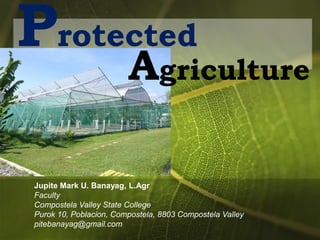
Protected
Jupite Mark U. Banayag, L.Agr
Faculty
Compostela Valley State College
Purok 10, Poblacion, Compostela, 8803 Compostela Valley
pitebanayag@gmail.com
Agriculture
A technology to address the
situation is
Protected Cultivation
JMBanayag
Protected Cultivation/Agriculture
- Protected agriculture is the modification of
the natural environment to achieve
optimum plant growth.
Modifications can be made to both
the aerial and root environment.
JMBanayag
What is protected crop
production?
• is growing vegetables, flowers,
ornamental plants, spices, and other
high value crops in a protective
structure .
– Protective structure prevents the plants
from damages caused by strong winds,
heavy rains and insects.
JMBanayag
Royal Botanic Gardens, Kew
(United Kingdom)
JMBanayag
History
• 14-37 AD in Rome
• Royal physicians have
asked the ailing Emperor
Tiberius to eat cucumber
every day.
• Growing off-season
cucumbers under
“transparent stone”
• Painstakingly built with
translucent sheets of mica.
JMBanayag
Ruins of Specularium Today
JMBanayag
JMBanayag
JMBanayag
Various Materials Used
• Stones
• Oiled translucent paper
• Manure and glass- Manure for
heating
• Glass
• Plastics
JMBanayag
JMBanayag
JMBanayag
• Protected
Cultivation of
High-Value
Crops in the
Philippines
JMBanayag
Rationale
Philippine crop production is
characterized by extreme seasonality:
Dry season: supply is abundant, prices are
low
Wet season: supply is low, prices are high
Prices fluctuate as dictated by supply.
JMBanayag
Supply is further affected by:
• Prevailing extreme
environmental conditions; and
• High incidence of pests and
diseases
There is a need for a production
technology which enables
growers to produce crops all
year round.
JMBanayag
The three major methods of
protected agriculture are:
1.Mulches
2.Row covers
3.Greenhouses
JMBanayag
GreenhousesJMBanayag
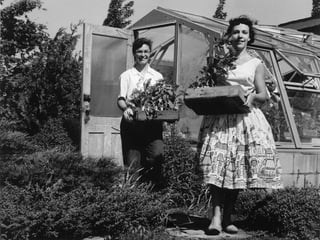
Greenhouse
 A transparent enclosure
designated to grow or
temporarily protect plants.
 It controls the environmental
conditions for plants.
 prevent the entry of insects,
 regulates sunlight and water
 protect the plants from strong
winds and
 too much heat caused by
solar radiation. JMBanayag
JMBanayag
• In most cases, these are massive
structures with metal support, glass or
plastic covers and a fully automated
operation:
– Temperature controls
– Humidity controls
– Irrigation
– Fertilization
– Pest management
.
*Requires a considerable initial investment
JMBanayag
JMBanayag
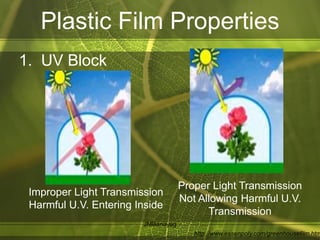
Plastic Film Properties
Improper Light Transmission
Harmful U.V. Entering Inside
Proper Light Transmission
Not Allowing Harmful U.V.
Transmission
http://www.essenpoly.com/greenhousefilm.htm
1. UV Block
JMBanayag
Plastic Film Properties
Direct sun rays falling on the
crops burns them
and also the lower foliage does
not get the proper
Light Comparatively
The direct rays are scattered
thus intensity is
reduced and also the Lower
Foliage Gets More Light
as The Shadow Effect Is
Eliminated
http://www.essenpoly.com/greenhousefilm.htm
2. Diffusion/Haze
JMBanayag
Diffused Light
JMBanayag
Types of Greenhouses Most Commonly
Used in the Philippines
Israel Greenhouse Type Korean Greenhouse Type
JMBanayag
Types of Greenhouses Most Commonly
Used in the Philippines
African Greenhouse Type Chinese Greenhouse Type
JMBanayag
CLSU Greenhouse Type
Types of Greenhouses Most Commonly
Used in the Philippines
AVRC Type - Taiwan shelter house
JMBanayag
Market Supply of Farm Produce
• Market requires steady supply of farm
produce.
• Production plan is needed.
• (Show Sample plan) MPPI_MFM
11022016- Revised Production Program
JMBanayag
JMBanayag
Light intensity
• Short day plant-
requires short days or
long nights to flower.
• Critical day length
– 14 - 15 hours for flower
initiation
–13 -14 hours for
development.
JMBanayag
Lighting for chrysanthemum
Growth phase Weeks from planting Photoperiod
Vegetative phase
Up to 4-5 weeks from
planting till the plant attains
50 to 60 cm height
Long day: 13 hrs light
and 11 hrs dark
Flowering
5 -6 weeks after planting till
harvest
Short day: 10 hrs light
and 14 hrs dark
JMBanayag
JMBanayag
JMBanayag
JMBanayag
JMBanayag
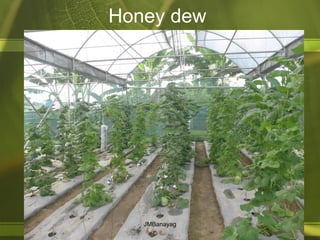
Honey dew
JMBanayag
Cabbage, Cauliflower and Broccoli
JMBanayag
JMBanayag
Row Cover/ Tunnel
JMBanayag
Row Cover/ Tunnel
• A tunnel refers to an
arched structure
figured by inserting
both ends of the rod
into the ground.
• It is the simplest
structure to support
the covering materials.
JMBanayag
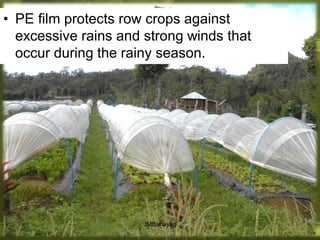
• PE film protects row crops against
excessive rains and strong winds that
occur during the rainy season.
JMBanayag
• High tunnels (2m from the ground) and
• Low tunnels (1m from the ground) can be
constructed.
• Tunnel structures are suitable for short
stature crops such as crucifers (pechay,
lettuce, cauliflower), peppers, eggplant
and herbs.
JMBanayag
JMBanayag
Tomato Row Cover
JMBanayag
JMBanayag
• In tropical conditions, the tunnel covers
the entire row of crops during continuous
heavy rains.
• In case no rain is expected, the plastic
sheet is rolled up and covers only the
topmost portion of the structure.JMBanayag
MulchingJMBanayag
Mulching
Types:
• Organic mulching
materials
– Rice straw, coco coir, rice
hull, paper
– Not very effective in
controlling weeds.
• Plastic Mulch
– Clear or Transparent
– Two-side color MulchesJMBanayag
JMBanayag
JMBanayag
Advantages
1. Control weed growth
2. Control soil erosion
3. Control moisture loss
4. Control insect pests
5. Reduce leaching of fertilizer
6. Prevent fruit rotting
7. Reduction in root damage
(since no need to cultivate the
soil, better growth)
JMBanayag
Plastic Mulch
• Made from polyethylene plastic polymers.
• Silver/black mulch is manufactured with
the co-extrusion process which enables
2 or more materials of different
characteristics to be combined in one
sheet. (2 Side color mulch)
• Silver/black
• Black/black
• Yellow/blackJMBanayag
JMBanayag
Two-side color Mulch
• Yellow/black- attracts certain insects and
thus acts as a trap for them, which
prevents diseases.
• White/black- Cools the soil.
• Silver/black- Cools the soil, through not to
the extent of white/black film and repels
some aphids and thrips.
• Red/black- partialy translucent allowing
radiation to pass through and warm soil.
JMBanayag
Percentage (%) Increase in Yield
• Plastic mulch vs. no mulch
• MacFarm Data 2014
Ampalaya 48%
Okra 93.75%
Sitao 31%
Squash 226%
Eggplant 81%
Tomato 4%
Pechay TBV
*TBV- to be validated
JMBanayag
JMBanayag
JMBanayag
JMBanayag
JMBanayag
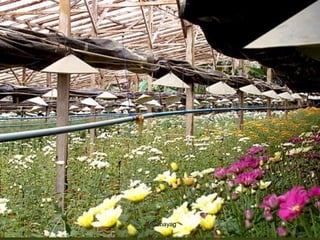
Cutflower Production
JMBanayag
Cutflower Production
JMBanayag
JMBanayag
Screen House/ Net HouseJMBanayag
Screen house/net house
• Using nylon net for top and
side covers.
• The net comes in several
mesh-sizes.
• The net acts as a physical
barrier for most insect pests.JMBanayag
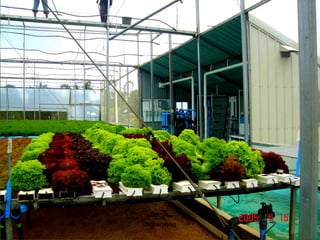
Leafy vegetables grown under
screen house
JMBanayag
Leafy vegetable
production under
screen or net
houses
JMBanayag
Rainshelter
JMBanayag
Rainshelter
• Simple plastic houses are built
using iron pipes, bamboo or
wooden frames. Rain shelters are
almost similar to high plastic
tunnels, sometimes called hoop
houses.
• Rainshelters- specifically designed
to mitigate the impact of raindrops
on crops that may result to leaf,
flower and fruit damage.JMBanayag
JMBanayag
JMBanayag
JMBanayag
JMBanayag
Hydroponics
• Hydroponics is a technology for
growing plants in a nutrient solution
(water and fertilizers) with or without
the use of artificial medium (e.g.
sand, gravel, vermiculite, peat moss,
sawdust) to provide mechanical
support to the plant.
JMBanayag
SNAP
Hydroponics
System
JMBanayag
Other Protected Cultivation
Practices
–The following practices are being
promoted in conjunction with
urban agriculture, which is
characterized by a very limited
land area for planting or a highly
congested available space.
JMBanayag
Container Growing
- Use of modified growing medium for
container growing and the utilization of
waste materials as containers.
JMBanayag
JMBanayag
JMBanayag
Use of Grow Bags
Artificial media are used fror growing crops
in a sort of hydroponics fashion.
The use of grow bags may solve the
problem of bacterial wilt in high value
which has no resistant variety.
JMBanayag
JMBanayag
JMBanayag
JMBanayag
JMBanayag
JMBanayag
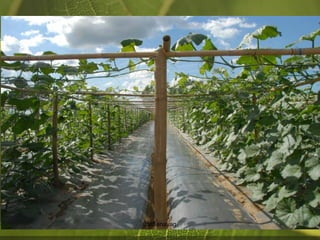
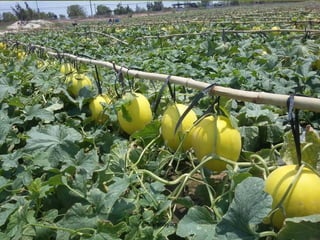
Trellises
• Structures commonly provided to support
viny vegetables such as cucurbits.
• Solanaceous crops are also provided with
trellis, primarily to prevent lodging. Rotting
is considerably minimized in this case.
JMBanayag
JMBanayag
JMBanayag
JMBanayag
JMBanayag
JMBanayag
JMBanayag
JMBanayag
JMBanayag
Technical Requirements for
Protective Cultivation
• Location
• Environmental Control
• Selection of Crops for Protected
Cultivation
– Resistance to pest and diseases
– Non-seasonality( Photoperiod)
– High demand and sustained market
– High yielding with quality produce
JMBanayag
More Protective
Cultivation Practice
JMBanayag
JMBanayag
JMBanayag
JMBanayag
JMBanayag
JMBanayag
JMBanayag
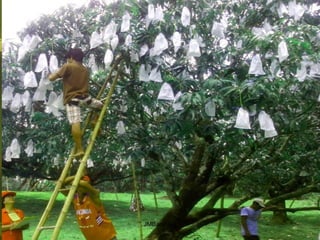
Tree Shroud
JMBanayag
JMBanayag
Summary
• Protective structures provide protection to
vegetable crops against biotic and abiotic
stresses.
• Vegetable production under protective
structures insures year-round supply of
vegetables and helps stabilize market
price.
• The three major methods of protected
agriculture are Mulching, Row cover and
Greenhouse. JMBanayag
• Main benefit of protective structures is
protection against the impact of heavy
rainfall and strong winds in the tropics.
• Yields of vegetables some crops have
been improved under protective
structures.
Summary
JMBanayag
Credits
• AVRDC- Manuel C. Palada
• UPLB- SNAP Hydroponics
• World Bank-Protected agriculture: a global
review / Merle H. Jensen and Alan J. Malter.
• DA
• Special Thanks to:
Macondray Plastics Products, Inc. (MacPlas)
JMBanayag

Protected Agriculture

  • 1.
    Protected Jupite Mark U.Banayag, L.Agr Faculty Compostela Valley State College Purok 10, Poblacion, Compostela, 8803 Compostela Valley pitebanayag@gmail.com Agriculture
  • 2.
    A technology toaddress the situation is Protected Cultivation JMBanayag
  • 3.
    Protected Cultivation/Agriculture - Protectedagriculture is the modification of the natural environment to achieve optimum plant growth. Modifications can be made to both the aerial and root environment. JMBanayag
  • 4.
    What is protectedcrop production? • is growing vegetables, flowers, ornamental plants, spices, and other high value crops in a protective structure . – Protective structure prevents the plants from damages caused by strong winds, heavy rains and insects. JMBanayag
  • 5.
    Royal Botanic Gardens,Kew (United Kingdom) JMBanayag
  • 6.
    History • 14-37 ADin Rome • Royal physicians have asked the ailing Emperor Tiberius to eat cucumber every day. • Growing off-season cucumbers under “transparent stone” • Painstakingly built with translucent sheets of mica. JMBanayag
  • 7.
    Ruins of SpeculariumToday JMBanayag
  • 8.
  • 9.
  • 10.
    Various Materials Used •Stones • Oiled translucent paper • Manure and glass- Manure for heating • Glass • Plastics JMBanayag
  • 11.
  • 12.
  • 13.
  • 14.
    Rationale Philippine crop productionis characterized by extreme seasonality: Dry season: supply is abundant, prices are low Wet season: supply is low, prices are high Prices fluctuate as dictated by supply. JMBanayag
  • 15.
    Supply is furtheraffected by: • Prevailing extreme environmental conditions; and • High incidence of pests and diseases There is a need for a production technology which enables growers to produce crops all year round. JMBanayag
  • 16.
    The three majormethods of protected agriculture are: 1.Mulches 2.Row covers 3.Greenhouses JMBanayag
  • 17.
  • 18.
    Greenhouse  A transparentenclosure designated to grow or temporarily protect plants.  It controls the environmental conditions for plants.  prevent the entry of insects,  regulates sunlight and water  protect the plants from strong winds and  too much heat caused by solar radiation. JMBanayag
  • 19.
  • 20.
    • In mostcases, these are massive structures with metal support, glass or plastic covers and a fully automated operation: – Temperature controls – Humidity controls – Irrigation – Fertilization – Pest management . *Requires a considerable initial investment JMBanayag
  • 21.
  • 22.
    Plastic Film Properties ImproperLight Transmission Harmful U.V. Entering Inside Proper Light Transmission Not Allowing Harmful U.V. Transmission http://www.essenpoly.com/greenhousefilm.htm 1. UV Block JMBanayag
  • 23.
    Plastic Film Properties Directsun rays falling on the crops burns them and also the lower foliage does not get the proper Light Comparatively The direct rays are scattered thus intensity is reduced and also the Lower Foliage Gets More Light as The Shadow Effect Is Eliminated http://www.essenpoly.com/greenhousefilm.htm 2. Diffusion/Haze JMBanayag
  • 24.
  • 25.
    Types of GreenhousesMost Commonly Used in the Philippines Israel Greenhouse Type Korean Greenhouse Type JMBanayag
  • 26.
    Types of GreenhousesMost Commonly Used in the Philippines African Greenhouse Type Chinese Greenhouse Type JMBanayag
  • 27.
    CLSU Greenhouse Type Typesof Greenhouses Most Commonly Used in the Philippines AVRC Type - Taiwan shelter house JMBanayag
  • 28.
    Market Supply ofFarm Produce • Market requires steady supply of farm produce. • Production plan is needed. • (Show Sample plan) MPPI_MFM 11022016- Revised Production Program JMBanayag
  • 29.
  • 30.
    Light intensity • Shortday plant- requires short days or long nights to flower. • Critical day length – 14 - 15 hours for flower initiation –13 -14 hours for development. JMBanayag
  • 31.
    Lighting for chrysanthemum Growthphase Weeks from planting Photoperiod Vegetative phase Up to 4-5 weeks from planting till the plant attains 50 to 60 cm height Long day: 13 hrs light and 11 hrs dark Flowering 5 -6 weeks after planting till harvest Short day: 10 hrs light and 14 hrs dark JMBanayag
  • 32.
  • 33.
  • 34.
  • 35.
  • 36.
  • 37.
    Cabbage, Cauliflower andBroccoli JMBanayag
  • 38.
  • 39.
  • 40.
    Row Cover/ Tunnel •A tunnel refers to an arched structure figured by inserting both ends of the rod into the ground. • It is the simplest structure to support the covering materials. JMBanayag
  • 41.
    • PE filmprotects row crops against excessive rains and strong winds that occur during the rainy season. JMBanayag
  • 42.
    • High tunnels(2m from the ground) and • Low tunnels (1m from the ground) can be constructed. • Tunnel structures are suitable for short stature crops such as crucifers (pechay, lettuce, cauliflower), peppers, eggplant and herbs. JMBanayag
  • 43.
  • 44.
  • 45.
  • 46.
    • In tropicalconditions, the tunnel covers the entire row of crops during continuous heavy rains. • In case no rain is expected, the plastic sheet is rolled up and covers only the topmost portion of the structure.JMBanayag
  • 47.
  • 48.
    Mulching Types: • Organic mulching materials –Rice straw, coco coir, rice hull, paper – Not very effective in controlling weeds. • Plastic Mulch – Clear or Transparent – Two-side color MulchesJMBanayag
  • 49.
  • 50.
  • 51.
    Advantages 1. Control weedgrowth 2. Control soil erosion 3. Control moisture loss 4. Control insect pests 5. Reduce leaching of fertilizer 6. Prevent fruit rotting 7. Reduction in root damage (since no need to cultivate the soil, better growth) JMBanayag
  • 52.
    Plastic Mulch • Madefrom polyethylene plastic polymers. • Silver/black mulch is manufactured with the co-extrusion process which enables 2 or more materials of different characteristics to be combined in one sheet. (2 Side color mulch) • Silver/black • Black/black • Yellow/blackJMBanayag
  • 53.
  • 54.
    Two-side color Mulch •Yellow/black- attracts certain insects and thus acts as a trap for them, which prevents diseases. • White/black- Cools the soil. • Silver/black- Cools the soil, through not to the extent of white/black film and repels some aphids and thrips. • Red/black- partialy translucent allowing radiation to pass through and warm soil. JMBanayag
  • 55.
    Percentage (%) Increasein Yield • Plastic mulch vs. no mulch • MacFarm Data 2014 Ampalaya 48% Okra 93.75% Sitao 31% Squash 226% Eggplant 81% Tomato 4% Pechay TBV *TBV- to be validated JMBanayag
  • 56.
  • 57.
  • 58.
  • 59.
  • 60.
  • 61.
  • 62.
  • 63.
    Screen House/ NetHouseJMBanayag
  • 64.
    Screen house/net house •Using nylon net for top and side covers. • The net comes in several mesh-sizes. • The net acts as a physical barrier for most insect pests.JMBanayag
  • 65.
    Leafy vegetables grownunder screen house JMBanayag
  • 66.
  • 67.
  • 68.
    Rainshelter • Simple plastichouses are built using iron pipes, bamboo or wooden frames. Rain shelters are almost similar to high plastic tunnels, sometimes called hoop houses. • Rainshelters- specifically designed to mitigate the impact of raindrops on crops that may result to leaf, flower and fruit damage.JMBanayag
  • 69.
  • 70.
  • 71.
  • 72.
  • 73.
    Hydroponics • Hydroponics isa technology for growing plants in a nutrient solution (water and fertilizers) with or without the use of artificial medium (e.g. sand, gravel, vermiculite, peat moss, sawdust) to provide mechanical support to the plant. JMBanayag
  • 74.
  • 75.
    Other Protected Cultivation Practices –Thefollowing practices are being promoted in conjunction with urban agriculture, which is characterized by a very limited land area for planting or a highly congested available space. JMBanayag
  • 76.
    Container Growing - Useof modified growing medium for container growing and the utilization of waste materials as containers. JMBanayag
  • 77.
  • 78.
  • 79.
    Use of GrowBags Artificial media are used fror growing crops in a sort of hydroponics fashion. The use of grow bags may solve the problem of bacterial wilt in high value which has no resistant variety. JMBanayag
  • 80.
  • 81.
  • 82.
  • 83.
  • 84.
  • 85.
    Trellises • Structures commonlyprovided to support viny vegetables such as cucurbits. • Solanaceous crops are also provided with trellis, primarily to prevent lodging. Rotting is considerably minimized in this case. JMBanayag
  • 86.
  • 87.
  • 88.
  • 89.
  • 90.
  • 91.
  • 92.
  • 93.
  • 94.
    Technical Requirements for ProtectiveCultivation • Location • Environmental Control • Selection of Crops for Protected Cultivation – Resistance to pest and diseases – Non-seasonality( Photoperiod) – High demand and sustained market – High yielding with quality produce JMBanayag
  • 95.
  • 96.
  • 97.
  • 98.
  • 99.
  • 100.
  • 101.
  • 102.
  • 103.
  • 104.
    Summary • Protective structuresprovide protection to vegetable crops against biotic and abiotic stresses. • Vegetable production under protective structures insures year-round supply of vegetables and helps stabilize market price. • The three major methods of protected agriculture are Mulching, Row cover and Greenhouse. JMBanayag
  • 105.
    • Main benefitof protective structures is protection against the impact of heavy rainfall and strong winds in the tropics. • Yields of vegetables some crops have been improved under protective structures. Summary JMBanayag
  • 106.
    Credits • AVRDC- ManuelC. Palada • UPLB- SNAP Hydroponics • World Bank-Protected agriculture: a global review / Merle H. Jensen and Alan J. Malter. • DA • Special Thanks to: Macondray Plastics Products, Inc. (MacPlas) JMBanayag