ANIMAL CLASSIFICATION
DR. C. BEULAH JAYARANI
M.Sc., M.A, M.Ed, M.Phil (Edn), M.Phil (ZOO), NET, Ph.D
ASST. PROFESSOR,
LOYOLA COLLEGE OF EDUCATION, CHENNAI - 34
ANIMALS Classification
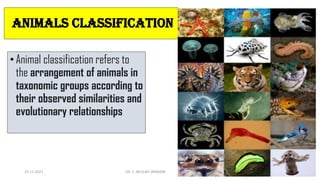
•Animal classification refers to
the arrangement of animals in
taxonomic groups according to
their observed similarities and
evolutionary relationships
15-11-2021 DR. C. BEULAH JAYARANI 2
WHY classification
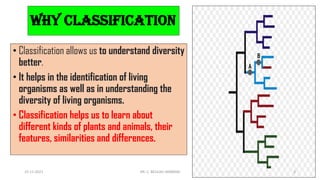
• Classification allows us to understand diversity
better.
• It helps in the identification of living
organisms as well as in understanding the
diversity of living organisms.
• Classification helps us to learn about
different kinds of plants and animals, their
features, similarities and differences.
15-11-2021 DR. C. BEULAH JAYARANI 3
CRITERIA FOR ANIMAL CLASSIFICATION
1. Number of germ layers
2. Animal body plan
3. Body symmetry
4. Body cavity or coelom
5. Body segmentation
6. Body support
15-11-2021 DR. C. BEULAH JAYARANI 4
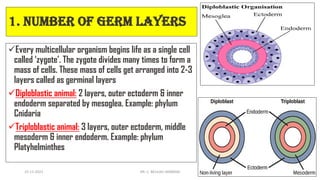
1. Number of germ layers
✓Every multicellular organism begins life as a single cell
called ‘zygote’. The zygote divides many times to form a
mass of cells. These mass of cells get arranged into 2-3
layers called as germinal layers
✓Diploblastic animal: 2 layers, outer ectoderm & inner
endoderm separated by mesoglea. Example: phylum
Cnidaria
✓Triploblastic animal: 3 layers, outer ectoderm, middle
mesoderm & inner endoderm. Example: phylum
Platyhelminthes
15-11-2021 DR. C. BEULAH JAYARANI 5
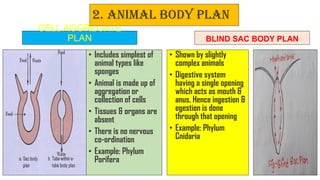
CELL AGGREGATE
PLAN
• Includes simplest of
animal types like
sponges
• Animal is made up of
aggregation or
collection of cells
• Tissues & organs are
absent
• There is no nervous
co-ordination
• Example: Phylum
Porifera
BLIND SAC BODY PLAN
• Shown by slightly
complex animals
• Digestive system
having a single opening
which acts as mouth &
anus. Hence ingestion &
egestion is done
through that opening
• Example: Phylum
Cnidaria
2. Animal body plan
6
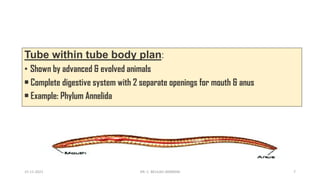
Tube within tube body plan:
• Shown by advanced & evolved animals
• Complete digestive system with 2 separate openings for mouth & anus
• Example: Phylum Annelida
15-11-2021 DR. C. BEULAH JAYARANI 7
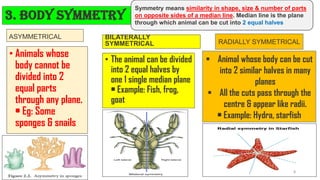
ASYMMETRICAL
• Animals whose
body cannot be
divided into 2
equal parts
through any plane.
• Eg: Some
sponges & snails
BILATERALLY
SYMMETRICAL
• The animal can be divided
into 2 equal halves by
one 1 single median plane
• Example: Fish, frog,
goat
3. Body symmetry
Symmetry means similarity in shape, size & number of parts
on opposite sides of a median line. Median line is the plane
through which animal can be cut into 2 equal halves
▪ Animal whose body can be cut
into 2 similar halves in many
planes
▪ All the cuts pass through the
centre & appear like radii.
• Example: Hydra, starfish
RADIALLY SYMMETRICAL
8
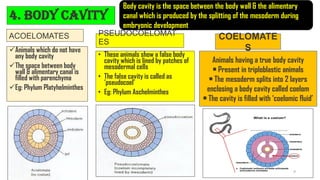
ACOELOMATES
✓Animals which do not have
any body cavity
✓The space between body
wall & alimentary canal is
filled with parenchyma
✓Eg: Phylum Platyhelminthes
PSEUDOCOELOMAT
ES
• These animals show a false body
cavity which is lined by patches of
mesodermal cells
• The false cavity is called as
‘pseudocoel’
• Eg: Phylum Aschelminthes
4. Body cavity
Body cavity is the space between the body wall & the alimentary
canal which is produced by the splitting of the mesoderm during
embryonic development
Animals having a true body cavity
• Present in triploblastic animals
• The mesoderm splits into 2 layers
enclosing a body cavity called coelom
• The cavity is filled with ‘coelomic fluid’
COELOMATE
S
9
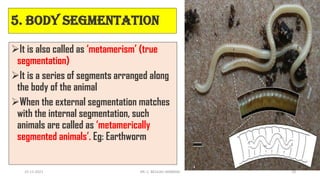
5. Body segmentation
➢It is also called as ‘metamerism’ (true
segmentation)
➢It is a series of segments arranged along
the body of the animal
➢When the external segmentation matches
with the internal segmentation, such
animals are called as ‘metamerically
segmented animals’. Eg: Earthworm
15-11-2021 DR. C. BEULAH JAYARANI 10
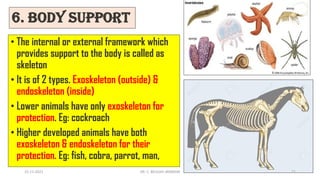
6. Body Support
• The internal or external framework which
provides support to the body is called as
skeleton
• It is of 2 types. Exoskeleton (outside) &
endoskeleton (inside)
• Lower animals have only exoskeleton for
protection. Eg: cockroach
• Higher developed animals have both
exoskeleton & endoskeleton for their
protection. Eg: fish, cobra, parrot, man,
15-11-2021 DR. C. BEULAH JAYARANI 11
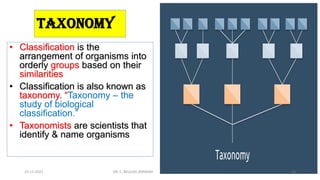
TAXONOMY
• Classification is the
arrangement of organisms into
orderly groups based on their
similarities
• Classification is also known as
taxonomy. “Taxonomy – the
study of biological
classification.”
• Taxonomists are scientists that
identify & name organisms
15-11-2021 DR. C. BEULAH JAYARANI 12
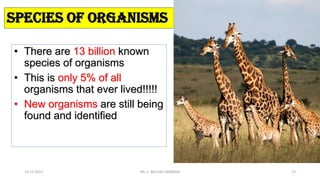
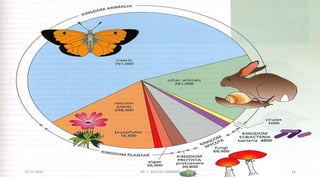
• There are 13 billion known
species of organisms
• This is only 5% of all
organisms that ever lived!!!!!
• New organisms are still being
found and identified
Species of Organisms
15-11-2021 DR. C. BEULAH JAYARANI 13
15-11-2021 DR. C. BEULAH JAYARANI 14
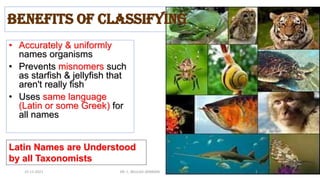
• Accurately & uniformly
names organisms
• Prevents misnomers such
as starfish & jellyfish that
aren't really fish
• Uses same language
(Latin or some Greek) for
all names
Latin Names are Understood
by all Taxonomists
Benefits of Classifying
15-11-2021 DR. C. BEULAH JAYARANI 15
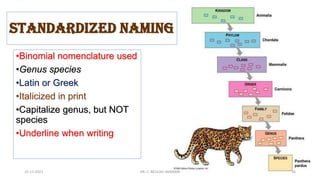
•Binomial nomenclature used
•Genus species
•Latin or Greek
•Italicized in print
•Capitalize genus, but NOT
species
•Underline when writing
Standardized Naming
15-11-2021 DR. C. BEULAH JAYARANI 16
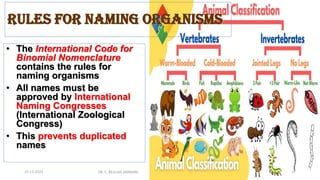
• The International Code for
Binomial Nomenclature
contains the rules for
naming organisms
• All names must be
approved by International
Naming Congresses
(International Zoological
Congress)
• This prevents duplicated
names
Rules for Naming Organisms
15-11-2021 DR. C. BEULAH JAYARANI 17
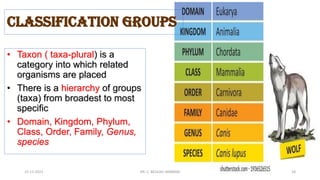
• Taxon ( taxa-plural) is a
category into which related
organisms are placed
• There is a hierarchy of groups
(taxa) from broadest to most
specific
• Domain, Kingdom, Phylum,
Class, Order, Family, Genus,
species
Classification Groups
15-11-2021 DR. C. BEULAH JAYARANI 18
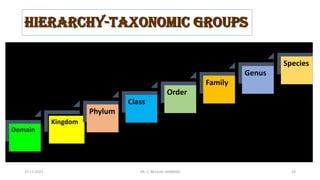
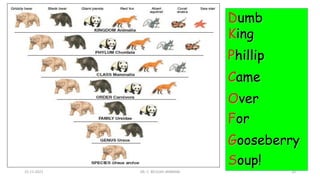
Hierarchy-Taxonomic Groups
Domain
Kingdom
Phylum
Class
Order
Family
Genus
Species
15-11-2021 DR. C. BEULAH JAYARANI 19
Dumb
King
Phillip
Came
Over
For
Gooseberry
Soup!
15-11-2021 DR. C. BEULAH JAYARANI 20
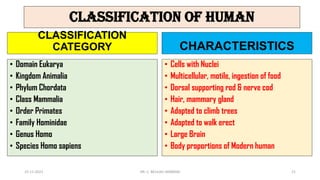
CLASSIFICATION OF HUMAN
CLASSIFICATION
CATEGORY
• Domain Eukarya
• Kingdom Animalia
• Phylum Chordata
• Class Mammalia
• Order Primates
• Family Hominidae
• Genus Homo
• Species Homo sapiens
CHARACTERISTICS
• Cells with Nuclei
• Multicellular, motile, ingestion of food
• Dorsal supporting rod & nerve cod
• Hair, mammary gland
• Adapted to climb trees
• Adapted to walk erect
• Large Brain
• Body proportions of Modern human
15-11-2021 DR. C. BEULAH JAYARANI 21
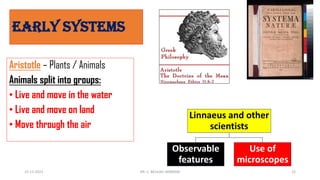
Early systems
Aristotle – Plants / Animals
Animals split into groups:
• Live and move in the water
• Live and move on land
• Move through the air
Linnaeus and other
scientists
Observable
features
Use of
microscopes
15-11-2021 DR. C. BEULAH JAYARANI 22
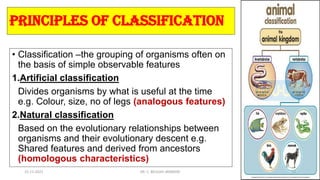
principles of classification
• Classification –the grouping of organisms often on
the basis of simple observable features
1.Artificial classification
Divides organisms by what is useful at the time
e.g. Colour, size, no of legs (analogous features)
2.Natural classification
Based on the evolutionary relationships between
organisms and their evolutionary descent e.g.
Shared features and derived from ancestors
(homologous characteristics)
15-11-2021 DR. C. BEULAH JAYARANI 23
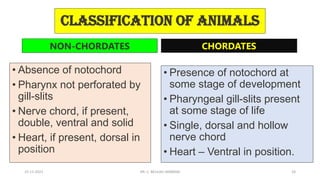
Classification of animals
NON-CHORDATES
• Absence of notochord
• Pharynx not perforated by
gill-slits
• Nerve chord, if present,
double, ventral and solid
• Heart, if present, dorsal in
position
CHORDATES
• Presence of notochord at
some stage of development
• Pharyngeal gill-slits present
at some stage of life
• Single, dorsal and hollow
nerve chord
• Heart – Ventral in position.
15-11-2021 DR. C. BEULAH JAYARANI 24
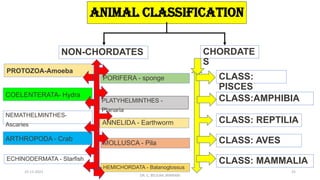
ANIMAL CLASSIFICATION
NON-CHORDATES CHORDATE
S
CLASS:
PISCES
CLASS:AMPHIBIA
CLASS: REPTILIA
CLASS: AVES
CLASS: MAMMALIA
PORIFERA - sponge
PLATYHELMINTHES -
Planaria
ANNELIDA - Earthworm
MOLLUSCA - Pila
HEMICHORDATA - Balanoglossus
PROTOZOA-Amoeba
COELENTERATA- Hydra
NEMATHELMINTHES-
Ascaries
ARTHROPODA - Crab
ECHINODERMATA - Starfish
15-11-2021
DR. C. BEULAH JAYARANI
25
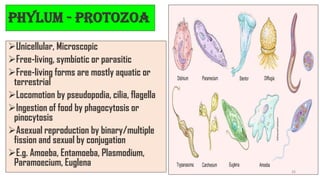
Phylum - Protozoa
➢Unicellular, Microscopic
➢Free-living, symbiotic or parasitic
➢Free-living forms are mostly aquatic or
terrestrial
➢Locomotion by pseudopodia, cilia, flagella
➢Ingestion of food by phagocytosis or
pinocytosis
➢Asexual reproduction by binary/multiple
fission and sexual by conjugation
➢E.g. Amoeba, Entamoeba, Plasmodium,
Paramoecium, Euglena
26
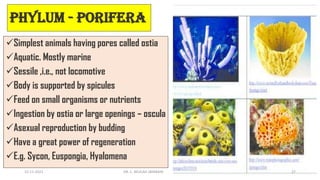
Phylum - Porifera
✓Simplest animals having pores called ostia
✓Aquatic. Mostly marine
✓Sessile ,i.e., not locomotive
✓Body is supported by spicules
✓Feed on small organisms or nutrients
✓Ingestion by ostia or large openings – oscula
✓Asexual reproduction by budding
✓Have a great power of regeneration
✓E.g. Sycon, Euspongia, Hyalomena
15-11-2021 DR. C. BEULAH JAYARANI 27
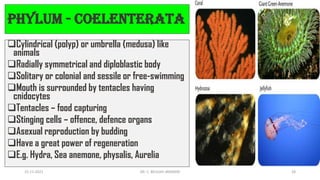
Phylum - Coelenterata
❑Cylindrical (polyp) or umbrella (medusa) like
animals
❑Radially symmetrical and diploblastic body
❑Solitary or colonial and sessile or free-swimming
❑Mouth is surrounded by tentacles having
cnidocytes
❑Tentacles – food capturing
❑Stinging cells – offence, defence organs
❑Asexual reproduction by budding
❑Have a great power of regeneration
❑E.g. Hydra, Sea anemone, physalis, Aurelia
15-11-2021 DR. C. BEULAH JAYARANI 28
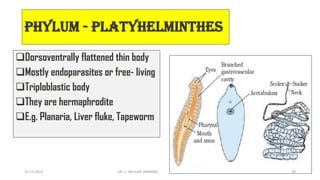
Phylum - Platyhelminthes
❑Dorsoventrally flattened thin body
❑Mostly endoparasites or free- living
❑Triploblastic body
❑They are hermaphrodite
❑E.g. Planaria, Liver fluke, Tapeworm
15-11-2021 DR. C. BEULAH JAYARANI 29
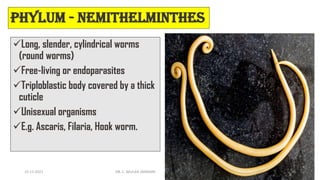
Phylum - Nemithelminthes
✓Long, slender, cylindrical worms
(round worms)
✓Free-living or endoparasites
✓Triploblastic body covered by a thick
cuticle
✓Unisexual organisms
✓E.g. Ascaris, Filaria, Hook worm.
15-11-2021 DR. C. BEULAH JAYARANI 30
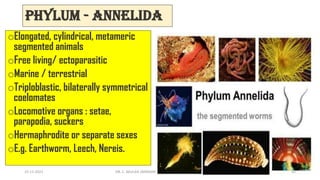
Phylum - Annelida
oElongated, cylindrical, metameric
segmented animals
oFree living/ ectoparasitic
oMarine / terrestrial
oTriploblastic, bilaterally symmetrical
coelomates
oLocomotive organs : setae,
parapodia, suckers
oHermaphrodite or separate sexes
oE.g. Earthworm, Leech, Nereis.
15-11-2021 DR. C. BEULAH JAYARANI 31
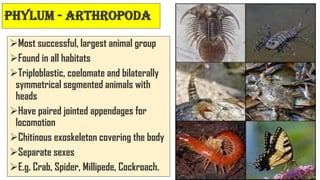
Phylum - ArthRopoda
➢Most successful, largest animal group
➢Found in all habitats
➢Triploblastic, coelomate and bilaterally
symmetrical segmented animals with
heads
➢Have paired jointed appendages for
locomotion
➢Chitinous exoskeleton covering the body
➢Separate sexes
➢E.g. Crab, Spider, Millipede, Cockroach. 32
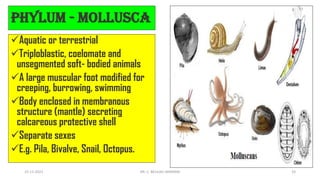
Phylum - Mollusca
✓Aquatic or terrestrial
✓Triploblastic, coelomate and
unsegmented soft- bodied animals
✓A large muscular foot modified for
creeping, burrowing, swimming
✓Body enclosed in membranous
structure (mantle) secreting
calcareous protective shell
✓Separate sexes
✓E.g. Pila, Bivalve, Snail, Octopus.
15-11-2021 DR. C. BEULAH JAYARANI 33
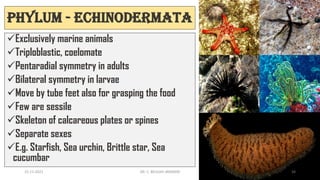
Phylum - Echinodermata
✓Exclusively marine animals
✓Triploblastic, coelomate
✓Pentaradial symmetry in adults
✓Bilateral symmetry in larvae
✓Move by tube feet also for grasping the food
✓Few are sessile
✓Skeleton of calcareous plates or spines
✓Separate sexes
✓E.g. Starfish, Sea urchin, Brittle star, Sea
cucumbar
15-11-2021 DR. C. BEULAH JAYARANI 34
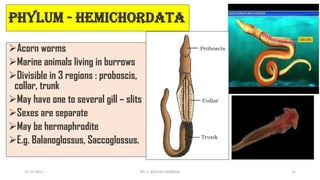
Phylum - Hemichordata
➢Acorn worms
➢Marine animals living in burrows
➢Divisible in 3 regions : proboscis,
collar, trunk
➢May have one to several gill – slits
➢Sexes are separate
➢May be hermaphrodite
➢E.g. Balanoglossus, Saccoglossus.
15-11-2021 DR. C. BEULAH JAYARANI 35
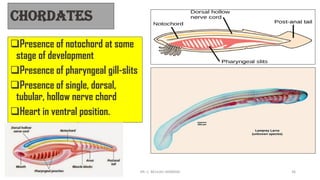
Chordates
❑Presence of notochord at some
stage of development
❑Presence of pharyngeal gill-slits
❑Presence of single, dorsal,
tubular, hollow nerve chord
❑Heart in ventral position.
DR. C. BEULAH JAYARANI 36
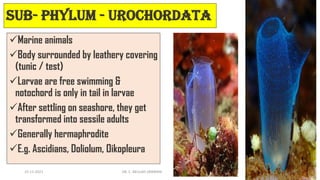
Sub- Phylum - Urochordata
✓Marine animals
✓Body surrounded by leathery covering
(tunic / test)
✓Larvae are free swimming &
notochord is only in tail in larvae
✓After settling on seashore, they get
transformed into sessile adults
✓Generally hermaphrodite
✓E.g. Ascidians, Doliolum, Oikopleura
15-11-2021 DR. C. BEULAH JAYARANI 37
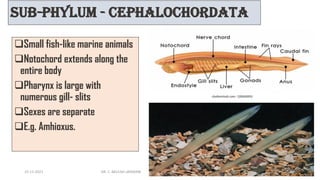
Sub-phylum - Cephalochordata
❑Small fish-like marine animals
❑Notochord extends along the
entire body
❑Pharynx is large with
numerous gill- slits
❑Sexes are separate
❑E.g. Amhioxus.
15-11-2021 DR. C. BEULAH JAYARANI 38
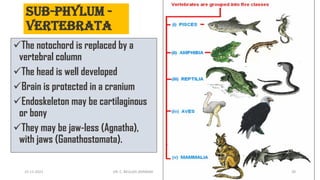
Sub-phylum -
Vertebrata
✓The notochord is replaced by a
vertebral column
✓The head is well developed
✓Brain is protected in a cranium
✓Endoskeleton may be cartilaginous
or bony
✓They may be jaw-less (Agnatha),
with jaws (Ganathostomata).
15-11-2021 DR. C. BEULAH JAYARANI 39
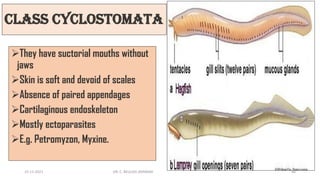
Class Cyclostomata
➢They have suctorial mouths without
jaws
➢Skin is soft and devoid of scales
➢Absence of paired appendages
➢Cartilaginous endoskeleton
➢Mostly ectoparasites
➢E.g. Petromyzon, Myxine.
15-11-2021 DR. C. BEULAH JAYARANI 40
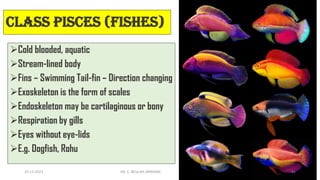
Class Pisces (Fishes)
➢Cold blooded, aquatic
➢Stream-lined body
➢Fins – Swimming Tail-fin – Direction changing
➢Exoskeleton is the form of scales
➢Endoskeleton may be cartilaginous or bony
➢Respiration by gills
➢Eyes without eye-lids
➢E.g. Dogfish, Rohu
15-11-2021 DR. C. BEULAH JAYARANI 41
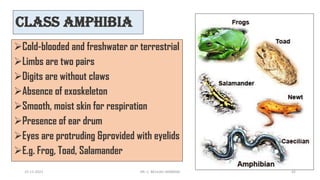
Class Amphibia
➢Cold-blooded and freshwater or terrestrial
➢Limbs are two pairs
➢Digits are without claws
➢Absence of exoskeleton
➢Smooth, moist skin for respiration
➢Presence of ear drum
➢Eyes are protruding &provided with eyelids
➢E.g. Frog, Toad, Salamander
15-11-2021 DR. C. BEULAH JAYARANI 42
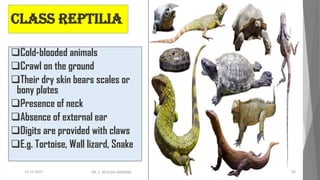
Class Reptilia
❑Cold-blooded animals
❑Crawl on the ground
❑Their dry skin bears scales or
bony plates
❑Presence of neck
❑Absence of external ear
❑Digits are provided with claws
❑E.g. Tortoise, Wall lizard, Snake
15-11-2021 DR. C. BEULAH JAYARANI 43
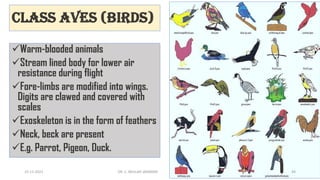
Class Aves (Birds)
✓Warm-blooded animals
✓Stream lined body for lower air
resistance during flight
✓Fore-limbs are modified into wings.
Digits are clawed and covered with
scales
✓Exoskeleton is in the form of feathers
✓Neck, beck are present
✓E.g. Parrot, Pigeon, Duck.
15-11-2021 DR. C. BEULAH JAYARANI 44
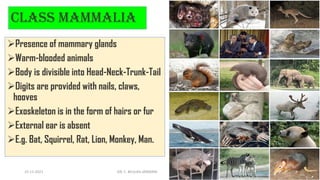
Class Mammalia
➢Presence of mammary glands
➢Warm-blooded animals
➢Body is divisible into Head-Neck-Trunk-Tail
➢Digits are provided with nails, claws,
hooves
➢Exoskeleton is in the form of hairs or fur
➢External ear is absent
➢E.g. Bat, Squirrel, Rat, Lion, Monkey, Man.
15-11-2021 DR. C. BEULAH JAYARANI 45
REFERENCES
“SCIENCE READER”
➢Tamil Nadu text books
➢NCERT Books
➢Google Images
15-11-2021 DR. C. BEULAH JAYARANI 46

Classification animals-converted

  • 1.
    ANIMAL CLASSIFICATION DR. C.BEULAH JAYARANI M.Sc., M.A, M.Ed, M.Phil (Edn), M.Phil (ZOO), NET, Ph.D ASST. PROFESSOR, LOYOLA COLLEGE OF EDUCATION, CHENNAI - 34
  • 2.
    ANIMALS Classification •Animal classificationrefers to the arrangement of animals in taxonomic groups according to their observed similarities and evolutionary relationships 15-11-2021 DR. C. BEULAH JAYARANI 2
  • 3.
    WHY classification • Classificationallows us to understand diversity better. • It helps in the identification of living organisms as well as in understanding the diversity of living organisms. • Classification helps us to learn about different kinds of plants and animals, their features, similarities and differences. 15-11-2021 DR. C. BEULAH JAYARANI 3
  • 4.
    CRITERIA FOR ANIMALCLASSIFICATION 1. Number of germ layers 2. Animal body plan 3. Body symmetry 4. Body cavity or coelom 5. Body segmentation 6. Body support 15-11-2021 DR. C. BEULAH JAYARANI 4
  • 5.
    1. Number ofgerm layers ✓Every multicellular organism begins life as a single cell called ‘zygote’. The zygote divides many times to form a mass of cells. These mass of cells get arranged into 2-3 layers called as germinal layers ✓Diploblastic animal: 2 layers, outer ectoderm & inner endoderm separated by mesoglea. Example: phylum Cnidaria ✓Triploblastic animal: 3 layers, outer ectoderm, middle mesoderm & inner endoderm. Example: phylum Platyhelminthes 15-11-2021 DR. C. BEULAH JAYARANI 5
  • 6.
    CELL AGGREGATE PLAN • Includessimplest of animal types like sponges • Animal is made up of aggregation or collection of cells • Tissues & organs are absent • There is no nervous co-ordination • Example: Phylum Porifera BLIND SAC BODY PLAN • Shown by slightly complex animals • Digestive system having a single opening which acts as mouth & anus. Hence ingestion & egestion is done through that opening • Example: Phylum Cnidaria 2. Animal body plan 6
  • 7.
    Tube within tubebody plan: • Shown by advanced & evolved animals • Complete digestive system with 2 separate openings for mouth & anus • Example: Phylum Annelida 15-11-2021 DR. C. BEULAH JAYARANI 7
  • 8.
    ASYMMETRICAL • Animals whose bodycannot be divided into 2 equal parts through any plane. • Eg: Some sponges & snails BILATERALLY SYMMETRICAL • The animal can be divided into 2 equal halves by one 1 single median plane • Example: Fish, frog, goat 3. Body symmetry Symmetry means similarity in shape, size & number of parts on opposite sides of a median line. Median line is the plane through which animal can be cut into 2 equal halves ▪ Animal whose body can be cut into 2 similar halves in many planes ▪ All the cuts pass through the centre & appear like radii. • Example: Hydra, starfish RADIALLY SYMMETRICAL 8
  • 9.
    ACOELOMATES ✓Animals which donot have any body cavity ✓The space between body wall & alimentary canal is filled with parenchyma ✓Eg: Phylum Platyhelminthes PSEUDOCOELOMAT ES • These animals show a false body cavity which is lined by patches of mesodermal cells • The false cavity is called as ‘pseudocoel’ • Eg: Phylum Aschelminthes 4. Body cavity Body cavity is the space between the body wall & the alimentary canal which is produced by the splitting of the mesoderm during embryonic development Animals having a true body cavity • Present in triploblastic animals • The mesoderm splits into 2 layers enclosing a body cavity called coelom • The cavity is filled with ‘coelomic fluid’ COELOMATE S 9
  • 10.
    5. Body segmentation ➢Itis also called as ‘metamerism’ (true segmentation) ➢It is a series of segments arranged along the body of the animal ➢When the external segmentation matches with the internal segmentation, such animals are called as ‘metamerically segmented animals’. Eg: Earthworm 15-11-2021 DR. C. BEULAH JAYARANI 10
  • 11.
    6. Body Support •The internal or external framework which provides support to the body is called as skeleton • It is of 2 types. Exoskeleton (outside) & endoskeleton (inside) • Lower animals have only exoskeleton for protection. Eg: cockroach • Higher developed animals have both exoskeleton & endoskeleton for their protection. Eg: fish, cobra, parrot, man, 15-11-2021 DR. C. BEULAH JAYARANI 11
  • 12.
    TAXONOMY • Classification isthe arrangement of organisms into orderly groups based on their similarities • Classification is also known as taxonomy. “Taxonomy – the study of biological classification.” • Taxonomists are scientists that identify & name organisms 15-11-2021 DR. C. BEULAH JAYARANI 12
  • 13.
    • There are13 billion known species of organisms • This is only 5% of all organisms that ever lived!!!!! • New organisms are still being found and identified Species of Organisms 15-11-2021 DR. C. BEULAH JAYARANI 13
  • 14.
    15-11-2021 DR. C.BEULAH JAYARANI 14
  • 15.
    • Accurately &uniformly names organisms • Prevents misnomers such as starfish & jellyfish that aren't really fish • Uses same language (Latin or some Greek) for all names Latin Names are Understood by all Taxonomists Benefits of Classifying 15-11-2021 DR. C. BEULAH JAYARANI 15
  • 16.
    •Binomial nomenclature used •Genusspecies •Latin or Greek •Italicized in print •Capitalize genus, but NOT species •Underline when writing Standardized Naming 15-11-2021 DR. C. BEULAH JAYARANI 16
  • 17.
    • The InternationalCode for Binomial Nomenclature contains the rules for naming organisms • All names must be approved by International Naming Congresses (International Zoological Congress) • This prevents duplicated names Rules for Naming Organisms 15-11-2021 DR. C. BEULAH JAYARANI 17
  • 18.
    • Taxon (taxa-plural) is a category into which related organisms are placed • There is a hierarchy of groups (taxa) from broadest to most specific • Domain, Kingdom, Phylum, Class, Order, Family, Genus, species Classification Groups 15-11-2021 DR. C. BEULAH JAYARANI 18
  • 19.
  • 20.
  • 21.
    CLASSIFICATION OF HUMAN CLASSIFICATION CATEGORY •Domain Eukarya • Kingdom Animalia • Phylum Chordata • Class Mammalia • Order Primates • Family Hominidae • Genus Homo • Species Homo sapiens CHARACTERISTICS • Cells with Nuclei • Multicellular, motile, ingestion of food • Dorsal supporting rod & nerve cod • Hair, mammary gland • Adapted to climb trees • Adapted to walk erect • Large Brain • Body proportions of Modern human 15-11-2021 DR. C. BEULAH JAYARANI 21
  • 22.
    Early systems Aristotle –Plants / Animals Animals split into groups: • Live and move in the water • Live and move on land • Move through the air Linnaeus and other scientists Observable features Use of microscopes 15-11-2021 DR. C. BEULAH JAYARANI 22
  • 23.
    principles of classification •Classification –the grouping of organisms often on the basis of simple observable features 1.Artificial classification Divides organisms by what is useful at the time e.g. Colour, size, no of legs (analogous features) 2.Natural classification Based on the evolutionary relationships between organisms and their evolutionary descent e.g. Shared features and derived from ancestors (homologous characteristics) 15-11-2021 DR. C. BEULAH JAYARANI 23
  • 24.
    Classification of animals NON-CHORDATES •Absence of notochord • Pharynx not perforated by gill-slits • Nerve chord, if present, double, ventral and solid • Heart, if present, dorsal in position CHORDATES • Presence of notochord at some stage of development • Pharyngeal gill-slits present at some stage of life • Single, dorsal and hollow nerve chord • Heart – Ventral in position. 15-11-2021 DR. C. BEULAH JAYARANI 24
  • 25.
    ANIMAL CLASSIFICATION NON-CHORDATES CHORDATE S CLASS: PISCES CLASS:AMPHIBIA CLASS:REPTILIA CLASS: AVES CLASS: MAMMALIA PORIFERA - sponge PLATYHELMINTHES - Planaria ANNELIDA - Earthworm MOLLUSCA - Pila HEMICHORDATA - Balanoglossus PROTOZOA-Amoeba COELENTERATA- Hydra NEMATHELMINTHES- Ascaries ARTHROPODA - Crab ECHINODERMATA - Starfish 15-11-2021 DR. C. BEULAH JAYARANI 25
  • 26.
    Phylum - Protozoa ➢Unicellular,Microscopic ➢Free-living, symbiotic or parasitic ➢Free-living forms are mostly aquatic or terrestrial ➢Locomotion by pseudopodia, cilia, flagella ➢Ingestion of food by phagocytosis or pinocytosis ➢Asexual reproduction by binary/multiple fission and sexual by conjugation ➢E.g. Amoeba, Entamoeba, Plasmodium, Paramoecium, Euglena 26
  • 27.
    Phylum - Porifera ✓Simplestanimals having pores called ostia ✓Aquatic. Mostly marine ✓Sessile ,i.e., not locomotive ✓Body is supported by spicules ✓Feed on small organisms or nutrients ✓Ingestion by ostia or large openings – oscula ✓Asexual reproduction by budding ✓Have a great power of regeneration ✓E.g. Sycon, Euspongia, Hyalomena 15-11-2021 DR. C. BEULAH JAYARANI 27
  • 28.
    Phylum - Coelenterata ❑Cylindrical(polyp) or umbrella (medusa) like animals ❑Radially symmetrical and diploblastic body ❑Solitary or colonial and sessile or free-swimming ❑Mouth is surrounded by tentacles having cnidocytes ❑Tentacles – food capturing ❑Stinging cells – offence, defence organs ❑Asexual reproduction by budding ❑Have a great power of regeneration ❑E.g. Hydra, Sea anemone, physalis, Aurelia 15-11-2021 DR. C. BEULAH JAYARANI 28
  • 29.
    Phylum - Platyhelminthes ❑Dorsoventrallyflattened thin body ❑Mostly endoparasites or free- living ❑Triploblastic body ❑They are hermaphrodite ❑E.g. Planaria, Liver fluke, Tapeworm 15-11-2021 DR. C. BEULAH JAYARANI 29
  • 30.
    Phylum - Nemithelminthes ✓Long,slender, cylindrical worms (round worms) ✓Free-living or endoparasites ✓Triploblastic body covered by a thick cuticle ✓Unisexual organisms ✓E.g. Ascaris, Filaria, Hook worm. 15-11-2021 DR. C. BEULAH JAYARANI 30
  • 31.
    Phylum - Annelida oElongated,cylindrical, metameric segmented animals oFree living/ ectoparasitic oMarine / terrestrial oTriploblastic, bilaterally symmetrical coelomates oLocomotive organs : setae, parapodia, suckers oHermaphrodite or separate sexes oE.g. Earthworm, Leech, Nereis. 15-11-2021 DR. C. BEULAH JAYARANI 31
  • 32.
    Phylum - ArthRopoda ➢Mostsuccessful, largest animal group ➢Found in all habitats ➢Triploblastic, coelomate and bilaterally symmetrical segmented animals with heads ➢Have paired jointed appendages for locomotion ➢Chitinous exoskeleton covering the body ➢Separate sexes ➢E.g. Crab, Spider, Millipede, Cockroach. 32
  • 33.
    Phylum - Mollusca ✓Aquaticor terrestrial ✓Triploblastic, coelomate and unsegmented soft- bodied animals ✓A large muscular foot modified for creeping, burrowing, swimming ✓Body enclosed in membranous structure (mantle) secreting calcareous protective shell ✓Separate sexes ✓E.g. Pila, Bivalve, Snail, Octopus. 15-11-2021 DR. C. BEULAH JAYARANI 33
  • 34.
    Phylum - Echinodermata ✓Exclusivelymarine animals ✓Triploblastic, coelomate ✓Pentaradial symmetry in adults ✓Bilateral symmetry in larvae ✓Move by tube feet also for grasping the food ✓Few are sessile ✓Skeleton of calcareous plates or spines ✓Separate sexes ✓E.g. Starfish, Sea urchin, Brittle star, Sea cucumbar 15-11-2021 DR. C. BEULAH JAYARANI 34
  • 35.
    Phylum - Hemichordata ➢Acornworms ➢Marine animals living in burrows ➢Divisible in 3 regions : proboscis, collar, trunk ➢May have one to several gill – slits ➢Sexes are separate ➢May be hermaphrodite ➢E.g. Balanoglossus, Saccoglossus. 15-11-2021 DR. C. BEULAH JAYARANI 35
  • 36.
    Chordates ❑Presence of notochordat some stage of development ❑Presence of pharyngeal gill-slits ❑Presence of single, dorsal, tubular, hollow nerve chord ❑Heart in ventral position. DR. C. BEULAH JAYARANI 36
  • 37.
    Sub- Phylum -Urochordata ✓Marine animals ✓Body surrounded by leathery covering (tunic / test) ✓Larvae are free swimming & notochord is only in tail in larvae ✓After settling on seashore, they get transformed into sessile adults ✓Generally hermaphrodite ✓E.g. Ascidians, Doliolum, Oikopleura 15-11-2021 DR. C. BEULAH JAYARANI 37
  • 38.
    Sub-phylum - Cephalochordata ❑Smallfish-like marine animals ❑Notochord extends along the entire body ❑Pharynx is large with numerous gill- slits ❑Sexes are separate ❑E.g. Amhioxus. 15-11-2021 DR. C. BEULAH JAYARANI 38
  • 39.
    Sub-phylum - Vertebrata ✓The notochordis replaced by a vertebral column ✓The head is well developed ✓Brain is protected in a cranium ✓Endoskeleton may be cartilaginous or bony ✓They may be jaw-less (Agnatha), with jaws (Ganathostomata). 15-11-2021 DR. C. BEULAH JAYARANI 39
  • 40.
    Class Cyclostomata ➢They havesuctorial mouths without jaws ➢Skin is soft and devoid of scales ➢Absence of paired appendages ➢Cartilaginous endoskeleton ➢Mostly ectoparasites ➢E.g. Petromyzon, Myxine. 15-11-2021 DR. C. BEULAH JAYARANI 40
  • 41.
    Class Pisces (Fishes) ➢Coldblooded, aquatic ➢Stream-lined body ➢Fins – Swimming Tail-fin – Direction changing ➢Exoskeleton is the form of scales ➢Endoskeleton may be cartilaginous or bony ➢Respiration by gills ➢Eyes without eye-lids ➢E.g. Dogfish, Rohu 15-11-2021 DR. C. BEULAH JAYARANI 41
  • 42.
    Class Amphibia ➢Cold-blooded andfreshwater or terrestrial ➢Limbs are two pairs ➢Digits are without claws ➢Absence of exoskeleton ➢Smooth, moist skin for respiration ➢Presence of ear drum ➢Eyes are protruding &provided with eyelids ➢E.g. Frog, Toad, Salamander 15-11-2021 DR. C. BEULAH JAYARANI 42
  • 43.
    Class Reptilia ❑Cold-blooded animals ❑Crawlon the ground ❑Their dry skin bears scales or bony plates ❑Presence of neck ❑Absence of external ear ❑Digits are provided with claws ❑E.g. Tortoise, Wall lizard, Snake 15-11-2021 DR. C. BEULAH JAYARANI 43
  • 44.
    Class Aves (Birds) ✓Warm-bloodedanimals ✓Stream lined body for lower air resistance during flight ✓Fore-limbs are modified into wings. Digits are clawed and covered with scales ✓Exoskeleton is in the form of feathers ✓Neck, beck are present ✓E.g. Parrot, Pigeon, Duck. 15-11-2021 DR. C. BEULAH JAYARANI 44
  • 45.
    Class Mammalia ➢Presence ofmammary glands ➢Warm-blooded animals ➢Body is divisible into Head-Neck-Trunk-Tail ➢Digits are provided with nails, claws, hooves ➢Exoskeleton is in the form of hairs or fur ➢External ear is absent ➢E.g. Bat, Squirrel, Rat, Lion, Monkey, Man. 15-11-2021 DR. C. BEULAH JAYARANI 45
  • 46.
    REFERENCES “SCIENCE READER” ➢Tamil Nadutext books ➢NCERT Books ➢Google Images 15-11-2021 DR. C. BEULAH JAYARANI 46