4
Cellular Features
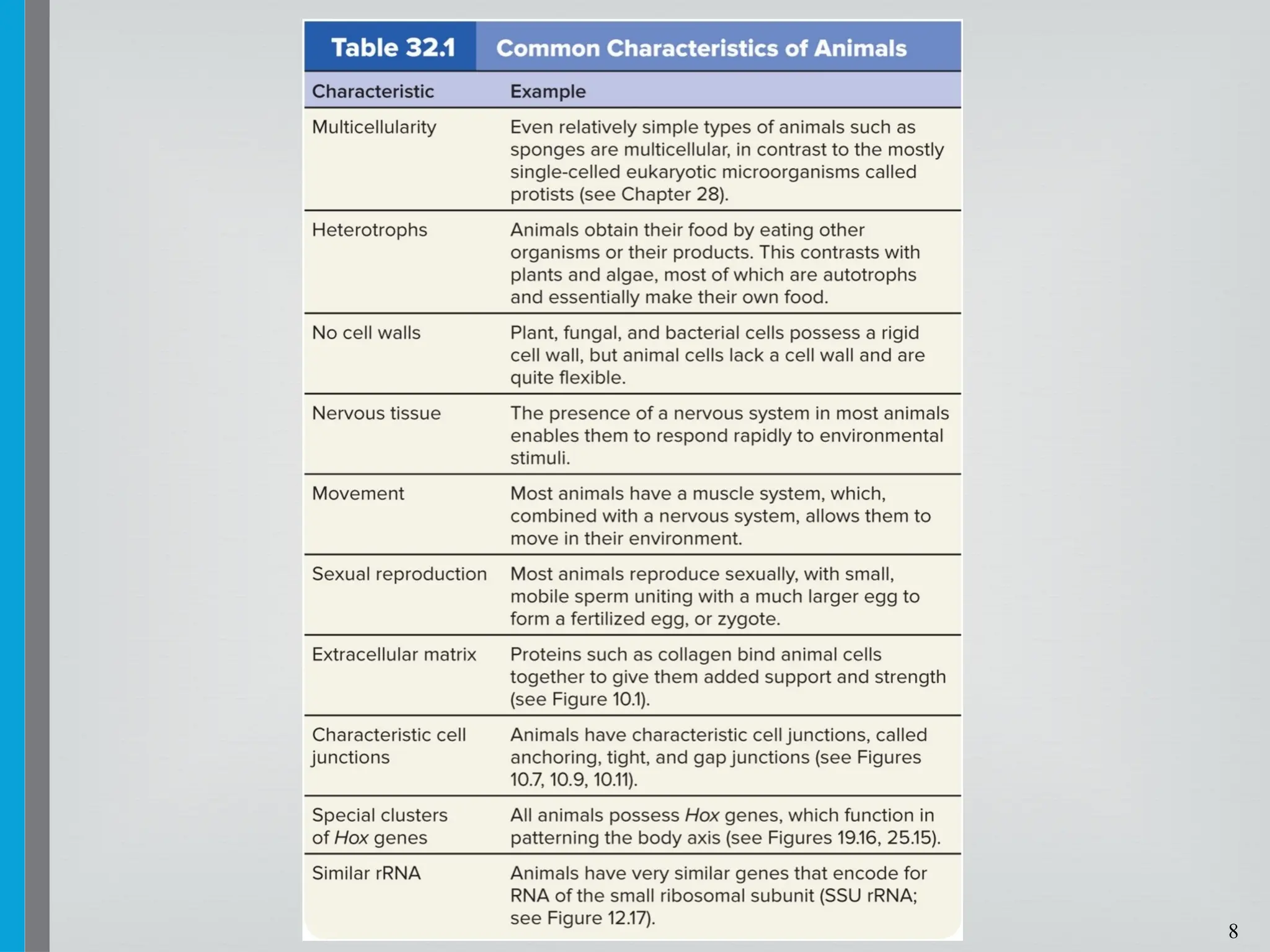
Animalsare multicellular
No cell walls – increases flexibility
Extracellular matrix forms strong fibres outside the cell
Cell junctions play an important role in holding animal cells
in place and allowing communication between cells
33.1 Characteristics of Animals
5.
5
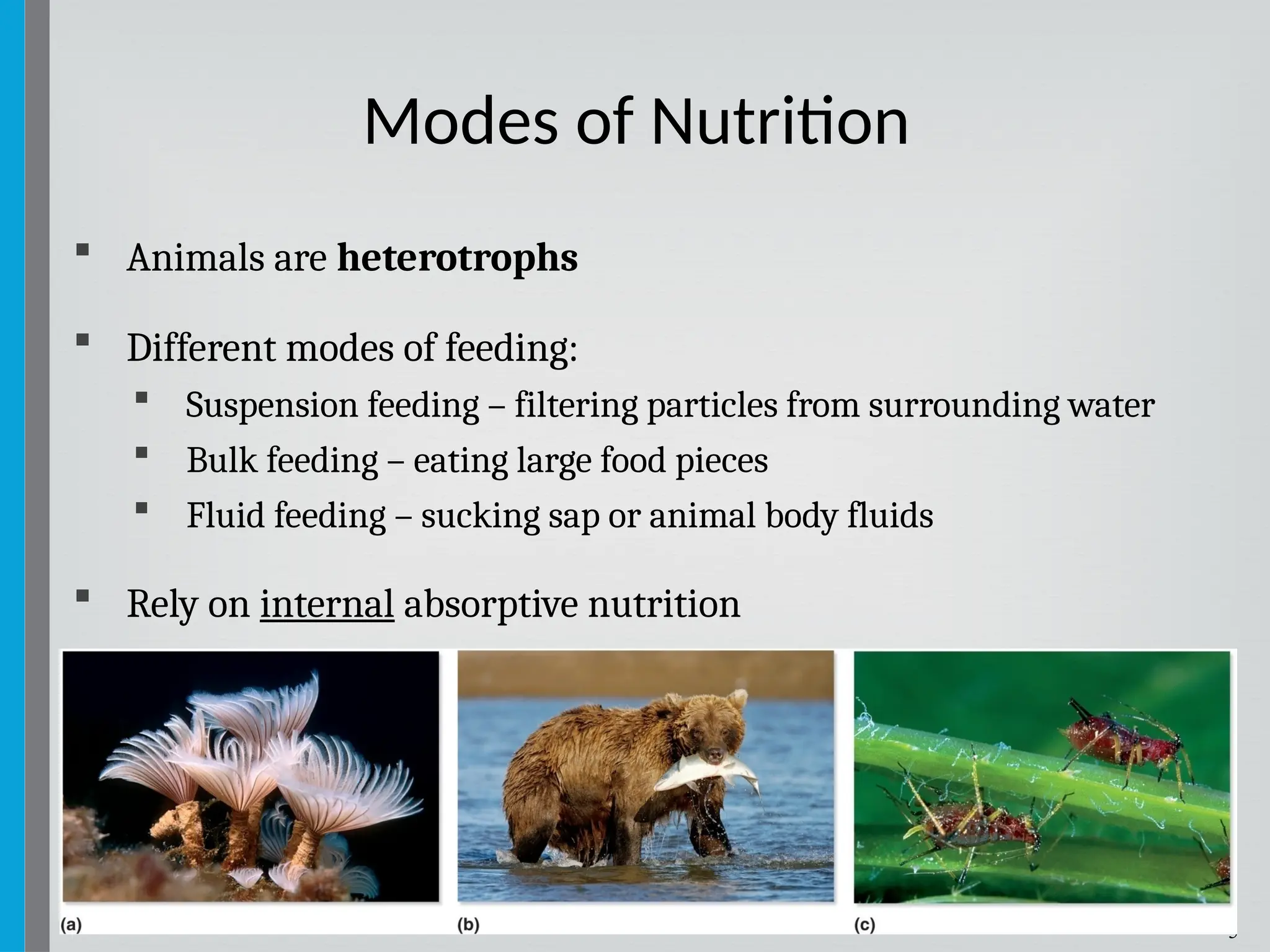
Animals areheterotrophs
Different modes of feeding:
Suspension feeding – filtering particles from surrounding water
Bulk feeding – eating large food pieces
Fluid feeding – sucking sap or animal body fluids
Rely on internal absorptive nutrition
Modes of Nutrition
6.
6
Most havemuscle cells and nerve cells organized into tissues
Most are capable of some kind of locomotion
Important for food acquisition and escape from predators
Coordinated by sensory structures, muscular-skeletal system,
and nervous system
Sessile species, such as barnacles, have moving appendages or
a swimming larval stage
Movement
7.
7
Nearly allanimals reproduce sexually
Small, mobile sperm unites with large egg to produce a zygote
Internal fertilization common in terrestrial species
External fertilization common in aquatic species
Certain insects, fish, and lizard species can reproduce asexually
Metamorphosis occurs in some species
Developmental phenomenon in which animal changes from a juvenile to an
adult form
Reduces competition for food between juveniles and adults, and facilitates
dispersal
Reproduction and Development
9
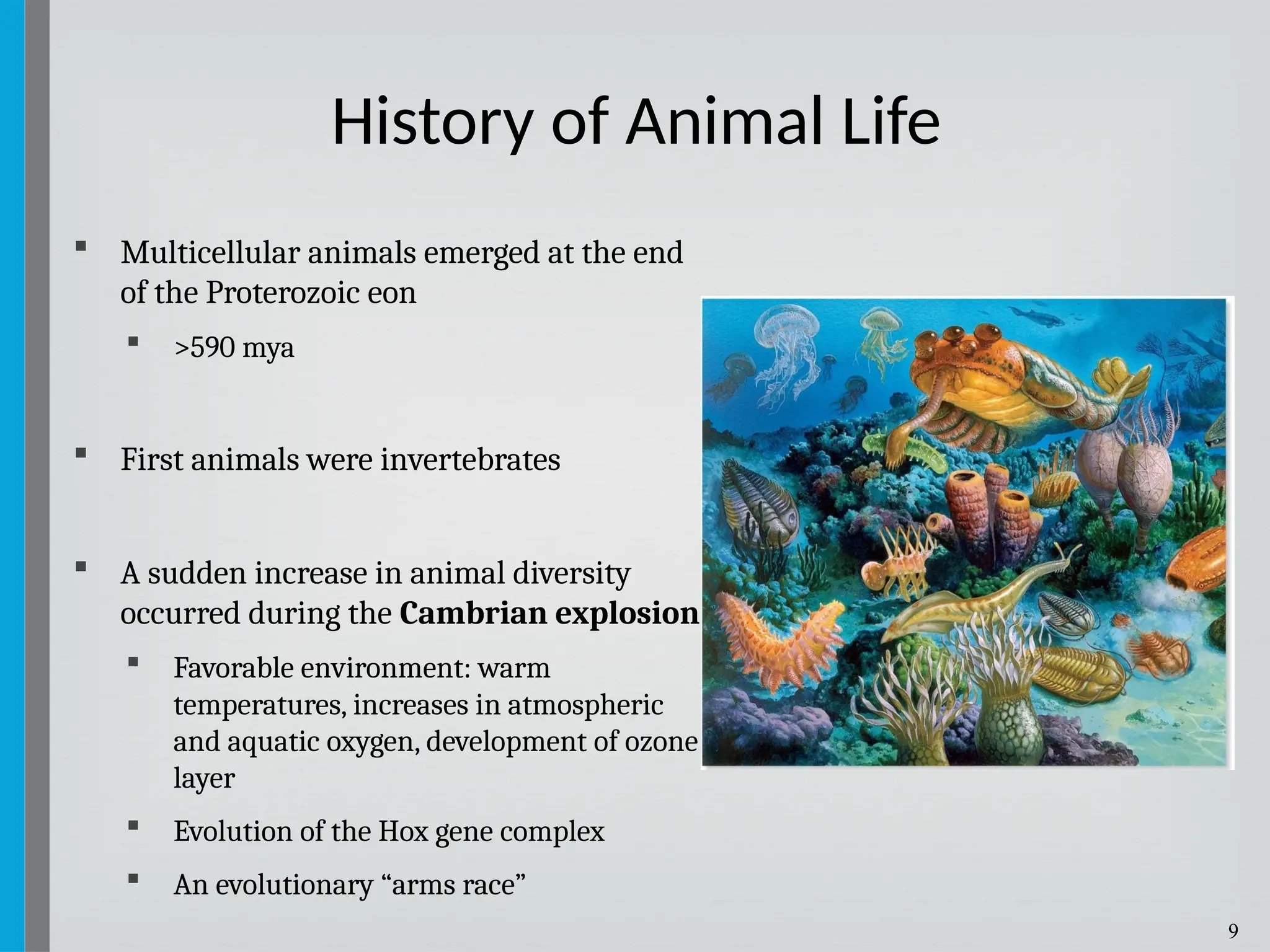
Multicellular animalsemerged at the end
of the Proterozoic eon
>590 mya
First animals were invertebrates
A sudden increase in animal diversity
occurred during the Cambrian explosion
Favorable environment: warm
temperatures, increases in atmospheric
and aquatic oxygen, development of ozone
layer
Evolution of the Hox gene complex
An evolutionary “arms race”
History of Animal Life
10.
10
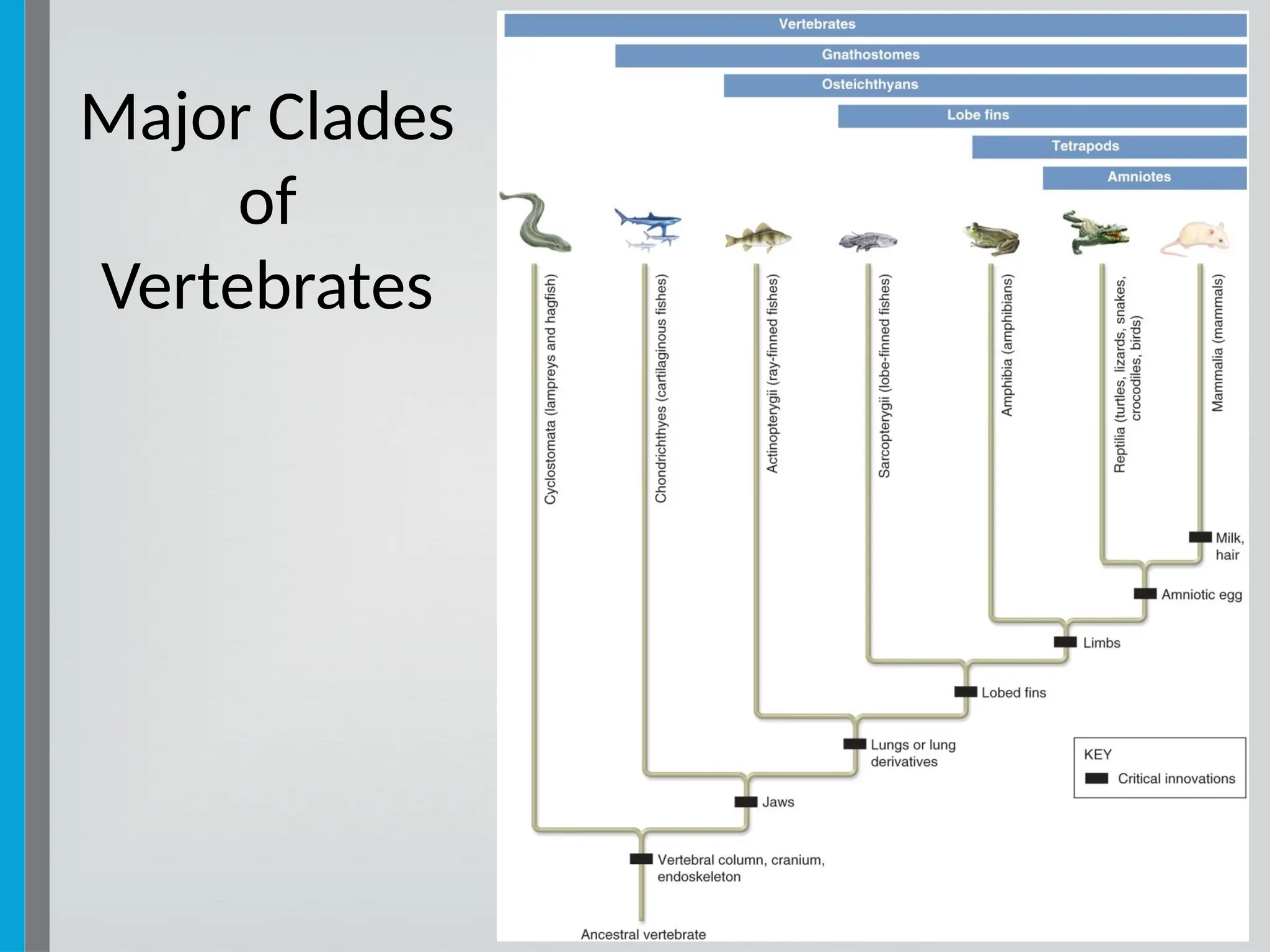
First vertebrateswere fishes ~520 mya
Plants colonized land around the same time
Provided a food source for animals on land, but also presented new
challenges
Colonization of land led to new adaptations
e.g. Lungs, tetrapod locomotion, internal fertilization, amniotic egg
Reptiles dominated the Earth for millions of years
Dinosaurs died out ~65 mya, giving way to an explosion in the number and
diversity of mammals
Vertebrate Evolution
11.
11
Most biologistsagree animal kingdom is monophyletic
All taxa evolved from a single common ancestor
About 35 recognized animal phyla
We will focus on the 12 that have the greatest number of species
Animal Classification
13
Closest livingrelative of animals
are choanoflagellates
Single-celled protists with a single
flagellum surrounded by a collar
of cytoplasmic tentacles
Some species are colonial
Bear a striking similarity to
sponge choanocytes
Animal Evolution
14.
14
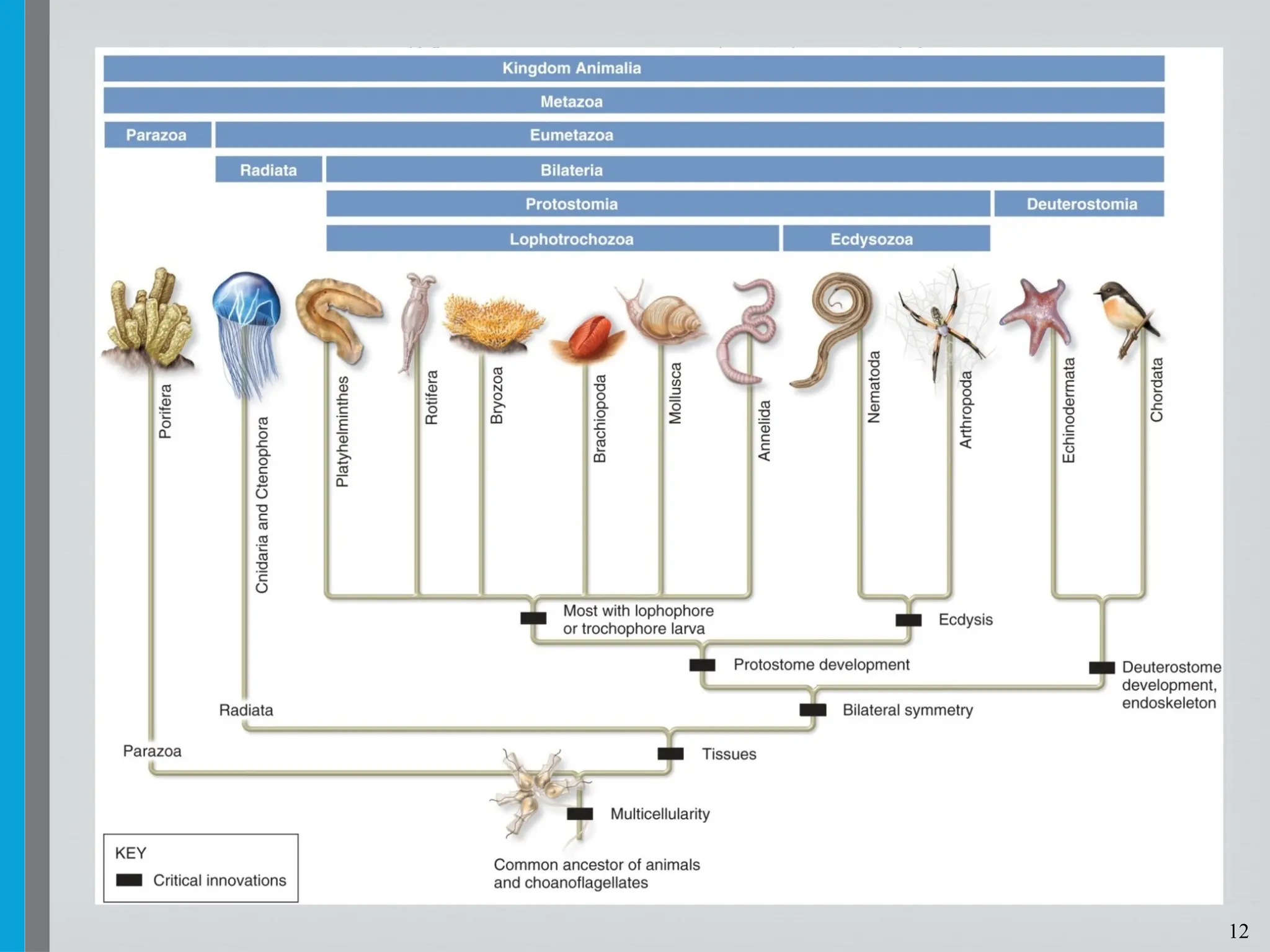
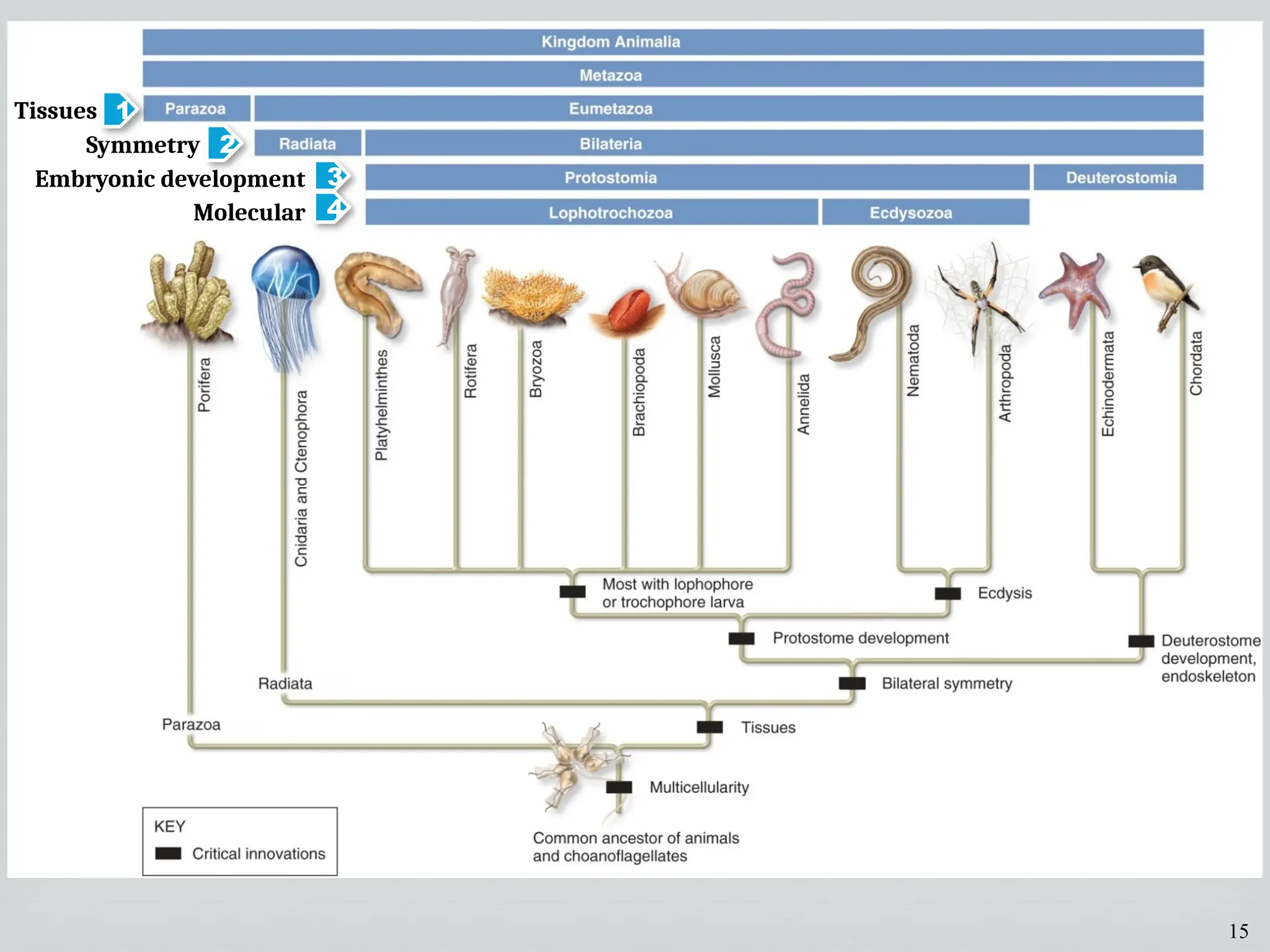
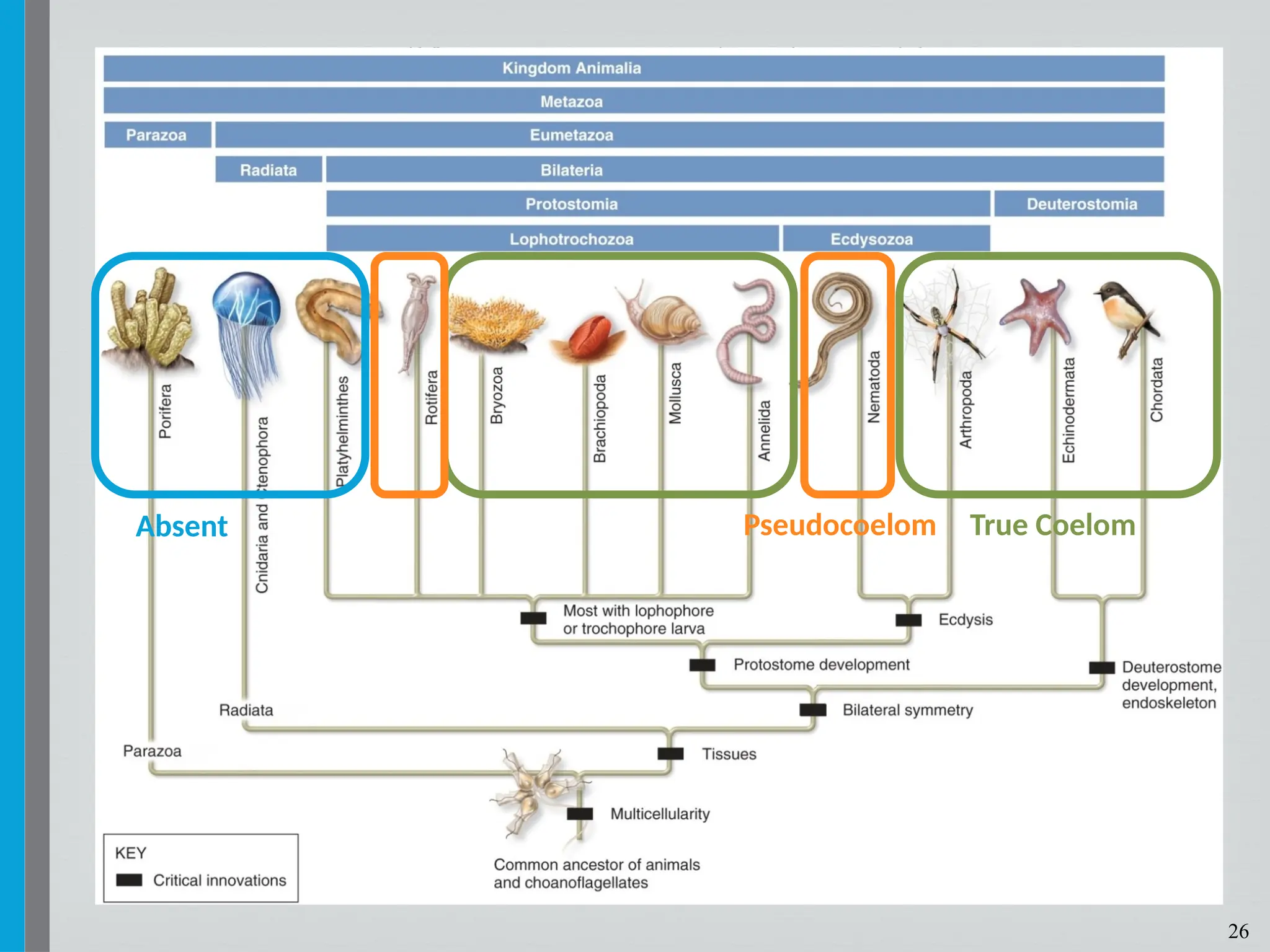
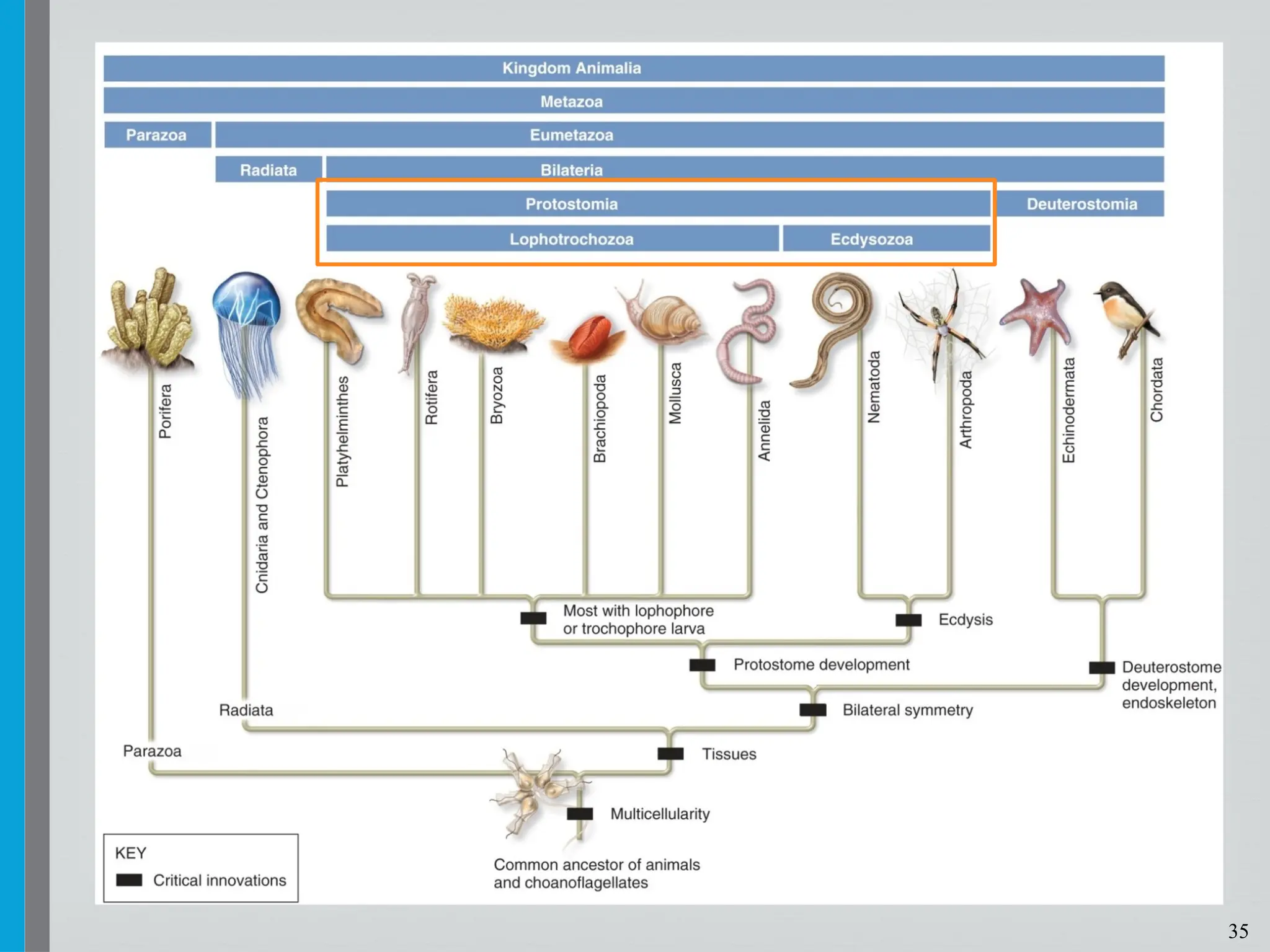
Morphological anddevelopmental features traditionally used to
classify animals:
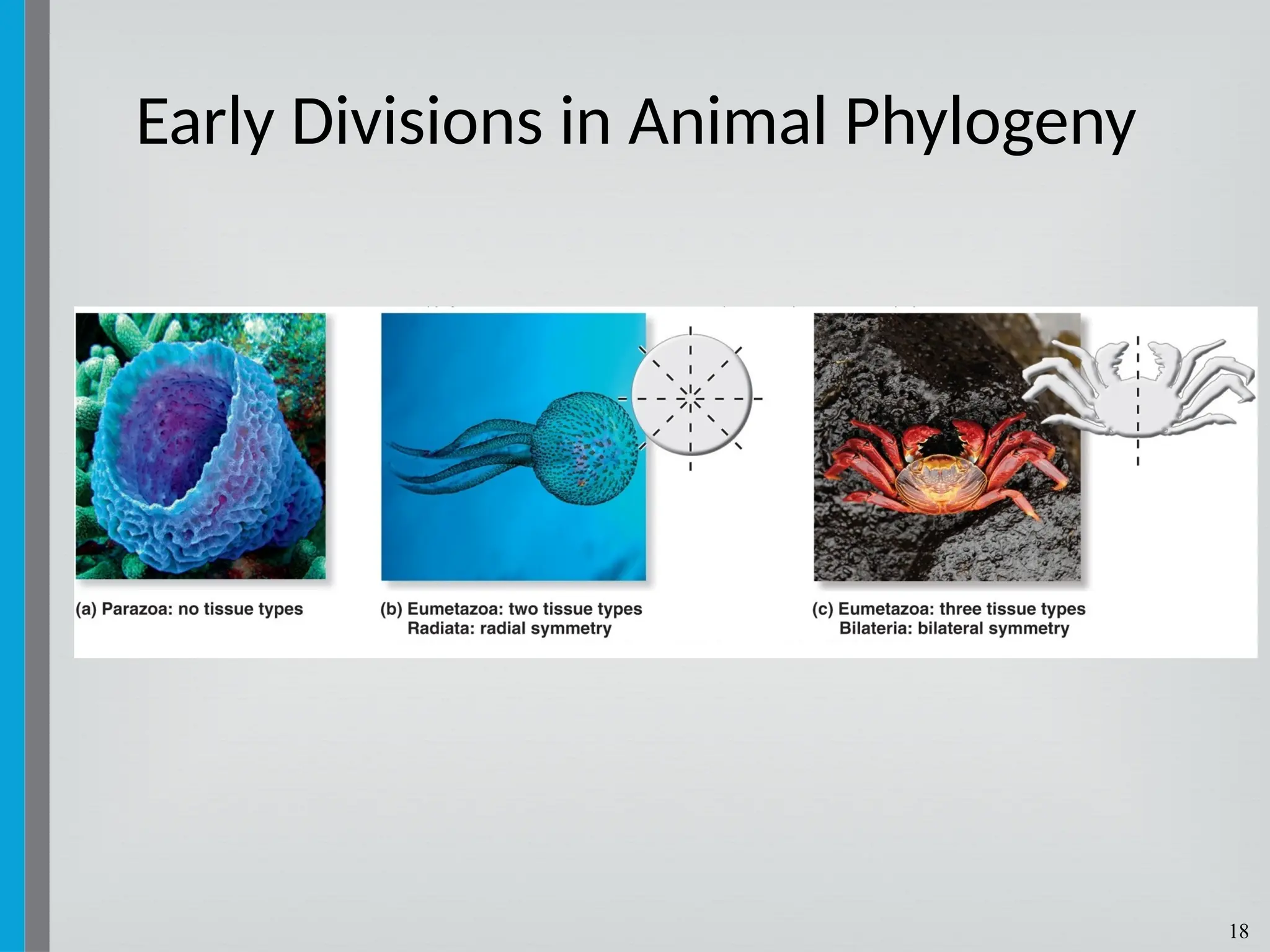
1. Presence or absence of different tissue types
Parazoa vs. Eumetazoa
2. Type of body symmetry
Radial vs. Bilateral
3. Specific features of embryonic development
Protostomes vs. Deuterostomes
Molecular analysis is used to further classify protostomes as:
4. Ecdysozoa or lophotrochozoa
Animal Classification
16
Collectively, animalsare known as metazoa
Divided into two subgroups based on whether they have
specialized tissues
Parazoa: Without specialized tissues or organs
May have distinct cell types
Consists of a single phylum, Porifera (sponges)
Eumetazoa: Have more than one type of tissue, and (usually)
different types of organs
All other animals
Tissues
1
17.
17
Eumetazoa aredivided by their type of symmetry
Radiata: Radially symmetric animals
Can be divided equally by any longitudinal plane through the central axis
Often circular or tubular in shape, with a mouth at one end
Consists of a single phylum, Cnidaria
Bilateria: Bilaterally symmetric animals
Can be divided along a vertical plane at the midline to create two halves (left
side and right side)
Have cephalization, dorsal/ventral (upper/lower) sides, and
anterior/posterior (head/tail) ends
Symmetry
2
19
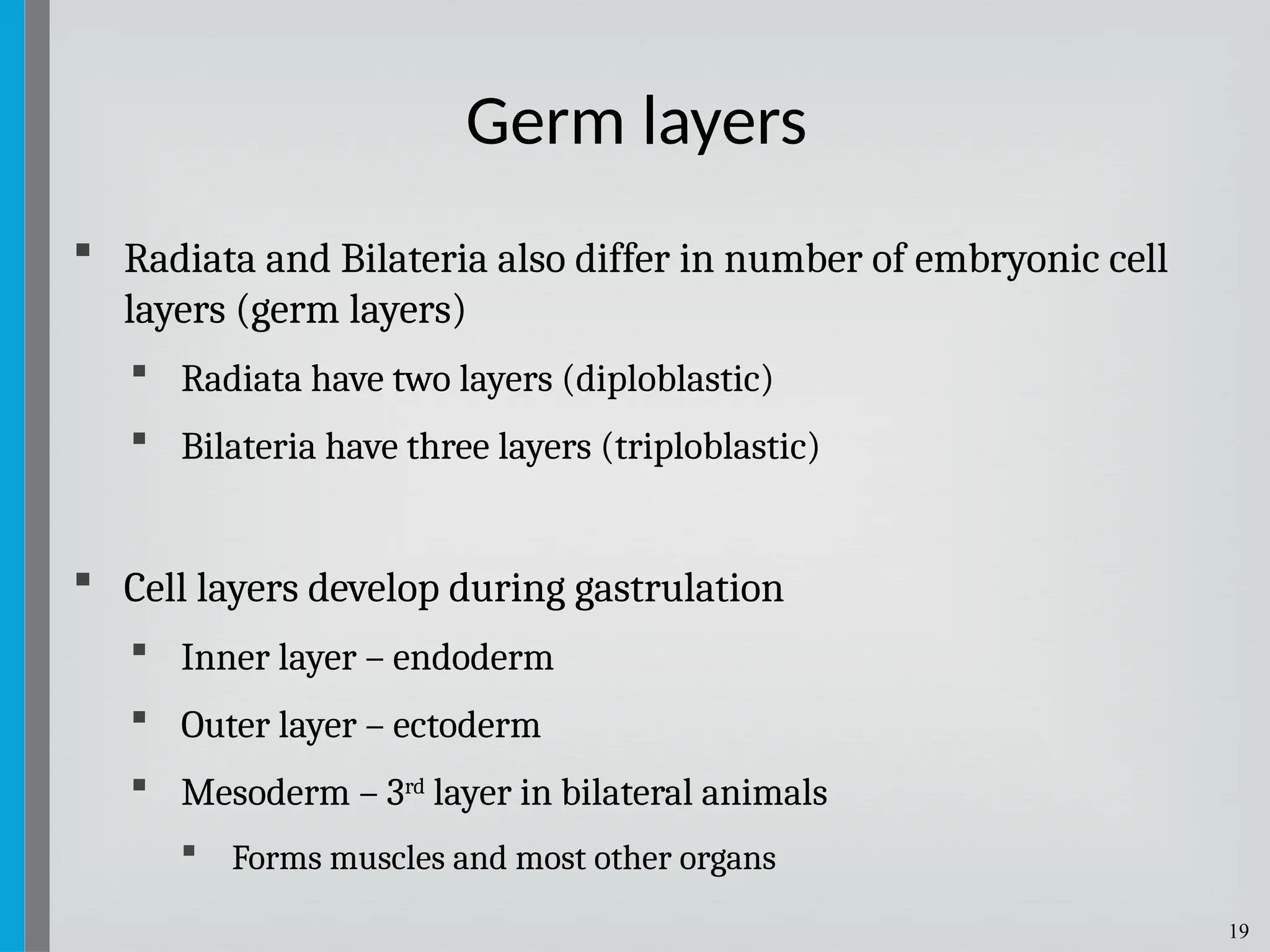
Radiata andBilateria also differ in number of embryonic cell
layers (germ layers)
Radiata have two layers (diploblastic)
Bilateria have three layers (triploblastic)
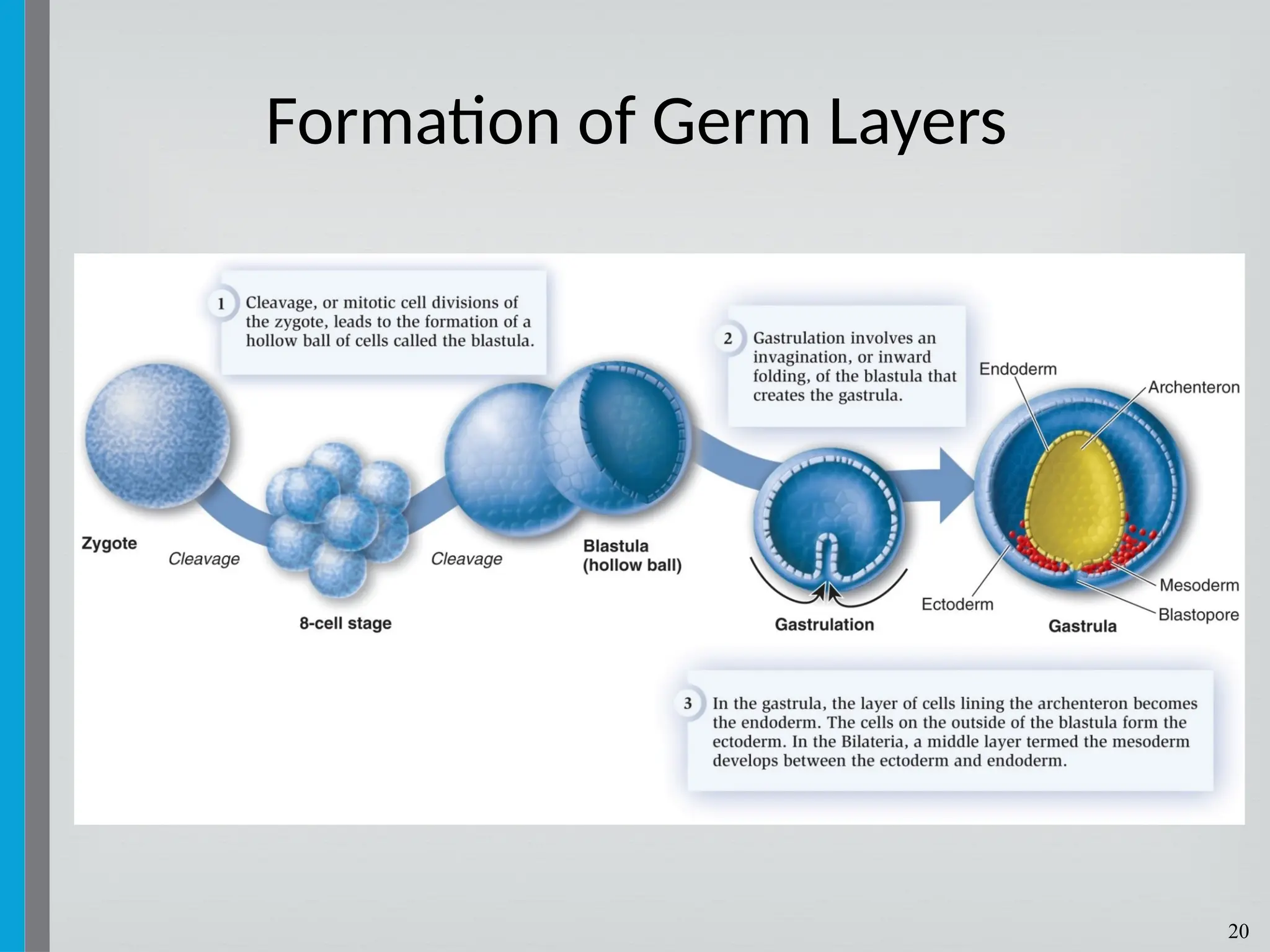
Cell layers develop during gastrulation
Inner layer – endoderm
Outer layer – ectoderm
Mesoderm – 3rd layer in bilateral animals
Forms muscles and most other organs
Germ layers
21
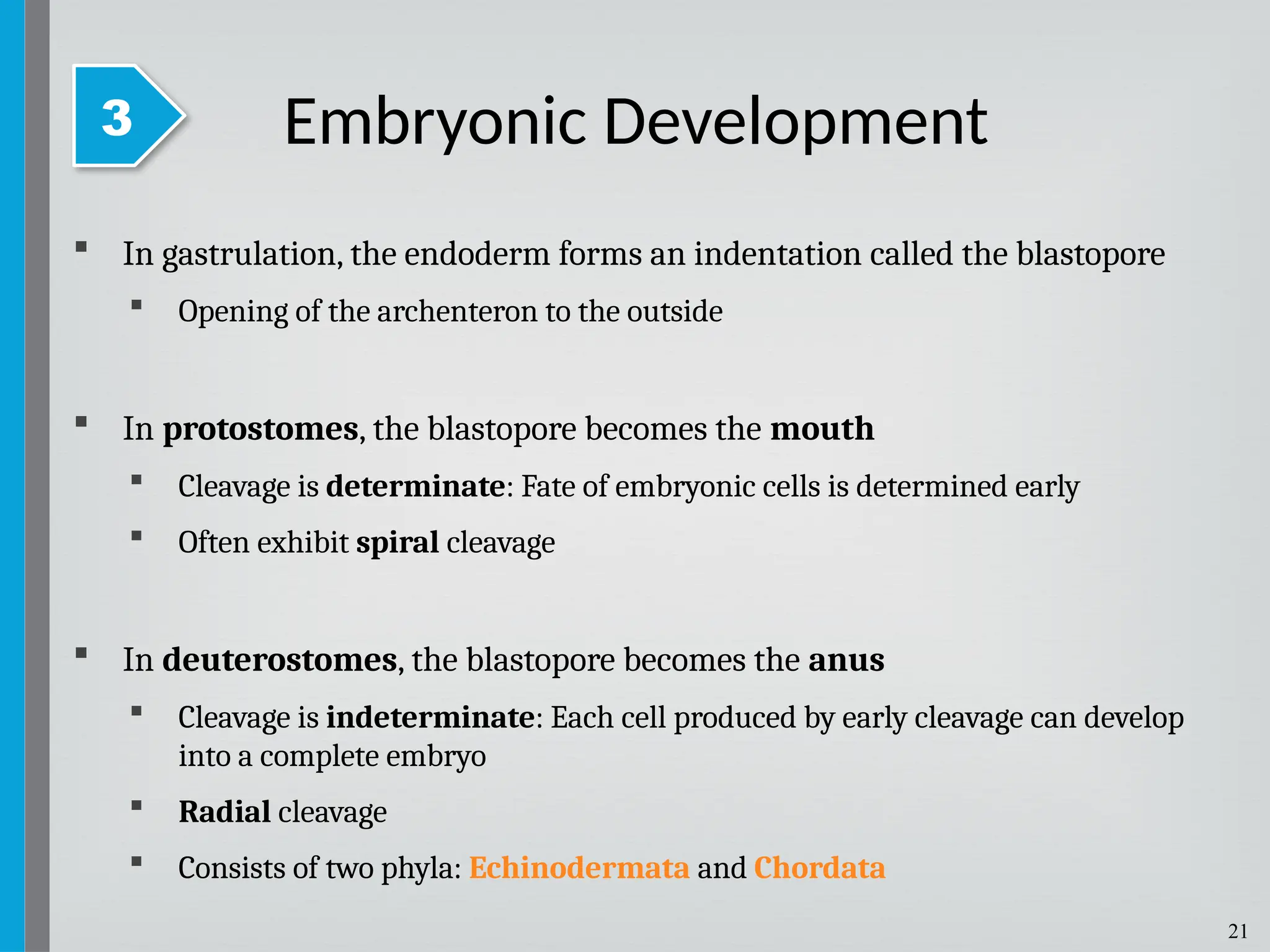
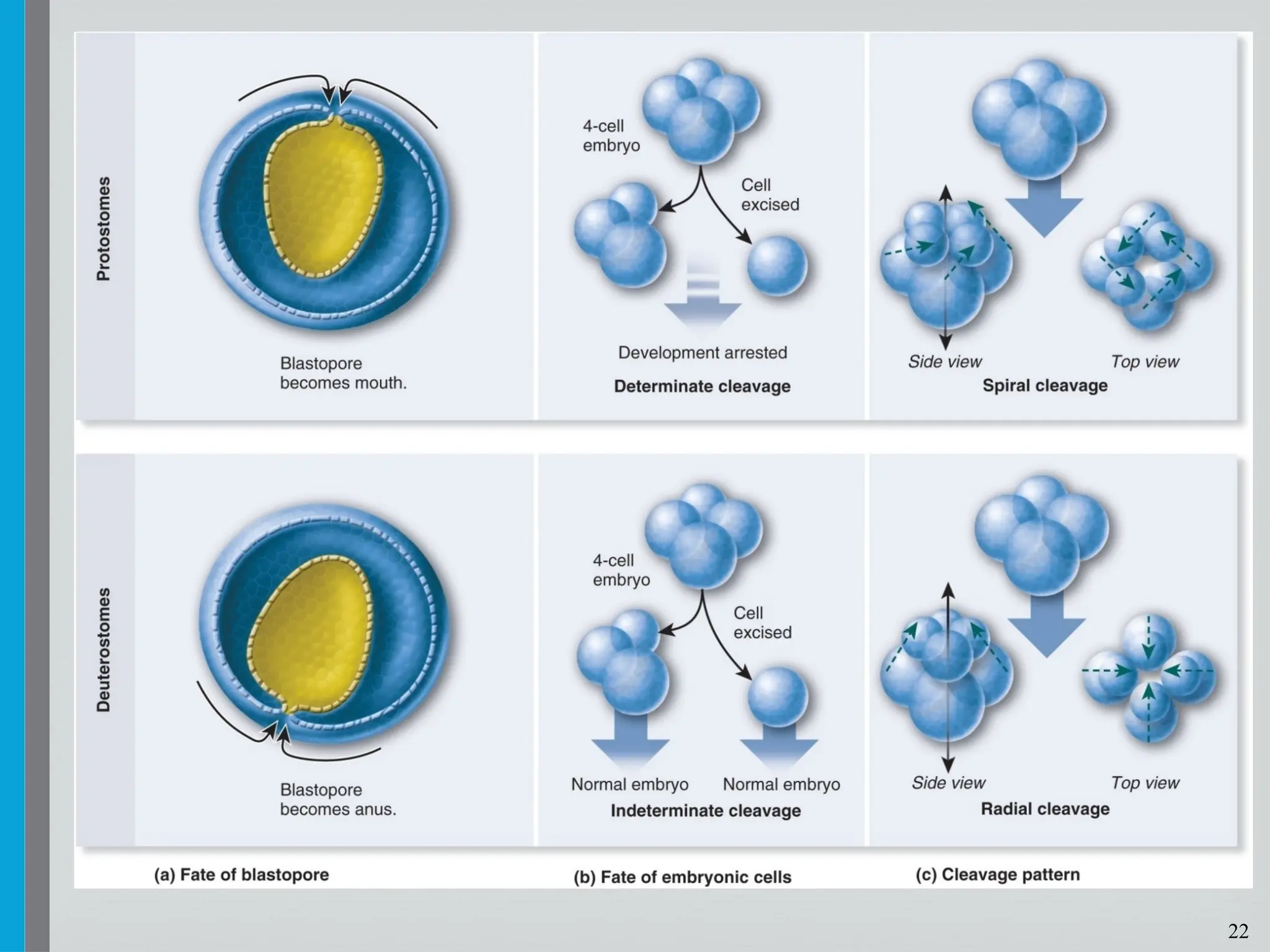
In gastrulation,the endoderm forms an indentation called the blastopore
Opening of the archenteron to the outside
In protostomes, the blastopore becomes the mouth
Cleavage is determinate: Fate of embryonic cells is determined early
Often exhibit spiral cleavage
In deuterostomes, the blastopore becomes the anus
Cleavage is indeterminate: Each cell produced by early cleavage can develop
into a complete embryo
Radial cleavage
Consists of two phyla: Echinodermata and Chordata
Embryonic Development
3
23
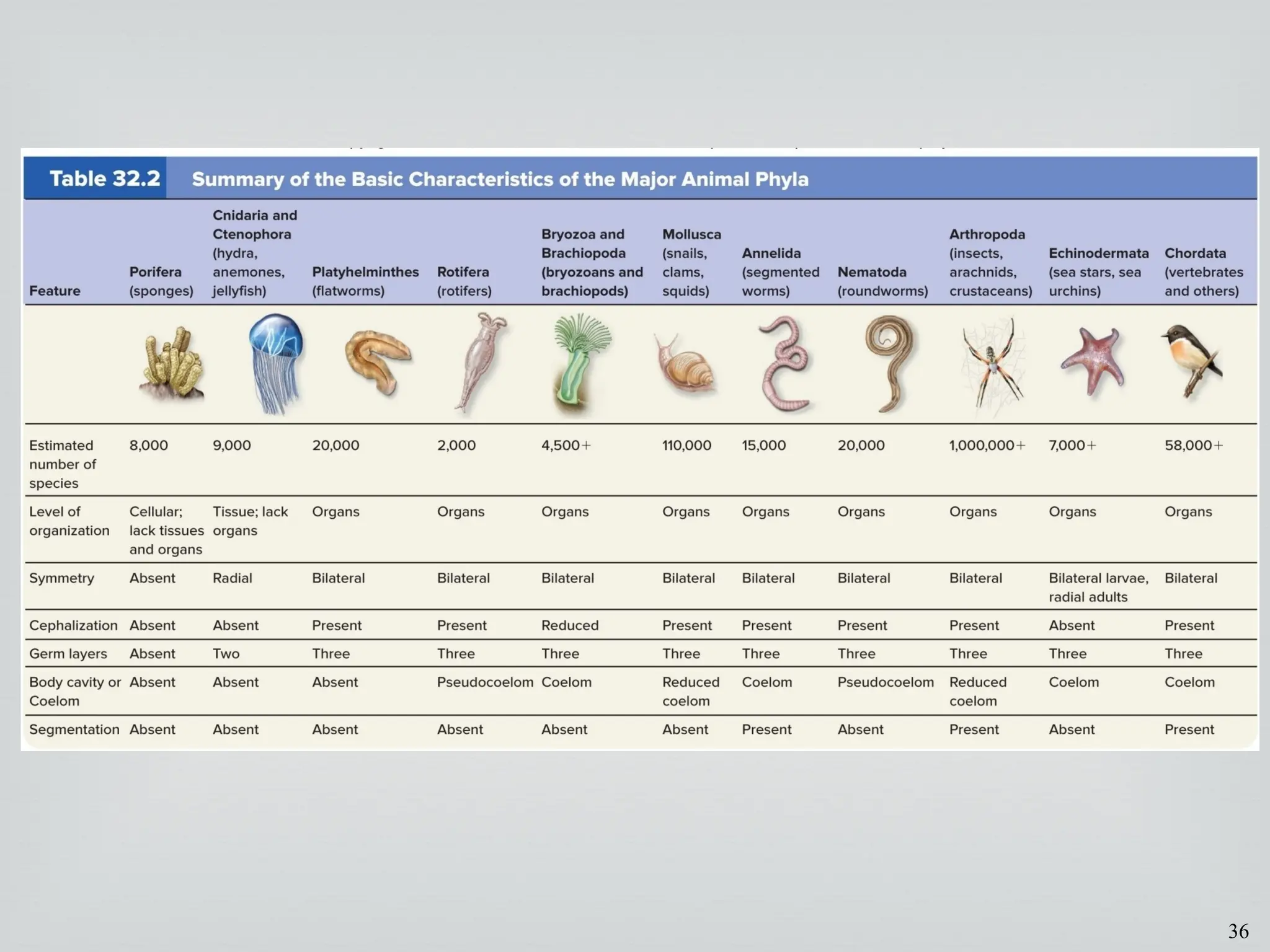
In thepast, presence or absence of a coelom, and the presence
of body segmentation was used in construction of
phylogenies
Molecular data suggest these features are unreliable in terms
of understanding evolutionary history
However, they continue to be useful in describing differences
in animal structure
Other Morphological Characteristics
used in Classification
24.
24
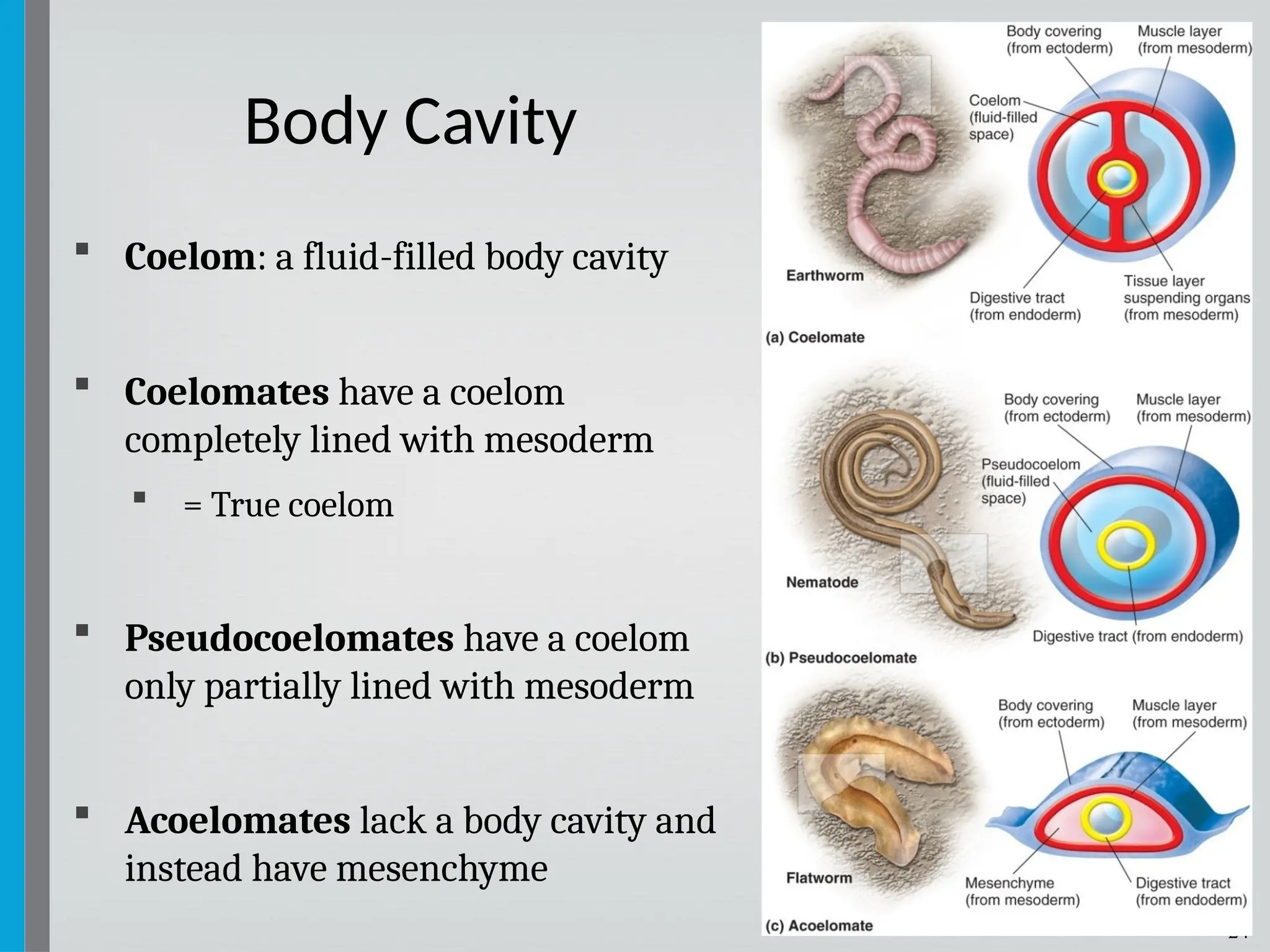
Coelom: afluid-filled body cavity
Coelomates have a coelom
completely lined with mesoderm
= True coelom
Pseudocoelomates have a coelom
only partially lined with mesoderm
Acoelomates lack a body cavity and
instead have mesenchyme
Body Cavity
25.
25
Cushions internalorgans
Enables movement and growth of internal organs independent of the
body wall
In some soft-bodied invertebrates, functions as a hydrostatic skeleton
Fluid-filled body cavity surrounded by muscles that gives support and
shape to the body
Muscle contractions push fluid from one part of the body to another
Fluid can act as a simple circulatory system
Functions of the Coelom
27
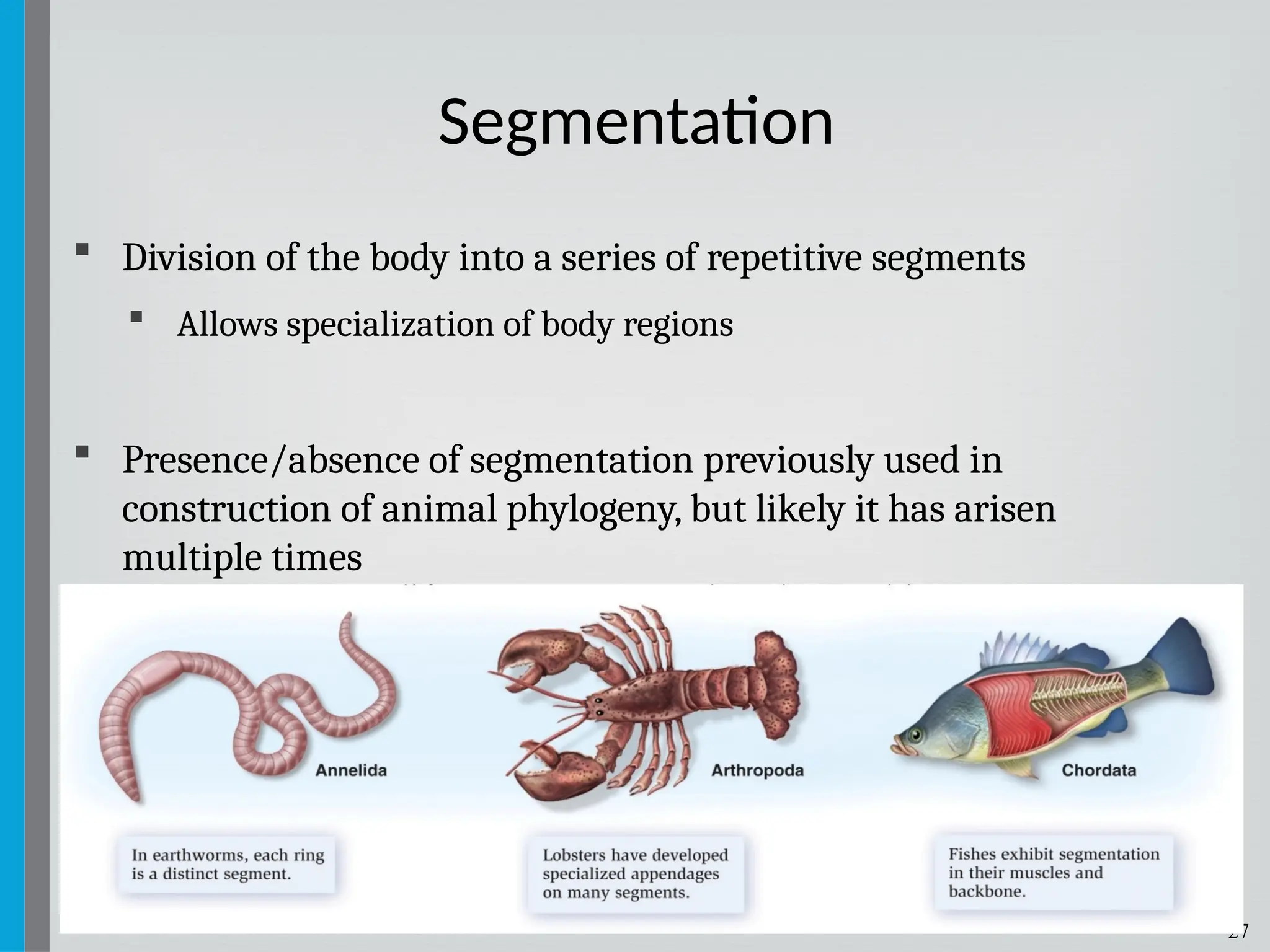
Division ofthe body into a series of repetitive segments
Allows specialization of body regions
Presence/absence of segmentation previously used in
construction of animal phylogeny, but likely it has arisen
multiple times
Segmentation
28.
28
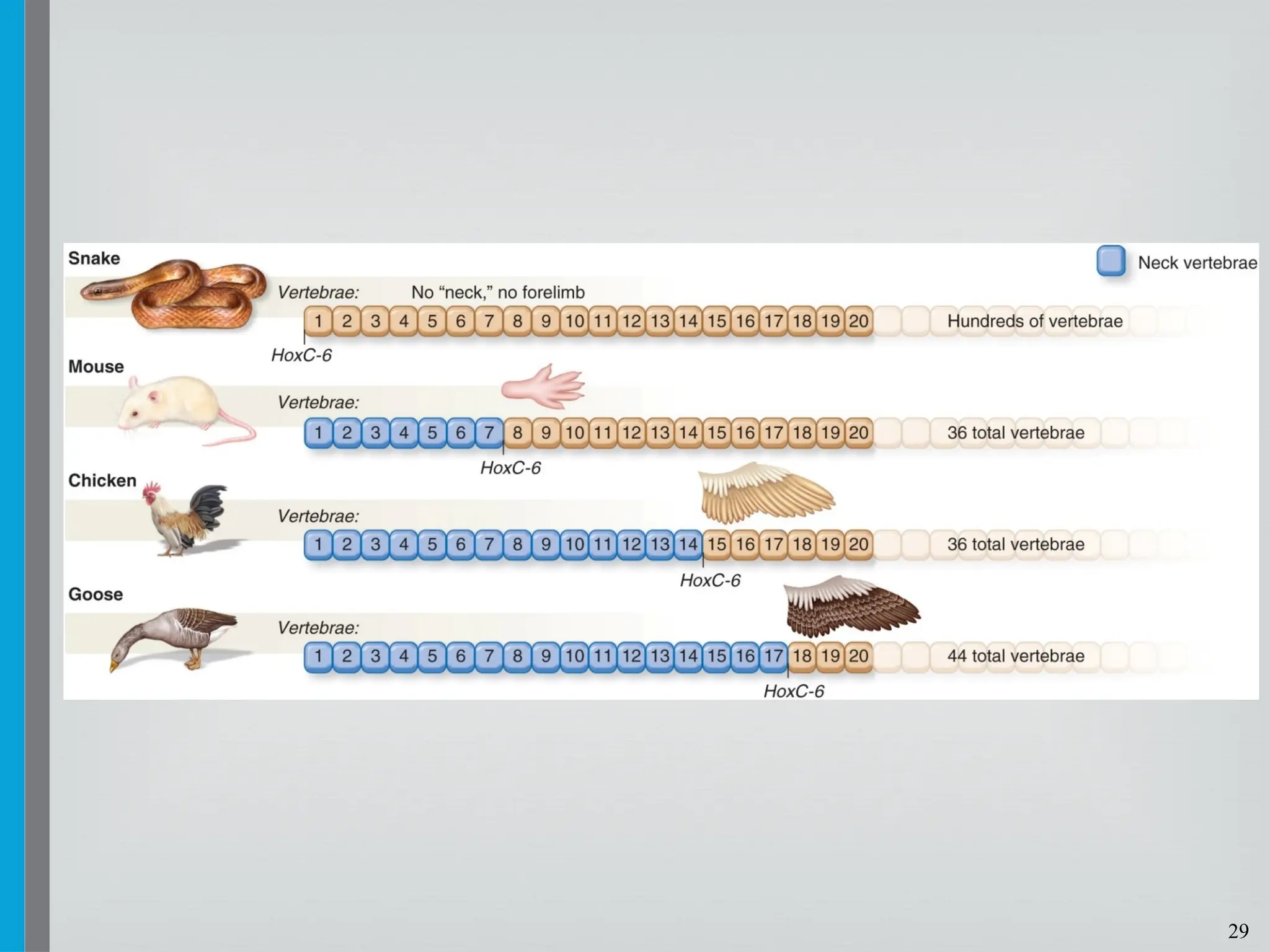
Changes inspecialization of body segments traced to changes in Hox
genes
Involved in pattern formation
In vertebrates, Hox gene expression along the anteroposterior axis
controls whether cervical (neck) vertebra or thoracic (chest) vertebra
develop
Expression of a gene called HoxC-6 determines the cervicothoracic
boundary
Shifts in where HoxC-6 is expressed affects neck length
Hox Genes & Segment Specialization
30
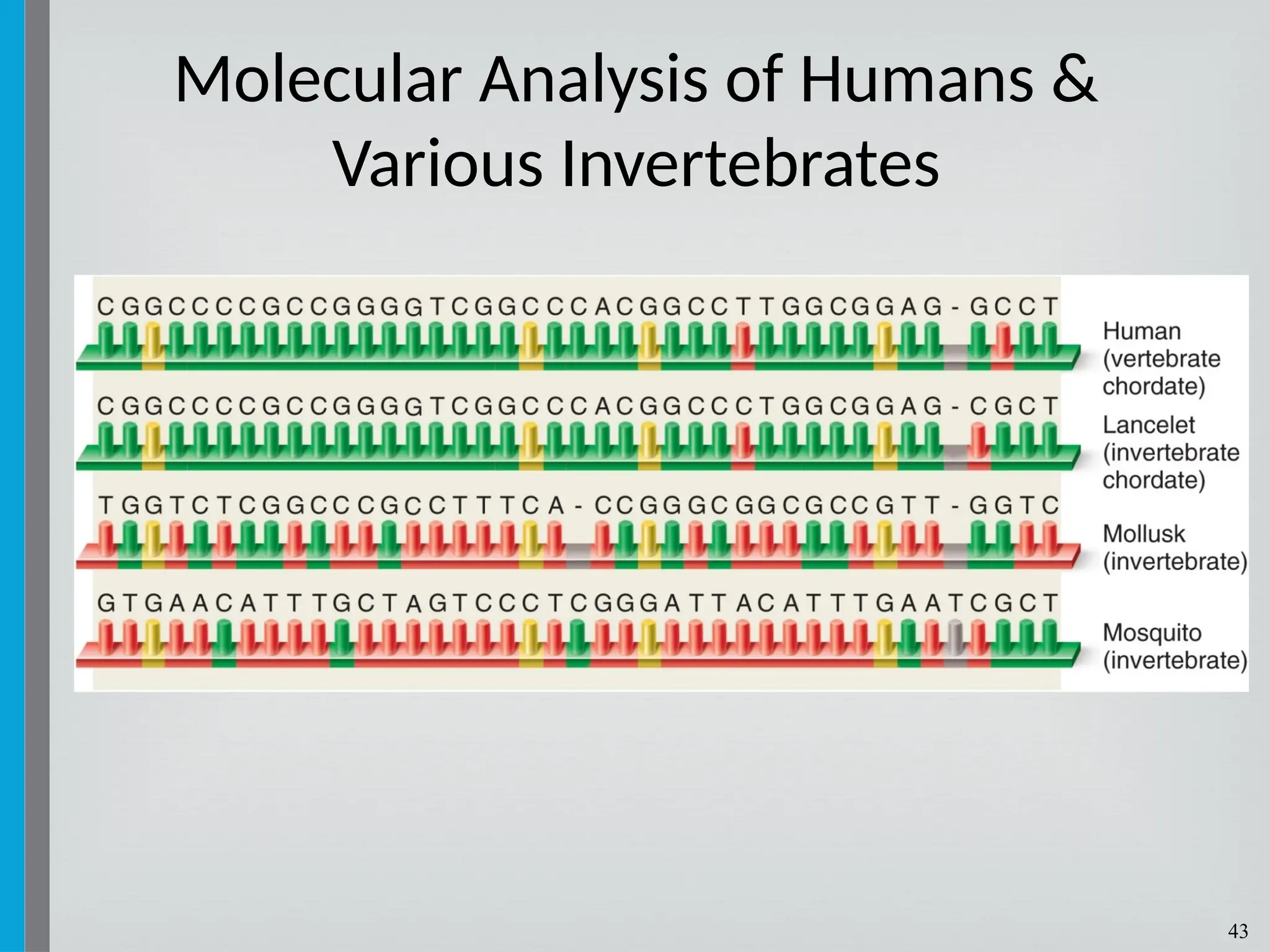
Molecular Views ofAnimal Diversity
Scientists now use molecular systematics to classify animals
and clarify questions posed by earlier data
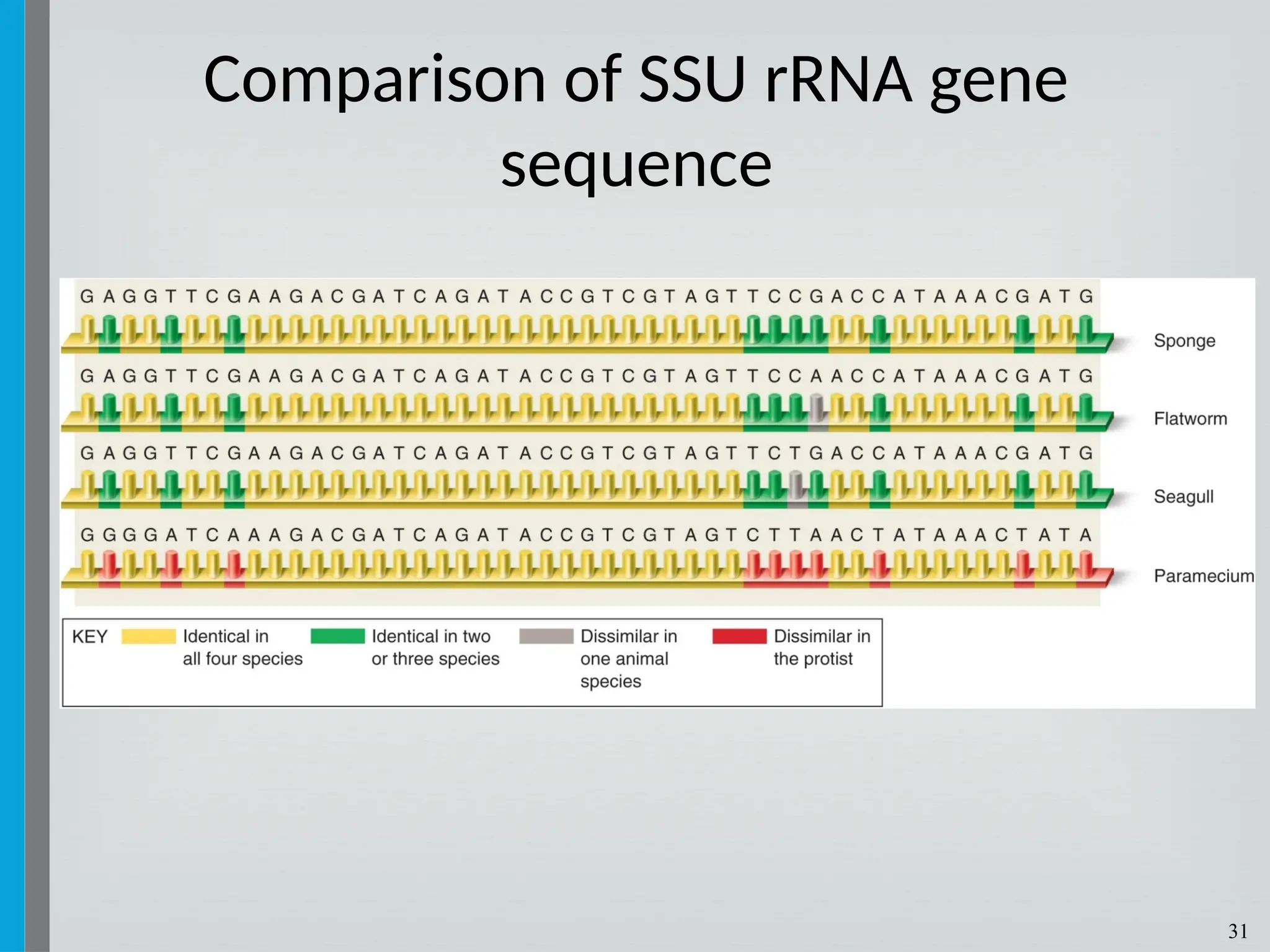
Compares similarity in DNA, RNA, and amino acid sequences
Closely related organisms have fewer differences than those
more distantly related
Advantage over morphological data in that genetic sequences
are easier to quantify and compare
DNA has only A, T, C, G
Morphological data are more subjective
33.3 Molecular Views of Animal Diversity
33
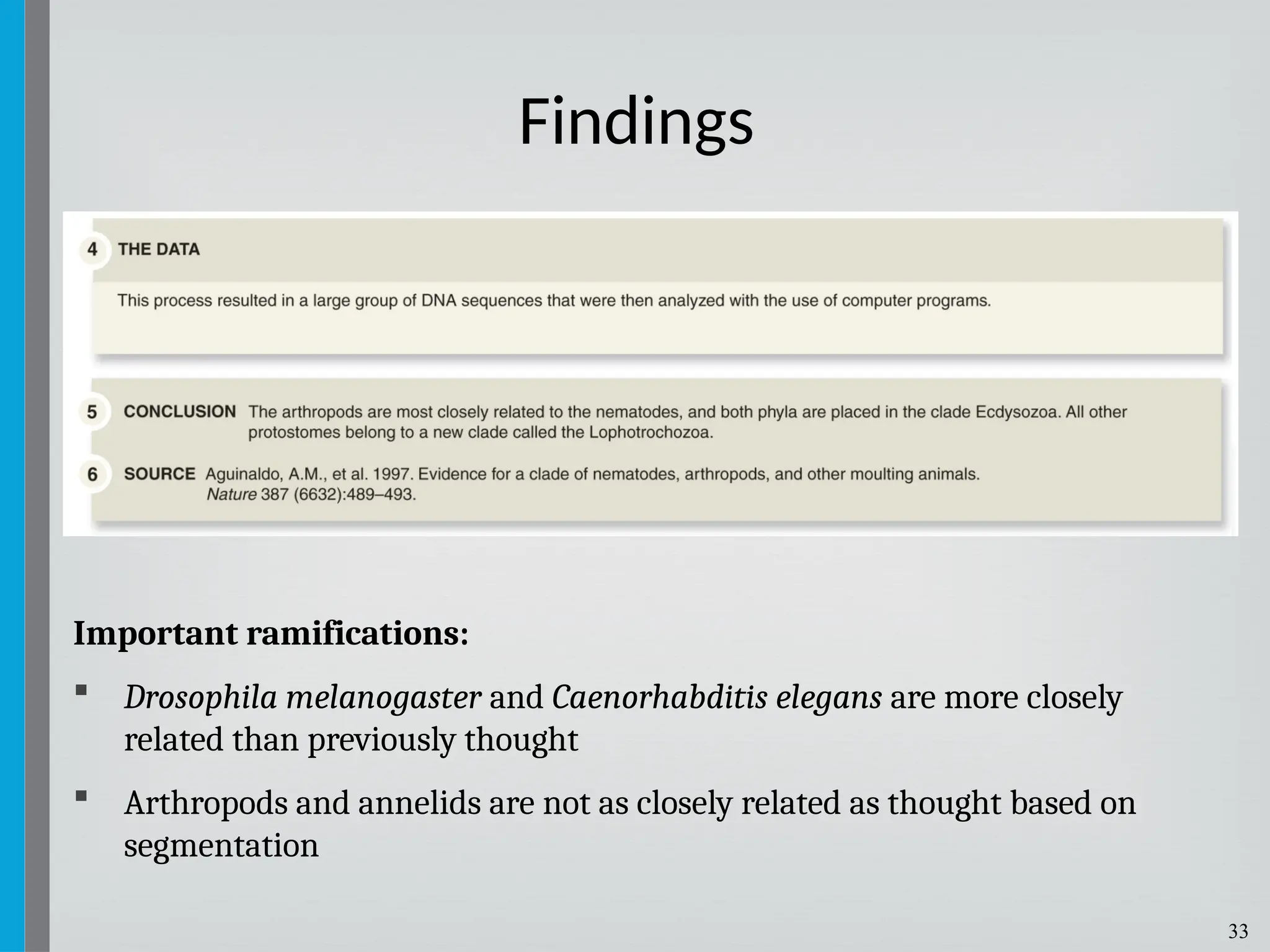
Important ramifications:
Drosophilamelanogaster and Caenorhabditis elegans are more closely
related than previously thought
Arthropods and annelids are not as closely related as thought based on
segmentation
Findings
34.
34
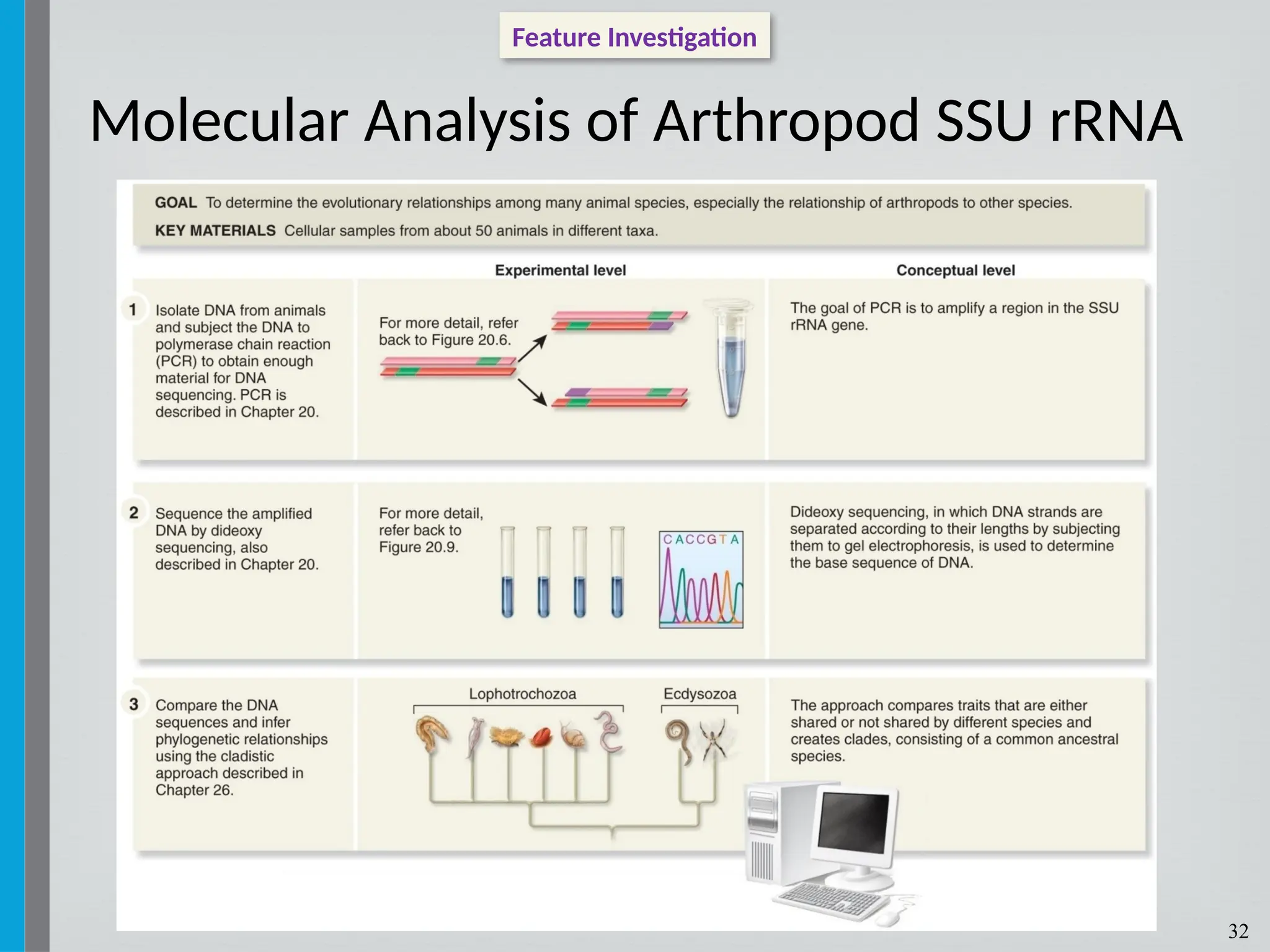
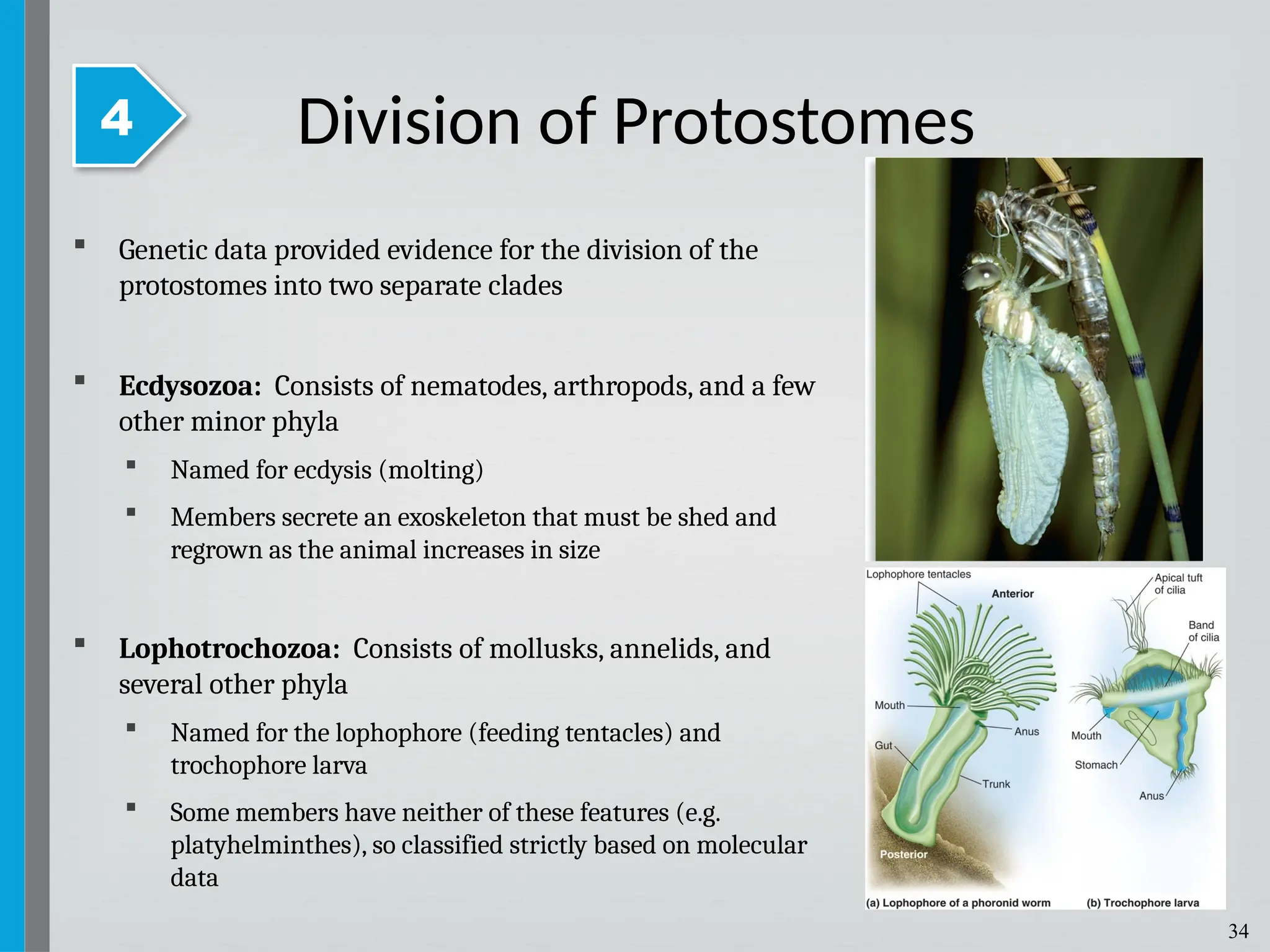
Genetic dataprovided evidence for the division of the
protostomes into two separate clades
Ecdysozoa: Consists of nematodes, arthropods, and a few
other minor phyla
Named for ecdysis (molting)
Members secrete an exoskeleton that must be shed and
regrown as the animal increases in size
Lophotrochozoa: Consists of mollusks, annelids, and
several other phyla
Named for the lophophore (feeding tentacles) and
trochophore larva
Some members have neither of these features (e.g.
platyhelminthes), so classified strictly based on molecular
data
Division of Protostomes
4
38
Deuterostomia
The deuterostomesincludes two phyla:
Echinodermata and Chordata
Share similar pattern of development
Relationship supported by molecular
evidence
Echinoderms includes sea stars, sea urchins
and sea cucumbers
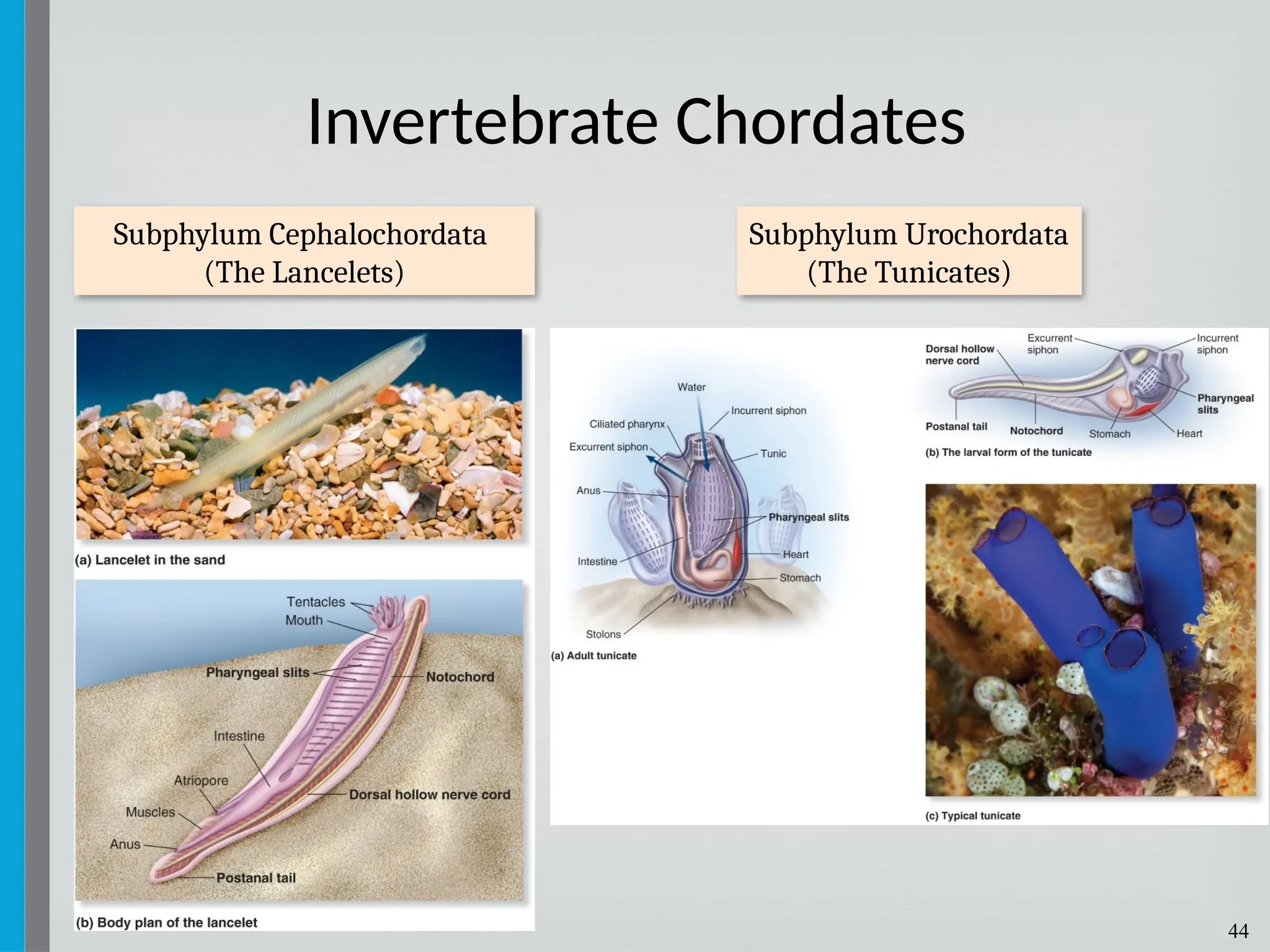
Chordates includes all vertebrates and some
invertebrates
A tiny bit of 34.6
39.
39
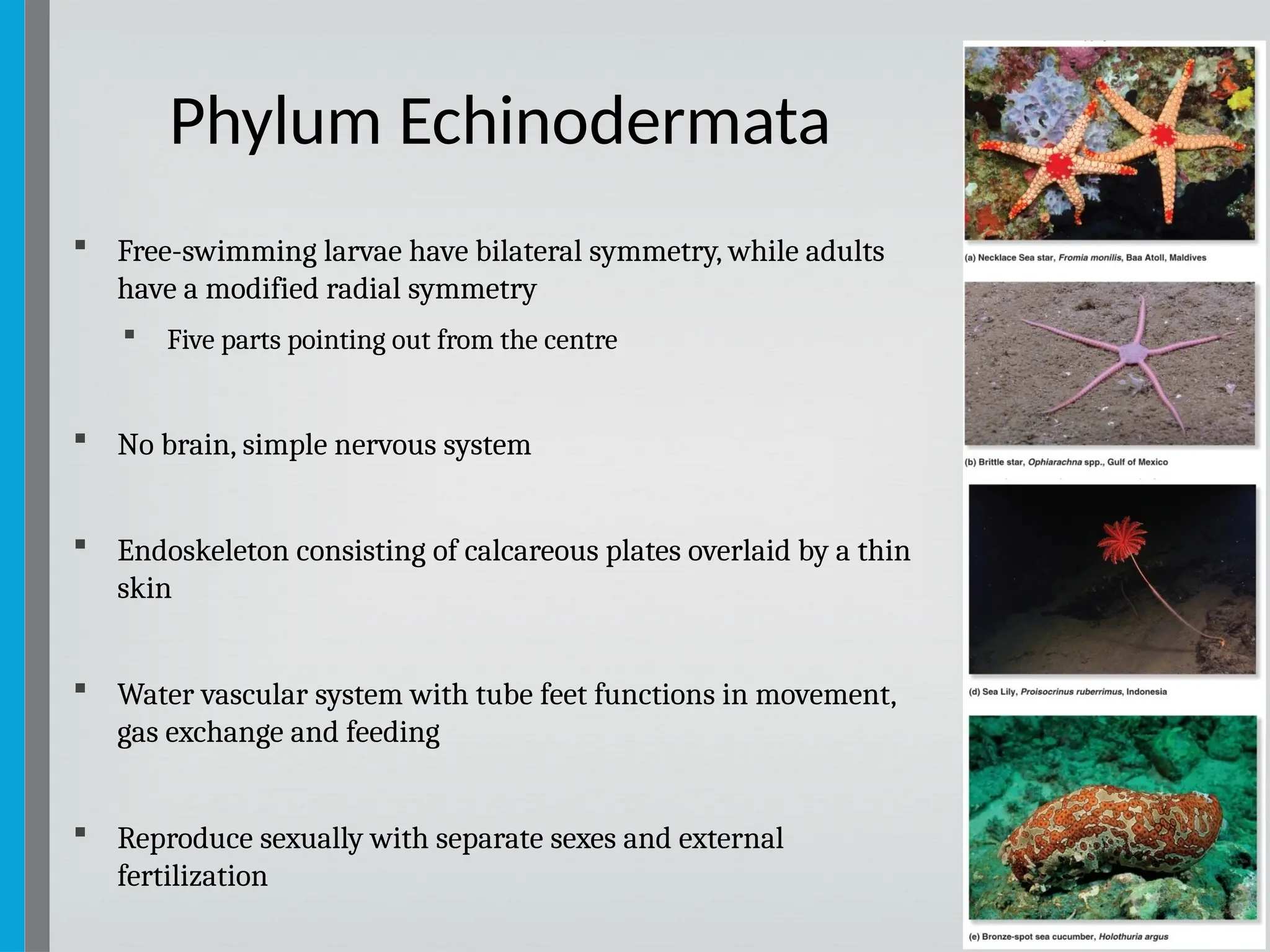
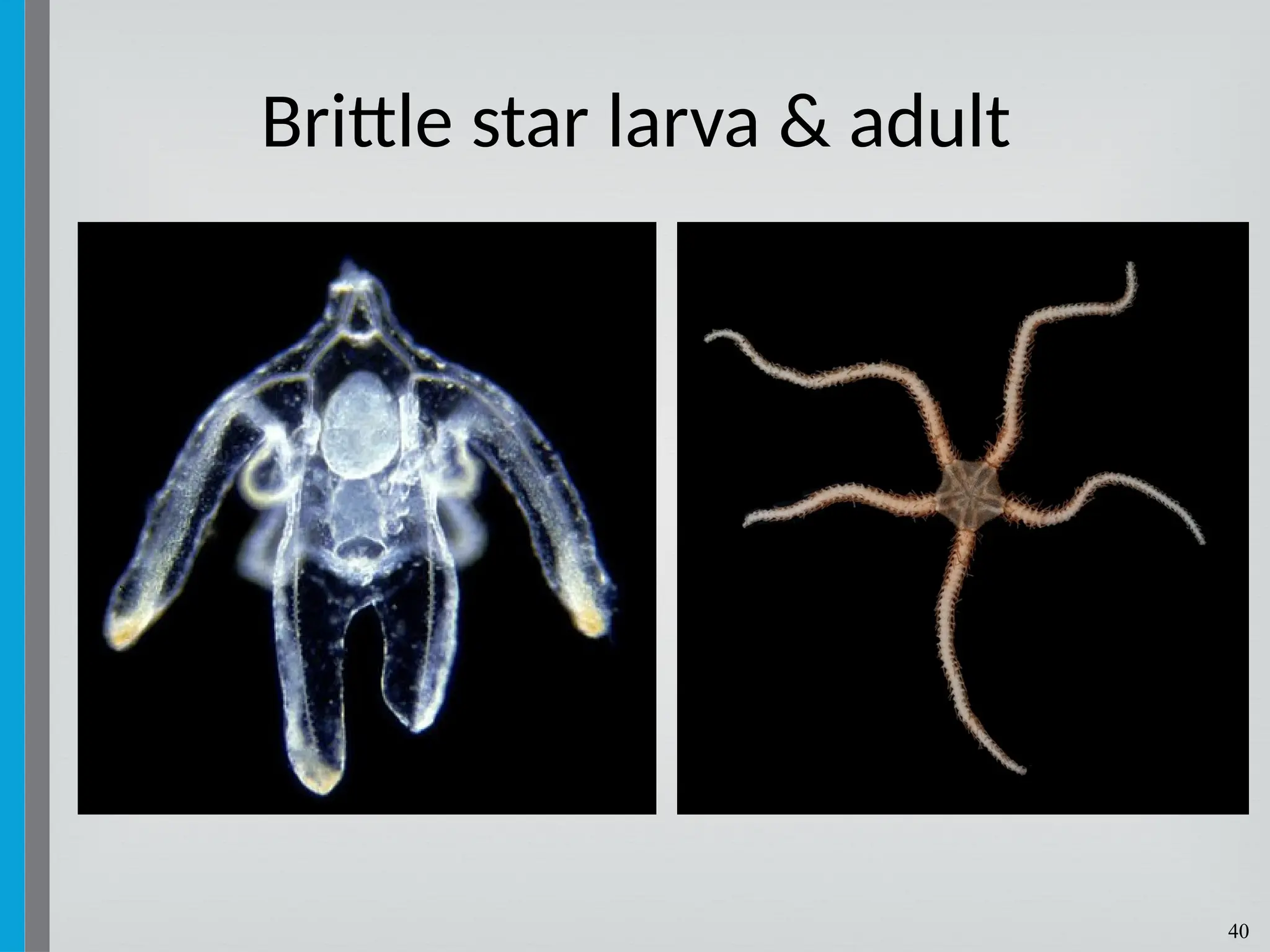
Free-swimming larvaehave bilateral symmetry, while adults
have a modified radial symmetry
Five parts pointing out from the centre
No brain, simple nervous system
Endoskeleton consisting of calcareous plates overlaid by a thin
skin
Water vascular system with tube feet functions in movement,
gas exchange and feeding
Reproduce sexually with separate sexes and external
fertilization
Phylum Echinodermata
41
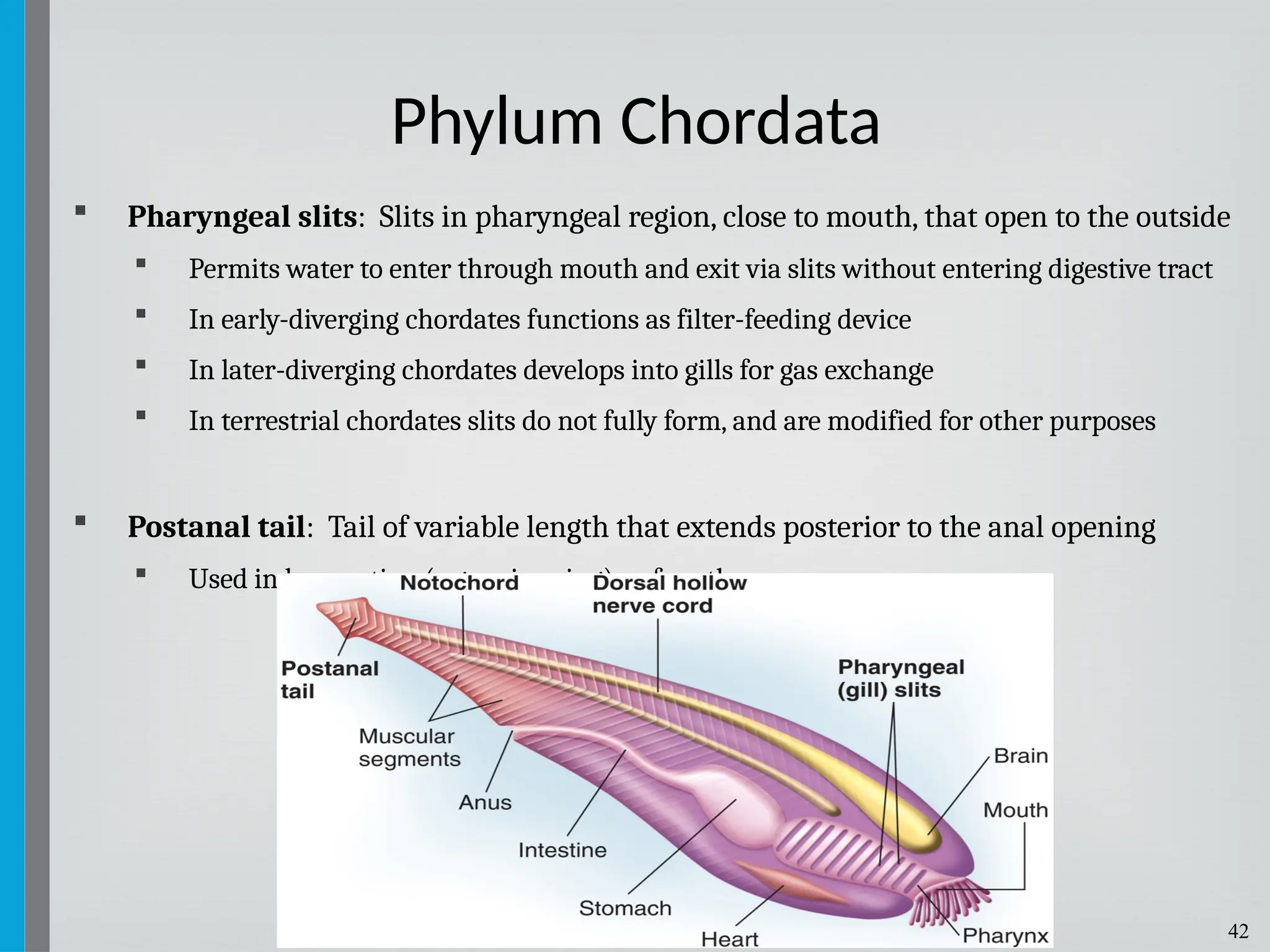
Four critical innovationsin body plan exhibited at some point
during development:
Notochord: Single flexible rod that lies between the digestive
tract and the nerve cord
Provides skeletal support for early diverging chordates
In vertebrates, mostly replaced by complex jointed backbone
Dorsal hollow nerve cord: Hollow tube that develops dorsal
to the digestive tract
In vertebrates, develops into brain and spinal cord
Phylum Chordata
42.
42
Pharyngeal slits:Slits in pharyngeal region, close to mouth, that open to the outside
Permits water to enter through mouth and exit via slits without entering digestive tract
In early-diverging chordates functions as filter-feeding device
In later-diverging chordates develops into gills for gas exchange
In terrestrial chordates slits do not fully form, and are modified for other purposes
Postanal tail: Tail of variable length that extends posterior to the anal opening
Used in locomotion (e.g. swimming) or for other purposes
Phylum Chordata
45
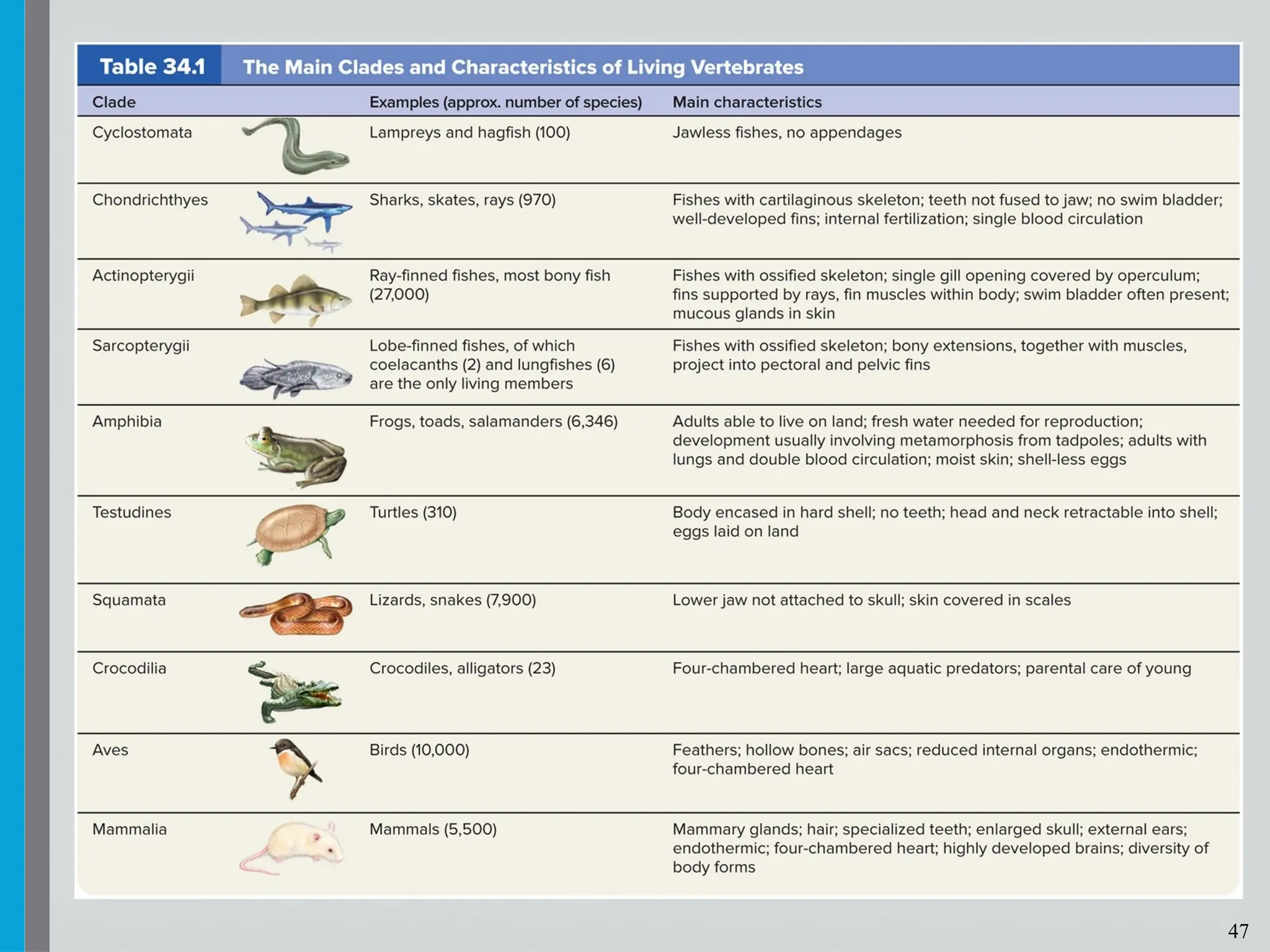
Retain all chordatecharacteristics, plus have:
A vertebral column: Notochord is replaced by a bony or cartilaginous
column of interlocking vertebrae
Provides support & protects nerve cord
Cranium: Bony or cartilaginous housing that protects a more developed
brain
Endoskeleton of cartilage or bone
Very strong yet flexible
Also have a greater diversity and complexity of internal organs
Vertebrates




![The animal kingdom.pptxrb[1]](https://cdn.slidesharecdn.com/ss_thumbnails/theanimalkingdom-pptxrb1-121031071444-phpapp02-thumbnail.jpg?width=640&height=640&fit=bounds)


