Leveraging Transformative Learning Theory to Promote
Student Development in Times of Campus Crisis
Nate Cradit
PhD Student, Michigan State University
Higher, Adult, & Lifelong Education
@natecradit
Marc Hunsaker
PhD Student, Michigan State University
Program Manager, Center for Service-Learning
@marchunsaker
A look at our presentation agenda
Today’s
Agenda
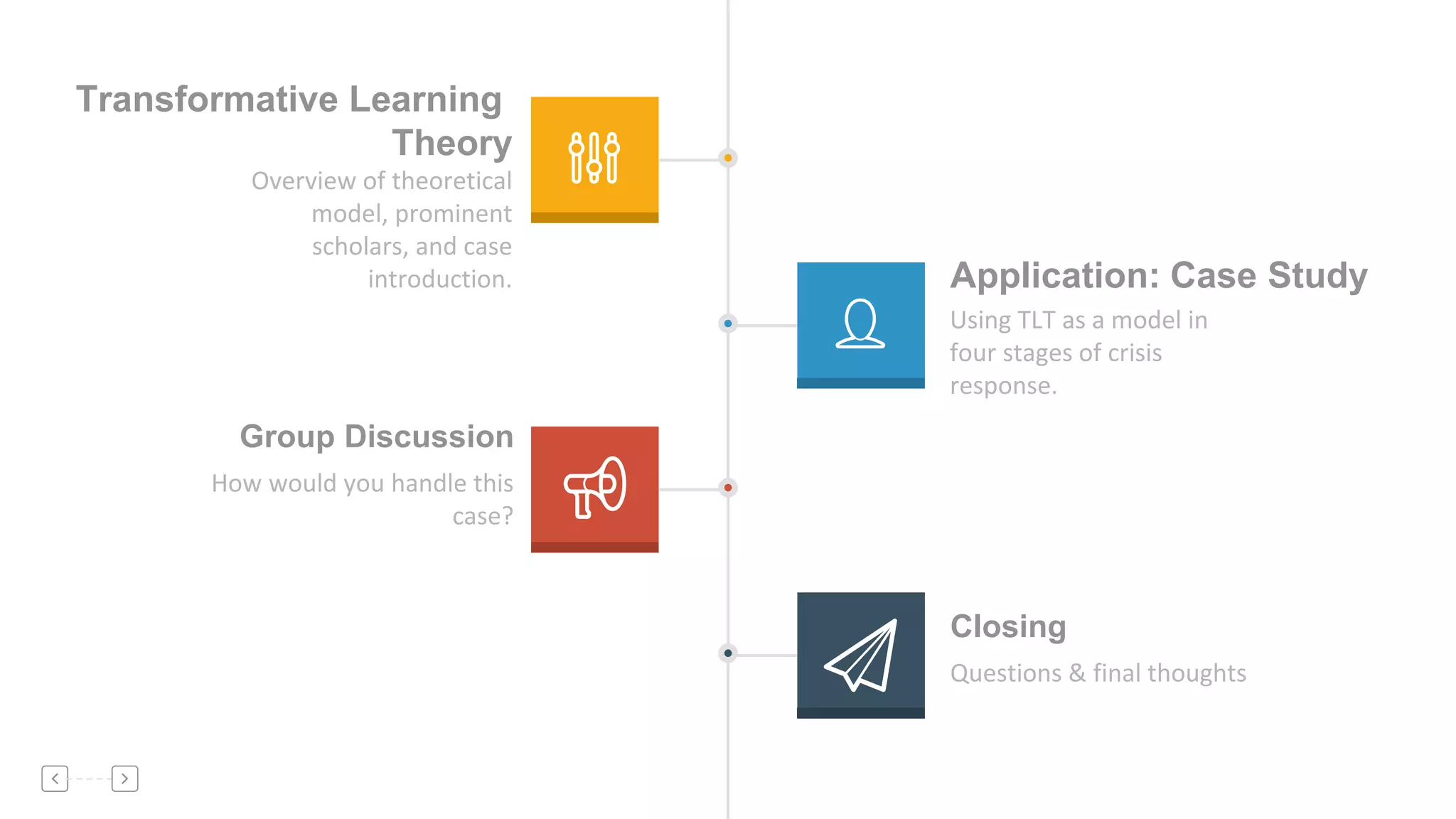
Introductions
Outcomes & Presenter
Context
The problem
Campus Crises and Going
Through vs. Growing Through
Transformative Learning
Theory
Overview of theoretical
model, prominent
scholars, and case
introduction. Application: Case Study
Using TLT as a model in
four stages of crisis
response.
Group Discussion
How would you handle this
case?
Closing
Questions & final thoughts
The Problem
As crises become more frequent, must students simply go through them?
Or can they grow through them as well?
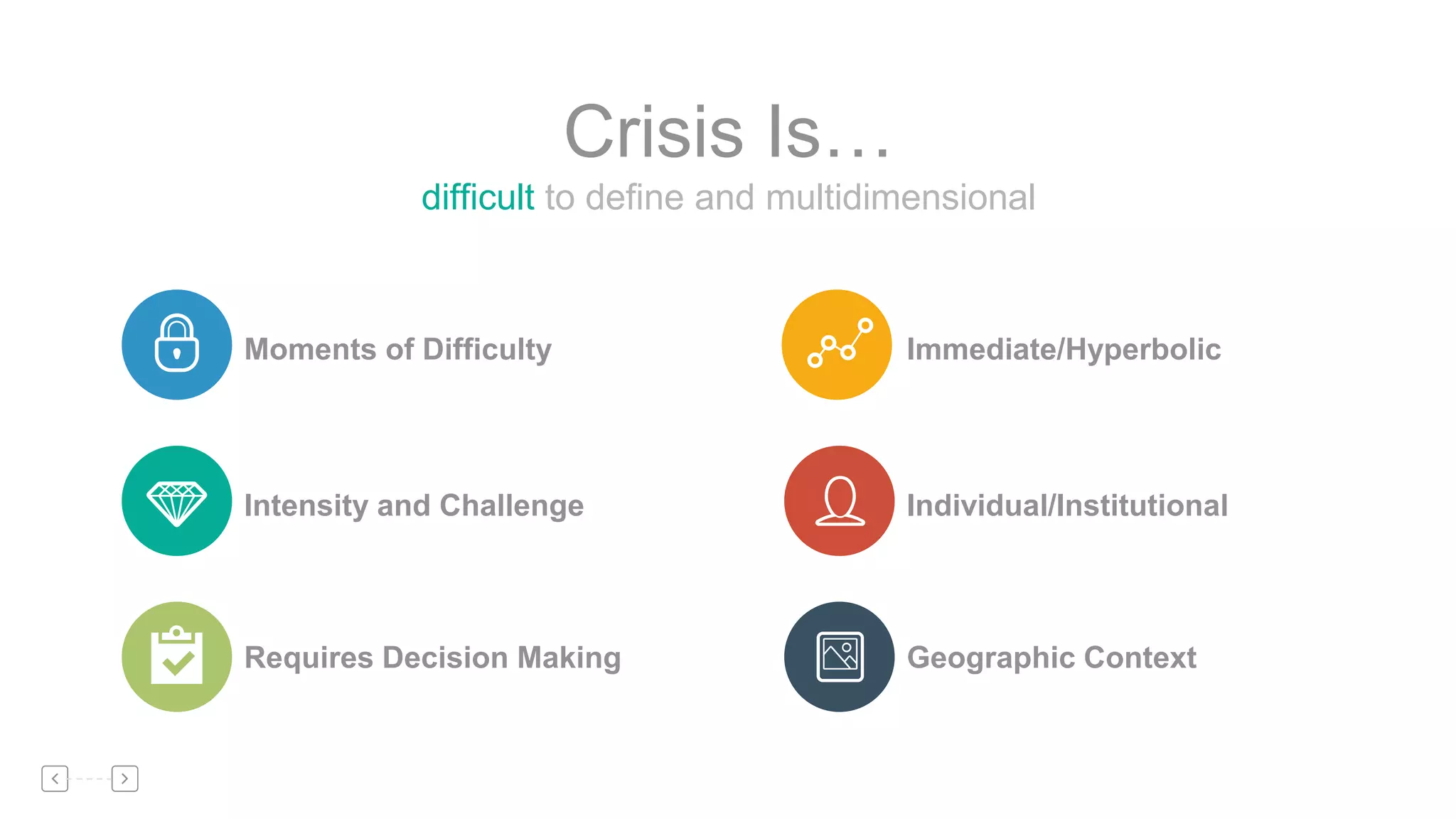
difficult to define and multidimensional
Crisis Is…
Moments of Difficulty
Intensity and Challenge
Requires Decision Making
Immediate/Hyperbolic
Individual/Institutional
Geographic Context
6
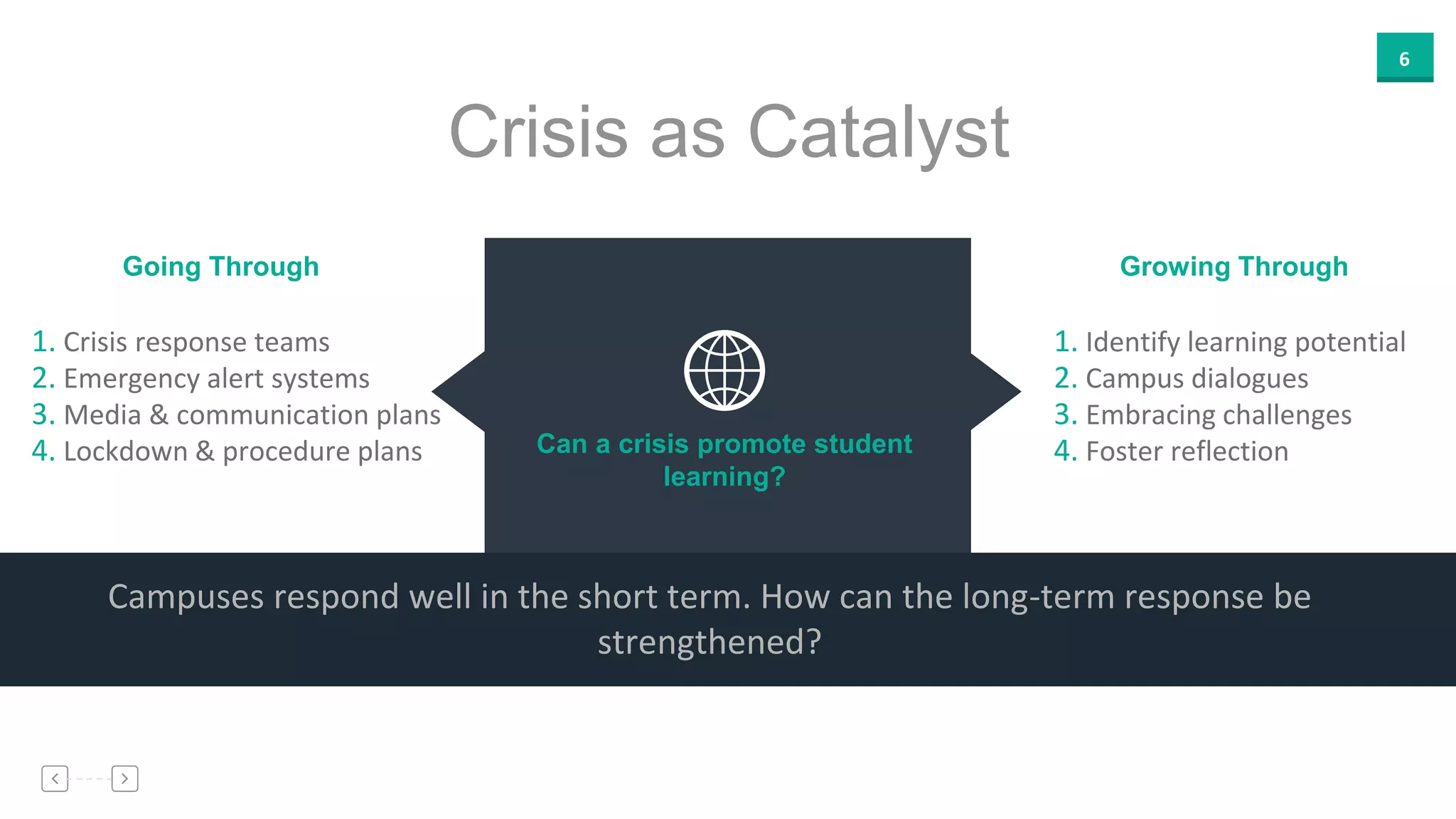
Crisis as Catalyst
Can a crisis promote student
learning?
Campuses respond well in the short term. How can the long-term response be
strengthened?
1. Crisis response teams
2. Emergency alert systems
3. Media & communication plans
4. Lockdown & procedure plans
Going Through
1. Identify learning potential
2. Campus dialogues
3. Embracing challenges
4. Foster reflection
Growing Through
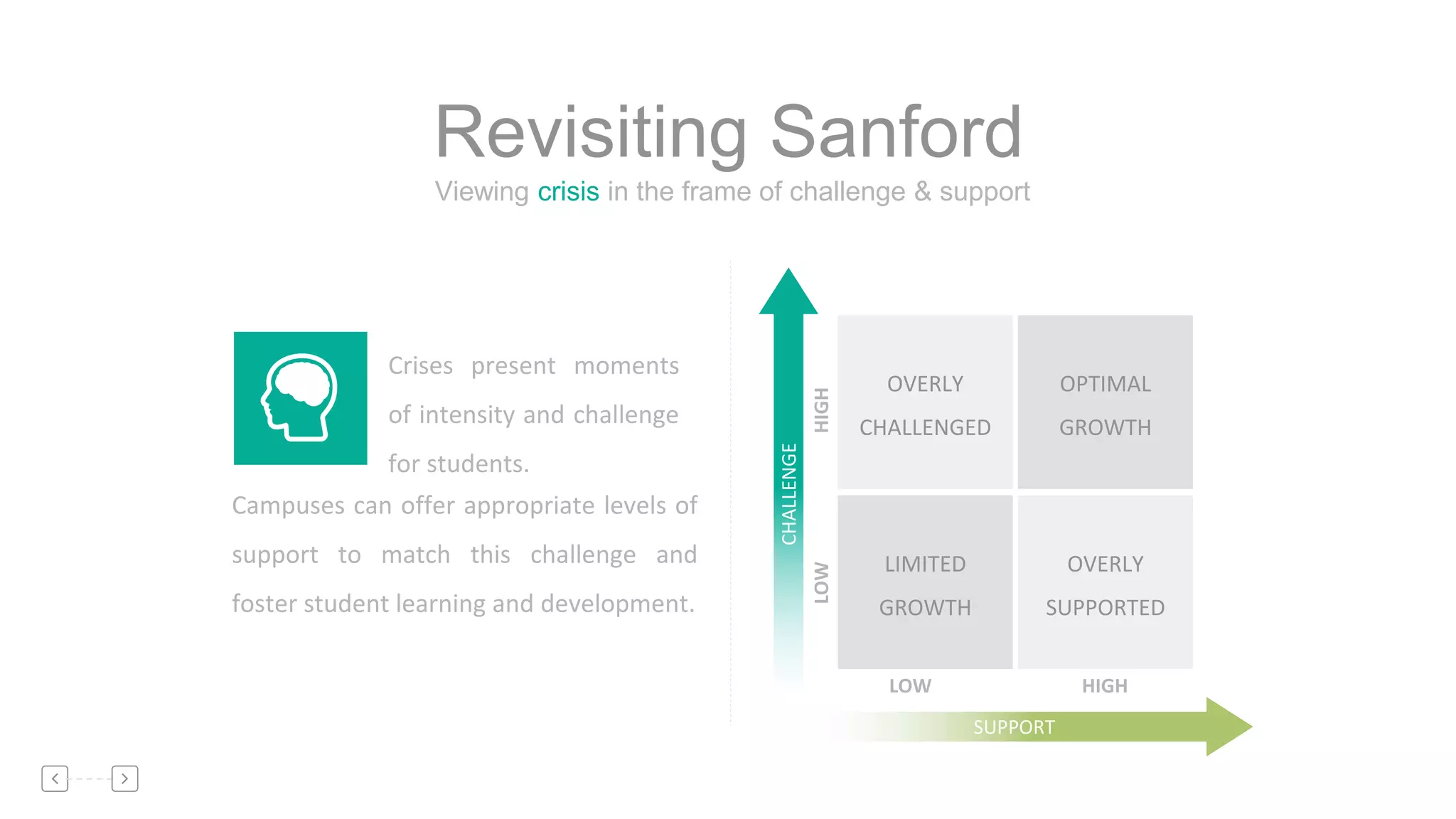
Revisiting Sanford
Viewing crisis in the frame of challenge & support
OVERLY
CHALLENGED
OPTIMAL
GROWTH
LIMITED
GROWTH
OVERLY
SUPPORTED
HIGHLOW
HIGHLOW
CHALLENGE
SUPPORT
Campuses can offer appropriate levels of
support to match this challenge and
foster student learning and development.
Crises present moments
of intensity and challenge
for students.
Transformative Learning Theory
Overview of existing theoretical model, prominent scholars, and
potential applications
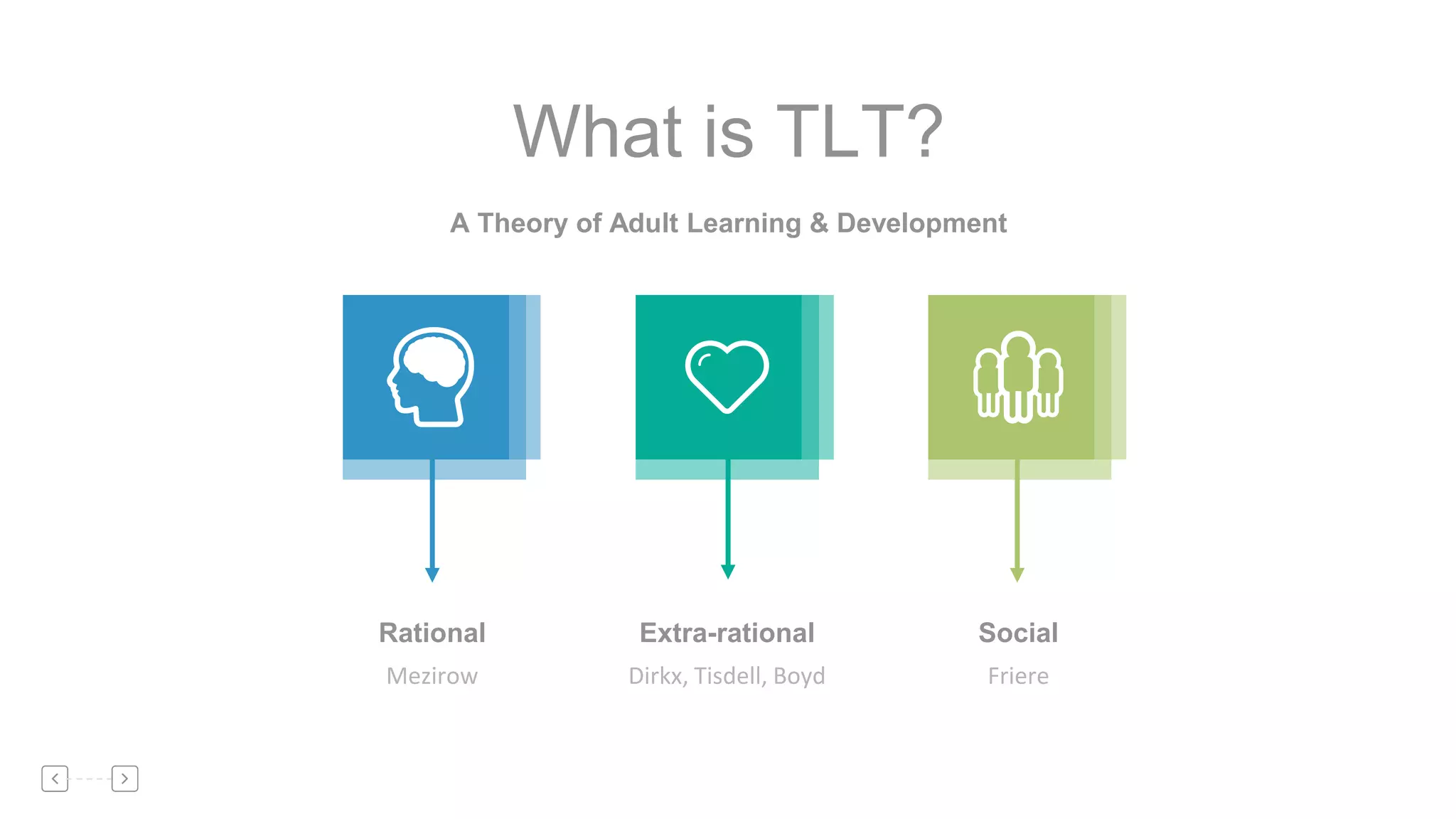
What is TLT?
A Theory of Adult Learning & Development
Rational
Mezirow
Extra-rational
Dirkx, Tisdell, Boyd
Social
Friere
10
Core concepts
Mezirow
Transformative Learning…
Is NOT - focused simply on the acquisition of skills
and knowledge.
IS - focused on a deeper type of learning, one that
results in a cognitive ‘paradigm shift’, through the
changing of a person’s “meaning perspectives”.
(Mezirow, 1991)
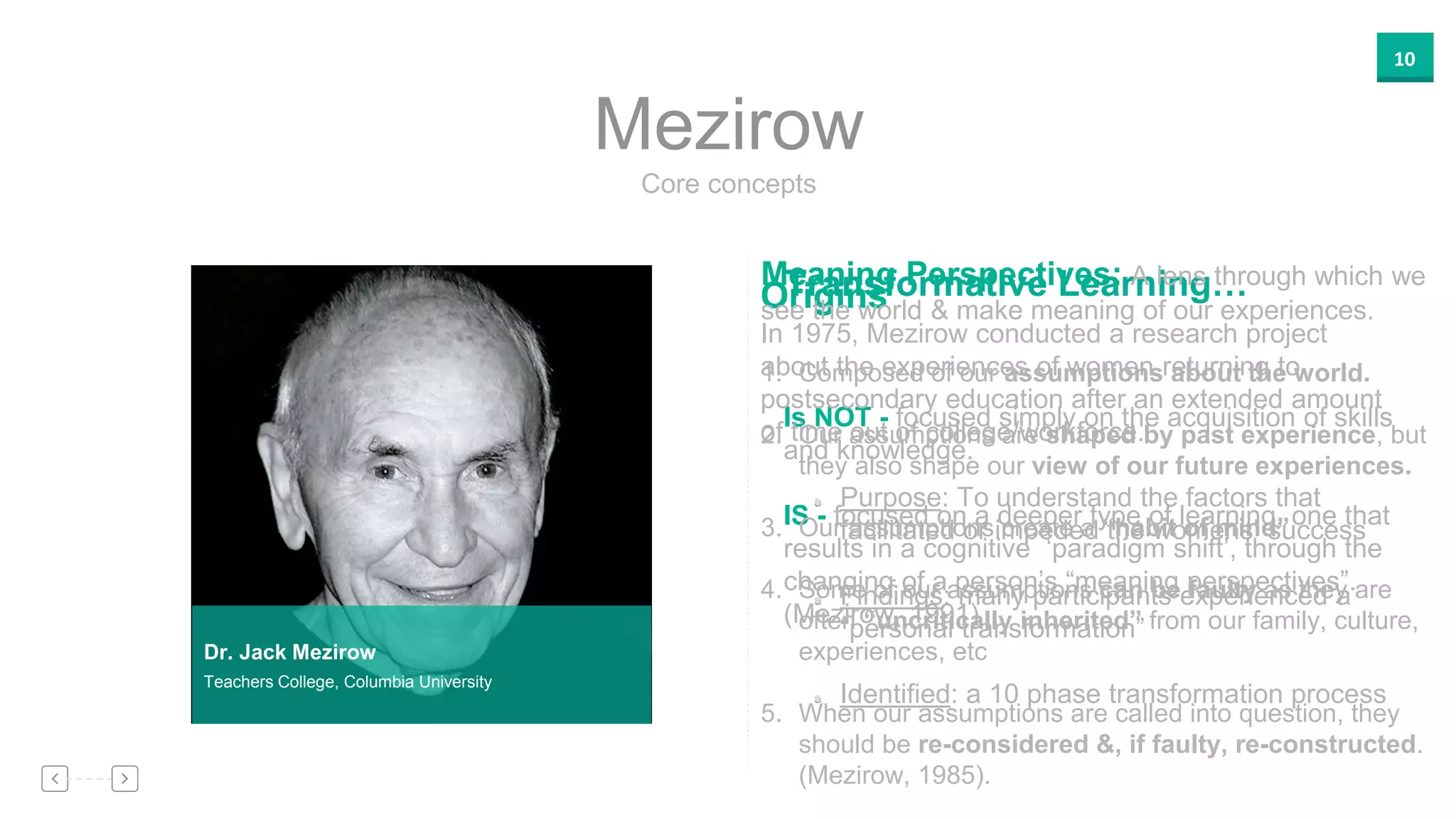
Dr. Jack Mezirow
Teachers College, Columbia University
Origins
In 1975, Mezirow conducted a research project
about the experiences of women returning to
postsecondary education after an extended amount
of time out of college/workforce.
Purpose: To understand the factors that
facilitated or impeded the womens’ success
Findings: many participants experienced a
“personal transformation”
Identified: a 10 phase transformation process
Meaning Perspectives: A lens through which we
see the world & make meaning of our experiences.
1. Composed of our assumptions about the world.
2. Our assumptions are shaped by past experience, but
they also shape our view of our future experiences.
3. Our assumptions create a “habit of mind”
4. Some of our assumptions can be faulty as they are
often “uncritically inherited” from our family, culture,
experiences, etc
5. When our assumptions are called into question, they
should be re-considered &, if faulty, re-constructed.
(Mezirow, 1985).
11
Transformative Learning
Definition
”
“
Dr. Jack Mezirow
1991
Perspective transformation [is]… changing these
structures of habitual expectation to make possible
a more inclusive, discriminating, and integrating
perspective; and, finally, making choices or
otherwise acting upon these new understandings.
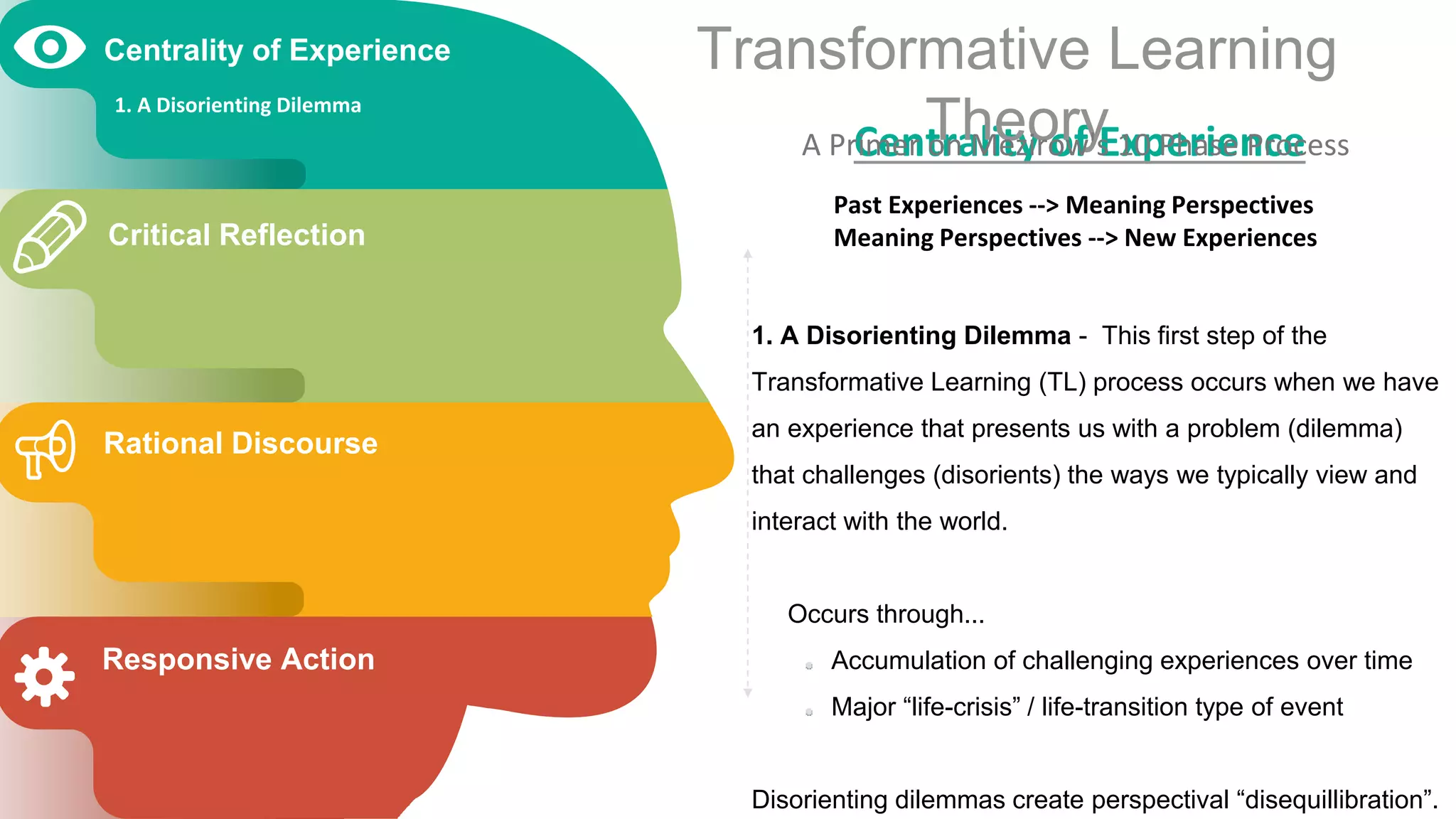
Centrality of Experience
1. A Disorienting Dilemma - This first step of the
Transformative Learning (TL) process occurs when we have
an experience that presents us with a problem (dilemma)
that challenges (disorients) the ways we typically view and
interact with the world.
Occurs through...
Accumulation of challenging experiences over time
Major “life-crisis” / life-transition type of event
Disorienting dilemmas create perspectival “disequillibration”.
Past Experiences --> Meaning Perspectives
Meaning Perspectives --> New Experiences
Transformative Learning
Theory
Centrality of Experience
1. A Disorienting Dilemma
Critical Reflection
Rational Discourse
Responsive Action
A Primer on Mezirow's 10 Phase Process
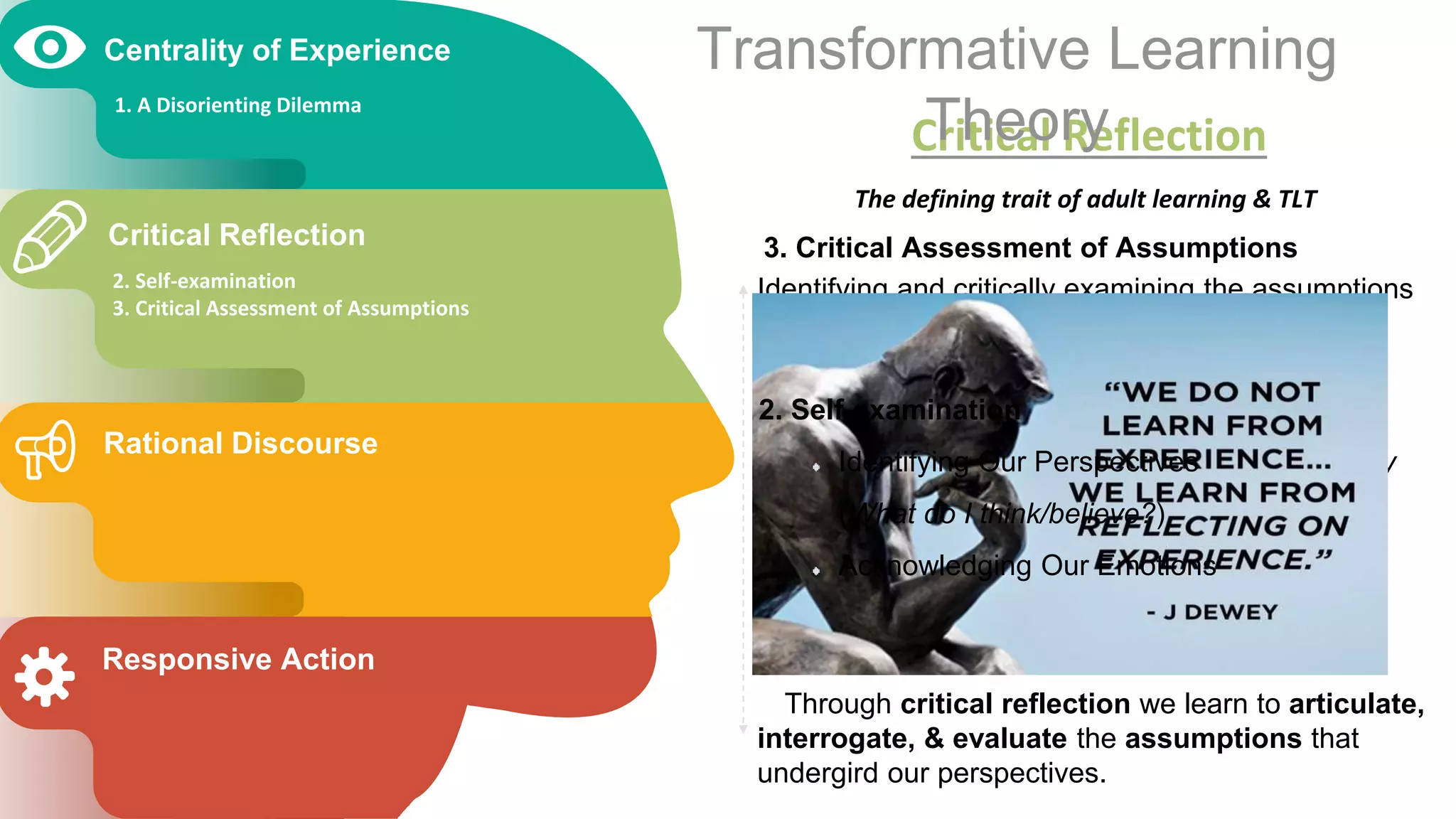
Critical Reflection
3. Critical Assessment of Assumptions
Identifying and critically examining the assumptions
beneath our beliefs and ideas.
This includes understanding their…
Origins - Why do I think/believe this?
Implications - What are consequences of my
beliefs?
Validity - How do my assumptions align
w/experience?
Goal: Should I continue to think/believe
this?
Through critical reflection we learn to articulate,
interrogate, & evaluate the assumptions that
undergird our perspectives.
The defining trait of adult learning & TLT
Centrality of Experience
1. A Disorienting Dilemma
Critical Reflection
2. Self-examination
3. Critical Assessment of Assumptions
Rational Discourse
Responsive Action
Transformative Learning
Theory
2. Self-examination
Identifying Our Perspectives
(What do I think/believe?)
Acknowledging Our Emotions
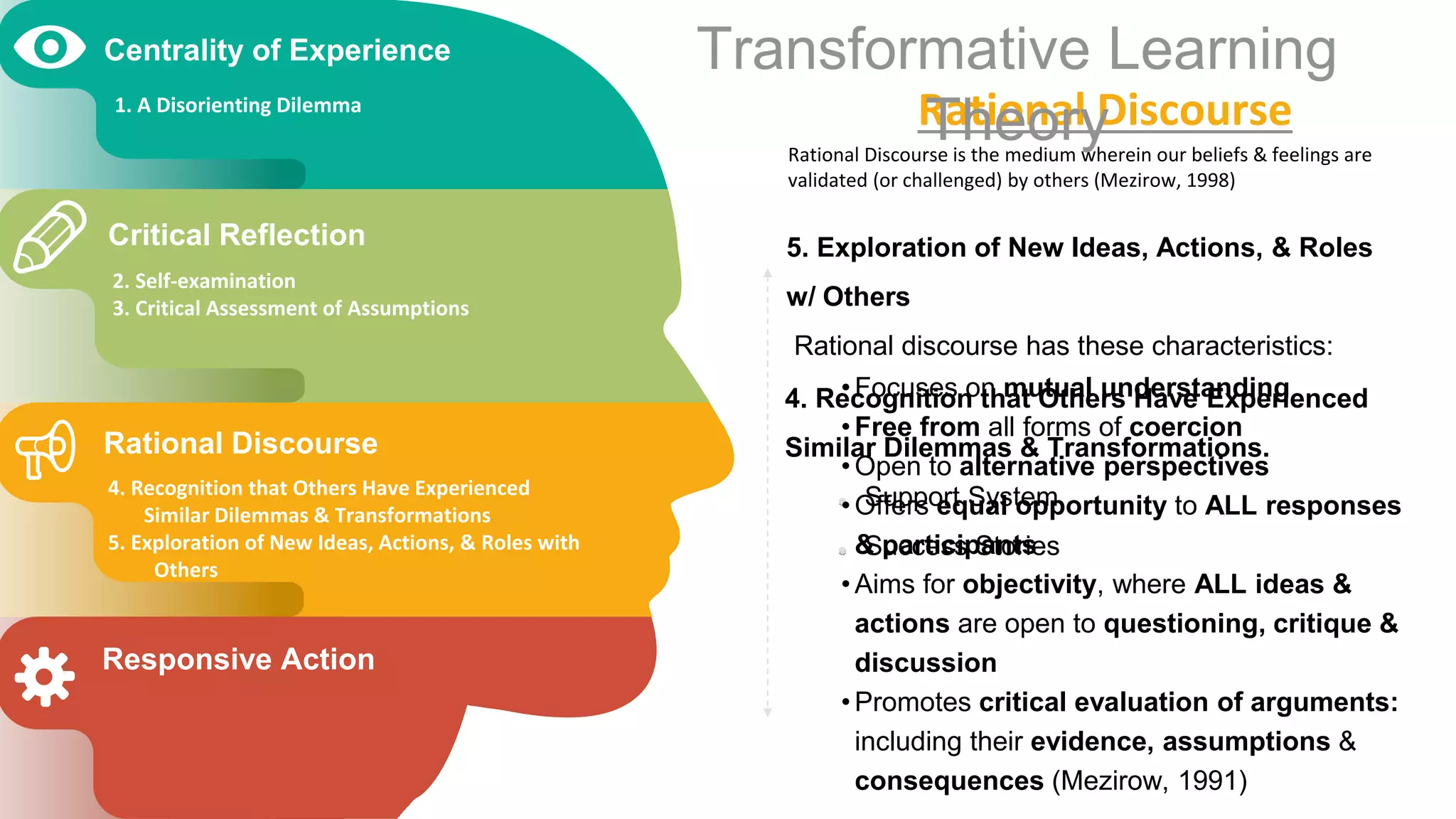
4. Recognition that Others Have Experienced
Similar Dilemmas & Transformations.
Support System
Success Stories
Rational Discourse
Rational Discourse is the medium wherein our beliefs & feelings are
validated (or challenged) by others (Mezirow, 1998)
Centrality of Experience
1. A Disorienting Dilemma
Critical Reflection
2. Self-examination
3. Critical Assessment of Assumptions
Rational Discourse
4. Recognition that Others Have Experienced
Similar Dilemmas & Transformations
5. Exploration of New Ideas, Actions, & Roles with
Others
Responsive Action
Transformative Learning
Theory
5. Exploration of New Ideas, Actions, & Roles
w/ Others
Rational discourse has these characteristics:
•Focuses on mutual understanding
•Free from all forms of coercion
•Open to alternative perspectives
•Offers equal opportunity to ALL responses
& participants
•Aims for objectivity, where ALL ideas &
actions are open to questioning, critique &
discussion
•Promotes critical evaluation of arguments:
including their evidence, assumptions &
consequences (Mezirow, 1991)
Centrality of Experience
1. A Disorienting Dilemma
Critical Reflection
2. Self-examination
3. Critical Assessment of Assumptions
Rational Discourse
4. Recognition that Others Have Experienced
Similar Dilemmas & Transformations
5. Exploration of New Ideas, Actions, & Roles with
Others
Responsive Action
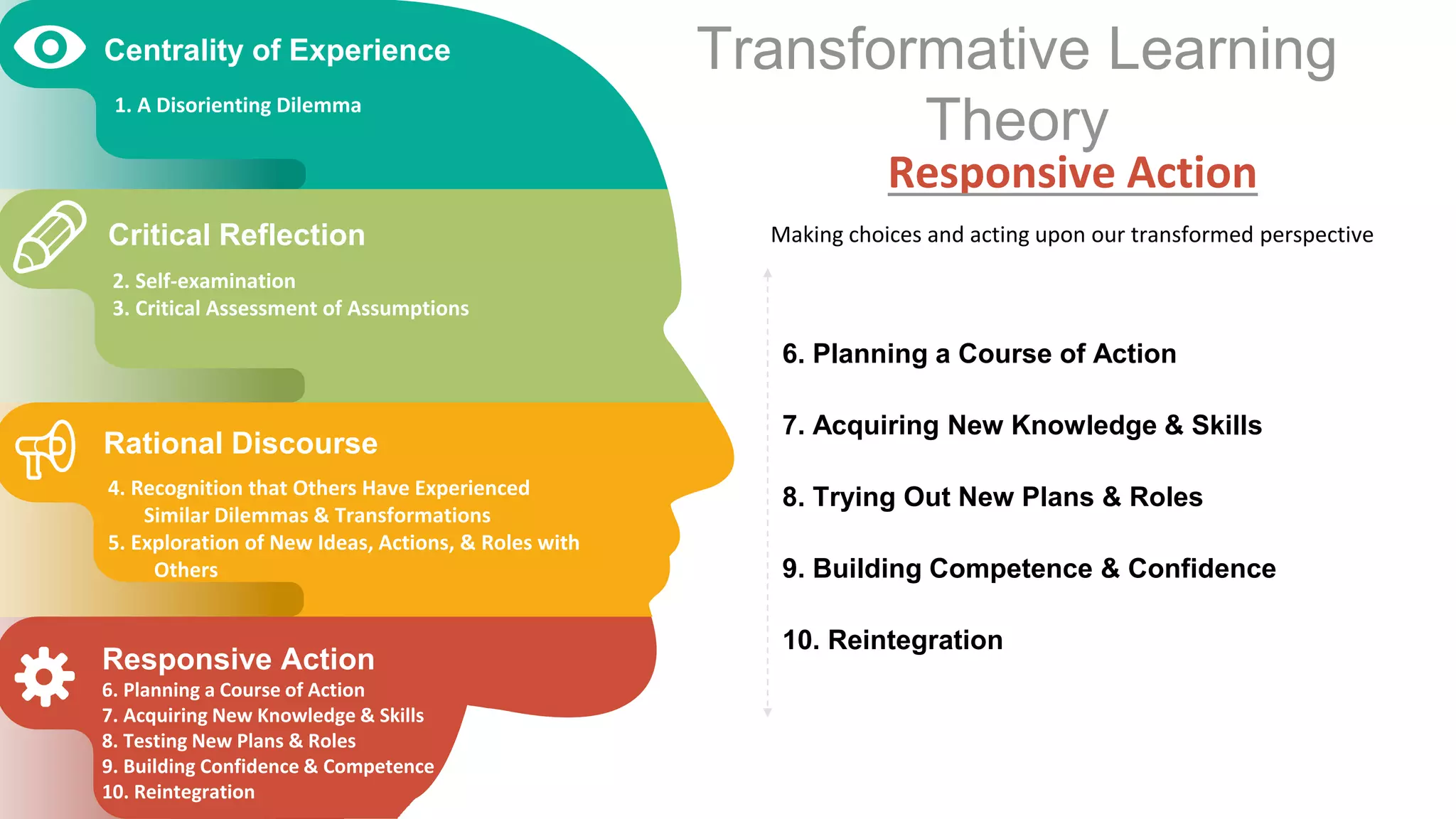
6. Planning a Course of Action
7. Acquiring New Knowledge & Skills
8. Testing New Plans & Roles
9. Building Confidence & Competence
10. Reintegration
6. Planning a Course of Action
7. Acquiring New Knowledge & Skills
8. Trying Out New Plans & Roles
9. Building Competence & Confidence
10. Reintegration
Responsive Action
Making choices and acting upon our transformed perspective
Transformative Learning
Theory
THE CASE
Student protests erupt over controversial commencement
speaker
17
Jones State University
Campus Crisis & Response
www.natecradit.com/naspa
Follow along on your device
View the Case
www.inspirasign.
com
Campus crisis and response
Jones State University
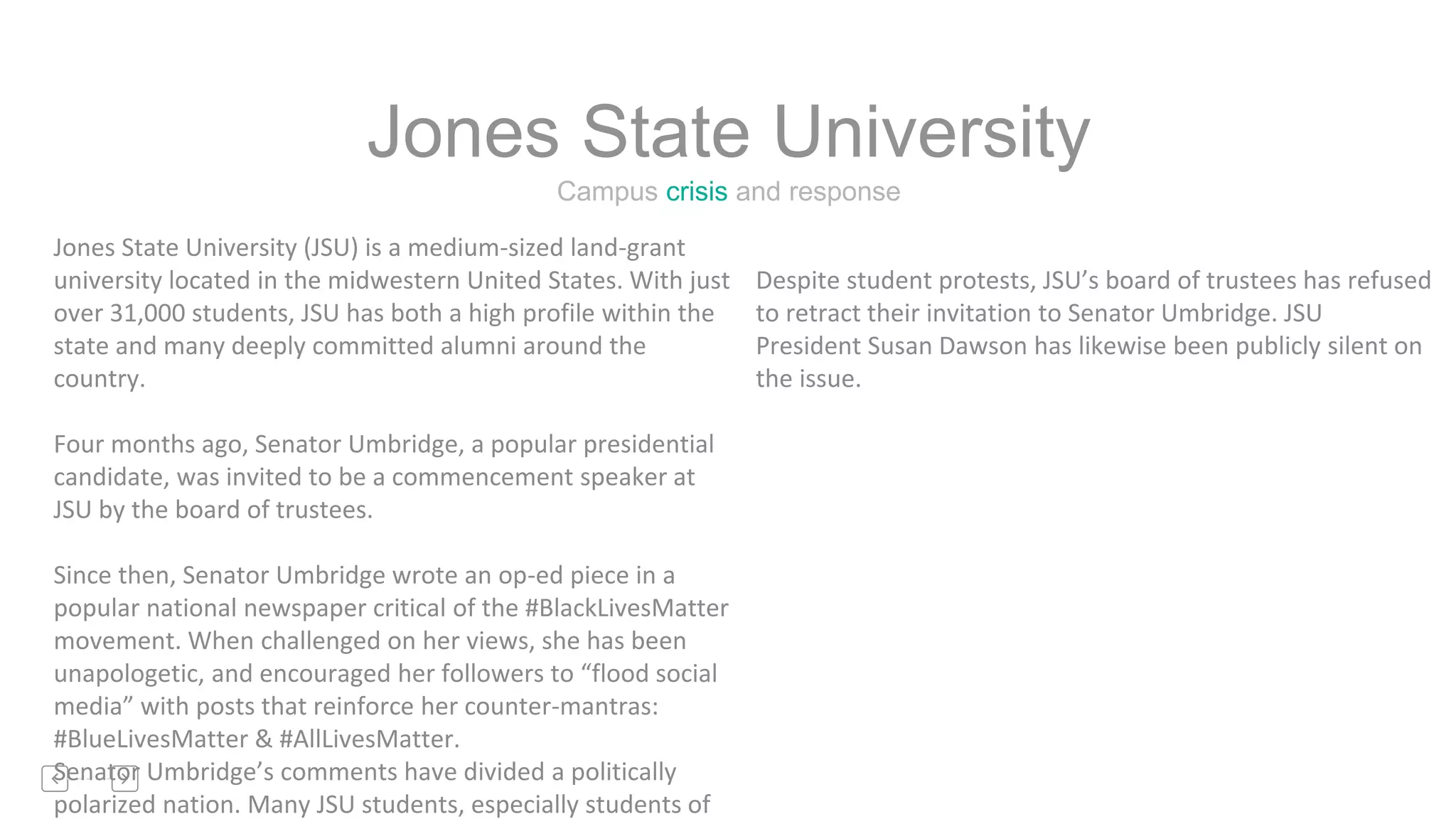
Jones State University (JSU) is a medium-sized land-grant
university located in the midwestern United States. With just
over 31,000 students, JSU has both a high profile within the
state and many deeply committed alumni around the
country.
Four months ago, Senator Umbridge, a popular presidential
candidate, was invited to be a commencement speaker at
JSU by the board of trustees.
Since then, Senator Umbridge wrote an op-ed piece in a
popular national newspaper critical of the #BlackLivesMatter
movement. When challenged on her views, she has been
unapologetic, and encouraged her followers to “flood social
media” with posts that reinforce her counter-mantras:
#BlueLivesMatter & #AllLivesMatter.
Senator Umbridge’s comments have divided a politically
polarized nation. Many JSU students, especially students of
Despite student protests, JSU’s board of trustees has refused
to retract their invitation to Senator Umbridge. JSU
President Susan Dawson has likewise been publicly silent on
the issue.
Campus crisis and response
Jones State University
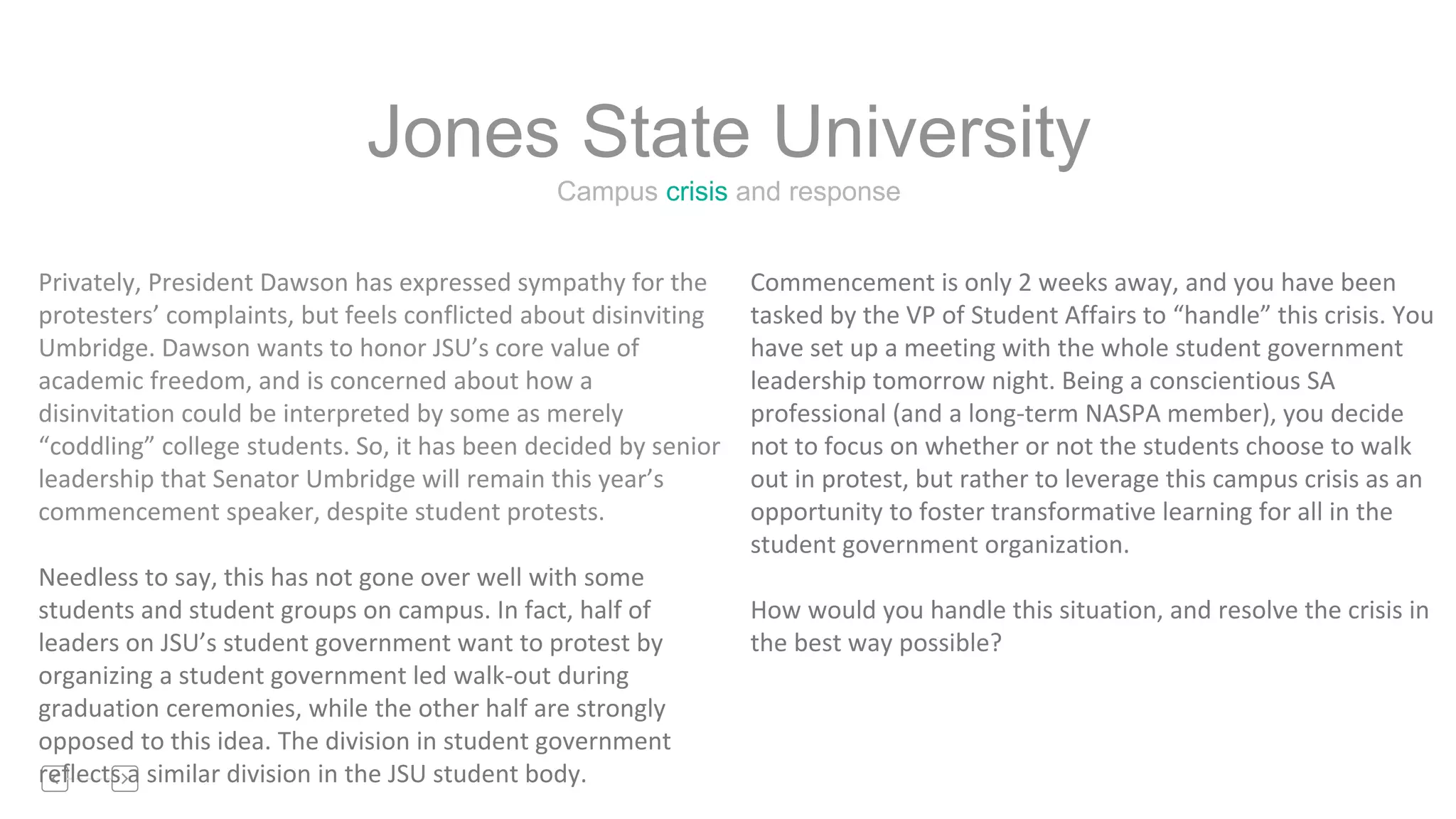
Privately, President Dawson has expressed sympathy for the
protesters’ complaints, but feels conflicted about disinviting
Umbridge. Dawson wants to honor JSU’s core value of
academic freedom, and is concerned about how a
disinvitation could be interpreted by some as merely
“coddling” college students. So, it has been decided by senior
leadership that Senator Umbridge will remain this year’s
commencement speaker, despite student protests.
Needless to say, this has not gone over well with some
students and student groups on campus. In fact, half of
leaders on JSU’s student government want to protest by
organizing a student government led walk-out during
graduation ceremonies, while the other half are strongly
opposed to this idea. The division in student government
reflects a similar division in the JSU student body.
Commencement is only 2 weeks away, and you have been
tasked by the VP of Student Affairs to “handle” this crisis. You
have set up a meeting with the whole student government
leadership tomorrow night. Being a conscientious SA
professional (and a long-term NASPA member), you decide
not to focus on whether or not the students choose to walk
out in protest, but rather to leverage this campus crisis as an
opportunity to foster transformative learning for all in the
student government organization.
How would you handle this situation, and resolve the crisis in
the best way possible?
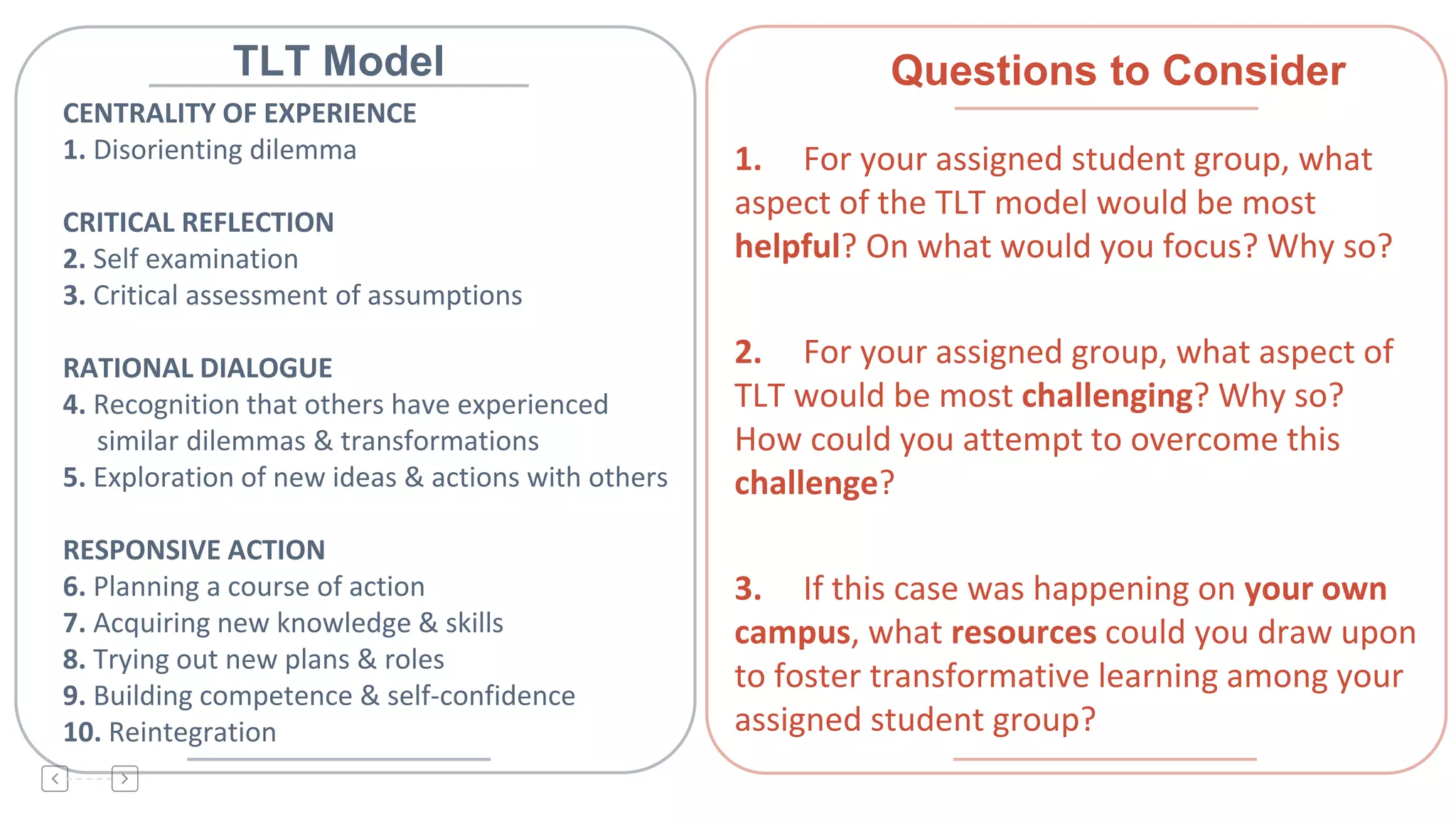
TLT Model
CENTRALITY OF EXPERIENCE
1. Disorienting dilemma
CRITICAL REFLECTION
2. Self examination
3. Critical assessment of assumptions
RATIONAL DIALOGUE
4. Recognition that others have experienced
similar dilemmas & transformations
5. Exploration of new ideas & actions with others
RESPONSIVE ACTION
6. Planning a course of action
7. Acquiring new knowledge & skills
8. Trying out new plans & roles
9. Building competence & self-confidence
10. Reintegration
Questions to Consider
1. For your assigned student group, what
aspect of the TLT model would be most
helpful? On what would you focus? Why so?
2. For your assigned group, what aspect of
TLT would be most challenging? Why so?
How could you attempt to overcome this
challenge?
3. If this case was happening on your own
campus, what resources could you draw upon
to foster transformative learning among your
assigned student group?
CLOSING
Questions, feedback and open
discussion

Leveraging Transformative Learning Theory to Promote Student Development in Times of Campus Crisis

  • 1.
    Leveraging Transformative LearningTheory to Promote Student Development in Times of Campus Crisis Nate Cradit PhD Student, Michigan State University Higher, Adult, & Lifelong Education @natecradit Marc Hunsaker PhD Student, Michigan State University Program Manager, Center for Service-Learning @marchunsaker
  • 2.
    A look atour presentation agenda Today’s Agenda Introductions Outcomes & Presenter Context The problem Campus Crises and Going Through vs. Growing Through
  • 3.
    Transformative Learning Theory Overview oftheoretical model, prominent scholars, and case introduction. Application: Case Study Using TLT as a model in four stages of crisis response. Group Discussion How would you handle this case? Closing Questions & final thoughts
  • 4.
    The Problem As crisesbecome more frequent, must students simply go through them? Or can they grow through them as well?
  • 5.
    difficult to defineand multidimensional Crisis Is… Moments of Difficulty Intensity and Challenge Requires Decision Making Immediate/Hyperbolic Individual/Institutional Geographic Context
  • 6.
    6 Crisis as Catalyst Cana crisis promote student learning? Campuses respond well in the short term. How can the long-term response be strengthened? 1. Crisis response teams 2. Emergency alert systems 3. Media & communication plans 4. Lockdown & procedure plans Going Through 1. Identify learning potential 2. Campus dialogues 3. Embracing challenges 4. Foster reflection Growing Through
  • 7.
    Revisiting Sanford Viewing crisisin the frame of challenge & support OVERLY CHALLENGED OPTIMAL GROWTH LIMITED GROWTH OVERLY SUPPORTED HIGHLOW HIGHLOW CHALLENGE SUPPORT Campuses can offer appropriate levels of support to match this challenge and foster student learning and development. Crises present moments of intensity and challenge for students.
  • 8.
    Transformative Learning Theory Overviewof existing theoretical model, prominent scholars, and potential applications
  • 9.
    What is TLT? ATheory of Adult Learning & Development Rational Mezirow Extra-rational Dirkx, Tisdell, Boyd Social Friere
  • 10.
    10 Core concepts Mezirow Transformative Learning… IsNOT - focused simply on the acquisition of skills and knowledge. IS - focused on a deeper type of learning, one that results in a cognitive ‘paradigm shift’, through the changing of a person’s “meaning perspectives”. (Mezirow, 1991) Dr. Jack Mezirow Teachers College, Columbia University Origins In 1975, Mezirow conducted a research project about the experiences of women returning to postsecondary education after an extended amount of time out of college/workforce. Purpose: To understand the factors that facilitated or impeded the womens’ success Findings: many participants experienced a “personal transformation” Identified: a 10 phase transformation process Meaning Perspectives: A lens through which we see the world & make meaning of our experiences. 1. Composed of our assumptions about the world. 2. Our assumptions are shaped by past experience, but they also shape our view of our future experiences. 3. Our assumptions create a “habit of mind” 4. Some of our assumptions can be faulty as they are often “uncritically inherited” from our family, culture, experiences, etc 5. When our assumptions are called into question, they should be re-considered &, if faulty, re-constructed. (Mezirow, 1985).
  • 11.
    11 Transformative Learning Definition ” “ Dr. JackMezirow 1991 Perspective transformation [is]… changing these structures of habitual expectation to make possible a more inclusive, discriminating, and integrating perspective; and, finally, making choices or otherwise acting upon these new understandings.
  • 12.
    Centrality of Experience 1.A Disorienting Dilemma - This first step of the Transformative Learning (TL) process occurs when we have an experience that presents us with a problem (dilemma) that challenges (disorients) the ways we typically view and interact with the world. Occurs through... Accumulation of challenging experiences over time Major “life-crisis” / life-transition type of event Disorienting dilemmas create perspectival “disequillibration”. Past Experiences --> Meaning Perspectives Meaning Perspectives --> New Experiences Transformative Learning Theory Centrality of Experience 1. A Disorienting Dilemma Critical Reflection Rational Discourse Responsive Action A Primer on Mezirow's 10 Phase Process
  • 13.
    Critical Reflection 3. CriticalAssessment of Assumptions Identifying and critically examining the assumptions beneath our beliefs and ideas. This includes understanding their… Origins - Why do I think/believe this? Implications - What are consequences of my beliefs? Validity - How do my assumptions align w/experience? Goal: Should I continue to think/believe this? Through critical reflection we learn to articulate, interrogate, & evaluate the assumptions that undergird our perspectives. The defining trait of adult learning & TLT Centrality of Experience 1. A Disorienting Dilemma Critical Reflection 2. Self-examination 3. Critical Assessment of Assumptions Rational Discourse Responsive Action Transformative Learning Theory 2. Self-examination Identifying Our Perspectives (What do I think/believe?) Acknowledging Our Emotions
  • 14.
    4. Recognition thatOthers Have Experienced Similar Dilemmas & Transformations. Support System Success Stories Rational Discourse Rational Discourse is the medium wherein our beliefs & feelings are validated (or challenged) by others (Mezirow, 1998) Centrality of Experience 1. A Disorienting Dilemma Critical Reflection 2. Self-examination 3. Critical Assessment of Assumptions Rational Discourse 4. Recognition that Others Have Experienced Similar Dilemmas & Transformations 5. Exploration of New Ideas, Actions, & Roles with Others Responsive Action Transformative Learning Theory 5. Exploration of New Ideas, Actions, & Roles w/ Others Rational discourse has these characteristics: •Focuses on mutual understanding •Free from all forms of coercion •Open to alternative perspectives •Offers equal opportunity to ALL responses & participants •Aims for objectivity, where ALL ideas & actions are open to questioning, critique & discussion •Promotes critical evaluation of arguments: including their evidence, assumptions & consequences (Mezirow, 1991)
  • 15.
    Centrality of Experience 1.A Disorienting Dilemma Critical Reflection 2. Self-examination 3. Critical Assessment of Assumptions Rational Discourse 4. Recognition that Others Have Experienced Similar Dilemmas & Transformations 5. Exploration of New Ideas, Actions, & Roles with Others Responsive Action 6. Planning a Course of Action 7. Acquiring New Knowledge & Skills 8. Testing New Plans & Roles 9. Building Confidence & Competence 10. Reintegration 6. Planning a Course of Action 7. Acquiring New Knowledge & Skills 8. Trying Out New Plans & Roles 9. Building Competence & Confidence 10. Reintegration Responsive Action Making choices and acting upon our transformed perspective Transformative Learning Theory
  • 16.
    THE CASE Student protestserupt over controversial commencement speaker
  • 17.
    17 Jones State University CampusCrisis & Response www.natecradit.com/naspa Follow along on your device View the Case www.inspirasign. com
  • 18.
    Campus crisis andresponse Jones State University Jones State University (JSU) is a medium-sized land-grant university located in the midwestern United States. With just over 31,000 students, JSU has both a high profile within the state and many deeply committed alumni around the country. Four months ago, Senator Umbridge, a popular presidential candidate, was invited to be a commencement speaker at JSU by the board of trustees. Since then, Senator Umbridge wrote an op-ed piece in a popular national newspaper critical of the #BlackLivesMatter movement. When challenged on her views, she has been unapologetic, and encouraged her followers to “flood social media” with posts that reinforce her counter-mantras: #BlueLivesMatter & #AllLivesMatter. Senator Umbridge’s comments have divided a politically polarized nation. Many JSU students, especially students of Despite student protests, JSU’s board of trustees has refused to retract their invitation to Senator Umbridge. JSU President Susan Dawson has likewise been publicly silent on the issue.
  • 19.
    Campus crisis andresponse Jones State University Privately, President Dawson has expressed sympathy for the protesters’ complaints, but feels conflicted about disinviting Umbridge. Dawson wants to honor JSU’s core value of academic freedom, and is concerned about how a disinvitation could be interpreted by some as merely “coddling” college students. So, it has been decided by senior leadership that Senator Umbridge will remain this year’s commencement speaker, despite student protests. Needless to say, this has not gone over well with some students and student groups on campus. In fact, half of leaders on JSU’s student government want to protest by organizing a student government led walk-out during graduation ceremonies, while the other half are strongly opposed to this idea. The division in student government reflects a similar division in the JSU student body. Commencement is only 2 weeks away, and you have been tasked by the VP of Student Affairs to “handle” this crisis. You have set up a meeting with the whole student government leadership tomorrow night. Being a conscientious SA professional (and a long-term NASPA member), you decide not to focus on whether or not the students choose to walk out in protest, but rather to leverage this campus crisis as an opportunity to foster transformative learning for all in the student government organization. How would you handle this situation, and resolve the crisis in the best way possible?
  • 20.
    TLT Model CENTRALITY OFEXPERIENCE 1. Disorienting dilemma CRITICAL REFLECTION 2. Self examination 3. Critical assessment of assumptions RATIONAL DIALOGUE 4. Recognition that others have experienced similar dilemmas & transformations 5. Exploration of new ideas & actions with others RESPONSIVE ACTION 6. Planning a course of action 7. Acquiring new knowledge & skills 8. Trying out new plans & roles 9. Building competence & self-confidence 10. Reintegration Questions to Consider 1. For your assigned student group, what aspect of the TLT model would be most helpful? On what would you focus? Why so? 2. For your assigned group, what aspect of TLT would be most challenging? Why so? How could you attempt to overcome this challenge? 3. If this case was happening on your own campus, what resources could you draw upon to foster transformative learning among your assigned student group?
  • 21.

Editor's Notes

  • #5 We often hear critiques in the public discourse - colleges “coddle” students. Crisis events present an opportunity to change this narrative, if done planfully.
  • #6 It’s not just that it’s difficult - rises to the level of crisis when it’s an intense, challenging experience, where normal operations often cease.
  • #7 As we define a crisis, I’m sure you can think of examples from your own campus. We suggest that campuses already do well helping students go through crises. Since those are established, we can move further. We want to encourage you to consider ways to help them grow though them as well. As student affairs pros, we are equipped with skills to handle these situations {Click} - we are good at being gladiators in suits and fixing. We encourage you to also consider the longer term impact of being an educator in these situations as well.
  • #8 The model Marc will introduce in a moment is rooted in this foundational theory. In a crisis, we have the opportunity to be in this optimal growth quadrant (click to highlight) If crisis presents high challenge, just how DO you offer high support? Transition to Marc/TLT
  • #10 3 Primary Strands within TL Scholarship. Today: Focus on Rational approach. - This approach is most well-known, developed (arguably), and widely accepted (not without critics) - IMHO: This approach is the easiest to understand, apply, & modify (makes a good primer) *Can’t talk about this approach without mentioning its originator - Jack Mezirow.
  • #11 Mezirow’s findings formed the basis for TLT, and for the next 20 years, he continued to modify this 10 phase process and clarify some of the concepts and language that we will discuss today. What is a Meaning Perspective? Said simply, a lens, a filter…a worldview! The process of re-considering & reconstructing our assumptions = Perspective Transformation. Perspective Transformation - is the primary phenomenon TLT is attempting to explain. (The Goal)
  • #12 Inclusive - open to new ideas Discriminating - able to see differences and distinctions between ideas and judge between them Integrating - perspectival consistency: combine & harmonize new/different ideas Go deeper…
  • #13 Disclaimer - A Primer! Give you an overview / big pic of TLT (30k ft view), but since theory can be very abstract we will swoop down (30 ft) and making this practical with concrete examples (Nate) 10 Phase Process: Not a hard sequential/exhaustive list. Spend most of our time on Phases 1-5 Don’t expect your to remember a 10 part process, so will describe these phases in a 4 part meta-framework Main Arugment: Leverage TLT to see to crises as a DD - not simply something to go through, but an opportunity to help students grow through these challenging events. See crises as a crucial first step to promote TL. Heather’s story: A sophomore member of ASB e-board, goes to Detroit for weekend service/SL training experience at a shelter/employment agency. As she goes through the day, becomes uncharacteristically reserved, uncomfortable. We’ll later see why. Transition: Although DD necessary for TL (not in/by themselves), these challenges must be balanced by additional supports…next 9 phases are those supports we can offer to create conditions for TL to occur.
  • #14 Dewey quote - emphasizes reflection as key for learning from experience (e.g., Service-Learning) same with TLT Heather: We mentioned before that Heather was clearly uncomfortable -disoriented. Near end of the day, individual reflection exercise, recognized discomfort in the context of assumptions. Grew up in U.P., parents made her promise not to go to detroit. Assumptions: poverty = unsafe; other people will solve issues, it didn’t affect her life. Disproven by generosity & kindness she felt from residents, and felt guilty for not acting sooner, discomfort realizing parents’ assumptions were inaccurate. Transition: CR is crucial if we are going to think differently. Promotes deep learning from experiences and develops important skills (critical thinking, self-awareness, etc) & prepares us to talk intelligently with others
  • #15 Yesterday: Dr DeFrancesco-Soto reminded us that “Dialogue & Diversity are the lifeblood of the University” Also the lifeblood of TL. Mezirow: RD medium…place where our perspectives are ultimately transformed. Heather: To this point, Heather was internalizing everything. In group discussion in the evening, others shared similar stories of perspective change. As one example, student from Detroit shared similar feelings from opposite perspective - feeling like an outsider in his own city. Transition: RD is a catalyst for the TL process, providing ongoing/important sources of support, feedback, and fodder for further reflection and new actions based on our new perspectives.
  • #16 Going to go through phases 6-10 VERY quickly. - Time is short (get to discussion) - Intuitive (easily understood and applied) - Dependent on phases 1-5 occurring first But, this is not to say that Phases 6-10 are not important, very important if we want transformative learning to occur - imperative for us to respond in ways that align our new perspective with our actions (and lives) Heather: To act upon transformed perspective, Heather, a sophomore, spent the next two years creating a weekend trip program to Detroit to combat similar assumptions in peers. Go through steps on slide. Institutionalized the experience. Transition to case.