Self-Directed Learning
Theories
ADLT 671, Summer 2017
Class Session 4
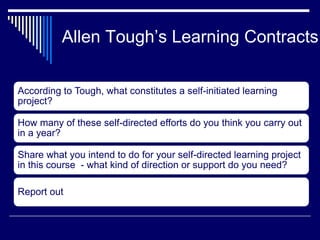
Allen Tough’s Learning Contracts
According to Tough, what constitutes a self-initiated learning
project?
How many of these self-directed efforts do you think you carry out
in a year?
Share what you intend to do for your self-directed learning project
in this course - what kind of direction or support do you need?
Report out
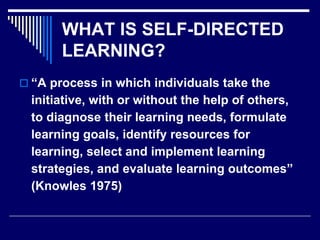
WHAT IS SELF-DIRECTED
LEARNING?
 “A process in which individuals take the
initiative, with or without the help of others,
to diagnose their learning needs, formulate
learning goals, identify resources for
learning, select and implement learning
strategies, and evaluate learning outcomes”
(Knowles 1975)
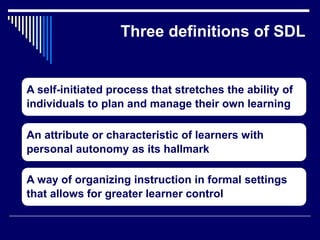
Three definitions of SDL
A self-initiated process that stretches the ability of
individuals to plan and manage their own learning
An attribute or characteristic of learners with
personal autonomy as its hallmark
A way of organizing instruction in formal settings
that allows for greater learner control
Questions to Consider
 Are most adults self-directed learners?
 To what extent are your own learners
(students, residents) self-directed, and when
are they not?
 Do we become more self-directed as we age?
 What factors does self-directed learning
depend upon?
Struggling to Be Self-Directed:
Residents Paradoxical Beliefs
What stands out for you in this article as true in
your own experience?
In what way does your experience vary from the
article?
What quote, sentence, or paragraph captures the
issues you face in working with learners in health
professions education?
Readiness to Learn
 Adults are ready to learn when their life
situation creates a need to know
 Most learning experiences are highly
situational and a person can exhibit different
learning behaviors in different situations
 A learner can be confident and self-directed in
one situation but dependent and unsure in
another
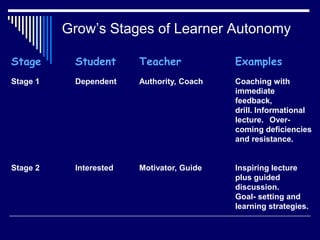
Grow’s Stages of Learner Autonomy
Stage Student Teacher Examples
Stage 1 Dependent Authority, Coach Coaching with
immediate
feedback,
drill. Informational
lecture. Over-
coming deficiencies
and resistance.
Stage 2 Interested Motivator, Guide Inspiring lecture
plus guided
discussion.
Goal- setting and
learning strategies.
Grow’s Stages of Learner Autonomy
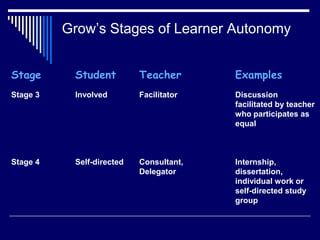
Stage Student Teacher Examples
Stage 3 Involved Facilitator Discussion
facilitated by teacher
who participates as
equal
Stage 4 Self-directed Consultant, Internship,
Delegator dissertation,
individual work or
self-directed study
group
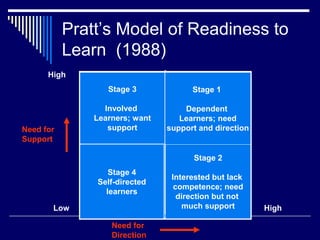
Pratt’s Model of Readiness to
Learn (1988)
Need for
Direction
Need for
Support
Low
High
High
Learner needs
direction and
support for
learning; lacks
competence and
confidence
Learner needs
direction
(new task) but is
self-motivated and
doesn’t need a lot
of support
Stage 1
Dependent
Learners; need
support and direction
Stage 2
Interested but lack
competence; need
direction but not
much support
Learners who
have ability but
want reassurance
(may act like they
need direction,
but seek support).
Stage 3
Involved
Learners; want
support
True self-
directed
learners; can
provide their
own support and
direction
Stage 4
Self-directed
learners
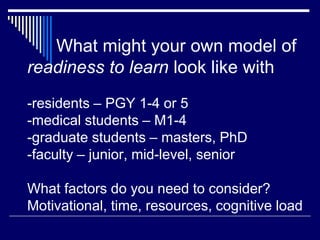
What might your own model of
readiness to learn look like with
-residents – PGY 1-4 or 5
-medical students – M1-4
-graduate students – masters, PhD
-faculty – junior, mid-level, senior
What factors do you need to consider?
Motivational, time, resources, cognitive load

Class session 4 sdl

  • 1.
    Self-Directed Learning Theories ADLT 671,Summer 2017 Class Session 4
  • 2.
    Allen Tough’s LearningContracts According to Tough, what constitutes a self-initiated learning project? How many of these self-directed efforts do you think you carry out in a year? Share what you intend to do for your self-directed learning project in this course - what kind of direction or support do you need? Report out
  • 3.
    WHAT IS SELF-DIRECTED LEARNING? “A process in which individuals take the initiative, with or without the help of others, to diagnose their learning needs, formulate learning goals, identify resources for learning, select and implement learning strategies, and evaluate learning outcomes” (Knowles 1975)
  • 4.
    Three definitions ofSDL A self-initiated process that stretches the ability of individuals to plan and manage their own learning An attribute or characteristic of learners with personal autonomy as its hallmark A way of organizing instruction in formal settings that allows for greater learner control
  • 5.
    Questions to Consider Are most adults self-directed learners?  To what extent are your own learners (students, residents) self-directed, and when are they not?  Do we become more self-directed as we age?  What factors does self-directed learning depend upon?
  • 6.
    Struggling to BeSelf-Directed: Residents Paradoxical Beliefs What stands out for you in this article as true in your own experience? In what way does your experience vary from the article? What quote, sentence, or paragraph captures the issues you face in working with learners in health professions education?
  • 7.
    Readiness to Learn Adults are ready to learn when their life situation creates a need to know  Most learning experiences are highly situational and a person can exhibit different learning behaviors in different situations  A learner can be confident and self-directed in one situation but dependent and unsure in another
  • 8.
    Grow’s Stages ofLearner Autonomy Stage Student Teacher Examples Stage 1 Dependent Authority, Coach Coaching with immediate feedback, drill. Informational lecture. Over- coming deficiencies and resistance. Stage 2 Interested Motivator, Guide Inspiring lecture plus guided discussion. Goal- setting and learning strategies.
  • 9.
    Grow’s Stages ofLearner Autonomy Stage Student Teacher Examples Stage 3 Involved Facilitator Discussion facilitated by teacher who participates as equal Stage 4 Self-directed Consultant, Internship, Delegator dissertation, individual work or self-directed study group
  • 10.
    Pratt’s Model ofReadiness to Learn (1988) Need for Direction Need for Support Low High High Learner needs direction and support for learning; lacks competence and confidence Learner needs direction (new task) but is self-motivated and doesn’t need a lot of support Stage 1 Dependent Learners; need support and direction Stage 2 Interested but lack competence; need direction but not much support Learners who have ability but want reassurance (may act like they need direction, but seek support). Stage 3 Involved Learners; want support True self- directed learners; can provide their own support and direction Stage 4 Self-directed learners
  • 11.
    What might yourown model of readiness to learn look like with -residents – PGY 1-4 or 5 -medical students – M1-4 -graduate students – masters, PhD -faculty – junior, mid-level, senior What factors do you need to consider? Motivational, time, resources, cognitive load