
Presented By: Shashank Varun
 Civility is a form of benevolent
awareness.
Respect
Restraint
Consideration
 Politeness
 Respect
 Affirmation
 Morality
 Connection
 Accountability
 Assertiveness
 The Golden Rule
 Manners
 Tolerance
 Self-Restraint
 Focus
 Public Health
 Quality of Life
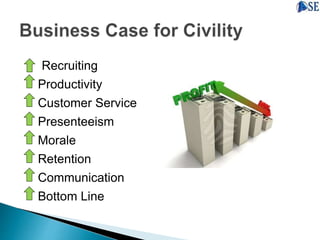
Recruiting
Productivity
Retention
Customer Service
Presenteeism
Morale
Communication
Bottom Line
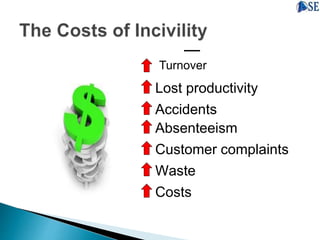
Costs
Waste
Customer complaints
Absenteeism
Accidents
Lost productivity
Turnover
 Lowered morale of employees
 Reduced team effectiveness
 Being uncivil to customers, clients, or others
outside the immediate organization, office, or
facility
http://www.citehr.com/PM Forni
 People are difficult because they either have too
high or too low an opinion of themselves.
 Suggest you need the person’s help to solve the
problem.
 Try to build the confidence of the difficult person.
 Talk to a supervisor or Human Resources if
the problem persists.
 Listen.
 Don’t react.
 Focus on facts not feelings.
 Supervise the work not the person.
 “Maybe you’re right.”
 Don’t take it personally.
 Avoid uncomfortable situations.
Civility & Respect in the Workplace

Civility & Respect in the Workplace

Editor's Notes

  • #5 Why SHOULD we care about civility? MEMORIZE (WALK AROUND): Organizations with healthy workplace cultures have employees that get along. When employees respect each other, and have healthy relationships with one another, they make better decisions, are more innovative, and learn more. That translates into employee engagement, and when you have engaged and loyal employees you have reduced turnover and absenteeism. Reduced turnover means better quality and quantity of work, and better customer service. Better work and happy customers means meeting organizational goals, and that means BOTTOM LINE RESULTS! One study found that both men and women would rather pursue a job with a supportive organization, even if that meant accepting less compensation. Global consulting firm, Watson Wyatt, study - companies that openly promote civility among employees earn 30% more revenue than competitors, are 4 times more likely to have highly engaged employees, and are 20% more likely to report reduced turnover. Stocks of the public companies on Fortune magazine’s “100 Best Companies to work For” list produced more than 3 times the gains of the broad market over the last 7years. The study suggests a strong link between workplace culture and a business’s financial performance... CONVINCED? If you aren’t, maybe you will be when we look at what it costs our organization
  • #6 SHRM Incivility Rising article - Study concluded that rudeness can have pervasive effects that permeate right to an organization’s bottom line. Turnover - Can drive high-potential employees away Mistakes Quality (Especially critical in healthcare setting) Employees might treat your customers they way they are being treated Incivility to customers Public image Reputation New customers Customer retention/loyalty Waste – ASK AUDIENCE Time, Material, Resources Time Lost -Gossip Time spent in HR alone. • Counsel • Hold meetings with decision makers to determine what to do to resolve the problem • Conduct investigations when grievances are filed • Discipline the perpetrators of the negative behavior • Interview, recruit, and train replacements Tangible Costs – ASK AUDIENCE Health insurance costs Litigation – get expensive Work comp Intangible Costs Think creativly Impairs critical thinking and cognitive skills. Creates: Fear Mistrust Sets example – how behave to get ahead Lost trust