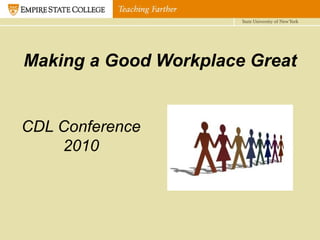
Making a Good Workplace Great CDL Conference 2010
Introductions Julie Gedro,   Central New York Mentor, Faculty Chair, Forum Director Mary Morton ,   Office of the President Affirmative Action Officer
Program Outline Introduction Purpose University and College Vision Civility Terms and Concepts Interactive Case Study & Reporting Out Communication Exercise Wrap-up
Purpose Evoke dialogue and raise awareness around workplace civility. Discuss the alignment of university initiatives with our college strategic initiatives. Discuss ethical, moral and legal implications that arise out of incivility in the workplace. Enhance the quality of work life.
SUNY’s Core Values Student Centeredness – Keep students at the center of all we do Community Engagement – learning goes both ways Diversity & Acceptance – it makes us stronger and smarter Integrity and Collegiality – It’s the bedrock of our business Collaboration – makes our expertise more powerful
College Strategic Plan Vision Statement – reads in part: “ The college, as a premier institution for adult learning within SUNY and across the nation… The college creates and supports cooperative initiatives among all segments of the population to foster respect, civility and a welcoming environment .”
Vision 2015 Three Strategic Themes: A. Innovative learning organization B. Sustaining and Management Growth C. Telling our Story
Strategic Theme “A” To be an innovative, learning organization, we need to: Do better by our learners Do better by each other Developing a culture innovation, reflections and continuous improvement
Civility in the Workplace
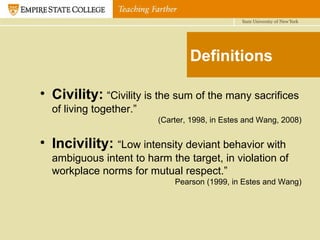
Definitions Civility:   “Civility is the sum of the many sacrifices of living together.” (Carter, 1998, in Estes and Wang, 2008) Incivility:   “Low intensity deviant behavior with ambiguous intent to harm the target, in violation of workplace norms for mutual respect.” Pearson (1999, in Estes and Wang)
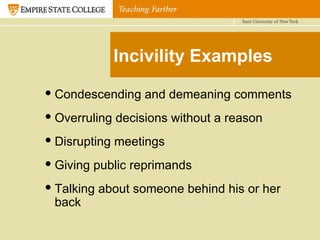
Incivility Examples Condescending and demeaning comments Overruling decisions without a reason Disrupting meetings Giving public reprimands Talking about someone behind his or her back
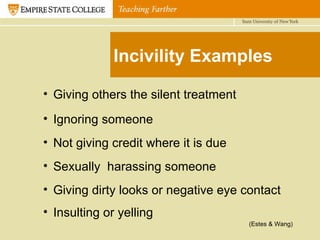
Incivility Examples Giving others the silent treatment Ignoring someone Not giving credit where it is due Sexually  harassing someone Giving dirty looks or negative eye contact Insulting or yelling  (Estes & Wang)
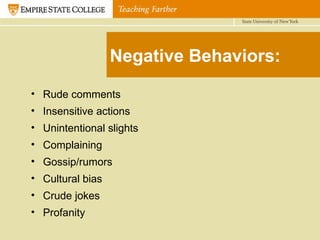
Negative Behaviors: Rude comments Insensitive actions Unintentional slights Complaining Gossip/rumors Cultural bias Crude jokes Profanity
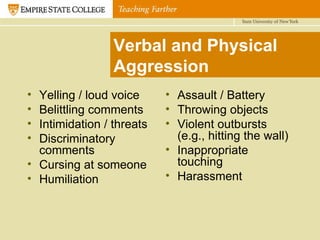
Verbal and Physical Aggression Yelling / loud voice Belittling comments Intimidation / threats Discriminatory comments Cursing at someone Humiliation Assault / Battery Throwing objects Violent outbursts (e.g., hitting the wall) Inappropriate touching Harassment
Positive Behaviors Can you identify characteristics of an effective workplace?
Barriers to Effectiveness What are some individual and  organizational barriers to effectiveness?
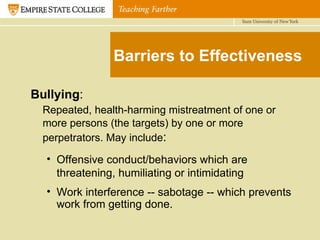
Barriers to Effectiveness Bullying :  Repeated, health-harming mistreatment of one or more persons (the targets) by one or more perpetrators. May include : Offensive conduct/behaviors which are threatening, humiliating or intimidating Work interference -- sabotage -- which prevents work from getting done.
Bullying Tactics False accusations of errors not actually made Staring or glaring Discounting the other person’s contributions “ Freezing out” and isolating and employee from others Exhibiting mood swings in front of the work group
Barriers to Effectiveness Mobbing Mobbing is emotional abuse in the workplace. "Ganging up" by co-workers, subordinates or superiors, to force someone out of the workplace through rumor, innuendo, intimidation, humiliation, discrediting, and isolation . Malicious, non-sexual, non-racial, general harassment.
Small Group Scenario’s 10 Minutes – Work in small groups – read and discuss scenario Reporting out
Expectations Exercise Individual Exercise: On a piece of paper, record 5 items that you  expect from colleagues in the workplace on a day-to-day basis (office etiquette). Examples: Pick up an item that has fallen on the floor rather than stepping over it Fill up the copier if it has run out of paper
Expectations Exercise Place a check next to each item that you agree should be an “unwritten rule”. Report out
So….What can you take back?
A Culture of Civility Clearly define expectations for how employees treat each other Learn social norms and customs Have a cooperative approach Learn tolerances Recognize individual differences Be open to adapting your position Leaders model civility for others Reward  civil behavior
Focus on common ground rather than differences
Make the workplace BETTER!
Questions??? THANK YOU FOR ATTENDING

Cdl conf making a good place great

  • 1.
    Making a GoodWorkplace Great CDL Conference 2010
  • 2.
    Introductions Julie Gedro, Central New York Mentor, Faculty Chair, Forum Director Mary Morton , Office of the President Affirmative Action Officer
  • 3.
    Program Outline IntroductionPurpose University and College Vision Civility Terms and Concepts Interactive Case Study & Reporting Out Communication Exercise Wrap-up
  • 4.
    Purpose Evoke dialogueand raise awareness around workplace civility. Discuss the alignment of university initiatives with our college strategic initiatives. Discuss ethical, moral and legal implications that arise out of incivility in the workplace. Enhance the quality of work life.
  • 5.
    SUNY’s Core ValuesStudent Centeredness – Keep students at the center of all we do Community Engagement – learning goes both ways Diversity & Acceptance – it makes us stronger and smarter Integrity and Collegiality – It’s the bedrock of our business Collaboration – makes our expertise more powerful
  • 6.
    College Strategic PlanVision Statement – reads in part: “ The college, as a premier institution for adult learning within SUNY and across the nation… The college creates and supports cooperative initiatives among all segments of the population to foster respect, civility and a welcoming environment .”
  • 7.
    Vision 2015 ThreeStrategic Themes: A. Innovative learning organization B. Sustaining and Management Growth C. Telling our Story
  • 8.
    Strategic Theme “A”To be an innovative, learning organization, we need to: Do better by our learners Do better by each other Developing a culture innovation, reflections and continuous improvement
  • 9.
    Civility in theWorkplace
  • 10.
    Definitions Civility: “Civility is the sum of the many sacrifices of living together.” (Carter, 1998, in Estes and Wang, 2008) Incivility: “Low intensity deviant behavior with ambiguous intent to harm the target, in violation of workplace norms for mutual respect.” Pearson (1999, in Estes and Wang)
  • 11.
    Incivility Examples Condescendingand demeaning comments Overruling decisions without a reason Disrupting meetings Giving public reprimands Talking about someone behind his or her back
  • 12.
    Incivility Examples Givingothers the silent treatment Ignoring someone Not giving credit where it is due Sexually harassing someone Giving dirty looks or negative eye contact Insulting or yelling (Estes & Wang)
  • 13.
    Negative Behaviors: Rudecomments Insensitive actions Unintentional slights Complaining Gossip/rumors Cultural bias Crude jokes Profanity
  • 14.
    Verbal and PhysicalAggression Yelling / loud voice Belittling comments Intimidation / threats Discriminatory comments Cursing at someone Humiliation Assault / Battery Throwing objects Violent outbursts (e.g., hitting the wall) Inappropriate touching Harassment
  • 15.
    Positive Behaviors Canyou identify characteristics of an effective workplace?
  • 16.
    Barriers to EffectivenessWhat are some individual and organizational barriers to effectiveness?
  • 17.
    Barriers to EffectivenessBullying : Repeated, health-harming mistreatment of one or more persons (the targets) by one or more perpetrators. May include : Offensive conduct/behaviors which are threatening, humiliating or intimidating Work interference -- sabotage -- which prevents work from getting done.
  • 18.
    Bullying Tactics Falseaccusations of errors not actually made Staring or glaring Discounting the other person’s contributions “ Freezing out” and isolating and employee from others Exhibiting mood swings in front of the work group
  • 19.
    Barriers to EffectivenessMobbing Mobbing is emotional abuse in the workplace. "Ganging up" by co-workers, subordinates or superiors, to force someone out of the workplace through rumor, innuendo, intimidation, humiliation, discrediting, and isolation . Malicious, non-sexual, non-racial, general harassment.
  • 20.
    Small Group Scenario’s10 Minutes – Work in small groups – read and discuss scenario Reporting out
  • 21.
    Expectations Exercise IndividualExercise: On a piece of paper, record 5 items that you expect from colleagues in the workplace on a day-to-day basis (office etiquette). Examples: Pick up an item that has fallen on the floor rather than stepping over it Fill up the copier if it has run out of paper
  • 22.
    Expectations Exercise Placea check next to each item that you agree should be an “unwritten rule”. Report out
  • 23.
  • 24.
    A Culture ofCivility Clearly define expectations for how employees treat each other Learn social norms and customs Have a cooperative approach Learn tolerances Recognize individual differences Be open to adapting your position Leaders model civility for others Reward civil behavior
  • 25.
    Focus on commonground rather than differences
  • 26.
  • 27.

Editor's Notes

  • #2 ##
  • #3 ##
  • #4 ## Abbreviated training session given the timeframe of 45-minutes
  • #6 The University-wide Strategic Plan, entitled “The Power of SUNY… 2010 and Beyond” cites 5 Core Values. You’ll see that the Universities values closely aligns with the college’s vision statements regarding civility in the workplace.
  • #7 This is 1 of 5 clear objectives identified in the President’s Vision Statement for 2015. Our attention today will be focused on the statement in blue.
  • #9 “ A learning organization is an institution that continuously reflects upon its operations and effectiveness and evolves accordingly in innovative ways in order to better achieve its mission.” Our discussion today will focus on doing better by each other.
  • #10 Julie
  • #16 ## Some positive workplace characteristics? Appreciation Rewards and Praise Being acknowledged for work well done Contributions to the mission Complements Self-worth
  • #17 ## Personal bias Lack of resources Lack of support Unwelcoming spaces Not recognized for work will done Lack of cultural understanding
  • #21 Scenario 1: Cindy and Peter Scenario 2: Joe Scenario 3: Janie ##
  • #24 ## What did you learn from the “Unwritten Rules” exercise? - communication - address early annoyances - don’t sweat the small stuff Everyone experiences annoyances at work. Work with each other – work it out!
  • #25 ## Learn acceptance
  • #26 We need to value and try to understand differences -- but most importantly, to move forward – to be a GREAT institution to work and learn, we need to focus on ‘common ground’ rather than differences. This is especially important when working in groups or cultivating teamwork. We need to focus on similarities, same goals and look for common ground. Share respectful expectation! Which means, we sometimes need to ‘shift our perspectives’
  • #27 It may take time for a workplace culture to change to be more positive. It takes dedication and input from all employees and it may require that employees look within to assure they are ‘in check’. Some may say that they work in a great environment that is respectful – and we say terrific!!! Stay Vigilant! Talk about it! Share it! Identify what it is you have that makes the work environment work well.
  • #28 ##