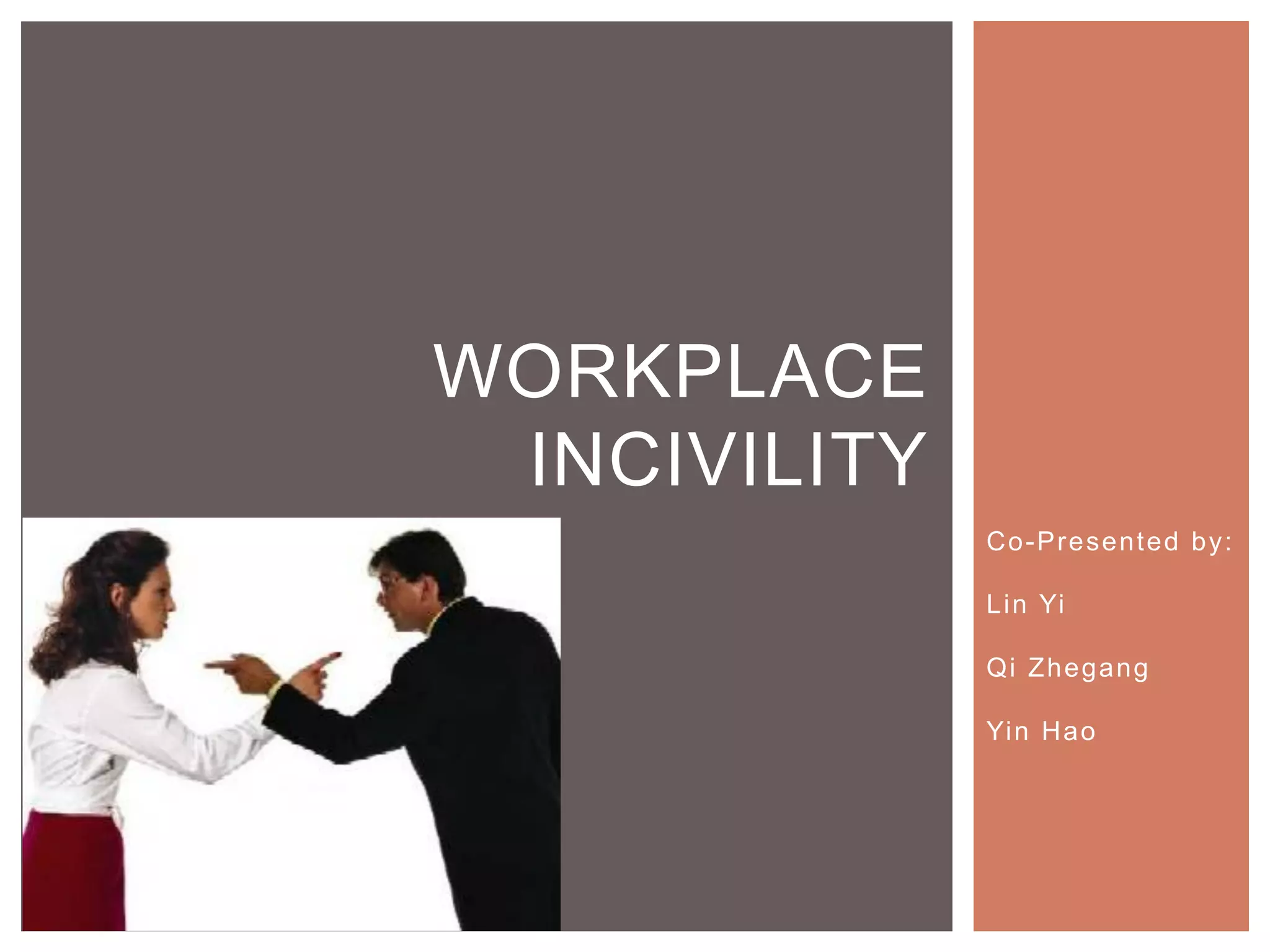
WORKPLACE
 INCIVILITY  
                 Co-Presented by:

                 L i n Yi

                 Qi Zhegang

                 Yin H a o
OUTLINE  

¡    Definition
¡    Research Background
¡    Forms of Incivility
¡    Costs of Incivility
¡    What’s a Leader to Do
¡    Global Approach
¡    Conclusion
DEFINITION  

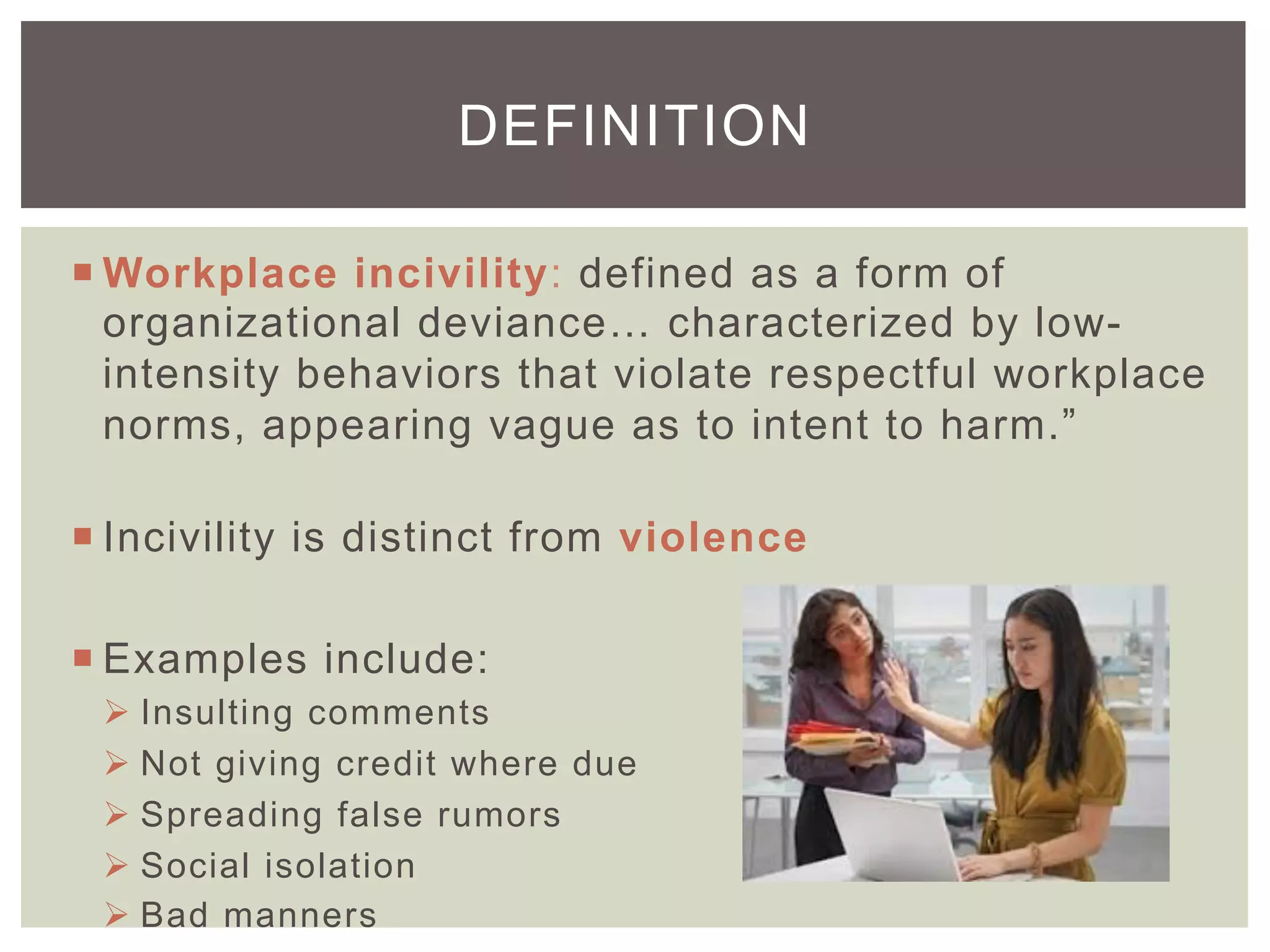
¡ Workplace incivility: defined as a form of
   organizational deviance… characterized by low-
   intensity behaviors that violate respectful workplace
   norms, appearing vague as to intent to harm.”

¡ Incivility is distinct from violence

¡ Examples include:
 Ø  Insulting comments
 Ø  Not giving credit where due
 Ø  Spreading false rumors
 Ø  Social isolation
 Ø  Bad manners
RESEARCH BACKGROUND  

Motivation of Research:
¡  Rudeness at work is rampant, and it’s on the rise
¡  Consequences have been severe, e.g. low morale of
    staff, broken customer relationships, ruined reputation

Methodology of Research:
¡  Interviews, questionnaires, experiments, workshops, etc.
¡  Collected data from14,000+ people in US and Canada

Two Key Findings of Research:
¡  Incivility is expensive
¡  Few organizations recognize or take action to curtail it
FORMS OF INCIVILITY  


                                             2) “Boss from hell” à destroy lower level staff’s
1)  Show indifference towards co-workers     confidence and morale at work
    (esp. those who are seeking for help);


           3) Isolation                       4) Absent-minded during meetings/ presentations  
COSTS OF INCIVILITY  

¡  Through a poll of 800 managers and employees in 17
    industries, we learned how people’s reactions play out.
    Among workers on the receiving end of incivility:
COSTS OF INCIVILITY  
¡  Many managers would say that incivility is wrong, but not all
    recognize that it has tangible costs.

Employee feedback that

¡  48% intentionally decreased their work ef fort.
¡  47% intentionally decreased the time spent at work.
¡  38% intentionally decreased the quality of their work.
¡  80% lost work time worr ying about the incident.
¡  63% lost work time avoiding the of fender.
¡  66% said that their per formance declined.
¡  78% said that their commitment to the organization declined.
¡  12% said that they left their job because of the uncivil treatment.
¡  25% admitted to taking their frustration out on customers  
COSTS OF INCIVILITY (CONT’D)  

¡  Creativity suffers
  §  Less Creative and have fewer new ideas if treat rudely

¡  Performance and team spirit deteriorate
  §  negative consequences, less likely than others to help

¡  Customers turn away
  §  Criticizing colleagues, disrespectful behavior
      makes customer uncomfortable
  §  Regardless of the circumstances, people don’t
      like to see others treated badly,

¡  Managing incidents is expensive
  §  one incident can soak up weeks of attention
      and effort, waste of manpower
WHAT’S A LEADER TO DO  

                           MANAGING YOURSELF

Leaders set the tone, be aware of your actions

¡  Model good behavior
  §  Role model, leader is rude
  §  Create a culture of respect and express your appreciation.


¡  Ask for feedback
    §  Leadership style


¡  Pay attention to your progress
  §    Self awareness and set good example and alert people when rude.
WHAT’S A LEADER TO DO  
                  M A N A G I N G T H E O R G A N I Z Z AT I O N


¡  Hire for civility
    §  Avoid bringing incivility into the workplace
   §  However, Only 11% of organizations report considering civility at all
       during the hiring process.


¡  Teach civility
   §  People can learn civility on the job. Role-playing is one technique
   §  Video can be a good teaching tool, especially when paired with
       coaching.
   §  Highlight the tone, volume and speed of the speech
WHAT’S A LEADER TO DO  
                 M A N A G I N G T H E O R G A N I Z Z AT I O N


¡  Create group norms
  §  Work in the group to discuss what should and should not do
  §  E.g. Hospital, smile, greet customer to gain customer satisfaction


¡  Reward good behavior & Penalize bad behavior
  §  Motivate the staff with incentives, e.g. bonus and TPM
  §  Warning, punishing action


¡  Conduct post-departure interviews
  §  Interview with resigned staff to find out Root cause
GLOBAL APPROACH  

¡  Take civility global = learn how to read
    behavior and to react respectfully across
    cultures

¡  Before you go:
  Ø  Know who you are
  Ø  Know where you are going
  Ø  Be open-minded
GLOBAL APPROACH (CONT’D)  

¡  Once you’re there:
  Ø  Show respect
  Ø  Be agreeable
  Ø  Show patience with others and yourself
  Ø  Pay sharp attention
  Ø  Break out of your comfort zone
  Ø  Be adaptable
  Ø  Accept and learn from mistakes
A CULTURE OF CIVILITY

      ¡  Have a cooperative approach

      ¡  Be aware of underlying needs

      ¡  Recognize individual differences

      ¡  Be open to adapting to positions

      ¡  Start from leaders

      ¡  Clearly define expectations for how
         employees treat each other

      ¡  Reward civilized behavior

      ¡  Encourage stress management
CONCLUSION  

¡  In order to minimize the workplace incivility, it requires the
 efforts from both leaders and employees


¡  Organizations need to promote the cultures for civility


¡  Civility can be enhanced by building competencies in skills
 such as listening, conflict resolution, negotiation, dealing
 with difficult people, and stress management
Workplace Incivility

Workplace Incivility

  • 1.
    WORKPLACE INCIVILITY   Co-Presented by: L i n Yi Qi Zhegang Yin H a o
  • 2.
    OUTLINE   ¡  Definition ¡  Research Background ¡  Forms of Incivility ¡  Costs of Incivility ¡  What’s a Leader to Do ¡  Global Approach ¡  Conclusion
  • 3.
    DEFINITION   ¡ Workplace incivility:defined as a form of organizational deviance… characterized by low- intensity behaviors that violate respectful workplace norms, appearing vague as to intent to harm.” ¡ Incivility is distinct from violence ¡ Examples include: Ø  Insulting comments Ø  Not giving credit where due Ø  Spreading false rumors Ø  Social isolation Ø  Bad manners
  • 4.
    RESEARCH BACKGROUND   Motivationof Research: ¡  Rudeness at work is rampant, and it’s on the rise ¡  Consequences have been severe, e.g. low morale of staff, broken customer relationships, ruined reputation Methodology of Research: ¡  Interviews, questionnaires, experiments, workshops, etc. ¡  Collected data from14,000+ people in US and Canada Two Key Findings of Research: ¡  Incivility is expensive ¡  Few organizations recognize or take action to curtail it
  • 5.
    FORMS OF INCIVILITY  2) “Boss from hell” à destroy lower level staff’s 1)  Show indifference towards co-workers confidence and morale at work (esp. those who are seeking for help); 3) Isolation 4) Absent-minded during meetings/ presentations  
  • 6.
    COSTS OF INCIVILITY  ¡  Through a poll of 800 managers and employees in 17 industries, we learned how people’s reactions play out. Among workers on the receiving end of incivility:
  • 7.
    COSTS OF INCIVILITY  ¡  Many managers would say that incivility is wrong, but not all recognize that it has tangible costs. Employee feedback that ¡  48% intentionally decreased their work ef fort. ¡  47% intentionally decreased the time spent at work. ¡  38% intentionally decreased the quality of their work. ¡  80% lost work time worr ying about the incident. ¡  63% lost work time avoiding the of fender. ¡  66% said that their per formance declined. ¡  78% said that their commitment to the organization declined. ¡  12% said that they left their job because of the uncivil treatment. ¡  25% admitted to taking their frustration out on customers  
  • 8.
    COSTS OF INCIVILITY(CONT’D)   ¡  Creativity suffers §  Less Creative and have fewer new ideas if treat rudely ¡  Performance and team spirit deteriorate §  negative consequences, less likely than others to help ¡  Customers turn away §  Criticizing colleagues, disrespectful behavior makes customer uncomfortable §  Regardless of the circumstances, people don’t like to see others treated badly, ¡  Managing incidents is expensive §  one incident can soak up weeks of attention and effort, waste of manpower
  • 9.
    WHAT’S A LEADERTO DO   MANAGING YOURSELF Leaders set the tone, be aware of your actions ¡  Model good behavior §  Role model, leader is rude §  Create a culture of respect and express your appreciation. ¡  Ask for feedback §  Leadership style ¡  Pay attention to your progress §  Self awareness and set good example and alert people when rude.
  • 10.
    WHAT’S A LEADERTO DO   M A N A G I N G T H E O R G A N I Z Z AT I O N ¡  Hire for civility §  Avoid bringing incivility into the workplace §  However, Only 11% of organizations report considering civility at all during the hiring process. ¡  Teach civility §  People can learn civility on the job. Role-playing is one technique §  Video can be a good teaching tool, especially when paired with coaching. §  Highlight the tone, volume and speed of the speech
  • 11.
    WHAT’S A LEADERTO DO   M A N A G I N G T H E O R G A N I Z Z AT I O N ¡  Create group norms §  Work in the group to discuss what should and should not do §  E.g. Hospital, smile, greet customer to gain customer satisfaction ¡  Reward good behavior & Penalize bad behavior §  Motivate the staff with incentives, e.g. bonus and TPM §  Warning, punishing action ¡  Conduct post-departure interviews §  Interview with resigned staff to find out Root cause
  • 12.
    GLOBAL APPROACH   ¡ Take civility global = learn how to read behavior and to react respectfully across cultures ¡  Before you go: Ø  Know who you are Ø  Know where you are going Ø  Be open-minded
  • 13.
    GLOBAL APPROACH (CONT’D)  ¡  Once you’re there: Ø  Show respect Ø  Be agreeable Ø  Show patience with others and yourself Ø  Pay sharp attention Ø  Break out of your comfort zone Ø  Be adaptable Ø  Accept and learn from mistakes
  • 14.
    A CULTURE OFCIVILITY ¡  Have a cooperative approach ¡  Be aware of underlying needs ¡  Recognize individual differences ¡  Be open to adapting to positions ¡  Start from leaders ¡  Clearly define expectations for how employees treat each other ¡  Reward civilized behavior ¡  Encourage stress management
  • 15.
    CONCLUSION   ¡  Inorder to minimize the workplace incivility, it requires the efforts from both leaders and employees ¡  Organizations need to promote the cultures for civility ¡  Civility can be enhanced by building competencies in skills such as listening, conflict resolution, negotiation, dealing with difficult people, and stress management