WORKPLACE CIVILITY -
RESPECTFUL HABITS THAT
ENHANCE PRODUCTIVITY
Katrina Plourde, SPHR, MLHR
Human Resources Manager
Westerville Public Library
kplourde@westervillelibrary.org
“Be civil to all, sociable to many,
familiar with a few, friend to one,
enemy to none.”
- Benjamin Franklin
OBJECTIVES
Today we will look at:
1. DEFINITION of what civility and
incivility looks like
2. The IMPACT of incivility on
workplaces and individuals
3. Ways to BUILD civility into your
organizations
4. EXAMPLES of civility programs
(Mike Shapiro/For Capital Business)
DEFINITION
Civility encompasses more than just
good manners and etiquette.
It includes the behavior that helps to
preserve the norms for mutual respect
at work.
DEFINITION
Civility usually is demonstrated through
manners, courtesy, politeness, and a
general awareness of the rights, wishes,
concerns, and feelings of others.
DEFINITION
Civility demands that one speaks in ways
that are respectful, responsible,
restrained and principled…
…and avoid that which is offensive, rude,
demeaning, and threatening.
DEFINITION
So now we see that incivility is the
opposite of respect.
Yet some may see some of these
behaviors as just “being real” in today’s
terminology.
DEFINITION
If civility is based on norms of behavior,
it is not surprising that we have a crisis
of civility brewing in America.
We don’t want to be told what to do or
that there is a common behavior we
need to mold to.
“Are we a nation of boors – or just
trying to keep things real?”
- Marco R. della Cava
DEFINITION
It's an age of total disclosure and total
expression and there is often very little
concern for the feelings of others.
DEFINITION
According to Urban Dictionary:
“Entitlementia” = Behaving any way in
which one chooses with total disregard
for public decorum.
We all know examples of this…right?
DEFINITION
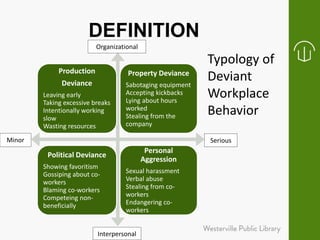
Incivility = low intensity deviant
behavior with ambiguous intent to harm
the target.
DEFINITION
Production
Deviance
Leaving early
Taking excessive breaks
Intentionally working
slow
Wasting resources
Property Deviance
Sabotaging equipment
Accepting kickbacks
Lying about hours
worked
Stealing from the
company
Political Deviance
Showing favoritism
Gossiping about co-
workers
Blaming co-workers
Competeing non-
beneficially
Personal
Aggression
Sexual harassment
Verbal abuse
Stealing from co-
workers
Endangering co-
workers
SeriousMinor
Interpersonal
Organizational
Typology of
Deviant
Workplace
Behavior
DEFINITION
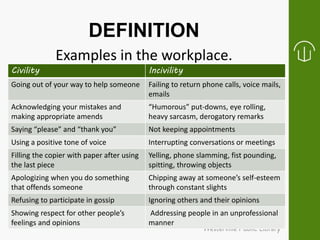
Examples in the workplace.
Civility Incivility
Going out of your way to help someone Failing to return phone calls, voice mails,
emails
Acknowledging your mistakes and
making appropriate amends
“Humorous” put-downs, eye rolling,
heavy sarcasm, derogatory remarks
Saying “please” and “thank you” Not keeping appointments
Using a positive tone of voice Interrupting conversations or meetings
Filling the copier with paper after using
the last piece
Yelling, phone slamming, fist pounding,
spitting, throwing objects
Apologizing when you do something
that offends someone
Chipping away at someone’s self-esteem
through constant slights
Refusing to participate in gossip Ignoring others and their opinions
Showing respect for other people’s
feelings and opinions
Addressing people in an unprofessional
manner
“Without civility…we run the risk of
acting as though we have ‘no fellow
passengers’ on the journey of life...”
- Deborah Eicher-Catt
IMPACT
The costs of incivility are significant
–decreased creativity,
–decreased morale,
–customer disdain—customers do not like
overhearing coworkers mistreat each
other—and
–time spent mending damages to
relationships
IMPACT
These costs aren’t merely interpersonal,
however.
Every human cost has a financial cost
(including a cost to both direct and
indirect compensation), as well.
IMPACT
Individual reactions vary, but Porath and
Pearson found that those who experience
incivility have:
– 48% - intentionally decreased their work effort
– 47% - intentionally decreased the time spent at work
– 38% - intentionally decreased the quality of their work
– 80% - lost work time worrying about the incident
– 63% - lost work time avoiding the offender
– 66% - said their performance declined
– 78% - said their commitment to the organization declined
– 12% - said they left their job because of the uncivil
treatment
– 25% - admitted to taking their frustration out on
customers
IMPACT
How do you perceive the incivility?
Your appraisal of the behavior
determines whether this breaks the
norms of your workplace and becomes
uncivil.
IMPACT
Is it:
Offensive
Annoying
Embarrassing
Frustrating
Disturbing
Threatening
IMPACT
Coping Strategies:
1. Conflict avoidance: Try to avoid/stay away
from the person, Just put up with it, Try not to
make the person angry, Try not to hurt the
person’s feelings.
2. Minimization: Tell yourself it wasn’t
important, Just try to forget it, Just ignore it,
Assume the person meant no harm/meant well.
3. Assertion: Confront the person, Ask the person
to leave you alone, Let the person know you
didn’t like what was happening.
IMPACT
Coping Strategies:
4. Informal social support seeking: Talk with
friend/someone for advice/support, Talk about
it with someone you trusted Talk with family for
understanding/support.
5. Informal organizational support seeking:
Talk with a supervisor/someone in
management, Report the situation informally.
6. Formal organizational support seeking:
Make a formal complaint.
BUILD
Note that incivility must be appraised as
fairly aversive and continue for some
time—and perhaps even escalate to
bullying—before employees report it to
management.
BUILD
Therefore, management should not
await formal grievances to take action
because most incivility targets employ a
variety of coping responses other than
organizational support seeking.
BUILD
In order to address incivility
organizationally, we need to be aware of
some of the triggers in our culture that
make this behavior more evident.
“Many people seem to think because
they are so busy and stressed, they are
allowed to be unpleasant to their
colleagues, or show up late to things
without apologizing.”
- Joyce E.A. Russel
Show video here:
Workplace Woes: Incivility Up,
Morale Down
CBS Early Show
August 9, 2011
BUILD
Incivility aggravators:
• Long hours/overwork
• “Hot temperament”
• Workplace stress
• Inflexibility
• Passive aggression
• Hurt feelings
• Intolerance of individual differences
BUILD
The organization’s responsibility is to
develop a system where incivility is
prevented to the extent possible, uncivil
conduct is taken seriously despite its
“minor” appearance, and employee-
targets are assisted in their attempts to
cope.
BUILD
One way to affect any culture change is
to assess the current climate.
Using an assessment will help target
workgroups that could benefit from
interventions (training) to enhance
civility and reduce liability.
BUILD
You could add questions to your current
employee survey that identify civility
issues.
Or…use a tool already built for that use.
BUILD
The Civility Norms Questionnaire-Brief (CNQ-
B) has four questions:
1. Rude behavior is not accepted by your co-
workers.
2. Angry outburts are not tolerated by anyone in
your unit/workgroup.
3. Respectful treatment is the norm in your
unit/workgroup.
4. Your co-workers make sure everyone in your
unit/workgroup is treated with respect.
BUILD
Tips for enhancing civility include:
1. Have good role models for good manners. If the
boss is abrasive, then everyone else has an
excuse for also being abrasive. If the boss is
polite and encouraging, everyone else will likely
follow in the boss’ footsteps.
2. Teach civility to everyone in the workplace. Offer
training on good manners and ways to show
respect to colleagues. Have the leaders at the
firm kick off the training to illustrate their
commitment to it.
BUILD
Tips for enhancing civility include:
3. Have zero-tolerance expectations for abrasive
behaviors in the workplace. Make sure you take
action otherwise you are condoning it.
4. Teach employees how to self-monitor their own
behavior. Employees need to know what their
triggers are and how to control their impulses
and responses.
BUILD
Tips for enhancing civility include:
5. A certain level of conflict is important in
companies, and yet employees and managers
often don’t know how to express conflict in a
healthy way. Make sure to examine the conflict
management styles of employees and managers
and teach the value of openly discussing issues.
6. Provide anger or stress management training in
the company. Even offering tips every week can
be useful for employees.
BUILD
Tips for enhancing civility include:
7. Encourage employees to consider the impact of
their words and actions on others before they
act. Too often, e-mails or text messages are sent
out in rapid fire, which only serve to escalate a
situation.
8. Encourage a business casual or professional
dress code. Some have argued that a more
casual or sloppy dress code is related to
colleagues treating each other in an overly
familiar and less professional manner.
BUILD
Tips for enhancing civility include:
9. Be on time. If you are late to meetings or to
getting work done, at least apologize. This is not
a sign of weakness, but a sign of good manners.
10. Help employees accept responsibility for their
actions and the consequences of those actions.
11. Ask for feedback to learn how you are coming
across to others. Listen to that feedback, and
take action to improve.
BUILD
As leaders your role should be to See and
Believe
• Workplace aggression does not occur in a
vacuum, and it doesn’t occur without leaving
evidence.
• If you begin to receive multiple complaints about
a manager, listen. If one department has higher
levels of absenteeism, medical leaves, and
turnover than all the rest, investigate.
• Don’t assume that everyone has benign motives.
They don’t.
BUILD
As individuals we have two choices
according to Deborah King:
“When incivility comes your way you can be a
thermometer and react, or you can be a thermostat
and change the temperature.”
EXAMPLES
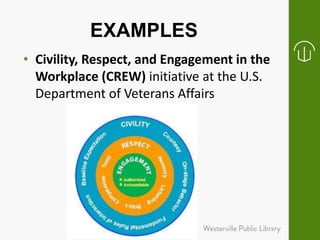
• Civility, Respect, and Engagement in the
Workplace (CREW) initiative at the U.S.
Department of Veterans Affairs
EXAMPLES
• Civility is an essential behavior of all employees
in all organizations. These are the interpersonal
“rules of engagement” for how we relate to each
other…the fundamentals of courtesy, politeness,
and consideration…
• Respect connects us at a personal level. It
reflects an attitude developed from deep listening
and understanding…
• Engagement is the result of respectful
relationships within an atmosphere of trust…
EXAMPLES
Southwest Airlines – workplace norms
foster civility.
• “We’ve talked to our employees from day one
about being one big family. If you stop and think
about it for even 20 seconds, the things we do are
things that you would do with your own families.
We try to acknowledge and react to any
significant event in our brothers’ or sisters’ lives,
whether it’s work related or personal…
EXAMPLES
Southwest Airlines – workplace norms
foster civility.
• …We do that traditional things, like sending
birthday cards and cards on the anniversary of
their date of hire. But if employees have a child
who’s sick or a death in the family, we do our best
to acknowledge it. We celebrate with out
employees wen good things happen, and we
grieve with them when they experience
something devastating.” – former CEO Colleen
Barrett
EXAMPLES
Show video here:
UT’s Civility Message
University of Tennessee Knoxville
April 13, 2011
RESOURCES
• Johnson, Lisa C.; Cultivating Workplace Civility, UMES 5th
Annual Administrative Assistant Retreat (2012).
• Payscale, Incivility & Other Types of Workplace Aggression,
What It Is, What It Costs, and How to Stop It (2014).
• Cortina, Lilia. Unseen Injustice: Incivility As Modern
Discrimination In Organizations, Academy of Management
Review. Jan 2008, Vol. 33 Issue 1, p55-75. 21p. 2 Diagrams.
• Cortina, Lilia. Patterns and profiles of response to incivility in
the workplace, Journal of Occupational Health Psychology
Volume: 14 Issue 3 (2009).
• Civility, Respect, and Engagement in the Workplace (CREW)
initiative at the U.S. Department of Veterans Affairs,
retrieved from http://www.va.gov/ncod/crew.asp (2015).
RESOURCES
• Richman, Barbara. Ten Tips for Creating Respect and Civility
in Your Workplace, HR Mpact, retrieved from
https://www.lorman.com/resources/ten-tips-for-creating-
respect-and-civility-in-your-workplace-15463 (May 2014).
• Russell, Joyce E.A. How To Cultivate Civility in the
Workplace, retrieved from
http://www.washingtonpost.com/business/capitalbusiness/
career-coach-how-to-cultivate-civility-in-the-
workplace/2012/06/15/gJQA6YIjjV_story.html (2015).
• Johns Hopkins University and the Jacob France Institute of
the University of Baltimore. Workplace Misdeeds Top
"Terrible Ten" Rude Behaviors List retrieved from
http://www.jhu.edu/news/home07/oct07/civility.html
(October 4, 2007).
RESOURCES
• Della Cava, Marco R. What Happened to Civility? USA
TODAY, updated 9/15/2009. Retrieved from
http://usatoday30.usatoday.com/life/lifestyle/2009-09-14-
civility-cover_N.htm (2015).
• Kim, Tae Wan, Strudler, Alan. Worklace Civility: A Confucian
Approach, Business Ethics Quarterly 22:3 (July 2012), pp
557-577.
• Forni, P.M. The Civility Solution - What to Do When People
Are Rude (September 1, 2009).
• Robinson, Sandra L. and Bennett, Rebecca J. A Typology of
Deviant Workplace Behaviors: A Multidimensional Scaling
Study, Academy Of Management Journal; April 1, 1995.
• King, Deborah. Civility In The Workplace,
https://www.youtube.com/watch?v=Vhzf8G1uy_Y.
RESOURCES
• Walsh, Benjamin M., Magley, Vicki J., Reeves, David W.,
Davies-Schrils, Kimberly A., Marmet, Matthew D., and
Gallus, Jessica A. Assessing Workgroup Norms for Civility:
The Development of the Civility Norms Questionnaire-Brief,
Journal of Business and Psychology, December 2012,
Volume 27, Issue 4, pp 407-420.
• University of Tennessee Knoxville, UT’s Civility Message,
https://youtu.be/K7uwiLK_FR0.
• CBS Early Show, Workplace woes: Incivility up, morale down,
https://youtu.be/V-_KtNTmy64.
• Eicher-Catt, Deborah. A Semiotic Interpretation of Authentic
Civility: Preserving the Ineffable for the Good of the
Common, Communication Quarterly, Vol. 6, No. 1, January –
March 2013, pp 1-17.

Workplace Civility

  • 1.
    WORKPLACE CIVILITY - RESPECTFULHABITS THAT ENHANCE PRODUCTIVITY Katrina Plourde, SPHR, MLHR Human Resources Manager Westerville Public Library kplourde@westervillelibrary.org
  • 2.
    “Be civil toall, sociable to many, familiar with a few, friend to one, enemy to none.” - Benjamin Franklin
  • 3.
    OBJECTIVES Today we willlook at: 1. DEFINITION of what civility and incivility looks like 2. The IMPACT of incivility on workplaces and individuals 3. Ways to BUILD civility into your organizations 4. EXAMPLES of civility programs
  • 4.
  • 5.
    DEFINITION Civility encompasses morethan just good manners and etiquette. It includes the behavior that helps to preserve the norms for mutual respect at work.
  • 6.
    DEFINITION Civility usually isdemonstrated through manners, courtesy, politeness, and a general awareness of the rights, wishes, concerns, and feelings of others.
  • 7.
    DEFINITION Civility demands thatone speaks in ways that are respectful, responsible, restrained and principled… …and avoid that which is offensive, rude, demeaning, and threatening.
  • 8.
    DEFINITION So now wesee that incivility is the opposite of respect. Yet some may see some of these behaviors as just “being real” in today’s terminology.
  • 9.
    DEFINITION If civility isbased on norms of behavior, it is not surprising that we have a crisis of civility brewing in America. We don’t want to be told what to do or that there is a common behavior we need to mold to.
  • 10.
    “Are we anation of boors – or just trying to keep things real?” - Marco R. della Cava
  • 11.
    DEFINITION It's an ageof total disclosure and total expression and there is often very little concern for the feelings of others.
  • 12.
    DEFINITION According to UrbanDictionary: “Entitlementia” = Behaving any way in which one chooses with total disregard for public decorum. We all know examples of this…right?
  • 13.
    DEFINITION Incivility = lowintensity deviant behavior with ambiguous intent to harm the target.
  • 14.
    DEFINITION Production Deviance Leaving early Taking excessivebreaks Intentionally working slow Wasting resources Property Deviance Sabotaging equipment Accepting kickbacks Lying about hours worked Stealing from the company Political Deviance Showing favoritism Gossiping about co- workers Blaming co-workers Competeing non- beneficially Personal Aggression Sexual harassment Verbal abuse Stealing from co- workers Endangering co- workers SeriousMinor Interpersonal Organizational Typology of Deviant Workplace Behavior
  • 15.
    DEFINITION Examples in theworkplace. Civility Incivility Going out of your way to help someone Failing to return phone calls, voice mails, emails Acknowledging your mistakes and making appropriate amends “Humorous” put-downs, eye rolling, heavy sarcasm, derogatory remarks Saying “please” and “thank you” Not keeping appointments Using a positive tone of voice Interrupting conversations or meetings Filling the copier with paper after using the last piece Yelling, phone slamming, fist pounding, spitting, throwing objects Apologizing when you do something that offends someone Chipping away at someone’s self-esteem through constant slights Refusing to participate in gossip Ignoring others and their opinions Showing respect for other people’s feelings and opinions Addressing people in an unprofessional manner
  • 16.
    “Without civility…we runthe risk of acting as though we have ‘no fellow passengers’ on the journey of life...” - Deborah Eicher-Catt
  • 17.
    IMPACT The costs ofincivility are significant –decreased creativity, –decreased morale, –customer disdain—customers do not like overhearing coworkers mistreat each other—and –time spent mending damages to relationships
  • 18.
    IMPACT These costs aren’tmerely interpersonal, however. Every human cost has a financial cost (including a cost to both direct and indirect compensation), as well.
  • 19.
    IMPACT Individual reactions vary,but Porath and Pearson found that those who experience incivility have: – 48% - intentionally decreased their work effort – 47% - intentionally decreased the time spent at work – 38% - intentionally decreased the quality of their work – 80% - lost work time worrying about the incident – 63% - lost work time avoiding the offender – 66% - said their performance declined – 78% - said their commitment to the organization declined – 12% - said they left their job because of the uncivil treatment – 25% - admitted to taking their frustration out on customers
  • 20.
    IMPACT How do youperceive the incivility? Your appraisal of the behavior determines whether this breaks the norms of your workplace and becomes uncivil.
  • 21.
  • 22.
    IMPACT Coping Strategies: 1. Conflictavoidance: Try to avoid/stay away from the person, Just put up with it, Try not to make the person angry, Try not to hurt the person’s feelings. 2. Minimization: Tell yourself it wasn’t important, Just try to forget it, Just ignore it, Assume the person meant no harm/meant well. 3. Assertion: Confront the person, Ask the person to leave you alone, Let the person know you didn’t like what was happening.
  • 23.
    IMPACT Coping Strategies: 4. Informalsocial support seeking: Talk with friend/someone for advice/support, Talk about it with someone you trusted Talk with family for understanding/support. 5. Informal organizational support seeking: Talk with a supervisor/someone in management, Report the situation informally. 6. Formal organizational support seeking: Make a formal complaint.
  • 24.
    BUILD Note that incivilitymust be appraised as fairly aversive and continue for some time—and perhaps even escalate to bullying—before employees report it to management.
  • 25.
    BUILD Therefore, management shouldnot await formal grievances to take action because most incivility targets employ a variety of coping responses other than organizational support seeking.
  • 26.
    BUILD In order toaddress incivility organizationally, we need to be aware of some of the triggers in our culture that make this behavior more evident.
  • 27.
    “Many people seemto think because they are so busy and stressed, they are allowed to be unpleasant to their colleagues, or show up late to things without apologizing.” - Joyce E.A. Russel
  • 28.
    Show video here: WorkplaceWoes: Incivility Up, Morale Down CBS Early Show August 9, 2011
  • 29.
    BUILD Incivility aggravators: • Longhours/overwork • “Hot temperament” • Workplace stress • Inflexibility • Passive aggression • Hurt feelings • Intolerance of individual differences
  • 30.
    BUILD The organization’s responsibilityis to develop a system where incivility is prevented to the extent possible, uncivil conduct is taken seriously despite its “minor” appearance, and employee- targets are assisted in their attempts to cope.
  • 31.
    BUILD One way toaffect any culture change is to assess the current climate. Using an assessment will help target workgroups that could benefit from interventions (training) to enhance civility and reduce liability.
  • 32.
    BUILD You could addquestions to your current employee survey that identify civility issues. Or…use a tool already built for that use.
  • 33.
    BUILD The Civility NormsQuestionnaire-Brief (CNQ- B) has four questions: 1. Rude behavior is not accepted by your co- workers. 2. Angry outburts are not tolerated by anyone in your unit/workgroup. 3. Respectful treatment is the norm in your unit/workgroup. 4. Your co-workers make sure everyone in your unit/workgroup is treated with respect.
  • 34.
    BUILD Tips for enhancingcivility include: 1. Have good role models for good manners. If the boss is abrasive, then everyone else has an excuse for also being abrasive. If the boss is polite and encouraging, everyone else will likely follow in the boss’ footsteps. 2. Teach civility to everyone in the workplace. Offer training on good manners and ways to show respect to colleagues. Have the leaders at the firm kick off the training to illustrate their commitment to it.
  • 35.
    BUILD Tips for enhancingcivility include: 3. Have zero-tolerance expectations for abrasive behaviors in the workplace. Make sure you take action otherwise you are condoning it. 4. Teach employees how to self-monitor their own behavior. Employees need to know what their triggers are and how to control their impulses and responses.
  • 36.
    BUILD Tips for enhancingcivility include: 5. A certain level of conflict is important in companies, and yet employees and managers often don’t know how to express conflict in a healthy way. Make sure to examine the conflict management styles of employees and managers and teach the value of openly discussing issues. 6. Provide anger or stress management training in the company. Even offering tips every week can be useful for employees.
  • 37.
    BUILD Tips for enhancingcivility include: 7. Encourage employees to consider the impact of their words and actions on others before they act. Too often, e-mails or text messages are sent out in rapid fire, which only serve to escalate a situation. 8. Encourage a business casual or professional dress code. Some have argued that a more casual or sloppy dress code is related to colleagues treating each other in an overly familiar and less professional manner.
  • 38.
    BUILD Tips for enhancingcivility include: 9. Be on time. If you are late to meetings or to getting work done, at least apologize. This is not a sign of weakness, but a sign of good manners. 10. Help employees accept responsibility for their actions and the consequences of those actions. 11. Ask for feedback to learn how you are coming across to others. Listen to that feedback, and take action to improve.
  • 39.
    BUILD As leaders yourrole should be to See and Believe • Workplace aggression does not occur in a vacuum, and it doesn’t occur without leaving evidence. • If you begin to receive multiple complaints about a manager, listen. If one department has higher levels of absenteeism, medical leaves, and turnover than all the rest, investigate. • Don’t assume that everyone has benign motives. They don’t.
  • 40.
    BUILD As individuals wehave two choices according to Deborah King: “When incivility comes your way you can be a thermometer and react, or you can be a thermostat and change the temperature.”
  • 41.
    EXAMPLES • Civility, Respect,and Engagement in the Workplace (CREW) initiative at the U.S. Department of Veterans Affairs
  • 42.
    EXAMPLES • Civility isan essential behavior of all employees in all organizations. These are the interpersonal “rules of engagement” for how we relate to each other…the fundamentals of courtesy, politeness, and consideration… • Respect connects us at a personal level. It reflects an attitude developed from deep listening and understanding… • Engagement is the result of respectful relationships within an atmosphere of trust…
  • 43.
    EXAMPLES Southwest Airlines –workplace norms foster civility. • “We’ve talked to our employees from day one about being one big family. If you stop and think about it for even 20 seconds, the things we do are things that you would do with your own families. We try to acknowledge and react to any significant event in our brothers’ or sisters’ lives, whether it’s work related or personal…
  • 44.
    EXAMPLES Southwest Airlines –workplace norms foster civility. • …We do that traditional things, like sending birthday cards and cards on the anniversary of their date of hire. But if employees have a child who’s sick or a death in the family, we do our best to acknowledge it. We celebrate with out employees wen good things happen, and we grieve with them when they experience something devastating.” – former CEO Colleen Barrett
  • 45.
    EXAMPLES Show video here: UT’sCivility Message University of Tennessee Knoxville April 13, 2011
  • 46.
    RESOURCES • Johnson, LisaC.; Cultivating Workplace Civility, UMES 5th Annual Administrative Assistant Retreat (2012). • Payscale, Incivility & Other Types of Workplace Aggression, What It Is, What It Costs, and How to Stop It (2014). • Cortina, Lilia. Unseen Injustice: Incivility As Modern Discrimination In Organizations, Academy of Management Review. Jan 2008, Vol. 33 Issue 1, p55-75. 21p. 2 Diagrams. • Cortina, Lilia. Patterns and profiles of response to incivility in the workplace, Journal of Occupational Health Psychology Volume: 14 Issue 3 (2009). • Civility, Respect, and Engagement in the Workplace (CREW) initiative at the U.S. Department of Veterans Affairs, retrieved from http://www.va.gov/ncod/crew.asp (2015).
  • 47.
    RESOURCES • Richman, Barbara.Ten Tips for Creating Respect and Civility in Your Workplace, HR Mpact, retrieved from https://www.lorman.com/resources/ten-tips-for-creating- respect-and-civility-in-your-workplace-15463 (May 2014). • Russell, Joyce E.A. How To Cultivate Civility in the Workplace, retrieved from http://www.washingtonpost.com/business/capitalbusiness/ career-coach-how-to-cultivate-civility-in-the- workplace/2012/06/15/gJQA6YIjjV_story.html (2015). • Johns Hopkins University and the Jacob France Institute of the University of Baltimore. Workplace Misdeeds Top "Terrible Ten" Rude Behaviors List retrieved from http://www.jhu.edu/news/home07/oct07/civility.html (October 4, 2007).
  • 48.
    RESOURCES • Della Cava,Marco R. What Happened to Civility? USA TODAY, updated 9/15/2009. Retrieved from http://usatoday30.usatoday.com/life/lifestyle/2009-09-14- civility-cover_N.htm (2015). • Kim, Tae Wan, Strudler, Alan. Worklace Civility: A Confucian Approach, Business Ethics Quarterly 22:3 (July 2012), pp 557-577. • Forni, P.M. The Civility Solution - What to Do When People Are Rude (September 1, 2009). • Robinson, Sandra L. and Bennett, Rebecca J. A Typology of Deviant Workplace Behaviors: A Multidimensional Scaling Study, Academy Of Management Journal; April 1, 1995. • King, Deborah. Civility In The Workplace, https://www.youtube.com/watch?v=Vhzf8G1uy_Y.
  • 49.
    RESOURCES • Walsh, BenjaminM., Magley, Vicki J., Reeves, David W., Davies-Schrils, Kimberly A., Marmet, Matthew D., and Gallus, Jessica A. Assessing Workgroup Norms for Civility: The Development of the Civility Norms Questionnaire-Brief, Journal of Business and Psychology, December 2012, Volume 27, Issue 4, pp 407-420. • University of Tennessee Knoxville, UT’s Civility Message, https://youtu.be/K7uwiLK_FR0. • CBS Early Show, Workplace woes: Incivility up, morale down, https://youtu.be/V-_KtNTmy64. • Eicher-Catt, Deborah. A Semiotic Interpretation of Authentic Civility: Preserving the Ineffable for the Good of the Common, Communication Quarterly, Vol. 6, No. 1, January – March 2013, pp 1-17.

Editor's Notes

  • #6 What are the norms we have in our workplaces? There should be an ‘esprit de corps’ – feelings of goodwill, loyalty, enthusiasm and devotion to a group.
  • #7 In a practical sense it is making sure the door doesn’t slam shut behind me, pausing to say thank you when someone holds the door for you, showing restraint in conversation (if you don’t have anything nice to say…).
  • #9 But we say, ‘we are American, I have the right to do and say anything I want’. Yes, but should you?
  • #47 Here are my resources and a few others that you might be interested in if you want more on this topic.
  • #48 Here are my resources and a few others that you might be interested in if you want more on this topic.
  • #49 Here are my resources and a few others that you might be interested in if you want more on this topic.
  • #50 Here are my resources and a few others that you might be interested in if you want more on this topic.