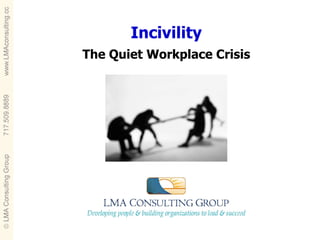
Incivility The Quiet Workplace Crisis
What is Workplace Incivility? Behavior that violates workplace norms for mutual respect in such a way that cooperation and motivation are reduced  Behavior can be “under the radar” and difficult to detect
“ Assessing and Attacking Workplace Incivility,”  Organizational Dynamics 29, no.2, 2000 , Lynne Anderson, Christine Pearson and Christine Porath. Affects of Incivility 22% of employees had intentionally decreased work efforts 10% had called in sick to avoid the instigator 28% lost productivity because they spent time at work avoiding the instigator 37% reduced their commitment to the organization 12% had actually quit organizations
Incivility Is Often Ambiguous The intent to harm may not be clear  The instigator often pretends innocence or claims that the injured party misunderstood or is too sensitive
Incivility Is Often Not Reported Employees fear reprisals or damage to their careers In exit interviews, incivility may not be mentioned by departing employees because they don’t want to affect future references or may blame themselves for not being able to “take it”
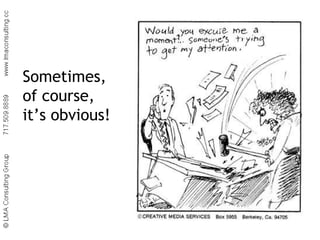
Sometimes,  of course,  it’s obvious!
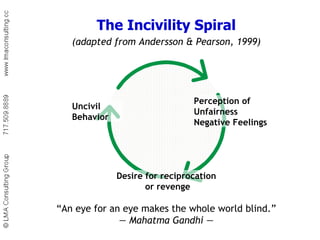
“ An eye for an eye makes the whole world blind.” —  Mahatma Gandhi — The Incivility Spiral (adapted from Andersson & Pearson, 1999) Uncivil Behavior Perception of Unfairness Negative Feelings Desire for reciprocation or revenge
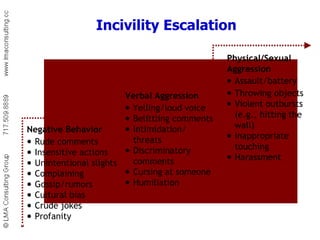
Incivility Escalation
Who Are The Instigators? Male or female: coworkers, supervisors, managers Tend to be rude to coworkers, disrespectful of subordinates  Generally difficult to get along with Often emotionally reactive to problems and stressful situations.  Some are particularly skilled at “kissing up and kicking down”
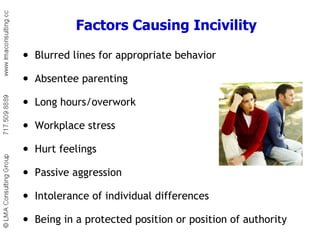
Factors Causing Incivility Blurred lines for appropriate behavior Absentee parenting Long hours/overwork Workplace stress Hurt feelings Passive aggression Intolerance of individual differences Being in a protected position or position of authority
Why Be Civil? 83% of people report that it is “very important” to work in a civil environment (Baltimore Workplace Study, 2003) What you give is what you get One person can have a positive impact on the work environment — Improved cooperation — Improved productivity — Improved teamwork
Create a Culture of Civility Clearly define expectations for how employees treat each other Organization culture and values Employee orientation Leaders model civility
Create a Culture of Civility Leaders identify and address incivility Reward/reinforce civil behavior Offenders face consequences Encourage stress management,  active listening, conflict  resolution skills
Define Civil Behavior Avoid sarcasm, put downs, offensive humor Listen attentively with eye contact Watch body language/personal space Apologize when in the wrong Respect coworkers’ “stuff” (e.g., workspace, tools, food in the refrigerator) Give each other positive reinforcement Engage employees in creating the definition.  Here are some items employee groups have suggested:
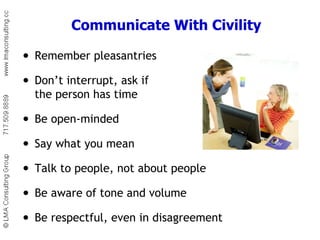
Remember pleasantries Don’t interrupt, ask if  the person has time Be open-minded Say what you mean Talk to people, not about people Be aware of tone and volume Be respectful, even in disagreement Communicate With Civility
Avoid Words That Promote Conflict “ You should/you must…” “ You lied…” “ This is so typical of you…” “ You always/you never…” “ The problem is you…” “ If you don’t do this, then I’ll…” “ You’ll never change…” “ You’re being hysterical/ unreasonable…”
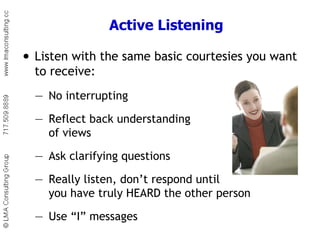
Active Listening Listen with the same basic courtesies you want to receive: — No interrupting — Reflect back understanding  of views — Ask clarifying questions — Really listen, don’t respond until  you have truly HEARD the other person — Use “I” messages
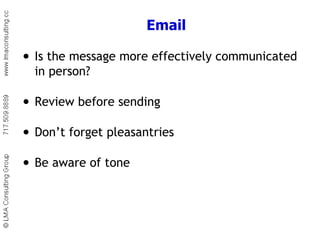
Email Is the message more effectively communicated in person? Review before sending Don’t forget pleasantries Be aware of tone
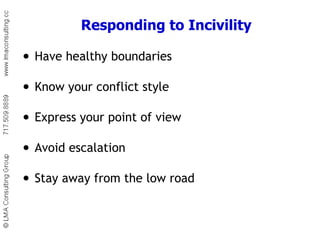
Responding to Incivility Have healthy boundaries Know your conflict style Express your point of view Avoid escalation Stay away from the low road
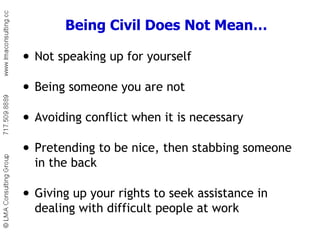
Being Civil Does Not Mean… Not speaking up for yourself Being someone you are not Avoiding conflict when it is necessary Pretending to be nice, then stabbing someone in the back Giving up your rights to seek assistance in dealing with difficult people at work
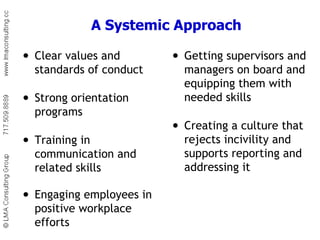
A Systemic Approach Clear values and standards of conduct Strong orientation programs Training in communication and related skills Engaging employees in positive workplace efforts Getting supervisors and managers on board and equipping them with needed skills Creating a culture that rejects incivility and supports reporting and addressing it
Resources Rude Awakenings: Overcoming the Civility Crisis in the Workplace  (2002) by Giovinella Gonthier Choosing Civility: The Twenty-Five Rules of Considerate Conduct  (2002) by P.M. Forni Conflict Resolution  (2001) by Daniel Dana People Styles at Work  (1996) by Robert Bolton & Dorothy Grover Bolton Resolving Conflicts at Work  (2005) by Kenneth Cloke & Joan Goldsmith Workplace Wars and How to End Them  (1994) by Kenneth Kaye
1848 Charter Lane Lancaster, PA 17601-5896 717.509.8889    877.562.2888 www.LMAconsulting.cc

Incivility In The Workplace

  • 1.
    Incivility The QuietWorkplace Crisis
  • 2.
    What is WorkplaceIncivility? Behavior that violates workplace norms for mutual respect in such a way that cooperation and motivation are reduced Behavior can be “under the radar” and difficult to detect
  • 3.
    “ Assessing andAttacking Workplace Incivility,” Organizational Dynamics 29, no.2, 2000 , Lynne Anderson, Christine Pearson and Christine Porath. Affects of Incivility 22% of employees had intentionally decreased work efforts 10% had called in sick to avoid the instigator 28% lost productivity because they spent time at work avoiding the instigator 37% reduced their commitment to the organization 12% had actually quit organizations
  • 4.
    Incivility Is OftenAmbiguous The intent to harm may not be clear The instigator often pretends innocence or claims that the injured party misunderstood or is too sensitive
  • 5.
    Incivility Is OftenNot Reported Employees fear reprisals or damage to their careers In exit interviews, incivility may not be mentioned by departing employees because they don’t want to affect future references or may blame themselves for not being able to “take it”
  • 6.
    Sometimes, ofcourse, it’s obvious!
  • 7.
    “ An eyefor an eye makes the whole world blind.” — Mahatma Gandhi — The Incivility Spiral (adapted from Andersson & Pearson, 1999) Uncivil Behavior Perception of Unfairness Negative Feelings Desire for reciprocation or revenge
  • 8.
  • 9.
    Who Are TheInstigators? Male or female: coworkers, supervisors, managers Tend to be rude to coworkers, disrespectful of subordinates Generally difficult to get along with Often emotionally reactive to problems and stressful situations. Some are particularly skilled at “kissing up and kicking down”
  • 10.
    Factors Causing IncivilityBlurred lines for appropriate behavior Absentee parenting Long hours/overwork Workplace stress Hurt feelings Passive aggression Intolerance of individual differences Being in a protected position or position of authority
  • 11.
    Why Be Civil?83% of people report that it is “very important” to work in a civil environment (Baltimore Workplace Study, 2003) What you give is what you get One person can have a positive impact on the work environment — Improved cooperation — Improved productivity — Improved teamwork
  • 12.
    Create a Cultureof Civility Clearly define expectations for how employees treat each other Organization culture and values Employee orientation Leaders model civility
  • 13.
    Create a Cultureof Civility Leaders identify and address incivility Reward/reinforce civil behavior Offenders face consequences Encourage stress management, active listening, conflict resolution skills
  • 14.
    Define Civil BehaviorAvoid sarcasm, put downs, offensive humor Listen attentively with eye contact Watch body language/personal space Apologize when in the wrong Respect coworkers’ “stuff” (e.g., workspace, tools, food in the refrigerator) Give each other positive reinforcement Engage employees in creating the definition. Here are some items employee groups have suggested:
  • 15.
    Remember pleasantries Don’tinterrupt, ask if the person has time Be open-minded Say what you mean Talk to people, not about people Be aware of tone and volume Be respectful, even in disagreement Communicate With Civility
  • 16.
    Avoid Words ThatPromote Conflict “ You should/you must…” “ You lied…” “ This is so typical of you…” “ You always/you never…” “ The problem is you…” “ If you don’t do this, then I’ll…” “ You’ll never change…” “ You’re being hysterical/ unreasonable…”
  • 17.
    Active Listening Listenwith the same basic courtesies you want to receive: — No interrupting — Reflect back understanding of views — Ask clarifying questions — Really listen, don’t respond until you have truly HEARD the other person — Use “I” messages
  • 18.
    Email Is themessage more effectively communicated in person? Review before sending Don’t forget pleasantries Be aware of tone
  • 19.
    Responding to IncivilityHave healthy boundaries Know your conflict style Express your point of view Avoid escalation Stay away from the low road
  • 20.
    Being Civil DoesNot Mean… Not speaking up for yourself Being someone you are not Avoiding conflict when it is necessary Pretending to be nice, then stabbing someone in the back Giving up your rights to seek assistance in dealing with difficult people at work
  • 21.
    A Systemic ApproachClear values and standards of conduct Strong orientation programs Training in communication and related skills Engaging employees in positive workplace efforts Getting supervisors and managers on board and equipping them with needed skills Creating a culture that rejects incivility and supports reporting and addressing it
  • 22.
    Resources Rude Awakenings:Overcoming the Civility Crisis in the Workplace (2002) by Giovinella Gonthier Choosing Civility: The Twenty-Five Rules of Considerate Conduct (2002) by P.M. Forni Conflict Resolution (2001) by Daniel Dana People Styles at Work (1996) by Robert Bolton & Dorothy Grover Bolton Resolving Conflicts at Work (2005) by Kenneth Cloke & Joan Goldsmith Workplace Wars and How to End Them (1994) by Kenneth Kaye
  • 23.
    1848 Charter LaneLancaster, PA 17601-5896 717.509.8889  877.562.2888 www.LMAconsulting.cc