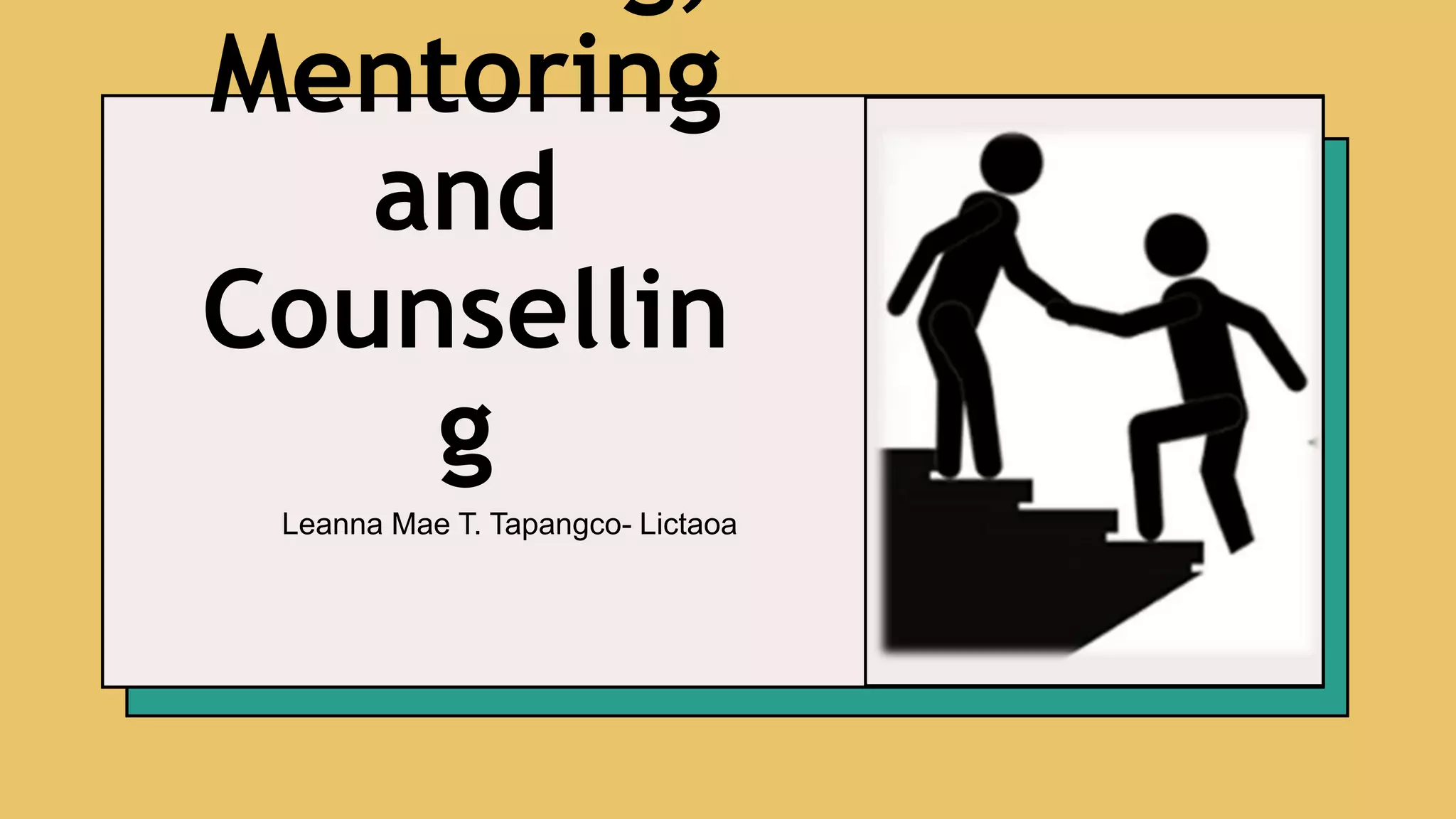
Mentoring
and
Counsellin
g
Leanna Mae T. Tapangco- Lictaoa
Coaching
It is a developmental approach to
working and interacting with other
people. It can help people develop
their personal capabilities,
interpersonal skills and capacity to
understand and empathize with
others.
2
Mentoring
It is a process of using specially
selected and trained individuals to
provide guidance, pragmatic
advice, and continuing support that
will help the people in their
learning and development process.
3
Counselling
It is a process of talking about and
working through personal
problems with a counsellor. It helps
you to address your problems in a
positive way by helping you clarify
the issues, explore options,
develop strategies and increase
self-awareness. 4
12 Counselling Skills
5 Presentation title 20XX
6 Presentation title 20XX
Active Listening
- This type of listening can be defined
as the use of eye contact, facial
expressions and gestures to imply
that you are engaged and focused on
the information the other person is
saying. It can help a client feel like
they've been heard and validated in
the information they chose to share.
7 Presentation title 20XX
Question
- Open questioning includes all
questioning that is directed toward
gathering more detailed and complex
information. Closed questioning is
directed toward more short-ended
questions with specific answers.
8 Presentation title 20XX
Note Taking
- Counselors should be skilled in
organized note-taking techniques in
order to record important points that
were discussed during the session
and the information the client
provided. This can be used for further
analysis later on.
9 Presentation title 20XX
Interpretation
- Counselors should be able to
interpret vague information that a
client shares and place it within the
context of what they are going
through. Phrases like "I'm just so
tired," or "I'm on edge all the time,"
constitute further information, and it is
up to the counselor to interpret this
10 Presentation title 20XX
Non Verbal Communication
- Similar to information interpretation,
counselors should be able to identify
current attitudes or feelings based
upon the body language that a client
uses during the session.
11 Presentation title 20XX
Self- Awareness
- Counselors need to be aware of how
their body language, gestures and
tone of voice can affect their client
and their willingness to talk about the
situation. Having good self-awareness
can keep a counselor from
accidentally exhibiting signs of
boredom, frustration or judgment.
12 Presentation title 20XX
Trustworthiness
- An important skill for a counselor is
to be able to build and maintain trust
with their clients. This can affect a
client's willingness to share
information.
13 Presentation title 20XX
Empathy
- A counselor needs to be able to see
a client's situation from their
perspective in order to best help them
overcome their obstacles.
14 Presentation title 20XX
Emotional compartmentalization-
Another skill that can be specific to
counselors is the ability to emotionally
compartmentalize themselves from
their clients and maintain professional
boundaries in order to continue
healthy client relationships.
15 Presentation title 20XX
Information Recall
Counselors should be able to retain
information that was shared with them
earlier in the session or from a
previous session in order to help
guide their questioning toward a
particular client.
16 Presentation title 20XX
Confidentiality
Confidentiality can be seen as a
valued skill for a counselor to have as
they must respect their clients and the
information they share with them.
17 Presentation title 20XX
Record keeping
Counselors should be able to keep
detailed records of their clients,
relevant paperwork and session notes
to make sure everything stays up-to-
date.
Thank you

Coaching, Mentoring and Counselling.pptx

  • 1.
  • 2.
    Coaching It is adevelopmental approach to working and interacting with other people. It can help people develop their personal capabilities, interpersonal skills and capacity to understand and empathize with others. 2
  • 3.
    Mentoring It is aprocess of using specially selected and trained individuals to provide guidance, pragmatic advice, and continuing support that will help the people in their learning and development process. 3
  • 4.
    Counselling It is aprocess of talking about and working through personal problems with a counsellor. It helps you to address your problems in a positive way by helping you clarify the issues, explore options, develop strategies and increase self-awareness. 4
  • 5.
    12 Counselling Skills 5Presentation title 20XX
  • 6.
    6 Presentation title20XX Active Listening - This type of listening can be defined as the use of eye contact, facial expressions and gestures to imply that you are engaged and focused on the information the other person is saying. It can help a client feel like they've been heard and validated in the information they chose to share.
  • 7.
    7 Presentation title20XX Question - Open questioning includes all questioning that is directed toward gathering more detailed and complex information. Closed questioning is directed toward more short-ended questions with specific answers.
  • 8.
    8 Presentation title20XX Note Taking - Counselors should be skilled in organized note-taking techniques in order to record important points that were discussed during the session and the information the client provided. This can be used for further analysis later on.
  • 9.
    9 Presentation title20XX Interpretation - Counselors should be able to interpret vague information that a client shares and place it within the context of what they are going through. Phrases like "I'm just so tired," or "I'm on edge all the time," constitute further information, and it is up to the counselor to interpret this
  • 10.
    10 Presentation title20XX Non Verbal Communication - Similar to information interpretation, counselors should be able to identify current attitudes or feelings based upon the body language that a client uses during the session.
  • 11.
    11 Presentation title20XX Self- Awareness - Counselors need to be aware of how their body language, gestures and tone of voice can affect their client and their willingness to talk about the situation. Having good self-awareness can keep a counselor from accidentally exhibiting signs of boredom, frustration or judgment.
  • 12.
    12 Presentation title20XX Trustworthiness - An important skill for a counselor is to be able to build and maintain trust with their clients. This can affect a client's willingness to share information.
  • 13.
    13 Presentation title20XX Empathy - A counselor needs to be able to see a client's situation from their perspective in order to best help them overcome their obstacles.
  • 14.
    14 Presentation title20XX Emotional compartmentalization- Another skill that can be specific to counselors is the ability to emotionally compartmentalize themselves from their clients and maintain professional boundaries in order to continue healthy client relationships.
  • 15.
    15 Presentation title20XX Information Recall Counselors should be able to retain information that was shared with them earlier in the session or from a previous session in order to help guide their questioning toward a particular client.
  • 16.
    16 Presentation title20XX Confidentiality Confidentiality can be seen as a valued skill for a counselor to have as they must respect their clients and the information they share with them.
  • 17.
    17 Presentation title20XX Record keeping Counselors should be able to keep detailed records of their clients, relevant paperwork and session notes to make sure everything stays up-to- date.
  • 18.