ETHICS IN COUNSELLING
BY: MS. ANU SAM JACOB
LECTURER, NBU
LEARNING OBJECTIVES
At the end of the class students will be able to:
1. Define ethics and code of ethics in counselling
2. Explaining counselors professional ethics
3. Describe the rights of clients in counselling
4. Understand to maintain confidentiality in
counselling
5. Enlist the ethical principles
6. Discuss the ethical and legal issues in counselling
What is ethics ???
Ethics are a set of moral principles or rules of
conduct for an individual or group.
The term ethics comes from the Greek ethos
meaning custom, habit or character.
Ethics determine choices made.
Ethics are principles that explain what is good and
right and what is bad and wrong and that prescribe
a code of behavior based on these definitions.
In counselling, ethics underpin the nature and
course of actions taken by the counsellor.
Counsellors and others in helping professions are
expected to behave in an ethical manner.
Counselling and ethics
Ethics in a holistic perspective
Ross (2002) draws on this further by asking counselors
to look at ethics from a holistic perspective.
 Body (the environment, structures, systems, policies,
laws, regulations, moral codes, and societal norms)
 Mind (ethical thinking, philosophy), heart
(relationships, emotions, values)
 And spirit (unknowing, unconscious). A complete
awareness of the ethics of a situation can occur when all
are taken into consideration.
 The concept of ethics relates to moral
consideration.
 The challenge lies in what is considered moral or
ethical.
 Each counsellor comes to the profession with
their own set of values and standards.
 Individual principles and how they were used to
interpret dilemmas would be universally different.
Therefore, a Code of Ethics is required.
Code of ethics
 A general standard that counsellors and
therapists adhere to and use co jointly with legal
standards to provide ethical practice and work
through ethical dilemmas.
 Ethical codes offer counsellors an outline of what
are considered acceptable and unacceptable
behaviours.
Code of ethics
COUNSELLORS
PROFESSIONAL ETHICS
Every profession has in some form or other a Code of Ethics
Meaning of Professional Ethics : systematized body of
moral principles that guide or determine the counsellor’s
behavior in his relationships to the counselee, to the
counselee's relatives, to his referring agency, and to society in
general.
Professional Ethics -> Values that determine the
counsellor’s behavior.
Professional ethics
A. Counsellor must respect the values of the counselee
 Can suggest to change her social values ( not the moral or
religious values)
B. Counsellor must keep secret the counselee’s confidential
material
 May not reveal information to anyone without securing her
permission
 Exceptions: Suicide or crime or for the good of the
counselee.
C. Test results must be interpreted to the counselee in a
manner likely to be constructive in her efforts to solve her
problem.
Counselor’s relationship to the Counselee
A. Counsellor should maintain high standards of work, not
just aim at expedience or temporary success
-unethical to offer services outside his area of training and
experiences or beyond the boundary of his competence
-Should not work for only for money
B. Should try to rectify the malpractices of other counselors
-Should not criticize who use other methods
c. Counselor should not accept for counselling someone who
already receiving it from someone else .
Counselor’s relationship to the profession
It is a courtesy to inform the referring person or
agency that the counselee kept the appointment
and is continuing counselling or has been referred
to other agency.
No confidential information should be imparted to
them.
Counselor’s relationship to Referring bodies
• Right to private life and relaxation.
• May not accept phone calls after certain hour
• Must leave the problems of counselee in the office
• Should not encourage dependency.
• Should realize that he is not expected to help
each and every counselee.
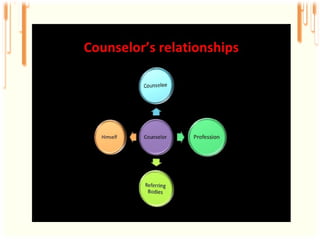
Counselor’s relationship with
Himself
RIGHTS OF CLIENTS IN
COUNSELLING
Client Rights
Clients at Counseling Services have the following rights:
1. The right to impartial access to counseling regardless
of gender, ethnicity, race, sexual orientation, gender
identity, age, religious beliefs, social/economic class,
outward appearance, body size/shape, disablility,
impairment, or political ideology.
2. The right to ask questions about the process of
counseling and procedures used at Counseling Services.
Client Rights
Clients at Counseling Services have the following
rights:
3. The right to information regarding counselor
credentials and training.
4. The right to expect that all information disclosed
in counseling will be kept confidential with the
exceptions described in the "Counselor-Client
Agreement"
Client Rights
Clients at Counseling Services have the following rights:
5. The right to participate in the planning of counseling services
6. The right to request a different counselor from the one
assigned
7. The right to terminate counseling at any time
8. The right to file a grievance about services offered and/or
received
MAINTAINING
CONFIDENTIALITY IN
COUNSELLING
 Confidentiality is an essential part of the counseling
relationship.
 A client must be able to trust that the personal
information he or she shares with counsellor will not be
revealed to other people.
 To protect their professional relationships, a counselor
must explain the benefits and problems inherent in
counseling services and clarify the limits of
confidentiality to the client.
1. Explaining Confidentiality
.
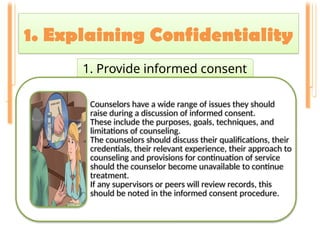
1. Provide informed consent
To give informed consent, the counselor must
explain the benefits and risks of counseling as
well as its alternatives.
The counselor must request permission to
record counseling sessions in writing or via
video and audio
1. Explaining Confidentiality
.
1. Provide informed consent
Counselors have a wide range of issues they should
raise during a discussion of informed consent.
These include the purposes, goals, techniques, and
limitations of counseling.
The counselors should discuss their qualifications, their
credentials, their relevant experience, their approach to
counseling and provisions for continuation of service
should the counselor become unavailable to continue
treatment.
If any supervisors or peers will review records, this
should be noted in the informed consent procedure.
1. Explaining Confidentiality
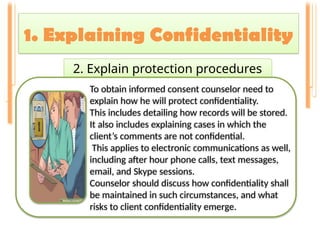
2. Explain protection procedures
To obtain informed consent counselor need to
explain how he will protect confidentiality.
This includes detailing how records will be stored.
It also includes explaining cases in which the
client’s comments are not confidential.
This applies to electronic communications as well,
including after hour phone calls, text messages,
email, and Skype sessions.
Counselor should discuss how confidentiality shall
be maintained in such circumstances, and what
risks to client confidentiality emerge.
1. Explaining Confidentiality
.
3. Give the patient a form to
sign
1. Explaining Confidentiality
.
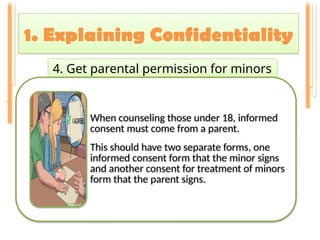
4. Get parental permission for minors
When counseling those under 18, informed
consent must come from a parent.
This should have two separate forms, one
informed consent form that the minor signs
and another consent for treatment of minors
form that the parent signs.
2. Protecting Client Records
.
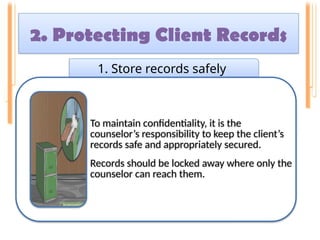
1. Store records safely
To maintain confidentiality, it is the
counselor’s responsibility to keep the client’s
records safe and appropriately secured.
Records should be locked away where only the
counselor can reach them.
2. Protecting Client Records
.
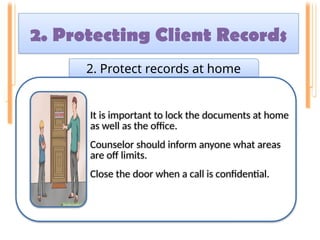
2. Protect records at home
It is important to lock the documents at home
as well as the office.
Counselor should inform anyone what areas
are off limits.
Close the door when a call is confidential.
2. Protecting Client Records
3. Provide records to client
A client may request his or her own records in most
situations. The counselor however can refuse to
provide access to portions of the records if it will
cause harm to the client. The counselor must
document the request of the client and the reason
for withholding the information.
When there are multiple clients, such as with family
counselling, then the counselor should only provide
records relevant to the individual client, not other
clients in the group.
2. Protecting Client Records
4. Do not release records to any third parties
A client's records are only to be released to a
third party if the client has provided written
consent.
With minors it is important to also obtain
consent from parents before releasing
information to a third party.
2. Protecting Client Records
5. Be aware of exceptions
There are some exceptions when
confidentiality should not be preserved.
These vary somewhat with state law.
Counselor should make both himself and his
clients aware of these exceptions.
2. Protecting Client Records
5. Be aware of exceptions
2. Protecting Client Records
6. Follow counseling ethics and regulations
Familiarize with national and state regulations.
When a counselor finds him in a situation where
maintaining a client's confidentiality becomes a
problem, consulting with colleagues and/or a direct
supervisor can help the counselor with appropriate
decision-making.
A counselor may also discuss confidentiality concerns
with his or her own therapist, so long as they don’t
reveal information that may identify the client being
discussed.
3. Protecting Against Lapses in
Conversations
.
1. Avoid confidential details in discussions with peers
3. Protecting Against Lapses in
Conversations
.
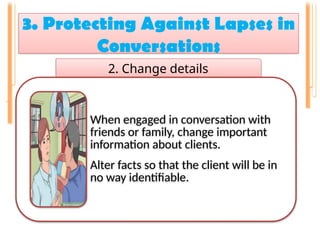
2. Change details
When engaged in conversation with
friends or family, change important
information about clients.
Alter facts so that the client will be in
no way identifiable.
3. Protecting Against Lapses in
Conversations
.
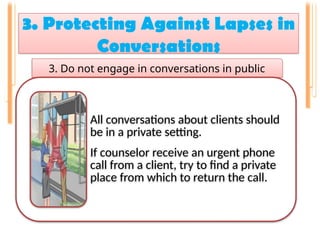
3. Do not engage in conversations in public
All conversations about clients should
be in a private setting.
If counselor receive an urgent phone
call from a client, try to find a private
place from which to return the call.
3. Protecting Against Lapses in
Conversations
.
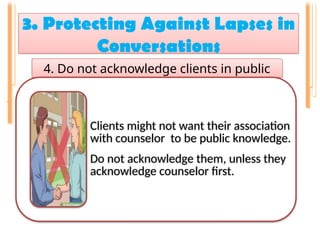
4. Do not acknowledge clients in public
Clients might not want their association
with counselor to be public knowledge.
Do not acknowledge them, unless they
acknowledge counselor first.
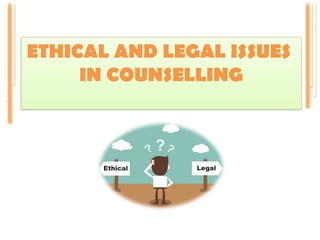
ETHICAL AND LEGAL ISSUES
IN COUNSELLING
Ethical Standards
Ethical standards are normally developed by
professional associations to guide the behavior of a
specific group of professionals.
Ethical standards help to:
 Educate members about sound ethical
conduct
 Provide a mechanism of accountability
 Improve professional practice
Ethical Principles
The ACA’s Code of Ethics is based on Kitchener’s five
moral principles:
1. Autonomy
2. Justice
3. Beneficence
4. Non maleficence
5. Fidelity.
Ethical Principles
Autonomy: refers to the concept of independence
and the ability to make one’s own decisions.
Justice: means treating each person fairly, but it
does not mean treating each person the same way.
Beneficence: refers to doing good or what is in the
best interests of the client.
Nonmaleficence: means doing no harm to others.
Fidelity: involves the concepts of loyalty,
faithfulness, and honoring commitments.
ACA Code of Ethics
Client Welfare: The primary responsibility of counselors
is to respect the dignity and promote the welfare of
clients.
Informed Consent in the Counseling Relationship :
They inform clients about issues such- the purposes,
goals, techniques, procedures, limitations, potential risks,
and benefits of services; the counselor’s qualifications,
credentials, relevant experience etc.
Section A: The Counseling Relationship
Section : B Confidentiality, Privileged
Communication, and Privacy
 Be respectful of differing views and inform clients with
whom, when, and how information will be shared.
 Take precautions to ensure confidentiality when using
technologies such as computers, electronic mail, or
voicemail.
 Maintain the confidentiality of deceased clients as is
consistent with legal requirements and policies.
 Inform parents and legal guardians of the confidential
nature of the counseling relationship as well as establish a
working relationship with them in order to better serve
clients.
Section : C Professional Responsibility
 Be alert to signs of personal impairment and refrain from
providing or offering services if the impairment could
potentially harm a client.
 Assist supervisors or colleagues in recognizing impairment
and if necessary, provide assistance, intervention, or
consultation.
 Designate a specific colleague or “records custodian” and
create a proper plan for file and client transfer in the case of
incapacitation, termination of practice, or death.
 Use techniques, modalities, or procedures that have a
scientific or empirical foundation and are grounded in
theory.
Section : D Relationships with Other
Professionals
• Become knowledgeable about colleagues and develop
positive working relationships and communication
systems.
•Be respectful of differing approaches to counseling
services as well as the traditions and practices of other
professional groups.
•Work to develop and strengthen relations with
interdisciplinary colleagues.
Section : E Evaluation, Assessment, and
Interpretation
• Take into account cultural, social and personal factors
when making assessments.
•Be aware of social and historical prejudices in the
pathologizing and misdiagnosis of specific individuals and
groups, and be cognizant of the role of mental health
professionals in the continuation of these problems.
•Generate objective findings that are supported by
appropriate techniques and information when
conducting forensic evaluations.
Section : F Supervision, Training, and
Teaching
• Foster professional relationships and create
appropriate boundaries with students.
•Be accurate, honest, and fair during the training
and assessment of students.
Section : G Research and Publication
• Take the appropriate steps to destroy any documents or
records that contain confidential data or may identify
research participants within a reasonable period of time
after the completion of a research study or project.
• Do not plagiarize or present another person’s work as your
own.
• When reviewing documents in a professional capacity,
counselors should make valid publication decisions, review
materials in a timely manner, avoid biases, and only
evaluate documents that fall within one’s field of
competency.
Section : H Distance Counseling,
Technology, and Social Media
• Counselors strive to become knowledgeable about
these resources like distance counselling, technology
and social media.
• Counselors understand the additional concerns
related to the use of distance counseling, technology,
and social media and make every attempt to protect
confidentiality and meet any legal and ethical
requirements for the use of such resources.
Section : I Resolving Ethical Issues
• If there is a conflict between ethical
responsibilities and laws, professional counselors
should make known their commitment to the Code
of Ethics and work to alleviate the conflict.
• Counselors may follow legal requirements or
regulations if the ethical conflict cannot be resolved
in this manner.
Section : I Resolving Ethical Issues
• Seek out further action such as referring to voluntary
national certification bodies, state or national ethics
committees, state licensing boards, or any suitable
institutional authorities when informal resolution is not
appropriate or the issue is not properly resolved.
• Do not deny a person’s advancement, admission to
academic programs, employment, promotion, or
tenure based only upon their having made an ethics
complaint nor their being the subject of an ethics
complaint.
By nature of the profession, counsellors are to act in
the best interest of their client, promoting client
goals, protecting client rights, maximising good and
minimizing harm (Stein, 1990).
Ethics including ethical codes and principles aim to
balance the power and ensure that the counsellor
operates for the good of the client and not for self.
CONCLUSION
ethics in counselling - 3.pptx ppppppppp

ethics in counselling - 3.pptx ppppppppp

  • 1.
    ETHICS IN COUNSELLING BY:MS. ANU SAM JACOB LECTURER, NBU
  • 2.
    LEARNING OBJECTIVES At theend of the class students will be able to: 1. Define ethics and code of ethics in counselling 2. Explaining counselors professional ethics 3. Describe the rights of clients in counselling 4. Understand to maintain confidentiality in counselling 5. Enlist the ethical principles 6. Discuss the ethical and legal issues in counselling
  • 3.
    What is ethics??? Ethics are a set of moral principles or rules of conduct for an individual or group. The term ethics comes from the Greek ethos meaning custom, habit or character. Ethics determine choices made.
  • 4.
    Ethics are principlesthat explain what is good and right and what is bad and wrong and that prescribe a code of behavior based on these definitions. In counselling, ethics underpin the nature and course of actions taken by the counsellor. Counsellors and others in helping professions are expected to behave in an ethical manner. Counselling and ethics
  • 5.
    Ethics in aholistic perspective Ross (2002) draws on this further by asking counselors to look at ethics from a holistic perspective.  Body (the environment, structures, systems, policies, laws, regulations, moral codes, and societal norms)  Mind (ethical thinking, philosophy), heart (relationships, emotions, values)  And spirit (unknowing, unconscious). A complete awareness of the ethics of a situation can occur when all are taken into consideration.
  • 6.
     The conceptof ethics relates to moral consideration.  The challenge lies in what is considered moral or ethical.  Each counsellor comes to the profession with their own set of values and standards.  Individual principles and how they were used to interpret dilemmas would be universally different. Therefore, a Code of Ethics is required. Code of ethics
  • 7.
     A generalstandard that counsellors and therapists adhere to and use co jointly with legal standards to provide ethical practice and work through ethical dilemmas.  Ethical codes offer counsellors an outline of what are considered acceptable and unacceptable behaviours. Code of ethics
  • 8.
  • 9.
    Every profession hasin some form or other a Code of Ethics Meaning of Professional Ethics : systematized body of moral principles that guide or determine the counsellor’s behavior in his relationships to the counselee, to the counselee's relatives, to his referring agency, and to society in general. Professional Ethics -> Values that determine the counsellor’s behavior. Professional ethics
  • 11.
    A. Counsellor mustrespect the values of the counselee  Can suggest to change her social values ( not the moral or religious values) B. Counsellor must keep secret the counselee’s confidential material  May not reveal information to anyone without securing her permission  Exceptions: Suicide or crime or for the good of the counselee. C. Test results must be interpreted to the counselee in a manner likely to be constructive in her efforts to solve her problem. Counselor’s relationship to the Counselee
  • 12.
    A. Counsellor shouldmaintain high standards of work, not just aim at expedience or temporary success -unethical to offer services outside his area of training and experiences or beyond the boundary of his competence -Should not work for only for money B. Should try to rectify the malpractices of other counselors -Should not criticize who use other methods c. Counselor should not accept for counselling someone who already receiving it from someone else . Counselor’s relationship to the profession
  • 13.
    It is acourtesy to inform the referring person or agency that the counselee kept the appointment and is continuing counselling or has been referred to other agency. No confidential information should be imparted to them. Counselor’s relationship to Referring bodies
  • 14.
    • Right toprivate life and relaxation. • May not accept phone calls after certain hour • Must leave the problems of counselee in the office • Should not encourage dependency. • Should realize that he is not expected to help each and every counselee. Counselor’s relationship with Himself
  • 15.
    RIGHTS OF CLIENTSIN COUNSELLING
  • 16.
    Client Rights Clients atCounseling Services have the following rights: 1. The right to impartial access to counseling regardless of gender, ethnicity, race, sexual orientation, gender identity, age, religious beliefs, social/economic class, outward appearance, body size/shape, disablility, impairment, or political ideology. 2. The right to ask questions about the process of counseling and procedures used at Counseling Services.
  • 17.
    Client Rights Clients atCounseling Services have the following rights: 3. The right to information regarding counselor credentials and training. 4. The right to expect that all information disclosed in counseling will be kept confidential with the exceptions described in the "Counselor-Client Agreement"
  • 18.
    Client Rights Clients atCounseling Services have the following rights: 5. The right to participate in the planning of counseling services 6. The right to request a different counselor from the one assigned 7. The right to terminate counseling at any time 8. The right to file a grievance about services offered and/or received
  • 19.
  • 20.
     Confidentiality isan essential part of the counseling relationship.  A client must be able to trust that the personal information he or she shares with counsellor will not be revealed to other people.  To protect their professional relationships, a counselor must explain the benefits and problems inherent in counseling services and clarify the limits of confidentiality to the client.
  • 21.
    1. Explaining Confidentiality . 1.Provide informed consent To give informed consent, the counselor must explain the benefits and risks of counseling as well as its alternatives. The counselor must request permission to record counseling sessions in writing or via video and audio
  • 22.
    1. Explaining Confidentiality . 1.Provide informed consent Counselors have a wide range of issues they should raise during a discussion of informed consent. These include the purposes, goals, techniques, and limitations of counseling. The counselors should discuss their qualifications, their credentials, their relevant experience, their approach to counseling and provisions for continuation of service should the counselor become unavailable to continue treatment. If any supervisors or peers will review records, this should be noted in the informed consent procedure.
  • 23.
    1. Explaining Confidentiality 2.Explain protection procedures To obtain informed consent counselor need to explain how he will protect confidentiality. This includes detailing how records will be stored. It also includes explaining cases in which the client’s comments are not confidential. This applies to electronic communications as well, including after hour phone calls, text messages, email, and Skype sessions. Counselor should discuss how confidentiality shall be maintained in such circumstances, and what risks to client confidentiality emerge.
  • 24.
    1. Explaining Confidentiality . 3.Give the patient a form to sign
  • 25.
    1. Explaining Confidentiality . 4.Get parental permission for minors When counseling those under 18, informed consent must come from a parent. This should have two separate forms, one informed consent form that the minor signs and another consent for treatment of minors form that the parent signs.
  • 26.
    2. Protecting ClientRecords . 1. Store records safely To maintain confidentiality, it is the counselor’s responsibility to keep the client’s records safe and appropriately secured. Records should be locked away where only the counselor can reach them.
  • 27.
    2. Protecting ClientRecords . 2. Protect records at home It is important to lock the documents at home as well as the office. Counselor should inform anyone what areas are off limits. Close the door when a call is confidential.
  • 28.
    2. Protecting ClientRecords 3. Provide records to client A client may request his or her own records in most situations. The counselor however can refuse to provide access to portions of the records if it will cause harm to the client. The counselor must document the request of the client and the reason for withholding the information. When there are multiple clients, such as with family counselling, then the counselor should only provide records relevant to the individual client, not other clients in the group.
  • 29.
    2. Protecting ClientRecords 4. Do not release records to any third parties A client's records are only to be released to a third party if the client has provided written consent. With minors it is important to also obtain consent from parents before releasing information to a third party.
  • 30.
    2. Protecting ClientRecords 5. Be aware of exceptions There are some exceptions when confidentiality should not be preserved. These vary somewhat with state law. Counselor should make both himself and his clients aware of these exceptions.
  • 31.
    2. Protecting ClientRecords 5. Be aware of exceptions
  • 32.
    2. Protecting ClientRecords 6. Follow counseling ethics and regulations Familiarize with national and state regulations. When a counselor finds him in a situation where maintaining a client's confidentiality becomes a problem, consulting with colleagues and/or a direct supervisor can help the counselor with appropriate decision-making. A counselor may also discuss confidentiality concerns with his or her own therapist, so long as they don’t reveal information that may identify the client being discussed.
  • 33.
    3. Protecting AgainstLapses in Conversations . 1. Avoid confidential details in discussions with peers
  • 34.
    3. Protecting AgainstLapses in Conversations . 2. Change details When engaged in conversation with friends or family, change important information about clients. Alter facts so that the client will be in no way identifiable.
  • 35.
    3. Protecting AgainstLapses in Conversations . 3. Do not engage in conversations in public All conversations about clients should be in a private setting. If counselor receive an urgent phone call from a client, try to find a private place from which to return the call.
  • 36.
    3. Protecting AgainstLapses in Conversations . 4. Do not acknowledge clients in public Clients might not want their association with counselor to be public knowledge. Do not acknowledge them, unless they acknowledge counselor first.
  • 37.
    ETHICAL AND LEGALISSUES IN COUNSELLING
  • 38.
    Ethical Standards Ethical standardsare normally developed by professional associations to guide the behavior of a specific group of professionals. Ethical standards help to:  Educate members about sound ethical conduct  Provide a mechanism of accountability  Improve professional practice
  • 39.
    Ethical Principles The ACA’sCode of Ethics is based on Kitchener’s five moral principles: 1. Autonomy 2. Justice 3. Beneficence 4. Non maleficence 5. Fidelity.
  • 40.
    Ethical Principles Autonomy: refersto the concept of independence and the ability to make one’s own decisions. Justice: means treating each person fairly, but it does not mean treating each person the same way. Beneficence: refers to doing good or what is in the best interests of the client. Nonmaleficence: means doing no harm to others. Fidelity: involves the concepts of loyalty, faithfulness, and honoring commitments.
  • 41.
    ACA Code ofEthics Client Welfare: The primary responsibility of counselors is to respect the dignity and promote the welfare of clients. Informed Consent in the Counseling Relationship : They inform clients about issues such- the purposes, goals, techniques, procedures, limitations, potential risks, and benefits of services; the counselor’s qualifications, credentials, relevant experience etc. Section A: The Counseling Relationship
  • 42.
    Section : BConfidentiality, Privileged Communication, and Privacy  Be respectful of differing views and inform clients with whom, when, and how information will be shared.  Take precautions to ensure confidentiality when using technologies such as computers, electronic mail, or voicemail.  Maintain the confidentiality of deceased clients as is consistent with legal requirements and policies.  Inform parents and legal guardians of the confidential nature of the counseling relationship as well as establish a working relationship with them in order to better serve clients.
  • 43.
    Section : CProfessional Responsibility  Be alert to signs of personal impairment and refrain from providing or offering services if the impairment could potentially harm a client.  Assist supervisors or colleagues in recognizing impairment and if necessary, provide assistance, intervention, or consultation.  Designate a specific colleague or “records custodian” and create a proper plan for file and client transfer in the case of incapacitation, termination of practice, or death.  Use techniques, modalities, or procedures that have a scientific or empirical foundation and are grounded in theory.
  • 44.
    Section : DRelationships with Other Professionals • Become knowledgeable about colleagues and develop positive working relationships and communication systems. •Be respectful of differing approaches to counseling services as well as the traditions and practices of other professional groups. •Work to develop and strengthen relations with interdisciplinary colleagues.
  • 45.
    Section : EEvaluation, Assessment, and Interpretation • Take into account cultural, social and personal factors when making assessments. •Be aware of social and historical prejudices in the pathologizing and misdiagnosis of specific individuals and groups, and be cognizant of the role of mental health professionals in the continuation of these problems. •Generate objective findings that are supported by appropriate techniques and information when conducting forensic evaluations.
  • 46.
    Section : FSupervision, Training, and Teaching • Foster professional relationships and create appropriate boundaries with students. •Be accurate, honest, and fair during the training and assessment of students.
  • 47.
    Section : GResearch and Publication • Take the appropriate steps to destroy any documents or records that contain confidential data or may identify research participants within a reasonable period of time after the completion of a research study or project. • Do not plagiarize or present another person’s work as your own. • When reviewing documents in a professional capacity, counselors should make valid publication decisions, review materials in a timely manner, avoid biases, and only evaluate documents that fall within one’s field of competency.
  • 48.
    Section : HDistance Counseling, Technology, and Social Media • Counselors strive to become knowledgeable about these resources like distance counselling, technology and social media. • Counselors understand the additional concerns related to the use of distance counseling, technology, and social media and make every attempt to protect confidentiality and meet any legal and ethical requirements for the use of such resources.
  • 49.
    Section : IResolving Ethical Issues • If there is a conflict between ethical responsibilities and laws, professional counselors should make known their commitment to the Code of Ethics and work to alleviate the conflict. • Counselors may follow legal requirements or regulations if the ethical conflict cannot be resolved in this manner.
  • 50.
    Section : IResolving Ethical Issues • Seek out further action such as referring to voluntary national certification bodies, state or national ethics committees, state licensing boards, or any suitable institutional authorities when informal resolution is not appropriate or the issue is not properly resolved. • Do not deny a person’s advancement, admission to academic programs, employment, promotion, or tenure based only upon their having made an ethics complaint nor their being the subject of an ethics complaint.
  • 51.
    By nature ofthe profession, counsellors are to act in the best interest of their client, promoting client goals, protecting client rights, maximising good and minimizing harm (Stein, 1990). Ethics including ethical codes and principles aim to balance the power and ensure that the counsellor operates for the good of the client and not for self. CONCLUSION