Communication
Etiquette
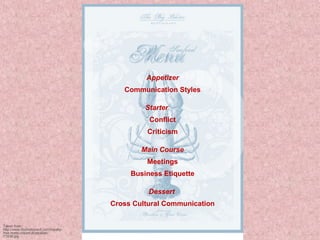
Appetizer
Communication Styles
Starter
Conflict
Criticism
Main Course
Meetings
Business Etiquette
Dessert
Cross Cultural Communication
Taken from:
http://www.illustrationsof.com/royaltyfree-menu-clipart-illustration71538.jpg
COMMUNICATION STYLES
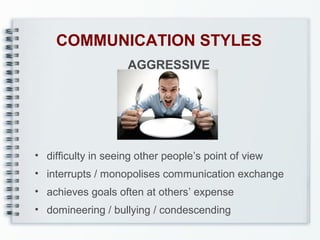
AGGRESSIVE

• difficulty in seeing other people’s point of view
• interrupts / monopolises communication exchange
• achieves goals often at others’ expense
• domineering / bullying / condescending
COMMUNICATION STYLES
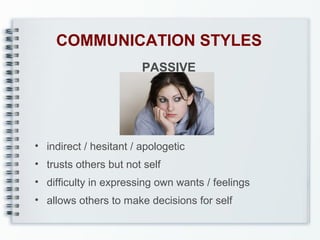
PASSIVE

• indirect / hesitant / apologetic
• trusts others but not self
• difficulty in expressing own wants / feelings
• allows others to make decisions for self
COMMUNICATION STYLES
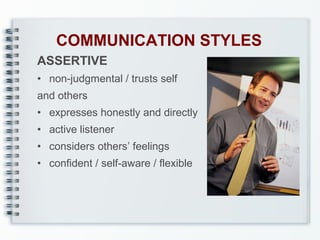
ASSERTIVE
• non-judgmental / trusts self
and others
• expresses honestly and directly
• active listener
• considers others’ feelings
• confident / self-aware / flexible
CONFLICT & CRITICISM

Group Work: Discuss and present (10 min)
Group 1: Define conflict and explain the two types of conflict.
Group 2: What are the causes of conflict?
Group 3: What are the five conflict management strategies?
Group 4: Explain what is constructive and destructive and how to
give constructive criticism.
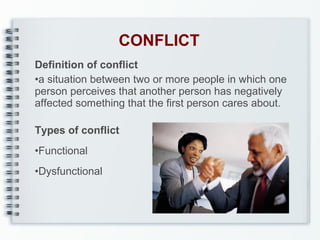
CONFLICT
Definition of conflict
•a situation between two or more people in which one
person perceives that another person has negatively
affected something that the first person cares about.
Types of conflict
•Functional
•Dysfunctional
CONFLICT
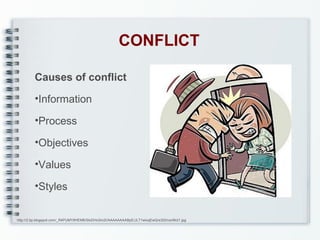
Causes of conflict
•Information
•Process
•Objectives
•Values
•Styles
http://2.bp.blogspot.com/_R4PUMY8HEM8/SloDHx3im2I/AAAAAAAABpE/JLT1wioqEwQ/s320/conflict1.jpg
CONFLICT MANAGEMENT
•

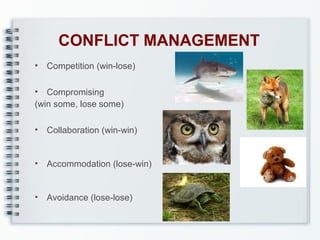
Competition (win-lose)

• Compromising
(win some, lose some)
•

Collaboration (win-win)

•

Accommodation (lose-win)

•

Avoidance (lose-lose)
CRITICISM
• What is criticism?
• Constructive & destructive criticism
• How to give constructive criticism
• The Positive Negative Positive (PNP) sandwich
• How to receive constructive criticism
MEETINGS
• Types of meetings
• Planning for meetings
• Meeting participants
• Good meeting
manners
• Barriers to effective
meetings
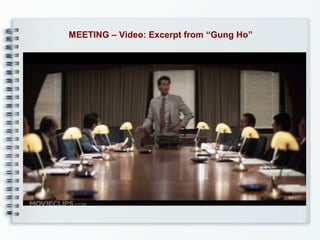
MEETING – Video: Excerpt from “Gung Ho”
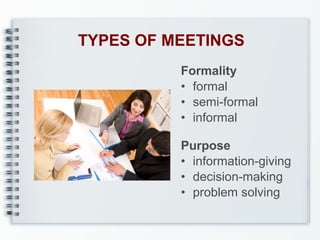
TYPES OF MEETINGS
Formality
• formal
• semi-formal
• informal
Purpose
• information-giving
• decision-making
• problem solving
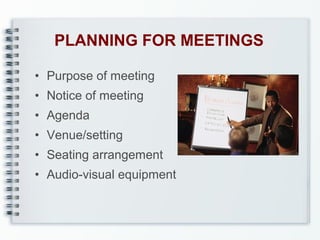
PLANNING FOR MEETINGS
• Purpose of meeting
• Notice of meeting
• Agenda
• Venue/setting
• Seating arrangement
• Audio-visual equipment
MEETING PARTICIPANTS
• Roles and duties of participants before, during and
after the meeting
Participants
• Chairperson
• Secretary
• Meeting members
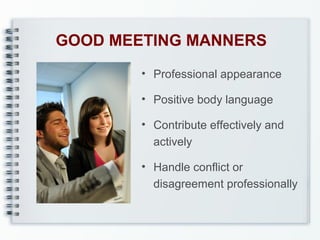
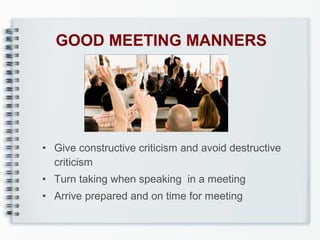
GOOD MEETING MANNERS
• Professional appearance
• Positive body language
• Contribute effectively and
actively
• Handle conflict or
disagreement professionally
GOOD MEETING MANNERS

• Give constructive criticism and avoid destructive
criticism
• Turn taking when speaking in a meeting
• Arrive prepared and on time for meeting
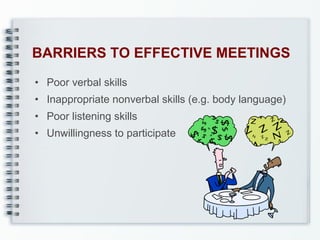
BARRIERS TO EFFECTIVE MEETINGS
• Poor verbal skills
• Inappropriate nonverbal skills (e.g. body language)
• Poor listening skills
• Unwillingness to participate
FOLLOW-UP OF MEETING
• Minutes of meeting
• Purpose of minutes of meeting
• Format
• Writing style & language
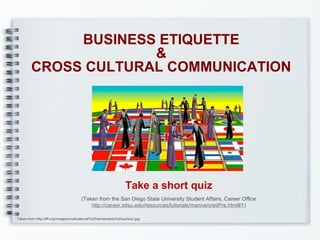
BUSINESS ETIQUETTE
&
CROSS CULTURAL COMMUNICATION

Take a short quiz
(Taken from the San Diego State University Student Affairs, Career Office
http://career.sdsu.edu/resources/tutorials/manners/etiPre.html#1)
Taken from http://tfli.org/images/multinational%20handshakes%20cartoon.jpg
GENERAL BUSINESS ETIQUETTE
•

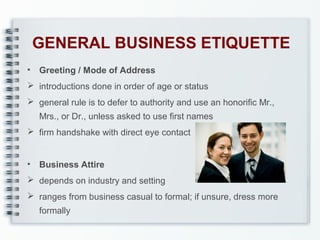
Greeting / Mode of Address

 introductions done in order of age or status
 general rule is to defer to authority and use an honorific Mr.,
Mrs., or Dr., unless asked to use first names
 firm handshake with direct eye contact
•

Business Attire

 depends on industry and setting
 ranges from business casual to formal; if unsure, dress more
formally
GENERAL BUSINESS ETIQUETTE
• Gift Giving
 choose good quality gifts;
company logo (if any) should be
discreet
 status of recipient is reflected in
choice and value of gift
 gifts are not opened when
received
GENERAL BUSINESS ETIQUETTE

•

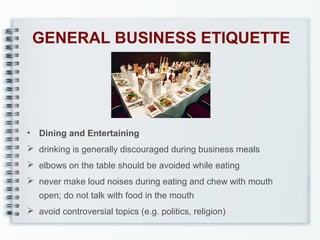
Dining and Entertaining

 drinking is generally discouraged during business meals
 elbows on the table should be avoided while eating
 never make loud noises during eating and chew with mouth
open; do not talk with food in the mouth
 avoid controversial topics (e.g. politics, religion)
BUSINESS ETIQUETTE
INDIAN CULTURE

Group Work: Write down two statements on each topic. (15 min)
Group 1: Meeting/greeting; making introductions; business cards
Group 2: Gift giving; small talk; dining and entertaining
Group 3: Personal reputation; business relationships
Group 4: Business meeting etiquette; negotiation & decision making
http://ethisphere.com/reporting-growth-in-india-an-emerging-business-case-for-an-emerging-market-leader/
BUSINESS ETIQUETTE
INDIAN CULTURE

• Meeting and greeting people
• Making introductions
• Business cards
• Gift Giving
• Small talk
• Dining and Entertaining
BUSINESS ETIQUETTE
INDIAN CULTURE

• Cultural issue:
Personal reputation

• Business relationships
• Business meeting etiquette
• Negotiation & decision making
Q&A

Communication Etiquette

  • 1.
  • 2.
    Appetizer Communication Styles Starter Conflict Criticism Main Course Meetings BusinessEtiquette Dessert Cross Cultural Communication Taken from: http://www.illustrationsof.com/royaltyfree-menu-clipart-illustration71538.jpg
  • 3.
    COMMUNICATION STYLES AGGRESSIVE • difficultyin seeing other people’s point of view • interrupts / monopolises communication exchange • achieves goals often at others’ expense • domineering / bullying / condescending
  • 4.
    COMMUNICATION STYLES PASSIVE • indirect/ hesitant / apologetic • trusts others but not self • difficulty in expressing own wants / feelings • allows others to make decisions for self
  • 5.
    COMMUNICATION STYLES ASSERTIVE • non-judgmental/ trusts self and others • expresses honestly and directly • active listener • considers others’ feelings • confident / self-aware / flexible
  • 6.
    CONFLICT & CRITICISM GroupWork: Discuss and present (10 min) Group 1: Define conflict and explain the two types of conflict. Group 2: What are the causes of conflict? Group 3: What are the five conflict management strategies? Group 4: Explain what is constructive and destructive and how to give constructive criticism.
  • 7.
    CONFLICT Definition of conflict •asituation between two or more people in which one person perceives that another person has negatively affected something that the first person cares about. Types of conflict •Functional •Dysfunctional
  • 8.
  • 9.
    CONFLICT MANAGEMENT • Competition (win-lose) •Compromising (win some, lose some) • Collaboration (win-win) • Accommodation (lose-win) • Avoidance (lose-lose)
  • 10.
    CRITICISM • What iscriticism? • Constructive & destructive criticism • How to give constructive criticism • The Positive Negative Positive (PNP) sandwich • How to receive constructive criticism
  • 11.
    MEETINGS • Types ofmeetings • Planning for meetings • Meeting participants • Good meeting manners • Barriers to effective meetings
  • 12.
    MEETING – Video:Excerpt from “Gung Ho”
  • 13.
    TYPES OF MEETINGS Formality •formal • semi-formal • informal Purpose • information-giving • decision-making • problem solving
  • 14.
    PLANNING FOR MEETINGS •Purpose of meeting • Notice of meeting • Agenda • Venue/setting • Seating arrangement • Audio-visual equipment
  • 15.
    MEETING PARTICIPANTS • Rolesand duties of participants before, during and after the meeting Participants • Chairperson • Secretary • Meeting members
  • 16.
    GOOD MEETING MANNERS •Professional appearance • Positive body language • Contribute effectively and actively • Handle conflict or disagreement professionally
  • 17.
    GOOD MEETING MANNERS •Give constructive criticism and avoid destructive criticism • Turn taking when speaking in a meeting • Arrive prepared and on time for meeting
  • 18.
    BARRIERS TO EFFECTIVEMEETINGS • Poor verbal skills • Inappropriate nonverbal skills (e.g. body language) • Poor listening skills • Unwillingness to participate
  • 19.
    FOLLOW-UP OF MEETING •Minutes of meeting • Purpose of minutes of meeting • Format • Writing style & language
  • 20.
    BUSINESS ETIQUETTE & CROSS CULTURALCOMMUNICATION Take a short quiz (Taken from the San Diego State University Student Affairs, Career Office http://career.sdsu.edu/resources/tutorials/manners/etiPre.html#1) Taken from http://tfli.org/images/multinational%20handshakes%20cartoon.jpg
  • 21.
    GENERAL BUSINESS ETIQUETTE • Greeting/ Mode of Address  introductions done in order of age or status  general rule is to defer to authority and use an honorific Mr., Mrs., or Dr., unless asked to use first names  firm handshake with direct eye contact • Business Attire  depends on industry and setting  ranges from business casual to formal; if unsure, dress more formally
  • 22.
    GENERAL BUSINESS ETIQUETTE •Gift Giving  choose good quality gifts; company logo (if any) should be discreet  status of recipient is reflected in choice and value of gift  gifts are not opened when received
  • 23.
    GENERAL BUSINESS ETIQUETTE • Diningand Entertaining  drinking is generally discouraged during business meals  elbows on the table should be avoided while eating  never make loud noises during eating and chew with mouth open; do not talk with food in the mouth  avoid controversial topics (e.g. politics, religion)
  • 24.
    BUSINESS ETIQUETTE INDIAN CULTURE GroupWork: Write down two statements on each topic. (15 min) Group 1: Meeting/greeting; making introductions; business cards Group 2: Gift giving; small talk; dining and entertaining Group 3: Personal reputation; business relationships Group 4: Business meeting etiquette; negotiation & decision making http://ethisphere.com/reporting-growth-in-india-an-emerging-business-case-for-an-emerging-market-leader/
  • 25.
    BUSINESS ETIQUETTE INDIAN CULTURE •Meeting and greeting people • Making introductions • Business cards • Gift Giving • Small talk • Dining and Entertaining
  • 26.
    BUSINESS ETIQUETTE INDIAN CULTURE •Cultural issue: Personal reputation • Business relationships • Business meeting etiquette • Negotiation & decision making
  • 27.

Editor's Notes

  • #10 ACTIVITY Matching conflict management strategy with description
  • #12 http://www.polleverywhere.com/multiple_choice_polls/MTY0MDgyOTM1MQ
  • #13 http://youtu.be/7trB7i2xpfc
  • #16 ACTIVITY Students to detail role & responsibilities of Chairperson, Secretary and meeting members List good meeting manners and barriers to effective meetings
  • #20 ACTIVITY Jigsaw for Minutes of Meeting