11
Civil Engineering Materials – CIVE 2110Civil Engineering Materials – CIVE 2110
Concrete MaterialConcrete Material
Stress vs. Strain CurvesStress vs. Strain Curves
Steel ReinforcementSteel Reinforcement
22
Stress-Strain Curve for CompressionStress-Strain Curve for Compression
 Slightly ductile shape of Stress-Strain curve
 A descending branch exists after is reached
 Due to redistribution of load to un-cracked regions with less stress,
'
cf
(MacGregor, 5(MacGregor, 5thth
ed., Fig. 3-26)ed., Fig. 3-26)
33
Stress-Strain Curve for CompressionStress-Strain Curve for Compression
 Strength of Reinforced Concrete structures controlled by,
 Size of members,
 Shape of members,
 Stress-Strain curves of; - concrete,
- reinforcement.
Five properties of Stress-Strain curves;
(1) - Initial slope, Ec
(2) - Ascending parabola
(3) - Strain at max stress,
(4) - Descending parabola
(5) - Strain at failure
'
cf
(Fig. 3-18, MacGregor, 5(Fig. 3-18, MacGregor, 5thth
ed.)ed.)
44
Stress-Strain Curve for CompressionStress-Strain Curve for Compression
 (1) - Initial Slope, Ec ;
 ACI 318, Sect. 8.5, 8.6
 sensitive to Eaggregate , Ecement .
 For normal weight concrete;
 For other weight concrete;
 Defined as the slope
of a line drawn from
As water increases, Ec decreases,
because cement paste becomes
'
45.00 cfto == σσ (MacGregor, 5(MacGregor, 5thth
ed., Fig. 3.17)ed., Fig. 3.17)
( ) ( )
( ) '5.1
33
33
16090
ccc
c
fwpsiE
FtLbwFtLb
=
≤≤
( )
( ) '
3
000,57
145
cc
c
fpsiE
FtLbw
=
≈
55
Stress-Strain Curve for CompressionStress-Strain Curve for Compression
 Lightweight Concrete ;
 ACI 318, Sect. 8.5, 8.6
 sensitive to Eaggregate .
 For all parameters involving
 Each parameter shall be multiplied by a modification factor
for sand-lightweight conc.
for all-lightweight concrete
 If splitting tensile strength, fct , is specified, then
 This accounts for the reduced
capacity of lightweight concrete
due to aggregate failure;
Such as:
 Shear strength
 Splitting resistance
 Concrete-rebar bond
For normal weight concrete the averageFor normal weight concrete the average
splitting tensile strength is;splitting tensile strength is;
( )[ ] 0.17.6/ '
≤= cct ffλ
'
cf
( )'
7.6 cct ff ≈
(MacGregor, 5(MacGregor, 5thth
ed., Fig. 3.26)ed., Fig. 3.26)
( ) ( )
( ) '5.1
33
33
12090
ccc
c
fwpsiE
FtLbwFtLb
=
≤≤
75.0
85.0
=
=
λ
λ
λ
66
Stress-Strain Curve for CompressionStress-Strain Curve for Compression
 (2) – Ascending Parabola;
 Curve becomes steeper
as increases.'
cf
(Fig. 3.18(Fig. 3.18, MacGregor, 5MacGregor, 5thth
ed.,)ed.,)
 (3) – Strain ( ) at ;
 Strain at max stress increases
as increases.
'
cf
'
cf
 (4) – Slope of descending branch;
 Less steep than ascending branch,
 Slope increases as increases.
'
cf
 (5) – Strain ( ) at failure;
 Decreases with increases in '
cf
0ε
cuε
 (4 and 5) – depend on;
 Specimen size; Load, type, rate
ksifc 6'
≤
77
Stress-Strain Curve forStress-Strain Curve for TensionTension
 Tensile strength of concrete:
 Determined by one of 2 tests:
 (1) Flexure (Modulus of Rupture) test,
 (2) Split Cylinder test, fct

( )
2
3
6
12
2
BH
M
f
BH
HM
f
I
My
f
r
r
Flexurer
=
=
== σ
 (1) Flexure (Modulus of Rupture) test;
 Load until failure due to cracking on tension side,
 ASTM C78 or ASTM C293,
 H = 6”, B = 6” L = 30”
3
PL
H
B
P P
3” 3”
8” 8” 8”
P
-P
V
M
0
0
88
Stress-Strain Curve for TensionStress-Strain Curve for Tension
( )
ld
P
f
ld
P
f
asistingAre
P
f
ldasistingAre
ct
ct
ct
π
π
σ
π
2
2
Re
2
Re
=
=
==
=
 (2) Split Cylinder test, fct ;
 Load in compression along long side,
 ASTM C496,
 a standard 6”x12” cylinder is placed on side,
 Outside surface area,
 Load is resisted by only half of surface area,
dlrlArea ππ == 2
(MacGregor, 5(MacGregor, 5thth
ed., Fig. 3.9)ed., Fig. 3.9)
99
1max σσ =Tension
ApCσσ =2
2
max
ApCσ
τ =
σ
τ
2x90˚
Compression
Tension
Concrete always cracks
on plane of MaxTensionσ
Split Cylinder Test
Bi-Axial Stress
Stress-Strain Curve for TensionStress-Strain Curve for Tension
1010
Stress-Strain Curve for TensionStress-Strain Curve for Tension
 Tensile strength of concrete:
 Determined by one of 2 tests:
 (1) Flexure (Modulus of Rupture) test,
 (2) Split Cylinder test,
rf
 Tensile strength from
Split Cylinder test
is less than that from
Flexure (modulus of Rupture) test
because;
 In Flexure test, only bottom of beam reaches
 In Split Cylinder test, majority of cylinder reaches
ctf
MaxTensionσ
MaxTensionσ
ctr ff 5.1≈
H
B
P P
1111
Stress-Strain Curve for TensionStress-Strain Curve for Tension
 Results from various Split Cylinder
tests vs. are plotted in Fig. 3.10
 The mean Split Cylinder strength is:
 ACI 318, Sect. R8.6.1 states;
 The mean Modulus of Rupture
strength is:
 ACI 318, Sects. 8.6.1 & 9.5.2.3 state,
for deflection calculations:
'
3.8 cr ff =
'
4.6 cct ff =
(MacGregor, 5(MacGregor, 5thth
ed., Fig. 3.10)ed., Fig. 3.10)
'
cf
'
7.6 cct ff ≈
0.1
7.6
5.7
'
'
≤=
=
c
ct
cr
f
f
ff
λ
λ
concretetlightweighallfor
concretetlightweighsandfor
concreteweightnormalfor
−=
−=
=
75.0
85.0
0.1
λ
λ
λ
1212
Stress-Strain Curve for TensionStress-Strain Curve for Tension
 Tensile strength of concrete:
( ) ''
15.008.0 ct ff →=
 Concrete tensile failure is BRITTLE.
 Same factors affect as ;
 Water/Cement ratio,
 Type of Cement,
 Type of Aggregate,
 Curing Moisture conditions,
 Curing Temperature,
 Age,
 Maturity,
 Loading rate.
(MacGregor,(MacGregor,
55thth
ed., Fig. 3-21)ed., Fig. 3-21)
'
tf '
cf
''
'
'
4.6
8.1
cctt
c
t
t
fff
where
E
f
==
=ε
E
tinitial=linear
flexurefor
tensionpurefor
MAX
MAX
t
t
0002.000014.0
0001.0
'
'
→=
=
ε
ε
'
5.0 tfFrom: 0 →
c
t
t E
f '
'
=ε
''
5.0 tt ff →From:
''
5.0 tt ff →
'
5.0 tf
1313
Steel Reinforcement in ConcreteSteel Reinforcement in Concrete
 In any beam (concrete, steel, masonry, wood):
 Applied loads produce
Internal resisting Couple,
Tension and Compression
forces form couple.
MacGregor, 5th
ed.
Fig. 1-4
In a concrete beam:In a concrete beam:
-- Cracks occur in areas ofoccur in areas of Tension,,
-- Beam will have suddenBeam will have sudden Brittle failurefailure
unless Steel reinforcementreinforcement
is present to takeis present to take Tension.
1414
Mohr’s Circle Method – Failure ModesMohr’s Circle Method – Failure Modes
ionslightTens=maxσ
Brittle concrete fails on plane of max normal (tension) Stress.
Failure stress located at: 2x90˚=180˚on Mohr Circle
ApCσσ =min
2
max
ApCσ
τ =
σ
τ
2x45˚
2x90˚
tensionσ
Shear Stress Normal Stress Principal
Stress
Neutral Axis
90˚
tensionσ
Plane of
max
Tension
Concrete
Brittle
1515
Steel Reinforcement in ConcreteSteel Reinforcement in Concrete
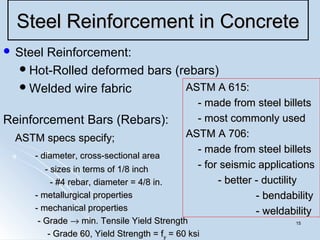
 Steel Reinforcement:
Hot-Rolled deformed bars (rebars)
Welded wire fabric
Reinforcement Bars (Rebars):
ASTM specs specify;ASTM specs specify;
- diameter, cross-sectional area- diameter, cross-sectional area
- sizes in terms of 1/8 inch- sizes in terms of 1/8 inch
- #4 rebar, diameter = 4/8 in.- #4 rebar, diameter = 4/8 in.
- metallurgical properties- metallurgical properties
- mechanical properties- mechanical properties
- Grade- Grade →→ min. Tensile Yield Strengthmin. Tensile Yield Strength
- Grade 60, Yield Strength = f- Grade 60, Yield Strength = fyy = 60 ksi= 60 ksi
ASTM A 615:ASTM A 615:
- made from steel billets- made from steel billets
- most commonly used- most commonly used
ASTM A 706:ASTM A 706:
- made from steel billets- made from steel billets
- for seismic applications- for seismic applications
- better - ductility- better - ductility
- bendability- bendability
- weldability- weldability
1616
Steel Reinforcement in ConcreteSteel Reinforcement in Concrete
Reinforcement Bars (Rebars):
Upper Limit on
( )dStrengthactualYielygthnsileStrenUltimateTe f σσ =≤ 25.1
(MacGregor, 5(MacGregor, 5thth
ed., Table 3-4)ed., Table 3-4)
1717
Steel Reinforcement in ConcreteSteel Reinforcement in Concrete
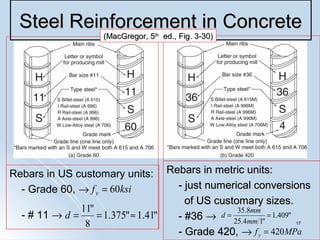
Rebars in US customary units:
- Grade 60, →
- # 11 →
Rebars in metric units:Rebars in metric units:
- just numerical conversions- just numerical conversions
of US customary sizes.of US customary sizes.
- #36- #36 →
- Grade 420,- Grade 420, → MPafy 420=
ksify 60=
(MacGregor, 5(MacGregor, 5thth
ed., Fig. 3-30)ed., Fig. 3-30)
"41.1"375.1
8
"11
≈==d "409.1
"14.25
8.35
==
mm
mm
d
1818
Steel Reinforcement in ConcreteSteel Reinforcement in Concrete
Reinforcement Bars (Rebars): (MacGregor, 5(MacGregor, 5thth
ed., Table A-1)ed., Table A-1)
1919
Steel Reinforcement in ConcreteSteel Reinforcement in Concrete
Reinforcement Bars (Rebars): (MacGregor, 5(MacGregor, 5thth
ed., Table A-1M)ed., Table A-1M)
2020
Steel Reinforcement in ConcreteSteel Reinforcement in Concrete
Reinforcement Bars (Rebars):
- modulus of Elasticity,
ES = 29,000,000 psi
ACI 318, Sect. 8.5.2
- for rebars with
fy > 60,000 psi
must use
fy = ES x ( )
ACI 318, Sect. 3.5.3.2
0035.0=Sε
(MacGregor, 5(MacGregor, 5thth
ed., Fig. 3-31)ed., Fig. 3-31)
2121
Steel Reinforcement in ConcreteSteel Reinforcement in Concrete
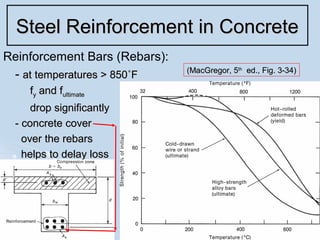
Reinforcement Bars (Rebars):
- at temperatures > 850at temperatures > 850˚F˚F
ffyy and fand fultimateultimate
drop significantlydrop significantly
- concrete cover- concrete cover
over the rebarsover the rebars
helps to delay losshelps to delay loss
loss during firesloss during fires
(MacGregor, 5(MacGregor, 5thth
ed., Fig. 3-34)ed., Fig. 3-34)
2222
Steel Reinforcement in ConcreteSteel Reinforcement in Concrete
Fatigue Strength of rebars:
- Bridge decks subjected to large number of load cycles
- Stress Range, Sr =
(MacGregor, 5(MacGregor, 5thth
ed., Fig. 3-33)ed., Fig. 3-33)
- Fatigue failure may
occur if at least one
stress is tensile
and Sr > 20 ksi
- Fatigue failure will not
occur if;
cyclesany
cyclesiniteksi
Max
Max
000,20
inf20
=
<
σ
σ
- Fatigue strength
reduced at: Bends, Welds
( ) ( ) cyclesameinMinStresscycleainStressMaxTensile σσ −
2323
Steel Reinforcement in ConcreteSteel Reinforcement in Concrete
Example: Fatigue Failure not possible;
Fatigue Strength of rebars:
- Stress Range, Sr = ( ) ( ) cyclesameinMinStresscycleainStressMaxTensile σσ −
( ) ( )
ksiS
ksiksiS
r
cyclesameincycleainr
21
165
=
−−=
( ) ( )
ksiS
ksiksiS
r
cyclesameincycleainr
21
265
=
−−−=
Example: Fatigue Failure possible;
2424
Steel Reinforcement in ConcreteSteel Reinforcement in Concrete
Welded-Wire Reinforcement:
- used in: Walls, Slabs, Pavements.
- due to cold-working process used in drawing the wire
strain-hardening occurs, so wire is BRITTLE.
- Plain wire; ASTM A82; A185;
ACI 318, Sect. R3.5.3.6 → fy = 60,000 psi
- mechanical anchorage in concrete provided by
- cross-wires
- Deformed wire; ASTM A496; A497;
ACI 318, Sect. R3.5.3.7
→ fy = 60,000 psi
- mechanical anchorage
in concrete provided by
- cross-wires
2525
Steel Reinforcement in ConcreteSteel Reinforcement in Concrete
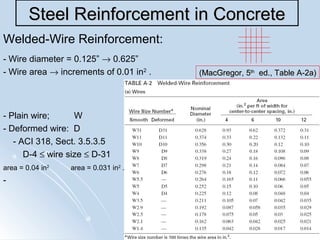
Welded-Wire Reinforcement:
- Wire diameter = 0.125” → 0.625”
- Wire area → increments of 0.01 in2
.
- Plain wire; W
- Deformed wire: D
- ACI 318, Sect. 3.5.3.5
D-4 ≤ wire size ≤ D-31
area = 0.04 in2
area = 0.031 in2
.
-
(MacGregor, 5(MacGregor, 5thth
ed., Table A-2a)ed., Table A-2a)
2626
Steel Reinforcement in ConcreteSteel Reinforcement in Concrete
Welded-Wire Reinforcement:
- Wire area → increments of 0.01 in2
.
- Wire center-center spacing → a x b , inches
- Plain wire; W
-
(MacGregor, 5(MacGregor, 5thth
ed., Table A-2b)ed., Table A-2b)

Civil Engineering Materials

  • 1.
    11 Civil Engineering Materials– CIVE 2110Civil Engineering Materials – CIVE 2110 Concrete MaterialConcrete Material Stress vs. Strain CurvesStress vs. Strain Curves Steel ReinforcementSteel Reinforcement
  • 2.
    22 Stress-Strain Curve forCompressionStress-Strain Curve for Compression  Slightly ductile shape of Stress-Strain curve  A descending branch exists after is reached  Due to redistribution of load to un-cracked regions with less stress, ' cf (MacGregor, 5(MacGregor, 5thth ed., Fig. 3-26)ed., Fig. 3-26)
  • 3.
    33 Stress-Strain Curve forCompressionStress-Strain Curve for Compression  Strength of Reinforced Concrete structures controlled by,  Size of members,  Shape of members,  Stress-Strain curves of; - concrete, - reinforcement. Five properties of Stress-Strain curves; (1) - Initial slope, Ec (2) - Ascending parabola (3) - Strain at max stress, (4) - Descending parabola (5) - Strain at failure ' cf (Fig. 3-18, MacGregor, 5(Fig. 3-18, MacGregor, 5thth ed.)ed.)
  • 4.
    44 Stress-Strain Curve forCompressionStress-Strain Curve for Compression  (1) - Initial Slope, Ec ;  ACI 318, Sect. 8.5, 8.6  sensitive to Eaggregate , Ecement .  For normal weight concrete;  For other weight concrete;  Defined as the slope of a line drawn from As water increases, Ec decreases, because cement paste becomes ' 45.00 cfto == σσ (MacGregor, 5(MacGregor, 5thth ed., Fig. 3.17)ed., Fig. 3.17) ( ) ( ) ( ) '5.1 33 33 16090 ccc c fwpsiE FtLbwFtLb = ≤≤ ( ) ( ) ' 3 000,57 145 cc c fpsiE FtLbw = ≈
  • 5.
    55 Stress-Strain Curve forCompressionStress-Strain Curve for Compression  Lightweight Concrete ;  ACI 318, Sect. 8.5, 8.6  sensitive to Eaggregate .  For all parameters involving  Each parameter shall be multiplied by a modification factor for sand-lightweight conc. for all-lightweight concrete  If splitting tensile strength, fct , is specified, then  This accounts for the reduced capacity of lightweight concrete due to aggregate failure; Such as:  Shear strength  Splitting resistance  Concrete-rebar bond For normal weight concrete the averageFor normal weight concrete the average splitting tensile strength is;splitting tensile strength is; ( )[ ] 0.17.6/ ' ≤= cct ffλ ' cf ( )' 7.6 cct ff ≈ (MacGregor, 5(MacGregor, 5thth ed., Fig. 3.26)ed., Fig. 3.26) ( ) ( ) ( ) '5.1 33 33 12090 ccc c fwpsiE FtLbwFtLb = ≤≤ 75.0 85.0 = = λ λ λ
  • 6.
    66 Stress-Strain Curve forCompressionStress-Strain Curve for Compression  (2) – Ascending Parabola;  Curve becomes steeper as increases.' cf (Fig. 3.18(Fig. 3.18, MacGregor, 5MacGregor, 5thth ed.,)ed.,)  (3) – Strain ( ) at ;  Strain at max stress increases as increases. ' cf ' cf  (4) – Slope of descending branch;  Less steep than ascending branch,  Slope increases as increases. ' cf  (5) – Strain ( ) at failure;  Decreases with increases in ' cf 0ε cuε  (4 and 5) – depend on;  Specimen size; Load, type, rate ksifc 6' ≤
  • 7.
    77 Stress-Strain Curve forStress-StrainCurve for TensionTension  Tensile strength of concrete:  Determined by one of 2 tests:  (1) Flexure (Modulus of Rupture) test,  (2) Split Cylinder test, fct  ( ) 2 3 6 12 2 BH M f BH HM f I My f r r Flexurer = = == σ  (1) Flexure (Modulus of Rupture) test;  Load until failure due to cracking on tension side,  ASTM C78 or ASTM C293,  H = 6”, B = 6” L = 30” 3 PL H B P P 3” 3” 8” 8” 8” P -P V M 0 0
  • 8.
    88 Stress-Strain Curve forTensionStress-Strain Curve for Tension ( ) ld P f ld P f asistingAre P f ldasistingAre ct ct ct π π σ π 2 2 Re 2 Re = = == =  (2) Split Cylinder test, fct ;  Load in compression along long side,  ASTM C496,  a standard 6”x12” cylinder is placed on side,  Outside surface area,  Load is resisted by only half of surface area, dlrlArea ππ == 2 (MacGregor, 5(MacGregor, 5thth ed., Fig. 3.9)ed., Fig. 3.9)
  • 9.
    99 1max σσ =Tension ApCσσ=2 2 max ApCσ τ = σ τ 2x90˚ Compression Tension Concrete always cracks on plane of MaxTensionσ Split Cylinder Test Bi-Axial Stress Stress-Strain Curve for TensionStress-Strain Curve for Tension
  • 10.
    1010 Stress-Strain Curve forTensionStress-Strain Curve for Tension  Tensile strength of concrete:  Determined by one of 2 tests:  (1) Flexure (Modulus of Rupture) test,  (2) Split Cylinder test, rf  Tensile strength from Split Cylinder test is less than that from Flexure (modulus of Rupture) test because;  In Flexure test, only bottom of beam reaches  In Split Cylinder test, majority of cylinder reaches ctf MaxTensionσ MaxTensionσ ctr ff 5.1≈ H B P P
  • 11.
    1111 Stress-Strain Curve forTensionStress-Strain Curve for Tension  Results from various Split Cylinder tests vs. are plotted in Fig. 3.10  The mean Split Cylinder strength is:  ACI 318, Sect. R8.6.1 states;  The mean Modulus of Rupture strength is:  ACI 318, Sects. 8.6.1 & 9.5.2.3 state, for deflection calculations: ' 3.8 cr ff = ' 4.6 cct ff = (MacGregor, 5(MacGregor, 5thth ed., Fig. 3.10)ed., Fig. 3.10) ' cf ' 7.6 cct ff ≈ 0.1 7.6 5.7 ' ' ≤= = c ct cr f f ff λ λ concretetlightweighallfor concretetlightweighsandfor concreteweightnormalfor −= −= = 75.0 85.0 0.1 λ λ λ
  • 12.
    1212 Stress-Strain Curve forTensionStress-Strain Curve for Tension  Tensile strength of concrete: ( ) '' 15.008.0 ct ff →=  Concrete tensile failure is BRITTLE.  Same factors affect as ;  Water/Cement ratio,  Type of Cement,  Type of Aggregate,  Curing Moisture conditions,  Curing Temperature,  Age,  Maturity,  Loading rate. (MacGregor,(MacGregor, 55thth ed., Fig. 3-21)ed., Fig. 3-21) ' tf ' cf '' ' ' 4.6 8.1 cctt c t t fff where E f == =ε E tinitial=linear flexurefor tensionpurefor MAX MAX t t 0002.000014.0 0001.0 ' ' →= = ε ε ' 5.0 tfFrom: 0 → c t t E f ' ' =ε '' 5.0 tt ff →From: '' 5.0 tt ff → ' 5.0 tf
  • 13.
    1313 Steel Reinforcement inConcreteSteel Reinforcement in Concrete  In any beam (concrete, steel, masonry, wood):  Applied loads produce Internal resisting Couple, Tension and Compression forces form couple. MacGregor, 5th ed. Fig. 1-4 In a concrete beam:In a concrete beam: -- Cracks occur in areas ofoccur in areas of Tension,, -- Beam will have suddenBeam will have sudden Brittle failurefailure unless Steel reinforcementreinforcement is present to takeis present to take Tension.
  • 14.
    1414 Mohr’s Circle Method– Failure ModesMohr’s Circle Method – Failure Modes ionslightTens=maxσ Brittle concrete fails on plane of max normal (tension) Stress. Failure stress located at: 2x90˚=180˚on Mohr Circle ApCσσ =min 2 max ApCσ τ = σ τ 2x45˚ 2x90˚ tensionσ Shear Stress Normal Stress Principal Stress Neutral Axis 90˚ tensionσ Plane of max Tension Concrete Brittle
  • 15.
    1515 Steel Reinforcement inConcreteSteel Reinforcement in Concrete  Steel Reinforcement: Hot-Rolled deformed bars (rebars) Welded wire fabric Reinforcement Bars (Rebars): ASTM specs specify;ASTM specs specify; - diameter, cross-sectional area- diameter, cross-sectional area - sizes in terms of 1/8 inch- sizes in terms of 1/8 inch - #4 rebar, diameter = 4/8 in.- #4 rebar, diameter = 4/8 in. - metallurgical properties- metallurgical properties - mechanical properties- mechanical properties - Grade- Grade →→ min. Tensile Yield Strengthmin. Tensile Yield Strength - Grade 60, Yield Strength = f- Grade 60, Yield Strength = fyy = 60 ksi= 60 ksi ASTM A 615:ASTM A 615: - made from steel billets- made from steel billets - most commonly used- most commonly used ASTM A 706:ASTM A 706: - made from steel billets- made from steel billets - for seismic applications- for seismic applications - better - ductility- better - ductility - bendability- bendability - weldability- weldability
  • 16.
    1616 Steel Reinforcement inConcreteSteel Reinforcement in Concrete Reinforcement Bars (Rebars): Upper Limit on ( )dStrengthactualYielygthnsileStrenUltimateTe f σσ =≤ 25.1 (MacGregor, 5(MacGregor, 5thth ed., Table 3-4)ed., Table 3-4)
  • 17.
    1717 Steel Reinforcement inConcreteSteel Reinforcement in Concrete Rebars in US customary units: - Grade 60, → - # 11 → Rebars in metric units:Rebars in metric units: - just numerical conversions- just numerical conversions of US customary sizes.of US customary sizes. - #36- #36 → - Grade 420,- Grade 420, → MPafy 420= ksify 60= (MacGregor, 5(MacGregor, 5thth ed., Fig. 3-30)ed., Fig. 3-30) "41.1"375.1 8 "11 ≈==d "409.1 "14.25 8.35 == mm mm d
  • 18.
    1818 Steel Reinforcement inConcreteSteel Reinforcement in Concrete Reinforcement Bars (Rebars): (MacGregor, 5(MacGregor, 5thth ed., Table A-1)ed., Table A-1)
  • 19.
    1919 Steel Reinforcement inConcreteSteel Reinforcement in Concrete Reinforcement Bars (Rebars): (MacGregor, 5(MacGregor, 5thth ed., Table A-1M)ed., Table A-1M)
  • 20.
    2020 Steel Reinforcement inConcreteSteel Reinforcement in Concrete Reinforcement Bars (Rebars): - modulus of Elasticity, ES = 29,000,000 psi ACI 318, Sect. 8.5.2 - for rebars with fy > 60,000 psi must use fy = ES x ( ) ACI 318, Sect. 3.5.3.2 0035.0=Sε (MacGregor, 5(MacGregor, 5thth ed., Fig. 3-31)ed., Fig. 3-31)
  • 21.
    2121 Steel Reinforcement inConcreteSteel Reinforcement in Concrete Reinforcement Bars (Rebars): - at temperatures > 850at temperatures > 850˚F˚F ffyy and fand fultimateultimate drop significantlydrop significantly - concrete cover- concrete cover over the rebarsover the rebars helps to delay losshelps to delay loss loss during firesloss during fires (MacGregor, 5(MacGregor, 5thth ed., Fig. 3-34)ed., Fig. 3-34)
  • 22.
    2222 Steel Reinforcement inConcreteSteel Reinforcement in Concrete Fatigue Strength of rebars: - Bridge decks subjected to large number of load cycles - Stress Range, Sr = (MacGregor, 5(MacGregor, 5thth ed., Fig. 3-33)ed., Fig. 3-33) - Fatigue failure may occur if at least one stress is tensile and Sr > 20 ksi - Fatigue failure will not occur if; cyclesany cyclesiniteksi Max Max 000,20 inf20 = < σ σ - Fatigue strength reduced at: Bends, Welds ( ) ( ) cyclesameinMinStresscycleainStressMaxTensile σσ −
  • 23.
    2323 Steel Reinforcement inConcreteSteel Reinforcement in Concrete Example: Fatigue Failure not possible; Fatigue Strength of rebars: - Stress Range, Sr = ( ) ( ) cyclesameinMinStresscycleainStressMaxTensile σσ − ( ) ( ) ksiS ksiksiS r cyclesameincycleainr 21 165 = −−= ( ) ( ) ksiS ksiksiS r cyclesameincycleainr 21 265 = −−−= Example: Fatigue Failure possible;
  • 24.
    2424 Steel Reinforcement inConcreteSteel Reinforcement in Concrete Welded-Wire Reinforcement: - used in: Walls, Slabs, Pavements. - due to cold-working process used in drawing the wire strain-hardening occurs, so wire is BRITTLE. - Plain wire; ASTM A82; A185; ACI 318, Sect. R3.5.3.6 → fy = 60,000 psi - mechanical anchorage in concrete provided by - cross-wires - Deformed wire; ASTM A496; A497; ACI 318, Sect. R3.5.3.7 → fy = 60,000 psi - mechanical anchorage in concrete provided by - cross-wires
  • 25.
    2525 Steel Reinforcement inConcreteSteel Reinforcement in Concrete Welded-Wire Reinforcement: - Wire diameter = 0.125” → 0.625” - Wire area → increments of 0.01 in2 . - Plain wire; W - Deformed wire: D - ACI 318, Sect. 3.5.3.5 D-4 ≤ wire size ≤ D-31 area = 0.04 in2 area = 0.031 in2 . - (MacGregor, 5(MacGregor, 5thth ed., Table A-2a)ed., Table A-2a)
  • 26.
    2626 Steel Reinforcement inConcreteSteel Reinforcement in Concrete Welded-Wire Reinforcement: - Wire area → increments of 0.01 in2 . - Wire center-center spacing → a x b , inches - Plain wire; W - (MacGregor, 5(MacGregor, 5thth ed., Table A-2b)ed., Table A-2b)