(6G4Z3001) Mathematics Fundamentals
Dr Killian O’Brien
2015/16
Introduction
A quick trip through the unit
See the unit’s Moodle area for info on:
Syllabus
Teaching team & pattern
Assessment
Resources
Some motivation
Motivation  Convergence and divergence in applied
mathematics
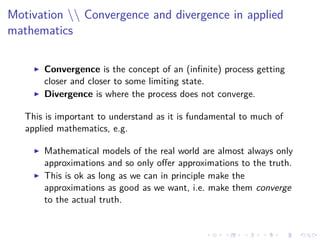
Convergence is the concept of an (infinite) process getting
closer and closer to some limiting state.
Divergence is where the process does not converge.
This is important to understand as it is fundamental to much of
applied mathematics, e.g.
Mathematical models of the real world are almost always only
approximations and so only offer approximations to the truth.
This is ok as long as we can in principle make the
approximations as good as we want, i.e. make them converge
to the actual truth.
Increasing detail of the IPCC reports 1990 - 2007
Source:
A National Strategy for Advancing Climate Modeling, US National
Academy of Sciences
Motivation  Convergence and divergence in applied
mathematics
In addition . . .
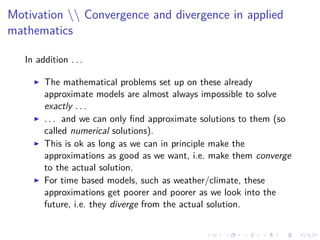
The mathematical problems set up on these already
approximate models are almost always impossible to solve
exactly . . .
. . . and we can only find approximate solutions to them (so
called numerical solutions).
This is ok as long as we can in principle make the
approximations as good as we want, i.e. make them converge
to the actual solution.
For time based models, such as weather/climate, these
approximations get poorer and poorer as we look into the
future, i.e. they diverge from the actual solution.
Motivation  Convergence and divergence in pure
mathematics
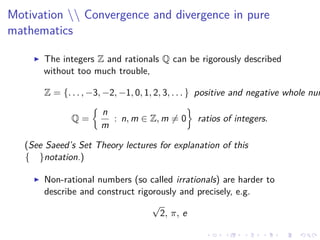
The integers Z and rationals Q can be rigorously described
without too much trouble,
Z = {. . . , −3, −2, −1, 0, 1, 2, 3, . . . } positive and negative whole num
Q =
n
m
: n, m ∈ Z, m = 0 ratios of integers.
(See Saeed’s Set Theory lectures for explanation of this
{ }notation.)
Non-rational numbers (so called irrationals) are harder to
describe and construct rigorously and precisely, e.g.
√
2, π, e
Motivation  Convergence and divergence in pure
mathematics
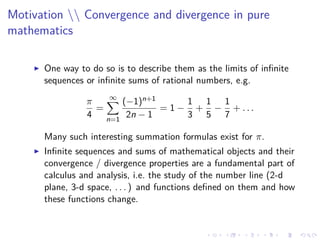
One way to do so is to describe them as the limits of infinite
sequences or infinite sums of rational numbers, e.g.
π
4
=
∞
n=1
(−1)n+1
2n − 1
= 1 −
1
3
+
1
5
−
1
7
+ . . .
Many such interesting summation formulas exist for π.
Infinite sequences and sums of mathematical objects and their
convergence / divergence properties are a fundamental part of
calculus and analysis, i.e. the study of the number line (2-d
plane, 3-d space, . . . ) and functions defined on them and how
these functions change.
Motivation  Convergence and divergence in pure &
applied mathematics
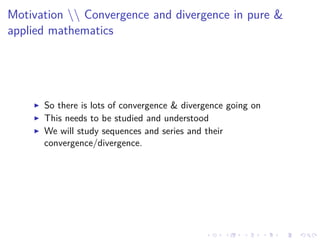
So there is lots of convergence & divergence going on
This needs to be studied and understood
We will study sequences and series and their
convergence/divergence.
Sequences  Definitions and notation
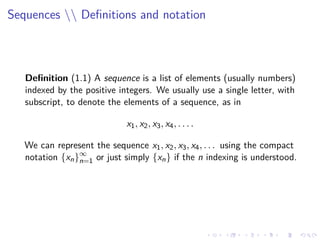
Definition (1.1) A sequence is a list of elements (usually numbers)
indexed by the positive integers. We usually use a single letter, with
subscript, to denote the elements of a sequence, as in
x1, x2, x3, x4, . . . .
We can represent the sequence x1, x2, x3, x4, . . . using the compact
notation {xn}∞
n=1 or just simply {xn} if the n indexing is understood.
Sequences  Examples
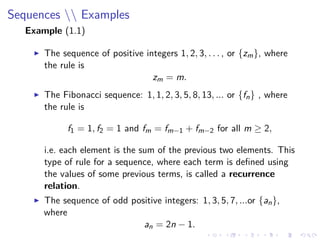
Example (1.1)
The sequence of positive integers 1, 2, 3, . . . , or {zm}, where
the rule is
zm = m.
The Fibonacci sequence: 1, 1, 2, 3, 5, 8, 13, ... or {fn} , where
the rule is
f1 = 1, f2 = 1 and fm = fm−1 + fm−2 for all m ≥ 2,
i.e. each element is the sum of the previous two elements. This
type of rule for a sequence, where each term is defined using
the values of some previous terms, is called a recurrence
relation.
The sequence of odd positive integers: 1, 3, 5, 7, ...or {an},
where
an = 2n − 1.
Sequences  Examples
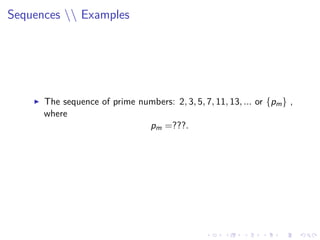
The sequence of prime numbers: 2, 3, 5, 7, 11, 13, ... or {pm} ,
where
pm =???.
Sequences  Arithmetic and geometric sequences
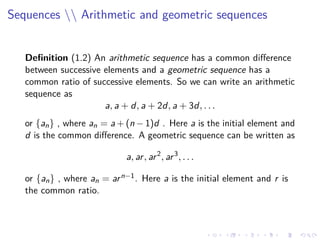
Definition (1.2) An arithmetic sequence has a common difference
between successive elements and a geometric sequence has a
common ratio of successive elements. So we can write an arithmetic
sequence as
a, a + d, a + 2d, a + 3d, . . .
or {an} , where an = a + (n − 1)d . Here a is the initial element and
d is the common difference. A geometric sequence can be written as
a, ar, ar2
, ar3
, . . .
or {an} , where an = arn−1. Here a is the initial element and r is
the common ratio.
Sequences  Arithmetic and geometric examples
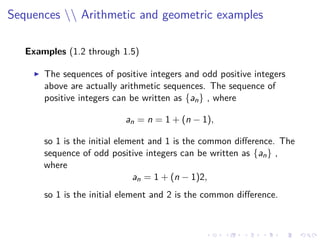
Examples (1.2 through 1.5)
The sequences of positive integers and odd positive integers
above are actually arithmetic sequences. The sequence of
positive integers can be written as {an} , where
an = n = 1 + (n − 1),
so 1 is the initial element and 1 is the common difference. The
sequence of odd positive integers can be written as {an} ,
where
an = 1 + (n − 1)2,
so 1 is the initial element and 2 is the common difference.
Sequences  Arithmetic and geometric examples
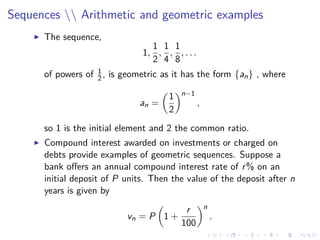
The sequence,
1,
1
2
,
1
4
,
1
8
, . . .
of powers of 1
2, is geometric as it has the form {an} , where
an =
1
2
n−1
,
so 1 is the initial element and 2 the common ratio.
Compound interest awarded on investments or charged on
debts provide examples of geometric sequences. Suppose a
bank offers an annual compound interest rate of r% on an
initial deposit of P units. Then the value of the deposit after n
years is given by
vn = P 1 +
r
100
n
.
Sequences  Arithmetic and geometric examples
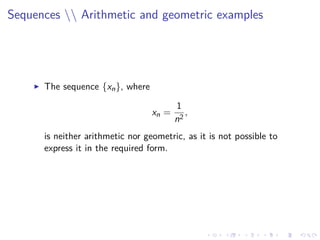
The sequence {xn}, where
xn =
1
n2
,
is neither arithmetic nor geometric, as it is not possible to
express it in the required form.
Sequences  Monotonic sequences: increasing or
decreasing behaviour
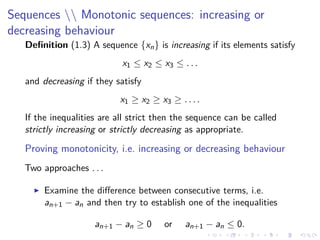
Definition (1.3) A sequence {xn} is increasing if its elements satisfy
x1 ≤ x2 ≤ x3 ≤ . . .
and decreasing if they satisfy
x1 ≥ x2 ≥ x3 ≥ . . . .
If the inequalities are all strict then the sequence can be called
strictly increasing or strictly decreasing as appropriate.
Proving monotonicity, i.e. increasing or decreasing behaviour
Two approaches . . .
Examine the difference between consecutive terms, i.e.
an+1 − an and then try to establish one of the inequalities
an+1 − an ≥ 0 or an+1 − an ≤ 0.
Proving monotonicity, i.e. increasing or decreasing
behaviour
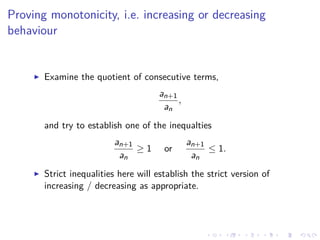
Examine the quotient of consecutive terms,
an+1
an
,
and try to establish one of the inequalties
an+1
an
≥ 1 or
an+1
an
≤ 1.
Strict inequalities here will establish the strict version of
increasing / decreasing as appropriate.
Proving monotonicity, i.e. increasing or decreasing
behaviour
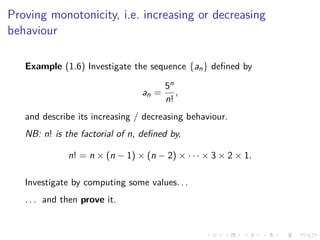
Example (1.6) Investigate the sequence {an} defined by
an =
5n
n!
,
and describe its increasing / decreasing behaviour.
NB: n! is the factorial of n, defined by,
n! = n × (n − 1) × (n − 2) × · · · × 3 × 2 × 1.
Investigate by computing some values. . .
. . . and then prove it.
Proving monotonicity, i.e. increasing or decreasing
behaviour
More examples
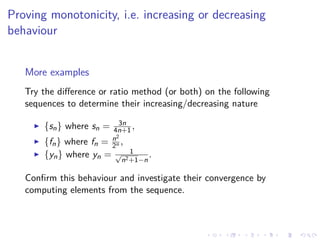
Try the difference or ratio method (or both) on the following
sequences to determine their increasing/decreasing nature
{sn} where sn = 3n
4n+1,
{fn} where fn = n2
2n ,
{yn} where yn = 1√
n2+1−n
.
Confirm this behaviour and investigate their convergence by
computing elements from the sequence.

Sequences 01

  • 1.
    (6G4Z3001) Mathematics Fundamentals DrKillian O’Brien 2015/16
  • 2.
  • 3.
    A quick tripthrough the unit See the unit’s Moodle area for info on: Syllabus Teaching team & pattern Assessment Resources
  • 4.
  • 5.
    Motivation Convergenceand divergence in applied mathematics Convergence is the concept of an (infinite) process getting closer and closer to some limiting state. Divergence is where the process does not converge. This is important to understand as it is fundamental to much of applied mathematics, e.g. Mathematical models of the real world are almost always only approximations and so only offer approximations to the truth. This is ok as long as we can in principle make the approximations as good as we want, i.e. make them converge to the actual truth.
  • 6.
    Increasing detail ofthe IPCC reports 1990 - 2007 Source: A National Strategy for Advancing Climate Modeling, US National Academy of Sciences
  • 7.
    Motivation Convergenceand divergence in applied mathematics In addition . . . The mathematical problems set up on these already approximate models are almost always impossible to solve exactly . . . . . . and we can only find approximate solutions to them (so called numerical solutions). This is ok as long as we can in principle make the approximations as good as we want, i.e. make them converge to the actual solution. For time based models, such as weather/climate, these approximations get poorer and poorer as we look into the future, i.e. they diverge from the actual solution.
  • 8.
    Motivation Convergenceand divergence in pure mathematics The integers Z and rationals Q can be rigorously described without too much trouble, Z = {. . . , −3, −2, −1, 0, 1, 2, 3, . . . } positive and negative whole num Q = n m : n, m ∈ Z, m = 0 ratios of integers. (See Saeed’s Set Theory lectures for explanation of this { }notation.) Non-rational numbers (so called irrationals) are harder to describe and construct rigorously and precisely, e.g. √ 2, π, e
  • 9.
    Motivation Convergenceand divergence in pure mathematics One way to do so is to describe them as the limits of infinite sequences or infinite sums of rational numbers, e.g. π 4 = ∞ n=1 (−1)n+1 2n − 1 = 1 − 1 3 + 1 5 − 1 7 + . . . Many such interesting summation formulas exist for π. Infinite sequences and sums of mathematical objects and their convergence / divergence properties are a fundamental part of calculus and analysis, i.e. the study of the number line (2-d plane, 3-d space, . . . ) and functions defined on them and how these functions change.
  • 10.
    Motivation Convergenceand divergence in pure & applied mathematics So there is lots of convergence & divergence going on This needs to be studied and understood We will study sequences and series and their convergence/divergence.
  • 11.
    Sequences Definitionsand notation Definition (1.1) A sequence is a list of elements (usually numbers) indexed by the positive integers. We usually use a single letter, with subscript, to denote the elements of a sequence, as in x1, x2, x3, x4, . . . . We can represent the sequence x1, x2, x3, x4, . . . using the compact notation {xn}∞ n=1 or just simply {xn} if the n indexing is understood.
  • 12.
    Sequences Examples Example(1.1) The sequence of positive integers 1, 2, 3, . . . , or {zm}, where the rule is zm = m. The Fibonacci sequence: 1, 1, 2, 3, 5, 8, 13, ... or {fn} , where the rule is f1 = 1, f2 = 1 and fm = fm−1 + fm−2 for all m ≥ 2, i.e. each element is the sum of the previous two elements. This type of rule for a sequence, where each term is defined using the values of some previous terms, is called a recurrence relation. The sequence of odd positive integers: 1, 3, 5, 7, ...or {an}, where an = 2n − 1.
  • 13.
    Sequences Examples Thesequence of prime numbers: 2, 3, 5, 7, 11, 13, ... or {pm} , where pm =???.
  • 14.
    Sequences Arithmeticand geometric sequences Definition (1.2) An arithmetic sequence has a common difference between successive elements and a geometric sequence has a common ratio of successive elements. So we can write an arithmetic sequence as a, a + d, a + 2d, a + 3d, . . . or {an} , where an = a + (n − 1)d . Here a is the initial element and d is the common difference. A geometric sequence can be written as a, ar, ar2 , ar3 , . . . or {an} , where an = arn−1. Here a is the initial element and r is the common ratio.
  • 15.
    Sequences Arithmeticand geometric examples Examples (1.2 through 1.5) The sequences of positive integers and odd positive integers above are actually arithmetic sequences. The sequence of positive integers can be written as {an} , where an = n = 1 + (n − 1), so 1 is the initial element and 1 is the common difference. The sequence of odd positive integers can be written as {an} , where an = 1 + (n − 1)2, so 1 is the initial element and 2 is the common difference.
  • 16.
    Sequences Arithmeticand geometric examples The sequence, 1, 1 2 , 1 4 , 1 8 , . . . of powers of 1 2, is geometric as it has the form {an} , where an = 1 2 n−1 , so 1 is the initial element and 2 the common ratio. Compound interest awarded on investments or charged on debts provide examples of geometric sequences. Suppose a bank offers an annual compound interest rate of r% on an initial deposit of P units. Then the value of the deposit after n years is given by vn = P 1 + r 100 n .
  • 17.
    Sequences Arithmeticand geometric examples The sequence {xn}, where xn = 1 n2 , is neither arithmetic nor geometric, as it is not possible to express it in the required form.
  • 18.
    Sequences Monotonicsequences: increasing or decreasing behaviour Definition (1.3) A sequence {xn} is increasing if its elements satisfy x1 ≤ x2 ≤ x3 ≤ . . . and decreasing if they satisfy x1 ≥ x2 ≥ x3 ≥ . . . . If the inequalities are all strict then the sequence can be called strictly increasing or strictly decreasing as appropriate. Proving monotonicity, i.e. increasing or decreasing behaviour Two approaches . . . Examine the difference between consecutive terms, i.e. an+1 − an and then try to establish one of the inequalities an+1 − an ≥ 0 or an+1 − an ≤ 0.
  • 19.
    Proving monotonicity, i.e.increasing or decreasing behaviour Examine the quotient of consecutive terms, an+1 an , and try to establish one of the inequalties an+1 an ≥ 1 or an+1 an ≤ 1. Strict inequalities here will establish the strict version of increasing / decreasing as appropriate.
  • 20.
    Proving monotonicity, i.e.increasing or decreasing behaviour Example (1.6) Investigate the sequence {an} defined by an = 5n n! , and describe its increasing / decreasing behaviour. NB: n! is the factorial of n, defined by, n! = n × (n − 1) × (n − 2) × · · · × 3 × 2 × 1. Investigate by computing some values. . . . . . and then prove it.
  • 21.
    Proving monotonicity, i.e.increasing or decreasing behaviour More examples Try the difference or ratio method (or both) on the following sequences to determine their increasing/decreasing nature {sn} where sn = 3n 4n+1, {fn} where fn = n2 2n , {yn} where yn = 1√ n2+1−n . Confirm this behaviour and investigate their convergence by computing elements from the sequence.