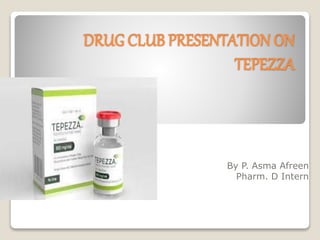
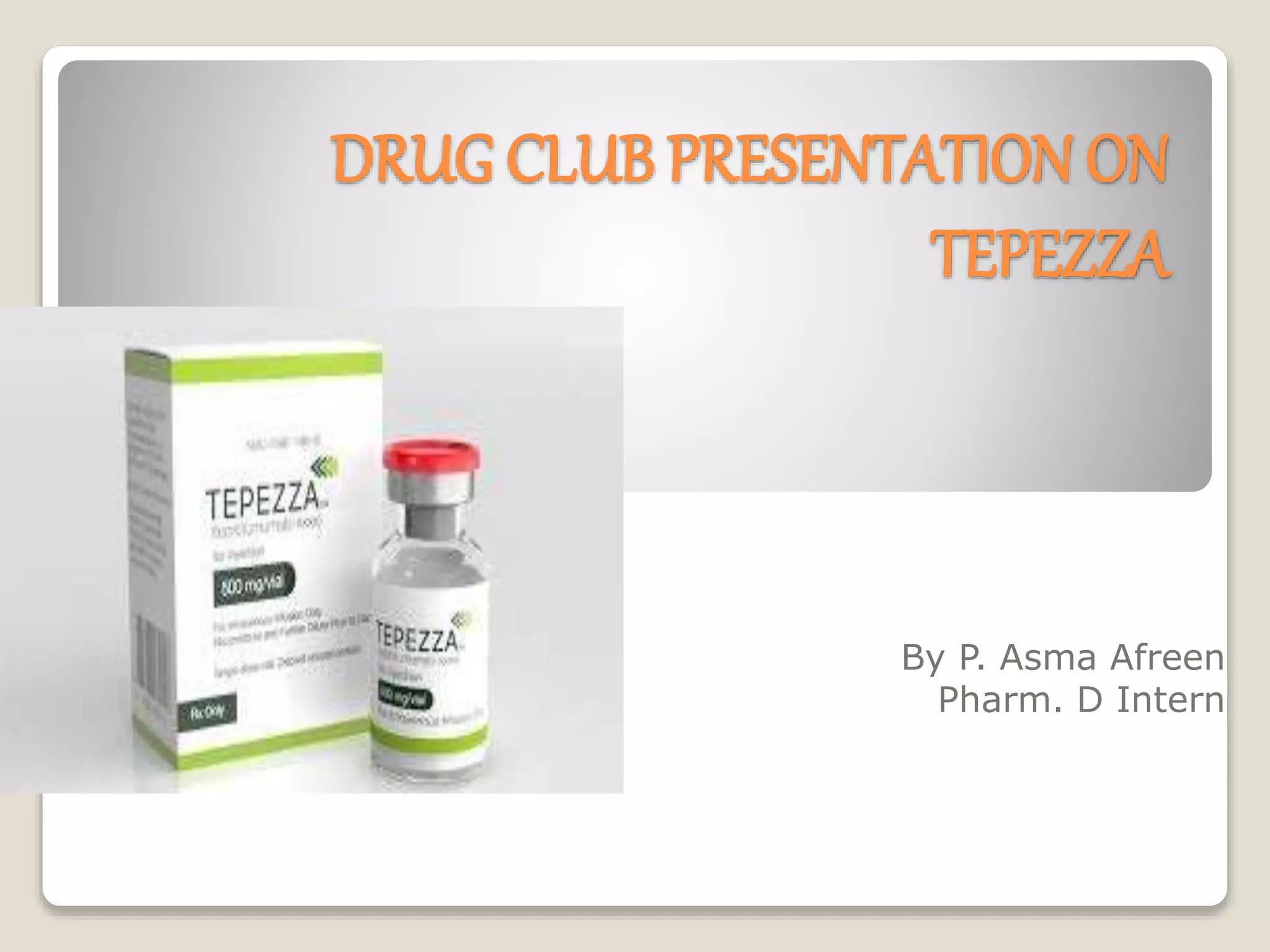
DRUG CLUB PRESENTATION ON
TEPEZZA
By P. Asma Afreen
Pharm. D Intern
DRUG DETAILS
Brand name: Tepezza
Generic name: teprotumumab-trbw
Dosage form: Injection
Treatment : Thyroid Eye Disease
FDAApproved: January 21, 2020
DESCRIPTION
 Teprotumumab-trbw, an insulin-like growth factor-1
receptor inhibitor (IGF-1R), is a fully human IgG1
monoclonal antibody produced in Chinese hamster
ovary (CHO-DG44) cells. It has a molecular weight
of approximately 148 kilodaltons.
Dosage Forms & Strengths
Injection, lyophilized powder for reconstitution
 500mg/single-dose
 10 mg/kg IV initially, followed by 20 mg/kg IV q3
weeks for 7 additional infusions
Mechanism of action
 Monoclonal antibody that binds insulin-like growth
factor-1 receptor (IGF-1R).
 Teprotumumab-trbw binds to IGF-1R and blocks its
activation and signaling
PHARMACOKINETICS
Absorption
 Peak plasma concentration: 632 mcg/mL
 Trough plasma concentration: 176 mcg/mL
 AUC: 138 mg⋅hr/mL
Distribution
 Vd: 3.26 L (central); 4.32 L (peripheral)
Metabolism
 proteolysis
Elimination
 Clearance: 0.27 L/day
 Half-life: 20 days
SIDE EFFCTS
 Muscle spasm,
 Nausea,
 Hair loss,
 Diarrhea,
 Fatigue,
 High blood sugar (hyperglycemia),
 Hearing impairment,
 Dry skin,
INDICATION
 Tepezza is indicated for the treatment of Thyroid Eye Disease.
STORAGE
 Protect from light
 Do not freeze
 Unused vials: Refrigerate at 2-8ºC (36-46ºF) in original carton
until time of use
 Reconstituted vials and diluted solutions
 Store at room temperature (20-25ºC [68-77ºF]) for up to 4 hr
OR
 Refrigerate at 2-8ºC (36-46ºF) for up to 48 hr
ADVISE TO PATIENTS
 Tepezza may cause fetal harm when administered to a
pregnant woman
 teprotumumab-trbw may cause infusion reactions that can
occur at any time. Instruct patients to recognize the signs
and symptoms of infusion reaction
 Advise patients on the risk of inflammatory bowel disease
(IBD) and to seek medical advice immediately if they
experience diarrhea, with or without blood or rectal
bleeding, associated with abdominal pain
 Advise patients on the risk of hyperglycemia and, if
diabetic, to adjust glycemic control medications as
appropriate.

Drug club presentation on tepezza

  • 1.
    DRUG CLUB PRESENTATIONON TEPEZZA By P. Asma Afreen Pharm. D Intern
  • 2.
    DRUG DETAILS Brand name:Tepezza Generic name: teprotumumab-trbw Dosage form: Injection Treatment : Thyroid Eye Disease FDAApproved: January 21, 2020
  • 3.
    DESCRIPTION  Teprotumumab-trbw, aninsulin-like growth factor-1 receptor inhibitor (IGF-1R), is a fully human IgG1 monoclonal antibody produced in Chinese hamster ovary (CHO-DG44) cells. It has a molecular weight of approximately 148 kilodaltons.
  • 4.
    Dosage Forms &Strengths Injection, lyophilized powder for reconstitution  500mg/single-dose  10 mg/kg IV initially, followed by 20 mg/kg IV q3 weeks for 7 additional infusions
  • 5.
    Mechanism of action Monoclonal antibody that binds insulin-like growth factor-1 receptor (IGF-1R).  Teprotumumab-trbw binds to IGF-1R and blocks its activation and signaling
  • 6.
    PHARMACOKINETICS Absorption  Peak plasmaconcentration: 632 mcg/mL  Trough plasma concentration: 176 mcg/mL  AUC: 138 mg⋅hr/mL Distribution  Vd: 3.26 L (central); 4.32 L (peripheral) Metabolism  proteolysis Elimination  Clearance: 0.27 L/day  Half-life: 20 days
  • 7.
    SIDE EFFCTS  Musclespasm,  Nausea,  Hair loss,  Diarrhea,  Fatigue,  High blood sugar (hyperglycemia),  Hearing impairment,  Dry skin,
  • 8.
    INDICATION  Tepezza isindicated for the treatment of Thyroid Eye Disease. STORAGE  Protect from light  Do not freeze  Unused vials: Refrigerate at 2-8ºC (36-46ºF) in original carton until time of use  Reconstituted vials and diluted solutions  Store at room temperature (20-25ºC [68-77ºF]) for up to 4 hr OR  Refrigerate at 2-8ºC (36-46ºF) for up to 48 hr
  • 9.
    ADVISE TO PATIENTS Tepezza may cause fetal harm when administered to a pregnant woman  teprotumumab-trbw may cause infusion reactions that can occur at any time. Instruct patients to recognize the signs and symptoms of infusion reaction  Advise patients on the risk of inflammatory bowel disease (IBD) and to seek medical advice immediately if they experience diarrhea, with or without blood or rectal bleeding, associated with abdominal pain  Advise patients on the risk of hyperglycemia and, if diabetic, to adjust glycemic control medications as appropriate.