Page 1 of 12
For any Query, Contact
abrar00adib@gmail.com
ANALYTICAL CHEMISTRY PART I
Chromatography: The International Union of Pure and Applied Chemistry (IUPAC) has
drafted a recommended definition of chromatography: “Chromatography is a physical method
of separation in which the components to be separated are distributed between two phases, one
of which is stationary (stationary phase), while the other (the mobile phase) moves in a definite
direction”
The stationary phase is usually in a column, but may take other forms, such as a planar phase
(flat sheet). Chromatographic techniques have been in valuable in the separation and analysis of
highly complex mixtures and revolutionized the capabilities
of analytical chemistry.
There are two principle types of chromatography. They are-
• Liquid Chromatography (LC)
• Gas Chromatography (GC)
Liquid Chromatography can be further divided into following
type-
I) Thin Layer Chromatography (TLC)
II) Column Chromatography
III)Paper Chromatography
IV) Ion Exchange Chromatography
V) High Performance/Pressure Liquid Chromatography
(HPLC)
VI) Size Exclusive Chromatography
Significance of Chromatography
Chromatography is the most versatile and widespread
technique employed in modern analytical chemistry and
there are a number of reasons for this.
Firstly, very sensitive methods of detection are available to all types of chromatography and.
thus. very small quantities of material can be separated, identified and assayed. It follows, that
only a few microgram of sample (at the extreme, even less than a nanogram) may be necessary
to ensure the required accuracy.
Secondly, chromatographic separations are usually relatively fast and an analysis can be
completed in a few minutes and possibly in a few seconds. Another advantage of
chromatography is its relative simplicity and ease of operation compared with other
instrumental techniques.
Finally, if the established procedure is well controlled and the apparatus well maintained, good
accuracy and precision can be achieved. However, if the established analytical protocol is not
carefully adhered to, there is evidence that analytical reproducibility between different
laboratories can vary and can sometimes be very poor.
In 1901, the Russian botanist, Mikhail
Tswett, invented adsorption
chromatography during his research on
plant pigments. He separated different
colored chlorophyll and carotenoid
pigments of leaves by passing an
extract of the leaves through a column
of calcium carbonate, alumina, and
sucrose, eluting them with petroleum
ether/ethanol mixtures.
In June 1941, the British chemists A. J.
P. Martin and R. L. M. Synge presented
a paper on the separation of
monoamino monocarboxylic acids in
wool using a new liquid–liquid
chromatography technique called
partition chromatography. The details
are published in Biochem. J., (1941).
For this work, they received the 1952
Nobel Prize in Chemistry.
Page 2 of 12
For any Query, Contact
abrar00adib@gmail.com
ANALYTICAL CHEMISTRY PART I
Principle of Chromatographic Separation
While the mechanisms of retention for various types of chromatography differ, they are all based
on the dynamic distribution of an analyte between a fixed stationary phase and a flowing mobile
phase. Each analyte will have a certain affinity for each phase.
Figure illustrates the separation of components in a mixture on a chromatographic column. A
small volume of sample is placed at the top of the column, which is filled with particles
constituting the stationary phase and the solvent. Rather than an equilibrium-based “plate view”
of chromatography, many hold that a “rate view” of chromatography to be more rigorous: in this
view, the partition ratio is simply the ratio of the time a solute spends in the stationary phase to
that it spends in the mobile phase.
More solvent, function in gas mobile phase, is added to the top of the column and percolates
through the column. The individual components interact with the stationary phase to different
degrees.
There is nominally an equilibrium between two phases, one mobile and one stationary. By
continually adding mobile phase, the analyte will distribute between the two phases and
eventually be eluted, and if the distribution is sufficiently different for the different substances,
they will be separated.
Here the equilibrium state is described as-
𝑥 𝑚 ⇌ 𝑥 𝑠
The distribution equilibrium is described by the distribution constant.
𝐾𝑒 =
[𝑥] 𝑠
[𝑥] 𝑚
Page 3 of 12
For any Query, Contact
abrar00adib@gmail.com
ANALYTICAL CHEMISTRY PART I
Where, [x]s is the concentration of component x in stationary phase at equilibrium
[x]m is the concentration in the mobile phase.
Figure illustrates the distribution of two species A and B along a column as they move down the
column
The distribution of the analyte between the two phases is governed by many factors:
• Temperature
• Type of compound
• Stationary phases
• Mobile phases
Thin Layer Chromatography (TLC)
Thin-layer chromatography (TLC) is a planar form of chromatography widely used for rapid
qualitative analysis. It can also be used in a high-performance mode (HPTLC). Quantitative
analysis is also possible, although the technique is most widely used for rapid screening.
Page 4 of 12
For any Query, Contact
abrar00adib@gmail.com
ANALYTICAL CHEMISTRY PART I
The stationary phase is a thin layer of finely divided sorbent supported on a glass, metal (most
commonly aluminum) or plastic sheet. Virtually any stationary phase used in HPLC can be used,
provided a suitable binder can make it adhere well to
the substrate. It differs with HPLC in that multiple
samples can be simultaneously analyzed.
The three stages of TLC are sample spotting, plate
development, and detection. In the simplest case, a
pencil line is drawn horizontally towards the bottom of
the plate (ca. 5–10mm from the bottom). This is where
one or more sample spots are applied.
Samples (typically 0.5−5 μL) are spotted onto the line at
regular intervals (ca. 20mm apart) with a micropipette.
The chromatogram is “developed” by placing the
bottom of the plate or strip in the developing solvent.
The solvent is drawn up the plate by capillary action, and the sample components move up the
plate at different rates, depending on the irrelative affinities for the mobile vs. the stationary
phase. Following development, the positions of the individual solute spots are noted.
Different analytes move at a fraction of the rate of solvent movement; each analyte is thus
characterized by the Rf value.
𝑅𝑓 =
𝑣𝑒𝑟𝑡𝑖𝑐𝑎𝑙 𝑑𝑖𝑠𝑡𝑎𝑛𝑐𝑒 𝑠𝑜𝑙𝑢𝑡𝑒 𝑚𝑜𝑣𝑒𝑠
𝑣𝑒𝑟𝑡𝑖𝑐𝑎𝑙 𝑑𝑖𝑠𝑡𝑎𝑛𝑐𝑒 𝑠𝑜𝑙𝑣𝑒𝑛𝑡 𝑓𝑟𝑜𝑛𝑡 𝑚𝑜𝑣𝑒𝑠
Where the distances are measured from the original position of the sample spot and the solvent
front is a line across the plate. In case an analyte spot tails or is diffuse, the position of
maximum density is taken to be the post-development solute position.
High-Performance Liquid Chromatography
High-performance liquid chromatography (HPLC) is the most widely used chromatographic
process nowadays. It is potentially broader because approximately 80% of known compounds
are not sufficiently volatile or stable to be separated by gas chromatography.
Horvath and Lipsky at Yale University built the first high-pressure liquid chromatograph. The
technology of producing small particles that will allow high efficiency and performance came in
the 1970s. HPLC today largely connotes “high-performance liquid chromatography” rather than
high pressure, the continued move to smaller particles does necessitate the use of higher and
higher pressures. Some commercially available systems are capable of pumping at 15,000–
19,000psi pressures and differentiate themselves by the term ultra-high-pressure liquid
chromatography (UHPLC) systems.
Page 5 of 12
For any Query, Contact
abrar00adib@gmail.com
ANALYTICAL CHEMISTRY PART I
In HPLC, analytes are separated based on their differential affinity between a solid stationary
phase and a liquid mobile phase. The kinetics of distribution of solutes between the stationary
and the mobile phase is largely diffusion-controlled. Compared to gases, the diffusion coefficient
of analytes in liquids is 1000 to 10,000 times slower. To minimize the time required for the
interaction of the analytes between the mobile and the stationary phase, two criteria should be
met-
First, the packing particles should be small and as uniformly and densely packed as
possible. This criterion is met by uniformly sized spherical particles
Second, the stationary phase should be effectively a thin uniform film with no stagnant
pools and provide a small C value (more rapid mass transport between the phases—
necessary for high flow rates).
Gas Chromatography
Gas chromatography (GC) is one of the most versatile and ubiquitous analytical techniques in
the laboratory. It is widely used for the determination of organic compounds. Very complex
mixtures can be separated by this technique. The recent technique of two-dimensional GC (also
called GC-GC) has further improved these capabilities.
There are two types of GC:
• Gas–solid (adsorption) chromatography
• Gas–liquid (partition) chromatography
The more important of the two is gas–liquid chromatography (GLC), used in the form of a
capillary column.
Page 6 of 12
For any Query, Contact
abrar00adib@gmail.com
ANALYTICAL CHEMISTRY PART I
Performing GC Separation
In gas chromatography, the sample is converted to the vapor state (if it is not already a gas) by
injection into a heated port, and the eluent is a gas (the carrier gas). The stationary phase is
generally a nonvolatile liquid or a liquid-like phase supported on or bonded to a capillary wall or
inert solid particles.
There are a large number of liquid phases available, and it is by changing the liquid phase,
rather than the mobile phase, that different separations are accomplished. The most important
factor in gas chromatography is the selection of the proper column (stationary phase) for the
particular separation to be attempted.
The nature of the liquid or solid phase will determine the exchange equilibrium with the sample
components; and this will depend on
• Solubility or adsorb ability of the analytes
• Polarity of the stationary phase and sample molecules
• Degree of hydrogen bonding
• specific chemical interactions
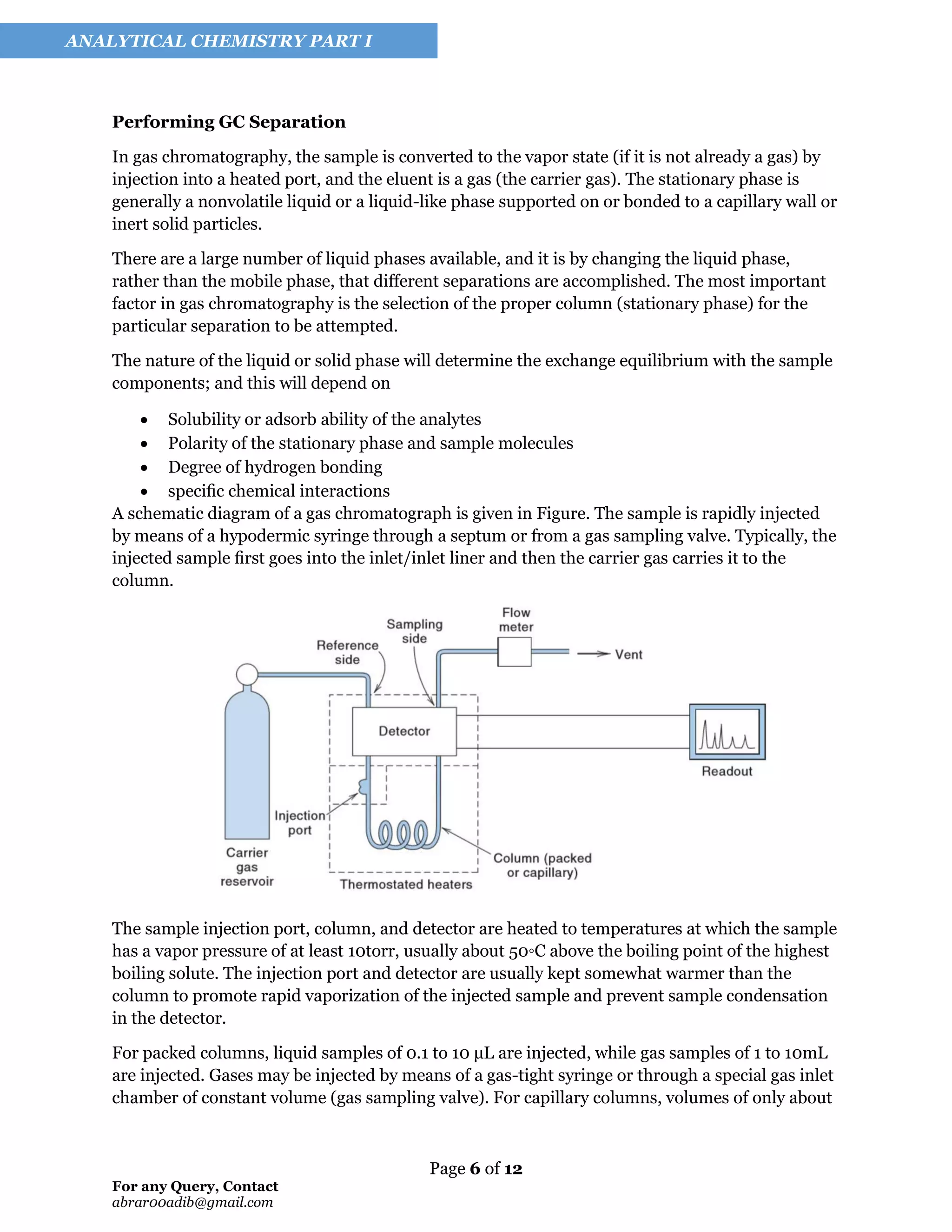
A schematic diagram of a gas chromatograph is given in Figure. The sample is rapidly injected
by means of a hypodermic syringe through a septum or from a gas sampling valve. Typically, the
injected sample first goes into the inlet/inlet liner and then the carrier gas carries it to the
column.
The sample injection port, column, and detector are heated to temperatures at which the sample
has a vapor pressure of at least 10torr, usually about 50◦C above the boiling point of the highest
boiling solute. The injection port and detector are usually kept somewhat warmer than the
column to promote rapid vaporization of the injected sample and prevent sample condensation
in the detector.
For packed columns, liquid samples of 0.1 to 10 μL are injected, while gas samples of 1 to 10mL
are injected. Gases may be injected by means of a gas-tight syringe or through a special gas inlet
chamber of constant volume (gas sampling valve). For capillary columns, volumes of only about
Page 7 of 12
For any Query, Contact
abrar00adib@gmail.com
ANALYTICAL CHEMISTRY PART I
1/100 these sizes must be injected because of the lower capacity (albeit greater resolution) of the
columns. Sample splitters are included on chromatographs designed for use with capillary
columns that deliver a small fixed fraction of the sample to the column.
Separation occurs as the vapor constituents equilibrate between carrier gas and the stationary
phase. The carrier gas is a chemically inert gas available in pure form such as argon, helium, or
nitrogen. A highly dense gas gives best efficiency since diffusivity is lower, but a low-density gas
gives faster speed. The choice of gas is often dictated by the type of detector. Gas
chromatography always uses flow-through detectors that automatically detect the analytes as
they elute from the column; the majority of GC detectors are destructive.
Question: How can you purify two leather dyes from the mixture by column
chromatographic technique?
Answer: Column chromatography is one of the most useful methods for the separation and
purification of both solids and liquids. This is a solid - liquid technique in which the stationary
phase is a solid & mobile phase is a liquid. The principle of column chromatography is based on
differential adsorption of substance by the adsorbent.
The usual adsorbents employed in column
chromatography are silica, alumina, calcium
etc., selection of solvent is based on the nature
of both the solvent and the adsorbent. The rate
at which the components of a mixture are
separated depends on the activity of the
adsorbent and polarity of the solvent. If the
activity of the adsorbent is very high and
polarity of the solvent is very low, then the
separation is very slow but gives a good
separation. On the other hand, if the activity of
adsorbent is low and polarity of the solvent is
high the separation is rapid but gives only a
poor separation, i.e., the components separated
are not 100% pure.
The adsorbent is made into slurry with a
suitable liquid and placed in a cylindrical tube
that is plugged at the bottom by a piece of glass
wool or porous disc. The mixture to be
separated is dissolved in a suitable solvent and
introduced at the top of the column and is
allowed to pass through the column.
As the mixture moves down through the
column, the components are adsorbed at
Page 8 of 12
For any Query, Contact
abrar00adib@gmail.com
ANALYTICAL CHEMISTRY PART I
different regions depending on their ability for adsorption. The component with greater
adsorption power will be adsorbed at the top and the other will be adsorbed at the bottom. The
different components can be desorbed and collected separately by adding more solvent at the
top and this process is known as elution.
That is, the process of dissolving out of the components from the adsorbent is called elution and
the solvent is called is called eluent. The weakly adsorbed component will be eluted more rapidly
than the other. The different fractions are collected separately. Distillation or evaporation of the
solvent from the different fractions gives the pure components.
Question: What are the types of Chromatography?
Answer: Classification of chromatography can be based on mainly three criteria. These are
written below-
On the basis of interaction of solute to the stationary phase
1. Adsorption Chromatography
2. Partition Chromatography
3. Ion Exchange Chromatography
Page 9 of 12
For any Query, Contact
abrar00adib@gmail.com
ANALYTICAL CHEMISTRY PART I
4. Size Exclusion Chromatography
• Adsorption Chromatography: Adsorption chromatography is probably one of the oldest
types of chromatography around. It utilizes a mobile liquid or gaseous phase that is
adsorbed onto the surface of a stationary solid phase. The equilibration between the mobile
and stationary phase accounts for the separation of different solutes.
• Partition Chromatography: This form of chromatography is based on a thin film formed
on the surface of a solid support by a liquid stationary phase. Solute equilibrates between the
mobile phase and the stationary liquid.
• Ion Exchange Chromatography: Ion Exchange Chromatography (Ion Chromatography)
is a process that allows the separation of ions and polar molecules based on their affinity to
the ion exchanger. It can be used for almost any kind of charged molecules including large
protein, small nucleotide and amino acids. The solution to be injected is called Sample and
individually separated components are called analytes. It is often used in protein
purification, water analysis, and quality control.
• Size-Exclusion Chromatography (SEC): SEC is a chromatographic method in which
molecules in a solution are separated by their size, and in some cases molecular weight. It is
usually applied to large molecules or macromolecular complexes such as proteins and
industrial polymers.
On the basis of chromatographic bed shape
• Two dimensional
a) Thin Layer Chromatography
b) Paper Chromatography
• Three dimensional
a) Column Chromatography
• Thin Layer Chromatography: Thin-layer chromatography (TLC) is a chromatographic
technique that is useful for separating organic compounds. Because of the simplicity and
rapidity of TLC, it is often used to monitor the progress of organic reactions and to check the
purity of products.
• Paper chromatography: This is an analytical method that is used to separate colored
chemicals or substances, especially pigments. This can also be used in secondary or primary
colors in ink experiments. This method has been largely replaced by thin layer
chromatography, but is still a powerful teaching tool.
On the base of physical state of mobile phase
1. Liquid Chromatography
2. Gas Chromatography
3. Super Critical Fluid Chromatography
Page 10 of 12
For any Query, Contact
abrar00adib@gmail.com
ANALYTICAL CHEMISTRY PART I
• Liquid chromatography: It is a technique used to separate a sample into its individual
parts. This separation occurs based on the interactions of the sample with the mobile and
stationary phases.
• Gas Chromatography: Gas chromatography (GC): It is a common type
of chromatography used in analytical chemistry for separating and analyzing compounds
that can be vaporized without decomposition.
• Supercritical Fluid Chromatography (SFC): SFC is a form of normal phase
chromatography, that is used for the analysis and purification of low to moderate molecular
weight, thermally labile molecules.
Question: Important applications of chromatographic techniques.
Answer: Chromatography plays an important role in many pharmaceutical industries and also
in the chemical and food industry. These separation techniques like chromatography gain
importance in different kinds of companies, different departments like Fuel Industry,
biotechnology, biochemical processes, and forensic science.
Chromatography is used for quality analyses and checker in the food industry, by identifying
and separating, analyzing additives, vitamins, preservatives, proteins, and amino acids.
Chromatography like HPLC is used in DNA fingerprinting and bioinformatics.
Some of the applications are written below-
a) Environmental monitoring: Organic Pollutants
b) Criminal forensics: Analyze the particles (fiber) from a human body in order to help
link a criminal to a crime.
c) Law enforcement: Detection of illegal narcotics
d) Forensic toxicology: Find drugs and/or poisons in biological specimens of suspects,
victims, or the deceased.
e) Sports anti-doping analysis: Test athletes' urine samples
f) Security: Explosive detection
g) Food, beverage and perfume: From spoilage or Adulteration - aromatic compounds,
esters, fatty acids, alcohols, aldehydes, terpenes.
h) Medicine: Congenital metabolic diseases, in Born error of metabolism
Question: What are the significances of Rf value?
Page 11 of 12
For any Query, Contact
abrar00adib@gmail.com
ANALYTICAL CHEMISTRY PART I
Answer: The retention factor, Rf, is a quantitative indication of how far a particular compound
travels in a particular solvent.
The Rf value is a good indicator of whether an unknown compound and a known compound are
similar, if not identical. If the Rf value for the unknown compound is close or the same as the Rf
value for the known compound, then the two compounds are most likely similar or identical.
The retention factor, Rf, is defined as-
Rf =
Migration distance of substance
Migration distance of solvent front
The Rf value can be used to identify compounds due to their uniqueness to each compound.
When comparing two different compounds under the same conditions, the compound with the
larger Rf value is less polar because it does not stick to the stationary phase as long as the polar
compound, which would have a lower Rf value.
Rf values and reproducibility can be affected by a number of different factors such as layer
thickness, moisture on the TLC plate, vessel saturation, temperature, depth of mobile phase,
nature of the TLC plate, sample size, and solvent parameters. These effects normally cause an
increase in Rf values. However, in the case of layer thickness, the Rf value would decrease
because the mobile phase moves slower up the plate.
If it is desired to express positions relative to the position of another substance, x, the Rx
(relative retention value) can be calculated:
Rx =
Distance of compound from origin
Distance of compound X from origin
Question: Application of thin layer chromatography (TLC)
Answer: Various applications of Thin Layer Chromatography (TLC) are as follows:
a) Purity of any sample: Purity of sample can be carried out with TLC. Direct
comparison is done between the sample and the standard or authentic sample; if any
impurity is detected, then it shows extra spots and this can be detected easily.
b) Identification of compounds: Thin layer chromatography can be employed in
purification, isolation and identification of natural products like volatile oil or essential
oil, fixed oil, waxes, terpenes, alkaloids, glycosides, steroids etc.
c) Examination of reactions: Reaction mixture can be examined by Thin layer
chromatography to access whether the reaction is complete or not. This method is also
used in checking other separation processes and purification processes like distillation,
molecular distillation etc.
Page 12 of 12
For any Query, Contact
abrar00adib@gmail.com
ANALYTICAL CHEMISTRY PART I
d) Biochemical analysis: TLC is extremely useful in isolation or separation of
biochemical metabolites or constituent from its body fluids, blood plasma, serum, urine
etc.
e) In Chemistry: TLC methodology is increasingly used in chemistry for the separation
and identification of compounds which are closely related to each other. It is also used
for identification of cations and anions in inorganic chemistry.
f) In pharmaceutical industry: Various pharmacopoeias have adopted TLC technique
for detection of impurity in a pharmacopoeial chemical.
g) One of the most important application of TLC is in separation of multicomponent
pharmaceutical formulations.
h) In food and cosmetic industry, TLC method is used for separation and identification of
colors, preservatives, sweetening agent, and various cosmetic products.

Chromatography

  • 1.
    Page 1 of12 For any Query, Contact abrar00adib@gmail.com ANALYTICAL CHEMISTRY PART I Chromatography: The International Union of Pure and Applied Chemistry (IUPAC) has drafted a recommended definition of chromatography: “Chromatography is a physical method of separation in which the components to be separated are distributed between two phases, one of which is stationary (stationary phase), while the other (the mobile phase) moves in a definite direction” The stationary phase is usually in a column, but may take other forms, such as a planar phase (flat sheet). Chromatographic techniques have been in valuable in the separation and analysis of highly complex mixtures and revolutionized the capabilities of analytical chemistry. There are two principle types of chromatography. They are- • Liquid Chromatography (LC) • Gas Chromatography (GC) Liquid Chromatography can be further divided into following type- I) Thin Layer Chromatography (TLC) II) Column Chromatography III)Paper Chromatography IV) Ion Exchange Chromatography V) High Performance/Pressure Liquid Chromatography (HPLC) VI) Size Exclusive Chromatography Significance of Chromatography Chromatography is the most versatile and widespread technique employed in modern analytical chemistry and there are a number of reasons for this. Firstly, very sensitive methods of detection are available to all types of chromatography and. thus. very small quantities of material can be separated, identified and assayed. It follows, that only a few microgram of sample (at the extreme, even less than a nanogram) may be necessary to ensure the required accuracy. Secondly, chromatographic separations are usually relatively fast and an analysis can be completed in a few minutes and possibly in a few seconds. Another advantage of chromatography is its relative simplicity and ease of operation compared with other instrumental techniques. Finally, if the established procedure is well controlled and the apparatus well maintained, good accuracy and precision can be achieved. However, if the established analytical protocol is not carefully adhered to, there is evidence that analytical reproducibility between different laboratories can vary and can sometimes be very poor. In 1901, the Russian botanist, Mikhail Tswett, invented adsorption chromatography during his research on plant pigments. He separated different colored chlorophyll and carotenoid pigments of leaves by passing an extract of the leaves through a column of calcium carbonate, alumina, and sucrose, eluting them with petroleum ether/ethanol mixtures. In June 1941, the British chemists A. J. P. Martin and R. L. M. Synge presented a paper on the separation of monoamino monocarboxylic acids in wool using a new liquid–liquid chromatography technique called partition chromatography. The details are published in Biochem. J., (1941). For this work, they received the 1952 Nobel Prize in Chemistry.
  • 2.
    Page 2 of12 For any Query, Contact abrar00adib@gmail.com ANALYTICAL CHEMISTRY PART I Principle of Chromatographic Separation While the mechanisms of retention for various types of chromatography differ, they are all based on the dynamic distribution of an analyte between a fixed stationary phase and a flowing mobile phase. Each analyte will have a certain affinity for each phase. Figure illustrates the separation of components in a mixture on a chromatographic column. A small volume of sample is placed at the top of the column, which is filled with particles constituting the stationary phase and the solvent. Rather than an equilibrium-based “plate view” of chromatography, many hold that a “rate view” of chromatography to be more rigorous: in this view, the partition ratio is simply the ratio of the time a solute spends in the stationary phase to that it spends in the mobile phase. More solvent, function in gas mobile phase, is added to the top of the column and percolates through the column. The individual components interact with the stationary phase to different degrees. There is nominally an equilibrium between two phases, one mobile and one stationary. By continually adding mobile phase, the analyte will distribute between the two phases and eventually be eluted, and if the distribution is sufficiently different for the different substances, they will be separated. Here the equilibrium state is described as- 𝑥 𝑚 ⇌ 𝑥 𝑠 The distribution equilibrium is described by the distribution constant. 𝐾𝑒 = [𝑥] 𝑠 [𝑥] 𝑚
  • 3.
    Page 3 of12 For any Query, Contact abrar00adib@gmail.com ANALYTICAL CHEMISTRY PART I Where, [x]s is the concentration of component x in stationary phase at equilibrium [x]m is the concentration in the mobile phase. Figure illustrates the distribution of two species A and B along a column as they move down the column The distribution of the analyte between the two phases is governed by many factors: • Temperature • Type of compound • Stationary phases • Mobile phases Thin Layer Chromatography (TLC) Thin-layer chromatography (TLC) is a planar form of chromatography widely used for rapid qualitative analysis. It can also be used in a high-performance mode (HPTLC). Quantitative analysis is also possible, although the technique is most widely used for rapid screening.
  • 4.
    Page 4 of12 For any Query, Contact abrar00adib@gmail.com ANALYTICAL CHEMISTRY PART I The stationary phase is a thin layer of finely divided sorbent supported on a glass, metal (most commonly aluminum) or plastic sheet. Virtually any stationary phase used in HPLC can be used, provided a suitable binder can make it adhere well to the substrate. It differs with HPLC in that multiple samples can be simultaneously analyzed. The three stages of TLC are sample spotting, plate development, and detection. In the simplest case, a pencil line is drawn horizontally towards the bottom of the plate (ca. 5–10mm from the bottom). This is where one or more sample spots are applied. Samples (typically 0.5−5 μL) are spotted onto the line at regular intervals (ca. 20mm apart) with a micropipette. The chromatogram is “developed” by placing the bottom of the plate or strip in the developing solvent. The solvent is drawn up the plate by capillary action, and the sample components move up the plate at different rates, depending on the irrelative affinities for the mobile vs. the stationary phase. Following development, the positions of the individual solute spots are noted. Different analytes move at a fraction of the rate of solvent movement; each analyte is thus characterized by the Rf value. 𝑅𝑓 = 𝑣𝑒𝑟𝑡𝑖𝑐𝑎𝑙 𝑑𝑖𝑠𝑡𝑎𝑛𝑐𝑒 𝑠𝑜𝑙𝑢𝑡𝑒 𝑚𝑜𝑣𝑒𝑠 𝑣𝑒𝑟𝑡𝑖𝑐𝑎𝑙 𝑑𝑖𝑠𝑡𝑎𝑛𝑐𝑒 𝑠𝑜𝑙𝑣𝑒𝑛𝑡 𝑓𝑟𝑜𝑛𝑡 𝑚𝑜𝑣𝑒𝑠 Where the distances are measured from the original position of the sample spot and the solvent front is a line across the plate. In case an analyte spot tails or is diffuse, the position of maximum density is taken to be the post-development solute position. High-Performance Liquid Chromatography High-performance liquid chromatography (HPLC) is the most widely used chromatographic process nowadays. It is potentially broader because approximately 80% of known compounds are not sufficiently volatile or stable to be separated by gas chromatography. Horvath and Lipsky at Yale University built the first high-pressure liquid chromatograph. The technology of producing small particles that will allow high efficiency and performance came in the 1970s. HPLC today largely connotes “high-performance liquid chromatography” rather than high pressure, the continued move to smaller particles does necessitate the use of higher and higher pressures. Some commercially available systems are capable of pumping at 15,000– 19,000psi pressures and differentiate themselves by the term ultra-high-pressure liquid chromatography (UHPLC) systems.
  • 5.
    Page 5 of12 For any Query, Contact abrar00adib@gmail.com ANALYTICAL CHEMISTRY PART I In HPLC, analytes are separated based on their differential affinity between a solid stationary phase and a liquid mobile phase. The kinetics of distribution of solutes between the stationary and the mobile phase is largely diffusion-controlled. Compared to gases, the diffusion coefficient of analytes in liquids is 1000 to 10,000 times slower. To minimize the time required for the interaction of the analytes between the mobile and the stationary phase, two criteria should be met- First, the packing particles should be small and as uniformly and densely packed as possible. This criterion is met by uniformly sized spherical particles Second, the stationary phase should be effectively a thin uniform film with no stagnant pools and provide a small C value (more rapid mass transport between the phases— necessary for high flow rates). Gas Chromatography Gas chromatography (GC) is one of the most versatile and ubiquitous analytical techniques in the laboratory. It is widely used for the determination of organic compounds. Very complex mixtures can be separated by this technique. The recent technique of two-dimensional GC (also called GC-GC) has further improved these capabilities. There are two types of GC: • Gas–solid (adsorption) chromatography • Gas–liquid (partition) chromatography The more important of the two is gas–liquid chromatography (GLC), used in the form of a capillary column.
  • 6.
    Page 6 of12 For any Query, Contact abrar00adib@gmail.com ANALYTICAL CHEMISTRY PART I Performing GC Separation In gas chromatography, the sample is converted to the vapor state (if it is not already a gas) by injection into a heated port, and the eluent is a gas (the carrier gas). The stationary phase is generally a nonvolatile liquid or a liquid-like phase supported on or bonded to a capillary wall or inert solid particles. There are a large number of liquid phases available, and it is by changing the liquid phase, rather than the mobile phase, that different separations are accomplished. The most important factor in gas chromatography is the selection of the proper column (stationary phase) for the particular separation to be attempted. The nature of the liquid or solid phase will determine the exchange equilibrium with the sample components; and this will depend on • Solubility or adsorb ability of the analytes • Polarity of the stationary phase and sample molecules • Degree of hydrogen bonding • specific chemical interactions A schematic diagram of a gas chromatograph is given in Figure. The sample is rapidly injected by means of a hypodermic syringe through a septum or from a gas sampling valve. Typically, the injected sample first goes into the inlet/inlet liner and then the carrier gas carries it to the column. The sample injection port, column, and detector are heated to temperatures at which the sample has a vapor pressure of at least 10torr, usually about 50◦C above the boiling point of the highest boiling solute. The injection port and detector are usually kept somewhat warmer than the column to promote rapid vaporization of the injected sample and prevent sample condensation in the detector. For packed columns, liquid samples of 0.1 to 10 μL are injected, while gas samples of 1 to 10mL are injected. Gases may be injected by means of a gas-tight syringe or through a special gas inlet chamber of constant volume (gas sampling valve). For capillary columns, volumes of only about
  • 7.
    Page 7 of12 For any Query, Contact abrar00adib@gmail.com ANALYTICAL CHEMISTRY PART I 1/100 these sizes must be injected because of the lower capacity (albeit greater resolution) of the columns. Sample splitters are included on chromatographs designed for use with capillary columns that deliver a small fixed fraction of the sample to the column. Separation occurs as the vapor constituents equilibrate between carrier gas and the stationary phase. The carrier gas is a chemically inert gas available in pure form such as argon, helium, or nitrogen. A highly dense gas gives best efficiency since diffusivity is lower, but a low-density gas gives faster speed. The choice of gas is often dictated by the type of detector. Gas chromatography always uses flow-through detectors that automatically detect the analytes as they elute from the column; the majority of GC detectors are destructive. Question: How can you purify two leather dyes from the mixture by column chromatographic technique? Answer: Column chromatography is one of the most useful methods for the separation and purification of both solids and liquids. This is a solid - liquid technique in which the stationary phase is a solid & mobile phase is a liquid. The principle of column chromatography is based on differential adsorption of substance by the adsorbent. The usual adsorbents employed in column chromatography are silica, alumina, calcium etc., selection of solvent is based on the nature of both the solvent and the adsorbent. The rate at which the components of a mixture are separated depends on the activity of the adsorbent and polarity of the solvent. If the activity of the adsorbent is very high and polarity of the solvent is very low, then the separation is very slow but gives a good separation. On the other hand, if the activity of adsorbent is low and polarity of the solvent is high the separation is rapid but gives only a poor separation, i.e., the components separated are not 100% pure. The adsorbent is made into slurry with a suitable liquid and placed in a cylindrical tube that is plugged at the bottom by a piece of glass wool or porous disc. The mixture to be separated is dissolved in a suitable solvent and introduced at the top of the column and is allowed to pass through the column. As the mixture moves down through the column, the components are adsorbed at
  • 8.
    Page 8 of12 For any Query, Contact abrar00adib@gmail.com ANALYTICAL CHEMISTRY PART I different regions depending on their ability for adsorption. The component with greater adsorption power will be adsorbed at the top and the other will be adsorbed at the bottom. The different components can be desorbed and collected separately by adding more solvent at the top and this process is known as elution. That is, the process of dissolving out of the components from the adsorbent is called elution and the solvent is called is called eluent. The weakly adsorbed component will be eluted more rapidly than the other. The different fractions are collected separately. Distillation or evaporation of the solvent from the different fractions gives the pure components. Question: What are the types of Chromatography? Answer: Classification of chromatography can be based on mainly three criteria. These are written below- On the basis of interaction of solute to the stationary phase 1. Adsorption Chromatography 2. Partition Chromatography 3. Ion Exchange Chromatography
  • 9.
    Page 9 of12 For any Query, Contact abrar00adib@gmail.com ANALYTICAL CHEMISTRY PART I 4. Size Exclusion Chromatography • Adsorption Chromatography: Adsorption chromatography is probably one of the oldest types of chromatography around. It utilizes a mobile liquid or gaseous phase that is adsorbed onto the surface of a stationary solid phase. The equilibration between the mobile and stationary phase accounts for the separation of different solutes. • Partition Chromatography: This form of chromatography is based on a thin film formed on the surface of a solid support by a liquid stationary phase. Solute equilibrates between the mobile phase and the stationary liquid. • Ion Exchange Chromatography: Ion Exchange Chromatography (Ion Chromatography) is a process that allows the separation of ions and polar molecules based on their affinity to the ion exchanger. It can be used for almost any kind of charged molecules including large protein, small nucleotide and amino acids. The solution to be injected is called Sample and individually separated components are called analytes. It is often used in protein purification, water analysis, and quality control. • Size-Exclusion Chromatography (SEC): SEC is a chromatographic method in which molecules in a solution are separated by their size, and in some cases molecular weight. It is usually applied to large molecules or macromolecular complexes such as proteins and industrial polymers. On the basis of chromatographic bed shape • Two dimensional a) Thin Layer Chromatography b) Paper Chromatography • Three dimensional a) Column Chromatography • Thin Layer Chromatography: Thin-layer chromatography (TLC) is a chromatographic technique that is useful for separating organic compounds. Because of the simplicity and rapidity of TLC, it is often used to monitor the progress of organic reactions and to check the purity of products. • Paper chromatography: This is an analytical method that is used to separate colored chemicals or substances, especially pigments. This can also be used in secondary or primary colors in ink experiments. This method has been largely replaced by thin layer chromatography, but is still a powerful teaching tool. On the base of physical state of mobile phase 1. Liquid Chromatography 2. Gas Chromatography 3. Super Critical Fluid Chromatography
  • 10.
    Page 10 of12 For any Query, Contact abrar00adib@gmail.com ANALYTICAL CHEMISTRY PART I • Liquid chromatography: It is a technique used to separate a sample into its individual parts. This separation occurs based on the interactions of the sample with the mobile and stationary phases. • Gas Chromatography: Gas chromatography (GC): It is a common type of chromatography used in analytical chemistry for separating and analyzing compounds that can be vaporized without decomposition. • Supercritical Fluid Chromatography (SFC): SFC is a form of normal phase chromatography, that is used for the analysis and purification of low to moderate molecular weight, thermally labile molecules. Question: Important applications of chromatographic techniques. Answer: Chromatography plays an important role in many pharmaceutical industries and also in the chemical and food industry. These separation techniques like chromatography gain importance in different kinds of companies, different departments like Fuel Industry, biotechnology, biochemical processes, and forensic science. Chromatography is used for quality analyses and checker in the food industry, by identifying and separating, analyzing additives, vitamins, preservatives, proteins, and amino acids. Chromatography like HPLC is used in DNA fingerprinting and bioinformatics. Some of the applications are written below- a) Environmental monitoring: Organic Pollutants b) Criminal forensics: Analyze the particles (fiber) from a human body in order to help link a criminal to a crime. c) Law enforcement: Detection of illegal narcotics d) Forensic toxicology: Find drugs and/or poisons in biological specimens of suspects, victims, or the deceased. e) Sports anti-doping analysis: Test athletes' urine samples f) Security: Explosive detection g) Food, beverage and perfume: From spoilage or Adulteration - aromatic compounds, esters, fatty acids, alcohols, aldehydes, terpenes. h) Medicine: Congenital metabolic diseases, in Born error of metabolism Question: What are the significances of Rf value?
  • 11.
    Page 11 of12 For any Query, Contact abrar00adib@gmail.com ANALYTICAL CHEMISTRY PART I Answer: The retention factor, Rf, is a quantitative indication of how far a particular compound travels in a particular solvent. The Rf value is a good indicator of whether an unknown compound and a known compound are similar, if not identical. If the Rf value for the unknown compound is close or the same as the Rf value for the known compound, then the two compounds are most likely similar or identical. The retention factor, Rf, is defined as- Rf = Migration distance of substance Migration distance of solvent front The Rf value can be used to identify compounds due to their uniqueness to each compound. When comparing two different compounds under the same conditions, the compound with the larger Rf value is less polar because it does not stick to the stationary phase as long as the polar compound, which would have a lower Rf value. Rf values and reproducibility can be affected by a number of different factors such as layer thickness, moisture on the TLC plate, vessel saturation, temperature, depth of mobile phase, nature of the TLC plate, sample size, and solvent parameters. These effects normally cause an increase in Rf values. However, in the case of layer thickness, the Rf value would decrease because the mobile phase moves slower up the plate. If it is desired to express positions relative to the position of another substance, x, the Rx (relative retention value) can be calculated: Rx = Distance of compound from origin Distance of compound X from origin Question: Application of thin layer chromatography (TLC) Answer: Various applications of Thin Layer Chromatography (TLC) are as follows: a) Purity of any sample: Purity of sample can be carried out with TLC. Direct comparison is done between the sample and the standard or authentic sample; if any impurity is detected, then it shows extra spots and this can be detected easily. b) Identification of compounds: Thin layer chromatography can be employed in purification, isolation and identification of natural products like volatile oil or essential oil, fixed oil, waxes, terpenes, alkaloids, glycosides, steroids etc. c) Examination of reactions: Reaction mixture can be examined by Thin layer chromatography to access whether the reaction is complete or not. This method is also used in checking other separation processes and purification processes like distillation, molecular distillation etc.
  • 12.
    Page 12 of12 For any Query, Contact abrar00adib@gmail.com ANALYTICAL CHEMISTRY PART I d) Biochemical analysis: TLC is extremely useful in isolation or separation of biochemical metabolites or constituent from its body fluids, blood plasma, serum, urine etc. e) In Chemistry: TLC methodology is increasingly used in chemistry for the separation and identification of compounds which are closely related to each other. It is also used for identification of cations and anions in inorganic chemistry. f) In pharmaceutical industry: Various pharmacopoeias have adopted TLC technique for detection of impurity in a pharmacopoeial chemical. g) One of the most important application of TLC is in separation of multicomponent pharmaceutical formulations. h) In food and cosmetic industry, TLC method is used for separation and identification of colors, preservatives, sweetening agent, and various cosmetic products.