CHROMATOGRAPHY
SUBMITTED BY: PRAJAKTA PANDA
REGD.NO. 190704180001
B.SC BIOCHEMISTRY 3RD SEMESTER
BIOCHEMICAL TECHNIQUES
CUTM: 1697
INTRODUCTION
◦ Chromatography’ is an analytical technique commonly used for separating
a mixture of chemical substances into its individual components, so that
the individual components can be thoroughly analyzed. There are many
types of chromatography e.g., liquid chromatography, gas
chromatography, ion-exchange chromatography, affinity chromatography,
but all of these employ the same basic principles.
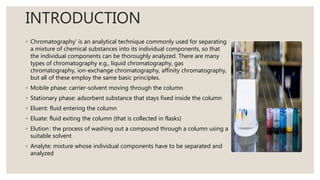
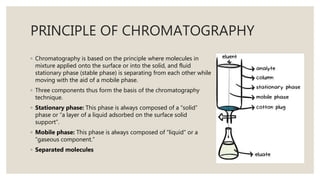
◦ Mobile phase: carrier-solvent moving through the column
◦ Stationary phase: adsorbent substance that stays fixed inside the column
◦ Eluent: fluid entering the column
◦ Eluate: fluid exiting the column (that is collected in flasks)
◦ Elution : the process of washing out a compound through a column using a
suitable solvent
◦ Analyte: mixture whose individual components have to be separated and
analyzed
PRINCIPLE OF CHROMATOGRAPHY
◦ Chromatography is based on the principle where molecules in
mixture applied onto the surface or into the solid, and fluid
stationary phase (stable phase) is separating from each other while
moving with the aid of a mobile phase.
◦ Three components thus form the basis of the chromatography
technique.
◦ Stationary phase: This phase is always composed of a “solid”
phase or “a layer of a liquid adsorbed on the surface solid
support”.
◦ Mobile phase: This phase is always composed of “liquid” or a
“gaseous component.”
◦ Separated molecules
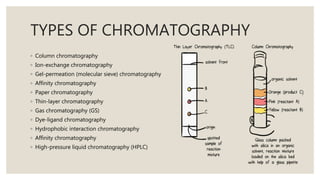
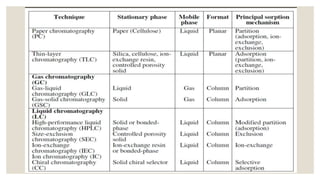
TYPES OF CHROMATOGRAPHY
◦ Column chromatography
◦ Ion-exchange chromatography
◦ Gel-permeation (molecular sieve) chromatography
◦ Affinity chromatography
◦ Paper chromatography
◦ Thin-layer chromatography
◦ Gas chromatography (GS)
◦ Dye-ligand chromatography
◦ Hydrophobic interaction chromatography
◦ Affinity chromatography
◦ High-pressure liquid chromatography (HPLC)
APPLICATIONS
◦ Pharmaceutical sector
◦ To identify and analyze samples for the presence of
trace elements or chemicals.
◦ Separation of compounds based on their molecular
weight and element composition.
◦ Detects the unknown compounds and purity of mixture.
◦ In drug development.
◦ Chemical industry
◦ In testing water samples and also checks air quality.
◦ HPLC and GC are very much used for detecting various
contaminants such as polychlorinated biphenyl (PCBs)
in pesticides and oils.
◦ In various life sciences applications
◦ Food Industry
◦ In food spoilage and additive detection
◦ Determining the nutritional quality of food
◦ Forensic Science
◦ In forensic pathology and crime scene testing like
analyzing blood and hair samples of crime place.
◦ Molecular Biology Studies
◦ Various hyphenated techniques in chromatographyare
applied in the study of metabolomics and proteomics
along with nucleic acid research.
◦ HPLC is used in Protein Separation like Insulin
Purification, Plasma Fractionation, and Enzyme
Purification and also in various departments like Fuel
Industry, biotechnology, and biochemical processes.
THANK YOU!

Chromatography

  • 1.
    CHROMATOGRAPHY SUBMITTED BY: PRAJAKTAPANDA REGD.NO. 190704180001 B.SC BIOCHEMISTRY 3RD SEMESTER BIOCHEMICAL TECHNIQUES CUTM: 1697
  • 2.
    INTRODUCTION ◦ Chromatography’ isan analytical technique commonly used for separating a mixture of chemical substances into its individual components, so that the individual components can be thoroughly analyzed. There are many types of chromatography e.g., liquid chromatography, gas chromatography, ion-exchange chromatography, affinity chromatography, but all of these employ the same basic principles. ◦ Mobile phase: carrier-solvent moving through the column ◦ Stationary phase: adsorbent substance that stays fixed inside the column ◦ Eluent: fluid entering the column ◦ Eluate: fluid exiting the column (that is collected in flasks) ◦ Elution : the process of washing out a compound through a column using a suitable solvent ◦ Analyte: mixture whose individual components have to be separated and analyzed
  • 3.
    PRINCIPLE OF CHROMATOGRAPHY ◦Chromatography is based on the principle where molecules in mixture applied onto the surface or into the solid, and fluid stationary phase (stable phase) is separating from each other while moving with the aid of a mobile phase. ◦ Three components thus form the basis of the chromatography technique. ◦ Stationary phase: This phase is always composed of a “solid” phase or “a layer of a liquid adsorbed on the surface solid support”. ◦ Mobile phase: This phase is always composed of “liquid” or a “gaseous component.” ◦ Separated molecules
  • 4.
    TYPES OF CHROMATOGRAPHY ◦Column chromatography ◦ Ion-exchange chromatography ◦ Gel-permeation (molecular sieve) chromatography ◦ Affinity chromatography ◦ Paper chromatography ◦ Thin-layer chromatography ◦ Gas chromatography (GS) ◦ Dye-ligand chromatography ◦ Hydrophobic interaction chromatography ◦ Affinity chromatography ◦ High-pressure liquid chromatography (HPLC)
  • 6.
    APPLICATIONS ◦ Pharmaceutical sector ◦To identify and analyze samples for the presence of trace elements or chemicals. ◦ Separation of compounds based on their molecular weight and element composition. ◦ Detects the unknown compounds and purity of mixture. ◦ In drug development. ◦ Chemical industry ◦ In testing water samples and also checks air quality. ◦ HPLC and GC are very much used for detecting various contaminants such as polychlorinated biphenyl (PCBs) in pesticides and oils. ◦ In various life sciences applications ◦ Food Industry ◦ In food spoilage and additive detection ◦ Determining the nutritional quality of food ◦ Forensic Science ◦ In forensic pathology and crime scene testing like analyzing blood and hair samples of crime place. ◦ Molecular Biology Studies ◦ Various hyphenated techniques in chromatographyare applied in the study of metabolomics and proteomics along with nucleic acid research. ◦ HPLC is used in Protein Separation like Insulin Purification, Plasma Fractionation, and Enzyme Purification and also in various departments like Fuel Industry, biotechnology, and biochemical processes.
  • 7.