Chromatography
little to do with colours but
everything with seperating mixtures.
Micheal tswett (Russian botanist)
father of chromatography
1904 published his work in seperating
the color pigements of plants.
His Techniques worked only for
substance having native color.
Chromatography helps in
• Separate components from complex mixtures.
• Quantitative analysis of a substance.
• Seperation at micro/nano level.
• Providing large temprarure ranges.
• More sensitive than extractions method.
• Separate millionth of a gram material.
Working principle
• All types of chromatographic methods work
on same principle.
• Differ in experimental set-up or analytical
details.
• Stationary phase could be
• 1. finely divided solid material.
• 2. viscous liquid
• Within a column of glass, metal or plastic.
Continue……..
• Mobile phase could be
• Liquid , liquid solution or gas under pressure.
• MP move through SP carrying analyte mixture.
• Movement of analytes components depends
on their affinity for SP.
• This helps in the seperation of analyte
component from other components along the
way.
Continue…….
• This means, progress of each component of
analyte will be affected by SP in different ways
from all others components.
• SP designed to attract or repel certain
member of analyte, each one in different way.
• When MP completed its journey through the
column, various components have been held
by the SP and form color bands at various
points in column.
Modern chromatography
• Mostly analyte component do not produce
color.
• Detectors are placed for the identification of
their seperating points on SP.
• Detectors use various properies of analytes to
signal their presence.
• Narrow bore cappilary have been developed
for improved seperations and efficiency.
Relationship b/w SP and MP on the
basis of polarity.
Normal phase
chromatography
• Mobile phase is less polar
than the stationary phase.
• Always in GC type
chromatography.
• Where MP is innert gas.
Reverse phase
chromatography
• Mobile phase is more polar
than s phase.
• In TLC and LC both reverse
and normal phases are
used.
Lets visualise how chromatography
works
• Group of tourists= analyte mixture
• Bus= mobile phase
• Destination= location on stationary phase
Gas chromatography
• Gas-liquid chromatography or cappillary GC.
• SP is in narrow , hollow tube made up of glass
or synthetic polymer coated with plastic to
add strength.
• Stationary phase
Thick, high boiling point viscous liquid form thin
coating inside of the cappilary and stable at 350
degree celcius.
• Column of GC= 30m long or more.
Continue……
• Mobile phase
Innert gas: nitrogen ,helium,hydrogen.
• In GC, mobile phase is forced through the
stationary phase under pressure.
• Since analyte carried by MP have to be in vapor
phase.
• Some compounds decompose at high temp and
not suitable for GC analysis e;g. explosives.
• Innert gas purges the oxygen out of system
therefore no chance for analytes to burn when
heated. But leakage in system can cause
explosion.
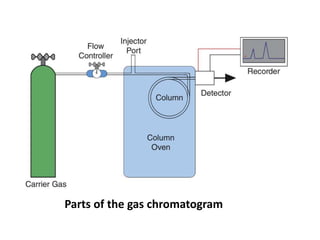
Parts of the gas chromatogram
1. injector
• Heating chamber.
• Analyte mixture introduction.
• Mixture combined with mobile phase.
• MP continually passing through injector under
pressure.
 in GC type, experiment the analyte mixture is
dissolved in a volatile solvent.
For instance, methlyl alcohol is suitable solvent for
seperating coccaine, caffeine and sugar.
Injectors configuration
Splitt injector configuration
• Cappillary column are very
thin and easily overloaded
with the analyte so the
mobile phase will splitt so
that some of it vented away
and a part of it goes
through the column.
Splitless injector configuration
• If the analytes are very
dilute or there is very little,
then the entire amount is
sent through the column in
a splitless configuration
Stationary phase
• As MP passes through the SP various
components of the analyte mixture exposes to
the surface of SP.
• Two principle determine how long it will take
a substance to traverse the entire column.
1. Molecular weight low MP traverse faster.
2. Polarity polarity b/w the sp and analytes.
Retention time and degree of
seperation of analytes depends
1. Varying polarity of stationary phase.
2. Speed of mobile phase.
3. Temprature of mobile and stationary phase.
 retention time is the time, analytes traverse the
stationary phase until reaches the detec tor.
on the basis of differences in structure and
polarities of caffeine and coccaine , they are
seperated.
Continue….
• Rule of thumb for GC is that, every 10 degrees
rise in temp of experiment halves the
retention time.
• Therefore temp is powerful factor in designing
an experiment to separate complex mixtures.
• Variation in weights of analytes will be
seperated when oven is set at low temprature
and gradually rises during the run.
Detector
• Once a component travers all the way through
the sp it has to be detected.
• Each component is a vapor mixed with innert
mobile phase.
• Detectors are designed so that they donot
respond to the pure mobile phase
• and donot show activity until the mobile
phase contain one of the analytic component.
Chromatogram( plot of response of
detector versus retention time)
• Analytes reach the detector
• It convert signal to small electric currents.
• Current is amplified and computerized.
• Each component is displayed as a triangular
peak.
Retention time = top of the peak.
Concentration of component = area under peak.
Continue….
• Ideally, each substance in the mixture would
take different amount of time to traverse the
column and reach the detector.
• In every GC, retention time would be same of
same substance maintaining the other
conditions similar.
• It is said that tentative identification of a
substance can be done with retention time.
But it is not reliable.

Gas chromatography by @Sana_haroon

  • 1.
    Chromatography little to dowith colours but everything with seperating mixtures.
  • 2.
    Micheal tswett (Russianbotanist) father of chromatography 1904 published his work in seperating the color pigements of plants. His Techniques worked only for substance having native color.
  • 3.
    Chromatography helps in •Separate components from complex mixtures. • Quantitative analysis of a substance. • Seperation at micro/nano level. • Providing large temprarure ranges. • More sensitive than extractions method. • Separate millionth of a gram material.
  • 4.
    Working principle • Alltypes of chromatographic methods work on same principle. • Differ in experimental set-up or analytical details. • Stationary phase could be • 1. finely divided solid material. • 2. viscous liquid • Within a column of glass, metal or plastic.
  • 5.
    Continue…….. • Mobile phasecould be • Liquid , liquid solution or gas under pressure. • MP move through SP carrying analyte mixture. • Movement of analytes components depends on their affinity for SP. • This helps in the seperation of analyte component from other components along the way.
  • 6.
    Continue……. • This means,progress of each component of analyte will be affected by SP in different ways from all others components. • SP designed to attract or repel certain member of analyte, each one in different way. • When MP completed its journey through the column, various components have been held by the SP and form color bands at various points in column.
  • 7.
    Modern chromatography • Mostlyanalyte component do not produce color. • Detectors are placed for the identification of their seperating points on SP. • Detectors use various properies of analytes to signal their presence. • Narrow bore cappilary have been developed for improved seperations and efficiency.
  • 8.
    Relationship b/w SPand MP on the basis of polarity. Normal phase chromatography • Mobile phase is less polar than the stationary phase. • Always in GC type chromatography. • Where MP is innert gas. Reverse phase chromatography • Mobile phase is more polar than s phase. • In TLC and LC both reverse and normal phases are used.
  • 9.
    Lets visualise howchromatography works • Group of tourists= analyte mixture • Bus= mobile phase • Destination= location on stationary phase
  • 10.
    Gas chromatography • Gas-liquidchromatography or cappillary GC. • SP is in narrow , hollow tube made up of glass or synthetic polymer coated with plastic to add strength. • Stationary phase Thick, high boiling point viscous liquid form thin coating inside of the cappilary and stable at 350 degree celcius. • Column of GC= 30m long or more.
  • 11.
    Continue…… • Mobile phase Innertgas: nitrogen ,helium,hydrogen. • In GC, mobile phase is forced through the stationary phase under pressure. • Since analyte carried by MP have to be in vapor phase. • Some compounds decompose at high temp and not suitable for GC analysis e;g. explosives. • Innert gas purges the oxygen out of system therefore no chance for analytes to burn when heated. But leakage in system can cause explosion.
  • 12.
    Parts of thegas chromatogram
  • 13.
    1. injector • Heatingchamber. • Analyte mixture introduction. • Mixture combined with mobile phase. • MP continually passing through injector under pressure.  in GC type, experiment the analyte mixture is dissolved in a volatile solvent. For instance, methlyl alcohol is suitable solvent for seperating coccaine, caffeine and sugar.
  • 14.
    Injectors configuration Splitt injectorconfiguration • Cappillary column are very thin and easily overloaded with the analyte so the mobile phase will splitt so that some of it vented away and a part of it goes through the column. Splitless injector configuration • If the analytes are very dilute or there is very little, then the entire amount is sent through the column in a splitless configuration
  • 15.
    Stationary phase • AsMP passes through the SP various components of the analyte mixture exposes to the surface of SP. • Two principle determine how long it will take a substance to traverse the entire column. 1. Molecular weight low MP traverse faster. 2. Polarity polarity b/w the sp and analytes.
  • 16.
    Retention time anddegree of seperation of analytes depends 1. Varying polarity of stationary phase. 2. Speed of mobile phase. 3. Temprature of mobile and stationary phase.  retention time is the time, analytes traverse the stationary phase until reaches the detec tor. on the basis of differences in structure and polarities of caffeine and coccaine , they are seperated.
  • 17.
    Continue…. • Rule ofthumb for GC is that, every 10 degrees rise in temp of experiment halves the retention time. • Therefore temp is powerful factor in designing an experiment to separate complex mixtures. • Variation in weights of analytes will be seperated when oven is set at low temprature and gradually rises during the run.
  • 18.
    Detector • Once acomponent travers all the way through the sp it has to be detected. • Each component is a vapor mixed with innert mobile phase. • Detectors are designed so that they donot respond to the pure mobile phase • and donot show activity until the mobile phase contain one of the analytic component.
  • 19.
    Chromatogram( plot ofresponse of detector versus retention time) • Analytes reach the detector • It convert signal to small electric currents. • Current is amplified and computerized. • Each component is displayed as a triangular peak. Retention time = top of the peak. Concentration of component = area under peak.
  • 20.
    Continue…. • Ideally, eachsubstance in the mixture would take different amount of time to traverse the column and reach the detector. • In every GC, retention time would be same of same substance maintaining the other conditions similar. • It is said that tentative identification of a substance can be done with retention time. But it is not reliable.