Tunicates or “Sea squirts,”
      and Lancelets
         By Sandra Cash
General info.
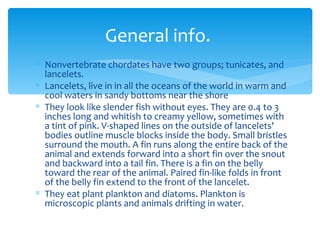
∗ Nonvertebrate chordates have two groups; tunicates, and
  lancelets.
∗ Lancelets, live in in all the oceans of the world in warm and
  cool waters in sandy bottoms near the shore
∗ They look like slender fish without eyes. They are 0.4 to 3
  inches long and whitish to creamy yellow, sometimes with
  a tint of pink. V-shaped lines on the outside of lancelets'
  bodies outline muscle blocks inside the body. Small bristles
  surround the mouth. A fin runs along the entire back of the
  animal and extends forward into a short fin over the snout
  and backward into a tail fin. There is a fin on the belly
  toward the rear of the animal. Paired fin-like folds in front
  of the belly fin extend to the front of the lancelet.
∗ They eat plant plankton and diatoms. Plankton is
  microscopic plants and animals drifting in water.
General info continued.
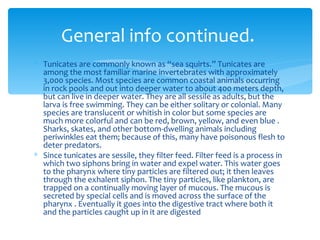
∗ Tunicates are commonly known as “sea squirts.” Tunicates are
  among the most familiar marine invertebrates with approximately
  3,000 species. Most species are common coastal animals occurring
  in rock pools and out into deeper water to about 400 meters depth,
  but can live in deeper water. They are all sessile as adults, but the
  larva is free swimming. They can be either solitary or colonial. Many
  species are translucent or whitish in color but some species are
  much more colorful and can be red, brown, yellow, and even blue .
  Sharks, skates, and other bottom-dwelling animals including
  periwinkles eat them; because of this, many have poisonous flesh to
  deter predators.
∗ Since tunicates are sessile, they filter feed. Filter feed is a process in
  which two siphons bring in water and expel water. This water goes
  to the pharynx where tiny particles are filtered out; it then leaves
  through the exhalent siphon. The tiny particles, like plankton, are
  trapped on a continually moving layer of mucous. The mucous is
  secreted by special cells and is moved across the surface of the
  pharynx . Eventually it goes into the digestive tract where both it
  and the particles caught up in it are digested
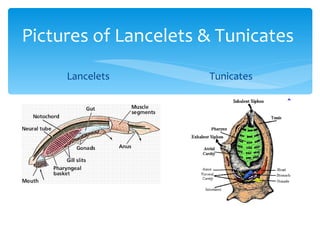
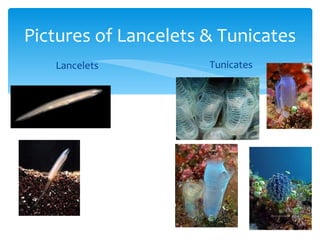
Pictures of Lancelets & Tunicates
     Lancelets        Tunicates
Pictures of Lancelets & Tunicates
   Lancelets          Tunicates
How they respond to their
               environment
          Lancelets                            Tunicates
∗ Depending on the coarseness       ∗ Filter feed, since they can not
  of the sand, lancelets assume       move to get food.
  different feeding positions. In
  coarse sand they bury their
  entire body with only the head
  exposed to the water. In fine
  sand they lie on the bottom.
Usefulness to Man
          Lancelets                         Tunicates

∗ In southern China local         ∗ Tunicates are currently being
  fishermen using traditional       studied in science for certain
  techniques fish for and eat       chemical compounds useful in
  lancelets.                        fighting cancer.
∗ The greatest importance of      ∗ Also eaten in a few countries
  lancelets to people, however,     like Japan and France.
  is in the study of evolution.
Unusual facts about Lancelets &
             Tunicates
          Lancelets                            Tunicates
                                   ∗ Tunicates are said to “eat its own
                                     brain” during metamorphosis - the
∗ Lancelets have blood vessels       tunicate body digests the cerebrial
  but no heart.                      ganglion – a mass of nerves that
∗ The chest has about two            have a role similar to a brain.
                                   ∗ Tunicates are currently being
  hundred gill slits that do not     studied in science for certain
  open to the outside but empty      chemical compounds useful in
  into a chamber inside the body     fighting cancer.
  wall. The chamber empties to     ∗ Tunicate blood contains a high
                                     concentration of the metal,
  the outside through a hole on      vanadium.
  the belly of the lancelet.       ∗ Tunicates are the only animals
                                     capable of producing cellulose
                                   ∗ Tunicates have a very short life span,
                                     about one year and sometimes far
                                     less.
Media
          Tunicates
∗ Some Tunicates have recently
  been discovered as invasive
  species, sometimes hitching a
  ride on the hulls of ships from
  one ocean to another.
∗ An example of this is in
  Georges Bank.
Relevance to organism to Minnesota
 ∗ There is no relevance of these animals to Minnesota,
   since there is no ocean or sea.
Works Cited
∗ Frances, . "Tunicates & Taxonomy." . Houston
  Museum of Natural Science,, 2010. Web. 27 Mar 2012.
  <http://blog.hmns.org/?p=2179>.
∗ Goemans, Bob. "Sea Squirts/Tunicates." Saltcorner.
  Bob Goemans, 2012. Web. 27 Mar 2012.
  <http://www.saltcorner.com/AquariumLibrary/browse
  sectiongroups.php?SectionID=36>.
∗ "Introduction to the Urochordata." . Regents of the
  University of California, 2006. Web. 26 Mar 2012
  <http://www.ucmp.berkeley.edu/chordata/urochorda
  ta.html>.
Works Cited
∗ "Invasive Marine Species Found On Georges Bank.” NOAA.
  NOAA , n.d. Web. 26 Mar 2012.
  <http://www.noaanews.noaa.gov/stories2003/s2125.htm>.
∗ "Lancelets: Cephalochordata - Physical Characteristics." .
  N.p., 2012 . Web. 27 Mar 2012.
  <http://animals.jrank.org/pages/1662/Lancelets-
  Cephalochordata-PHYSICAL-CHARACTERISTICS.html>.
∗ "Lancelets: Cephalochordata - Physical Characteristics,
  Behavior And Reproduction, Lancelets And Vertebrates,
  Florida Lancelet (branchiostoma Floridae): Species
  Account - GEOGRAPHIC RANGE, HABITAT, DIET,
  CONSERVATION STATUS." . N.p., 2012 . Web. 27 Mar 2012.
  <http://animals.jrank.org/pages/1666/Lancelets-
  Cephalochordata.html>.
Works Cited Continued
∗ “Lancelets: Cephalochordata - Behavior And
  Reproduction.” N.p., 2012 . Web. 27 Mar 2012. <http://
  animals.jrank.org/pages/1663/Lancelets-
  Cephalochordata-BEHAVIOR-REPRODUCTION.html>.
∗ Ramel , G.. "Sea Squirts and Tunicates." Earthlife.net.
  N.p., 2005. Web. 26 Mar 2012.
  <http://www.earthlife.net/inverts/ascidiacea.html>.
∗ "Tunicates." Marine Education Society of Australasia.
  N.p., n.d. Web. 26 Mar 2012.
  <http://www.mesa.edu.au/tunicates/default.asp>.

Tuncates or sea squirts and lancelets

  • 1.
    Tunicates or “Seasquirts,” and Lancelets By Sandra Cash
  • 2.
    General info. ∗ Nonvertebratechordates have two groups; tunicates, and lancelets. ∗ Lancelets, live in in all the oceans of the world in warm and cool waters in sandy bottoms near the shore ∗ They look like slender fish without eyes. They are 0.4 to 3 inches long and whitish to creamy yellow, sometimes with a tint of pink. V-shaped lines on the outside of lancelets' bodies outline muscle blocks inside the body. Small bristles surround the mouth. A fin runs along the entire back of the animal and extends forward into a short fin over the snout and backward into a tail fin. There is a fin on the belly toward the rear of the animal. Paired fin-like folds in front of the belly fin extend to the front of the lancelet. ∗ They eat plant plankton and diatoms. Plankton is microscopic plants and animals drifting in water.
  • 3.
    General info continued. ∗Tunicates are commonly known as “sea squirts.” Tunicates are among the most familiar marine invertebrates with approximately 3,000 species. Most species are common coastal animals occurring in rock pools and out into deeper water to about 400 meters depth, but can live in deeper water. They are all sessile as adults, but the larva is free swimming. They can be either solitary or colonial. Many species are translucent or whitish in color but some species are much more colorful and can be red, brown, yellow, and even blue . Sharks, skates, and other bottom-dwelling animals including periwinkles eat them; because of this, many have poisonous flesh to deter predators. ∗ Since tunicates are sessile, they filter feed. Filter feed is a process in which two siphons bring in water and expel water. This water goes to the pharynx where tiny particles are filtered out; it then leaves through the exhalent siphon. The tiny particles, like plankton, are trapped on a continually moving layer of mucous. The mucous is secreted by special cells and is moved across the surface of the pharynx . Eventually it goes into the digestive tract where both it and the particles caught up in it are digested
  • 4.
    Pictures of Lancelets& Tunicates Lancelets Tunicates
  • 5.
    Pictures of Lancelets& Tunicates Lancelets Tunicates
  • 6.
    How they respondto their environment Lancelets Tunicates ∗ Depending on the coarseness ∗ Filter feed, since they can not of the sand, lancelets assume move to get food. different feeding positions. In coarse sand they bury their entire body with only the head exposed to the water. In fine sand they lie on the bottom.
  • 7.
    Usefulness to Man Lancelets Tunicates ∗ In southern China local ∗ Tunicates are currently being fishermen using traditional studied in science for certain techniques fish for and eat chemical compounds useful in lancelets. fighting cancer. ∗ The greatest importance of ∗ Also eaten in a few countries lancelets to people, however, like Japan and France. is in the study of evolution.
  • 8.
    Unusual facts aboutLancelets & Tunicates Lancelets Tunicates ∗ Tunicates are said to “eat its own brain” during metamorphosis - the ∗ Lancelets have blood vessels tunicate body digests the cerebrial but no heart. ganglion – a mass of nerves that ∗ The chest has about two have a role similar to a brain. ∗ Tunicates are currently being hundred gill slits that do not studied in science for certain open to the outside but empty chemical compounds useful in into a chamber inside the body fighting cancer. wall. The chamber empties to ∗ Tunicate blood contains a high concentration of the metal, the outside through a hole on vanadium. the belly of the lancelet. ∗ Tunicates are the only animals capable of producing cellulose ∗ Tunicates have a very short life span, about one year and sometimes far less.
  • 9.
    Media Tunicates ∗ Some Tunicates have recently been discovered as invasive species, sometimes hitching a ride on the hulls of ships from one ocean to another. ∗ An example of this is in Georges Bank.
  • 10.
    Relevance to organismto Minnesota ∗ There is no relevance of these animals to Minnesota, since there is no ocean or sea.
  • 11.
    Works Cited ∗ Frances,. "Tunicates & Taxonomy." . Houston Museum of Natural Science,, 2010. Web. 27 Mar 2012. <http://blog.hmns.org/?p=2179>. ∗ Goemans, Bob. "Sea Squirts/Tunicates." Saltcorner. Bob Goemans, 2012. Web. 27 Mar 2012. <http://www.saltcorner.com/AquariumLibrary/browse sectiongroups.php?SectionID=36>. ∗ "Introduction to the Urochordata." . Regents of the University of California, 2006. Web. 26 Mar 2012 <http://www.ucmp.berkeley.edu/chordata/urochorda ta.html>.
  • 12.
    Works Cited ∗ "InvasiveMarine Species Found On Georges Bank.” NOAA. NOAA , n.d. Web. 26 Mar 2012. <http://www.noaanews.noaa.gov/stories2003/s2125.htm>. ∗ "Lancelets: Cephalochordata - Physical Characteristics." . N.p., 2012 . Web. 27 Mar 2012. <http://animals.jrank.org/pages/1662/Lancelets- Cephalochordata-PHYSICAL-CHARACTERISTICS.html>. ∗ "Lancelets: Cephalochordata - Physical Characteristics, Behavior And Reproduction, Lancelets And Vertebrates, Florida Lancelet (branchiostoma Floridae): Species Account - GEOGRAPHIC RANGE, HABITAT, DIET, CONSERVATION STATUS." . N.p., 2012 . Web. 27 Mar 2012. <http://animals.jrank.org/pages/1666/Lancelets- Cephalochordata.html>.
  • 13.
    Works Cited Continued ∗“Lancelets: Cephalochordata - Behavior And Reproduction.” N.p., 2012 . Web. 27 Mar 2012. <http:// animals.jrank.org/pages/1663/Lancelets- Cephalochordata-BEHAVIOR-REPRODUCTION.html>. ∗ Ramel , G.. "Sea Squirts and Tunicates." Earthlife.net. N.p., 2005. Web. 26 Mar 2012. <http://www.earthlife.net/inverts/ascidiacea.html>. ∗ "Tunicates." Marine Education Society of Australasia. N.p., n.d. Web. 26 Mar 2012. <http://www.mesa.edu.au/tunicates/default.asp>.