Psychiatry
Li Yan
Xinjiang Production and Construction Corps Mental
Health Center
The Oasis Hospital
Preface
 1.The definition and the research scope of
Psychiatry
 2.The classification in Psychiatry and
classification of causes
 3. Diagnostic Criteria of Mental Disorders
 4.Mental state examination
 Psychiatry is a section of medicine. It is a
clinical medicine that studies causes,
mechanisms, clinical syndromes or signs ,
prognosis, diagnosis and treatment of
mental illnesses.
 In the past,psychiatry was considered as a
 science which study severe psychoses
 such as Schizophrenia,Mood disorders,etc.
 At present,the scope of Psychiatry has been
 broadened,including not only severe
 psychoses,but also Neuroses,Personality
 disorders,Developmental disorders,
 psychosomatic medicine, mental health, etc.
 Psychiatry has many branches
 (1) Community psychiatry
 (2) Consultation – liaison psychiatry
 (3) Geriatric psychiatry
 (4) Child psychiatry
 (5) Transcultural psychiatry
 (6) Judicial psychiatry
 (7) Biological psychiatry
 (8) Clinical psychiatry
& . Mental illness or mental
disease
 Mental illness or mental disease express the
disorders in cognition, affection, will, behavior,
etc.
 (1) The disorders are caused by many factors.
 (2)The social function of patients is weakened.
 Mental Illnesses incline psychosis, mood
disorders, anxiety disorders, mental
retardation, personality disorders, etc.
 &.Mental Health
 Mental Health involves in the
prevention and treatment of mental
illnesses and mental hygiene in normal
persons. Its aims are preventing and
reducing mental disorders.
1.Aetiology of Mental Disorder
 The causes of psychiatry are complex.
 In psychiatry, the study of causation is
complicated by two problems.
 (1) The first problem is that causes are
often remote in time from the effects they
produce.
 For instance, it is widely believed that
childhood experiences partly determine the
occurrence of neuroses in adult life. It is
difficult to test this idea?
 ① Because the necessary information can
only be gathered either by studying children
and tracing them many years later, which is
difficult.
 ② By asking adults about their childhood
experiences , which is unreliable.
 (2)The second problem is that a single cause
may lead to several effects.
 For example deprivation of parental
affection in childhood has been reported to
predispose to antisocial behavior , suicide,
depressive illness and several other
disorders. Conversely, a single effect may
arise from several different causes.
2. The classification of causes
 A single psychiatric disorder may result
from causes. For this reason, a scheme
for classifying causes is required. An
useful approach is to divide causes
chronologically into predisposing,
precipitating and perpetuating.
(1) Predisposing factors
 These factors that determine a person’s
vulnerability to causes acting closely to
the time of the illness. Many of them
operating from early life, they include
genetic endowment and environment in
utero, as well as physical, psychological
and social factors in infancy and early
childhood.
 There is an important conception: constitution.
Constitution is often used to describe mental
and physical make up of a person at any point
in life. This make-up changes as life goes on,
under the influence of further physical,
psychological and social influences. The
concept of constitution includes the idea that a
person may have a predisposition to develop a
disorder (such as schizophrenia) ever though
the latter never manifests it.
 From the standpoint of psychiatric an
etiology, one of the important parts of the
constitution is the personality.
 When the etiology of an individual case is
formulated, the person is always an
essential element.
 The clinicians should be prepared to
spend considerable time in talking to the
patient and to people who know him, in
order to build up a clear picture of his
personality. This assessment usually
helps to explain why the patient responds
to certain stressful events and why he
reacted in a particular way.
In the evaluation of person a
life, it is important to acquire
sound clinical skill through
supervised practice.
(2) Precipitating factors
 These are events that occur shortly
before the onset of a disorder and appear
to have induced it. They may be physical,
psychological or social. Whether they
produce a disorder at all and what kind
of disorder they produce, depend partly
on constitutional factors in the patient.
 Physical precipitating factors, for
example, cerebral tumors or drugs.
Psychological and social precipitants
include personal misfortunes such as
the lost of a job and changes in the
routine of life such as moving home.
 Sometimes the same factor can act in
more than one way for example a
head injury can induce psychological
disorder either through physical
changes in the brain or through its
stressful implication to patient.
(3)Perpetuating factors
 These factors prolong the course of a
disorder after it has been provoked引发了 .
When planning treatment, it is particularly
important to give attention to these factors.
The original precipitating factors may have
ceased to act by the time the patient is seen,
and the predisposing factors may be well
treatable.
3.Biological, psychological, social
factors and psychiatric illnesses.
 Biological factors included:
 Anatomic and molecular factors those factors
related to gender, age, ethnicity and genetics.
 Psychological factors were related to :
 The individual’s personality·
 Social factors included
 Family, culture, society, environment, religious
and spiritual, economic factors.
(1) Genetic factors(Biological factor)
 These are important in several
psychiatric disorders, including
schizophrenia and affective illness, as
evidenced by the following: (see P247)
 A higher prevalence among first-degree
relatives than in the general population.
 A higher concordance rate in
monozygotic than in dizygotic twins, even
if the monozygotic twins have been
reared apart寄养 .
 A higher prevalence rate for children of
mentally ill patients who brought up by
healthy adoptive parents.
 Some disorders are due to single gene
transmission, such as Huntington’s
chorea and some uncommon causes of
mental retardation (e.g. fragile X
syndrome).
 for the majority of psychiatric disorders
in which heredity plays a role, no single
gene has been isolated and it is assumed
that several gene, have influence on the
development of the condition.
(2) Family background
 Many patients with psychiatric disorders
report an unhappy childhood and it
seems likely that a traumatic upbringing
predisposes to future psychiatric illness.
Important factors are loss of a parent in
childhood, due to either death or
separation, parental disharmony and
physical, especially sexual, abuse.
 (3) Physical illness and chronic ill health.
 Both predispose to psychiatric disorders.
(Why?)
 (4) Stressful life events
 We usually call the stressors. These can
precipitate episodes of illness in
vulnerable people. They usually involve a
sense of loss or threat of loss, and include
death of a close relative, marital
breakdown, redundancy裁员 , retirement
and major financial crisis.
(5) Social isolation
 May psychiatrically ill patients are socially
isolated and this often appears to be a
contributory factor in their illness. Particularly
important is lack of a close, confiding
relationship. Social deprivation is associated
with various conditions, such as attempted
suicide, alcoholism and drug dependence.

Diagnostic Criteria of Mental
Disorders
 Symptom criteria
 Severity criteria
 Course criteria
 Exclusion criteria
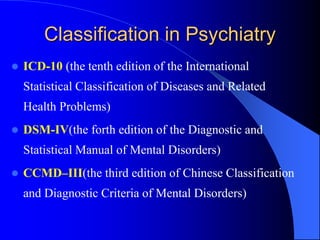
Classification in Psychiatry
 ICD-10 (the tenth edition of the International
Statistical Classification of Diseases and Related
Health Problems)
 DSM-IV(the forth edition of the Diagnostic and
Statistical Manual of Mental Disorders)
 CCMD–III(the third edition of Chinese Classification
and Diagnostic Criteria of Mental Disorders)
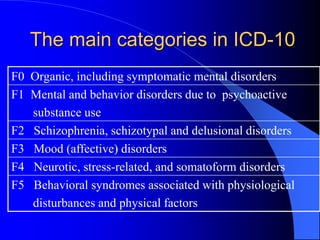
The main categories in ICD-10
F0 Organic, including symptomatic mental disorders
F1 Mental and behavior disorders due to psychoactive
substance use
F2 Schizophrenia, schizotypal and delusional disorders
F3 Mood (affective) disorders
F4 Neurotic, stress-related, and somatoform disorders
F5 Behavioral syndromes associated with physiological
disturbances and physical factors
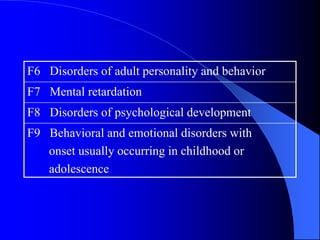
F6 Disorders of adult personality and behavior
F7 Mental retardation
F8 Disorders of psychological development
F9 Behavioral and emotional disorders with
onset usually occurring in childhood or
adolescence
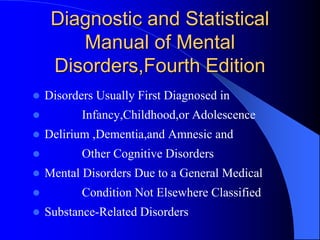
Diagnostic and Statistical
Manual of Mental
Disorders,Fourth Edition
 Disorders Usually First Diagnosed in
 Infancy,Childhood,or Adolescence
 Delirium ,Dementia,and Amnesic and
 Other Cognitive Disorders
 Mental Disorders Due to a General Medical
 Condition Not Elsewhere Classified
 Substance-Related Disorders
 Schizophrenia and Other Psychotic
 Disorders
 Mood Disorders
 Anxiety Disorders
 Somatoform Disorders
 Factitious Disorders
 Dissociative Disorders
 Sexual and Gender Identity Disorders
 Eating Disorders
 Sleep Disorders
 Impulse-Control Disorders Not Elsewhere
 Classified
 Adjustment Disorders
 Personality Disorders
Multiaxial Assessment System
 Diagnostic axes
 Axis I Clinical Disorders
 Other Conditions That May be a
 Focus of Clinical Attention
 Axis II Personality Disorders and
 Mental Retardation
 Axis III General Medical Conditions
 Other domains for assessment
 Axis IV Psychosocial and
 Environmental Problems
 Axis V Global Assessment of
 Functioning
The diagnostic criteria of
Mental Disorders in CCMD-3
 0 Organic mental disorders
 1 Mental disorders due to psychoactive
 substances or non-addictive substances
 2 Schizophrenia and other psychotic
 disorders
 3 Mood (affective) disorders
 4 Hysteria, Stress-related disorders, Neurosis
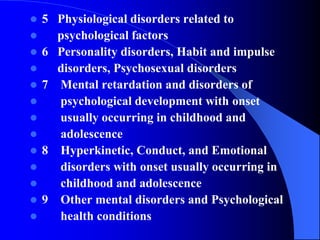
 5 Physiological disorders related to
 psychological factors
 6 Personality disorders, Habit and impulse
 disorders, Psychosexual disorders
 7 Mental retardation and disorders of
 psychological development with onset
 usually occurring in childhood and
 adolescence
 8 Hyperkinetic, Conduct, and Emotional
 disorders with onset usually occurring in
 childhood and adolescence
 9 Other mental disorders and Psychological
 health conditions
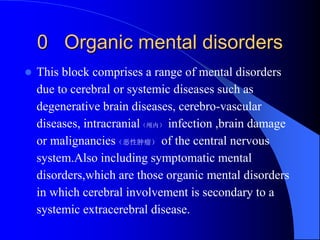
0 Organic mental disorders
 This block comprises a range of mental disorders
due to cerebral or systemic diseases such as
degenerative brain diseases, cerebro-vascular
diseases, intracranial(颅内) infection ,brain damage
or malignancies(恶性肿瘤) of the central nervous
system.Also including symptomatic mental
disorders,which are those organic mental disorders
in which cerebral involvement is secondary to a
systemic extracerebral disease.
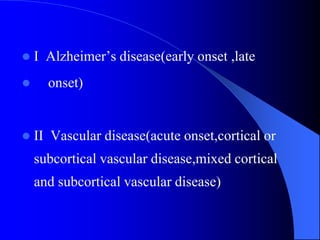
 I Alzheimer’s disease(early onset ,late
 onset)
 II Vascular disease(acute onset,cortical or
subcortical vascular disease,mixed cortical
and subcortical vascular disease)
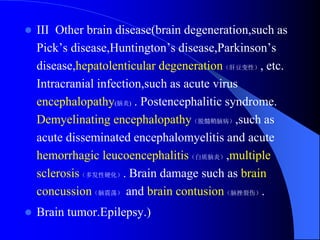
 III Other brain disease(brain degeneration,such as
Pick’s disease,Huntington’s disease,Parkinson’s
disease,hepatolenticular degeneration(肝豆变性), etc.
Intracranial infection,such as acute virus
encephalopathy(脑炎) . Postencephalitic syndrome.
Demyelinating encephalopathy(脱髓鞘脑病),such as
acute disseminated encephalomyelitis and acute
hemorrhagic leucoencephalitis(白质脑炎),multiple
sclerosis(多发性硬化). Brain damage such as brain
concussion(脑震荡) and brain contusion(脑挫裂伤).
 Brain tumor.Epilepsy.)
 IV Mental disorders due to physical
disease(physical infection,human
immunodeficiency virus, visceral(内脏的) organ
disease,endocrine disease,nutritional and
metabolic disease,disease of connective tissue
such as systemic lupus erythematosus(系红狼苍),
chromosomal abnormality, physical factors,
Puerperal(围生期) mental disorder)
1. Mental disorders due to
psychoactive
substances or non-addictive
substances
 Psychoactive substances refer to extraneous
substance that may alter mental activities
and cause dependence. They include
alcohol, opioids , cannabinoids, hypnotics(催
眠药), anxiolytics,anesthetics,stimulants,
hallucinogens, and tobacco.
 Inappropriate medical prescription or
repeated self-administration of
psychoactive drugs may cause dependence
syndrome and/or other mental
disorders,such as intoxication,withdrawal
syndrome,psychotic symptoms,affective
disorders,and residual(残留) or delayed-onset
mental disorders.
2. Schizophrenia and other
psychotic disorders
 Schizophrenia comprises a group of psychotic
disorders of unknown specific etiology,often
presented with a gradual onset of abnormalities in
perception,thought,emotion and behavior since
young adulthood. Consciousness is usually
maintained. Intelligence is intact,but in some
cases,there is some degree of cognitive impairment.
The natural course of the disorders is chronic
remitting but sometimes deteriorating.
Clinical categories
 Paranoid schizophrenia
 Hebephrenic schizophrenia
 Catatonic schizophrenia
 Simple schizophrenia
 Post-schizophrenic depression
 Remitted(缓解期的) schizophrenia
 Residual schizophrenia
 Chronic schizophrenia
 Deteriorated schizophrenia
 Paranoid mental disorders
 Acute and transient psychosis
 Schizophrenia-like psychosis
 Traveling psychosis
 Delusional episodes
 Induced(感应性) psychosis
 Schizo-affective psychosis
 Periodic psychosis
3. Mood disorders
 Mood disorders are a group of mental disorders
characterized by obvious and persistent elation
or depression of mood(elated or depressed
mood). The mood disturbance is commonly
associated with cognitive and behavioral
changes. In severe cases,psychotic
symptoms,such as hallucinations and delusions,
may be observed.
 There is a tendency for the disorders to
recur,but most recurrent episodes will
eventually remit. In certain cases, an
episode may become chronic and residual
symptoms are observed.
Clinical categories
 Manic episode( Hypomania, recurrent
mania, etc)
 Depressive episode
 Bipolar disorder
 Persistent mood disorder (Dysthymia)
4. Hysteria, Stress-related
disorders, Neurosis
 Hysteria: these are a group of mental disorders
with some traits of hysterical personality, usually
onset associated with psychosocial factors. The
main manifestations are dissociative symptoms(a
partial or complete loss of memories and loss of
awareness of personal identity),and conversion
symptoms(the unpleasant affect caused by stresses
and conflicts that the individual can not resolve.
Then ,it is somehow transformed into the
somatizational symptoms).
 Hysterical amnesia
 Hysterical fugue(神游)
 Hysterical double or multiple personalities
 Hysterical psychosis
 Hysterical somatic disorders(motor and
sensory symptoms,convulsions)
 Other hysterical symptoms
Stress-related disorders
 The factors determining the occurrence,
development, duration and clinical manifestations
of this disorders are: ①life events and life
situations, such as severe superstrong mental
trauma or life events or continuous difficult
situation all may be direct causes; ②social cultural
background; ③personality trait, level of
intelligence, attitude of life and creed; ④excluding
hysteria, neurosis, physiological disorders
associated with psychological factors and
psychotic disorders.
Clinical categories
 Acute stress disorders (Acute stress
psychosis or acute reactive (反应)psychosis)
 Post-traumatic stress disorders
 Adjustment disorders
Neurosis
 A group of mental disorders with certain factors,
without any demonstrable organic basis, usually
onset after psychosocial factors and last for a long
time. The main manifestation are anxiety,
depression, phobia, obsession-compulsion,
hypochondriasis(疑病症), somatic symptoms, or
neurasthenic symptoms, which are disproportional
to the patient’s actual situation. The patient has
insight of the illness, but feels affliction (痛苦)and no
significance.
Clinical categories
 Phobia ( Agoraphobia(场所), Social phobia, Specific
phobia(单项恐怖))
 Anxiety disorder ( Panic disorder, Generalized
anxiety disorder)
 Obsessive-compulsive disorder
 Somatoform disorders (Somatization disorder,
Undifferentiated(未分化) somatoform disorders,
Hypochondriasis, Somatoform autonomic
dysfunction, Persistent somatoform pain disorder)
 Neurasthenia神经衰弱症
5 Physiological Disorders related
to psychological factors
 Refer to a group of mental disorders
characterized by the abnormality of
eating, sleeping, and sexual behavior
related to psychosocial factors.
Eating disorders
 Anorexia(厌) nervosa
 Bulimia (贪) nervosa
 Psychogenic(神经性) vomiting
 Anorexia nervosa : a type of eating disorder
occurs most commonly in adolescent girls and
young women, characterized by deliberately
eating less and weight loss obviously below
normal standard, which are induced and
sustained by the patient with excessive exercise,
vomiting, or purging(通便).
 Most patients often worry about “fattening”, or
consider themselves to be too fat when they are
obviously thin, despite doctor’s explanation.
 In some patients eating and drinking too much
at one meal is episodic.
Nonorganic sleep disorders
 A group of sleep disorders caused by
various kinds nonorganic factors, in this
section including insomnia, hypersomnia,
disorder of sleep-wake rhythm, and
parasomnias(发作性睡眠异常) (sleep walking, night
terrors, and nightmare, etc).
 Insomnia
 Hypersomnia
 Disorder of the sleep-wake schedule
 Sleepwalking ( somnambulism)
 Night terrors
 Nightmares
 Other or unspecified nonorganic sleep
disorders
Nonorganic sexual dysfunction
 Lack or loss of sexual desire
 Impotence(阳痿)
 Failure of female genital response
 Orgasmic dysfunction(性高潮障碍)
 Premature ejaculation(早泄)
 Vaginismus(阴道痉挛)
 Dyspareunia(性交疼痛)
6. Personality disorders, Habit
and impulse disorders,
Psychosexual disorders
This block comprises a group of disorders that are
characterized by deeply ingrained, enduring and
pervasive behavioral pattern manifested in a wide
range of situations and out of context of a given
cultural and social norm, resulting in marked
impairment in socio-occupational functioning as
well as personal distress. Such patients do not
have intelligent impairment. However, it is
difficult to correct such behavioral pattern.
 The onset of the disorder is usually in
adolescence and continues through adulthood. In
some exceptional cases there are attenuations of
the clinical problem with aging. If the
personality deviation is due to physical diseases
or secondary to mental disorders, it should be
coded as a personality change.
 Paranoid personality disorder
 Schizoid personality disorder
 Dissocial(反社会) personality disorder
 Impulsive personality disorder
 Hysterical personality disorder
 Anankastic(强迫) personality disorder
 Anxious personality disorder
 Dependent personality disorder
Habit and impulse disorders
 This group of disorders comprises a range
of behavior characterized by irrational acts
with underlying excessive impulse. The
behaviors are not socially approved and are
directed for self-gratification. This block
excludes deviant sexual desire or behavior.
 Pathological gambling
 Pathological fire-setting (pyromania)
 Pathological stealing (kleptomania)
 Trichotillomania(拔毛症)
Psychosexual disorders
 This is a group of disorders characterized by
abnormal psychosexual behavior. The patients
have a strong desire to change their gender, or
reliance on inanimate(无生命的) or non-human
subjects as source of sexual gratification, or
sexual attraction to individuals of homosex or
bisexes. Apart from these, there is no other
mental disturbance. This group of disorders
exclude excessive or lack of sexual desire and
physiological disorders of sexuality.
Clinical categories
 Gender identity disorders (Transsexualism
(易性僻))
 Disorders of sexual preference (Fetishism
(恋物症), Exhibitionism(露阴症), Voyeurism(窥阴症),
Frotteurism(摩擦症), Sadomasochism(性施涅与性受捏
症), Mixed disorders of sexual preference)
 Sexual orientation disorders
(Homosexuality, Bisexuality)
7 Mental retardation and disorders of
psychological development with
onset usually occurring in childhood
and adolescence
 Mental retardation is a condition of arrested
or incomplete development of the mind,
which is characterized by deficits in
intelligence and social adjustment. The
disorders emerges before 18 years old.
 Retardation can occur with or without the
presence of other mental or physical
disorders.
 The level of intelligence as shown in
standardized psychometric(心理测验的) test is
defined as below 70, while the scores from
70-85 are defined as borderline intelligence.
 Mild mental retardation
 Moderate mental retardation
 Severe mental retardation
 Profound mental retardation
Development disorders of
speech and language
 Specific speech articulation (构音)disorder
 Expressive language disorder
 Receptive(感受性) language disorder
 Acquired aphasia(失语) with epilepsy
 Specific development disorders of scholastic skill
(reading, spelling, arithmetic skills)
 Specific development disorder of motor skills
 Mixed specified development disorders
 Pervasive development disorders
Pervasive development disorders
 Childhood autism(孤独症)
 Atypical autism (孤独症)
 Rett’s syndrome(Reactive attachment
disorder of childhood)
 Childhood disintegrative disorder (Heller’s
syndrome)(瓦解性)
 Asperger’s syndrome(广泛性发育障碍)
8 Hyperkinetic(多动), conduct, and
Emotional disorders with onset usually
occurring in childhood and adolescence
 This group of disorders is characterized by a
combination f pervasive manifestation of
over-activity, marked inattention and lack
of perseverance in task performance since
early childhood (usually about 3 years old).
The clinical features should be evident in
more one situation (e.g., home, classroom,
clinic, etc.). It is more common in boys than
in girls.
 Hyperkinetic disorders
 Attention deficit and hyperactivity disorder
 Hyperkinetic conduct disorder
 Conduct disorders
 Dissocial conduct disorder
 Oppositional defiant disorder(对立违抗性)
Emotional disorders with onset
specific to childhood
 Separation anxiety disorder of childhood
 Phobic anxiety disorder of childhood
 Social anxiety disorder of childhood
 Generalized anxiety with onset specific to
childhood occurring in childhood
 Elective autism(选择性缄默症)
 Reactive attachment disorder of childhood
 Tic disorders(抽动障碍)
 Transient tic disorder(短暂性抽动障碍)
 Chronic motor or vocal(发声) tic disorder
 Tourette’s syndrome(发声与多种运动联合抽动障
碍)
The mental status
examination
 1. Presentation
 2.Motor behavior and affect
 3.Cognitive status
 4.Thought
 5.Mood
Presentation
 Level of consciousness: coma to alert
wakefulness
 General appearance:body habitus, hygiene,
cosmesis, dress
 Attitude
Motor behavior and affect
 Motor behavior: akinesia, involuntary
movement,mannerisms(作态)
 Affect: facial expression, gestures, speech
characteristics, pressure, volume,
prosody
Cognitive status
 Attention
 Oritentation
 Language
 Memory
 Constructional ability
 Calculations
 Reasoning
Thought
 Process: coherence, goal directedness,
logicality
 Content: hallucinations, delusions,
preoccupations, suicidal or homicidal
ideation
 Insight
Mood
 Relation to affect and congruence(一致)
with thought content
谢 谢!
Thanks for
attending!

chapter 1 Preface.ppt

  • 1.
    Psychiatry Li Yan Xinjiang Productionand Construction Corps Mental Health Center The Oasis Hospital
  • 2.
    Preface  1.The definitionand the research scope of Psychiatry  2.The classification in Psychiatry and classification of causes  3. Diagnostic Criteria of Mental Disorders  4.Mental state examination
  • 3.
     Psychiatry isa section of medicine. It is a clinical medicine that studies causes, mechanisms, clinical syndromes or signs , prognosis, diagnosis and treatment of mental illnesses.
  • 4.
     In thepast,psychiatry was considered as a  science which study severe psychoses  such as Schizophrenia,Mood disorders,etc.  At present,the scope of Psychiatry has been  broadened,including not only severe  psychoses,but also Neuroses,Personality  disorders,Developmental disorders,  psychosomatic medicine, mental health, etc.
  • 5.
     Psychiatry hasmany branches  (1) Community psychiatry  (2) Consultation – liaison psychiatry  (3) Geriatric psychiatry  (4) Child psychiatry  (5) Transcultural psychiatry
  • 6.
     (6) Judicialpsychiatry  (7) Biological psychiatry  (8) Clinical psychiatry
  • 7.
    & . Mentalillness or mental disease  Mental illness or mental disease express the disorders in cognition, affection, will, behavior, etc.  (1) The disorders are caused by many factors.  (2)The social function of patients is weakened.  Mental Illnesses incline psychosis, mood disorders, anxiety disorders, mental retardation, personality disorders, etc.
  • 8.
     &.Mental Health Mental Health involves in the prevention and treatment of mental illnesses and mental hygiene in normal persons. Its aims are preventing and reducing mental disorders.
  • 9.
    1.Aetiology of MentalDisorder  The causes of psychiatry are complex.  In psychiatry, the study of causation is complicated by two problems.  (1) The first problem is that causes are often remote in time from the effects they produce.
  • 10.
     For instance,it is widely believed that childhood experiences partly determine the occurrence of neuroses in adult life. It is difficult to test this idea?  ① Because the necessary information can only be gathered either by studying children and tracing them many years later, which is difficult.  ② By asking adults about their childhood experiences , which is unreliable.
  • 11.
     (2)The secondproblem is that a single cause may lead to several effects.  For example deprivation of parental affection in childhood has been reported to predispose to antisocial behavior , suicide, depressive illness and several other disorders. Conversely, a single effect may arise from several different causes.
  • 12.
    2. The classificationof causes  A single psychiatric disorder may result from causes. For this reason, a scheme for classifying causes is required. An useful approach is to divide causes chronologically into predisposing, precipitating and perpetuating.
  • 13.
    (1) Predisposing factors These factors that determine a person’s vulnerability to causes acting closely to the time of the illness. Many of them operating from early life, they include genetic endowment and environment in utero, as well as physical, psychological and social factors in infancy and early childhood.
  • 14.
     There isan important conception: constitution. Constitution is often used to describe mental and physical make up of a person at any point in life. This make-up changes as life goes on, under the influence of further physical, psychological and social influences. The concept of constitution includes the idea that a person may have a predisposition to develop a disorder (such as schizophrenia) ever though the latter never manifests it.
  • 15.
     From thestandpoint of psychiatric an etiology, one of the important parts of the constitution is the personality.  When the etiology of an individual case is formulated, the person is always an essential element.
  • 16.
     The cliniciansshould be prepared to spend considerable time in talking to the patient and to people who know him, in order to build up a clear picture of his personality. This assessment usually helps to explain why the patient responds to certain stressful events and why he reacted in a particular way.
  • 17.
    In the evaluationof person a life, it is important to acquire sound clinical skill through supervised practice.
  • 18.
    (2) Precipitating factors These are events that occur shortly before the onset of a disorder and appear to have induced it. They may be physical, psychological or social. Whether they produce a disorder at all and what kind of disorder they produce, depend partly on constitutional factors in the patient.
  • 19.
     Physical precipitatingfactors, for example, cerebral tumors or drugs. Psychological and social precipitants include personal misfortunes such as the lost of a job and changes in the routine of life such as moving home.
  • 20.
     Sometimes thesame factor can act in more than one way for example a head injury can induce psychological disorder either through physical changes in the brain or through its stressful implication to patient.
  • 21.
    (3)Perpetuating factors  Thesefactors prolong the course of a disorder after it has been provoked引发了 . When planning treatment, it is particularly important to give attention to these factors. The original precipitating factors may have ceased to act by the time the patient is seen, and the predisposing factors may be well treatable.
  • 22.
    3.Biological, psychological, social factorsand psychiatric illnesses.  Biological factors included:  Anatomic and molecular factors those factors related to gender, age, ethnicity and genetics.  Psychological factors were related to :  The individual’s personality·  Social factors included  Family, culture, society, environment, religious and spiritual, economic factors.
  • 23.
    (1) Genetic factors(Biologicalfactor)  These are important in several psychiatric disorders, including schizophrenia and affective illness, as evidenced by the following: (see P247)
  • 24.
     A higherprevalence among first-degree relatives than in the general population.  A higher concordance rate in monozygotic than in dizygotic twins, even if the monozygotic twins have been reared apart寄养 .  A higher prevalence rate for children of mentally ill patients who brought up by healthy adoptive parents.
  • 25.
     Some disordersare due to single gene transmission, such as Huntington’s chorea and some uncommon causes of mental retardation (e.g. fragile X syndrome).
  • 26.
     for themajority of psychiatric disorders in which heredity plays a role, no single gene has been isolated and it is assumed that several gene, have influence on the development of the condition.
  • 27.
    (2) Family background Many patients with psychiatric disorders report an unhappy childhood and it seems likely that a traumatic upbringing predisposes to future psychiatric illness. Important factors are loss of a parent in childhood, due to either death or separation, parental disharmony and physical, especially sexual, abuse.
  • 28.
     (3) Physicalillness and chronic ill health.  Both predispose to psychiatric disorders. (Why?)  (4) Stressful life events  We usually call the stressors. These can precipitate episodes of illness in vulnerable people. They usually involve a sense of loss or threat of loss, and include death of a close relative, marital breakdown, redundancy裁员 , retirement and major financial crisis.
  • 29.
    (5) Social isolation May psychiatrically ill patients are socially isolated and this often appears to be a contributory factor in their illness. Particularly important is lack of a close, confiding relationship. Social deprivation is associated with various conditions, such as attempted suicide, alcoholism and drug dependence. 
  • 30.
    Diagnostic Criteria ofMental Disorders  Symptom criteria  Severity criteria  Course criteria  Exclusion criteria
  • 31.
    Classification in Psychiatry ICD-10 (the tenth edition of the International Statistical Classification of Diseases and Related Health Problems)  DSM-IV(the forth edition of the Diagnostic and Statistical Manual of Mental Disorders)  CCMD–III(the third edition of Chinese Classification and Diagnostic Criteria of Mental Disorders)
  • 32.
    The main categoriesin ICD-10 F0 Organic, including symptomatic mental disorders F1 Mental and behavior disorders due to psychoactive substance use F2 Schizophrenia, schizotypal and delusional disorders F3 Mood (affective) disorders F4 Neurotic, stress-related, and somatoform disorders F5 Behavioral syndromes associated with physiological disturbances and physical factors
  • 33.
    F6 Disorders ofadult personality and behavior F7 Mental retardation F8 Disorders of psychological development F9 Behavioral and emotional disorders with onset usually occurring in childhood or adolescence
  • 34.
    Diagnostic and Statistical Manualof Mental Disorders,Fourth Edition  Disorders Usually First Diagnosed in  Infancy,Childhood,or Adolescence  Delirium ,Dementia,and Amnesic and  Other Cognitive Disorders  Mental Disorders Due to a General Medical  Condition Not Elsewhere Classified  Substance-Related Disorders
  • 35.
     Schizophrenia andOther Psychotic  Disorders  Mood Disorders  Anxiety Disorders  Somatoform Disorders  Factitious Disorders  Dissociative Disorders
  • 36.
     Sexual andGender Identity Disorders  Eating Disorders  Sleep Disorders  Impulse-Control Disorders Not Elsewhere  Classified  Adjustment Disorders  Personality Disorders
  • 37.
    Multiaxial Assessment System Diagnostic axes  Axis I Clinical Disorders  Other Conditions That May be a  Focus of Clinical Attention  Axis II Personality Disorders and  Mental Retardation  Axis III General Medical Conditions
  • 38.
     Other domainsfor assessment  Axis IV Psychosocial and  Environmental Problems  Axis V Global Assessment of  Functioning
  • 39.
    The diagnostic criteriaof Mental Disorders in CCMD-3  0 Organic mental disorders  1 Mental disorders due to psychoactive  substances or non-addictive substances  2 Schizophrenia and other psychotic  disorders  3 Mood (affective) disorders  4 Hysteria, Stress-related disorders, Neurosis
  • 40.
     5 Physiologicaldisorders related to  psychological factors  6 Personality disorders, Habit and impulse  disorders, Psychosexual disorders  7 Mental retardation and disorders of  psychological development with onset  usually occurring in childhood and  adolescence  8 Hyperkinetic, Conduct, and Emotional  disorders with onset usually occurring in  childhood and adolescence  9 Other mental disorders and Psychological  health conditions
  • 41.
    0 Organic mentaldisorders  This block comprises a range of mental disorders due to cerebral or systemic diseases such as degenerative brain diseases, cerebro-vascular diseases, intracranial(颅内) infection ,brain damage or malignancies(恶性肿瘤) of the central nervous system.Also including symptomatic mental disorders,which are those organic mental disorders in which cerebral involvement is secondary to a systemic extracerebral disease.
  • 42.
     I Alzheimer’sdisease(early onset ,late  onset)  II Vascular disease(acute onset,cortical or subcortical vascular disease,mixed cortical and subcortical vascular disease)
  • 43.
     III Otherbrain disease(brain degeneration,such as Pick’s disease,Huntington’s disease,Parkinson’s disease,hepatolenticular degeneration(肝豆变性), etc. Intracranial infection,such as acute virus encephalopathy(脑炎) . Postencephalitic syndrome. Demyelinating encephalopathy(脱髓鞘脑病),such as acute disseminated encephalomyelitis and acute hemorrhagic leucoencephalitis(白质脑炎),multiple sclerosis(多发性硬化). Brain damage such as brain concussion(脑震荡) and brain contusion(脑挫裂伤).  Brain tumor.Epilepsy.)
  • 44.
     IV Mentaldisorders due to physical disease(physical infection,human immunodeficiency virus, visceral(内脏的) organ disease,endocrine disease,nutritional and metabolic disease,disease of connective tissue such as systemic lupus erythematosus(系红狼苍), chromosomal abnormality, physical factors, Puerperal(围生期) mental disorder)
  • 45.
    1. Mental disordersdue to psychoactive substances or non-addictive substances  Psychoactive substances refer to extraneous substance that may alter mental activities and cause dependence. They include alcohol, opioids , cannabinoids, hypnotics(催 眠药), anxiolytics,anesthetics,stimulants, hallucinogens, and tobacco.
  • 46.
     Inappropriate medicalprescription or repeated self-administration of psychoactive drugs may cause dependence syndrome and/or other mental disorders,such as intoxication,withdrawal syndrome,psychotic symptoms,affective disorders,and residual(残留) or delayed-onset mental disorders.
  • 47.
    2. Schizophrenia andother psychotic disorders  Schizophrenia comprises a group of psychotic disorders of unknown specific etiology,often presented with a gradual onset of abnormalities in perception,thought,emotion and behavior since young adulthood. Consciousness is usually maintained. Intelligence is intact,but in some cases,there is some degree of cognitive impairment. The natural course of the disorders is chronic remitting but sometimes deteriorating.
  • 48.
    Clinical categories  Paranoidschizophrenia  Hebephrenic schizophrenia  Catatonic schizophrenia  Simple schizophrenia
  • 49.
     Post-schizophrenic depression Remitted(缓解期的) schizophrenia  Residual schizophrenia  Chronic schizophrenia  Deteriorated schizophrenia  Paranoid mental disorders  Acute and transient psychosis
  • 50.
     Schizophrenia-like psychosis Traveling psychosis  Delusional episodes  Induced(感应性) psychosis  Schizo-affective psychosis  Periodic psychosis
  • 51.
    3. Mood disorders Mood disorders are a group of mental disorders characterized by obvious and persistent elation or depression of mood(elated or depressed mood). The mood disturbance is commonly associated with cognitive and behavioral changes. In severe cases,psychotic symptoms,such as hallucinations and delusions, may be observed.
  • 52.
     There isa tendency for the disorders to recur,but most recurrent episodes will eventually remit. In certain cases, an episode may become chronic and residual symptoms are observed.
  • 53.
    Clinical categories  Manicepisode( Hypomania, recurrent mania, etc)  Depressive episode  Bipolar disorder  Persistent mood disorder (Dysthymia)
  • 54.
    4. Hysteria, Stress-related disorders,Neurosis  Hysteria: these are a group of mental disorders with some traits of hysterical personality, usually onset associated with psychosocial factors. The main manifestations are dissociative symptoms(a partial or complete loss of memories and loss of awareness of personal identity),and conversion symptoms(the unpleasant affect caused by stresses and conflicts that the individual can not resolve. Then ,it is somehow transformed into the somatizational symptoms).
  • 55.
     Hysterical amnesia Hysterical fugue(神游)  Hysterical double or multiple personalities  Hysterical psychosis  Hysterical somatic disorders(motor and sensory symptoms,convulsions)  Other hysterical symptoms
  • 56.
    Stress-related disorders  Thefactors determining the occurrence, development, duration and clinical manifestations of this disorders are: ①life events and life situations, such as severe superstrong mental trauma or life events or continuous difficult situation all may be direct causes; ②social cultural background; ③personality trait, level of intelligence, attitude of life and creed; ④excluding hysteria, neurosis, physiological disorders associated with psychological factors and psychotic disorders.
  • 57.
    Clinical categories  Acutestress disorders (Acute stress psychosis or acute reactive (反应)psychosis)  Post-traumatic stress disorders  Adjustment disorders
  • 58.
    Neurosis  A groupof mental disorders with certain factors, without any demonstrable organic basis, usually onset after psychosocial factors and last for a long time. The main manifestation are anxiety, depression, phobia, obsession-compulsion, hypochondriasis(疑病症), somatic symptoms, or neurasthenic symptoms, which are disproportional to the patient’s actual situation. The patient has insight of the illness, but feels affliction (痛苦)and no significance.
  • 59.
    Clinical categories  Phobia( Agoraphobia(场所), Social phobia, Specific phobia(单项恐怖))  Anxiety disorder ( Panic disorder, Generalized anxiety disorder)  Obsessive-compulsive disorder  Somatoform disorders (Somatization disorder, Undifferentiated(未分化) somatoform disorders, Hypochondriasis, Somatoform autonomic dysfunction, Persistent somatoform pain disorder)  Neurasthenia神经衰弱症
  • 60.
    5 Physiological Disordersrelated to psychological factors  Refer to a group of mental disorders characterized by the abnormality of eating, sleeping, and sexual behavior related to psychosocial factors.
  • 61.
    Eating disorders  Anorexia(厌)nervosa  Bulimia (贪) nervosa  Psychogenic(神经性) vomiting  Anorexia nervosa : a type of eating disorder occurs most commonly in adolescent girls and young women, characterized by deliberately eating less and weight loss obviously below normal standard, which are induced and sustained by the patient with excessive exercise, vomiting, or purging(通便).
  • 62.
     Most patientsoften worry about “fattening”, or consider themselves to be too fat when they are obviously thin, despite doctor’s explanation.  In some patients eating and drinking too much at one meal is episodic.
  • 63.
    Nonorganic sleep disorders A group of sleep disorders caused by various kinds nonorganic factors, in this section including insomnia, hypersomnia, disorder of sleep-wake rhythm, and parasomnias(发作性睡眠异常) (sleep walking, night terrors, and nightmare, etc).
  • 64.
     Insomnia  Hypersomnia Disorder of the sleep-wake schedule  Sleepwalking ( somnambulism)  Night terrors  Nightmares  Other or unspecified nonorganic sleep disorders
  • 65.
    Nonorganic sexual dysfunction Lack or loss of sexual desire  Impotence(阳痿)  Failure of female genital response  Orgasmic dysfunction(性高潮障碍)  Premature ejaculation(早泄)  Vaginismus(阴道痉挛)  Dyspareunia(性交疼痛)
  • 66.
    6. Personality disorders,Habit and impulse disorders, Psychosexual disorders This block comprises a group of disorders that are characterized by deeply ingrained, enduring and pervasive behavioral pattern manifested in a wide range of situations and out of context of a given cultural and social norm, resulting in marked impairment in socio-occupational functioning as well as personal distress. Such patients do not have intelligent impairment. However, it is difficult to correct such behavioral pattern.
  • 67.
     The onsetof the disorder is usually in adolescence and continues through adulthood. In some exceptional cases there are attenuations of the clinical problem with aging. If the personality deviation is due to physical diseases or secondary to mental disorders, it should be coded as a personality change.
  • 68.
     Paranoid personalitydisorder  Schizoid personality disorder  Dissocial(反社会) personality disorder  Impulsive personality disorder  Hysterical personality disorder  Anankastic(强迫) personality disorder  Anxious personality disorder  Dependent personality disorder
  • 69.
    Habit and impulsedisorders  This group of disorders comprises a range of behavior characterized by irrational acts with underlying excessive impulse. The behaviors are not socially approved and are directed for self-gratification. This block excludes deviant sexual desire or behavior.
  • 70.
     Pathological gambling Pathological fire-setting (pyromania)  Pathological stealing (kleptomania)  Trichotillomania(拔毛症)
  • 71.
    Psychosexual disorders  Thisis a group of disorders characterized by abnormal psychosexual behavior. The patients have a strong desire to change their gender, or reliance on inanimate(无生命的) or non-human subjects as source of sexual gratification, or sexual attraction to individuals of homosex or bisexes. Apart from these, there is no other mental disturbance. This group of disorders exclude excessive or lack of sexual desire and physiological disorders of sexuality.
  • 72.
    Clinical categories  Genderidentity disorders (Transsexualism (易性僻))  Disorders of sexual preference (Fetishism (恋物症), Exhibitionism(露阴症), Voyeurism(窥阴症), Frotteurism(摩擦症), Sadomasochism(性施涅与性受捏 症), Mixed disorders of sexual preference)  Sexual orientation disorders (Homosexuality, Bisexuality)
  • 73.
    7 Mental retardationand disorders of psychological development with onset usually occurring in childhood and adolescence  Mental retardation is a condition of arrested or incomplete development of the mind, which is characterized by deficits in intelligence and social adjustment. The disorders emerges before 18 years old.
  • 74.
     Retardation canoccur with or without the presence of other mental or physical disorders.  The level of intelligence as shown in standardized psychometric(心理测验的) test is defined as below 70, while the scores from 70-85 are defined as borderline intelligence.
  • 75.
     Mild mentalretardation  Moderate mental retardation  Severe mental retardation  Profound mental retardation
  • 76.
    Development disorders of speechand language  Specific speech articulation (构音)disorder  Expressive language disorder  Receptive(感受性) language disorder  Acquired aphasia(失语) with epilepsy  Specific development disorders of scholastic skill (reading, spelling, arithmetic skills)  Specific development disorder of motor skills  Mixed specified development disorders  Pervasive development disorders
  • 77.
    Pervasive development disorders Childhood autism(孤独症)  Atypical autism (孤独症)  Rett’s syndrome(Reactive attachment disorder of childhood)  Childhood disintegrative disorder (Heller’s syndrome)(瓦解性)  Asperger’s syndrome(广泛性发育障碍)
  • 78.
    8 Hyperkinetic(多动), conduct,and Emotional disorders with onset usually occurring in childhood and adolescence  This group of disorders is characterized by a combination f pervasive manifestation of over-activity, marked inattention and lack of perseverance in task performance since early childhood (usually about 3 years old). The clinical features should be evident in more one situation (e.g., home, classroom, clinic, etc.). It is more common in boys than in girls.
  • 79.
     Hyperkinetic disorders Attention deficit and hyperactivity disorder  Hyperkinetic conduct disorder  Conduct disorders  Dissocial conduct disorder  Oppositional defiant disorder(对立违抗性)
  • 80.
    Emotional disorders withonset specific to childhood  Separation anxiety disorder of childhood  Phobic anxiety disorder of childhood  Social anxiety disorder of childhood  Generalized anxiety with onset specific to childhood occurring in childhood
  • 81.
     Elective autism(选择性缄默症) Reactive attachment disorder of childhood  Tic disorders(抽动障碍)  Transient tic disorder(短暂性抽动障碍)  Chronic motor or vocal(发声) tic disorder  Tourette’s syndrome(发声与多种运动联合抽动障 碍)
  • 82.
    The mental status examination 1. Presentation  2.Motor behavior and affect  3.Cognitive status  4.Thought  5.Mood
  • 83.
    Presentation  Level ofconsciousness: coma to alert wakefulness  General appearance:body habitus, hygiene, cosmesis, dress  Attitude
  • 84.
    Motor behavior andaffect  Motor behavior: akinesia, involuntary movement,mannerisms(作态)  Affect: facial expression, gestures, speech characteristics, pressure, volume, prosody
  • 85.
    Cognitive status  Attention Oritentation  Language  Memory  Constructional ability  Calculations  Reasoning
  • 86.
    Thought  Process: coherence,goal directedness, logicality  Content: hallucinations, delusions, preoccupations, suicidal or homicidal ideation  Insight
  • 87.
    Mood  Relation toaffect and congruence(一致) with thought content
  • 88.