PRESENTATION
ON
COMMON CHILD
PSYCHIATRIC PROBLEMS
MENTAL ILLNESS
• Mental health is the overall wellness of how child
think, regulate feelings and behave.
• A mental illness, or mental health disorder, is
defined as patterns or changes in thinking, feeling or
behaving that cause distress or disrupt a person's
ability to function.
• Mental health disorders in children are generally
defined as delays or disruptions in developing age-
appropriate thinking, behaviors, social skills or
regulation of emotions.
• These problems are distressing to children and
disrupt their ability to function well at home, in
school or in other social situations.
COMMON CHILD PSYCHIATRIC
PROBLEMS
• The various psychiatric problems seen in
children are;-
• Specific developmental disorders
• Pervasive developmental disorders(PDD)
• Disruptive behavior disorders
Oppositional defiant disorder (ODD)
Conduct disorder
Attention deficit hyperactivity disorder (ADHD)
• Anxiety disorders
COMMON DISORDERS AMONG CHILDREN
• Anxiety disorders. Anxiety disorders in children are
persistent fears, worries or anxiety that disrupt their ability to
participate in play, school or typical age-appropriate social
situations.
• Attention-deficit/hyperactivity disorder
(ADHD). Compared with most children of the same age,
children with ADHD have difficulty with attention, impulsive
behaviors, hyperactivity or some combination of these
problems.
• Autism spectrum disorder (ASD). Autism spectrum
disorder is a neurological condition that appears in early
childhood — usually before age 3.
• Although the severity of ASD varies, a child with this disorder
has difficulty communicating and interacting with others.
COMMON DISORDERS AMONG CHILDREN
• Eating disorders. Eating disorders are defined as a preoccupation with
an ideal body type, disordered thinking about weight and weight loss, and
unsafe eating and dieting habits.
• Eating disorders — such as anorexia nervosa, bulimia nervosa and binge-
eating disorder — can result in emotional and social dysfunction and life-
threatening physical complications.
• Depression and other mood disorders. Depression is persistent
feelings of sadness and loss of interest that disrupt a child's ability to
function in school and interact with others.
• Bipolar disorder results in extreme mood swings between depression and
extreme emotional or behavioral highs that may be unguarded, risky or
unsafe.
• Post-traumatic stress disorder (PTSD). PTSD is prolonged emotional
distress, anxiety, distressing memories, nightmares and disruptive
behaviors in response to violence, abuse, injury or other traumatic events.
• Schizophrenia. Schizophrenia is a disorder in perceptions and thoughts
that cause a person to lose touch with reality (psychosis).
• Most often appearing in the late teens through the 20s, schizophrenia
results in hallucinations, delusions, and disordered thinking.
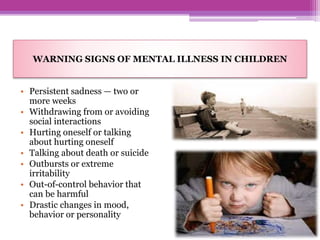
WARNING SIGNS OF MENTAL ILLNESS IN CHILDREN
• Persistent sadness — two or
more weeks
• Withdrawing from or avoiding
social interactions
• Hurting oneself or talking
about hurting oneself
• Talking about death or suicide
• Outbursts or extreme
irritability
• Out-of-control behavior that
can be harmful
• Drastic changes in mood,
behavior or personality
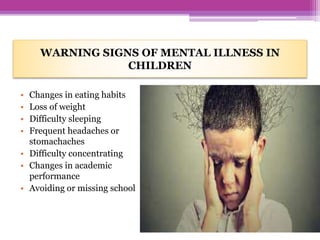
WARNING SIGNS OF MENTAL ILLNESS IN
CHILDREN
• Changes in eating habits
• Loss of weight
• Difficulty sleeping
• Frequent headaches or
stomachaches
• Difficulty concentrating
• Changes in academic
performance
• Avoiding or missing school
DIAGNOSIS
• Complete medical exam
• Medical history
• History of physical or emotional trauma
• Family history of physical and mental health
• Review of symptoms and general concerns with
parents
• Timeline of child's developmental progress
• Academic history
• Interview with parents
• Conversations with and observations of the child
• Standardized assessments and questionnaires for
child and parents
TREATMENT
• Common treatment options for children who have
mental health conditions include:
• PSYCHOTHERAPY. Psychotherapy, also known
as Talk Therapy Or Behavior Therapy, is a way
to address mental health concerns by talking with a
psychologist or other mental health professional.
• With young children, psychotherapy may include
play time or games, as well as talk about what
happens while playing.
• During psychotherapy, children and adolescents
learn how to talk about thoughts and feelings, how
to respond to them, and how to learn new behaviors
and coping skills.
TREATMENT
MEDICATION.
• Doctor or mental health professional may
recommend a medication — such as a stimulant,
antidepressant, anti-anxiety medication,
antipsychotic or mood stabilizer — as part of the
treatment plan.
• The doctor will explain risks, side effects and
benefits of drug treatments.
 COPE UP WITH MENTAL ILLNESS :-
• Consider family counseling that treats all members as
partners in the treatment plan.
• Ask child's mental health professional for advice on how
to respond to child and handle difficult behavior.
• Enroll in parent training programs, particularly those
designed for parents of children with a mental illness.
• Explore stress management techniques to help them
respond calmly.
• Seek ways to relax and have fun with the child.
• Praise the child's strengths and abilities.
• Work with the child's school to secure necessary support.
TREATMENT
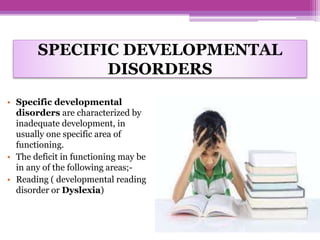
SPECIFIC DEVELOPMENTAL
DISORDERS
• Specific developmental
disorders are characterized by
inadequate development, in
usually one specific area of
functioning.
• The deficit in functioning may be
in any of the following areas;-
• Reading ( developmental reading
disorder or Dyslexia)
SPECIFIC DEVELOPMENTAL
DISORDERS
• Specific developmental
disorders are characterized
by inadequate development, in
usually one specific area of
functioning.
• The deficit in functioning may
be in any of the following
areas;-
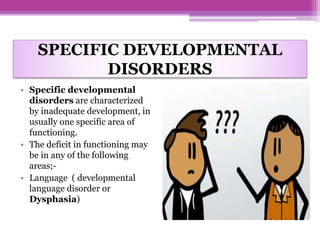
• Language ( developmental
language disorder or
Dysphasia)
SPECIFIC DEVELOPMENTAL
DISORDERS
• Specific developmental
disorders are characterized
by inadequate development, in
usually one specific area of
functioning.
• The deficit in functioning may
be in any of the following
areas;-
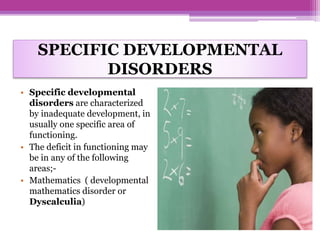
• Mathematics ( developmental
mathematics disorder or
Dyscalculia)
SPECIFIC DEVELOPMENTAL
DISORDERS
• Specific developmental
disorders are characterized
by inadequate development, in
usually one specific area of
functioning.
• The deficit in functioning may
be in any of the following
areas;-
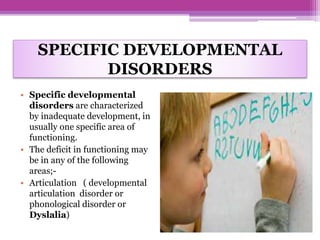
• Articulation ( developmental
articulation disorder or
phonological disorder or
Dyslalia)
SPECIFIC DEVELOPMENTAL
DISORDERS
• At times, more than one developmental disorder is
present.
• child with all the developmental disorders having
impairment in academic functioning at school
( especially when language is affected )
• There is also impairment in daily activities.
• In most of children, the cause is cerebral disorders
• Treatment of these disorders is based on learning
theory principles and is behavior in approach.
MANAGEMENT
• Parents skills training
• Physical therapy
• Speech therapy
• Occupational therapy
• Special education &
• Psychological counseling
PERVASIVE DEVELOPMENTAL
DISORDERS (PDD)
• Pervasive developmental disorders (PDD)
are more common in male than females.
• The onset occurs before the age of 21/2 years, the
onset may occur later in childhood.
AUTISM
• Also called autism spectrum disorder (ASD), is a
complicated condition that includes problems with
communication and behavior.
• Child with autism have trouble with communication.
They have trouble understanding what other people
think and feel. This makes it hard for them to express
themselves, either with words or through gestures, facial
expressions, and touch.
• Child with autism might have problems with learning.
• Their skills might develop unevenly. For example, they
could have trouble communicating but be unusually
good at art, music , math, or memory. Because of this,
they might do especially well on tests of analysis or
problem-solving.
INCIDENCE
• According to the Centers for Disease Control and
Prevention (CDC)Trusted Source, autism does
occur more often in boys than in girls, with a 4
to 1 male-to-female ratio.
• The CDC estimated in 2014 that nearly 1 in 59
children have been identified with ASD.
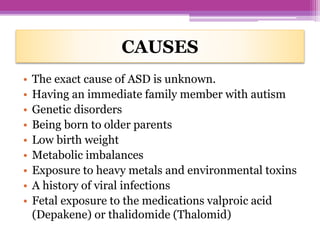
CAUSES
• The exact cause of ASD is unknown.
• Having an immediate family member with autism
• Genetic disorders
• Being born to older parents
• Low birth weight
• Metabolic imbalances
• Exposure to heavy metals and environmental toxins
• A history of viral infections
• Fetal exposure to the medications valproic acid
(Depakene) or thalidomide (Thalomid)
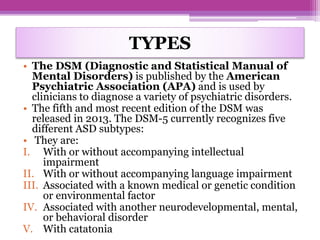
TYPES
• The DSM (Diagnostic and Statistical Manual of
Mental Disorders) is published by the American
Psychiatric Association (APA) and is used by
clinicians to diagnose a variety of psychiatric disorders.
• The fifth and most recent edition of the DSM was
released in 2013. The DSM-5 currently recognizes five
different ASD subtypes:
• They are:
I. With or without accompanying intellectual
impairment
II. With or without accompanying language impairment
III. Associated with a known medical or genetic condition
or environmental factor
IV. Associated with another neurodevelopmental, mental,
or behavioral disorder
V. With catatonia
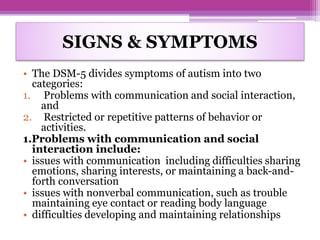
SIGNS & SYMPTOMS
• The DSM-5 divides symptoms of autism into two
categories:
1. Problems with communication and social interaction,
and
2. Restricted or repetitive patterns of behavior or
activities.
1.Problems with communication and social
interaction include:
• issues with communication including difficulties sharing
emotions, sharing interests, or maintaining a back-and-
forth conversation
• issues with nonverbal communication, such as trouble
maintaining eye contact or reading body language
• difficulties developing and maintaining relationships
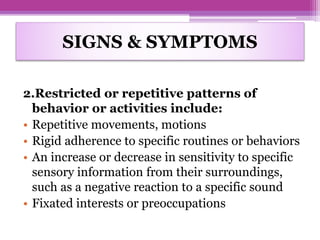
SIGNS & SYMPTOMS
2.Restricted or repetitive patterns of
behavior or activities include:
• Repetitive movements, motions
• Rigid adherence to specific routines or behaviors
• An increase or decrease in sensitivity to specific
sensory information from their surroundings,
such as a negative reaction to a specific sound
• Fixated interests or preoccupations
SIGNS AND SYMPTOMS
• Symptoms of autism usually appear before a child
turns 3.
• Some people show signs from birth.
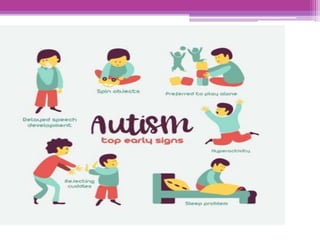
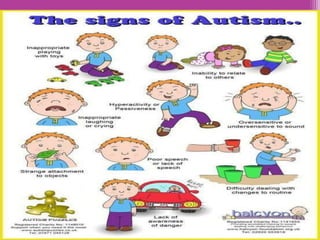
• Common symptoms of autism include:
• A lack of eye contact
• A narrow range of interests or intense interest in
certain topics
• Doing something over and over, like repeating
words or phrases, rocking back and forth, or flipping
a lever
• High sensitivity to sounds, touches, smells, or sights
that seem ordinary to other people
SIGNS AND SYMPTOMS
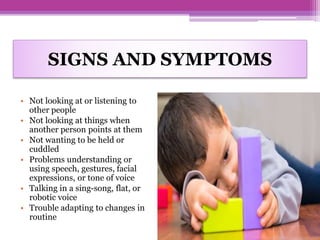
• Not looking at or listening to
other people
• Not looking at things when
another person points at them
• Not wanting to be held or
cuddled
• Problems understanding or
using speech, gestures, facial
expressions, or tone of voice
• Talking in a sing-song, flat, or
robotic voice
• Trouble adapting to changes in
routine
DIAGNOSIS
• An ASD diagnosis involves several different screenings,
genetic tests, and evaluations.
• Developmental screenings
• The American Academy of Pediatrics (AAP) recommends
that all children undergo screening for ASD at the ages of
18 and 24 months.
• Screening can help with early identification of children
who could have ASD. These children may benefit from
early diagnosis and intervention.
• The Modified Checklist for Autism in Toddlers
(M-CHAT) is a common screening tool used by many
pediatric offices.
• This 23-question survey is filled out by parents.
Pediatricians can then use the responses provided to
identify children that may be at risk of having ASD.
DIAGNOSIS
Other screenings and tests
Physician may recommend a combination of
tests for autism, including:-
• DNA testing for genetic diseases
• Behavioral evaluation
• Visual and audio tests to rule out any issues with vision
and hearing that aren’t related to autism
• Occupational therapy screening
• Developmental questionnaires, such as the autism
diagnostic observation schedule (ADOS)
• Diagnoses are typically made by a team of specialists.
This team may include child psychologists, occupational
therapists, or speech and language pathologists.
TREATMENT
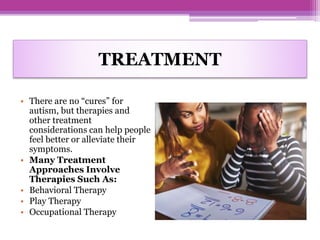
• There are no “cures” for
autism, but therapies and
other treatment
considerations can help people
feel better or alleviate their
symptoms.
• Many Treatment
Approaches Involve
Therapies Such As:
• Behavioral Therapy
• Play Therapy
• Occupational Therapy
TREATMENT
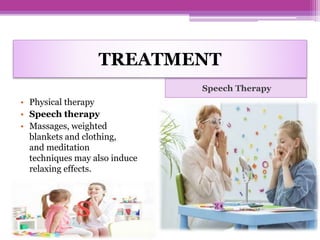
Speech Therapy
• Physical therapy
• Speech therapy
• Massages, weighted
blankets and clothing,
and meditation
techniques may also induce
relaxing effects.
ROLE OF NURSING IN AUTISM
• Education.
• Diagnosis and referrals.
• Case management.
• Personal care.
• Arranging a health care visit.
• Access to needed resources.
• Advocacy.
• Nursing intervention of an Autistic child at
special school.
TREATMENT
Alternative treatments
• Alternative treatments for managing autism may
include:
• High-dose vitamins
ANXIETY DISORDERS
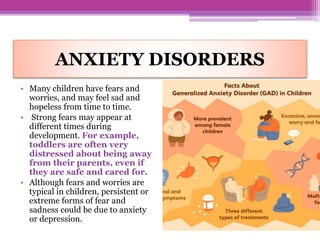
• Many children have fears and
worries, and may feel sad and
hopeless from time to time.
• Strong fears may appear at
different times during
development. For example,
toddlers are often very
distressed about being away
from their parents, even if
they are safe and cared for.
• Although fears and worries are
typical in children, persistent or
extreme forms of fear and
sadness could be due to anxiety
or depression.
TYPES OF ANXIETY DISORDERS
Examples of different
types of anxiety disorders
include:
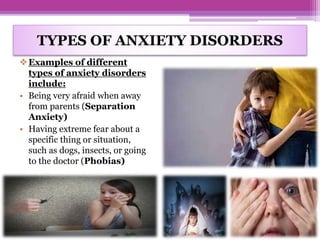
• Being very afraid when away
from parents (Separation
Anxiety)
• Having extreme fear about a
specific thing or situation,
such as dogs, insects, or going
to the doctor (Phobias)
TYPES OF ANXIETY DISORDERS
 Examples of different types
of anxiety disorders include:
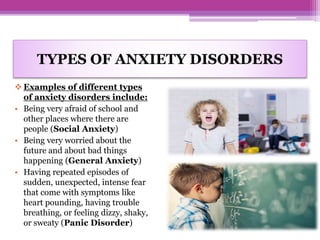
• Being very afraid of school and
other places where there are
people (Social Anxiety)
• Being very worried about the
future and about bad things
happening (General Anxiety)
• Having repeated episodes of
sudden, unexpected, intense fear
that come with symptoms like
heart pounding, having trouble
breathing, or feeling dizzy, shaky,
or sweaty (Panic Disorder)
• Generalized anxiety disorder (GAD). GAD causes kids to
worry almost every day — and over lots of things.
• Kids with GAD worry over things that most kids worry about, like
homework, tests, or making mistakes.
• Kids with GAD also worry over things parents might not expect
would cause worry. For example, they might worry about recess,
lunchtime, birthday parties, playtime with friends, or riding the
school bus.
• Having GAD can make it hard for kids to focus in school. Because
with GAD, there is almost always a worry on a kid's mind. GAD
makes it hard for kids to relax and have fun, eat well, or fall asleep
at night.
• They may miss many days of school because worry makes them feel
sick, afraid, or tired.
• Some kids with GAD keep worries to themselves. Others talk about
their worries with a parent or teacher. They might ask over and over
whether something they worry about will happen.
TYPES OF ANXIETY DISORDERS
• Separation anxiety disorder (SAD). It's normal for babies and
very young kids to feel anxious the first times they are apart from
their parent.
• But soon they get used to being with a grandparent, babysitter, or
teacher. And they start to feel at home at daycare or school.
• But when kids don't outgrow the fear of being apart from a parent,
it's called separation anxiety disorder Even as they get older, kids
with SAD feel very anxious about being away from their parent or
away from home.
• They may miss many days of school. They may say they feel too sick
or upset to go.
• They may cling to a parent, cry, or refuse to go to school, sleepovers,
playdates, or other activities without their parent. At home, they
may have trouble falling asleep or sleeping alone. They may avoid
being in a room at home if their parent isn't close by.
TYPES OF ANXIETY DISORDERS
• Social phobia (social anxiety disorder). With social phobia ,
kids to feel too afraid of what others will think or say. They are
always afraid they might do or say something embarrassing.
• They worry they might sound or look weird. They don't like to be the
center of attention. They don't want others to notice them, so they
might avoid raising their hand in class.
• If they get called on in class, they may freeze or panic and can't
answer. With social phobia, a class presentation or a group activity
with classmates can cause extreme fear.
• Social phobia can cause kids and teens to avoid school or friends.
They may feel sick or tired before or during school.
• They may complain of other body sensations that go with anxiety
too. For example, they may feel their heart racing or feel short of
breath. They may feel jumpy and feel they can't sit still. They may
feel their face get hot or blush. They may feel shaky or lightheaded.
TYPES OF ANXIETY DISORDERS
• Selective Mutism (SM). This extreme form of
social phobia causes kids to be so afraid they
don't talk.
• Kids and teens with SM can talk. And they do
talk at home or with their closest people. But
they refuse to talk at all at school, with friends,
or in other places where they have this fear.
TYPES OF ANXIETY DISORDERS
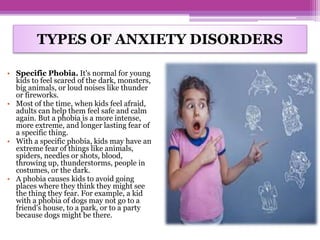
• Specific Phobia. It's normal for young
kids to feel scared of the dark, monsters,
big animals, or loud noises like thunder
or fireworks.
• Most of the time, when kids feel afraid,
adults can help them feel safe and calm
again. But a phobia is a more intense,
more extreme, and longer lasting fear of
a specific thing.
• With a specific phobia, kids may have an
extreme fear of things like animals,
spiders, needles or shots, blood,
throwing up, thunderstorms, people in
costumes, or the dark.
• A phobia causes kids to avoid going
places where they think they might see
the thing they fear. For example, a kid
with a phobia of dogs may not go to a
friend's house, to a park, or to a party
because dogs might be there.
SIGNS & SYMPTOMS
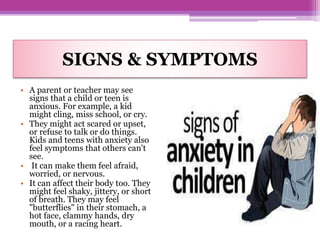
• A parent or teacher may see
signs that a child or teen is
anxious. For example, a kid
might cling, miss school, or cry.
• They might act scared or upset,
or refuse to talk or do things.
Kids and teens with anxiety also
feel symptoms that others can't
see.
• It can make them feel afraid,
worried, or nervous.
• It can affect their body too. They
might feel shaky, jittery, or short
of breath. They may feel
"butterflies" in their stomach, a
hot face, clammy hands, dry
mouth, or a racing heart.
SIGNS & SYMPTOMS
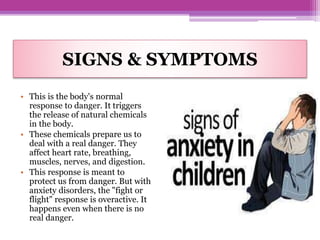
• This is the body's normal
response to danger. It triggers
the release of natural chemicals
in the body.
• These chemicals prepare us to
deal with a real danger. They
affect heart rate, breathing,
muscles, nerves, and digestion.
• This response is meant to
protect us from danger. But with
anxiety disorders, the "fight or
flight" response is overactive. It
happens even when there is no
real danger.
CAUSES
• What Causes Anxiety Disorders?
• Several things play a role in causing the overactive
"fight or flight" that happens with anxiety disorders.
They include:
• Genetics. A child who has a family member with an
anxiety disorder is more likely to have one too. Kids
may inherit genes that make them prone to anxiety.
• Learned behaviors. Growing up in a family where
others are fearful or anxious also can "teach" a child
to be afraid too.
DIAGNOSIS
• How Are Anxiety Disorders Diagnosed?
• Anxiety disorders can be diagnosed by a trained
therapist. They talk with you and your child, ask
questions, and listen carefully.
• They'll ask how and when the child's anxiety and
fears happen most. That helps them diagnose the
specific anxiety disorder the child has.
• A child or teen with symptoms of anxiety should also
have a regular health checkup. This helps make sure
no other health problem is causing the symptoms.
TREATMENT
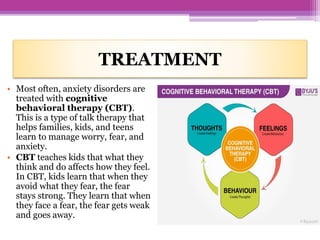
• Most often, anxiety disorders are
treated with cognitive
behavioral therapy (CBT).
This is a type of talk therapy that
helps families, kids, and teens
learn to manage worry, fear, and
anxiety.
• CBT teaches kids that what they
think and do affects how they feel.
In CBT, kids learn that when they
avoid what they fear, the fear
stays strong. They learn that when
they face a fear, the fear gets weak
and goes away.
TREATMENT
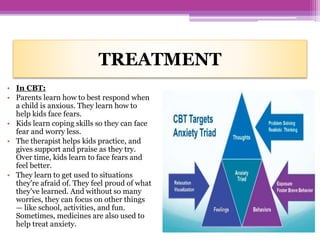
• In CBT:
• Parents learn how to best respond when
a child is anxious. They learn how to
help kids face fears.
• Kids learn coping skills so they can face
fear and worry less.
• The therapist helps kids practice, and
gives support and praise as they try.
Over time, kids learn to face fears and
feel better.
• They learn to get used to situations
they're afraid of. They feel proud of what
they've learned. And without so many
worries, they can focus on other things
— like school, activities, and fun.
Sometimes, medicines are also used to
help treat anxiety.
HOW CAN PARENTS HELP THEIR
CHILD?
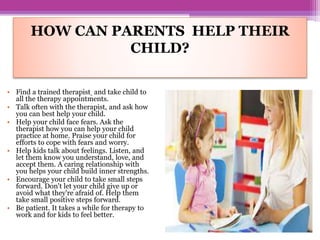
• Find a trained therapist and take child to
all the therapy appointments.
• Talk often with the therapist, and ask how
you can best help your child.
• Help your child face fears. Ask the
therapist how you can help your child
practice at home. Praise your child for
efforts to cope with fears and worry.
• Help kids talk about feelings. Listen, and
let them know you understand, love, and
accept them. A caring relationship with
you helps your child build inner strengths.
• Encourage your child to take small steps
forward. Don't let your child give up or
avoid what they're afraid of. Help them
take small positive steps forward.
• Be patient. It takes a while for therapy to
work and for kids to feel better.
COMMON CHILD PSYCHIATRIC PROBLEMS.pptx..................

COMMON CHILD PSYCHIATRIC PROBLEMS.pptx..................

  • 1.
  • 2.
    MENTAL ILLNESS • Mentalhealth is the overall wellness of how child think, regulate feelings and behave. • A mental illness, or mental health disorder, is defined as patterns or changes in thinking, feeling or behaving that cause distress or disrupt a person's ability to function. • Mental health disorders in children are generally defined as delays or disruptions in developing age- appropriate thinking, behaviors, social skills or regulation of emotions. • These problems are distressing to children and disrupt their ability to function well at home, in school or in other social situations.
  • 3.
    COMMON CHILD PSYCHIATRIC PROBLEMS •The various psychiatric problems seen in children are;- • Specific developmental disorders • Pervasive developmental disorders(PDD) • Disruptive behavior disorders Oppositional defiant disorder (ODD) Conduct disorder Attention deficit hyperactivity disorder (ADHD) • Anxiety disorders
  • 4.
    COMMON DISORDERS AMONGCHILDREN • Anxiety disorders. Anxiety disorders in children are persistent fears, worries or anxiety that disrupt their ability to participate in play, school or typical age-appropriate social situations. • Attention-deficit/hyperactivity disorder (ADHD). Compared with most children of the same age, children with ADHD have difficulty with attention, impulsive behaviors, hyperactivity or some combination of these problems. • Autism spectrum disorder (ASD). Autism spectrum disorder is a neurological condition that appears in early childhood — usually before age 3. • Although the severity of ASD varies, a child with this disorder has difficulty communicating and interacting with others.
  • 5.
    COMMON DISORDERS AMONGCHILDREN • Eating disorders. Eating disorders are defined as a preoccupation with an ideal body type, disordered thinking about weight and weight loss, and unsafe eating and dieting habits. • Eating disorders — such as anorexia nervosa, bulimia nervosa and binge- eating disorder — can result in emotional and social dysfunction and life- threatening physical complications. • Depression and other mood disorders. Depression is persistent feelings of sadness and loss of interest that disrupt a child's ability to function in school and interact with others. • Bipolar disorder results in extreme mood swings between depression and extreme emotional or behavioral highs that may be unguarded, risky or unsafe. • Post-traumatic stress disorder (PTSD). PTSD is prolonged emotional distress, anxiety, distressing memories, nightmares and disruptive behaviors in response to violence, abuse, injury or other traumatic events. • Schizophrenia. Schizophrenia is a disorder in perceptions and thoughts that cause a person to lose touch with reality (psychosis). • Most often appearing in the late teens through the 20s, schizophrenia results in hallucinations, delusions, and disordered thinking.
  • 6.
    WARNING SIGNS OFMENTAL ILLNESS IN CHILDREN • Persistent sadness — two or more weeks • Withdrawing from or avoiding social interactions • Hurting oneself or talking about hurting oneself • Talking about death or suicide • Outbursts or extreme irritability • Out-of-control behavior that can be harmful • Drastic changes in mood, behavior or personality
  • 7.
    WARNING SIGNS OFMENTAL ILLNESS IN CHILDREN • Changes in eating habits • Loss of weight • Difficulty sleeping • Frequent headaches or stomachaches • Difficulty concentrating • Changes in academic performance • Avoiding or missing school
  • 8.
    DIAGNOSIS • Complete medicalexam • Medical history • History of physical or emotional trauma • Family history of physical and mental health • Review of symptoms and general concerns with parents • Timeline of child's developmental progress • Academic history • Interview with parents • Conversations with and observations of the child • Standardized assessments and questionnaires for child and parents
  • 9.
    TREATMENT • Common treatmentoptions for children who have mental health conditions include: • PSYCHOTHERAPY. Psychotherapy, also known as Talk Therapy Or Behavior Therapy, is a way to address mental health concerns by talking with a psychologist or other mental health professional. • With young children, psychotherapy may include play time or games, as well as talk about what happens while playing. • During psychotherapy, children and adolescents learn how to talk about thoughts and feelings, how to respond to them, and how to learn new behaviors and coping skills.
  • 10.
    TREATMENT MEDICATION. • Doctor ormental health professional may recommend a medication — such as a stimulant, antidepressant, anti-anxiety medication, antipsychotic or mood stabilizer — as part of the treatment plan. • The doctor will explain risks, side effects and benefits of drug treatments.
  • 11.
     COPE UPWITH MENTAL ILLNESS :- • Consider family counseling that treats all members as partners in the treatment plan. • Ask child's mental health professional for advice on how to respond to child and handle difficult behavior. • Enroll in parent training programs, particularly those designed for parents of children with a mental illness. • Explore stress management techniques to help them respond calmly. • Seek ways to relax and have fun with the child. • Praise the child's strengths and abilities. • Work with the child's school to secure necessary support. TREATMENT
  • 12.
    SPECIFIC DEVELOPMENTAL DISORDERS • Specificdevelopmental disorders are characterized by inadequate development, in usually one specific area of functioning. • The deficit in functioning may be in any of the following areas;- • Reading ( developmental reading disorder or Dyslexia)
  • 13.
    SPECIFIC DEVELOPMENTAL DISORDERS • Specificdevelopmental disorders are characterized by inadequate development, in usually one specific area of functioning. • The deficit in functioning may be in any of the following areas;- • Language ( developmental language disorder or Dysphasia)
  • 14.
    SPECIFIC DEVELOPMENTAL DISORDERS • Specificdevelopmental disorders are characterized by inadequate development, in usually one specific area of functioning. • The deficit in functioning may be in any of the following areas;- • Mathematics ( developmental mathematics disorder or Dyscalculia)
  • 15.
    SPECIFIC DEVELOPMENTAL DISORDERS • Specificdevelopmental disorders are characterized by inadequate development, in usually one specific area of functioning. • The deficit in functioning may be in any of the following areas;- • Articulation ( developmental articulation disorder or phonological disorder or Dyslalia)
  • 16.
    SPECIFIC DEVELOPMENTAL DISORDERS • Attimes, more than one developmental disorder is present. • child with all the developmental disorders having impairment in academic functioning at school ( especially when language is affected ) • There is also impairment in daily activities. • In most of children, the cause is cerebral disorders • Treatment of these disorders is based on learning theory principles and is behavior in approach.
  • 17.
    MANAGEMENT • Parents skillstraining • Physical therapy • Speech therapy • Occupational therapy • Special education & • Psychological counseling
  • 18.
    PERVASIVE DEVELOPMENTAL DISORDERS (PDD) •Pervasive developmental disorders (PDD) are more common in male than females. • The onset occurs before the age of 21/2 years, the onset may occur later in childhood.
  • 19.
    AUTISM • Also calledautism spectrum disorder (ASD), is a complicated condition that includes problems with communication and behavior. • Child with autism have trouble with communication. They have trouble understanding what other people think and feel. This makes it hard for them to express themselves, either with words or through gestures, facial expressions, and touch. • Child with autism might have problems with learning. • Their skills might develop unevenly. For example, they could have trouble communicating but be unusually good at art, music , math, or memory. Because of this, they might do especially well on tests of analysis or problem-solving.
  • 20.
    INCIDENCE • According tothe Centers for Disease Control and Prevention (CDC)Trusted Source, autism does occur more often in boys than in girls, with a 4 to 1 male-to-female ratio. • The CDC estimated in 2014 that nearly 1 in 59 children have been identified with ASD.
  • 21.
    CAUSES • The exactcause of ASD is unknown. • Having an immediate family member with autism • Genetic disorders • Being born to older parents • Low birth weight • Metabolic imbalances • Exposure to heavy metals and environmental toxins • A history of viral infections • Fetal exposure to the medications valproic acid (Depakene) or thalidomide (Thalomid)
  • 22.
    TYPES • The DSM(Diagnostic and Statistical Manual of Mental Disorders) is published by the American Psychiatric Association (APA) and is used by clinicians to diagnose a variety of psychiatric disorders. • The fifth and most recent edition of the DSM was released in 2013. The DSM-5 currently recognizes five different ASD subtypes: • They are: I. With or without accompanying intellectual impairment II. With or without accompanying language impairment III. Associated with a known medical or genetic condition or environmental factor IV. Associated with another neurodevelopmental, mental, or behavioral disorder V. With catatonia
  • 23.
    SIGNS & SYMPTOMS •The DSM-5 divides symptoms of autism into two categories: 1. Problems with communication and social interaction, and 2. Restricted or repetitive patterns of behavior or activities. 1.Problems with communication and social interaction include: • issues with communication including difficulties sharing emotions, sharing interests, or maintaining a back-and- forth conversation • issues with nonverbal communication, such as trouble maintaining eye contact or reading body language • difficulties developing and maintaining relationships
  • 24.
    SIGNS & SYMPTOMS 2.Restrictedor repetitive patterns of behavior or activities include: • Repetitive movements, motions • Rigid adherence to specific routines or behaviors • An increase or decrease in sensitivity to specific sensory information from their surroundings, such as a negative reaction to a specific sound • Fixated interests or preoccupations
  • 26.
    SIGNS AND SYMPTOMS •Symptoms of autism usually appear before a child turns 3. • Some people show signs from birth. • Common symptoms of autism include: • A lack of eye contact • A narrow range of interests or intense interest in certain topics • Doing something over and over, like repeating words or phrases, rocking back and forth, or flipping a lever • High sensitivity to sounds, touches, smells, or sights that seem ordinary to other people
  • 28.
    SIGNS AND SYMPTOMS •Not looking at or listening to other people • Not looking at things when another person points at them • Not wanting to be held or cuddled • Problems understanding or using speech, gestures, facial expressions, or tone of voice • Talking in a sing-song, flat, or robotic voice • Trouble adapting to changes in routine
  • 29.
    DIAGNOSIS • An ASDdiagnosis involves several different screenings, genetic tests, and evaluations. • Developmental screenings • The American Academy of Pediatrics (AAP) recommends that all children undergo screening for ASD at the ages of 18 and 24 months. • Screening can help with early identification of children who could have ASD. These children may benefit from early diagnosis and intervention. • The Modified Checklist for Autism in Toddlers (M-CHAT) is a common screening tool used by many pediatric offices. • This 23-question survey is filled out by parents. Pediatricians can then use the responses provided to identify children that may be at risk of having ASD.
  • 30.
    DIAGNOSIS Other screenings andtests Physician may recommend a combination of tests for autism, including:- • DNA testing for genetic diseases • Behavioral evaluation • Visual and audio tests to rule out any issues with vision and hearing that aren’t related to autism • Occupational therapy screening • Developmental questionnaires, such as the autism diagnostic observation schedule (ADOS) • Diagnoses are typically made by a team of specialists. This team may include child psychologists, occupational therapists, or speech and language pathologists.
  • 31.
    TREATMENT • There areno “cures” for autism, but therapies and other treatment considerations can help people feel better or alleviate their symptoms. • Many Treatment Approaches Involve Therapies Such As: • Behavioral Therapy • Play Therapy • Occupational Therapy
  • 32.
    TREATMENT Speech Therapy • Physicaltherapy • Speech therapy • Massages, weighted blankets and clothing, and meditation techniques may also induce relaxing effects.
  • 33.
    ROLE OF NURSINGIN AUTISM • Education. • Diagnosis and referrals. • Case management. • Personal care. • Arranging a health care visit. • Access to needed resources. • Advocacy. • Nursing intervention of an Autistic child at special school.
  • 34.
    TREATMENT Alternative treatments • Alternativetreatments for managing autism may include: • High-dose vitamins
  • 35.
    ANXIETY DISORDERS • Manychildren have fears and worries, and may feel sad and hopeless from time to time. • Strong fears may appear at different times during development. For example, toddlers are often very distressed about being away from their parents, even if they are safe and cared for. • Although fears and worries are typical in children, persistent or extreme forms of fear and sadness could be due to anxiety or depression.
  • 36.
    TYPES OF ANXIETYDISORDERS Examples of different types of anxiety disorders include: • Being very afraid when away from parents (Separation Anxiety) • Having extreme fear about a specific thing or situation, such as dogs, insects, or going to the doctor (Phobias)
  • 37.
    TYPES OF ANXIETYDISORDERS  Examples of different types of anxiety disorders include: • Being very afraid of school and other places where there are people (Social Anxiety) • Being very worried about the future and about bad things happening (General Anxiety) • Having repeated episodes of sudden, unexpected, intense fear that come with symptoms like heart pounding, having trouble breathing, or feeling dizzy, shaky, or sweaty (Panic Disorder)
  • 38.
    • Generalized anxietydisorder (GAD). GAD causes kids to worry almost every day — and over lots of things. • Kids with GAD worry over things that most kids worry about, like homework, tests, or making mistakes. • Kids with GAD also worry over things parents might not expect would cause worry. For example, they might worry about recess, lunchtime, birthday parties, playtime with friends, or riding the school bus. • Having GAD can make it hard for kids to focus in school. Because with GAD, there is almost always a worry on a kid's mind. GAD makes it hard for kids to relax and have fun, eat well, or fall asleep at night. • They may miss many days of school because worry makes them feel sick, afraid, or tired. • Some kids with GAD keep worries to themselves. Others talk about their worries with a parent or teacher. They might ask over and over whether something they worry about will happen. TYPES OF ANXIETY DISORDERS
  • 39.
    • Separation anxietydisorder (SAD). It's normal for babies and very young kids to feel anxious the first times they are apart from their parent. • But soon they get used to being with a grandparent, babysitter, or teacher. And they start to feel at home at daycare or school. • But when kids don't outgrow the fear of being apart from a parent, it's called separation anxiety disorder Even as they get older, kids with SAD feel very anxious about being away from their parent or away from home. • They may miss many days of school. They may say they feel too sick or upset to go. • They may cling to a parent, cry, or refuse to go to school, sleepovers, playdates, or other activities without their parent. At home, they may have trouble falling asleep or sleeping alone. They may avoid being in a room at home if their parent isn't close by. TYPES OF ANXIETY DISORDERS
  • 40.
    • Social phobia(social anxiety disorder). With social phobia , kids to feel too afraid of what others will think or say. They are always afraid they might do or say something embarrassing. • They worry they might sound or look weird. They don't like to be the center of attention. They don't want others to notice them, so they might avoid raising their hand in class. • If they get called on in class, they may freeze or panic and can't answer. With social phobia, a class presentation or a group activity with classmates can cause extreme fear. • Social phobia can cause kids and teens to avoid school or friends. They may feel sick or tired before or during school. • They may complain of other body sensations that go with anxiety too. For example, they may feel their heart racing or feel short of breath. They may feel jumpy and feel they can't sit still. They may feel their face get hot or blush. They may feel shaky or lightheaded. TYPES OF ANXIETY DISORDERS
  • 41.
    • Selective Mutism(SM). This extreme form of social phobia causes kids to be so afraid they don't talk. • Kids and teens with SM can talk. And they do talk at home or with their closest people. But they refuse to talk at all at school, with friends, or in other places where they have this fear. TYPES OF ANXIETY DISORDERS
  • 42.
    TYPES OF ANXIETYDISORDERS • Specific Phobia. It's normal for young kids to feel scared of the dark, monsters, big animals, or loud noises like thunder or fireworks. • Most of the time, when kids feel afraid, adults can help them feel safe and calm again. But a phobia is a more intense, more extreme, and longer lasting fear of a specific thing. • With a specific phobia, kids may have an extreme fear of things like animals, spiders, needles or shots, blood, throwing up, thunderstorms, people in costumes, or the dark. • A phobia causes kids to avoid going places where they think they might see the thing they fear. For example, a kid with a phobia of dogs may not go to a friend's house, to a park, or to a party because dogs might be there.
  • 43.
    SIGNS & SYMPTOMS •A parent or teacher may see signs that a child or teen is anxious. For example, a kid might cling, miss school, or cry. • They might act scared or upset, or refuse to talk or do things. Kids and teens with anxiety also feel symptoms that others can't see. • It can make them feel afraid, worried, or nervous. • It can affect their body too. They might feel shaky, jittery, or short of breath. They may feel "butterflies" in their stomach, a hot face, clammy hands, dry mouth, or a racing heart.
  • 44.
    SIGNS & SYMPTOMS •This is the body's normal response to danger. It triggers the release of natural chemicals in the body. • These chemicals prepare us to deal with a real danger. They affect heart rate, breathing, muscles, nerves, and digestion. • This response is meant to protect us from danger. But with anxiety disorders, the "fight or flight" response is overactive. It happens even when there is no real danger.
  • 45.
    CAUSES • What CausesAnxiety Disorders? • Several things play a role in causing the overactive "fight or flight" that happens with anxiety disorders. They include: • Genetics. A child who has a family member with an anxiety disorder is more likely to have one too. Kids may inherit genes that make them prone to anxiety. • Learned behaviors. Growing up in a family where others are fearful or anxious also can "teach" a child to be afraid too.
  • 46.
    DIAGNOSIS • How AreAnxiety Disorders Diagnosed? • Anxiety disorders can be diagnosed by a trained therapist. They talk with you and your child, ask questions, and listen carefully. • They'll ask how and when the child's anxiety and fears happen most. That helps them diagnose the specific anxiety disorder the child has. • A child or teen with symptoms of anxiety should also have a regular health checkup. This helps make sure no other health problem is causing the symptoms.
  • 47.
    TREATMENT • Most often,anxiety disorders are treated with cognitive behavioral therapy (CBT). This is a type of talk therapy that helps families, kids, and teens learn to manage worry, fear, and anxiety. • CBT teaches kids that what they think and do affects how they feel. In CBT, kids learn that when they avoid what they fear, the fear stays strong. They learn that when they face a fear, the fear gets weak and goes away.
  • 48.
    TREATMENT • In CBT: •Parents learn how to best respond when a child is anxious. They learn how to help kids face fears. • Kids learn coping skills so they can face fear and worry less. • The therapist helps kids practice, and gives support and praise as they try. Over time, kids learn to face fears and feel better. • They learn to get used to situations they're afraid of. They feel proud of what they've learned. And without so many worries, they can focus on other things — like school, activities, and fun. Sometimes, medicines are also used to help treat anxiety.
  • 49.
    HOW CAN PARENTSHELP THEIR CHILD? • Find a trained therapist and take child to all the therapy appointments. • Talk often with the therapist, and ask how you can best help your child. • Help your child face fears. Ask the therapist how you can help your child practice at home. Praise your child for efforts to cope with fears and worry. • Help kids talk about feelings. Listen, and let them know you understand, love, and accept them. A caring relationship with you helps your child build inner strengths. • Encourage your child to take small steps forward. Don't let your child give up or avoid what they're afraid of. Help them take small positive steps forward. • Be patient. It takes a while for therapy to work and for kids to feel better.