Pediatric
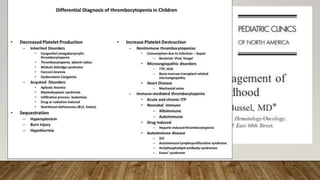
Thrombocytopenia
Marwa Abo Elmaaty Besar
Lecturer of Internal Medicine
(Rheumatology Immunology Unit)
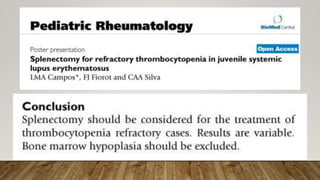
(Pediatric Rheumatology)
Thrombocytopenia:
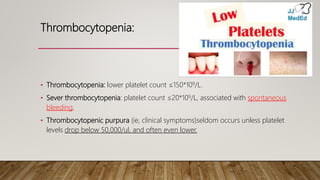
• Thrombocytopenia: lower platelet count ≤150*109/L.
• Sever thrombocytopenia: platelet count ≤20*109/L, associated with spontaneous
bleeding.
• Thrombocytopenic purpura (ie, clinical symptoms)seldom occurs unless platelet
levels drop below 50,000/ul, and often even lower.
Isolated thrombocytopenia in JSLE.
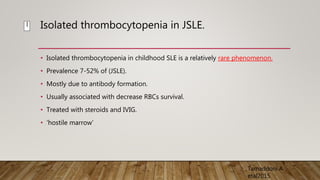
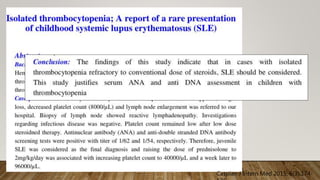
• Isolated thrombocytopenia in childhood SLE is a relatively rare phenomenon.
• Prevalence 7-52% of (JSLE).
• Mostly due to antibody formation.
• Usually associated with decrease RBCs survival.
• Treated with steroids and IVIG.
• ‘hostile marrow’
Tamaddoni A
etal2015
I
Caspian J Intern Med 2015; 6(3):174-
Thrombotic Thrombocytopenic Purpura (TTP)
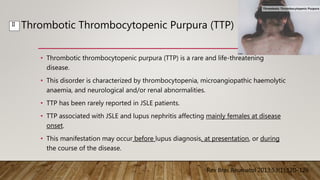
• Thrombotic thrombocytopenic purpura (TTP) is a rare and life-threatening
disease.
• This disorder is characterized by thrombocytopenia, microangiopathic haemolytic
anaemia, and neurological and/or renal abnormalities.
• TTP has been rarely reported in JSLE patients.
• TTP associated with JSLE and lupus nephritis affecting mainly females at disease
onset.
• This manifestation may occur before lupus diagnosis, at presentation, or during
the course of the disease.
Rev Bras Reumatol 2013;53(1):120–126
II
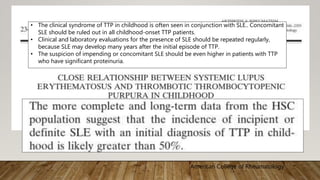
• The clinical syndrome of TTP in childhood is often seen in conjunction with SLE.. Concomitant
SLE should be ruled out in all childhood-onset TTP patients.
• Clinical and laboratory evaluations for the presence of SLE should be repeated regularly,
because SLE may develop many years after the initial episode of TTP.
• The suspicion of impending or concomitant SLE should be even higher in patients with TTP
who have significant proteinuria.
American College of Rheumatology
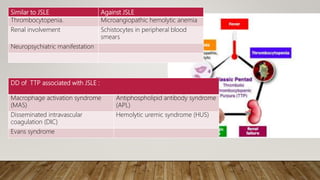
Similar to JSLE Against JSLE
Thrombocytopenia. Microangiopathic hemolytic anemia
Renal involvement Schistocytes in peripheral blood
smears
Neuropsychiatric manifestation
DD of TTP associated with JSLE :
Macrophage activation syndrome
(MAS)
Antiphospholipid antibody syndrome
(APL)
Disseminated intravascular
coagulation (DIC)
Hemolytic uremic syndrome (HUS)
Evans syndrome
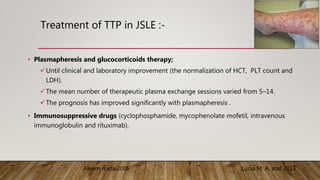
Treatment of TTP in JSLE :-
• Plasmapheresis and glucocorticoids therapy;
Until clinical and laboratory improvement (the normalization of HCT, PLT count and
LDH).
The mean number of therapeutic plasma exchange sessions varied from 5–14.
The prognosis has improved significantly with plasmapheresis .
• Immunosuppressive drugs (cyclophosphamide, mycophenolate mofetil, intravenous
immunoglobulin and rituximab).
Lucia M. A, etal 2013
Aleem A,etal2006
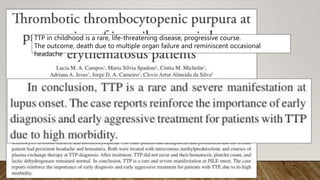
TTP in childhood is a rare, life-threatening disease, progressive course.
The outcome, death due to multiple organ failure and reminiscent occasional
headache
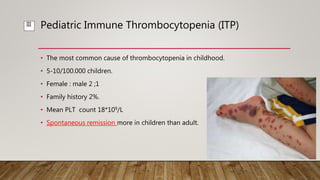
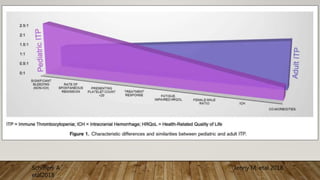
Pediatric Immune Thrombocytopenia (ITP)
• The most common cause of thrombocytopenia in childhood.
• 5-10/100.000 children.
• Female : male 2 ;1
• Family history 2%.
• Mean PLT count 18*109/L
• Spontaneous remission more in children than adult.
III
Jenny M. etal 2018
Schifferli A
etal2018
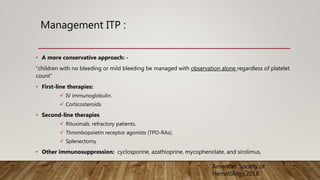
Management ITP :
• A more conservative approach: -
“children with no bleeding or mild bleeding be managed with observation alone regardless of platelet
count”
• First-line therapies:
 IV immunoglobulin.
 Corticosteroids
• Second-line therapies
 Rituximab, refractory patients.
 Thrombopoietin receptor agonists (TPO-RAs).
 Splenectomy
• Other immunosuppression: cyclosporine, azathioprine, mycophenolate, and sirolimus,
American Society of
Hematology,2018
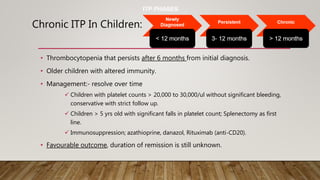
Chronic ITP In Children:
• Thrombocytopenia that persists after 6 months from initial diagnosis.
• Older children with altered immunity.
• Management:- resolve over time
 Children with platelet counts > 20,000 to 30,000/ul without significant bleeding,
conservative with strict follow up.
 Children > 5 yrs old with significant falls in platelet count; Splenectomy as first
line.
 Immunosuppression; azathioprine, danazol, Rituximab (anti-CD20).
• Favourable outcome, duration of remission is still unknown.
Drug-induced Thrombocytopenia:-
• Antibiotics (sulphonamides, rifampin, vancomycin, penicillin, and penicillin).
• As more children are on mood stabilizers and other psychotropic medications,
thrombocytopenia may become more common.
• The selective serotonin reuptake inhibitors (SSRI) have been known to cause
bleeding symptoms without thrombocytopenia.
• Treatment:
Removal of the offending drug.
Symptomatic treatment
Good prognosis
R.N. Kaplan, J.B. Bussel / Pediatr Clin N Am 51 (2004) 1109–
1140
1V
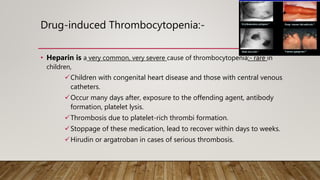
Drug-induced Thrombocytopenia:-
• Heparin is a very common, very severe cause of thrombocytopenia:- rare in
children,
Children with congenital heart disease and those with central venous
catheters.
Occur many days after, exposure to the offending agent, antibody
formation, platelet lysis.
Thrombosis due to platelet-rich thrombi formation.
Stoppage of these medication, lead to recover within days to weeks.
Hirudin or argatroban in cases of serious thrombosis.
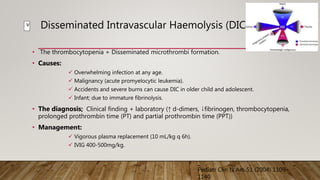
Disseminated Intravascular Haemolysis (DIC):
• The thrombocytopenia + Disseminated microthrombi formation.
• Causes:
 Overwhelming infection at any age.
 Malignancy (acute promyelocytic leukemia).
 Accidents and severe burns can cause DIC in older child and adolescent.
 Infant; due to immature fibrinolysis.
• The diagnosis; Clinical finding + laboratory (↑ d-dimers, ↓fibrinogen, thrombocytopenia,
prolonged prothrombin time (PT) and partial prothrombin time (PPT))
• Management:
 Vigorous plasma replacement (10 mL/kg q 6h).
 IVIG 400-500mg/kg.
Pediatr Clin N Am 51 (2004) 1109–
1140
v
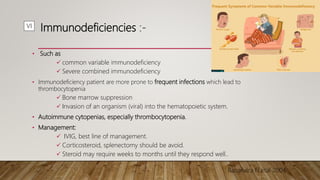
Immunodeficiencies :-
• Such as
 common variable immunodeficiency
 Severe combined immunodeficiency
• Immunodeficiency patient are more prone to frequent infections which lead to
thrombocytopenia
 Bone marrow suppression
 Invasion of an organism (viral) into the hematopoietic system.
• Autoimmune cytopenias, especially thrombocytopenia.
• Management:
 IVIG, best line of management.
 Corticosteroid, splenectomy should be avoid.
 Steroid may require weeks to months until they respond well..
Rosandra N,etal 2004
VI
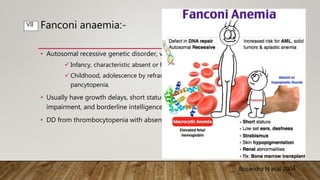
Fanconi anaemia:-
• Autosomal recessive genetic disorder, variable expression.
 Infancy, characteristic absent or hypoplastic thumbs and thenar eminences.
 Childhood, adolescence by refractory thrombocytopenia or marrow aplasia as
pancytopenia.
• Usually have growth delays, short stature, microcephaly, strabismus, hearing
impairment, and borderline intelligence.
• DD from thrombocytopenia with absent radii (TAR) syndrome.
Rosandra N etal 2004
VII
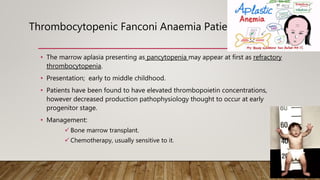
Thrombocytopenic Fanconi Anaemia Patients:
• The marrow aplasia presenting as pancytopenia may appear at first as refractory
thrombocytopenia.
• Presentation; early to middle childhood.
• Patients have been found to have elevated thrombopoietin concentrations,
however decreased production pathophysiology thought to occur at early
progenitor stage.
• Management:
 Bone marrow transplant.
 Chemotherapy, usually sensitive to it.
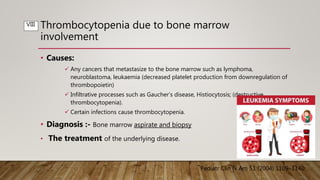
Thrombocytopenia due to bone marrow
involvement
• Causes:
 Any cancers that metastasize to the bone marrow such as lymphoma,
neuroblastoma, leukaemia (decreased platelet production from downregulation of
thrombopoietin)
 Infiltrative processes such as Gaucher’s disease, Histiocytosis; (destructive
thrombocytopenia).
 Certain infections cause thrombocytopenia.
• Diagnosis :- Bone marrow aspirate and biopsy
• The treatment of the underlying disease.
Pediatr Clin N Am 51 (2004) 1109–1140
VIII
Reference:
• Terrell DR, Beebe LA, Vesely SK, Neas BR, Segal JB, George JN. The incidence of immune
thrombocytopenic purpura in children and adults: a critical review of published reports. Am J Hematol.
2010;85(3):174-180.
• Schifferli A, Holbro A, Chitlur M, et al; Intercontinental Cooperative ITP Study Group (ICIS). A
comparative prospective observational study of children and adults with immune thrombocytopenia:
2-year follow-up.Am J Hematol. 2018;93(6):751-759.
• Tamaddoni A, Yousefghahari B, Khani A, et al. Isolated thrombocytopenia; A report of a rare
presentation of childhood Systemic Lupus Erythematosus (SLE) Caspian J Intern Med 2015; 6(3):174-
176.
• Campos LM, Spadoni MS, Michelin CM, et al. Thrombotic thrombocytopenic purpura at presentation
of juvenile systemic lupus erythematosus patients. Rev Bras Reumatol 2013; 53: 120-6
• Chak WK, Lam DS, Lo WH, Hui CM, Wong SN. Thrombotic thrombocytopenic purpura as a rare
complication in childhood systemic lupus erythematosus: case report and literature review. Hong Kong
Med J 2003; 9(5):363–8
• Aleem A, Al-Sugair S. Thrombotic thrombocytopenic purpura associated with systemic lupus
erythematosus. Acta Haematol 2006; 115(1-2):68–73.
Pediatric thrombocytopenia

Pediatric thrombocytopenia

  • 1.
    Pediatric Thrombocytopenia Marwa Abo ElmaatyBesar Lecturer of Internal Medicine (Rheumatology Immunology Unit) (Pediatric Rheumatology)
  • 3.
    Thrombocytopenia: • Thrombocytopenia: lowerplatelet count ≤150*109/L. • Sever thrombocytopenia: platelet count ≤20*109/L, associated with spontaneous bleeding. • Thrombocytopenic purpura (ie, clinical symptoms)seldom occurs unless platelet levels drop below 50,000/ul, and often even lower.
  • 5.
    Isolated thrombocytopenia inJSLE. • Isolated thrombocytopenia in childhood SLE is a relatively rare phenomenon. • Prevalence 7-52% of (JSLE). • Mostly due to antibody formation. • Usually associated with decrease RBCs survival. • Treated with steroids and IVIG. • ‘hostile marrow’ Tamaddoni A etal2015 I
  • 6.
    Caspian J InternMed 2015; 6(3):174-
  • 8.
    Thrombotic Thrombocytopenic Purpura(TTP) • Thrombotic thrombocytopenic purpura (TTP) is a rare and life-threatening disease. • This disorder is characterized by thrombocytopenia, microangiopathic haemolytic anaemia, and neurological and/or renal abnormalities. • TTP has been rarely reported in JSLE patients. • TTP associated with JSLE and lupus nephritis affecting mainly females at disease onset. • This manifestation may occur before lupus diagnosis, at presentation, or during the course of the disease. Rev Bras Reumatol 2013;53(1):120–126 II
  • 9.
    • The clinicalsyndrome of TTP in childhood is often seen in conjunction with SLE.. Concomitant SLE should be ruled out in all childhood-onset TTP patients. • Clinical and laboratory evaluations for the presence of SLE should be repeated regularly, because SLE may develop many years after the initial episode of TTP. • The suspicion of impending or concomitant SLE should be even higher in patients with TTP who have significant proteinuria. American College of Rheumatology
  • 10.
    Similar to JSLEAgainst JSLE Thrombocytopenia. Microangiopathic hemolytic anemia Renal involvement Schistocytes in peripheral blood smears Neuropsychiatric manifestation DD of TTP associated with JSLE : Macrophage activation syndrome (MAS) Antiphospholipid antibody syndrome (APL) Disseminated intravascular coagulation (DIC) Hemolytic uremic syndrome (HUS) Evans syndrome
  • 11.
    Treatment of TTPin JSLE :- • Plasmapheresis and glucocorticoids therapy; Until clinical and laboratory improvement (the normalization of HCT, PLT count and LDH). The mean number of therapeutic plasma exchange sessions varied from 5–14. The prognosis has improved significantly with plasmapheresis . • Immunosuppressive drugs (cyclophosphamide, mycophenolate mofetil, intravenous immunoglobulin and rituximab). Lucia M. A, etal 2013 Aleem A,etal2006
  • 12.
    TTP in childhoodis a rare, life-threatening disease, progressive course. The outcome, death due to multiple organ failure and reminiscent occasional headache
  • 14.
    Pediatric Immune Thrombocytopenia(ITP) • The most common cause of thrombocytopenia in childhood. • 5-10/100.000 children. • Female : male 2 ;1 • Family history 2%. • Mean PLT count 18*109/L • Spontaneous remission more in children than adult. III
  • 15.
    Jenny M. etal2018 Schifferli A etal2018
  • 16.
    Management ITP : •A more conservative approach: - “children with no bleeding or mild bleeding be managed with observation alone regardless of platelet count” • First-line therapies:  IV immunoglobulin.  Corticosteroids • Second-line therapies  Rituximab, refractory patients.  Thrombopoietin receptor agonists (TPO-RAs).  Splenectomy • Other immunosuppression: cyclosporine, azathioprine, mycophenolate, and sirolimus, American Society of Hematology,2018
  • 17.
    Chronic ITP InChildren: • Thrombocytopenia that persists after 6 months from initial diagnosis. • Older children with altered immunity. • Management:- resolve over time  Children with platelet counts > 20,000 to 30,000/ul without significant bleeding, conservative with strict follow up.  Children > 5 yrs old with significant falls in platelet count; Splenectomy as first line.  Immunosuppression; azathioprine, danazol, Rituximab (anti-CD20). • Favourable outcome, duration of remission is still unknown.
  • 18.
    Drug-induced Thrombocytopenia:- • Antibiotics(sulphonamides, rifampin, vancomycin, penicillin, and penicillin). • As more children are on mood stabilizers and other psychotropic medications, thrombocytopenia may become more common. • The selective serotonin reuptake inhibitors (SSRI) have been known to cause bleeding symptoms without thrombocytopenia. • Treatment: Removal of the offending drug. Symptomatic treatment Good prognosis R.N. Kaplan, J.B. Bussel / Pediatr Clin N Am 51 (2004) 1109– 1140 1V
  • 19.
    Drug-induced Thrombocytopenia:- • Heparinis a very common, very severe cause of thrombocytopenia:- rare in children, Children with congenital heart disease and those with central venous catheters. Occur many days after, exposure to the offending agent, antibody formation, platelet lysis. Thrombosis due to platelet-rich thrombi formation. Stoppage of these medication, lead to recover within days to weeks. Hirudin or argatroban in cases of serious thrombosis.
  • 20.
    Disseminated Intravascular Haemolysis(DIC): • The thrombocytopenia + Disseminated microthrombi formation. • Causes:  Overwhelming infection at any age.  Malignancy (acute promyelocytic leukemia).  Accidents and severe burns can cause DIC in older child and adolescent.  Infant; due to immature fibrinolysis. • The diagnosis; Clinical finding + laboratory (↑ d-dimers, ↓fibrinogen, thrombocytopenia, prolonged prothrombin time (PT) and partial prothrombin time (PPT)) • Management:  Vigorous plasma replacement (10 mL/kg q 6h).  IVIG 400-500mg/kg. Pediatr Clin N Am 51 (2004) 1109– 1140 v
  • 21.
    Immunodeficiencies :- • Suchas  common variable immunodeficiency  Severe combined immunodeficiency • Immunodeficiency patient are more prone to frequent infections which lead to thrombocytopenia  Bone marrow suppression  Invasion of an organism (viral) into the hematopoietic system. • Autoimmune cytopenias, especially thrombocytopenia. • Management:  IVIG, best line of management.  Corticosteroid, splenectomy should be avoid.  Steroid may require weeks to months until they respond well.. Rosandra N,etal 2004 VI
  • 22.
    Fanconi anaemia:- • Autosomalrecessive genetic disorder, variable expression.  Infancy, characteristic absent or hypoplastic thumbs and thenar eminences.  Childhood, adolescence by refractory thrombocytopenia or marrow aplasia as pancytopenia. • Usually have growth delays, short stature, microcephaly, strabismus, hearing impairment, and borderline intelligence. • DD from thrombocytopenia with absent radii (TAR) syndrome. Rosandra N etal 2004 VII
  • 23.
    Thrombocytopenic Fanconi AnaemiaPatients: • The marrow aplasia presenting as pancytopenia may appear at first as refractory thrombocytopenia. • Presentation; early to middle childhood. • Patients have been found to have elevated thrombopoietin concentrations, however decreased production pathophysiology thought to occur at early progenitor stage. • Management:  Bone marrow transplant.  Chemotherapy, usually sensitive to it.
  • 24.
    Thrombocytopenia due tobone marrow involvement • Causes:  Any cancers that metastasize to the bone marrow such as lymphoma, neuroblastoma, leukaemia (decreased platelet production from downregulation of thrombopoietin)  Infiltrative processes such as Gaucher’s disease, Histiocytosis; (destructive thrombocytopenia).  Certain infections cause thrombocytopenia. • Diagnosis :- Bone marrow aspirate and biopsy • The treatment of the underlying disease. Pediatr Clin N Am 51 (2004) 1109–1140 VIII
  • 26.
    Reference: • Terrell DR,Beebe LA, Vesely SK, Neas BR, Segal JB, George JN. The incidence of immune thrombocytopenic purpura in children and adults: a critical review of published reports. Am J Hematol. 2010;85(3):174-180. • Schifferli A, Holbro A, Chitlur M, et al; Intercontinental Cooperative ITP Study Group (ICIS). A comparative prospective observational study of children and adults with immune thrombocytopenia: 2-year follow-up.Am J Hematol. 2018;93(6):751-759. • Tamaddoni A, Yousefghahari B, Khani A, et al. Isolated thrombocytopenia; A report of a rare presentation of childhood Systemic Lupus Erythematosus (SLE) Caspian J Intern Med 2015; 6(3):174- 176. • Campos LM, Spadoni MS, Michelin CM, et al. Thrombotic thrombocytopenic purpura at presentation of juvenile systemic lupus erythematosus patients. Rev Bras Reumatol 2013; 53: 120-6 • Chak WK, Lam DS, Lo WH, Hui CM, Wong SN. Thrombotic thrombocytopenic purpura as a rare complication in childhood systemic lupus erythematosus: case report and literature review. Hong Kong Med J 2003; 9(5):363–8 • Aleem A, Al-Sugair S. Thrombotic thrombocytopenic purpura associated with systemic lupus erythematosus. Acta Haematol 2006; 115(1-2):68–73.