Models of Patient
assignment
Bivin JB
Dept of
Psychiatric
Nursing
Introduction
• Grouping of patients according to the
amount & complexity of their nursing
requirements
• Patient acuity- Nursing work load that is
generated for each patients
• Patient acuity ≈ Amount of nursing service
• Patient classification system is the scheme
that group patients according to the
amount & complexity of their nursing care
requirements
Class Presentation
Ms Anila Mathew
Presentation overview
1. Case method nursing or total patient
care.
2. Functional nursing
3. Team nursing or modular nursing
4. Primary nursing
5. Case management or managed care
Case method
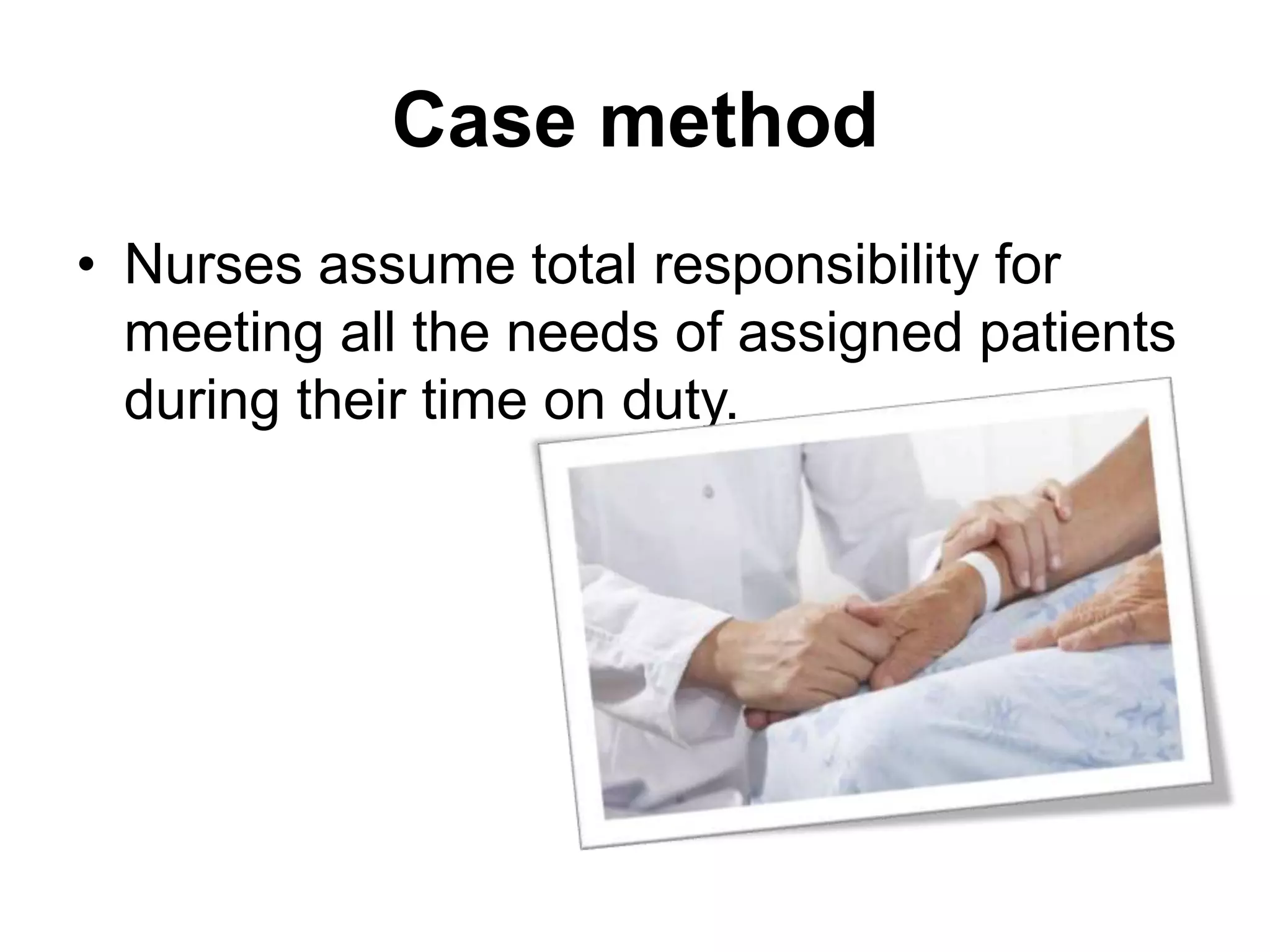
• Nurses assume total responsibility for
meeting all the needs of assigned patients
during their time on duty.
Characteristics:
• Complete care.
• Nurses with high autonomy and responsibility.
• It is developed and communicated through
written sources, its usage remains in
contemporary practice.
• The lines of authority and accountability are
clear.
Merits:
• The nurses attend to total needs of clients
• Continuity of care.
• Client/ nurse interaction/rapport can be
developed.
• Client may feel more comfortable
• Educational needs of the client can be closely
monitored.
• Family and friends became better known by
the nurse
• Workload of the patient can be equally
divided.
• Nurse’s accountability for their function is
built-in.
Demerits:
• Many clients do not require the inherent care
of intensity in this type of service.
• This method need to be modified if
professional workers are to be involved
effectively.
• It is difficult for the nurses to use this method
to become involved in long term planning and
evaluation of care.
• It is not possible if the nurses are not
adequately trained for the total care of the
patient.
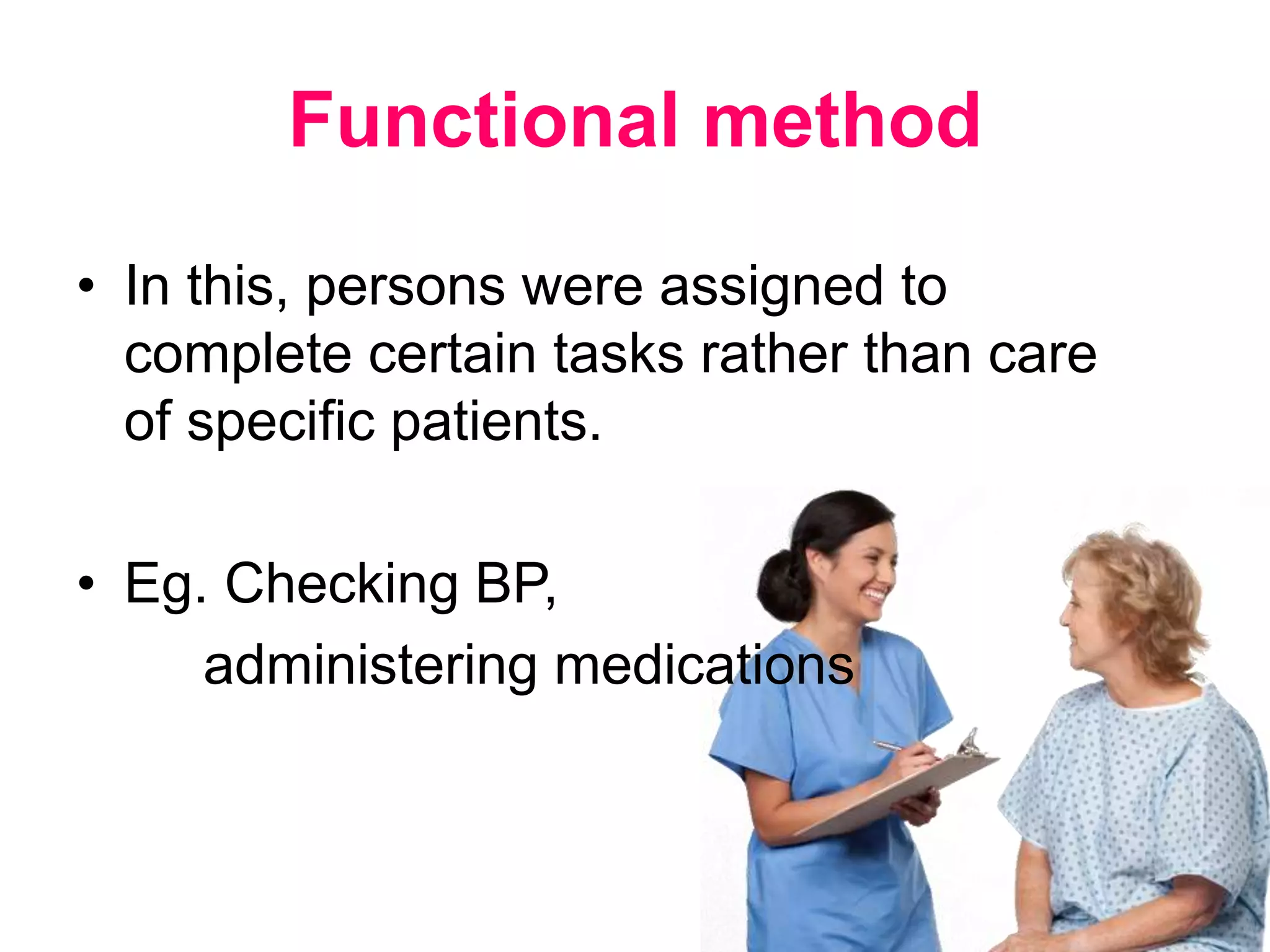
Functional method
• In this, persons were assigned to
complete certain tasks rather than care
of specific patients.
• Eg. Checking BP,
administering medications
Characteristics:
• A functional method is a technical approach
of nursing care.
• The available staff in the unit, for a particular
period of time, are assigned selected
functions of nursing practice such as vital
signs, treatments, medications.
• All the responsibilities are assigned in
accordance with the expertise.
• The only person who has responsibility of the
client is the head nurse or nurse acting the
role.
Merits:
• Person become specifically skilled in
performing certain assigned task.
• Best utilization of a person’s aptitudes,
experiences and desires.
• Less equipment is needed.
• Saves time.
• Development of technical skill
• Sense of productivity for the task oriented
nurse
• Easy to organize the work of the unit and
staff
Demerits:
• Client care become impersonal,
compartmentalized and fragmented.
• Diminishing continuity of care.
• Staff may become bored and have little
motivation.
• Only the nurse in-charge has
accountability for the client.
Continues…
• Little avenue for the staff development.
• Client may tend to feel insecure.
• Only parts of the nursing care plan are
known
• Difficult to establish the client priorities.
• Only safe when the head nurse co-
ordinate all the activities of the members.
Team nursing
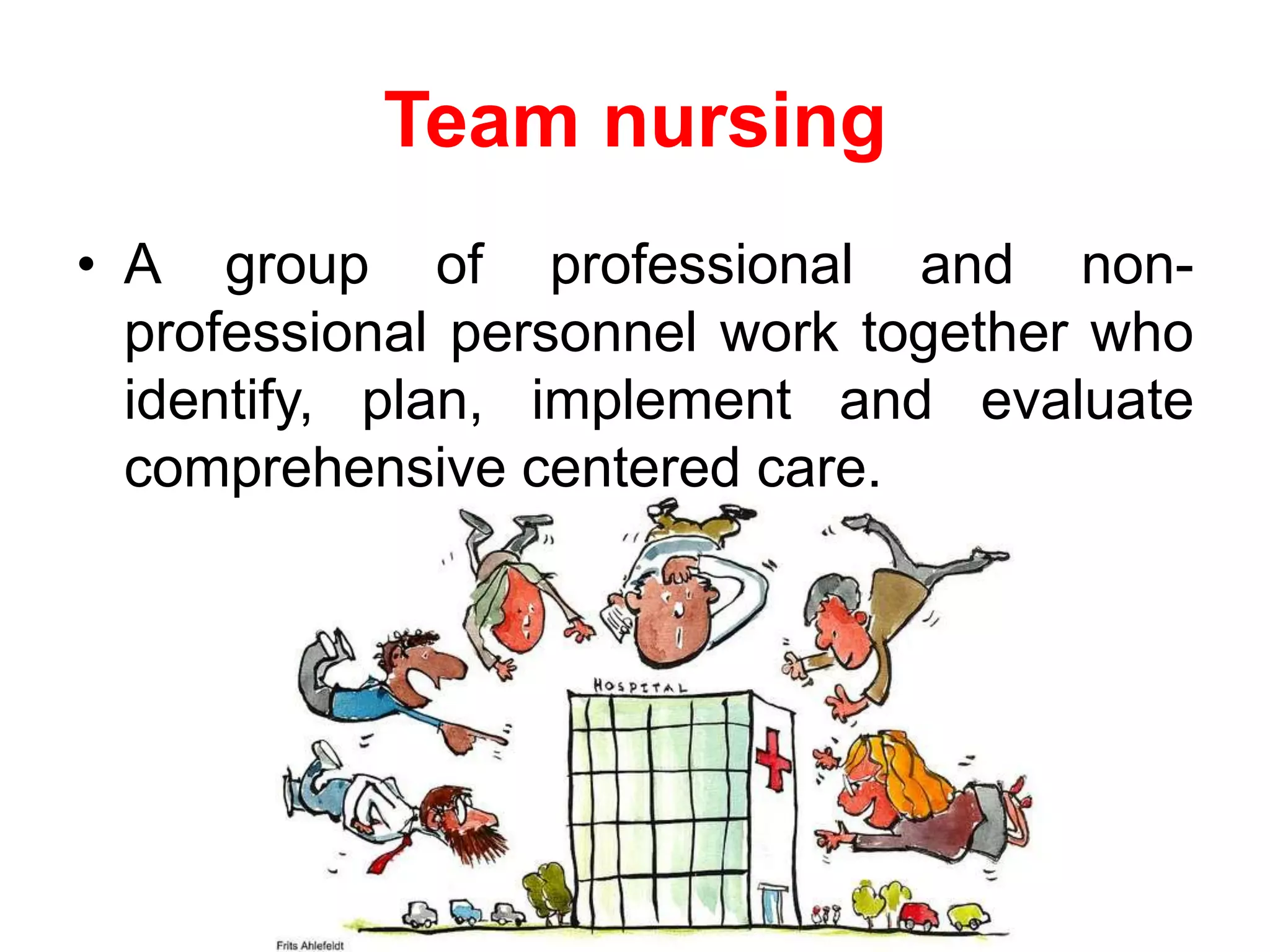
• A group of professional and non-
professional personnel work together who
identify, plan, implement and evaluate
comprehensive centered care.
Characteristics:
• Ancillary personnel collaborate in
providing care.
• Team nursing involves decentralization of
nursing unit and professional head nurse
authority.
• Each team composed of a team leader,
team members and patients.
• Comprehensive care is the responsibility
of the entire team.
Continues…
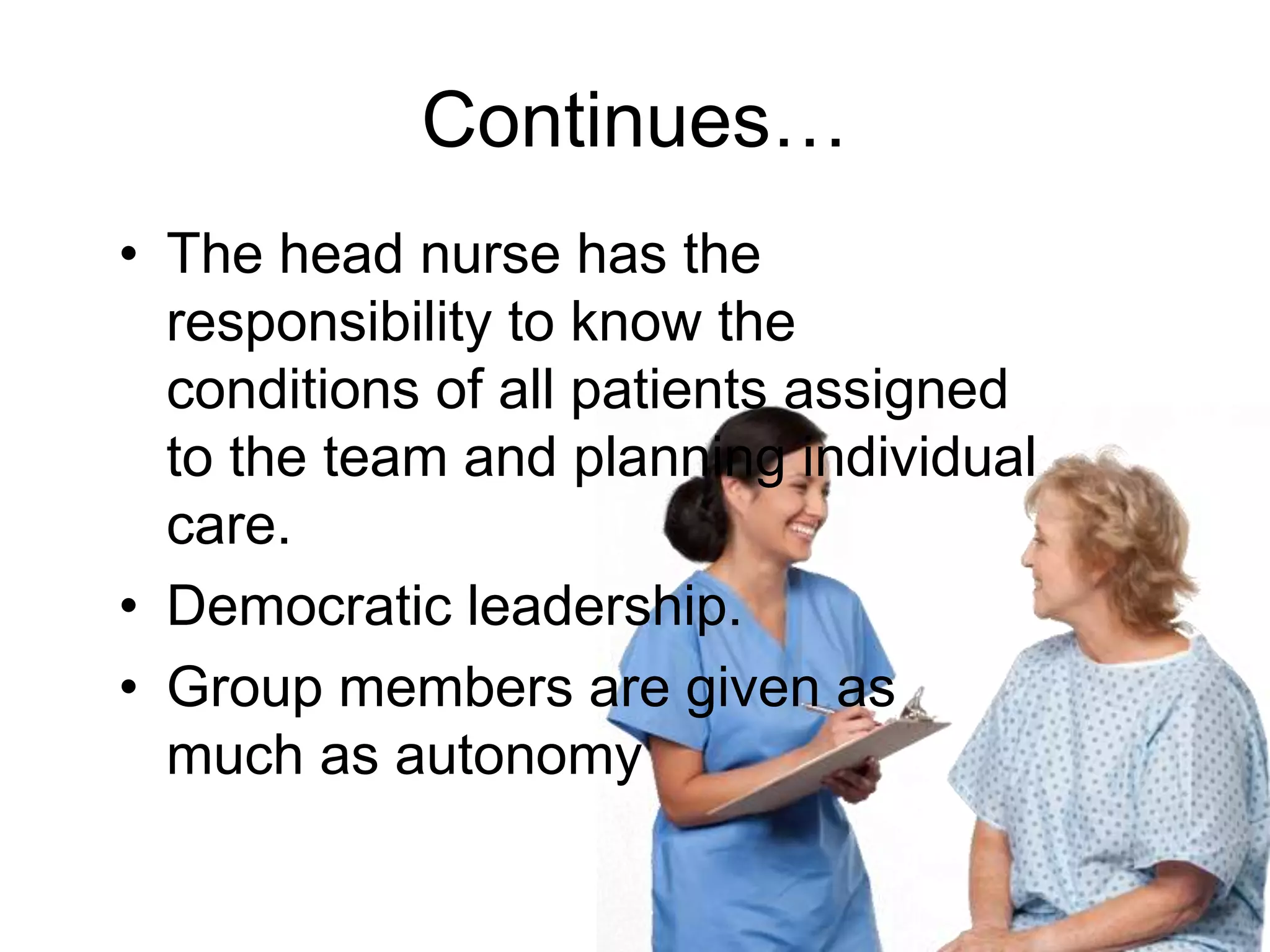
• The head nurse has the
responsibility to know the
conditions of all patients assigned
to the team and planning individual
care.
• Democratic leadership.
• Group members are given as
much as autonomy
Merits:
• includes all health care personnel in the
group functioning and goals.
• Feelings of participation and belonging
• Workload can be balanced and shared.
• Division of labor allows members the
opportunity to develop leadership skills
• Every team members has the opportunity
to learn from and teach colleagues.
Demerits:
• Establishing the team concept takes time, effort
and constancy of personnel.
• Unstable staffing patterns make team nursing
skills patterns make team nursing difficult.
• All personnel must be client centered.
• This leads to blurred lines of responsibility,
errors, and fragmented care.
• For the team nursing to be effective the leader
must be excellent practitioner and have good
communication, organizational, management,
and leadership skills.
Primary nursing
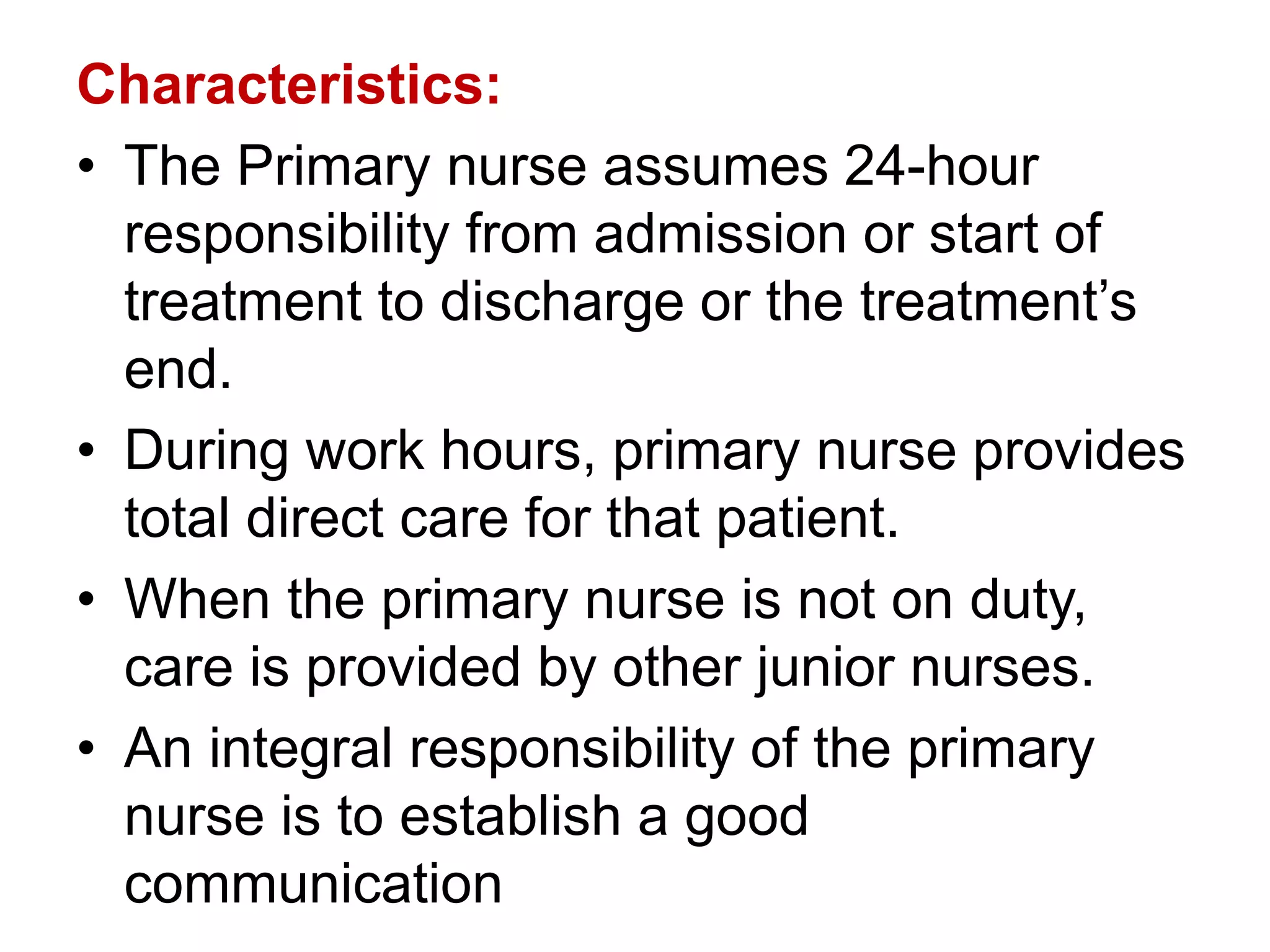
• It is also called
relationship based
nursing. It involves
total nursing care,
directed by a nurse on
24 hour basis as long
as the client is under
the care.
Characteristics:
• The Primary nurse assumes 24-hour
responsibility from admission or start of
treatment to discharge or the treatment’s
end.
• During work hours, primary nurse provides
total direct care for that patient.
• When the primary nurse is not on duty,
care is provided by other junior nurses.
• An integral responsibility of the primary
nurse is to establish a good
communication
Merits:
• Opportunity for the nurse to see the client
and family as one system.
• Nursing accountability, responsibility and
independence are increased.
• The nurse is able to use wide range of
skills, knowledge and expertise.
• Potentiates creativity by the nurse and
thereby work satisfaction increases
• Increased trust and satisfaction for both
Demerits:
• The nurse may be isolated from the
colleagues.
• Little avenue for group planning of care.
• Nurse must be mature and independently
competent.
• It must be cost effective.
• Staffing patterns may necessitate a heavy
client load.
• It may be difficult to recruit and retain
enough staff, especially in times of nursing
shortage.
Case management
A collaborative process that assesses,
plans, implements, coordinates, monitors
and evaluates opinions and services to
meet an individual health needs through
communication and available resources to
promote quality, cost-effective outcomes.
Case management society of America
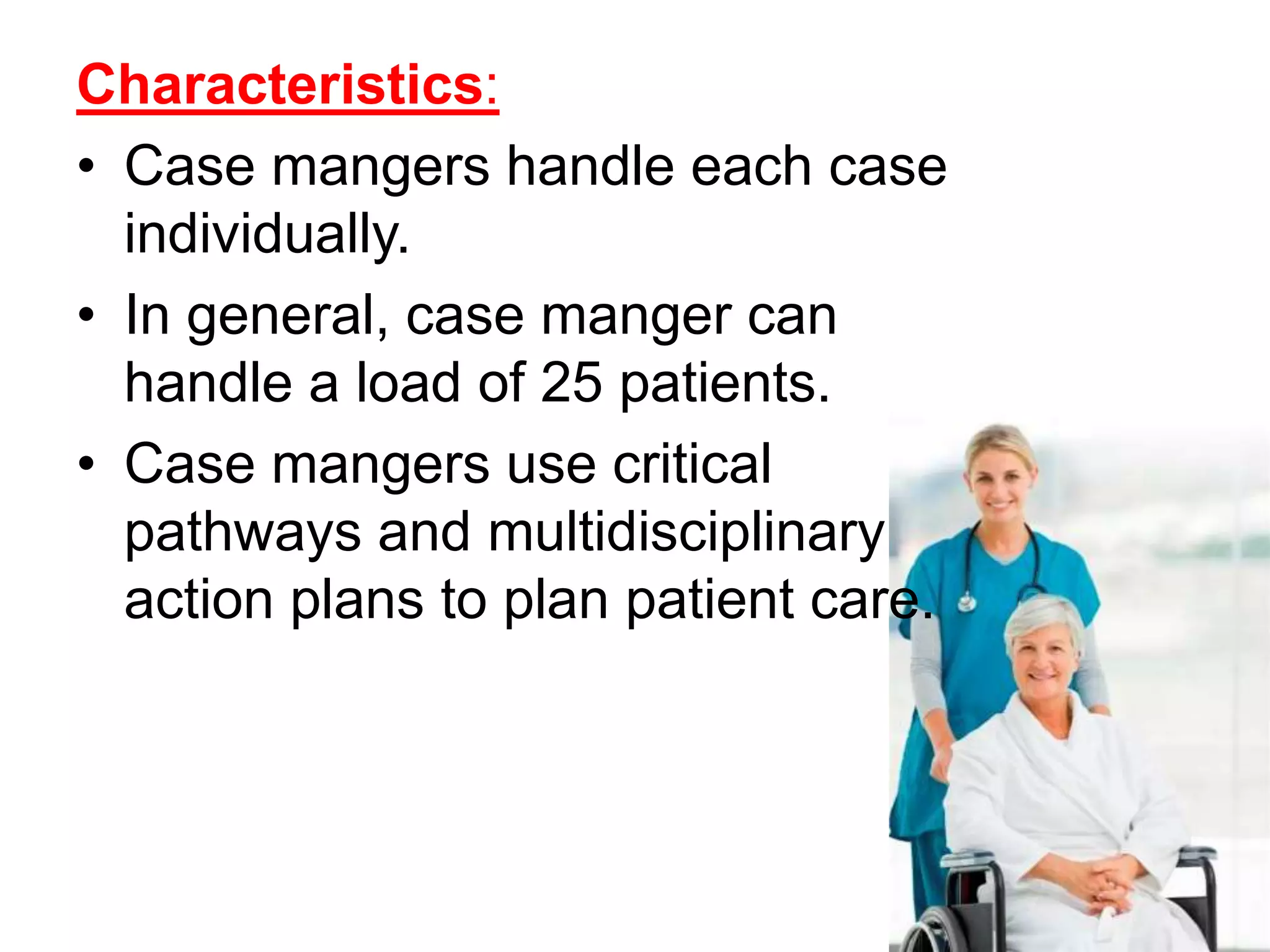
Characteristics:
• Case mangers handle each case
individually.
• In general, case manger can
handle a load of 25 patients.
• Case mangers use critical
pathways and multidisciplinary
action plans to plan patient care.
Responsibilities of case managers:
• Assessing clients and their homes and
communities.
• Coordinating and planning client care.
• Collaborating with other health team
• Monitoring client progress and client
outcomes.
• Advocating for clients
• Serving as a liaison with third party
Merits:
• Additional work efficiency due to
geographical proximity.
• Establishes solid relationships with nursing
and ancillary staff working on the unit.
• Case management provides a well
coordinated care.
• Provides comprehensive care
• It seeks the active involvement of the
patient, family and diverse health care
professionals
Demerits:
• Some experts are argued that this role should
be reserved for the advance practitioner
nurse or an RN with advanced training or
need 3 to 5 year experience.
• The case manger should also be extremely
bright, have well developed interpersonal
skills, be able to multitask, have a strong
foundation in utilization review, and
understand payer-patient specifics and
hospital reimbursement mechanisms.
• Expensive
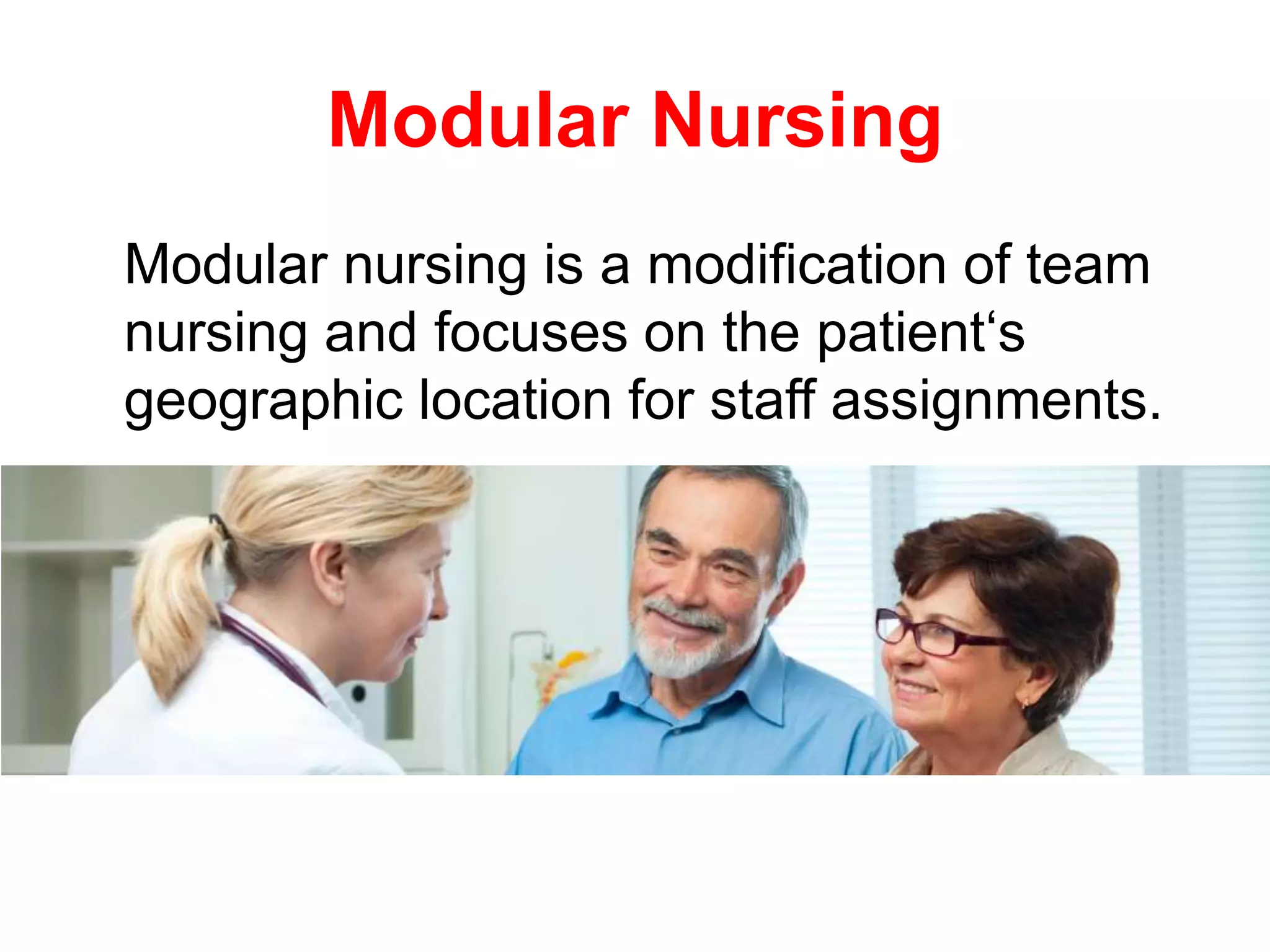
Modular Nursing
Modular nursing is a modification of team
nursing and focuses on the patient‘s
geographic location for staff assignments.
Characteristics:
• The patient unit is divided into modules or
districts, and the same team of caregivers
is assigned consistently to the same
geographic location.
• Each location, or module, has an RN
assigned as the team leader, and the other
team members may include LPN.
Continues..
• The team leader is accountable for all
patient care and is responsible for
providing leadership for team members
and creating a cooperative work
environment.
• The success of the modular nursing
depends greatly on the leadership abilities
of the team leader.
Merits:
♣ Nursing care hours are usually cost-
effective.
♣ The client is able to identify personnel who
are responsible for his care.
♣ All care is directed by a registered nurse.
♣ Continuity of care is improved
♣ The RN as team leader is able to be more
involved in planning & coordinating care.
♣ Save staff time.
♣ Feelings of participation and belonging
♣ Work load can be balanced and shared.
♣ Develop leadership skills
♣ Continuity care is facilitated
♣ Everyone has the opportunity to contribute
to the care plan.
Demerits:
♠ Costs may be increased to stock each
♠ Takes time, effort, and constancy of
personnel.
♠ Unstable staffing pattern make team
difficult.
♠ There is less individual responsibility and
autonomy regarding nursing function.
♠ All personnel must be client centered.
♠ The team leader must have complex skills
and knowledge.
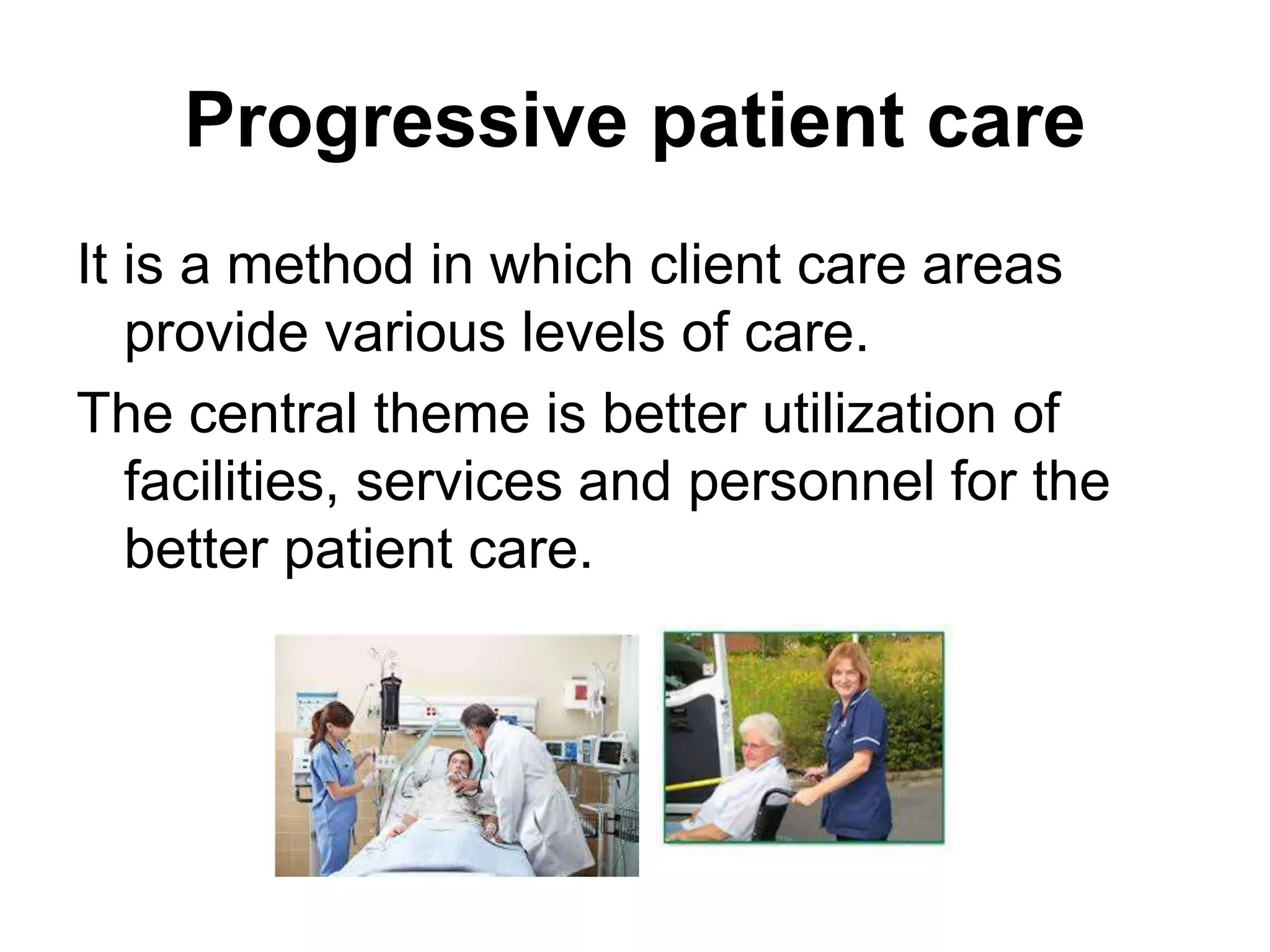
Progressive patient care
It is a method in which client care areas
provide various levels of care.
The central theme is better utilization of
facilities, services and personnel for the
better patient care.
Principal elements of PPC
• Intensive care or critical care
• Intermediate care
• Convalescent and Self Care
• Long-term care
• Home care
• Ambulatory care
Merits:
♣ Efficient use is made of personnel and
equipment.
♣ Clients are in the best place to receive the
care .
♣ Use of nursing skills and expertise are
maximized.
♣ Clients are moved towards self care,
independence is fostered where indicated.
♣ Efficient use and placement of equipment is
possible.
♣ Persons have greater probability to function
towards their fullest capacity.
Demerits:
♣ Discomfort to clients who are moved often.
♣ Continuity care is difficult.
♣ Nurse/Client relationships are difficult to
arrange.
♣ Great emphasis is placed on
comprehensive, written care plan.
♣ There is often difficulty in meeting
administrative need of the organization,
staffing evaluation and accreditation.
Differentiated Nursing Practice
• An attempt to separate nursing practice roles
based on education or experience or some
combination of both.
• Education model:
Role differentiation based upon type of
educational preparation [BSN, MSN etc]
• Competency model:
Role differentiation based on individual
nursing skills, expertise, experience etc.
Merits:
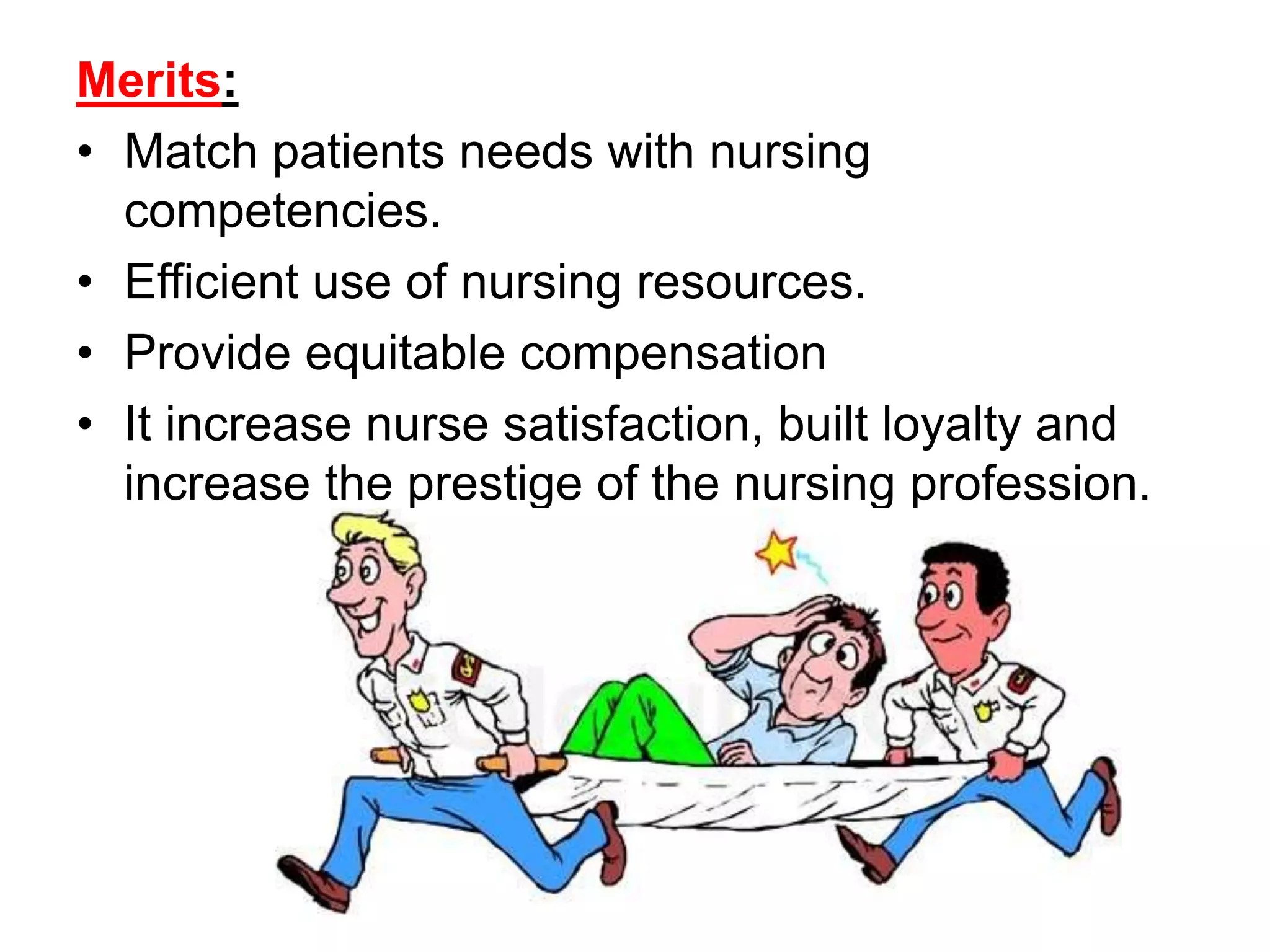
• Match patients needs with nursing
competencies.
• Efficient use of nursing resources.
• Provide equitable compensation
• It increase nurse satisfaction, built loyalty and
increase the prestige of the nursing profession.
THANK YOU…

Patient classification system bjb

  • 1.
    Models of Patient assignment BivinJB Dept of Psychiatric Nursing
  • 2.
    Introduction • Grouping ofpatients according to the amount & complexity of their nursing requirements • Patient acuity- Nursing work load that is generated for each patients • Patient acuity ≈ Amount of nursing service • Patient classification system is the scheme that group patients according to the amount & complexity of their nursing care requirements
  • 3.
  • 4.
    Presentation overview 1. Casemethod nursing or total patient care. 2. Functional nursing 3. Team nursing or modular nursing 4. Primary nursing 5. Case management or managed care
  • 5.
    Case method • Nursesassume total responsibility for meeting all the needs of assigned patients during their time on duty.
  • 6.
    Characteristics: • Complete care. •Nurses with high autonomy and responsibility. • It is developed and communicated through written sources, its usage remains in contemporary practice. • The lines of authority and accountability are clear.
  • 7.
    Merits: • The nursesattend to total needs of clients • Continuity of care. • Client/ nurse interaction/rapport can be developed. • Client may feel more comfortable • Educational needs of the client can be closely monitored. • Family and friends became better known by the nurse • Workload of the patient can be equally divided. • Nurse’s accountability for their function is built-in.
  • 8.
    Demerits: • Many clientsdo not require the inherent care of intensity in this type of service. • This method need to be modified if professional workers are to be involved effectively. • It is difficult for the nurses to use this method to become involved in long term planning and evaluation of care. • It is not possible if the nurses are not adequately trained for the total care of the patient.
  • 9.
    Functional method • Inthis, persons were assigned to complete certain tasks rather than care of specific patients. • Eg. Checking BP, administering medications
  • 10.
    Characteristics: • A functionalmethod is a technical approach of nursing care. • The available staff in the unit, for a particular period of time, are assigned selected functions of nursing practice such as vital signs, treatments, medications. • All the responsibilities are assigned in accordance with the expertise. • The only person who has responsibility of the client is the head nurse or nurse acting the role.
  • 11.
    Merits: • Person becomespecifically skilled in performing certain assigned task. • Best utilization of a person’s aptitudes, experiences and desires. • Less equipment is needed. • Saves time. • Development of technical skill • Sense of productivity for the task oriented nurse • Easy to organize the work of the unit and staff
  • 12.
    Demerits: • Client carebecome impersonal, compartmentalized and fragmented. • Diminishing continuity of care. • Staff may become bored and have little motivation. • Only the nurse in-charge has accountability for the client.
  • 13.
    Continues… • Little avenuefor the staff development. • Client may tend to feel insecure. • Only parts of the nursing care plan are known • Difficult to establish the client priorities. • Only safe when the head nurse co- ordinate all the activities of the members.
  • 14.
    Team nursing • Agroup of professional and non- professional personnel work together who identify, plan, implement and evaluate comprehensive centered care.
  • 15.
    Characteristics: • Ancillary personnelcollaborate in providing care. • Team nursing involves decentralization of nursing unit and professional head nurse authority. • Each team composed of a team leader, team members and patients. • Comprehensive care is the responsibility of the entire team.
  • 16.
    Continues… • The headnurse has the responsibility to know the conditions of all patients assigned to the team and planning individual care. • Democratic leadership. • Group members are given as much as autonomy
  • 17.
    Merits: • includes allhealth care personnel in the group functioning and goals. • Feelings of participation and belonging • Workload can be balanced and shared. • Division of labor allows members the opportunity to develop leadership skills • Every team members has the opportunity to learn from and teach colleagues.
  • 18.
    Demerits: • Establishing theteam concept takes time, effort and constancy of personnel. • Unstable staffing patterns make team nursing skills patterns make team nursing difficult. • All personnel must be client centered. • This leads to blurred lines of responsibility, errors, and fragmented care. • For the team nursing to be effective the leader must be excellent practitioner and have good communication, organizational, management, and leadership skills.
  • 19.
    Primary nursing • Itis also called relationship based nursing. It involves total nursing care, directed by a nurse on 24 hour basis as long as the client is under the care.
  • 20.
    Characteristics: • The Primarynurse assumes 24-hour responsibility from admission or start of treatment to discharge or the treatment’s end. • During work hours, primary nurse provides total direct care for that patient. • When the primary nurse is not on duty, care is provided by other junior nurses. • An integral responsibility of the primary nurse is to establish a good communication
  • 21.
    Merits: • Opportunity forthe nurse to see the client and family as one system. • Nursing accountability, responsibility and independence are increased. • The nurse is able to use wide range of skills, knowledge and expertise. • Potentiates creativity by the nurse and thereby work satisfaction increases • Increased trust and satisfaction for both
  • 22.
    Demerits: • The nursemay be isolated from the colleagues. • Little avenue for group planning of care. • Nurse must be mature and independently competent. • It must be cost effective. • Staffing patterns may necessitate a heavy client load. • It may be difficult to recruit and retain enough staff, especially in times of nursing shortage.
  • 23.
    Case management A collaborativeprocess that assesses, plans, implements, coordinates, monitors and evaluates opinions and services to meet an individual health needs through communication and available resources to promote quality, cost-effective outcomes. Case management society of America
  • 24.
    Characteristics: • Case mangershandle each case individually. • In general, case manger can handle a load of 25 patients. • Case mangers use critical pathways and multidisciplinary action plans to plan patient care.
  • 25.
    Responsibilities of casemanagers: • Assessing clients and their homes and communities. • Coordinating and planning client care. • Collaborating with other health team • Monitoring client progress and client outcomes. • Advocating for clients • Serving as a liaison with third party
  • 26.
    Merits: • Additional workefficiency due to geographical proximity. • Establishes solid relationships with nursing and ancillary staff working on the unit. • Case management provides a well coordinated care. • Provides comprehensive care • It seeks the active involvement of the patient, family and diverse health care professionals
  • 27.
    Demerits: • Some expertsare argued that this role should be reserved for the advance practitioner nurse or an RN with advanced training or need 3 to 5 year experience. • The case manger should also be extremely bright, have well developed interpersonal skills, be able to multitask, have a strong foundation in utilization review, and understand payer-patient specifics and hospital reimbursement mechanisms. • Expensive
  • 28.
    Modular Nursing Modular nursingis a modification of team nursing and focuses on the patient‘s geographic location for staff assignments.
  • 29.
    Characteristics: • The patientunit is divided into modules or districts, and the same team of caregivers is assigned consistently to the same geographic location. • Each location, or module, has an RN assigned as the team leader, and the other team members may include LPN.
  • 30.
    Continues.. • The teamleader is accountable for all patient care and is responsible for providing leadership for team members and creating a cooperative work environment. • The success of the modular nursing depends greatly on the leadership abilities of the team leader.
  • 31.
    Merits: ♣ Nursing carehours are usually cost- effective. ♣ The client is able to identify personnel who are responsible for his care. ♣ All care is directed by a registered nurse. ♣ Continuity of care is improved ♣ The RN as team leader is able to be more involved in planning & coordinating care.
  • 32.
    ♣ Save stafftime. ♣ Feelings of participation and belonging ♣ Work load can be balanced and shared. ♣ Develop leadership skills ♣ Continuity care is facilitated ♣ Everyone has the opportunity to contribute to the care plan.
  • 33.
    Demerits: ♠ Costs maybe increased to stock each ♠ Takes time, effort, and constancy of personnel. ♠ Unstable staffing pattern make team difficult. ♠ There is less individual responsibility and autonomy regarding nursing function. ♠ All personnel must be client centered. ♠ The team leader must have complex skills and knowledge.
  • 34.
    Progressive patient care Itis a method in which client care areas provide various levels of care. The central theme is better utilization of facilities, services and personnel for the better patient care.
  • 35.
    Principal elements ofPPC • Intensive care or critical care • Intermediate care • Convalescent and Self Care • Long-term care • Home care • Ambulatory care
  • 36.
    Merits: ♣ Efficient useis made of personnel and equipment. ♣ Clients are in the best place to receive the care . ♣ Use of nursing skills and expertise are maximized. ♣ Clients are moved towards self care, independence is fostered where indicated. ♣ Efficient use and placement of equipment is possible. ♣ Persons have greater probability to function towards their fullest capacity.
  • 37.
    Demerits: ♣ Discomfort toclients who are moved often. ♣ Continuity care is difficult. ♣ Nurse/Client relationships are difficult to arrange. ♣ Great emphasis is placed on comprehensive, written care plan. ♣ There is often difficulty in meeting administrative need of the organization, staffing evaluation and accreditation.
  • 38.
    Differentiated Nursing Practice •An attempt to separate nursing practice roles based on education or experience or some combination of both. • Education model: Role differentiation based upon type of educational preparation [BSN, MSN etc] • Competency model: Role differentiation based on individual nursing skills, expertise, experience etc.
  • 39.
    Merits: • Match patientsneeds with nursing competencies. • Efficient use of nursing resources. • Provide equitable compensation • It increase nurse satisfaction, built loyalty and increase the prestige of the nursing profession.
  • 40.