



Childhood Anxiety
Thomas Clay, MSW, Terry LaRue, MSW
December, 2014
1
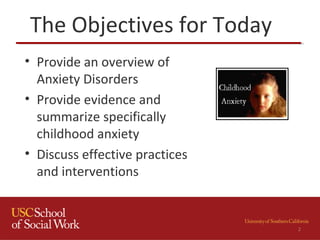
The Objectives for Today
• Provide an overview of
Anxiety Disorders
• Provide evidence and
summarize specifically
childhood anxiety
• Discuss effective practices
and interventions
2
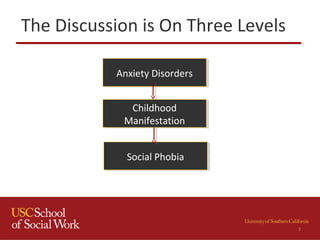
The Discussion is On Three Levels
3
Anxiety DisordersAnxiety Disorders
Childhood
Manifestation
Childhood
Manifestation
Social PhobiaSocial Phobia
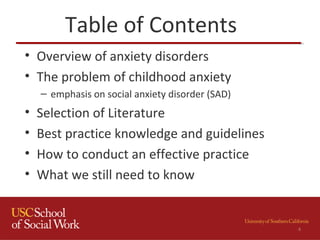
Table of Contents
• Overview of anxiety disorders
• The problem of childhood anxiety
– emphasis on social anxiety disorder (SAD)
• Selection of Literature
• Best practice knowledge and guidelines
• How to conduct an effective practice
• What we still need to know
4
5
I. Overview
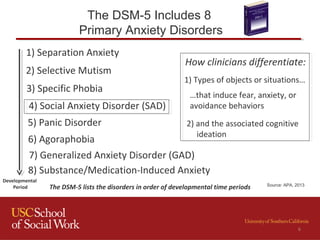
1) Separation Anxiety
2) Selective Mutism
4) Social Anxiety Disorder (SAD)
3) Specific Phobia
5) Panic Disorder
6) Agoraphobia
7) Generalized Anxiety Disorder (GAD)
8) Substance/Medication-Induced Anxiety
The DSM-5 Includes 8
Primary Anxiety Disorders
How clinicians differentiate:
1) Types of objects or situations…
…that induce fear, anxiety, or
avoidance behaviors
2) and the associated cognitive
ideation
The DSM-5 lists the disorders in order of developmental time periods Source: APA, 2013
Developmental
Period
6
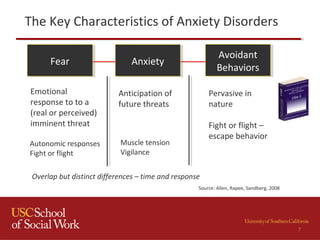
The Key Characteristics of Anxiety Disorders
FearFear AnxietyAnxiety
Avoidant
Behaviors
Avoidant
Behaviors
Emotional
response to to a
(real or perceived)
imminent threat
Anticipation of
future threats
Pervasive in
nature
Fight or flight –
escape behavior
Autonomic responses
Fight or flight
Muscle tension
Vigilance
Overlap but distinct differences – time and response
Source: Allen, Rapee, Sandberg, 2008
7
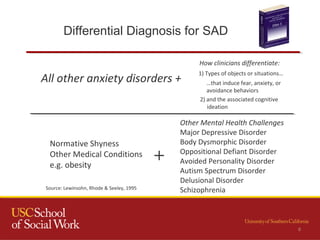
Differential Diagnosis for SAD
8
All other anxiety disorders +
Other Mental Health Challenges
Major Depressive Disorder
Body Dysmorphic Disorder
Oppositional Defiant Disorder
Avoided Personality Disorder
Autism Spectrum Disorder
Delusional Disorder
Schizophrenia
Normative Shyness
Other Medical Conditions
e.g. obesity
How clinicians differentiate:
1) Types of objects or situations…
…that induce fear, anxiety, or
avoidance behaviors
2) and the associated cognitive
ideation
+
Source: Lewinsohn, Rhode & Seeley, 1995
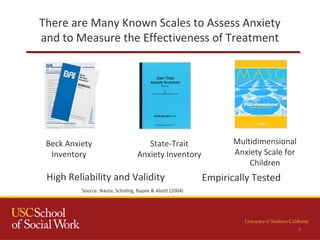
There are Many Known Scales to Assess Anxiety
and to Measure the Effectiveness of Treatment
Beck Anxiety
Inventory
State-Trait
Anxiety Inventory
High Reliability and Validity Empirically Tested
9
Multidimensional
Anxiety Scale for
Children
Source: Nauta, Scholing, Rapee & Abott (2004)
10
II. The Problem of
Childhood Anxiety
Anxiety is a Significant
Challenge for Many Children
• Research suggests anxious children:
– Marked impact on child development
– Miss out on key social experiences
– Commonly comorbid with other disorders
• Anxiety has the highest prevalence rate of all mental health
challenges for children:
– Research suggests that approximately 2.5 to 5% of children and
adolescents meet the DSM guidelines for an anxiety disorder at any
given time
– Females have twice the risk than males to develop disorders
Source: Rapee, Schniering & Hudson, 2009
11
Childhood Anxiety Has a Moderate
to High Impact on Functioning
• Largest impact area is family processes
• Functioning in school and with peers is significantly
impacted
• Positively associated with victimization (bullying)
• Negatively associated with popularity and social
competence
• Childhood anxiety often continues to impact functioning
into adulthood
12
Source: Rapee, 2012, 2013
Childhood Anxiety Has an
Impact on Brain Integration
• Dr. Daniel Siegel defines well-being as:
– “the vertical and horizontal integration of widely separated
areas in the brain”
• Stress causes cortisol to be released
• Excessive stress impacts the:
– development of areas of the brain that link widely separated
areas
• Three primary areas involved–
– the prefrontal area, the hippocampus, and the corpus callosum
• Cortisol can slow the growth of synapses, kill
synapses, and can kill whole neurons
13
Source: Siegel, 2010
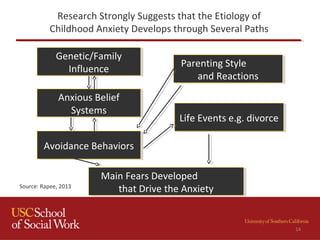
Research Strongly Suggests that the Etiology of
Childhood Anxiety Develops through Several Paths
Genetic/Family
Influence
Genetic/Family
Influence
Anxious Belief
Systems
Anxious Belief
Systems
Parenting Style
and Reactions
Parenting Style
and Reactions
Life Events e.g. divorceLife Events e.g. divorce
Avoidance BehaviorsAvoidance Behaviors
Main Fears Developed
that Drive the Anxiety
Main Fears Developed
that Drive the AnxietySource: Rapee, 2013
14
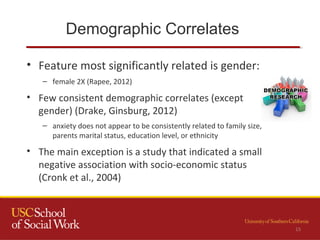
Demographic Correlates
• Feature most significantly related is gender:
– female 2X (Rapee, 2012)
• Few consistent demographic correlates (except
gender) (Drake, Ginsburg, 2012)
– anxiety does not appear to be consistently related to family size,
parents marital status, education level, or ethnicity
• The main exception is a study that indicated a small
negative association with socio-economic status
(Cronk et al., 2004)
15
Risk Factors
• Poor pre-natal care has been associated with
anxiety (Lewinsohn, Rohde & Seeley, 1995)
• First degree relatives with an anxiety disorders
– increase likelihood of development 6X (Rapee, 2012)
• Children most at risk for social anxiety disorder:
– include disabled, obese and children with low-self esteem and /
or social awkwardness (Hettema, Neale & Kendler, 2001)
16
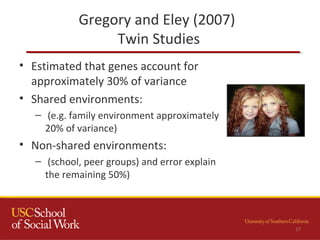
Gregory and Eley (2007)
Twin Studies
17
• Estimated that genes account for
approximately 30% of variance
• Shared environments:
– (e.g. family environment approximately
20% of variance)
• Non-shared environments:
– (school, peer groups) and error explain
the remaining 50%)
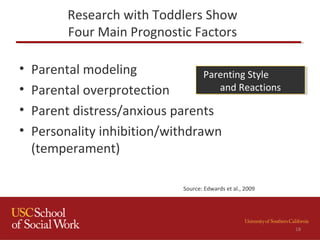
Research with Toddlers Show
Four Main Prognostic Factors
• Parental modeling
• Parental overprotection
• Parent distress/anxious parents
• Personality inhibition/withdrawn
(temperament)
Parenting Style
and Reactions
Parenting Style
and Reactions
Source: Edwards et al., 2009
18
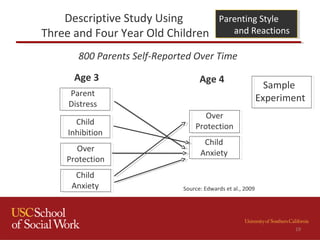
Descriptive Study Using
Three and Four Year Old Children
Parenting Style
and Reactions
Parenting Style
and Reactions
800 Parents Self-Reported Over Time
Parent
Distress
Child
Inhibition
Over
Protection
Child
Anxiety
Age 3 Age 4
Source: Edwards et al., 2009
Over
Protection
Child
Anxiety
19
Sample
Experiment
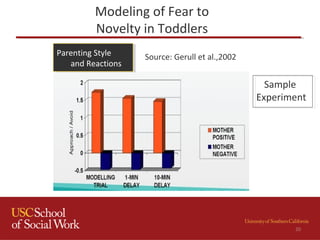
Modeling of Fear to
Novelty in Toddlers
Source: Gerull et al.,2002Parenting Style
and Reactions
Parenting Style
and Reactions
20
Sample
Experiment
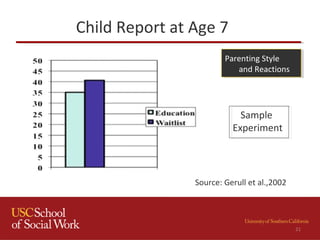
Child Report at Age 7
Parenting Style
and Reactions
Parenting Style
and Reactions
Source: Gerull et al.,2002
21
Sample
Experiment
A Sample of Theories that Inform
the Problem of Childhood Anxiety
22
• Etiological studies point to familial
• Erikson’s life stage theory
• Social learning theory – learning through
modeling
• Attachment theory – neurological factors
• Cognitive behavioral theory – thought distortions
• Empowerment theory – social acceptance
Source: Rapee, 2013
Deleterious Effects of Anxiety
• Internalizing affect – higher probability for
women
• Externalizing affect – more males impacted
• Social functioning impairment
• Marital status and intimacy issues
• Overall employability
• Educational obtainment
Source: Rapee, 2012, 2013
It’s important
to help children
manage anxiety
as they progress
to adulthood.
23
The DSM-5 Symptoms for
Social Anxiety Disorder (SAD) Include…
• Excessive anxiety across a variety of social domains:
– e.g. meeting new people, being observed in front of others, eating in
groups, everyday dyadic conversations
• Fear is present in almost all social situations and has
persisted for at least six months
• One has a heightened sense of being evaluated by others:
– humiliating/embarrassing; will lead to rejection or will offend others
• Clear demonstration of avoidance behaviors relative to
social situations
Source: APA, 2013
24
The Clinical Presentation of Childhood Anxiety
• Excessive distress out of proportion to the
situation
• Repetitive reassurance questions: “what if”
• Anticipatory anxiety – often weeks ahead
• Perfectionism and overly self-critical
• Demonstrating excessive avoidance
• Excessive time consoling child about distress
in ordinary situations
Source: The Children’s and Adult Center for Anxiety
25
Comorbidity Rates are Significant
• Research suggests that 40-50% of anxious children meet
criteria for more than one anxiety disorder
– Likely reflects common risks and maintenance (Rapee, 2012)
• High correlation with depression (Brady & Kendall, 1992)
– anxious children 8 to 29 times the risk for depression
• Population studies have confirmed strong overlap between
anxiety and depression (Angold et al., 1999)
• Unlike adult anxiety, childhood anxiety does not have a
strong correlation to substance abuse
Source: Rapee, Schniering & Hudson, 2009
26
Development and Course
27
Researchers use homotypic vs. heterotypic continuity as relevant
constructs for childhood anxiety:
•Homotypic refers to a future occurrence of the same constellation of
symptoms:
– Medium age of onset 13 years old (SAD)
– Research suggests moderate to strong homotypic continuity in
anxious children. The disorder continues as they move through life
stages.
•Heterotypic continuity refers to developing other additional disorders
later in life:
– Research suggests a strong relationship with later depression and
substance abuse
Source: Rapee, Schniering & Hudson (2007)
28
III. Selection of Literature
Search Procedures
29
• Searched USC libraries databases, Google Scholar, National
Institute of Health, PsychInfo, ProQuest Psychology Journals,
Family & Society Studies Worldwide, National Registry of
Evidence Based Programs and Practices (SAMSHA)
• A sample of search terms and phrases:
– “evidence based practice for childhood anxiety”
– “prevalence of childhood anxiety”
– “diagnosing childhood anxiety”
Availability, Quality and
Selection of Literature
30
• A significant amount of research exists:
– the large portion is peer reviewed, random controlled
experiments
– we also reviewed 4 meta-analyses
• New research being added and an increased
emphasis since early 1990’s
• However, a wide range of prevalence rates
• Also, some gaps in the literature
– (to be discussed later) Source: Rapee, 2013
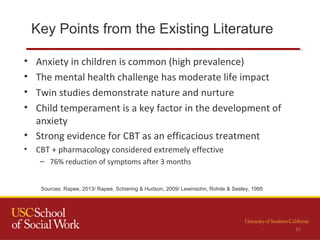
Key Points from the Existing Literature
31
• Anxiety in children is common (high prevalence)
• The mental health challenge has moderate life impact
• Twin studies demonstrate nature and nurture
• Child temperament is a key factor in the development of
anxiety
• Strong evidence for CBT as an efficacious treatment
• CBT + pharmacology considered extremely effective
– 76% reduction of symptoms after 3 months
Sources: Rapee, 2013/ Rapee, Schiering & Hudson, 2009/ Lewinsohn, Rohde & Seeley, 1995
32
IV. Best Practice Knowledge
and Guidelines
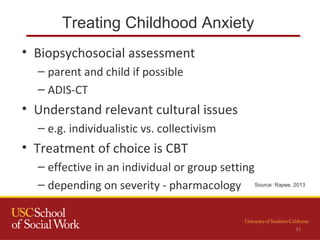
Treating Childhood Anxiety
33
• Biopsychosocial assessment
– parent and child if possible
– ADIS-CT
• Understand relevant cultural issues
– e.g. individualistic vs. collectivism
• Treatment of choice is CBT
– effective in an individual or group setting
– depending on severity - pharmacology Source: Rapee, 2013
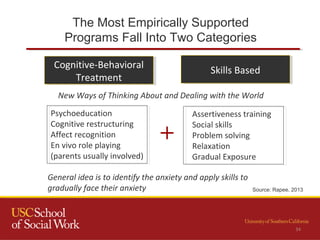
The Most Empirically Supported
Programs Fall Into Two Categories
34
Cognitive-Behavioral
Treatment
Cognitive-Behavioral
Treatment
Skills BasedSkills Based
Assertiveness training
Social skills
Problem solving
Relaxation
Gradual Exposure
Psychoeducation
Cognitive restructuring
Affect recognition
En vivo role playing
(parents usually involved)
General idea is to identify the anxiety and apply skills to
gradually face their anxiety Source: Rapee, 2013
New Ways of Thinking About and Dealing with the World
+
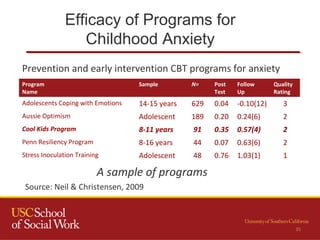
Efficacy of Programs for
Childhood Anxiety
35
Program
Name
Sample N= Post
Test
Follow
Up
Quality
Rating
Adolescents Coping with Emotions 14-15 years 629 0.04 -0.10(12) 3
Aussie Optimism Adolescent 189 0.20 0.24(6) 2
Cool Kids Program 8-11 years 91 0.35 0.57(4) 2
Penn Resiliency Program 8-16 years 44 0.07 0.63(6) 2
Stress Inoculation Training Adolescent 48 0.76 1.03(1) 1
A sample of programs
Prevention and early intervention CBT programs for anxiety
Source: Neil & Christensen, 2009
36
An Overview of an
Evidence Based Practice
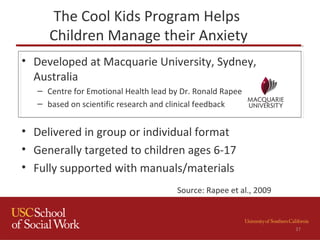
The Cool Kids Program Helps
Children Manage their Anxiety
• Developed at Macquarie University, Sydney,
Australia
– Centre for Emotional Health lead by Dr. Ronald Rapee
– based on scientific research and clinical feedback
• Delivered in group or individual format
• Generally targeted to children ages 6-17
• Fully supported with manuals/materials
Source: Rapee et al., 2009
37
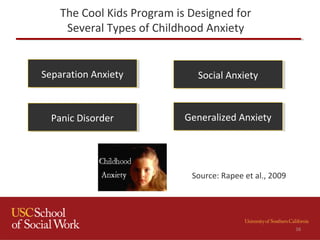
The Cool Kids Program is Designed for
Several Types of Childhood Anxiety
Generalized AnxietyGeneralized Anxiety
Social AnxietySocial Anxiety
Panic DisorderPanic Disorder
Separation AnxietySeparation Anxiety
38
Source: Rapee et al., 2009
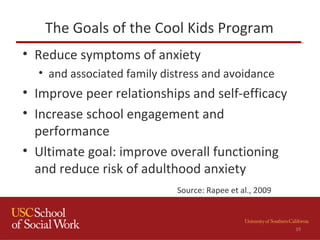
The Goals of the Cool Kids Program
• Reduce symptoms of anxiety
• and associated family distress and avoidance
• Improve peer relationships and self-efficacy
• Increase school engagement and
performance
• Ultimate goal: improve overall functioning
and reduce risk of adulthood anxiety
39
Source: Rapee et al., 2009
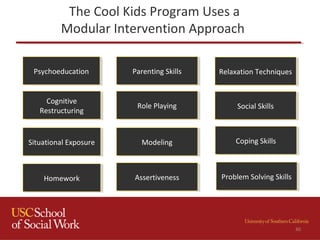
The Cool Kids Program Uses a
Modular Intervention Approach
PsychoeducationPsychoeducation
HomeworkHomework
Parenting SkillsParenting Skills
Cognitive
Restructuring
Cognitive
Restructuring
Relaxation TechniquesRelaxation Techniques
Social SkillsSocial SkillsRole PlayingRole Playing
Problem Solving SkillsProblem Solving Skills
ModelingModeling
AssertivenessAssertiveness
Coping SkillsCoping SkillsSituational ExposureSituational Exposure
40
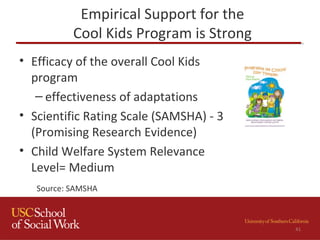
Empirical Support for the
Cool Kids Program is Strong
• Efficacy of the overall Cool Kids
program
– effectiveness of adaptations
• Scientific Rating Scale (SAMSHA) - 3
(Promising Research Evidence)
• Child Welfare System Relevance
Level= Medium
41
Source: SAMSHA
Empirical Support for the Cool
Kids Program is Strong (Cont.)
• Cool Kids scored in the top 10 of all programs
(SAMSHA)
• Cool Kids program at post-test 4-month effect
size (.57)
• Programs specifically studying ages 7-11, Cool
Kids tied for 1st
• Why did we choose the program?
42
Source: Rapee et al., 2009
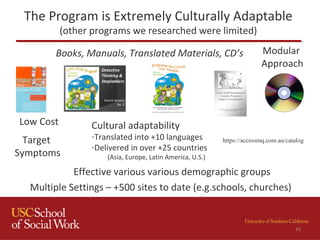
The Program is Extremely Culturally Adaptable
(other programs we researched were limited)
Low Cost
Target
Symptoms
Cultural adaptability
-Translated into +10 languages
-Delivered in over +25 countries
(Asia, Europe, Latin America, U.S.)
Multiple Settings – +500 sites to date (e.g.schools, churches)
Effective various various demographic groups
43
Books, Manuals, Translated Materials, CD’s Modular
Approach
https://accessmq.com.au/catalog
Evidence Based Practices
Alternative Treatment
• EMDR – proven efficacious for a wide range of
disorders, including anxiety, panic attacks, and
social phobias
• Delivery method(s) – especially via bibliotherapy
– low cost, minimal therapist contact
– empirically tested:
• Randomized controlled test (bibliotherapy, standard group, or wait list)
• Bibliotherapy demonstrated benefit relative to standard group and
wait list
44
45
V. How to Conduct
Effective Practice
Salient Factors that Impact
Treatment Outcomes
• Type of assessment tool used and outcome
measure emphasized
– Diagnostic status, clinician ratings, child self-report,
parent report
– Research suggests more positive outcomes with child
self-report
• Parent anxiety status and parenting style
• Comorbidity – additional challenges
Source: Rapee, Schniering & Hudson (2007)
46
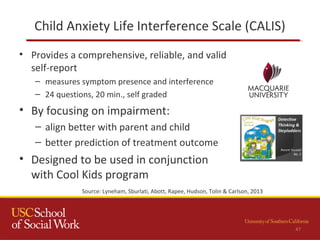
Child Anxiety Life Interference Scale (CALIS)
47
Source: Lyneham, Sburlati, Abott, Rapee, Hudson, Tolin & Carlson, 2013
• Provides a comprehensive, reliable, and valid
self-report
– measures symptom presence and interference
– 24 questions, 20 min., self graded
• By focusing on impairment:
– align better with parent and child
– better prediction of treatment outcome
• Designed to be used in conjunction
with Cool Kids program
Child Anxiety Life Interference Scale (CALIS)
High Reliability – Cronbach’s Alpha on child’s life - .80
48
Source: Lyneham, Sburlati, Abott, Rapee, Hudson, Tolin & Carlson, 2013
Cronbach’s Alpha for mother’s report - .88
Cronbach’s Alpha for father’s report - .89
High Validity – Moderate to strong positive correlations for
self-reported internalizing symptoms
Moderate positive correlations between
anxiety interference scores and externalizing
symptoms
How to Conduct Effective Practice
Acting Upon the Principles of CBT
• Sessions 1-2 – psychoeducation
– “name it and tame it” cognitive reactions
• Thematic anxiety triggers worksheet
• Sessions 3-5 – social skills training and cognitive
rehearsal
• Relaxation training
• Session 5-8 – imaginal exposure and measuring
anxiety symptoms
49
Sources: Beck, 2011/ Ledley, Marx & Heimberg, 2010
Efficacious Medications for
Childhood Anxiety
50
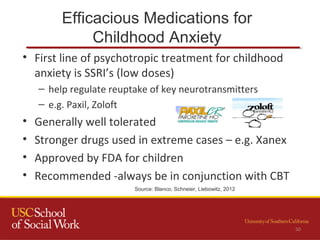
• First line of psychotropic treatment for childhood
anxiety is SSRI’s (low doses)
– help regulate reuptake of key neurotransmitters
– e.g. Paxil, Zoloft
• Generally well tolerated
• Stronger drugs used in extreme cases – e.g. Xanex
• Approved by FDA for children
• Recommended -always be in conjunction with CBT
Source: Blanco, Schneier, Liebowitz, 2012
51
VI. What We Still
Need to Know
Future Knowledge Needed
52
1. A common methodology to measure prevalence
2. A comprehensive understanding of factors leading to
childhood anxiety (Rapee, 2013)
3. Additional understanding of gender differences
4. The significance of parent involvement in treatment:
1. limited studies show little effect (Barrett, 1998)
5. Stronger comorbidity research
6. The mechanisms by which parent anxiety impacts the child’s
anxiety and treatment outcomes (Rapee, 2012)
Trends for Future Research
53
1. Stress is being studied extensively as part of several
“brain initiatives”
2. Research is being conducted that focuses more on
prevention strategies for entire populations e.g.
school districts
3. Alternative delivery methods are being
experimentally tested
Sources: Rapee, 2013/ Rapee, Schiering & Hudson, 2009/ Lewinsohn, Rohde & Seeley, 1995
Knowledge and Skills Needed
for Effective Practice
54
• Specialized training for assessing childhood anxiety
and using scales
– ADIS-C, CALIS, MASC
• CBT training and familiarity with Cool Kid modules
• Training in delivering social skills training
• Additional training e.g. play therapy, role play and
thematic psychology
Important Cultural Considerations
55
• Harper & Lantz (1994) outlined eight important variables
when working with anxious clients:
– Understanding and respect for client’s worldview
– Emphasis on hope and empowerment
– Recognition of cultural rites designed to aid in transitions
– Cultural norms regarding the expression of emotions
– Allowing client to apply personal “meaning to their experience”
• However, respect for individual qualities and experience is
vital to develop an effective therapeutic relationship
Source: Harper & Lantz (1994)
56
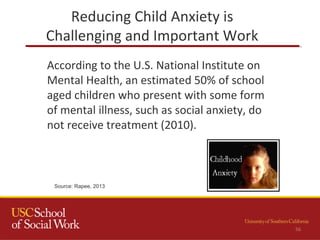
According to the U.S. National Institute on
Mental Health, an estimated 50% of school
aged children who present with some form
of mental illness, such as social anxiety, do
not receive treatment (2010).
Source: Rapee, 2013
Reducing Child Anxiety is
Challenging and Important Work
What We Covered Today
• Provided an overview of
Anxiety Disorders
• Provided evidence and
summarize specifically
childhood anxiety
• Discussed effective practices
and interventions
57




Childhood anxiety

  • 1.
    Childhood Anxiety Thomas Clay,MSW, Terry LaRue, MSW December, 2014 1
  • 2.
    The Objectives forToday • Provide an overview of Anxiety Disorders • Provide evidence and summarize specifically childhood anxiety • Discuss effective practices and interventions 2
  • 3.
    The Discussion isOn Three Levels 3 Anxiety DisordersAnxiety Disorders Childhood Manifestation Childhood Manifestation Social PhobiaSocial Phobia
  • 4.
    Table of Contents •Overview of anxiety disorders • The problem of childhood anxiety – emphasis on social anxiety disorder (SAD) • Selection of Literature • Best practice knowledge and guidelines • How to conduct an effective practice • What we still need to know 4
  • 5.
  • 6.
    1) Separation Anxiety 2)Selective Mutism 4) Social Anxiety Disorder (SAD) 3) Specific Phobia 5) Panic Disorder 6) Agoraphobia 7) Generalized Anxiety Disorder (GAD) 8) Substance/Medication-Induced Anxiety The DSM-5 Includes 8 Primary Anxiety Disorders How clinicians differentiate: 1) Types of objects or situations… …that induce fear, anxiety, or avoidance behaviors 2) and the associated cognitive ideation The DSM-5 lists the disorders in order of developmental time periods Source: APA, 2013 Developmental Period 6
  • 7.
    The Key Characteristicsof Anxiety Disorders FearFear AnxietyAnxiety Avoidant Behaviors Avoidant Behaviors Emotional response to to a (real or perceived) imminent threat Anticipation of future threats Pervasive in nature Fight or flight – escape behavior Autonomic responses Fight or flight Muscle tension Vigilance Overlap but distinct differences – time and response Source: Allen, Rapee, Sandberg, 2008 7
  • 8.
    Differential Diagnosis forSAD 8 All other anxiety disorders + Other Mental Health Challenges Major Depressive Disorder Body Dysmorphic Disorder Oppositional Defiant Disorder Avoided Personality Disorder Autism Spectrum Disorder Delusional Disorder Schizophrenia Normative Shyness Other Medical Conditions e.g. obesity How clinicians differentiate: 1) Types of objects or situations… …that induce fear, anxiety, or avoidance behaviors 2) and the associated cognitive ideation + Source: Lewinsohn, Rhode & Seeley, 1995
  • 9.
    There are ManyKnown Scales to Assess Anxiety and to Measure the Effectiveness of Treatment Beck Anxiety Inventory State-Trait Anxiety Inventory High Reliability and Validity Empirically Tested 9 Multidimensional Anxiety Scale for Children Source: Nauta, Scholing, Rapee & Abott (2004)
  • 10.
    10 II. The Problemof Childhood Anxiety
  • 11.
    Anxiety is aSignificant Challenge for Many Children • Research suggests anxious children: – Marked impact on child development – Miss out on key social experiences – Commonly comorbid with other disorders • Anxiety has the highest prevalence rate of all mental health challenges for children: – Research suggests that approximately 2.5 to 5% of children and adolescents meet the DSM guidelines for an anxiety disorder at any given time – Females have twice the risk than males to develop disorders Source: Rapee, Schniering & Hudson, 2009 11
  • 12.
    Childhood Anxiety Hasa Moderate to High Impact on Functioning • Largest impact area is family processes • Functioning in school and with peers is significantly impacted • Positively associated with victimization (bullying) • Negatively associated with popularity and social competence • Childhood anxiety often continues to impact functioning into adulthood 12 Source: Rapee, 2012, 2013
  • 13.
    Childhood Anxiety Hasan Impact on Brain Integration • Dr. Daniel Siegel defines well-being as: – “the vertical and horizontal integration of widely separated areas in the brain” • Stress causes cortisol to be released • Excessive stress impacts the: – development of areas of the brain that link widely separated areas • Three primary areas involved– – the prefrontal area, the hippocampus, and the corpus callosum • Cortisol can slow the growth of synapses, kill synapses, and can kill whole neurons 13 Source: Siegel, 2010
  • 14.
    Research Strongly Suggeststhat the Etiology of Childhood Anxiety Develops through Several Paths Genetic/Family Influence Genetic/Family Influence Anxious Belief Systems Anxious Belief Systems Parenting Style and Reactions Parenting Style and Reactions Life Events e.g. divorceLife Events e.g. divorce Avoidance BehaviorsAvoidance Behaviors Main Fears Developed that Drive the Anxiety Main Fears Developed that Drive the AnxietySource: Rapee, 2013 14
  • 15.
    Demographic Correlates • Featuremost significantly related is gender: – female 2X (Rapee, 2012) • Few consistent demographic correlates (except gender) (Drake, Ginsburg, 2012) – anxiety does not appear to be consistently related to family size, parents marital status, education level, or ethnicity • The main exception is a study that indicated a small negative association with socio-economic status (Cronk et al., 2004) 15
  • 16.
    Risk Factors • Poorpre-natal care has been associated with anxiety (Lewinsohn, Rohde & Seeley, 1995) • First degree relatives with an anxiety disorders – increase likelihood of development 6X (Rapee, 2012) • Children most at risk for social anxiety disorder: – include disabled, obese and children with low-self esteem and / or social awkwardness (Hettema, Neale & Kendler, 2001) 16
  • 17.
    Gregory and Eley(2007) Twin Studies 17 • Estimated that genes account for approximately 30% of variance • Shared environments: – (e.g. family environment approximately 20% of variance) • Non-shared environments: – (school, peer groups) and error explain the remaining 50%)
  • 18.
    Research with ToddlersShow Four Main Prognostic Factors • Parental modeling • Parental overprotection • Parent distress/anxious parents • Personality inhibition/withdrawn (temperament) Parenting Style and Reactions Parenting Style and Reactions Source: Edwards et al., 2009 18
  • 19.
    Descriptive Study Using Threeand Four Year Old Children Parenting Style and Reactions Parenting Style and Reactions 800 Parents Self-Reported Over Time Parent Distress Child Inhibition Over Protection Child Anxiety Age 3 Age 4 Source: Edwards et al., 2009 Over Protection Child Anxiety 19 Sample Experiment
  • 20.
    Modeling of Fearto Novelty in Toddlers Source: Gerull et al.,2002Parenting Style and Reactions Parenting Style and Reactions 20 Sample Experiment
  • 21.
    Child Report atAge 7 Parenting Style and Reactions Parenting Style and Reactions Source: Gerull et al.,2002 21 Sample Experiment
  • 22.
    A Sample ofTheories that Inform the Problem of Childhood Anxiety 22 • Etiological studies point to familial • Erikson’s life stage theory • Social learning theory – learning through modeling • Attachment theory – neurological factors • Cognitive behavioral theory – thought distortions • Empowerment theory – social acceptance Source: Rapee, 2013
  • 23.
    Deleterious Effects ofAnxiety • Internalizing affect – higher probability for women • Externalizing affect – more males impacted • Social functioning impairment • Marital status and intimacy issues • Overall employability • Educational obtainment Source: Rapee, 2012, 2013 It’s important to help children manage anxiety as they progress to adulthood. 23
  • 24.
    The DSM-5 Symptomsfor Social Anxiety Disorder (SAD) Include… • Excessive anxiety across a variety of social domains: – e.g. meeting new people, being observed in front of others, eating in groups, everyday dyadic conversations • Fear is present in almost all social situations and has persisted for at least six months • One has a heightened sense of being evaluated by others: – humiliating/embarrassing; will lead to rejection or will offend others • Clear demonstration of avoidance behaviors relative to social situations Source: APA, 2013 24
  • 25.
    The Clinical Presentationof Childhood Anxiety • Excessive distress out of proportion to the situation • Repetitive reassurance questions: “what if” • Anticipatory anxiety – often weeks ahead • Perfectionism and overly self-critical • Demonstrating excessive avoidance • Excessive time consoling child about distress in ordinary situations Source: The Children’s and Adult Center for Anxiety 25
  • 26.
    Comorbidity Rates areSignificant • Research suggests that 40-50% of anxious children meet criteria for more than one anxiety disorder – Likely reflects common risks and maintenance (Rapee, 2012) • High correlation with depression (Brady & Kendall, 1992) – anxious children 8 to 29 times the risk for depression • Population studies have confirmed strong overlap between anxiety and depression (Angold et al., 1999) • Unlike adult anxiety, childhood anxiety does not have a strong correlation to substance abuse Source: Rapee, Schniering & Hudson, 2009 26
  • 27.
    Development and Course 27 Researchersuse homotypic vs. heterotypic continuity as relevant constructs for childhood anxiety: •Homotypic refers to a future occurrence of the same constellation of symptoms: – Medium age of onset 13 years old (SAD) – Research suggests moderate to strong homotypic continuity in anxious children. The disorder continues as they move through life stages. •Heterotypic continuity refers to developing other additional disorders later in life: – Research suggests a strong relationship with later depression and substance abuse Source: Rapee, Schniering & Hudson (2007)
  • 28.
  • 29.
    Search Procedures 29 • SearchedUSC libraries databases, Google Scholar, National Institute of Health, PsychInfo, ProQuest Psychology Journals, Family & Society Studies Worldwide, National Registry of Evidence Based Programs and Practices (SAMSHA) • A sample of search terms and phrases: – “evidence based practice for childhood anxiety” – “prevalence of childhood anxiety” – “diagnosing childhood anxiety”
  • 30.
    Availability, Quality and Selectionof Literature 30 • A significant amount of research exists: – the large portion is peer reviewed, random controlled experiments – we also reviewed 4 meta-analyses • New research being added and an increased emphasis since early 1990’s • However, a wide range of prevalence rates • Also, some gaps in the literature – (to be discussed later) Source: Rapee, 2013
  • 31.
    Key Points fromthe Existing Literature 31 • Anxiety in children is common (high prevalence) • The mental health challenge has moderate life impact • Twin studies demonstrate nature and nurture • Child temperament is a key factor in the development of anxiety • Strong evidence for CBT as an efficacious treatment • CBT + pharmacology considered extremely effective – 76% reduction of symptoms after 3 months Sources: Rapee, 2013/ Rapee, Schiering & Hudson, 2009/ Lewinsohn, Rohde & Seeley, 1995
  • 32.
    32 IV. Best PracticeKnowledge and Guidelines
  • 33.
    Treating Childhood Anxiety 33 •Biopsychosocial assessment – parent and child if possible – ADIS-CT • Understand relevant cultural issues – e.g. individualistic vs. collectivism • Treatment of choice is CBT – effective in an individual or group setting – depending on severity - pharmacology Source: Rapee, 2013
  • 34.
    The Most EmpiricallySupported Programs Fall Into Two Categories 34 Cognitive-Behavioral Treatment Cognitive-Behavioral Treatment Skills BasedSkills Based Assertiveness training Social skills Problem solving Relaxation Gradual Exposure Psychoeducation Cognitive restructuring Affect recognition En vivo role playing (parents usually involved) General idea is to identify the anxiety and apply skills to gradually face their anxiety Source: Rapee, 2013 New Ways of Thinking About and Dealing with the World +
  • 35.
    Efficacy of Programsfor Childhood Anxiety 35 Program Name Sample N= Post Test Follow Up Quality Rating Adolescents Coping with Emotions 14-15 years 629 0.04 -0.10(12) 3 Aussie Optimism Adolescent 189 0.20 0.24(6) 2 Cool Kids Program 8-11 years 91 0.35 0.57(4) 2 Penn Resiliency Program 8-16 years 44 0.07 0.63(6) 2 Stress Inoculation Training Adolescent 48 0.76 1.03(1) 1 A sample of programs Prevention and early intervention CBT programs for anxiety Source: Neil & Christensen, 2009
  • 36.
    36 An Overview ofan Evidence Based Practice
  • 37.
    The Cool KidsProgram Helps Children Manage their Anxiety • Developed at Macquarie University, Sydney, Australia – Centre for Emotional Health lead by Dr. Ronald Rapee – based on scientific research and clinical feedback • Delivered in group or individual format • Generally targeted to children ages 6-17 • Fully supported with manuals/materials Source: Rapee et al., 2009 37
  • 38.
    The Cool KidsProgram is Designed for Several Types of Childhood Anxiety Generalized AnxietyGeneralized Anxiety Social AnxietySocial Anxiety Panic DisorderPanic Disorder Separation AnxietySeparation Anxiety 38 Source: Rapee et al., 2009
  • 39.
    The Goals ofthe Cool Kids Program • Reduce symptoms of anxiety • and associated family distress and avoidance • Improve peer relationships and self-efficacy • Increase school engagement and performance • Ultimate goal: improve overall functioning and reduce risk of adulthood anxiety 39 Source: Rapee et al., 2009
  • 40.
    The Cool KidsProgram Uses a Modular Intervention Approach PsychoeducationPsychoeducation HomeworkHomework Parenting SkillsParenting Skills Cognitive Restructuring Cognitive Restructuring Relaxation TechniquesRelaxation Techniques Social SkillsSocial SkillsRole PlayingRole Playing Problem Solving SkillsProblem Solving Skills ModelingModeling AssertivenessAssertiveness Coping SkillsCoping SkillsSituational ExposureSituational Exposure 40
  • 41.
    Empirical Support forthe Cool Kids Program is Strong • Efficacy of the overall Cool Kids program – effectiveness of adaptations • Scientific Rating Scale (SAMSHA) - 3 (Promising Research Evidence) • Child Welfare System Relevance Level= Medium 41 Source: SAMSHA
  • 42.
    Empirical Support forthe Cool Kids Program is Strong (Cont.) • Cool Kids scored in the top 10 of all programs (SAMSHA) • Cool Kids program at post-test 4-month effect size (.57) • Programs specifically studying ages 7-11, Cool Kids tied for 1st • Why did we choose the program? 42 Source: Rapee et al., 2009
  • 43.
    The Program isExtremely Culturally Adaptable (other programs we researched were limited) Low Cost Target Symptoms Cultural adaptability -Translated into +10 languages -Delivered in over +25 countries (Asia, Europe, Latin America, U.S.) Multiple Settings – +500 sites to date (e.g.schools, churches) Effective various various demographic groups 43 Books, Manuals, Translated Materials, CD’s Modular Approach https://accessmq.com.au/catalog
  • 44.
    Evidence Based Practices AlternativeTreatment • EMDR – proven efficacious for a wide range of disorders, including anxiety, panic attacks, and social phobias • Delivery method(s) – especially via bibliotherapy – low cost, minimal therapist contact – empirically tested: • Randomized controlled test (bibliotherapy, standard group, or wait list) • Bibliotherapy demonstrated benefit relative to standard group and wait list 44
  • 45.
    45 V. How toConduct Effective Practice
  • 46.
    Salient Factors thatImpact Treatment Outcomes • Type of assessment tool used and outcome measure emphasized – Diagnostic status, clinician ratings, child self-report, parent report – Research suggests more positive outcomes with child self-report • Parent anxiety status and parenting style • Comorbidity – additional challenges Source: Rapee, Schniering & Hudson (2007) 46
  • 47.
    Child Anxiety LifeInterference Scale (CALIS) 47 Source: Lyneham, Sburlati, Abott, Rapee, Hudson, Tolin & Carlson, 2013 • Provides a comprehensive, reliable, and valid self-report – measures symptom presence and interference – 24 questions, 20 min., self graded • By focusing on impairment: – align better with parent and child – better prediction of treatment outcome • Designed to be used in conjunction with Cool Kids program
  • 48.
    Child Anxiety LifeInterference Scale (CALIS) High Reliability – Cronbach’s Alpha on child’s life - .80 48 Source: Lyneham, Sburlati, Abott, Rapee, Hudson, Tolin & Carlson, 2013 Cronbach’s Alpha for mother’s report - .88 Cronbach’s Alpha for father’s report - .89 High Validity – Moderate to strong positive correlations for self-reported internalizing symptoms Moderate positive correlations between anxiety interference scores and externalizing symptoms
  • 49.
    How to ConductEffective Practice Acting Upon the Principles of CBT • Sessions 1-2 – psychoeducation – “name it and tame it” cognitive reactions • Thematic anxiety triggers worksheet • Sessions 3-5 – social skills training and cognitive rehearsal • Relaxation training • Session 5-8 – imaginal exposure and measuring anxiety symptoms 49 Sources: Beck, 2011/ Ledley, Marx & Heimberg, 2010
  • 50.
    Efficacious Medications for ChildhoodAnxiety 50 • First line of psychotropic treatment for childhood anxiety is SSRI’s (low doses) – help regulate reuptake of key neurotransmitters – e.g. Paxil, Zoloft • Generally well tolerated • Stronger drugs used in extreme cases – e.g. Xanex • Approved by FDA for children • Recommended -always be in conjunction with CBT Source: Blanco, Schneier, Liebowitz, 2012
  • 51.
    51 VI. What WeStill Need to Know
  • 52.
    Future Knowledge Needed 52 1.A common methodology to measure prevalence 2. A comprehensive understanding of factors leading to childhood anxiety (Rapee, 2013) 3. Additional understanding of gender differences 4. The significance of parent involvement in treatment: 1. limited studies show little effect (Barrett, 1998) 5. Stronger comorbidity research 6. The mechanisms by which parent anxiety impacts the child’s anxiety and treatment outcomes (Rapee, 2012)
  • 53.
    Trends for FutureResearch 53 1. Stress is being studied extensively as part of several “brain initiatives” 2. Research is being conducted that focuses more on prevention strategies for entire populations e.g. school districts 3. Alternative delivery methods are being experimentally tested Sources: Rapee, 2013/ Rapee, Schiering & Hudson, 2009/ Lewinsohn, Rohde & Seeley, 1995
  • 54.
    Knowledge and SkillsNeeded for Effective Practice 54 • Specialized training for assessing childhood anxiety and using scales – ADIS-C, CALIS, MASC • CBT training and familiarity with Cool Kid modules • Training in delivering social skills training • Additional training e.g. play therapy, role play and thematic psychology
  • 55.
    Important Cultural Considerations 55 •Harper & Lantz (1994) outlined eight important variables when working with anxious clients: – Understanding and respect for client’s worldview – Emphasis on hope and empowerment – Recognition of cultural rites designed to aid in transitions – Cultural norms regarding the expression of emotions – Allowing client to apply personal “meaning to their experience” • However, respect for individual qualities and experience is vital to develop an effective therapeutic relationship Source: Harper & Lantz (1994)
  • 56.
    56 According to theU.S. National Institute on Mental Health, an estimated 50% of school aged children who present with some form of mental illness, such as social anxiety, do not receive treatment (2010). Source: Rapee, 2013 Reducing Child Anxiety is Challenging and Important Work
  • 57.
    What We CoveredToday • Provided an overview of Anxiety Disorders • Provided evidence and summarize specifically childhood anxiety • Discussed effective practices and interventions 57   