Bivin JB
Dept of Psychiatric Nursing
Functions of a Hospital
• Preventive
– Concerned with health promotion
– Participated with community/peripheral health
care delivery systems
• Curative
– Patient care
– Includes health education
• Training
– Continuing and on the job training
• Research
– Health related researches
Categories of Hospitals
• Based on levels of
functioning:
• Primary hospitals
• Secondary hospitals
• Tertiary hospitals
• Based clinical
specialties:
• General hospitals
• Special hospitals• Based
ownership:
• Government
Principles of Planning Hospital
Units
• Protection
– Protection from unwanted & unnecessary
disturbances in order to help speedy recovery
• Separation
– Separation of dissimilar activities
• Control
– Control over the untoward incidents
• Circulation
– Proper integration of departments
• Emerson Goble
Objectives of Planning Hospital
Units
• Provide quality care
– Quality medical services & enhancing patient
satisfaction
• Provide maximum comfort
– Comfort in terms of safety, security, convenience &
privacy
– Avoiding slippery floors, direct sunlight etc.
• Enhance staff satisfaction
– Staff motivation & safe working environment
• Patient relatives & visitors convenience
– Comfortable stay, safe environments etc
• Maintenance & cost of services
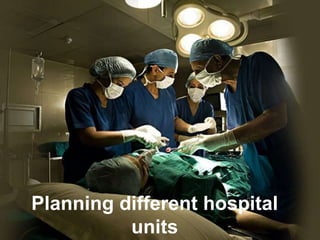
Planning different hospital
units
Divisions of a Hospital
• Administration division.
• Outpatients’ division, includes;
• Outpatient clinics.
• Pharmacy.
• Emergency reception.
• Diagnostic services division, includes;
• Laboratories.
• Radiology (diagnostic).
• Therapeutic services division, includes;
• Physical Therapy.
• Radiology (therapeutic).
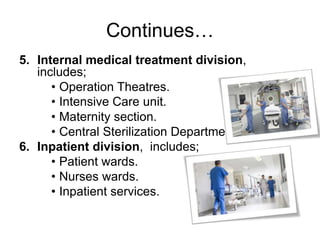
Continues…
5. Internal medical treatment division,
includes;
• Operation Theatres.
• Intensive Care unit.
• Maternity section.
• Central Sterilization Department.
6. Inpatient division, includes;
• Patient wards.
• Nurses wards.
• Inpatient services.
Continues…
7. General service division, includes;
• Kitchen.
• Laundry.
• Storages.
• Workshops.
• Mechanical services.
• Mortuary.
• Security.
• Parking.
• Landscaping.
Inpatient Unit
• Patient rooms
– Private/semi private or multi-bed general
wards
– Safe and aesthetic
– Contain space for equipments, staffs &
various needs of the patients
• Nurse station
– Designed to observe the patients
• Work area
– Space for materials necessary for patient care
Continues…
• Facilities & space required:
– Examination & treatment room with wash basin
– Cupboard for clean linen
– Baskets for soiled linen
– Waste baskets
– Equipment storage rooms (For IV stands)
– Lockers for staff
– Space for storing stretchers and wheel chairs
– Staff toilets
– Small laboratory
– Telephone
• Outpatient unit
– Preferably on the ground level with separate
entrance and adequate parking facilities
– Should be close to admitting area, MRD,
Emergency, Radiology/Lab services & Pharmacy
– Proper ventilation & wide passages
– Properly signed
• Emergency unit
– Should be in the ground level
– Separate entrance
– Well marked with proper lightings & signs
– Should be visible & accessible from the street
– Close to the admitting dept, MRD, Diagnostic
services, Blood banks, elevators & cash counter.
• Intensive care units
– Preferably in the ground floor with convenient
access to OT & ED
– Consists of patient area, staff area & support
area
• Basic requirements are:
– Direct observation of the pt by the nsg &
medical staffs
– Surveillance of physiological monitoring
– Provision and efficient use of routine and
emergency diagnostic procedures &
interventions
– Recording/Monitoring equipments
• Obstetrical units
– Located close to labor & delivery room & also
to the nursery
– A separate room for patient education & group
discussions
• Newborn unit
– An area of 30 sq ft/ infant
– Partitions made of clear glass (For
observation)
– Furniture, cabinets, incubator, utility tables,
wash basin, waste receptacles, oxygen &
suction outlets
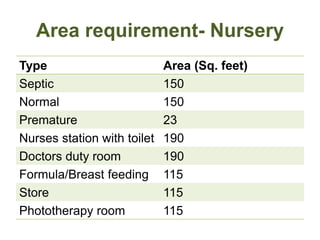
Area requirement- Nursery
Type Area (Sq. feet)
Septic 150
Normal 150
Premature 23
Nurses station with toilet 190
Doctors duty room 190
Formula/Breast feeding 115
Store 115
Phototherapy room 115
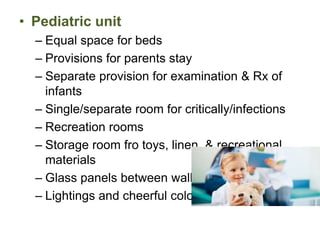
• Pediatric unit
– Equal space for beds
– Provisions for parents stay
– Separate provision for examination & Rx of
infants
– Single/separate room for critically/infections
– Recreation rooms
– Storage room fro toys, linen, & recreational
materials
– Glass panels between walls
– Lightings and cheerful colors
• Psychiatric unit
– Consultation area containing individual and
family sessions
– Conference/therapy rooms
– Activity area/ occupational therapy unit
– Ward with 20-24 beds
– Private rooms
– Time-out rooms for violent/aggressive patients
– Secure wards/rooms
– All electrical fittings shall be suitably protected
• Radiology & laboratory services
– Should be easily accessible from OPD, causality
& IP
– Preferably in the Ground floor
– Adequate area for reception/waiting
– Provision of separate rooms for technical
functioning
• Pharmacy
– Easily accessible
– Dispense counters
– Drugs storage spaces- cool & cold
– Administrative offices
– Circulation space
• Hospital workshop department (Bio Medial
Dept)
– It maintains & repairs the technical requirements
in a hospital
• Laundry
– Space for washing & keeping clothes
• Hospital store
– With separate entrance
• CSSD
– Located at centrally or unit wise (Maternity,
childcare etc.)
• Hospital dietary services
– Should be at ground level
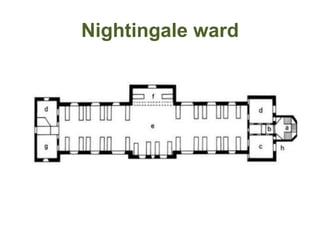
Nightingale ward
The Nightingale Ward
• Advantages
– Excellent cross ventilation
– Good lighting
– Clear and unimpeded view of all patients
• Disadvantages
– No privacy for the patients
– Nurses or professionals may find difficult to
move across
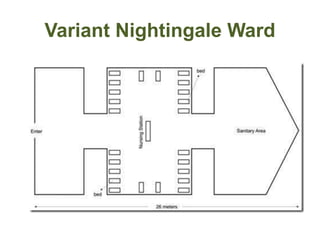
Variant Nightingale Ward
Variant nightingale ward
• Advantage
– Privacy for the patients
– Reduction in the noise levels
– Reduced incidence of cross infection
– Attached toilets making it convenient for patient
relatives
• Disadvantages
– Reduced view from the nurses station
– Difficulty to communicate
– Construction cost is high
– Maintenance is difficult
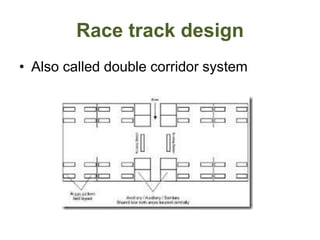
Race track design
• Also called double corridor system
Rig’s design
• Spacing of bed is
improved
• Enhanced privacy
due to wall partition
of 5 ft height.
• Reduced walking
distance
• Patient beds are
arranged parallel
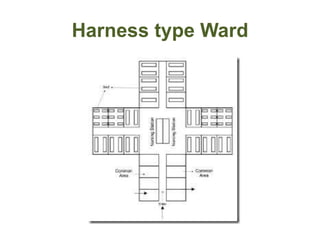
Harness type Ward
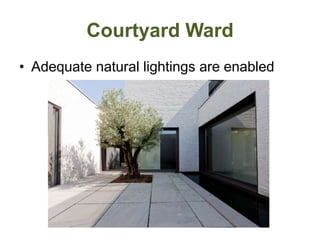
Courtyard Ward
• Adequate natural lightings are enabled
References
• Suneetha M. Management of nursing
service and education. 1st Ed.,

Planning hospital service

  • 1.
    Bivin JB Dept ofPsychiatric Nursing
  • 2.
    Functions of aHospital • Preventive – Concerned with health promotion – Participated with community/peripheral health care delivery systems • Curative – Patient care – Includes health education • Training – Continuing and on the job training • Research – Health related researches
  • 3.
    Categories of Hospitals •Based on levels of functioning: • Primary hospitals • Secondary hospitals • Tertiary hospitals • Based clinical specialties: • General hospitals • Special hospitals• Based ownership: • Government
  • 4.
    Principles of PlanningHospital Units • Protection – Protection from unwanted & unnecessary disturbances in order to help speedy recovery • Separation – Separation of dissimilar activities • Control – Control over the untoward incidents • Circulation – Proper integration of departments • Emerson Goble
  • 5.
    Objectives of PlanningHospital Units • Provide quality care – Quality medical services & enhancing patient satisfaction • Provide maximum comfort – Comfort in terms of safety, security, convenience & privacy – Avoiding slippery floors, direct sunlight etc. • Enhance staff satisfaction – Staff motivation & safe working environment • Patient relatives & visitors convenience – Comfortable stay, safe environments etc • Maintenance & cost of services
  • 6.
  • 7.
    Divisions of aHospital • Administration division. • Outpatients’ division, includes; • Outpatient clinics. • Pharmacy. • Emergency reception. • Diagnostic services division, includes; • Laboratories. • Radiology (diagnostic). • Therapeutic services division, includes; • Physical Therapy. • Radiology (therapeutic).
  • 8.
    Continues… 5. Internal medicaltreatment division, includes; • Operation Theatres. • Intensive Care unit. • Maternity section. • Central Sterilization Department. 6. Inpatient division, includes; • Patient wards. • Nurses wards. • Inpatient services.
  • 9.
    Continues… 7. General servicedivision, includes; • Kitchen. • Laundry. • Storages. • Workshops. • Mechanical services. • Mortuary. • Security. • Parking. • Landscaping.
  • 10.
    Inpatient Unit • Patientrooms – Private/semi private or multi-bed general wards – Safe and aesthetic – Contain space for equipments, staffs & various needs of the patients • Nurse station – Designed to observe the patients • Work area – Space for materials necessary for patient care
  • 11.
    Continues… • Facilities &space required: – Examination & treatment room with wash basin – Cupboard for clean linen – Baskets for soiled linen – Waste baskets – Equipment storage rooms (For IV stands) – Lockers for staff – Space for storing stretchers and wheel chairs – Staff toilets – Small laboratory – Telephone
  • 13.
    • Outpatient unit –Preferably on the ground level with separate entrance and adequate parking facilities – Should be close to admitting area, MRD, Emergency, Radiology/Lab services & Pharmacy – Proper ventilation & wide passages – Properly signed • Emergency unit – Should be in the ground level – Separate entrance – Well marked with proper lightings & signs – Should be visible & accessible from the street – Close to the admitting dept, MRD, Diagnostic services, Blood banks, elevators & cash counter.
  • 14.
    • Intensive careunits – Preferably in the ground floor with convenient access to OT & ED – Consists of patient area, staff area & support area • Basic requirements are: – Direct observation of the pt by the nsg & medical staffs – Surveillance of physiological monitoring – Provision and efficient use of routine and emergency diagnostic procedures & interventions – Recording/Monitoring equipments
  • 15.
    • Obstetrical units –Located close to labor & delivery room & also to the nursery – A separate room for patient education & group discussions • Newborn unit – An area of 30 sq ft/ infant – Partitions made of clear glass (For observation) – Furniture, cabinets, incubator, utility tables, wash basin, waste receptacles, oxygen & suction outlets
  • 16.
    Area requirement- Nursery TypeArea (Sq. feet) Septic 150 Normal 150 Premature 23 Nurses station with toilet 190 Doctors duty room 190 Formula/Breast feeding 115 Store 115 Phototherapy room 115
  • 17.
    • Pediatric unit –Equal space for beds – Provisions for parents stay – Separate provision for examination & Rx of infants – Single/separate room for critically/infections – Recreation rooms – Storage room fro toys, linen, & recreational materials – Glass panels between walls – Lightings and cheerful colors
  • 18.
    • Psychiatric unit –Consultation area containing individual and family sessions – Conference/therapy rooms – Activity area/ occupational therapy unit – Ward with 20-24 beds – Private rooms – Time-out rooms for violent/aggressive patients – Secure wards/rooms – All electrical fittings shall be suitably protected
  • 19.
    • Radiology &laboratory services – Should be easily accessible from OPD, causality & IP – Preferably in the Ground floor – Adequate area for reception/waiting – Provision of separate rooms for technical functioning • Pharmacy – Easily accessible – Dispense counters – Drugs storage spaces- cool & cold – Administrative offices – Circulation space
  • 20.
    • Hospital workshopdepartment (Bio Medial Dept) – It maintains & repairs the technical requirements in a hospital • Laundry – Space for washing & keeping clothes • Hospital store – With separate entrance • CSSD – Located at centrally or unit wise (Maternity, childcare etc.) • Hospital dietary services – Should be at ground level
  • 22.
  • 23.
    The Nightingale Ward •Advantages – Excellent cross ventilation – Good lighting – Clear and unimpeded view of all patients • Disadvantages – No privacy for the patients – Nurses or professionals may find difficult to move across
  • 24.
  • 25.
    Variant nightingale ward •Advantage – Privacy for the patients – Reduction in the noise levels – Reduced incidence of cross infection – Attached toilets making it convenient for patient relatives • Disadvantages – Reduced view from the nurses station – Difficulty to communicate – Construction cost is high – Maintenance is difficult
  • 26.
    Race track design •Also called double corridor system
  • 27.
    Rig’s design • Spacingof bed is improved • Enhanced privacy due to wall partition of 5 ft height. • Reduced walking distance • Patient beds are arranged parallel
  • 28.
  • 29.
    Courtyard Ward • Adequatenatural lightings are enabled
  • 30.
    References • Suneetha M.Management of nursing service and education. 1st Ed.,