Assessment and management of chest
trauma as a cause of respiratory distress
By. Teshome B.(MD,Assistant Professor
of Surgery)
INTRODUCTION
• Trauma, or injury, is defined as cellular disruption caused by
environmental energy that is beyond the body’s resilience,
which is compounded by cell death due to
ischemia/reperfusion.
• Trauma is the most common cause of death for all individuals
between the ages of 1 and 44 years, and is the third most
common cause of death regardless of age.
• 25% of all trauma deaths are the result of chest injuries alone.
• It is also the leading cause of years of productive life lost.
Causes
• Road traffic accidents
• Bullet injuries
• Blast injuries
• Industrial accidents
• Stab injuries.
Types of Chest Trauma
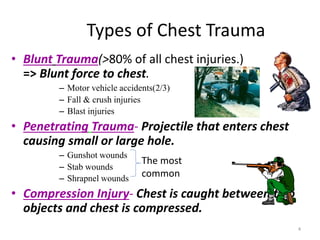
• Blunt Trauma(>80% of all chest injuries.)
=> Blunt force to chest.
– Motor vehicle accidents(2/3)
– Fall & crush injuries
– Blast injuries
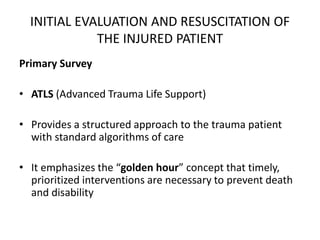
• Penetrating Trauma- Projectile that enters chest
causing small or large hole.
– Gunshot wounds
– Stab wounds
– Shrapnel wounds
• Compression Injury- Chest is caught between two
objects and chest is compressed.
The most
common
4
INITIAL EVALUATION AND RESUSCITATION OF
THE INJURED PATIENT
Primary Survey
• ATLS (Advanced Trauma Life Support)
• Provides a structured approach to the trauma patient
with standard algorithms of care
• It emphasizes the “golden hour” concept that timely,
prioritized interventions are necessary to prevent death
and disability
The initial management of seriously injured patients
consists of phases that include
• The primary survey/concurrent resuscitation,
• The secondary survey/diagnostic evaluation,
• Definitive care
• The tertiary survey.
• The first step in patient management is performing the
primary survey. Goal?
• The ATLS course refers to the primary survey as
assessment of the “ABCs” (Airway with cervical spine
protection, Breathing, and Circulation).
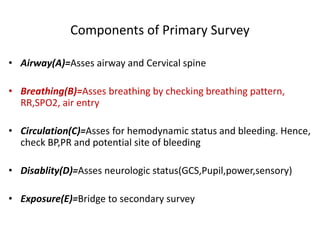
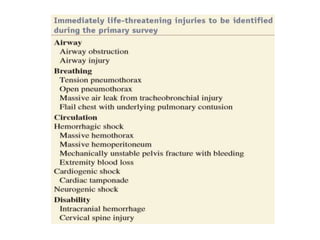
Components of Primary Survey
• Airway(A)=Asses airway and Cervical spine
• Breathing(B)=Asses breathing by checking breathing pattern,
RR,SPO2, air entry
• Circulation(C)=Asses for hemodynamic status and bleeding. Hence,
check BP,PR and potential site of bleeding
• Disablity(D)=Asses neurologic status(GCS,Pupil,power,sensory)
• Exposure(E)=Bridge to secondary survey
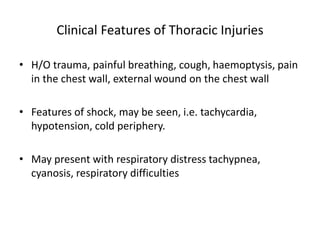
Clinical Features of Thoracic Injuries
• H/O trauma, painful breathing, cough, haemoptysis, pain
in the chest wall, external wound on the chest wall
• Features of shock, may be seen, i.e. tachycardia,
hypotension, cold periphery.
• May present with respiratory distress tachypnea,
cyanosis, respiratory difficulties
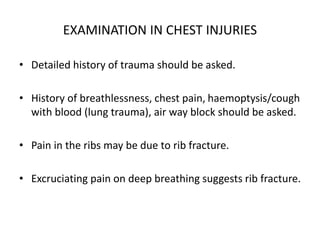
EXAMINATION IN CHEST INJURIES
• Detailed history of trauma should be asked.
• History of breathlessness, chest pain, haemoptysis/cough
with blood (lung trauma), air way block should be asked.
• Pain in the ribs may be due to rib fracture.
• Excruciating pain on deep breathing suggests rib fracture.
Examination
• General Examination
• Pulse, blood pressure, cyanosis, tachypnea, features of
shock should be checked.
• Abdomen, limbs, head and neurological systems also be
examined.
Inspection
• Chest, abdomen and neck should be exposed for proper
inspection.
• Ecchymosis, bruises in the skin over chest wall should be
inspected.
• Wound may often look small superficially but may be
deep penetrating into the thoracic cavity.
• Air may be bubbling through the wound with noise.
• Blood, clot may be present in such wounds.
• Such patient often may need emergency resuscitation to
maintain adequate ventilation.
• Type of breathing – abdominal or thoracic and its
character should be checked.
• Hyperpnea, dyspnea, altered breathing should be
observed.
• Collapse of chest wall during inspiration and distension of
part of chest wall during expiration suggests flail chest
with paradoxical breathing, mediastinal flutter and
pendular movement of the air.
• If patient develop sudden distress in breathing and
sudden respiratory arrest, it suggest likely the cause is
tension pneumothorax .
• Localized swelling due to hematoma may be evident.
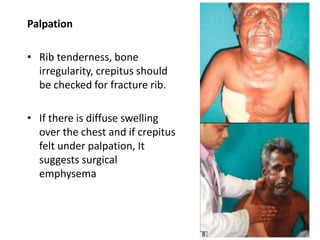
• Diffuse puffy look suggests surgical emphysema. It may
be in the chest wall, abdomen, neck both sides.
Palpation
• Rib tenderness, bone
irregularity, crepitus should
be checked for fracture rib.
• If there is diffuse swelling
over the chest and if crepitus
felt under palpation, It
suggests surgical
emphysema
Percussion
• Resonant on percussion in case of pneumothorax and
dull in hemothorax.
Auscultation
• Breath sounds is reduced in pneumothorax or
hemothorax
Investigations
• Baseline =HCT,BG&RH
• Chest X-ray
– To see fracture ribs, pneumothorax, haemothorax,
haemopneumothorax.
• Ultrasound of the chest wall to confirm fluid/blood/air
General mgt of chest trauma patient
• Secure IV line (give fluid if needed)
• Analgesics(strong antipain)
• Antibiotics(if patient have wound)
• Chest physiotherapy
• Chest tube care (if in place)
• Oxygen and frequent monitoring
• NB: All the above mgt shouldn`t delay patient from
treatment of underlying condition
Management of specific injuries
Pneumothorax
• Air in pleural space
• Many are caused by trauma but from primary problem in lung
• Causes collapse of a lung on the affected side
• May be caused by fractures of ribs, stab or bullet
Types
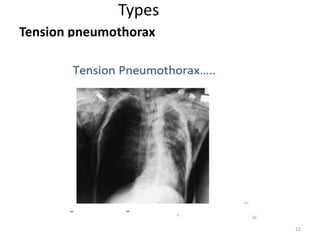
Tension pneumothorax
22
Clinical features
• Tachypnoea
• Dyspnea
• Distended neck veins
• Tachycardia
• Use of acce. Muscles
• Hypotension
• Tracheal deviation
• Hyperresonance
• Absent breath sound
• Failure of chest
expansion
23
Diagnosis
• Clinical
Management
• Don’t wait for CXR!!!!!!
• Consult Physician
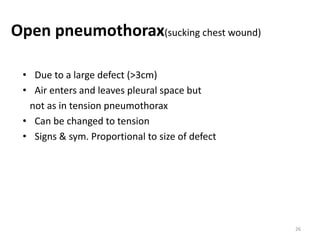
• Immediate decompression-Insert needle in 2nd ICS to convert
tension pneumothorax to simple pneumothorax
– Definitive mgt for both is chest tube drainge
24
25
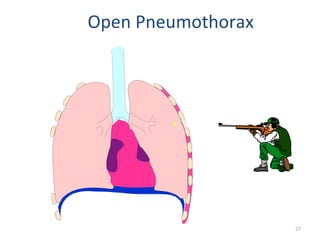
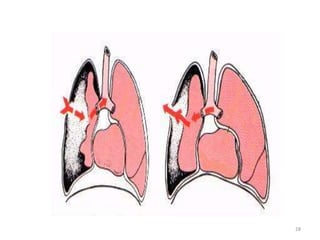
Open pneumothorax(sucking chest wound)
• Due to a large defect (>3cm)
• Air enters and leaves pleural space but
not as in tension pneumothorax
• Can be changed to tension
• Signs & sym. Proportional to size of defect
26
Open Pneumothorax
27
28
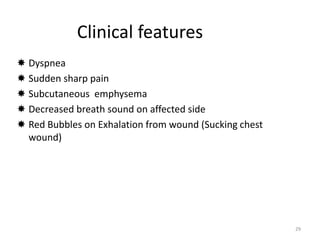
Clinical features
 Dyspnea
 Sudden sharp pain
 Subcutaneous emphysema
 Decreased breath sound on affected side
 Red Bubbles on Exhalation from wound (Sucking chest
wound)
29
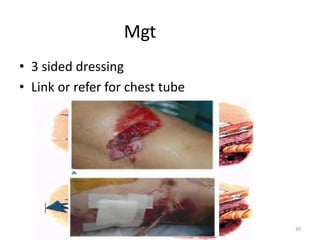
Mgt
• 3 sided dressing
• Link or refer for chest tube
30
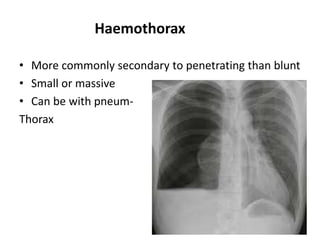
Haemothorax
• More commonly secondary to penetrating than blunt
• Small or massive
• Can be with pneum-
Thorax
31
Clinical features
 Anxiety/Restlessness
 Tachypnea
 Tachycardia
 Signs of Shock
 Flat neck veins
 Resp. distress
 Reduced chest expansion
 Diminished Breath Sounds on Affected Side
 Dullness to percussion
32
Management
• Put on fluid to correct hypovolemia
• Consult or link or refer for chest tube.
33
Cardiac Tamponade
• Mostly follow penetrating injury
• Acutely,<100ml of pericardial blood can cause tamponade
• Impairs atrial filling and also cause myocardial ischemia
• Beck`s triad?
• Ix-Pericardial ultrasound
• Mgt-removing 15-20ml blood can alleviate smx
hence early consultation or referral
Thank you

Chest trauma for Nurse.pptx

  • 1.
    Assessment and managementof chest trauma as a cause of respiratory distress By. Teshome B.(MD,Assistant Professor of Surgery)
  • 2.
    INTRODUCTION • Trauma, orinjury, is defined as cellular disruption caused by environmental energy that is beyond the body’s resilience, which is compounded by cell death due to ischemia/reperfusion. • Trauma is the most common cause of death for all individuals between the ages of 1 and 44 years, and is the third most common cause of death regardless of age. • 25% of all trauma deaths are the result of chest injuries alone. • It is also the leading cause of years of productive life lost.
  • 3.
    Causes • Road trafficaccidents • Bullet injuries • Blast injuries • Industrial accidents • Stab injuries.
  • 4.
    Types of ChestTrauma • Blunt Trauma(>80% of all chest injuries.) => Blunt force to chest. – Motor vehicle accidents(2/3) – Fall & crush injuries – Blast injuries • Penetrating Trauma- Projectile that enters chest causing small or large hole. – Gunshot wounds – Stab wounds – Shrapnel wounds • Compression Injury- Chest is caught between two objects and chest is compressed. The most common 4
  • 5.
    INITIAL EVALUATION ANDRESUSCITATION OF THE INJURED PATIENT Primary Survey • ATLS (Advanced Trauma Life Support) • Provides a structured approach to the trauma patient with standard algorithms of care • It emphasizes the “golden hour” concept that timely, prioritized interventions are necessary to prevent death and disability
  • 6.
    The initial managementof seriously injured patients consists of phases that include • The primary survey/concurrent resuscitation, • The secondary survey/diagnostic evaluation, • Definitive care • The tertiary survey.
  • 7.
    • The firststep in patient management is performing the primary survey. Goal? • The ATLS course refers to the primary survey as assessment of the “ABCs” (Airway with cervical spine protection, Breathing, and Circulation).
  • 8.
    Components of PrimarySurvey • Airway(A)=Asses airway and Cervical spine • Breathing(B)=Asses breathing by checking breathing pattern, RR,SPO2, air entry • Circulation(C)=Asses for hemodynamic status and bleeding. Hence, check BP,PR and potential site of bleeding • Disablity(D)=Asses neurologic status(GCS,Pupil,power,sensory) • Exposure(E)=Bridge to secondary survey
  • 10.
    Clinical Features ofThoracic Injuries • H/O trauma, painful breathing, cough, haemoptysis, pain in the chest wall, external wound on the chest wall • Features of shock, may be seen, i.e. tachycardia, hypotension, cold periphery. • May present with respiratory distress tachypnea, cyanosis, respiratory difficulties
  • 11.
    EXAMINATION IN CHESTINJURIES • Detailed history of trauma should be asked. • History of breathlessness, chest pain, haemoptysis/cough with blood (lung trauma), air way block should be asked. • Pain in the ribs may be due to rib fracture. • Excruciating pain on deep breathing suggests rib fracture.
  • 12.
    Examination • General Examination •Pulse, blood pressure, cyanosis, tachypnea, features of shock should be checked. • Abdomen, limbs, head and neurological systems also be examined.
  • 13.
    Inspection • Chest, abdomenand neck should be exposed for proper inspection. • Ecchymosis, bruises in the skin over chest wall should be inspected.
  • 14.
    • Wound mayoften look small superficially but may be deep penetrating into the thoracic cavity. • Air may be bubbling through the wound with noise. • Blood, clot may be present in such wounds. • Such patient often may need emergency resuscitation to maintain adequate ventilation.
  • 15.
    • Type ofbreathing – abdominal or thoracic and its character should be checked. • Hyperpnea, dyspnea, altered breathing should be observed. • Collapse of chest wall during inspiration and distension of part of chest wall during expiration suggests flail chest with paradoxical breathing, mediastinal flutter and pendular movement of the air.
  • 16.
    • If patientdevelop sudden distress in breathing and sudden respiratory arrest, it suggest likely the cause is tension pneumothorax . • Localized swelling due to hematoma may be evident. • Diffuse puffy look suggests surgical emphysema. It may be in the chest wall, abdomen, neck both sides.
  • 17.
    Palpation • Rib tenderness,bone irregularity, crepitus should be checked for fracture rib. • If there is diffuse swelling over the chest and if crepitus felt under palpation, It suggests surgical emphysema
  • 18.
    Percussion • Resonant onpercussion in case of pneumothorax and dull in hemothorax. Auscultation • Breath sounds is reduced in pneumothorax or hemothorax
  • 19.
    Investigations • Baseline =HCT,BG&RH •Chest X-ray – To see fracture ribs, pneumothorax, haemothorax, haemopneumothorax. • Ultrasound of the chest wall to confirm fluid/blood/air
  • 20.
    General mgt ofchest trauma patient • Secure IV line (give fluid if needed) • Analgesics(strong antipain) • Antibiotics(if patient have wound) • Chest physiotherapy • Chest tube care (if in place) • Oxygen and frequent monitoring • NB: All the above mgt shouldn`t delay patient from treatment of underlying condition
  • 21.
    Management of specificinjuries Pneumothorax • Air in pleural space • Many are caused by trauma but from primary problem in lung • Causes collapse of a lung on the affected side • May be caused by fractures of ribs, stab or bullet
  • 22.
  • 23.
    Clinical features • Tachypnoea •Dyspnea • Distended neck veins • Tachycardia • Use of acce. Muscles • Hypotension • Tracheal deviation • Hyperresonance • Absent breath sound • Failure of chest expansion 23
  • 24.
    Diagnosis • Clinical Management • Don’twait for CXR!!!!!! • Consult Physician • Immediate decompression-Insert needle in 2nd ICS to convert tension pneumothorax to simple pneumothorax – Definitive mgt for both is chest tube drainge 24
  • 25.
  • 26.
    Open pneumothorax(sucking chestwound) • Due to a large defect (>3cm) • Air enters and leaves pleural space but not as in tension pneumothorax • Can be changed to tension • Signs & sym. Proportional to size of defect 26
  • 27.
  • 28.
  • 29.
    Clinical features  Dyspnea Sudden sharp pain  Subcutaneous emphysema  Decreased breath sound on affected side  Red Bubbles on Exhalation from wound (Sucking chest wound) 29
  • 30.
    Mgt • 3 sideddressing • Link or refer for chest tube 30
  • 31.
    Haemothorax • More commonlysecondary to penetrating than blunt • Small or massive • Can be with pneum- Thorax 31
  • 32.
    Clinical features  Anxiety/Restlessness Tachypnea  Tachycardia  Signs of Shock  Flat neck veins  Resp. distress  Reduced chest expansion  Diminished Breath Sounds on Affected Side  Dullness to percussion 32
  • 33.
    Management • Put onfluid to correct hypovolemia • Consult or link or refer for chest tube. 33
  • 34.
    Cardiac Tamponade • Mostlyfollow penetrating injury • Acutely,<100ml of pericardial blood can cause tamponade • Impairs atrial filling and also cause myocardial ischemia • Beck`s triad? • Ix-Pericardial ultrasound • Mgt-removing 15-20ml blood can alleviate smx hence early consultation or referral
  • 35.