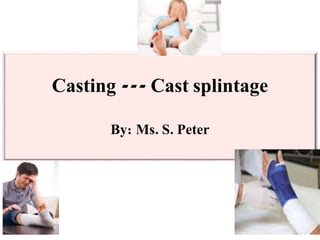
Casting --- Cast splintage
By: Ms. S. Peter
• To immobilize a reduced fracture, correct
deformity.
• Apply uniform pressure to underlying soft
tissue or support and stabilize weakened
joints
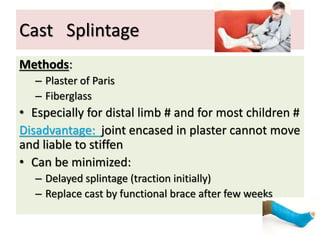
Cast Splintage
Methods:
– Plaster of Paris
– Fiberglass
• Especially for distal limb # and for most children #
Disadvantage: joint encased in plaster cannot move
and liable to stiffen
• Can be minimized:
– Delayed splintage (traction initially)
– Replace cast by functional brace after few weeks
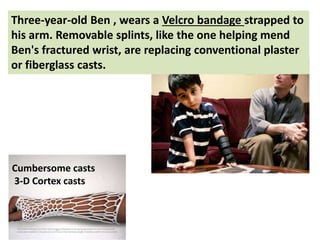
Three-year-old Ben , wears a Velcro bandage strapped to
his arm. Removable splints, like the one helping mend
Ben's fractured wrist, are replacing conventional plaster
or fiberglass casts.
Cumbersome casts
3-D Cortex casts
• Application ---
• Care
• Health Teaching –
• Removal -
Implementation
• Keep cast & extremity elevated
• Allow cast to dry- POP 24-48 hrs synthetic –
20mins
• Handle the wet cast with palms until dry
• Heat can be used to dry the cast
• Color of the dry cast is shiny – wet dull
• Examine the cast and skin for pressure areas
• Observe the extremity for circulatory
impairment- color, pain, swelling, tingling,
numbness, coolness, or diminished pulse—notify
immediately
…implementation…
• Cutting/bivalving the cast – if circ. impairment
• Petal the cast:--- maintain smooth edges around- to
prevent crumbling of the cast material
• Monitor pt temp
• Observe for foul odor- (infection ), drainage –
( circle the area on the cast)
• Monitor warmth on the cast
• Monitor for wet spots – need for drying /drainage
under the cast
• If open drainage present – keep a window…
• Teach to keep the cast clean and dry ---
• Isometric exercises to prevent muscle atrophy
Assessment
• Physical assessment of the part to be
immobilized must include – neurovascular
status ( Swelling- degree & location, bruise,
skin abrasion etc) -- along with the-
psychological--- general health …
Diagnosis: Based on the assessment data –
• Knowledge deficit related to treatment regimen
• Pain related to M/S disorder
• Impaired physical mobility related to cast
• Self care deficit: hygiene- bathing, feeding
dressing, grooming, toileting due to restricted
mobility
• Impaired skin integrity related to lacerations and
abrasions
• Risk for peripheral Neurovascular dysfunction
related to physiologic responses to injury and
compression effect of cast
Pot. complications
• Compartment syndrome, Pressure ulcer
• Disuse syndrome
• Prepare pt – describe – anticipated sensations
– heaviness, heat guidelines foe POP
• Relieve pain; exact site – exact character and
intensity .. ( most pain relieved by elevating the
limb . apply cold, analgesics ) report unrelieved
pain ( possible paralysis or necrosis)
• pain controlled --- with immobilization
• Swelling, surgery – edema – apply cold ( ice
caps on side of the casts ( not to intent the cast)
If edema – elevate – or modify the cast
Pain – indication of complications
• Pain on comp. syndrome--- relentless – not
controlled by any of these or analgesics
• Pain of body prominence--- impending pressure
ulcer – pain decrease when ulcer is formed
• Never ignore pain --- potential to impaired tissue
perfusion or pressure ulcer
Improve mobility
• All other free – uninvolved joints should be
exercised to maintain function- finger/toe
exercise
Neuro – Vascular functions –
• Oedema is normal stage …
• Monitor- circulation motion, and sensation of the
affected extremity—compare with the other
extremity
• If c/o too tight – cast- vasc insufficiency, nerve
compression, due to unrelieved swelling –
compartment syndrome
( normal findings – minimal swelling, minimal
discomfort, pink color, warm to touch, rapid
capillary refill, normal sensations able to exercise
toes/fingers Make frequent regular exercises –
assessments
Monitoring for pot complications
Compartment syndrome – increased tissue
pressure within a limited apace—cast—muscle
compartment
Relieve pressure
• Bivalve the cast , maintain alignment and elevate
extremity
• If not relieved – faciotomy – to relieve pressure
• Close observations and recording of neuro-
vascular response –….. reporting
Pressure ulcer : Pressure of the cast on soft tissues –
tissue anoxia – pres ulcer
( Low ext . more susceptible—heel malleoli, dorsum of
the foot, head of fibula, and ant surf of patella ..
Upper ext . pres areas --- medial epicondyle of
humerus, and ulnar styloid
• C/o pain and tightness – a warm area on the cast –
area may break down – drainage – may stain cast –
emit odor ( after tissue break down pain less. Ext
loss of tissue
• To inspect pres area—bivalve the cast – or window –
treat the site – the portion of the cast is replaced or
pressure dressing
DISUSE SYNDROME- isometric exercise – muscle
contraction – without moving the part – this helps
to reduce muscle atrophy and maintain muscle
strength –
• Teach push down the knee or clenching the fist
etc ( hourly …
• Muscle stimulators may attach to skin over large
muscle – electrically stimulated 8hrs /day to
prevent disuse
Health Teaching
• Encourage to participate in self care – and use
assistive devices –
• Help to give self care -- -- participate pt ADLs
When the cast is dry instruct the patient---
• Move about as normally as possible – avoid
excessive use of injured part – avoid walking
on wet slippery floors or side walks
• Perform the exercises –
• Elevate the casted extremity to heart level –
to prevent swelling
• Do not scratch the skin under the cast – it may
form skin ulcer – cool air from hair dryer
alleviate itching
• Cushion the rough edges with tape
• Keep the cast dry—not to cover with plastic or rubber –
as it causes condensation and dampens the cast and skin
----- thoroughly dry with hair dryer – cool setting
• If the dry cast become wet- may use blow dryer slow
setting – if are area is wet—report
• Clean the surface of plaster cast with slightly damp cloth
( synthetic cast—mild soap can be used – white shoe
polish – to brighten the cast
• Report—persistent pain, swelling that does not respond
to elevation, changes in sensation
• Decreased ability to move fingers /toes and changes in
color and temp
• Note odors around cast – stained area or warm spots,
pressure areas
• Report broken cast – do not attempt to fix
• Isometric exercises ---
Cast removal
• Explain---
• Cutter vibrate feel --- -- it will not cut skin---
padding is cut with scissors
• The casted part is weak—disuse—stiff …look
atrophied – need support
• skin – dry scaly ( from accumulated dead skin –
wash gently and lubricate with emollient
• Resume activities slowly and gradually
• Elevate extremity if swelling
We’ll Continue …………..
on
traction

Cast -

  • 1.
    Casting --- Castsplintage By: Ms. S. Peter
  • 2.
    • To immobilizea reduced fracture, correct deformity. • Apply uniform pressure to underlying soft tissue or support and stabilize weakened joints
  • 3.
    Cast Splintage Methods: – Plasterof Paris – Fiberglass • Especially for distal limb # and for most children # Disadvantage: joint encased in plaster cannot move and liable to stiffen • Can be minimized: – Delayed splintage (traction initially) – Replace cast by functional brace after few weeks
  • 4.
    Three-year-old Ben ,wears a Velcro bandage strapped to his arm. Removable splints, like the one helping mend Ben's fractured wrist, are replacing conventional plaster or fiberglass casts. Cumbersome casts 3-D Cortex casts
  • 5.
    • Application --- •Care • Health Teaching – • Removal -
  • 6.
    Implementation • Keep cast& extremity elevated • Allow cast to dry- POP 24-48 hrs synthetic – 20mins • Handle the wet cast with palms until dry • Heat can be used to dry the cast • Color of the dry cast is shiny – wet dull • Examine the cast and skin for pressure areas • Observe the extremity for circulatory impairment- color, pain, swelling, tingling, numbness, coolness, or diminished pulse—notify immediately
  • 7.
    …implementation… • Cutting/bivalving thecast – if circ. impairment • Petal the cast:--- maintain smooth edges around- to prevent crumbling of the cast material • Monitor pt temp • Observe for foul odor- (infection ), drainage – ( circle the area on the cast) • Monitor warmth on the cast • Monitor for wet spots – need for drying /drainage under the cast • If open drainage present – keep a window… • Teach to keep the cast clean and dry --- • Isometric exercises to prevent muscle atrophy
  • 8.
    Assessment • Physical assessmentof the part to be immobilized must include – neurovascular status ( Swelling- degree & location, bruise, skin abrasion etc) -- along with the- psychological--- general health …
  • 9.
    Diagnosis: Based onthe assessment data – • Knowledge deficit related to treatment regimen • Pain related to M/S disorder • Impaired physical mobility related to cast • Self care deficit: hygiene- bathing, feeding dressing, grooming, toileting due to restricted mobility • Impaired skin integrity related to lacerations and abrasions • Risk for peripheral Neurovascular dysfunction related to physiologic responses to injury and compression effect of cast
  • 10.
    Pot. complications • Compartmentsyndrome, Pressure ulcer • Disuse syndrome • Prepare pt – describe – anticipated sensations – heaviness, heat guidelines foe POP • Relieve pain; exact site – exact character and intensity .. ( most pain relieved by elevating the limb . apply cold, analgesics ) report unrelieved pain ( possible paralysis or necrosis) • pain controlled --- with immobilization • Swelling, surgery – edema – apply cold ( ice caps on side of the casts ( not to intent the cast) If edema – elevate – or modify the cast
  • 11.
    Pain – indicationof complications • Pain on comp. syndrome--- relentless – not controlled by any of these or analgesics • Pain of body prominence--- impending pressure ulcer – pain decrease when ulcer is formed • Never ignore pain --- potential to impaired tissue perfusion or pressure ulcer Improve mobility • All other free – uninvolved joints should be exercised to maintain function- finger/toe exercise
  • 12.
    Neuro – Vascularfunctions – • Oedema is normal stage … • Monitor- circulation motion, and sensation of the affected extremity—compare with the other extremity • If c/o too tight – cast- vasc insufficiency, nerve compression, due to unrelieved swelling – compartment syndrome ( normal findings – minimal swelling, minimal discomfort, pink color, warm to touch, rapid capillary refill, normal sensations able to exercise toes/fingers Make frequent regular exercises – assessments
  • 13.
    Monitoring for potcomplications Compartment syndrome – increased tissue pressure within a limited apace—cast—muscle compartment Relieve pressure • Bivalve the cast , maintain alignment and elevate extremity • If not relieved – faciotomy – to relieve pressure • Close observations and recording of neuro- vascular response –….. reporting
  • 14.
    Pressure ulcer :Pressure of the cast on soft tissues – tissue anoxia – pres ulcer ( Low ext . more susceptible—heel malleoli, dorsum of the foot, head of fibula, and ant surf of patella .. Upper ext . pres areas --- medial epicondyle of humerus, and ulnar styloid • C/o pain and tightness – a warm area on the cast – area may break down – drainage – may stain cast – emit odor ( after tissue break down pain less. Ext loss of tissue • To inspect pres area—bivalve the cast – or window – treat the site – the portion of the cast is replaced or pressure dressing
  • 15.
    DISUSE SYNDROME- isometricexercise – muscle contraction – without moving the part – this helps to reduce muscle atrophy and maintain muscle strength – • Teach push down the knee or clenching the fist etc ( hourly … • Muscle stimulators may attach to skin over large muscle – electrically stimulated 8hrs /day to prevent disuse
  • 16.
    Health Teaching • Encourageto participate in self care – and use assistive devices – • Help to give self care -- -- participate pt ADLs
  • 17.
    When the castis dry instruct the patient--- • Move about as normally as possible – avoid excessive use of injured part – avoid walking on wet slippery floors or side walks • Perform the exercises – • Elevate the casted extremity to heart level – to prevent swelling • Do not scratch the skin under the cast – it may form skin ulcer – cool air from hair dryer alleviate itching • Cushion the rough edges with tape
  • 18.
    • Keep thecast dry—not to cover with plastic or rubber – as it causes condensation and dampens the cast and skin ----- thoroughly dry with hair dryer – cool setting • If the dry cast become wet- may use blow dryer slow setting – if are area is wet—report • Clean the surface of plaster cast with slightly damp cloth ( synthetic cast—mild soap can be used – white shoe polish – to brighten the cast • Report—persistent pain, swelling that does not respond to elevation, changes in sensation • Decreased ability to move fingers /toes and changes in color and temp • Note odors around cast – stained area or warm spots, pressure areas • Report broken cast – do not attempt to fix • Isometric exercises ---
  • 19.
    Cast removal • Explain--- •Cutter vibrate feel --- -- it will not cut skin--- padding is cut with scissors • The casted part is weak—disuse—stiff …look atrophied – need support • skin – dry scaly ( from accumulated dead skin – wash gently and lubricate with emollient • Resume activities slowly and gradually • Elevate extremity if swelling
  • 20.