CHEMILUMINESCENCE AND
ITS APPLICTIONS
Presented By- Dr. Y L S
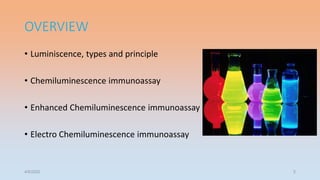
OVERVIEW
• Luminiscence, types and principle
• Chemiluminescence immunoassay
• Enhanced Chemiluminescence immunoassay
• Electro Chemiluminescence immunoassay
4/5/2022 2
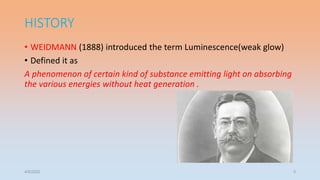
HISTORY
• WEIDMANN (1888) introduced the term Luminescence(weak glow)
• Defined it as
A phenomenon of certain kind of substance emitting light on absorbing
the various energies without heat generation .
4/5/2022 3
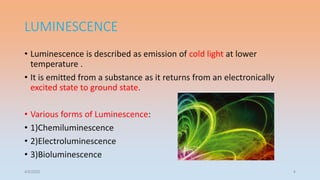
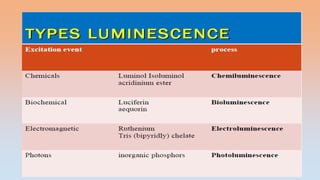
LUMINESCENCE
• Luminescence is described as emission of cold light at lower
temperature .
• It is emitted from a substance as it returns from an electronically
excited state to ground state.
• Various forms of Luminescence:
• 1)Chemiluminescence
• 2)Electroluminescence
• 3)Bioluminescence
4/5/2022 4
4/5/2022 5
BIOLUMINESCENCE
4/5/2022 6
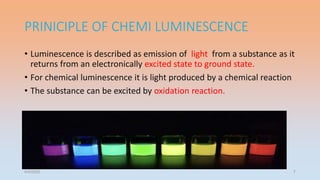
PRINICIPLE OF CHEMI LUMINESCENCE
• Luminescence is described as emission of light from a substance as it
returns from an electronically excited state to ground state.
• For chemical luminescence it is light produced by a chemical reaction
• The substance can be excited by oxidation reaction.
4/5/2022 7
4/5/2022 8
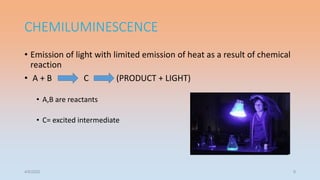
CHEMILUMINESCENCE
• Emission of light with limited emission of heat as a result of chemical
reaction
• A + B C (PRODUCT + LIGHT)
• A,B are reactants
• C= excited intermediate
4/5/2022 9
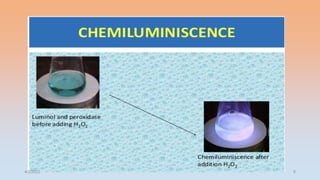
• For example A is luminol and B is hydrogen peroxide in the presence
of suitable catalyst we get
• Luminol + H2O2 =3 APA ( ) =3-APA + LIGHT
• Where
• 3-APA is aminophthalate
• 3 –APA ( ) Is the excited state producing light as it decays to a lower
energy level
4/5/2022 10
CRITERIA FOR SUCCESSFUL
CHEMILUMINISCENT REACTION
• Sufficient excitation energy provided for chemical reaction for red
emissionis 47.6 kcal/mol and blue emission is 63.5kcal/mol.
• The liberation of this much energy usually comes from bond
cleavage or electron transfer.
• Formation of products capable of forming an excited state multiple
bonds ,conjugation.
• Rapid kinetics( rate is imp than high yield)
4/5/2022 11
• Luminescent reactions usually involves the cleavage or fragmentation
of O-O bond an organic peroxide compound.
• Peroxides are prevalent in light emitting reaction because the relative
weak bond in easily cleaved and liberates large amount of energy.
• In order to achieve highest level of sensitivity a reaction must be as
efficient as possible in generating photons of light.
4/5/2022 12
• CL REACTION CAN BE GENERATED BY TWO BASIC MECHANISMS
In a DIRECT REACTION, two reagents, usually a substrate and an
oxidant in presence of some co-factor, react to form a product, then some
fraction of the product will be formed in an electronically excited state
which can subsequently relax to the ground state with emission of a photon.
4/5/2022 13
• INDIRECT REACTION is based on a process of transference of energy of the
excited species to a fluorophore.
• This process makes it possible for those molecules that are unable to be directly
involved in CL reactions to transfer their excess of energy to a fluorophore that in
turn is excited, releasing to its ground state with photon emission.
4/5/2022 14
• CHEMILUMINESCENT METHODS
• direct—using luminophore markers
• indirect—using enzyme markers.
• Either method may be competitive or non-competitive.
• In direct chemiluminescent methods, the luminophore markers used are
acridinium and ruthenium esters.
4/5/2022 15
• The enzymatic markers used in indirect methods .
• alkaline phosphatase with adamantyl 1, 2-dioxetane aryl phosphate
(AMPPD) substrate and horseradish peroxidase with luminol or its
derivatives as substrate.
• Synthesizing molecules such as AMPPD and isoluminol base molecule
derivatives are more stable and result in light emission with a
characteristically elevated quantum yield.
4/5/2022 16
• The addition of an enhancer (e.g. ferrocyanide, metallic ions) further
boosts the electronic activation, ultimately leading to extremely
elevated analytic sensitivity (mol−16 per litre).
• certainly superior to those attainable by other immunoassay methods
such as RIA, immune enzymatic (ELISA) and fluoro immune
enzymatic (FEIA) methods etc.
4/5/2022 17
APPLICATIONS OF CHEMILUMINESCENCE
• Chemiluminescence immunoassay
• DNA hybridization detection
• Forensic science
• Food analysis
4/5/2022 18
CHEMILUMINESCENCE IMMUNOASSAY
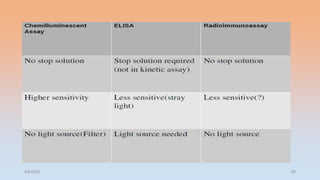
• Provides a sensitive high through output alternative to conventional
colorimetric methodologies.
• PRINCIPLES
• Same as ELISA
• Uses chemiluminescent substrate, hydrogen peroxide ,enhancers
• Stopping reagent is not required
• Incubation period is small
4/5/2022 19
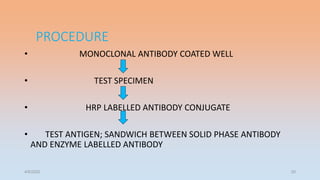
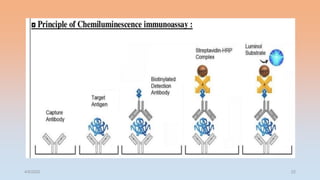
PROCEDURE
• MONOCLONAL ANTIBODY COATED WELL
• TEST SPECIMEN
• HRP LABELLED ANTIBODY CONJUGATE
• TEST ANTIGEN; SANDWICH BETWEEN SOLID PHASE ANTIBODY
AND ENZYME LABELLED ANTIBODY
4/5/2022 20
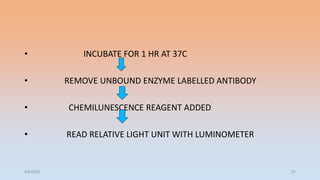
• INCUBATE FOR 1 HR AT 37C
• REMOVE UNBOUND ENZYME LABELLED ANTIBODY
• CHEMILUNESCENCE REAGENT ADDED
• READ RELATIVE LIGHT UNIT WITH LUMINOMETER
4/5/2022 21
4/5/2022 22
labels
• Reagents required for reactions that produce CL may be coupled to
Abs or antigens (Ags) and used as labels for IA.
• This category involves labels that are consumed in the CL analytical
reaction (e.g., luminol derivatives, acridinium esters).
4/5/2022 23
• Luminol is the best known and one of the most efficient CL reagents.
It is coupled to ligands via reactions involving the amino group.
• However, the resulting conjugates have lower CL efficiencies than the
parent compounds. Labels derived from isoluminol have been more
successful.
4/5/2022 24
• SOLID-PHASE MATERIALS
 Commonly used solid-phase are 96-well microtitration plates prepared
with Polystyrene.
 For the purposes of IA, the microplates are pre-coated with capturing
protein like Ab to allow analyte immobilization.
4/5/2022 25
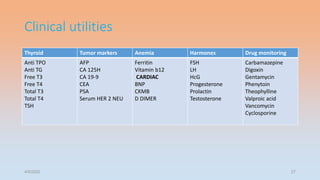
• IMMUNOASSAY
• Chemiluminescent immunoassay test kits and automated immunoassay
analyzers have been developed.
• The analysers routinely measured in a clinical chemistry, immunology,
toxicology, virology and endocrinology laboratories for the assessment
of :
4/5/2022 26
Clinical utilities
Thyroid Tumor markers Anemia Harmones Drug monitoring
Anti TPO
Anti TG
Free T3
Free T4
Total T3
Total T4
TSH
AFP
CA 125H
CA 19-9
CEA
PSA
Serum HER 2 NEU
Ferritin
Vitamin b12
CARDIAC
BNP
CKMB
D DIMER
FSH
LH
HcG
Progesterone
Prolactin
Testosterone
Carbamazepine
Digoxin
Gentamycin
Phenytoin
Theophylline
Valproic acid
Vancomycin
Cyclosporine
4/5/2022 27
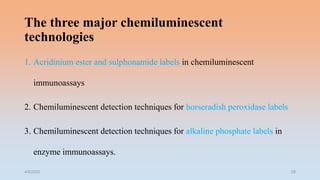
The three major chemiluminescent
technologies
1. Acridinium ester and sulphonamide labels in chemiluminescent
immunoassays
2. Chemiluminescent detection techniques for horseradish peroxidase labels
3. Chemiluminescent detection techniques for alkaline phosphate labels in
enzyme immunoassays.
4/5/2022 28
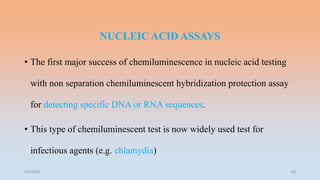
NUCLEIC ACID ASSAYS
• The first major success of chemiluminescence in nucleic acid testing
with non separation chemiluminescent hybridization protection assay
for detecting specific DNA or RNA sequences.
• This type of chemiluminescent test is now widely used test for
infectious agents (e.g. chlamydia)
4/5/2022 29
CLINICAL RESEARCH
• In clinical research sensitivity, dynamic range and diversity of
chemiluminescent assays has lead to a vast range of applications notably in
 Immunoassays
 Protein and nucleic acid blotting
 Microarray- based assays
4/5/2022 30
• Monitoring reactive oxygen species and as detection reactions for
substances separated by HPLC
• Capillary electrophoresis ( CE) and
• Flow- injection analysis.
4/5/2022 31
RESEARCH IMMUNOASSAY
• A large number of research immunoassays and emerging clinical tests have been
developed in chemiluminescent format e.g.
 cytokines (IL-4, IL-5, IL-6, IL-10)
 Endothelin-1
 Epidermal growth factors
 50 granulocyte colony- stimulating factor
 Interferon
 vascular endothelial growth factor c
4/5/2022 32
• The luminescent oxygen channeling immunoassay (LOCI) exploits the
in situ production of a chemiluminescent compound due to single
oxygen transfer between a donor and acceptor antibody coated
microbead (250nm diameter) brought in to contact as a result of
specific binding with the test agent.
4/5/2022 33
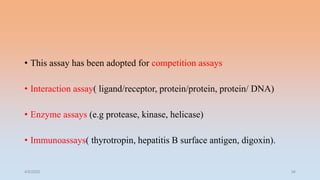
• This assay has been adopted for competition assays
• Interaction assay( ligand/receptor, protein/protein, protein/ DNA)
• Enzyme assays (e.g protease, kinase, helicase)
• Immunoassays( thyrotropin, hepatitis B surface antigen, digoxin).
4/5/2022 34
• The LOCI- type assay is also used for nucleic acid assays, example
• Single nucleotide polymorphism typing
• Nucleic acid amplification techniques such as the polymerase chain reaction
• Lassa fever virus( reverse transcriptase polymerase chain reaction method)
papilloma virus in cervical scrapes.
4/5/2022 35
BLOTTING TECHNIQUES
• WESTERN BLOTTING for proteins using gel electrophoresis
 Southern blotting for DNA
 Northern blotting for RNA.
4/5/2022 36
GENE- BASED ASSAYS
• A successful research application for chemiluminescence is detecting the
expressed products of the reporter genes developed as alternatives to the
traditional methods like detecting chloramphenicol acetyl transferase (CAT)
gene.
• It is also used to detect and quantitate expression products of genes for placental
alkaline phosphatase(PLAP), galactosidase(GAL), and glucuronidase(GUS).
4/5/2022 37
CELLULAR CHEMI LUMINESCENCE
• The cellular chemi luminescence studies includes investigations /detecting-
• human spermatozoa
• defects in the production of reactive oxygen intermediates
• response of cells (e.g. PMN-leukocytes, neutrophils) to drugs and different agents
• Complement receptors
• Polyunsaturated fatty acids ,lectins, endotoxins, H PYLORI lipopolysacharides
4/5/2022 38
Advantages and limitations of CLIA technology
• The key advantages of chemiluminescent analytical methods
• Wide dynamic range
• High signal intensity
• Absence of interfering emissions (i.e. high specificity)
• Rapid acquisition of the analytical signal
4/5/2022 39
• high stability of reagents and their conjugates
• Low consumption of reagents
• Random access
• Reduced incubation time and full compatibility with immunology
assay protocols (homogenous or non-homogenous).
4/5/2022 40
• DISADVANTAGES OF CLIA
• Limited Ag detection
• High costs
• Limited tests panel
• Closed analytical systems.
4/5/2022 41
CHEMILUMINESCENT ASSAYS AND FOR ANALYSIS IN BODY FLUIDS
• Urinary N-acetyl-d-glucose aminidase
• Cholesterol
• Vitamin C
• Blood spot screening tests for phenyl ketonuria (PUK)
• Galactossemia and maple syrup urine disease.
4/5/2022 42
• Chemi luminescence is also useful in detection reactions for
components of mixtures separated by techniques such as
• HPLC
• Capillary electrophoresis
• Flow injection.
4/5/2022 43
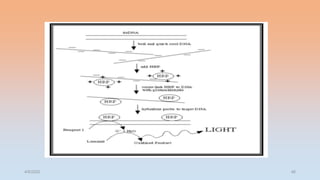
DNA HYBRIDIZATION
• STEPS IN HYBRIDIZATION
• Process of forming double stranded DNA molecule between a single
stranded DNA probe and single stranded targeted DNA.
• The restriction fragments present in the gel are denatured with alkali
and transferred on to nitrocellulose filter or nylon membrane by
blotting
• This procedure preserves the distribution of the fragments in the gel
creating a replica of the gel on the filter paper.
4/5/2022 44
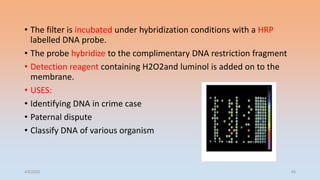
• The filter is incubated under hybridization conditions with a HRP
labelled DNA probe.
• The probe hybridize to the complimentary DNA restriction fragment
• Detection reagent containing H2O2and luminol is added on to the
membrane.
• USES:
• Identifying DNA in crime case
• Paternal dispute
• Classify DNA of various organism
4/5/2022 45
4/5/2022 46
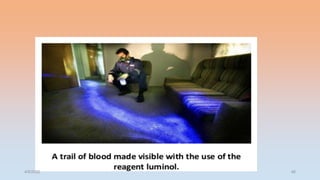
FORENSIC SCIENCE
• It is used by criminalists to detect traces of blood at crime scene.
• Solution luminol powder ,hydrogen peroxide are sprayed where blood
might be found.
• Tiny amount of iron from Hb in blood serves as catalyst for the
chemiluminiscence reaction, luminol to glow.
4/5/2022 47
4/5/2022 48
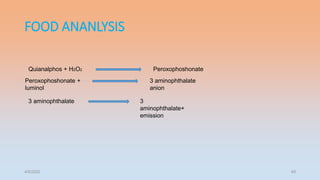
FOOD ANANLYSIS
4/5/2022 49
Peroxophoshonate +
luminol
3 aminophthalate
anion
Quianalphos + H2O2 Peroxophoshonate
3 aminophthalate 3
aminophthalate+
emission
OTHER APPLICATIONS
• GAS ANALYSIS-to determine small amount of impurities and poisons in
air
• Other compounds such as ozone, S compounds , fluxes of -oxide
compounds .
• Lightening objects, chemiluminescent kites, glow stick, emergency
lightenings
• Children toys
• COMBUSTION ANALYSIS-certain radical species (CH+ AND OH+) gives off
radiation at specific wavelengths .
4/5/2022 50
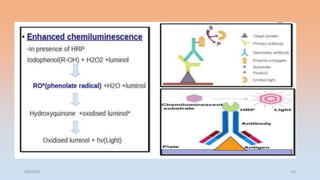
ENHANCED CHEMILUMINESCENCE
• It is common technique for variety of detection assays
• A horse radish peroxide enzyme is tethered to antibody that
specifically recognises the molecule of interest.
• This enzyme complex then catalyse the conversion of enhanced
substrate into sensitised reagent .
• Which on further oxidation by H2O2 produces a triplet carbonyl
which emits light when it reduced to single carbonyl
4/5/2022 51
• It allows the minute quantities of biomolecules detection in femto
litres
• It is characterised by following features
• Intense light emission
• Prolong emission of light no pre incubation step
• Substrate that can be added several minutes prior to detection
• As long as commercially preparations of luminal are used control of
reaction PH is not a concern
4/5/2022 52
4/5/2022 53
ELECTROCHEMICAL LUMINESCENCE
• In this process electro chemically generated intermediates undergo
highly exogonic reaction to produce electronically excited state .
• Emits light upon relaxation to lower state.
• ECL excitation can be caused by redox reaction of electron generated
species.
• It is observed during application of potential to electrodes of
electrochemical cell that contains solution of luminescent species
(metal complexes, quantum dots) in aprotic organic solvents.
4/5/2022 54
• The excitation energy is obtained from recombination of oxidised and
reduced species .
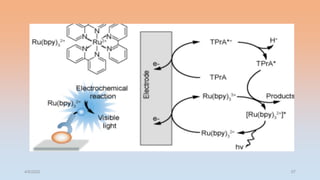
• The luminescent species are oxidised at electrode together with co
reactant which gives strong reducing agent after some chemical
transformation.
• It generally uses ruthenium complexes regenerating with TPrA
(tripropylamine) in liquid phase
• Photon detection is done in photo multiplier tubes or silicon photo
diodes.
4/5/2022 55
• It is highly sensitive and specific method.
• It present with outstanding advantage over other methods
• versatility
• simplified optical setup compared with photo luminescence
• good temporal control.
4/5/2022 56
4/5/2022 57
4/5/2022 58
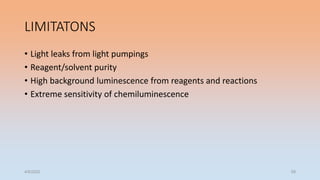
LIMITATONS
• Light leaks from light pumpings
• Reagent/solvent purity
• High background luminescence from reagents and reactions
• Extreme sensitivity of chemiluminescence
4/5/2022 59
CONCLUSION
• Chemiluminescent methods are now well established in routine
clinical analysis and as tools in clinical and biomedical research.
• Many clinical laboratories preform routine immunoassay and nucleic
acid testing and research applications.
4/5/2022 60
References
• Campbell, A K. Chemiluminescence. Principles and applications in biology and
medicine. Germany: N. p., 1988. Web.
• C. Dodeigne, L. Thunus, R. Lejeune, Chemiluminescence as diagnostic tool. A
review, Talanta, Volume 51, Issue 3, 2000, Pages 415-439.
• ixia Zhao, Li Sun, Xiaogang Chu, Chemiluminescence immunoassay,TrAC Trends
in Analytical Chemistry, Volume 28, Issue 4,2009,Pages 404-415.
• L.J Kricka,Clinical applications of chemiluminescence,Analytica Chimica Acta,
Volume 500, Issues 1–2, 2003, Pages 279-286.
4/5/2022 61
4/5/2022 62

chemilunescence

  • 1.
  • 2.
    OVERVIEW • Luminiscence, typesand principle • Chemiluminescence immunoassay • Enhanced Chemiluminescence immunoassay • Electro Chemiluminescence immunoassay 4/5/2022 2
  • 3.
    HISTORY • WEIDMANN (1888)introduced the term Luminescence(weak glow) • Defined it as A phenomenon of certain kind of substance emitting light on absorbing the various energies without heat generation . 4/5/2022 3
  • 4.
    LUMINESCENCE • Luminescence isdescribed as emission of cold light at lower temperature . • It is emitted from a substance as it returns from an electronically excited state to ground state. • Various forms of Luminescence: • 1)Chemiluminescence • 2)Electroluminescence • 3)Bioluminescence 4/5/2022 4
  • 5.
  • 6.
  • 7.
    PRINICIPLE OF CHEMILUMINESCENCE • Luminescence is described as emission of light from a substance as it returns from an electronically excited state to ground state. • For chemical luminescence it is light produced by a chemical reaction • The substance can be excited by oxidation reaction. 4/5/2022 7
  • 8.
  • 9.
    CHEMILUMINESCENCE • Emission oflight with limited emission of heat as a result of chemical reaction • A + B C (PRODUCT + LIGHT) • A,B are reactants • C= excited intermediate 4/5/2022 9
  • 10.
    • For exampleA is luminol and B is hydrogen peroxide in the presence of suitable catalyst we get • Luminol + H2O2 =3 APA ( ) =3-APA + LIGHT • Where • 3-APA is aminophthalate • 3 –APA ( ) Is the excited state producing light as it decays to a lower energy level 4/5/2022 10
  • 11.
    CRITERIA FOR SUCCESSFUL CHEMILUMINISCENTREACTION • Sufficient excitation energy provided for chemical reaction for red emissionis 47.6 kcal/mol and blue emission is 63.5kcal/mol. • The liberation of this much energy usually comes from bond cleavage or electron transfer. • Formation of products capable of forming an excited state multiple bonds ,conjugation. • Rapid kinetics( rate is imp than high yield) 4/5/2022 11
  • 12.
    • Luminescent reactionsusually involves the cleavage or fragmentation of O-O bond an organic peroxide compound. • Peroxides are prevalent in light emitting reaction because the relative weak bond in easily cleaved and liberates large amount of energy. • In order to achieve highest level of sensitivity a reaction must be as efficient as possible in generating photons of light. 4/5/2022 12
  • 13.
    • CL REACTIONCAN BE GENERATED BY TWO BASIC MECHANISMS In a DIRECT REACTION, two reagents, usually a substrate and an oxidant in presence of some co-factor, react to form a product, then some fraction of the product will be formed in an electronically excited state which can subsequently relax to the ground state with emission of a photon. 4/5/2022 13
  • 14.
    • INDIRECT REACTIONis based on a process of transference of energy of the excited species to a fluorophore. • This process makes it possible for those molecules that are unable to be directly involved in CL reactions to transfer their excess of energy to a fluorophore that in turn is excited, releasing to its ground state with photon emission. 4/5/2022 14
  • 15.
    • CHEMILUMINESCENT METHODS •direct—using luminophore markers • indirect—using enzyme markers. • Either method may be competitive or non-competitive. • In direct chemiluminescent methods, the luminophore markers used are acridinium and ruthenium esters. 4/5/2022 15
  • 16.
    • The enzymaticmarkers used in indirect methods . • alkaline phosphatase with adamantyl 1, 2-dioxetane aryl phosphate (AMPPD) substrate and horseradish peroxidase with luminol or its derivatives as substrate. • Synthesizing molecules such as AMPPD and isoluminol base molecule derivatives are more stable and result in light emission with a characteristically elevated quantum yield. 4/5/2022 16
  • 17.
    • The additionof an enhancer (e.g. ferrocyanide, metallic ions) further boosts the electronic activation, ultimately leading to extremely elevated analytic sensitivity (mol−16 per litre). • certainly superior to those attainable by other immunoassay methods such as RIA, immune enzymatic (ELISA) and fluoro immune enzymatic (FEIA) methods etc. 4/5/2022 17
  • 18.
    APPLICATIONS OF CHEMILUMINESCENCE •Chemiluminescence immunoassay • DNA hybridization detection • Forensic science • Food analysis 4/5/2022 18
  • 19.
    CHEMILUMINESCENCE IMMUNOASSAY • Providesa sensitive high through output alternative to conventional colorimetric methodologies. • PRINCIPLES • Same as ELISA • Uses chemiluminescent substrate, hydrogen peroxide ,enhancers • Stopping reagent is not required • Incubation period is small 4/5/2022 19
  • 20.
    PROCEDURE • MONOCLONAL ANTIBODYCOATED WELL • TEST SPECIMEN • HRP LABELLED ANTIBODY CONJUGATE • TEST ANTIGEN; SANDWICH BETWEEN SOLID PHASE ANTIBODY AND ENZYME LABELLED ANTIBODY 4/5/2022 20
  • 21.
    • INCUBATE FOR1 HR AT 37C • REMOVE UNBOUND ENZYME LABELLED ANTIBODY • CHEMILUNESCENCE REAGENT ADDED • READ RELATIVE LIGHT UNIT WITH LUMINOMETER 4/5/2022 21
  • 22.
  • 23.
    labels • Reagents requiredfor reactions that produce CL may be coupled to Abs or antigens (Ags) and used as labels for IA. • This category involves labels that are consumed in the CL analytical reaction (e.g., luminol derivatives, acridinium esters). 4/5/2022 23
  • 24.
    • Luminol isthe best known and one of the most efficient CL reagents. It is coupled to ligands via reactions involving the amino group. • However, the resulting conjugates have lower CL efficiencies than the parent compounds. Labels derived from isoluminol have been more successful. 4/5/2022 24
  • 25.
    • SOLID-PHASE MATERIALS Commonly used solid-phase are 96-well microtitration plates prepared with Polystyrene.  For the purposes of IA, the microplates are pre-coated with capturing protein like Ab to allow analyte immobilization. 4/5/2022 25
  • 26.
    • IMMUNOASSAY • Chemiluminescentimmunoassay test kits and automated immunoassay analyzers have been developed. • The analysers routinely measured in a clinical chemistry, immunology, toxicology, virology and endocrinology laboratories for the assessment of : 4/5/2022 26
  • 27.
    Clinical utilities Thyroid Tumormarkers Anemia Harmones Drug monitoring Anti TPO Anti TG Free T3 Free T4 Total T3 Total T4 TSH AFP CA 125H CA 19-9 CEA PSA Serum HER 2 NEU Ferritin Vitamin b12 CARDIAC BNP CKMB D DIMER FSH LH HcG Progesterone Prolactin Testosterone Carbamazepine Digoxin Gentamycin Phenytoin Theophylline Valproic acid Vancomycin Cyclosporine 4/5/2022 27
  • 28.
    The three majorchemiluminescent technologies 1. Acridinium ester and sulphonamide labels in chemiluminescent immunoassays 2. Chemiluminescent detection techniques for horseradish peroxidase labels 3. Chemiluminescent detection techniques for alkaline phosphate labels in enzyme immunoassays. 4/5/2022 28
  • 29.
    NUCLEIC ACID ASSAYS •The first major success of chemiluminescence in nucleic acid testing with non separation chemiluminescent hybridization protection assay for detecting specific DNA or RNA sequences. • This type of chemiluminescent test is now widely used test for infectious agents (e.g. chlamydia) 4/5/2022 29
  • 30.
    CLINICAL RESEARCH • Inclinical research sensitivity, dynamic range and diversity of chemiluminescent assays has lead to a vast range of applications notably in  Immunoassays  Protein and nucleic acid blotting  Microarray- based assays 4/5/2022 30
  • 31.
    • Monitoring reactiveoxygen species and as detection reactions for substances separated by HPLC • Capillary electrophoresis ( CE) and • Flow- injection analysis. 4/5/2022 31
  • 32.
    RESEARCH IMMUNOASSAY • Alarge number of research immunoassays and emerging clinical tests have been developed in chemiluminescent format e.g.  cytokines (IL-4, IL-5, IL-6, IL-10)  Endothelin-1  Epidermal growth factors  50 granulocyte colony- stimulating factor  Interferon  vascular endothelial growth factor c 4/5/2022 32
  • 33.
    • The luminescentoxygen channeling immunoassay (LOCI) exploits the in situ production of a chemiluminescent compound due to single oxygen transfer between a donor and acceptor antibody coated microbead (250nm diameter) brought in to contact as a result of specific binding with the test agent. 4/5/2022 33
  • 34.
    • This assayhas been adopted for competition assays • Interaction assay( ligand/receptor, protein/protein, protein/ DNA) • Enzyme assays (e.g protease, kinase, helicase) • Immunoassays( thyrotropin, hepatitis B surface antigen, digoxin). 4/5/2022 34
  • 35.
    • The LOCI-type assay is also used for nucleic acid assays, example • Single nucleotide polymorphism typing • Nucleic acid amplification techniques such as the polymerase chain reaction • Lassa fever virus( reverse transcriptase polymerase chain reaction method) papilloma virus in cervical scrapes. 4/5/2022 35
  • 36.
    BLOTTING TECHNIQUES • WESTERNBLOTTING for proteins using gel electrophoresis  Southern blotting for DNA  Northern blotting for RNA. 4/5/2022 36
  • 37.
    GENE- BASED ASSAYS •A successful research application for chemiluminescence is detecting the expressed products of the reporter genes developed as alternatives to the traditional methods like detecting chloramphenicol acetyl transferase (CAT) gene. • It is also used to detect and quantitate expression products of genes for placental alkaline phosphatase(PLAP), galactosidase(GAL), and glucuronidase(GUS). 4/5/2022 37
  • 38.
    CELLULAR CHEMI LUMINESCENCE •The cellular chemi luminescence studies includes investigations /detecting- • human spermatozoa • defects in the production of reactive oxygen intermediates • response of cells (e.g. PMN-leukocytes, neutrophils) to drugs and different agents • Complement receptors • Polyunsaturated fatty acids ,lectins, endotoxins, H PYLORI lipopolysacharides 4/5/2022 38
  • 39.
    Advantages and limitationsof CLIA technology • The key advantages of chemiluminescent analytical methods • Wide dynamic range • High signal intensity • Absence of interfering emissions (i.e. high specificity) • Rapid acquisition of the analytical signal 4/5/2022 39
  • 40.
    • high stabilityof reagents and their conjugates • Low consumption of reagents • Random access • Reduced incubation time and full compatibility with immunology assay protocols (homogenous or non-homogenous). 4/5/2022 40
  • 41.
    • DISADVANTAGES OFCLIA • Limited Ag detection • High costs • Limited tests panel • Closed analytical systems. 4/5/2022 41
  • 42.
    CHEMILUMINESCENT ASSAYS ANDFOR ANALYSIS IN BODY FLUIDS • Urinary N-acetyl-d-glucose aminidase • Cholesterol • Vitamin C • Blood spot screening tests for phenyl ketonuria (PUK) • Galactossemia and maple syrup urine disease. 4/5/2022 42
  • 43.
    • Chemi luminescenceis also useful in detection reactions for components of mixtures separated by techniques such as • HPLC • Capillary electrophoresis • Flow injection. 4/5/2022 43
  • 44.
    DNA HYBRIDIZATION • STEPSIN HYBRIDIZATION • Process of forming double stranded DNA molecule between a single stranded DNA probe and single stranded targeted DNA. • The restriction fragments present in the gel are denatured with alkali and transferred on to nitrocellulose filter or nylon membrane by blotting • This procedure preserves the distribution of the fragments in the gel creating a replica of the gel on the filter paper. 4/5/2022 44
  • 45.
    • The filteris incubated under hybridization conditions with a HRP labelled DNA probe. • The probe hybridize to the complimentary DNA restriction fragment • Detection reagent containing H2O2and luminol is added on to the membrane. • USES: • Identifying DNA in crime case • Paternal dispute • Classify DNA of various organism 4/5/2022 45
  • 46.
  • 47.
    FORENSIC SCIENCE • Itis used by criminalists to detect traces of blood at crime scene. • Solution luminol powder ,hydrogen peroxide are sprayed where blood might be found. • Tiny amount of iron from Hb in blood serves as catalyst for the chemiluminiscence reaction, luminol to glow. 4/5/2022 47
  • 48.
  • 49.
    FOOD ANANLYSIS 4/5/2022 49 Peroxophoshonate+ luminol 3 aminophthalate anion Quianalphos + H2O2 Peroxophoshonate 3 aminophthalate 3 aminophthalate+ emission
  • 50.
    OTHER APPLICATIONS • GASANALYSIS-to determine small amount of impurities and poisons in air • Other compounds such as ozone, S compounds , fluxes of -oxide compounds . • Lightening objects, chemiluminescent kites, glow stick, emergency lightenings • Children toys • COMBUSTION ANALYSIS-certain radical species (CH+ AND OH+) gives off radiation at specific wavelengths . 4/5/2022 50
  • 51.
    ENHANCED CHEMILUMINESCENCE • Itis common technique for variety of detection assays • A horse radish peroxide enzyme is tethered to antibody that specifically recognises the molecule of interest. • This enzyme complex then catalyse the conversion of enhanced substrate into sensitised reagent . • Which on further oxidation by H2O2 produces a triplet carbonyl which emits light when it reduced to single carbonyl 4/5/2022 51
  • 52.
    • It allowsthe minute quantities of biomolecules detection in femto litres • It is characterised by following features • Intense light emission • Prolong emission of light no pre incubation step • Substrate that can be added several minutes prior to detection • As long as commercially preparations of luminal are used control of reaction PH is not a concern 4/5/2022 52
  • 53.
  • 54.
    ELECTROCHEMICAL LUMINESCENCE • Inthis process electro chemically generated intermediates undergo highly exogonic reaction to produce electronically excited state . • Emits light upon relaxation to lower state. • ECL excitation can be caused by redox reaction of electron generated species. • It is observed during application of potential to electrodes of electrochemical cell that contains solution of luminescent species (metal complexes, quantum dots) in aprotic organic solvents. 4/5/2022 54
  • 55.
    • The excitationenergy is obtained from recombination of oxidised and reduced species . • The luminescent species are oxidised at electrode together with co reactant which gives strong reducing agent after some chemical transformation. • It generally uses ruthenium complexes regenerating with TPrA (tripropylamine) in liquid phase • Photon detection is done in photo multiplier tubes or silicon photo diodes. 4/5/2022 55
  • 56.
    • It ishighly sensitive and specific method. • It present with outstanding advantage over other methods • versatility • simplified optical setup compared with photo luminescence • good temporal control. 4/5/2022 56
  • 57.
  • 58.
  • 59.
    LIMITATONS • Light leaksfrom light pumpings • Reagent/solvent purity • High background luminescence from reagents and reactions • Extreme sensitivity of chemiluminescence 4/5/2022 59
  • 60.
    CONCLUSION • Chemiluminescent methodsare now well established in routine clinical analysis and as tools in clinical and biomedical research. • Many clinical laboratories preform routine immunoassay and nucleic acid testing and research applications. 4/5/2022 60
  • 61.
    References • Campbell, AK. Chemiluminescence. Principles and applications in biology and medicine. Germany: N. p., 1988. Web. • C. Dodeigne, L. Thunus, R. Lejeune, Chemiluminescence as diagnostic tool. A review, Talanta, Volume 51, Issue 3, 2000, Pages 415-439. • ixia Zhao, Li Sun, Xiaogang Chu, Chemiluminescence immunoassay,TrAC Trends in Analytical Chemistry, Volume 28, Issue 4,2009,Pages 404-415. • L.J Kricka,Clinical applications of chemiluminescence,Analytica Chimica Acta, Volume 500, Issues 1–2, 2003, Pages 279-286. 4/5/2022 61
  • 62.