TRANSFUSION
REACTIONS
INVESTIGATIONS
DR Y L S
7/31/19
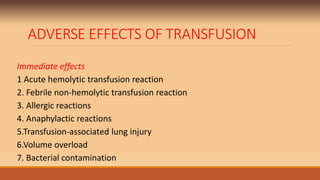
ADVERSE EFFECTS OF TRANSFUSION
Immediate effects
1 Acute hemolytic transfusion reaction
2. Febrile non-hemolytic transfusion reaction
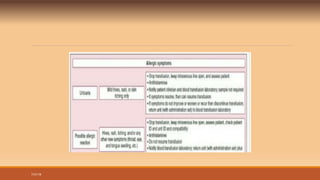
3. Allergic reactions
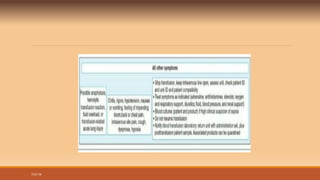
4. Anaphylactic reactions
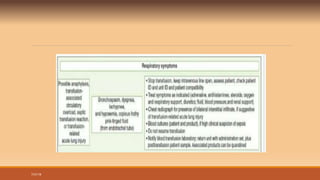
5.Transfusion-associated lung injury
6.Volume overload
7. Bacterial contamination
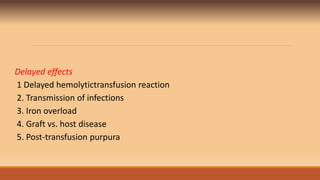
Delayed effects
1 Delayed hemolytictransfusion reaction
2. Transmission of infections
3. Iron overload
4. Graft vs. host disease
5. Post-transfusion purpura
RECOGNITION AND INVESTIGATION OF A
TRANSFUSION REACTION
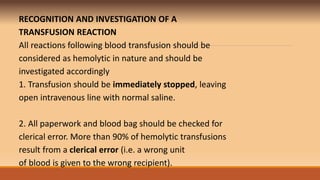
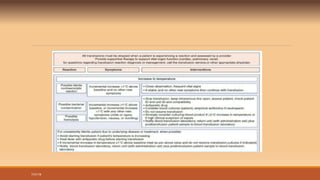
All reactions following blood transfusion should be
considered as hemolytic in nature and should be
investigated accordingly
1. Transfusion should be immediately stopped, leaving
open intravenous line with normal saline.
2. All paperwork and blood bag should be checked for
clerical error. More than 90% of hemolytic transfusions
result from a clerical error (i.e. a wrong unit
of blood is given to the wrong recipient).
3 .Blood bank is informed immediately and the blood
bag, administration set, and post-transfusion blood
and urine samples should be sent to the blood bank.
4. Evidence of hemolysis: Obtain a post-transfusion
blood sample from the recipient, centrifuge, and
observe for pink discoloration of overlying plasma
(hemoglobinemia);
7/31/19
• this is the most rapid way of detecting intravascular hemolysis if pre-transfusion sample is normal.
• Similarly, visual examination of patient’s urine can be done for hemoglobinuria.
• Blood smear examination will show fragmented red
cells and spherocytes.
• Indirect serum bilirubin is raised.
7/31/19
7/31/19
Evidence of blood group incompatibility: Perform
a direct antiglobulin test (DAT) on post- and pre transfusion
blood samples.
• Positive DAT on post transfusion sample (with negative test on pre transfusion sample) is
indicative of an immunological hemolytic transfusion reaction.
• Blood group incompatibility will also be revealed on
• (i) repeat ABO grouping on recipient’s pre- and post-transfusion samples and on donor unit.
• (ii) repeat cross matching of donor blood against recipient’s pre- and post-transfusion samples.
7/31/19
Investigations for detection of complications of
hemolytic transfusion reaction:
• Tests for disseminated intravascular coagulation:
Blood smear, coagulation screen, and test for fibrin
degradation products
• Tests for acute renal failure: Blood urea, serum
creatinine, and serum electrolytes
. Bacteriological culture if the cause of the acute
transfusion is still not clear.
7/31/19
7/31/19
7/31/19
7/31/19
7/31/19
7/31/19

Transfusion reaction investigations

  • 1.
  • 2.
    ADVERSE EFFECTS OFTRANSFUSION Immediate effects 1 Acute hemolytic transfusion reaction 2. Febrile non-hemolytic transfusion reaction 3. Allergic reactions 4. Anaphylactic reactions 5.Transfusion-associated lung injury 6.Volume overload 7. Bacterial contamination
  • 3.
    Delayed effects 1 Delayedhemolytictransfusion reaction 2. Transmission of infections 3. Iron overload 4. Graft vs. host disease 5. Post-transfusion purpura
  • 4.
    RECOGNITION AND INVESTIGATIONOF A TRANSFUSION REACTION All reactions following blood transfusion should be considered as hemolytic in nature and should be investigated accordingly 1. Transfusion should be immediately stopped, leaving open intravenous line with normal saline. 2. All paperwork and blood bag should be checked for clerical error. More than 90% of hemolytic transfusions result from a clerical error (i.e. a wrong unit of blood is given to the wrong recipient).
  • 5.
    3 .Blood bankis informed immediately and the blood bag, administration set, and post-transfusion blood and urine samples should be sent to the blood bank. 4. Evidence of hemolysis: Obtain a post-transfusion blood sample from the recipient, centrifuge, and observe for pink discoloration of overlying plasma (hemoglobinemia); 7/31/19
  • 6.
    • this isthe most rapid way of detecting intravascular hemolysis if pre-transfusion sample is normal. • Similarly, visual examination of patient’s urine can be done for hemoglobinuria. • Blood smear examination will show fragmented red cells and spherocytes. • Indirect serum bilirubin is raised. 7/31/19
  • 7.
  • 8.
    Evidence of bloodgroup incompatibility: Perform a direct antiglobulin test (DAT) on post- and pre transfusion blood samples. • Positive DAT on post transfusion sample (with negative test on pre transfusion sample) is indicative of an immunological hemolytic transfusion reaction. • Blood group incompatibility will also be revealed on • (i) repeat ABO grouping on recipient’s pre- and post-transfusion samples and on donor unit. • (ii) repeat cross matching of donor blood against recipient’s pre- and post-transfusion samples. 7/31/19
  • 9.
    Investigations for detectionof complications of hemolytic transfusion reaction: • Tests for disseminated intravascular coagulation: Blood smear, coagulation screen, and test for fibrin degradation products • Tests for acute renal failure: Blood urea, serum creatinine, and serum electrolytes . Bacteriological culture if the cause of the acute transfusion is still not clear. 7/31/19
  • 10.
  • 11.
  • 12.
  • 13.
  • 14.