LUMINOSCENCE
IMMUNOASSAY
SUBMITTED BY- SK AZIZ UDDIN
SUBMITTED TO- DR.RIKESHWAR PRASAD
DEWANGAN
COURSE-M.PHARM
BRANCH-PHARMACEUTICAL ANALYSIS
COLLEGE NAME- JAMIA HAMDARD
YEAR-2020-2022
CONTENTS
INTRODUCTION (LUMINESCENCE)
TYPES OF LUMINESCENCE.
PRINCIPLE( CHEMILUMINESCENCE)
PRINCIPLE OF CLIA
TYPES OF CLIA
APPLICATION OF CLIA
ADVANTAGES & DISADVANTAGES OF CLIA
REFERENCES
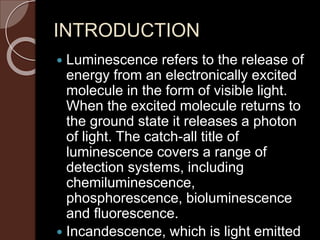
INTRODUCTION
 Luminescence refers to the release of
energy from an electronically excited
molecule in the form of visible light.
When the excited molecule returns to
the ground state it releases a photon
of light. The catch-all title of
luminescence covers a range of
detection systems, including
chemiluminescence,
phosphorescence, bioluminescence
and fluorescence.
 Incandescence, which is light emitted
LUMINESCENCE
 Cold light that can be emitted at lower
temperature.
 Source kicks an electron of an atom
out of its lowest energy ‘ground’ state
higher energy ‘excited’ state.
 Finally electron returns the energy in
the form of light so it can fall back to
its ‘ground’ state.
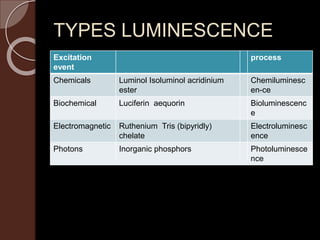
TYPES LUMINESCENCE
Excitation
event
process
Chemicals Luminol Isoluminol acridinium
ester
Chemiluminesc
en-ce
Biochemical Luciferin aequorin Bioluminescenc
e
Electromagnetic Ruthenium Tris (bipyridly)
chelate
Electroluminesc
ence
Photons Inorganic phosphors Photoluminesce
nce
CHEMILUMINESCENCE
 Emission of light with limited emission of
heat , as the result of a chemical
reaction.
 [A]+[B]→[◊]→[products]+ light
 Where ;- [A], [B] ; reactants
[◊] is excited intermediate
 Commonly used catalysts in this reaction are
 Alkaline phosphate(ALP) label is 1,2 dioxane
 Horse radish peroxidase(HRP) label is luminol.
 Metal ions complexes (copper and iron
phthalocyanine complex)
-15
CONTINUE;-
 For example if [A] is luminol and [B] is
hydrogen peroxide in the presence of
a suitable catalyst we have:
 Luminol+ H2 O2 → 3-APA[◊]→3-APA +
light
 Where
3-APA is 3- amino phthalate
3-APA[◊] is the excited state producing light as
it decays to lower energy level.
CONTINUE;-
Application of
chemiluminescence
 Chemiluminescence immunoassay
 DNA hybridization detection
 Western blotting
 Forensic science
 Food analysis
CHEMILUMINESENCE
IMMUNOASSAY(CLIA)
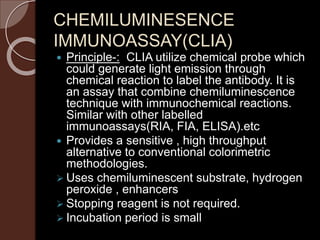
 Principle-: CLIA utilize chemical probe which
could generate light emission through
chemical reaction to label the antibody. It is
an assay that combine chemiluminescence
technique with immunochemical reactions.
Similar with other labelled
immunoassays(RIA, FIA, ELISA).etc
 Provides a sensitive , high throughput
alternative to conventional colorimetric
methodologies.
 Uses chemiluminescent substrate, hydrogen
peroxide , enhancers
 Stopping reagent is not required.
 Incubation period is small
Types of chemiluminescent
assay.
 Direct chemiluminescent assay
 In this method luminophore markers used are
acridinium and ruthenium esters. This kind of
chemical with special structure can transfer to
an excited state through chemical reaction.
Exposure of an acridinium ester label to an
alkaline hydrogen peroxide solution triggers a
flash of light. A subsequent development has
been the acridinium sulfonamide ester labels.
It is also triggered by alkaline hydrogen
peroxide to emit a flash of light. The light
emission mechanism of acridinium ester is
shown in Figure
Direct chemiluminescent
assay
Indirect chemiluminescent
assay
 Enzymatic markers used indirect methods
are alkaline phosphates with adamantly 1,2
dioxetane aryl phosphate(AMPPD) and horse
radish peroxidase(HRP) each has its own
luminescent substrates.
 Luminol is a very common chemiluminescent
substrate used for detection of HRP. HRP
catalyzes the decomposition of luminol in the
presence of peroxide to produce an excited
state intermediate. Flashes of visible light
(maximum at 425nm) is emitted on decay of
the singlet intermediate.
Indirect chemiluminescent
assay
 AMPPD is a derivative of 1, 2-
dioxetane substrates. It has a similar
mechanism of chemiluminescence.
On enzymatic cleavage of the
phosphate group, this compound
becomes destabilized and
decomposes via an intermediate
anion, AMPD, which is moderately
stable. The wavelength of maximum
light emission is 470nm.
Sandwich chemiluminescent
immunoassay
 Sandwich CLIA is a kind of detection method combined
double antibody sandwich method with
chemiluminescence detection method. It regularly
includes lots of steps, which are shown below. At first,
the microtiter plate has been pre-coated with an
antibody specific to analyte. Then, standards or
samples are added to the appropriate microtiter plate
wells, the analyte in standards and samples will bound
to the immobilized Ab. Next, biotin-conjugated antibody
is added and binds to the analyte absorbed on the
plate. The complex of two antibodies and analytes in
the wells act as a “sandwich” structure. After the
unbound biotin-conjugated antibody is washed away,
avidin-conjugated Horseradish Peroxidase (HRP) is
added to each micro plate well, after incubation, luminol
is added into the micro wells, and then relative
luminosity values (RLU) will be scanned by photon
USES
 Used to estimate analytes which have extremely low
conc. In the blood such as hormones, serological
markers and drugs.
 Hormones ; insulin, thyroxin,
estradiol,testosterone,progesterone,prolactin, LH, FSH
etc. Vitamin; vit B12
 Tumor markers: bone morphogenic protein-2, carcino
embryonic antigen(CEA), alpha fetoprotein(AFP)
 Also COVID-19 marker, biochemical marker is also
detected
 Human beta chorionic gonadotropin
 C- reactive protein.
 Tumor necrosis factor
 To detect ATP specific enzymes.(Luciferase,creatin
ADVANTAGES OF CLIA
 It is a analytical methods reside in the
wide dynamic range.
 It has high signal intensity, absence of
interfering emissions(i.e. High
specificity)
 Rapid acquisition of the analytical
signal.
 High stability of reagents and their
conjugates.
 Low consumption of reagents.
 Random access, reduced incubation
DISADVANTAGES OF CLIA
Light leaks from assay reagent &
reaction vessels
Ultra sensitive- stringent controls on
purity of reagents
High intensity light emission leads to
pulse pile up in photomultiplier tubes
leads to underestimation.
Limited Ag detection
High costs
Limited tests panel
REFERENCES
 Internet browsing (GOOGLE)
 http://www.cloud-
clone.com/topic/201511200859289789.htm#:~:text=San
dwich%20CLIA%20is%20a%20kind,method%20with%2
0chemiluminescence%20detecion%20method.&text=Th
e%20complex%20of%20two%20antibodies,as%20a%2
0%E2%80%9Csandwich%E2%80%9D%20structure.
 https://www.ncbi.nlm.nih.gov/pmc/articles/PMC5483212
/
 You tube video
 Google Slide share
 Immunoassay book.
THANK YOU

Luminoscence immunoassay

  • 1.
    LUMINOSCENCE IMMUNOASSAY SUBMITTED BY- SKAZIZ UDDIN SUBMITTED TO- DR.RIKESHWAR PRASAD DEWANGAN COURSE-M.PHARM BRANCH-PHARMACEUTICAL ANALYSIS COLLEGE NAME- JAMIA HAMDARD YEAR-2020-2022
  • 2.
    CONTENTS INTRODUCTION (LUMINESCENCE) TYPES OFLUMINESCENCE. PRINCIPLE( CHEMILUMINESCENCE) PRINCIPLE OF CLIA TYPES OF CLIA APPLICATION OF CLIA ADVANTAGES & DISADVANTAGES OF CLIA REFERENCES
  • 3.
    INTRODUCTION  Luminescence refersto the release of energy from an electronically excited molecule in the form of visible light. When the excited molecule returns to the ground state it releases a photon of light. The catch-all title of luminescence covers a range of detection systems, including chemiluminescence, phosphorescence, bioluminescence and fluorescence.  Incandescence, which is light emitted
  • 4.
    LUMINESCENCE  Cold lightthat can be emitted at lower temperature.  Source kicks an electron of an atom out of its lowest energy ‘ground’ state higher energy ‘excited’ state.  Finally electron returns the energy in the form of light so it can fall back to its ‘ground’ state.
  • 6.
    TYPES LUMINESCENCE Excitation event process Chemicals LuminolIsoluminol acridinium ester Chemiluminesc en-ce Biochemical Luciferin aequorin Bioluminescenc e Electromagnetic Ruthenium Tris (bipyridly) chelate Electroluminesc ence Photons Inorganic phosphors Photoluminesce nce
  • 7.
    CHEMILUMINESCENCE  Emission oflight with limited emission of heat , as the result of a chemical reaction.  [A]+[B]→[◊]→[products]+ light  Where ;- [A], [B] ; reactants [◊] is excited intermediate  Commonly used catalysts in this reaction are  Alkaline phosphate(ALP) label is 1,2 dioxane  Horse radish peroxidase(HRP) label is luminol.  Metal ions complexes (copper and iron phthalocyanine complex) -15
  • 8.
    CONTINUE;-  For exampleif [A] is luminol and [B] is hydrogen peroxide in the presence of a suitable catalyst we have:  Luminol+ H2 O2 → 3-APA[◊]→3-APA + light  Where 3-APA is 3- amino phthalate 3-APA[◊] is the excited state producing light as it decays to lower energy level.
  • 9.
  • 10.
    Application of chemiluminescence  Chemiluminescenceimmunoassay  DNA hybridization detection  Western blotting  Forensic science  Food analysis
  • 11.
    CHEMILUMINESENCE IMMUNOASSAY(CLIA)  Principle-: CLIAutilize chemical probe which could generate light emission through chemical reaction to label the antibody. It is an assay that combine chemiluminescence technique with immunochemical reactions. Similar with other labelled immunoassays(RIA, FIA, ELISA).etc  Provides a sensitive , high throughput alternative to conventional colorimetric methodologies.  Uses chemiluminescent substrate, hydrogen peroxide , enhancers  Stopping reagent is not required.  Incubation period is small
  • 12.
    Types of chemiluminescent assay. Direct chemiluminescent assay  In this method luminophore markers used are acridinium and ruthenium esters. This kind of chemical with special structure can transfer to an excited state through chemical reaction. Exposure of an acridinium ester label to an alkaline hydrogen peroxide solution triggers a flash of light. A subsequent development has been the acridinium sulfonamide ester labels. It is also triggered by alkaline hydrogen peroxide to emit a flash of light. The light emission mechanism of acridinium ester is shown in Figure
  • 13.
  • 14.
    Indirect chemiluminescent assay  Enzymaticmarkers used indirect methods are alkaline phosphates with adamantly 1,2 dioxetane aryl phosphate(AMPPD) and horse radish peroxidase(HRP) each has its own luminescent substrates.  Luminol is a very common chemiluminescent substrate used for detection of HRP. HRP catalyzes the decomposition of luminol in the presence of peroxide to produce an excited state intermediate. Flashes of visible light (maximum at 425nm) is emitted on decay of the singlet intermediate.
  • 15.
    Indirect chemiluminescent assay  AMPPDis a derivative of 1, 2- dioxetane substrates. It has a similar mechanism of chemiluminescence. On enzymatic cleavage of the phosphate group, this compound becomes destabilized and decomposes via an intermediate anion, AMPD, which is moderately stable. The wavelength of maximum light emission is 470nm.
  • 17.
    Sandwich chemiluminescent immunoassay  SandwichCLIA is a kind of detection method combined double antibody sandwich method with chemiluminescence detection method. It regularly includes lots of steps, which are shown below. At first, the microtiter plate has been pre-coated with an antibody specific to analyte. Then, standards or samples are added to the appropriate microtiter plate wells, the analyte in standards and samples will bound to the immobilized Ab. Next, biotin-conjugated antibody is added and binds to the analyte absorbed on the plate. The complex of two antibodies and analytes in the wells act as a “sandwich” structure. After the unbound biotin-conjugated antibody is washed away, avidin-conjugated Horseradish Peroxidase (HRP) is added to each micro plate well, after incubation, luminol is added into the micro wells, and then relative luminosity values (RLU) will be scanned by photon
  • 19.
    USES  Used toestimate analytes which have extremely low conc. In the blood such as hormones, serological markers and drugs.  Hormones ; insulin, thyroxin, estradiol,testosterone,progesterone,prolactin, LH, FSH etc. Vitamin; vit B12  Tumor markers: bone morphogenic protein-2, carcino embryonic antigen(CEA), alpha fetoprotein(AFP)  Also COVID-19 marker, biochemical marker is also detected  Human beta chorionic gonadotropin  C- reactive protein.  Tumor necrosis factor  To detect ATP specific enzymes.(Luciferase,creatin
  • 20.
    ADVANTAGES OF CLIA It is a analytical methods reside in the wide dynamic range.  It has high signal intensity, absence of interfering emissions(i.e. High specificity)  Rapid acquisition of the analytical signal.  High stability of reagents and their conjugates.  Low consumption of reagents.  Random access, reduced incubation
  • 21.
    DISADVANTAGES OF CLIA Lightleaks from assay reagent & reaction vessels Ultra sensitive- stringent controls on purity of reagents High intensity light emission leads to pulse pile up in photomultiplier tubes leads to underestimation. Limited Ag detection High costs Limited tests panel
  • 22.
    REFERENCES  Internet browsing(GOOGLE)  http://www.cloud- clone.com/topic/201511200859289789.htm#:~:text=San dwich%20CLIA%20is%20a%20kind,method%20with%2 0chemiluminescence%20detecion%20method.&text=Th e%20complex%20of%20two%20antibodies,as%20a%2 0%E2%80%9Csandwich%E2%80%9D%20structure.  https://www.ncbi.nlm.nih.gov/pmc/articles/PMC5483212 /  You tube video  Google Slide share  Immunoassay book.
  • 23.