CHEMILUMINESCENCE
Presented by TANVI VYAS
M. Sc. (CHEMISTRY)
• LUMINESCENCE – It is general term for the
emission of light from a cool object. Most of
these fall into on of three categories :
• Phosphorescence
• Fluorescence
• Chemiluminescence
• bioluminescence
CHEMILUMINESCENCE
• The Chemiluminescence is the production of the
light from a chemical reaction.
• 2 chemicals reacts to form an excited high
energy intermediate which breaks down
releasing some of its energy as photons of light
to reach its ground state.
• The Packet of energy (a photon) is released in
the form of electromagnetic radiation.
• If the wavelength is within the range of visible
light then the electron transition will be
perceived as light of the particular colour.
• It involves the oxidation of an organic
compound.
• Light is emitted from the excited product formed
in the oxidation reaction.
• In this there is no need of an external source of
photon to excite a molecule.
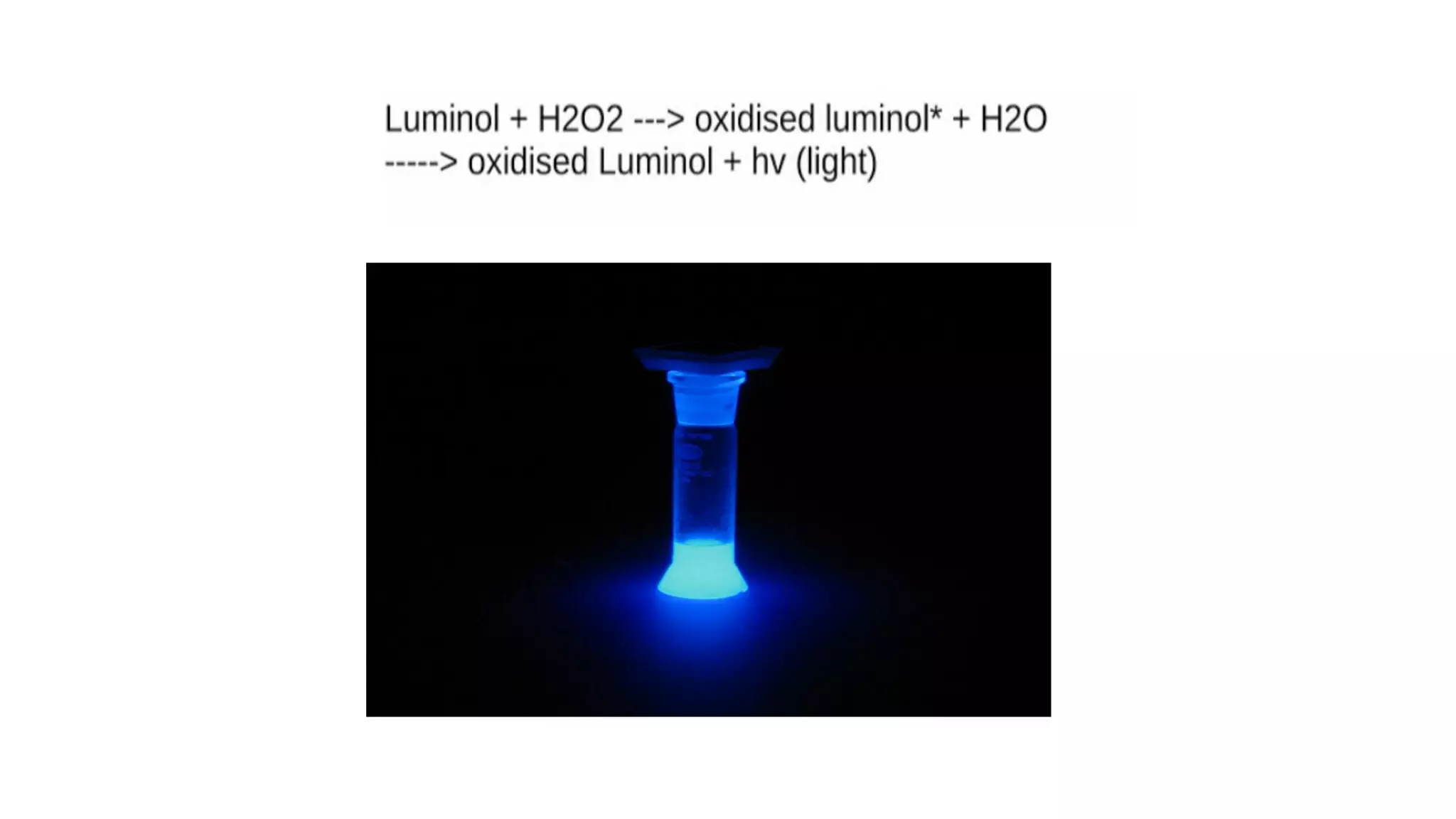
• Luminol is chemiluminescent Molecule was
discovered by the german scientist H. O
ALBERECHT in 1928.
BIOLUMINESCENCE
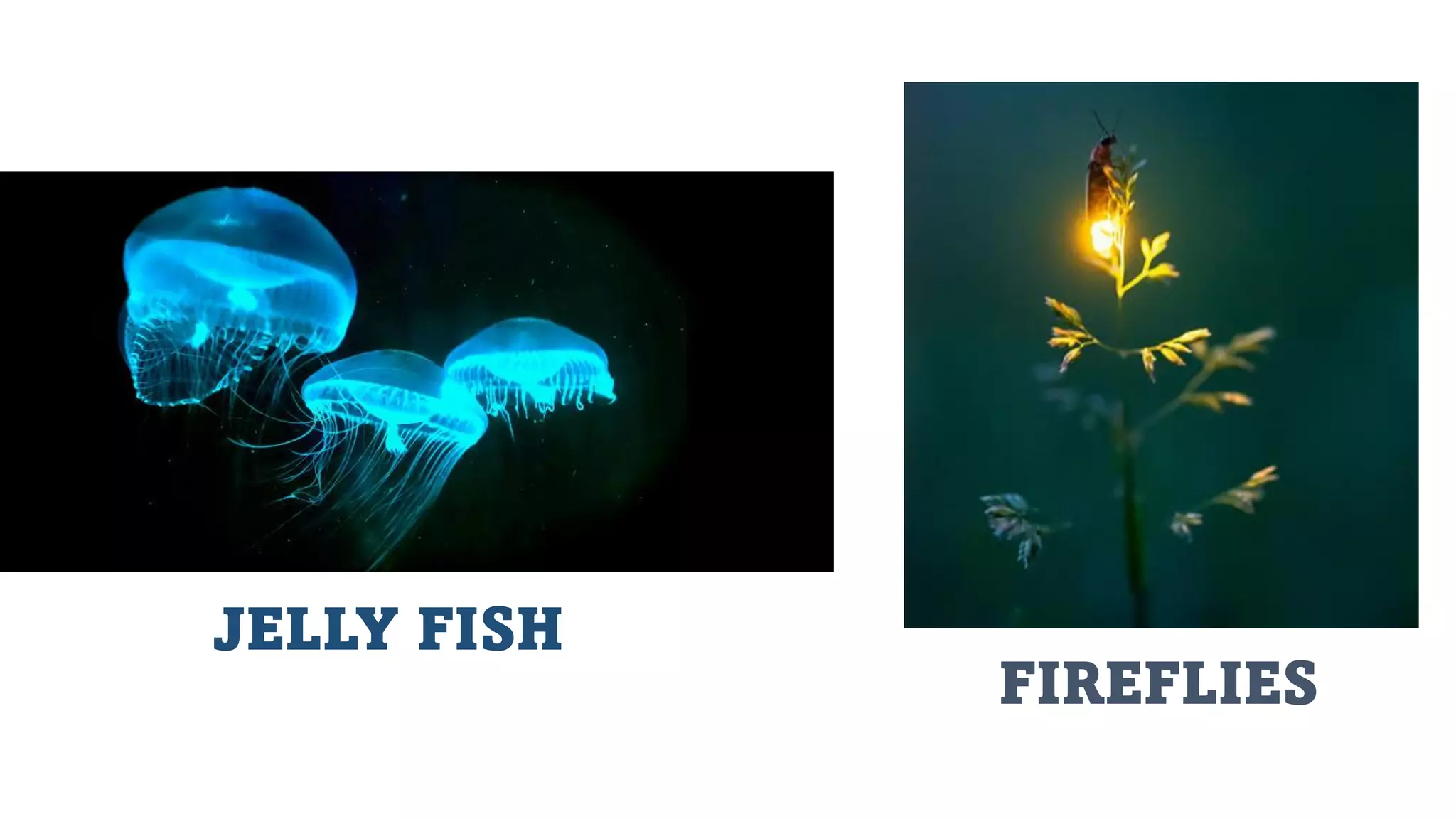
• When Chemiluminescence is occurs in any
biological process it is called bioluminescence.
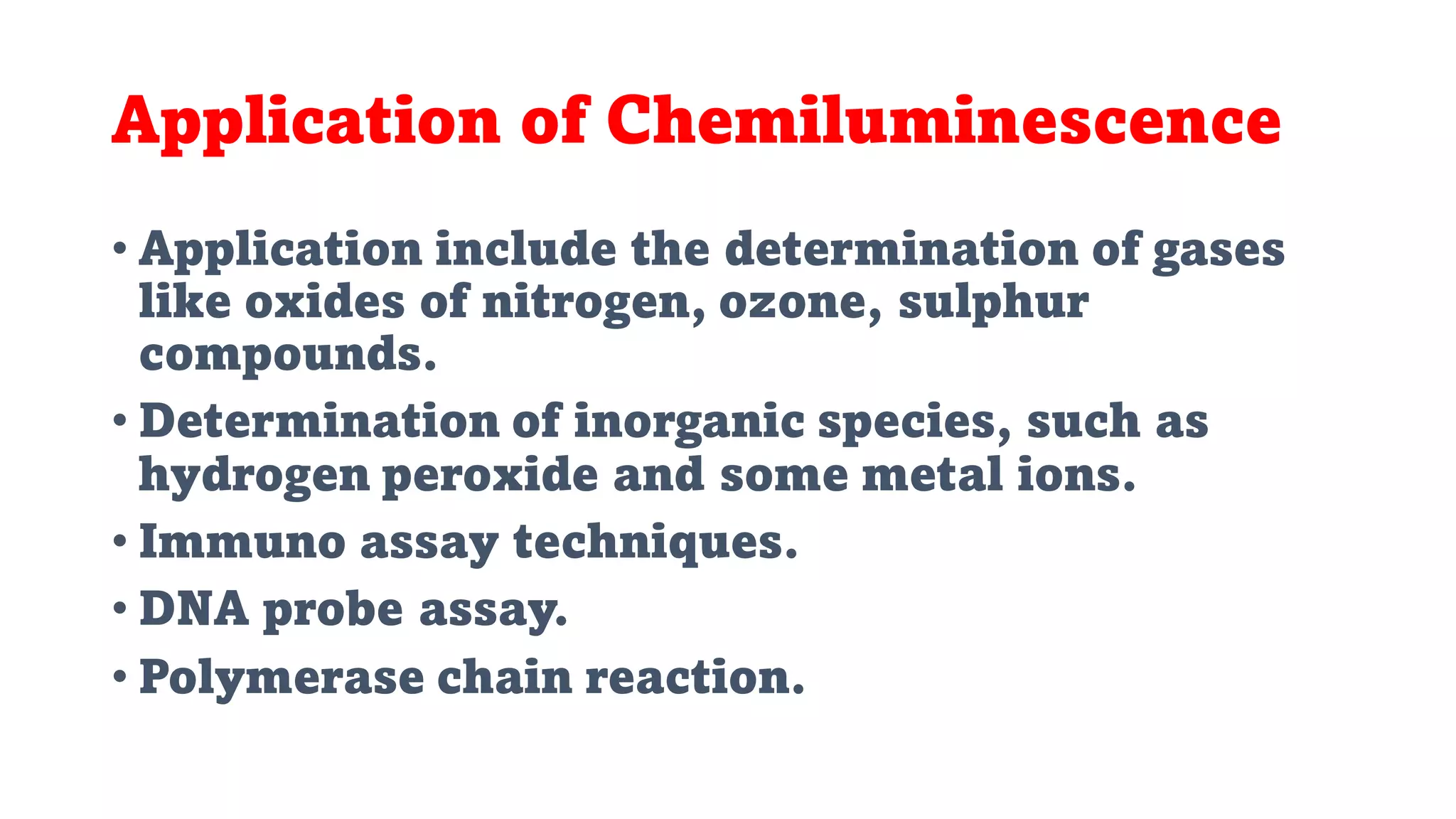
• Examples – when fireflies glow, the luciferin is
oxidized to produce an excited complex, which
falls back down to the ground state releasing a
photon of light.
• And the another examples are the sea pency,
certain jelly fishes, bacteria, protozoa.
JELLY FISH
FIREFLIES
Application of Chemiluminescence
• Application include the determination of gases
like oxides of nitrogen, ozone, sulphur
compounds.
• Determination of inorganic species, such as
hydrogen peroxide and some metal ions.
• Immuno assay techniques.
• DNA probe assay.
• Polymerase chain reaction.
• Chemiluminescence reaction generally involves
those that are very highly energetic, often
involving strong oxidants.
• Ozone reacts with many substance producing
light.
• Many metals hydrides are also show
Chemiluminescence as ASH3
• Chemiluminescence reaction that doesn’t
involve ozone is production of monoatomic
sulphur in a hydrogen flame.
• Other example is Ru(bipy)3+ oxidizes to its
reduced form Ru(bipy)2+, which in return to
the ground state emit orange light.
Chemiluminescence in forensics
• Luminol to detect blood an crime scenes.
• Mixture of luminol in a dilute solution of
hydrogen peroxide sprayed on to the areas
where the blood is present.
• The iron present in Haem unit of a haemoglobin
act as a metal catalyst in the reaction.
• If the blood is present, the blue colour glow
observed.

CHEMILUMINESCENCE.ppt

  • 1.
    CHEMILUMINESCENCE Presented by TANVIVYAS M. Sc. (CHEMISTRY)
  • 2.
    • LUMINESCENCE –It is general term for the emission of light from a cool object. Most of these fall into on of three categories : • Phosphorescence • Fluorescence • Chemiluminescence • bioluminescence
  • 3.
    CHEMILUMINESCENCE • The Chemiluminescenceis the production of the light from a chemical reaction. • 2 chemicals reacts to form an excited high energy intermediate which breaks down releasing some of its energy as photons of light to reach its ground state. • The Packet of energy (a photon) is released in the form of electromagnetic radiation.
  • 4.
    • If thewavelength is within the range of visible light then the electron transition will be perceived as light of the particular colour. • It involves the oxidation of an organic compound. • Light is emitted from the excited product formed in the oxidation reaction. • In this there is no need of an external source of photon to excite a molecule. • Luminol is chemiluminescent Molecule was discovered by the german scientist H. O ALBERECHT in 1928.
  • 6.
    BIOLUMINESCENCE • When Chemiluminescenceis occurs in any biological process it is called bioluminescence. • Examples – when fireflies glow, the luciferin is oxidized to produce an excited complex, which falls back down to the ground state releasing a photon of light. • And the another examples are the sea pency, certain jelly fishes, bacteria, protozoa.
  • 7.
  • 8.
    Application of Chemiluminescence •Application include the determination of gases like oxides of nitrogen, ozone, sulphur compounds. • Determination of inorganic species, such as hydrogen peroxide and some metal ions. • Immuno assay techniques. • DNA probe assay. • Polymerase chain reaction.
  • 9.
    • Chemiluminescence reactiongenerally involves those that are very highly energetic, often involving strong oxidants. • Ozone reacts with many substance producing light. • Many metals hydrides are also show Chemiluminescence as ASH3
  • 11.
    • Chemiluminescence reactionthat doesn’t involve ozone is production of monoatomic sulphur in a hydrogen flame. • Other example is Ru(bipy)3+ oxidizes to its reduced form Ru(bipy)2+, which in return to the ground state emit orange light.
  • 13.
    Chemiluminescence in forensics •Luminol to detect blood an crime scenes. • Mixture of luminol in a dilute solution of hydrogen peroxide sprayed on to the areas where the blood is present. • The iron present in Haem unit of a haemoglobin act as a metal catalyst in the reaction. • If the blood is present, the blue colour glow observed.