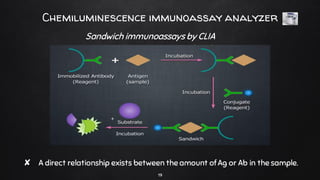
Chemiluminescence immunoassay analyzers use the principle of chemiluminescence to detect analytes in samples. They work by forming immune complexes between antigens/analytes in samples and antibodies on magnetic microparticles or reaction vessels. A chemiluminescent-labeled conjugate is then added, forming a sandwich. When a trigger is added, it causes the chemiluminescent compound to emit light, whose intensity is directly proportional to the amount of antigen/analyte present. The light is measured and converted to a concentration value. The analyzer is fully automated and can detect various analytes through daily maintenance and sample/reagent loading.















![✘ References
[1] Automated ChemiluminescenceImmunoassay Analyzer
Yao Yufeng,LuShizhou,HuangBo,Zhao Jianwen
Harbin Instituteof Technology at Weihai,Shandong,264209,China
[2] Architect system en TSH 7K62 49-3481/R3 B7K620‘
[3] Brochure of CLIA i1000sr(https://www.medwrench.com/documents/view/4116/abbott-architect-i1000sr-
brochure)
[4] TSH Reagent Kit Literature for Cobas e601,Roche Diagnostics. Mannheim:2011.
[5] ChemiluminescenceImmunoassay:Basic Mechanism and Applications
Mohammad Anwar-ulAzim, Mizanul Hasan, Israque Hossain Ansari and Faria Nasreen
National Institute of Nuclear Medicine and AlliedSciences,BAEC,BSMMU, Shahbagh, Dhaka
103](https://image.slidesharecdn.com/clia-220720053723-560b1a7d/85/CLIA-pdf-103-320.jpg)


![IMMUNODIAGNOSTICS seminar final [2].pptx](https://cdn.slidesharecdn.com/ss_thumbnails/immunodiagnostics2-251119101657-7a9d73de-thumbnail.jpg?width=640&height=640&fit=bounds)


