By-Sanju Sah
St. Xavier’s college, Maitighar, Kathmandu
Department of Microbiology
I. Introduction
Important!
Occurrence In
Nature
Fireflies, glow worms
90% of deep-sea creatures
Bacteria
Fungi
Dinoflagellate
Chemiluminesc
ence
Emission of light (usually in visible and near infrared)
as a result of a chem. reaction.
[A] + [B] → [◊] → [Products] + light
A: chemiluminescent precursor
B: oxidant
◊: excited intermediate
Sometimes in a presence of catalyst (reduce
activation energy), intermediate in electronically
excited state, subsequently relax to ground state by
the emission of photon.
EXAMPL
ES
Marine microorganisms
signal distress – in this
case, being disturbed by
the waves.
An Anglerfish trying to make a snack of Marlin
use chemiluminescence to and Dory in Finding Nemo. The real fish is almost
as scary.
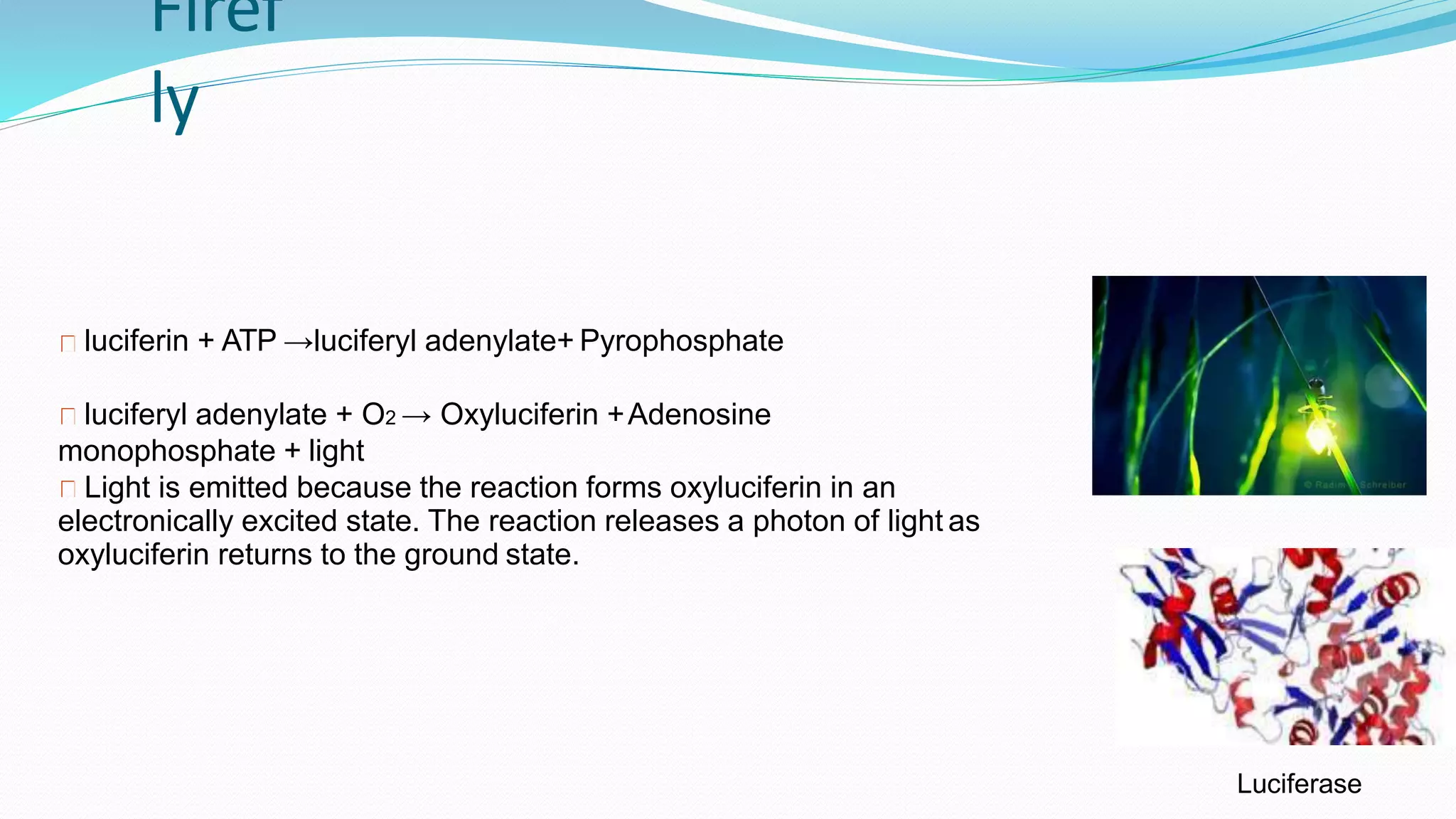
Fireflies use
chemiluminescence to
find their mates
Firef
ly
luciferin + ATP →luciferyl adenylate+ Pyrophosphate
luciferyl adenylate + O2 → Oxyluciferin +Adenosine
monophosphate + light
Light is emitted because the reaction forms oxyluciferin in an
electronically excited state. The reaction releases a photon of light as
oxyluciferin returns to the ground state.
Luciferase
Application Of
Chemiluminescence
Gas-Phase Reactions
In Forensic Science
In Biomedical research
Glow Stick
In DNA Hybridisation
Gas-Phase
Reactions
1.Oxidation of white phosphorus
One of the oldest chemiluminescent reactions is that of elemental white phosphorus
oxidising in moist air ,producing a green glow .
This is a gas phase reaction of phosphorus vapour ,above the solid ,with oxygen
producing excited states (PO)2 and HPO .
2.Detection of the amount of Nitricoxide
To detect the amount of nitric oxide present in a sample ,Ozone is combined with
nitric oxide to form nitrogen dioxide in an activated states which luminesces
broadband visible to infrared light asit reverts to a lower energy state .
Application In Forensic
Science
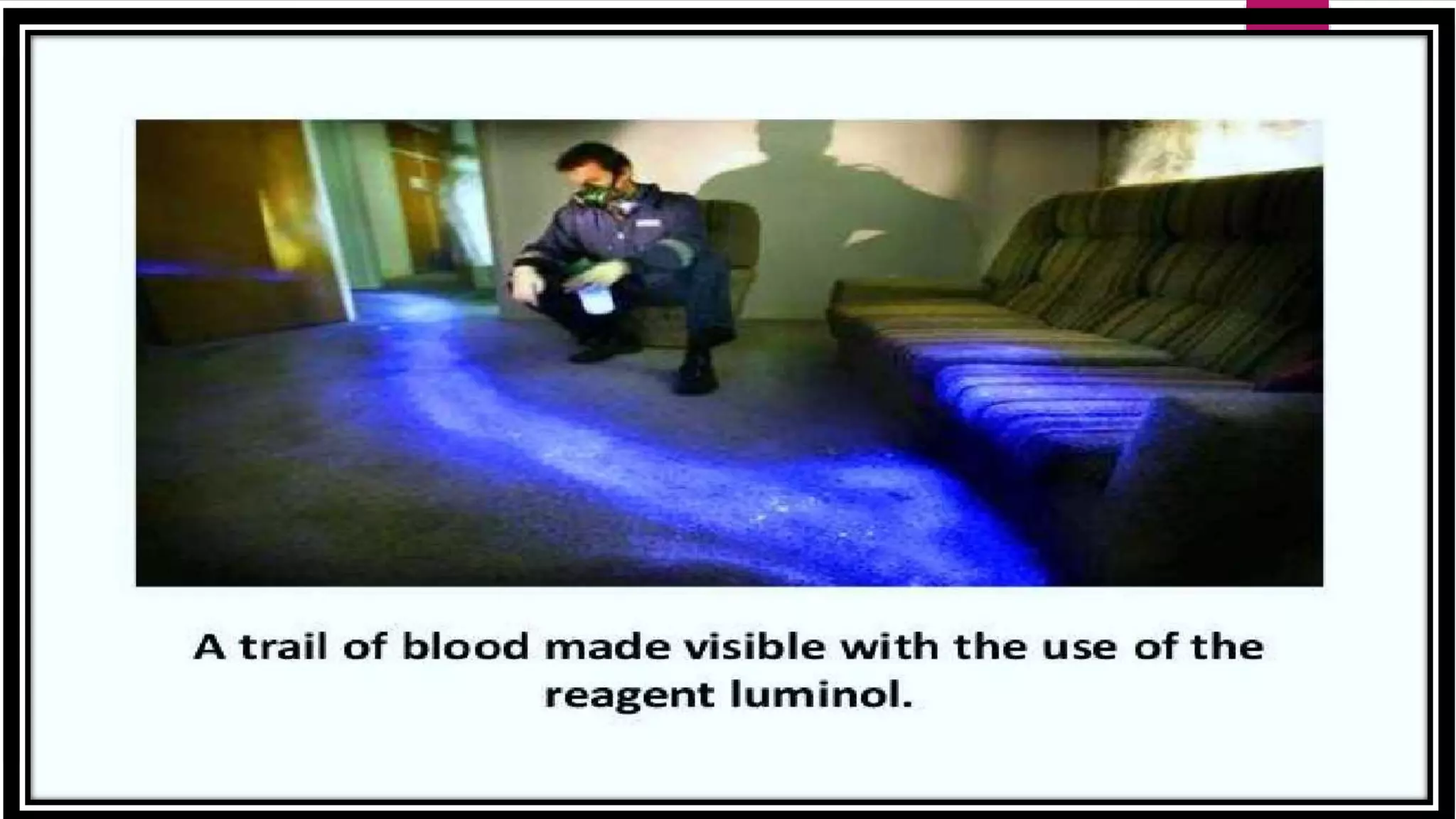
Chemiluminescence has been applied by forensic scientists to
solve crimes.in this case they use luminol and hydrogen
peroxide .The iron from blood act as a catalyst and react with
luminol and hydrogen peroxide to produce blue light for about
30 seconds .As only small amount of blood is required for
Chemiluminescence , trace amounts of blood are sufficient.
Application In Biomedical
Research
 In biomedical research the protein luciferin that gives
fireflies their glow and its co factor are used to produce red
light through consumption of ATP.This reaction is used to
detect the effectiveness of cancer drugs that choke off a
tumour's blood supply .This form of bioluminescence
imaging help the scientists to test drug in pre-clinical stage
.
 Another protein aequorin ,found in jelly fish which produce
blue light in presence of calcium use to assesscalcium
levels in cells .
Glow
sticks
First container contains Phenyl
Oxalate and dye. Glass vial contains
Hydrogen Peroxide.
Reaction produces 2 molecules of
phenol and one molecule of
Peroxyacid ester.
Peroxyacid decompose to CO2 and
releases energy which excites the dye.
Dye relaxes by releasing a photon.
Wavelength is dye dependant!
Other
Applications
It is used for analysis of inorganic species in liquid phase.
Detection of biomolecules in system .
Used for DNA sequencing .
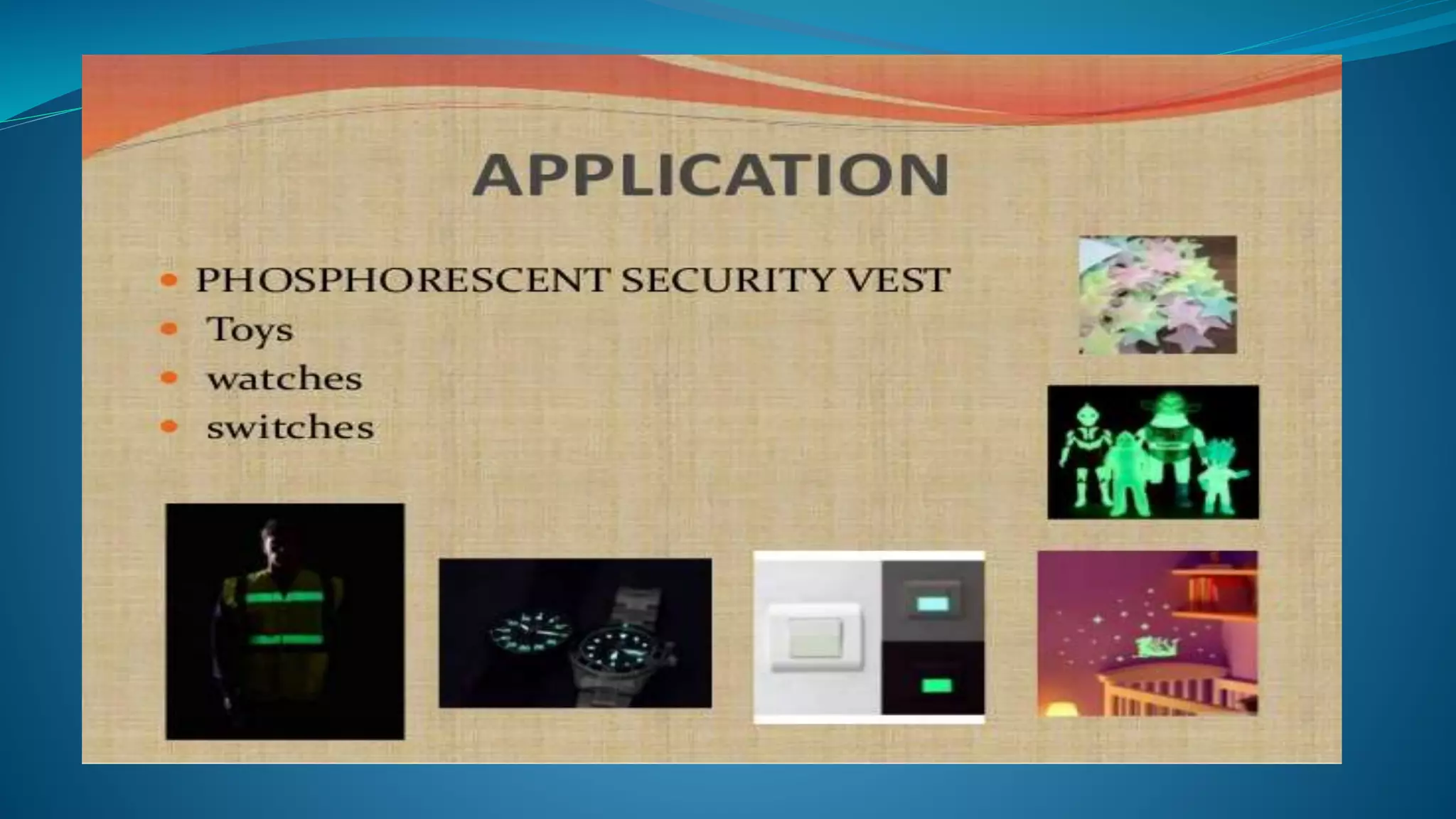
Used for lighting objects .
 emission of light from some minerals and certain other crystalline materials.
The light energy released is derived from electron displacements within the
crystal lattice of such a substance caused by previous exposure to high-energy
radiation. Heating the substance at temperatures of about 450° C (842° F) and
higher enables the trapped electrons to return to their normal positions,
resulting in the release of energy. The intensity of the emission can be
correlated to the length of time that a given substance was exposed to radiation;
the longer the time allowed for the radiation to build up an inventory of trapped
electrons, the greater the energy released. Because of this feature,
thermoluminescence has been exploited as a means of dating various minerals
and archaeological artifacts.
Thermoluminescence Dating
Thermoluminescence dating (TL) is a
technique that is based on the analysis of
light release when heating crystalline
material. TL-dating is used in mineralogy
and geology, but is also increasingly being
applied for dating of anthropological and
archaeologica

Chemiluminiscence

  • 1.
    By-Sanju Sah St. Xavier’scollege, Maitighar, Kathmandu Department of Microbiology
  • 2.
  • 6.
  • 7.
    Occurrence In Nature Fireflies, glowworms 90% of deep-sea creatures Bacteria Fungi Dinoflagellate
  • 8.
    Chemiluminesc ence Emission of light(usually in visible and near infrared) as a result of a chem. reaction. [A] + [B] → [◊] → [Products] + light A: chemiluminescent precursor B: oxidant ◊: excited intermediate Sometimes in a presence of catalyst (reduce activation energy), intermediate in electronically excited state, subsequently relax to ground state by the emission of photon.
  • 9.
    EXAMPL ES Marine microorganisms signal distress– in this case, being disturbed by the waves. An Anglerfish trying to make a snack of Marlin use chemiluminescence to and Dory in Finding Nemo. The real fish is almost as scary. Fireflies use chemiluminescence to find their mates
  • 10.
    Firef ly luciferin + ATP→luciferyl adenylate+ Pyrophosphate luciferyl adenylate + O2 → Oxyluciferin +Adenosine monophosphate + light Light is emitted because the reaction forms oxyluciferin in an electronically excited state. The reaction releases a photon of light as oxyluciferin returns to the ground state. Luciferase
  • 11.
    Application Of Chemiluminescence Gas-Phase Reactions InForensic Science In Biomedical research Glow Stick In DNA Hybridisation
  • 12.
    Gas-Phase Reactions 1.Oxidation of whitephosphorus One of the oldest chemiluminescent reactions is that of elemental white phosphorus oxidising in moist air ,producing a green glow . This is a gas phase reaction of phosphorus vapour ,above the solid ,with oxygen producing excited states (PO)2 and HPO . 2.Detection of the amount of Nitricoxide To detect the amount of nitric oxide present in a sample ,Ozone is combined with nitric oxide to form nitrogen dioxide in an activated states which luminesces broadband visible to infrared light asit reverts to a lower energy state .
  • 13.
    Application In Forensic Science Chemiluminescencehas been applied by forensic scientists to solve crimes.in this case they use luminol and hydrogen peroxide .The iron from blood act as a catalyst and react with luminol and hydrogen peroxide to produce blue light for about 30 seconds .As only small amount of blood is required for Chemiluminescence , trace amounts of blood are sufficient.
  • 15.
    Application In Biomedical Research In biomedical research the protein luciferin that gives fireflies their glow and its co factor are used to produce red light through consumption of ATP.This reaction is used to detect the effectiveness of cancer drugs that choke off a tumour's blood supply .This form of bioluminescence imaging help the scientists to test drug in pre-clinical stage .  Another protein aequorin ,found in jelly fish which produce blue light in presence of calcium use to assesscalcium levels in cells .
  • 16.
    Glow sticks First container containsPhenyl Oxalate and dye. Glass vial contains Hydrogen Peroxide. Reaction produces 2 molecules of phenol and one molecule of Peroxyacid ester. Peroxyacid decompose to CO2 and releases energy which excites the dye. Dye relaxes by releasing a photon. Wavelength is dye dependant!
  • 17.
    Other Applications It is usedfor analysis of inorganic species in liquid phase. Detection of biomolecules in system . Used for DNA sequencing . Used for lighting objects .
  • 19.
     emission oflight from some minerals and certain other crystalline materials. The light energy released is derived from electron displacements within the crystal lattice of such a substance caused by previous exposure to high-energy radiation. Heating the substance at temperatures of about 450° C (842° F) and higher enables the trapped electrons to return to their normal positions, resulting in the release of energy. The intensity of the emission can be correlated to the length of time that a given substance was exposed to radiation; the longer the time allowed for the radiation to build up an inventory of trapped electrons, the greater the energy released. Because of this feature, thermoluminescence has been exploited as a means of dating various minerals and archaeological artifacts.
  • 20.
    Thermoluminescence Dating Thermoluminescence dating(TL) is a technique that is based on the analysis of light release when heating crystalline material. TL-dating is used in mineralogy and geology, but is also increasingly being applied for dating of anthropological and archaeologica