LuminesEcence
LUMINESCENCE ASSAY
VINDHYA.V.V
Definition
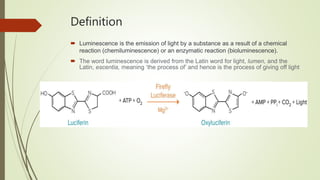
 Luminescence is the emission of light by a substance as a result of a chemical
reaction (chemiluminescence) or an enzymatic reaction (bioluminescence).
 The word luminescence is derived from the Latin word for light, lumen, and the
Latin, escentia, meaning ‘the process of’ and hence is the process of giving off light
Luminescence can be divided into two
types:
 Luminescence can be either a ‘flash(fluorescence,)or a ‘glow(’ phosphorescence)
reaction, depending on the kinetic profiles.
 Flash luminescence gives a very bright signal for a short amount of time, usually
seconds.
 Glow luminescence emits a more stable but usually less intense signal that can
last for several minutes or hours.
 White microplates are usually recommended for luminescence as they reflect light
and maximize the signal.
Types of luminescence
 The following are types of luminescence:
 Chemiluminescence, the emission of light as a result of a chemical reaction
 Bioluminescence, a result of biochemical reactions in a living organism
 Electrochemiluminescence, a result of an electrochemical reaction
 Lyoluminescence, a result of dissolving a solid (usually heavily irradiated) in a liquid solvent
 Candoluminescence, is light emitted by certain materials at elevated temperatures, which
differs from the blackbody emission expected at the temperature in question.
 Crystalloluminescence, produced during crystallization
 Electroluminescence, a result of an electric current passed through a substance
 Cathodoluminescence, a result of a luminescent material being struck by electrons
 Mechanoluminescence, a result of a mechanical action on a solid
 Photoluminescence, a result of absorption of photonsFluorescence,
photoluminescence as a result of singlet–singlet
electronic relaxation (typical lifetime: nanoseconds)
 Phosphorescence, photoluminescence as a result of triplet–singlet electronic
relaxation
 Radioluminescence, a result of bombardment by ionizing radiation
 Thermoluminescence, the re-emission of absorbed energy when a substance is
heated[5]
 Cryoluminescence, the emission of light when an object is cooled
Advantages of luminescence
 Luminescence is an extremely popular detection platform for many applications
compared to absorbance and fluorescence
 higher sensitivity as background interference (autofluorescence from compounds,
media and cells) is low.
 In addition, luminescence assays often use a homogenous (no wash) protocol,
which makes them simpler to automate for high-throughput applications.
luminescence detection work
 luminescence is generated by a chemical or biological reaction, for example an
enzyme and its substrate. The resulting light can be detected by a photomultiplier
tube (PMT), in which photons are converted to electrons, with the resulting current
proportional to the amount of light. Measurement of the signal is expressed as
relative light units (RLU).
luminometer
 When a luminescence reaction is set up in a microplate, a luminometer (or
luminescence microplate reader), is used to measure the amount of light
produced.
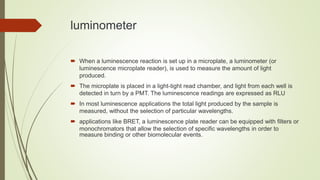
 The microplate is placed in a light-tight read chamber, and light from each well is
detected in turn by a PMT. The luminescence readings are expressed as RLU
 In most luminescence applications the total light produced by the sample is
measured, without the selection of particular wavelengths.
 applications like BRET, a luminescence plate reader can be equipped with filters or
monochromators that allow the selection of specific wavelengths in order to
measure binding or other biomolecular events.
NanoBRET/BRET
 BRET (bioluminescence resonance energy transfer) is a technique for measuring
protein-protein or protein-ligand interactions that involves the interaction of a
bioluminescent donor and a fluorescent acceptor.

Luminescence assay

  • 1.
  • 2.
    Definition  Luminescence isthe emission of light by a substance as a result of a chemical reaction (chemiluminescence) or an enzymatic reaction (bioluminescence).  The word luminescence is derived from the Latin word for light, lumen, and the Latin, escentia, meaning ‘the process of’ and hence is the process of giving off light
  • 3.
    Luminescence can bedivided into two types:  Luminescence can be either a ‘flash(fluorescence,)or a ‘glow(’ phosphorescence) reaction, depending on the kinetic profiles.  Flash luminescence gives a very bright signal for a short amount of time, usually seconds.  Glow luminescence emits a more stable but usually less intense signal that can last for several minutes or hours.  White microplates are usually recommended for luminescence as they reflect light and maximize the signal.
  • 4.
    Types of luminescence The following are types of luminescence:  Chemiluminescence, the emission of light as a result of a chemical reaction  Bioluminescence, a result of biochemical reactions in a living organism  Electrochemiluminescence, a result of an electrochemical reaction  Lyoluminescence, a result of dissolving a solid (usually heavily irradiated) in a liquid solvent  Candoluminescence, is light emitted by certain materials at elevated temperatures, which differs from the blackbody emission expected at the temperature in question.  Crystalloluminescence, produced during crystallization  Electroluminescence, a result of an electric current passed through a substance  Cathodoluminescence, a result of a luminescent material being struck by electrons  Mechanoluminescence, a result of a mechanical action on a solid
  • 5.
     Photoluminescence, aresult of absorption of photonsFluorescence, photoluminescence as a result of singlet–singlet electronic relaxation (typical lifetime: nanoseconds)  Phosphorescence, photoluminescence as a result of triplet–singlet electronic relaxation  Radioluminescence, a result of bombardment by ionizing radiation  Thermoluminescence, the re-emission of absorbed energy when a substance is heated[5]  Cryoluminescence, the emission of light when an object is cooled
  • 6.
    Advantages of luminescence Luminescence is an extremely popular detection platform for many applications compared to absorbance and fluorescence  higher sensitivity as background interference (autofluorescence from compounds, media and cells) is low.  In addition, luminescence assays often use a homogenous (no wash) protocol, which makes them simpler to automate for high-throughput applications.
  • 7.
    luminescence detection work luminescence is generated by a chemical or biological reaction, for example an enzyme and its substrate. The resulting light can be detected by a photomultiplier tube (PMT), in which photons are converted to electrons, with the resulting current proportional to the amount of light. Measurement of the signal is expressed as relative light units (RLU).
  • 9.
    luminometer  When aluminescence reaction is set up in a microplate, a luminometer (or luminescence microplate reader), is used to measure the amount of light produced.  The microplate is placed in a light-tight read chamber, and light from each well is detected in turn by a PMT. The luminescence readings are expressed as RLU  In most luminescence applications the total light produced by the sample is measured, without the selection of particular wavelengths.  applications like BRET, a luminescence plate reader can be equipped with filters or monochromators that allow the selection of specific wavelengths in order to measure binding or other biomolecular events.
  • 10.
    NanoBRET/BRET  BRET (bioluminescenceresonance energy transfer) is a technique for measuring protein-protein or protein-ligand interactions that involves the interaction of a bioluminescent donor and a fluorescent acceptor.