CHEM 372:
ANALYTICAL CHEMISTRY II
PRESENTED BY:
MR. JUSTICE DZADZE
STUDENT ID NO.: 1101210005
EMAIL: jdzadze@jm.used.edu.gh
DBS & DPMS, SNES, UESD.
Thursday,
September 7,
2023
1
TOPIC:
LUMINESCENCE
Thursday,
September 7,
2023
2
OUTLINE
• Introduction to luminescent
• Luminescence
• Operation of luminescence
• Types of luminescence
• Examples of luminesce
• Applications of luminescence
• Glossary
• References
Thursday,
September 7,
2023
3
INTRODUCTION
• Luminescence was first seen in rotting wood and in glowworms by Robert
Boyle.
• The word “luminescence” was first used by a German physicist, Eilhardt
Wiedemann, in 1888.
• In Latin, ‘Lumen’ means ‘Light’.
• The materials that exhibit this phenomenon are known as ‘Luminescent
materials’, or ‘Phosphors’, meaning ‘Light bearer’ in Greek.
Thursday,
September 7,
2023
4
INTRODUCTION CONT’D
• The production of light is usually associated with heat.
• For instance, a campfire, a light bulb, a candle, or the sun.
• They produce light and heat simultaneously, referred to as “incandescence”.
Light can also be produced without heat through a phenomenon called
“luminescence”, or “cold light”.
Thursday,
September 7,
2023
5
WHAT IS LUMINESCENCE?
• Luminescence is the emission of light produced by methods other than heat.
• Luminescence is the emission of light due to transitions of electrons from
molecular orbitals of higher energy to those of lower energy, usually the
ground state or the lowest unoccupied molecular orbitals.
Thursday,
September 7,
2023
6
OPERATION OF LUMINESCENCE
Thursday,
September 7,
2023
7
OPERATION OF LUMINESCENCE
CONT’D
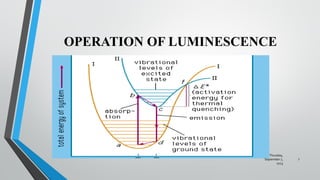
• Luminescence emission occurs after an appropriate material has absorbed
energy from a source such as ultraviolet or X-ray radiation, electron beams,
chemical reactions, and so on.
• The energy lifts the atoms of the material into an excited state, and then,
because excited states are unstable, the material undergoes another transition,
back to its unexcited ground state, and the absorbed energy is liberated in the
form of either light or heat or both (all discrete energy states, including the
ground state, of an atom are defined as quantum states).
Thursday,
September 7,
2023
8
TYPES OF LUMINESCENCE
There are many different types of luminescence, such as:
• Chemiluminescence
• Phosphorescence
• Fluorescence
• Bioluminescence
Thursday,
September 7,
2023
9
TYPES OF LUMINESCENCE CONT’D
• Chemiluminescence is the emission of light caused by a chemical reaction.
• This type of luminescence can be observed by bending and shaking a light
stick. Inside the light stick is an encapsulated chemical solution, surrounded
by a different chemical solution. Bending the light stick causes the
encapsulated chemical solution to break open. Shaking the light stick then
causes the two solutions inside the stick to mix. When these chemicals
combine, energy is created in the form of light.
• Organisms that emit light, known as bioluminescent organisms, also produce
light through a chemical reaction.
Thursday,
September 7,
2023
10
TYPES OF LUMINESCENCE CONT’D
• Phosphorescence is the ability of a material to absorb energy from an
electromagnetic radiation source, such as a flashlight, and then continue to
emit light after the source has been removed.
• In this activity, the glow in the dark object absorbs or stores the energy from
the flashlight and then gradually re-emits the energy as light, even after the
flashlight has been turned off.
Thursday,
September 7,
2023
11
TYPES OF LUMINESCENCE CONT’D
• Fluorescence is similar to phosphorescence, in that it is the ability of a
material to emit light by absorbing energy from a source of electromagnetic
radiation.
• However, unlike phosphorescence, fluorescent materials can only emit light
during the time that they are exposed to the source of electromagnetic
radiation.
• A fluorescent material will stop “glowing” once the light source is removed.
Thursday,
September 7,
2023
12
TYPES OF LUMINESCENCE CONT’D
• Bioluminescence: is the production and emission of light by living
organisms. It is a form of chemiluminescence.
• Bioluminescent organisms produce light by energy released from chemical
reactions occurring inside (or ejected by) them.
• Examples of these organisms are jellyfish, starfish, crustaceans, squid, sharks,
etc.
Thursday,
September 7,
2023
13
EXAMPLES OF LUMINESCENCE
Luminescence light can be:
• Natural: bioluminescent phytoplankton or fireflies.
• Artificial: LED lights, television screens, phone screens.
Thursday,
September 7,
2023
14
APPLICATIONS OF LUMINESCENCE
Luminescence is applied in:
• Fluorescent lamps, photon counting, LEDs.
• Systems for detecting X-rays or gamma rays.
• Minerals identification.
Thursday,
September 7,
2023
15
GLOSSARY
• Luminescence: the emission of light produced by means other than heat.
• Fluorescence: the emission of light by an object exposed to electromagnetic
radiation.
• Phosphorescence: the continued emission of light without heat after
exposure to and removal of a source of electromagnetic radiation.
• Chemiluminescence: the emission of light as a result of a chemical reaction.
• Bioluminescence: the emission of light by living organisms.
Thursday,
September 7,
2023
16
THANK YOU
Thursday,
September 7,
2023
17
REFERENCES
• Gundermann, K. (Rev. 2023, June 29). luminescence. Encyclopedia
Britannica. https://www.britannica.com/science/luminescence.
• Goldberg, M.C., Weiner, E.R. (1993). Fluorescence Spectroscopy in
Environmental and Hydrological Sciences. In: Wolfbeis, O.S. (eds)
Fluorescence Spectroscopy. Springer, Berlin, Heidelberg.
https://doi.org/10.1007/978-3-642-77372-3_16.
• Daniel C. Harris (2010). Quantitative Chemical Analysis. W. H. Freeman and
Co. Eighth Edition.
Thursday,
September 7,
2023
18

LUMINESCENCE PRESENTATION.pdf

  • 1.
    CHEM 372: ANALYTICAL CHEMISTRYII PRESENTED BY: MR. JUSTICE DZADZE STUDENT ID NO.: 1101210005 EMAIL: jdzadze@jm.used.edu.gh DBS & DPMS, SNES, UESD. Thursday, September 7, 2023 1
  • 2.
  • 3.
    OUTLINE • Introduction toluminescent • Luminescence • Operation of luminescence • Types of luminescence • Examples of luminesce • Applications of luminescence • Glossary • References Thursday, September 7, 2023 3
  • 4.
    INTRODUCTION • Luminescence wasfirst seen in rotting wood and in glowworms by Robert Boyle. • The word “luminescence” was first used by a German physicist, Eilhardt Wiedemann, in 1888. • In Latin, ‘Lumen’ means ‘Light’. • The materials that exhibit this phenomenon are known as ‘Luminescent materials’, or ‘Phosphors’, meaning ‘Light bearer’ in Greek. Thursday, September 7, 2023 4
  • 5.
    INTRODUCTION CONT’D • Theproduction of light is usually associated with heat. • For instance, a campfire, a light bulb, a candle, or the sun. • They produce light and heat simultaneously, referred to as “incandescence”. Light can also be produced without heat through a phenomenon called “luminescence”, or “cold light”. Thursday, September 7, 2023 5
  • 6.
    WHAT IS LUMINESCENCE? •Luminescence is the emission of light produced by methods other than heat. • Luminescence is the emission of light due to transitions of electrons from molecular orbitals of higher energy to those of lower energy, usually the ground state or the lowest unoccupied molecular orbitals. Thursday, September 7, 2023 6
  • 7.
  • 8.
    OPERATION OF LUMINESCENCE CONT’D •Luminescence emission occurs after an appropriate material has absorbed energy from a source such as ultraviolet or X-ray radiation, electron beams, chemical reactions, and so on. • The energy lifts the atoms of the material into an excited state, and then, because excited states are unstable, the material undergoes another transition, back to its unexcited ground state, and the absorbed energy is liberated in the form of either light or heat or both (all discrete energy states, including the ground state, of an atom are defined as quantum states). Thursday, September 7, 2023 8
  • 9.
    TYPES OF LUMINESCENCE Thereare many different types of luminescence, such as: • Chemiluminescence • Phosphorescence • Fluorescence • Bioluminescence Thursday, September 7, 2023 9
  • 10.
    TYPES OF LUMINESCENCECONT’D • Chemiluminescence is the emission of light caused by a chemical reaction. • This type of luminescence can be observed by bending and shaking a light stick. Inside the light stick is an encapsulated chemical solution, surrounded by a different chemical solution. Bending the light stick causes the encapsulated chemical solution to break open. Shaking the light stick then causes the two solutions inside the stick to mix. When these chemicals combine, energy is created in the form of light. • Organisms that emit light, known as bioluminescent organisms, also produce light through a chemical reaction. Thursday, September 7, 2023 10
  • 11.
    TYPES OF LUMINESCENCECONT’D • Phosphorescence is the ability of a material to absorb energy from an electromagnetic radiation source, such as a flashlight, and then continue to emit light after the source has been removed. • In this activity, the glow in the dark object absorbs or stores the energy from the flashlight and then gradually re-emits the energy as light, even after the flashlight has been turned off. Thursday, September 7, 2023 11
  • 12.
    TYPES OF LUMINESCENCECONT’D • Fluorescence is similar to phosphorescence, in that it is the ability of a material to emit light by absorbing energy from a source of electromagnetic radiation. • However, unlike phosphorescence, fluorescent materials can only emit light during the time that they are exposed to the source of electromagnetic radiation. • A fluorescent material will stop “glowing” once the light source is removed. Thursday, September 7, 2023 12
  • 13.
    TYPES OF LUMINESCENCECONT’D • Bioluminescence: is the production and emission of light by living organisms. It is a form of chemiluminescence. • Bioluminescent organisms produce light by energy released from chemical reactions occurring inside (or ejected by) them. • Examples of these organisms are jellyfish, starfish, crustaceans, squid, sharks, etc. Thursday, September 7, 2023 13
  • 14.
    EXAMPLES OF LUMINESCENCE Luminescencelight can be: • Natural: bioluminescent phytoplankton or fireflies. • Artificial: LED lights, television screens, phone screens. Thursday, September 7, 2023 14
  • 15.
    APPLICATIONS OF LUMINESCENCE Luminescenceis applied in: • Fluorescent lamps, photon counting, LEDs. • Systems for detecting X-rays or gamma rays. • Minerals identification. Thursday, September 7, 2023 15
  • 16.
    GLOSSARY • Luminescence: theemission of light produced by means other than heat. • Fluorescence: the emission of light by an object exposed to electromagnetic radiation. • Phosphorescence: the continued emission of light without heat after exposure to and removal of a source of electromagnetic radiation. • Chemiluminescence: the emission of light as a result of a chemical reaction. • Bioluminescence: the emission of light by living organisms. Thursday, September 7, 2023 16
  • 17.
  • 18.
    REFERENCES • Gundermann, K.(Rev. 2023, June 29). luminescence. Encyclopedia Britannica. https://www.britannica.com/science/luminescence. • Goldberg, M.C., Weiner, E.R. (1993). Fluorescence Spectroscopy in Environmental and Hydrological Sciences. In: Wolfbeis, O.S. (eds) Fluorescence Spectroscopy. Springer, Berlin, Heidelberg. https://doi.org/10.1007/978-3-642-77372-3_16. • Daniel C. Harris (2010). Quantitative Chemical Analysis. W. H. Freeman and Co. Eighth Edition. Thursday, September 7, 2023 18