Chemical Reaction Engineering is the
study of the rate at which reaction takes place and
effect the parameters such as Temperature, Pressure
and Concentration of reactants.
Chemical reaction engineering gives
the information about the rate of the mechanism,
speed of reaction and type of reaction which can
be used in designing of reactions in bioreactor.
FUNDAMENTAL CONCEPTS OF
CHEMICAL REACTION
Reaction rate or Rate of reaction
Rate law or Rate of reaction or Kinetic
law
Rate constant
RATE OF REACTION
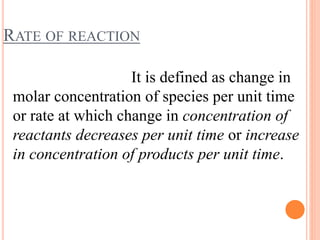
It is defined as change in
molar concentration of species per unit time
or rate at which change in concentration of
reactants decreases per unit time or increase
in concentration of products per unit time.
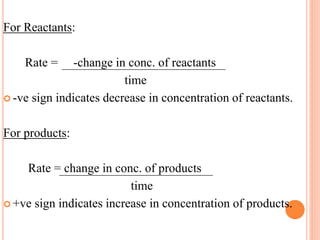
For Reactants:
Rate = -change in conc. of reactants
time
 -ve sign indicates decrease in concentration of reactants.
For products:
Rate = change in conc. of products
time
 +ve sign indicates increase in concentration of products.
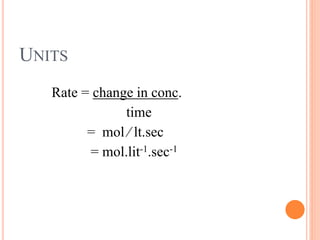
UNITS
Rate = change in conc.
time
= mol ∕ lt.sec
= mol.lit-1.sec-1
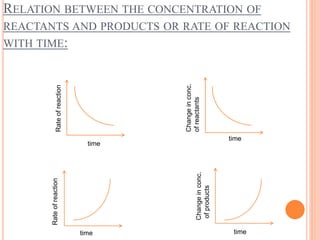
RELATION BETWEEN THE CONCENTRATION OF
REACTANTS AND PRODUCTS OR RATE OF REACTION
WITH TIME:
time
Rateofreaction
time
Changeinconc.
ofreactants
time
Rateofreaction
time
Changeinconc.
ofproducts
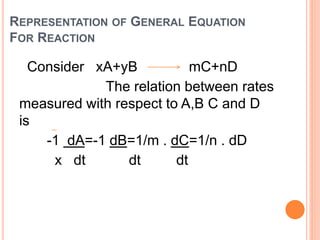
REPRESENTATION OF GENERAL EQUATION
FOR REACTION
Consider xA+yB mC+nD
The relation between rates
measured with respect to A,B C and D
is
-1 dA=-1 dB=1/m . dC=1/n . dD
x dt dt dt
RATE LAW OR RATE EQUATION OR KINETIC LAW
The equation which relates the rate of
reaction and the concentration of reactants in a
reaction is called rate law or rate equation .
Consider an equation:
xA+yB product
Rate α [A]x [B]y
Rate=k[A]x [B]y
This equation is called rate equation where x,y
are powers of the concentration of reactants.
‘k’ is rate constant
RATE CONSTANT
Rate constant of a chemical reaction is a measure of
rate of reaction, when all reactants are unit conc.
Rate constant = Rate of reaction
[reactants]n
Rate= Rate concentration
Rate constant depends on temperature
Rate constant α temperature
UNITS
Rate constant (k) = Rate of reaction
[reactants]n
k = mol.lit-1.sec-1
[mol]n.[lit]-n
=[mol]1-n.[lit]n-1.sec-1
=[conc.]1-n. sec-1
These two equations are called general nth order
equation.
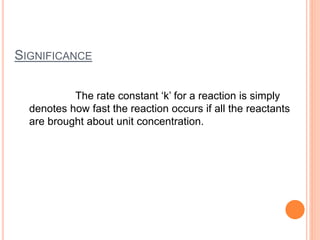
SIGNIFICANCE
The rate constant ‘k’ for a reaction is simply
denotes how fast the reaction occurs if all the reactants
are brought about unit concentration.
THANK YOU

Chemical reaction 2316

  • 2.
    Chemical Reaction Engineeringis the study of the rate at which reaction takes place and effect the parameters such as Temperature, Pressure and Concentration of reactants. Chemical reaction engineering gives the information about the rate of the mechanism, speed of reaction and type of reaction which can be used in designing of reactions in bioreactor.
  • 3.
    FUNDAMENTAL CONCEPTS OF CHEMICALREACTION Reaction rate or Rate of reaction Rate law or Rate of reaction or Kinetic law Rate constant
  • 4.
    RATE OF REACTION Itis defined as change in molar concentration of species per unit time or rate at which change in concentration of reactants decreases per unit time or increase in concentration of products per unit time.
  • 5.
    For Reactants: Rate =-change in conc. of reactants time  -ve sign indicates decrease in concentration of reactants. For products: Rate = change in conc. of products time  +ve sign indicates increase in concentration of products.
  • 6.
    UNITS Rate = changein conc. time = mol ∕ lt.sec = mol.lit-1.sec-1
  • 7.
    RELATION BETWEEN THECONCENTRATION OF REACTANTS AND PRODUCTS OR RATE OF REACTION WITH TIME: time Rateofreaction time Changeinconc. ofreactants time Rateofreaction time Changeinconc. ofproducts
  • 8.
    REPRESENTATION OF GENERALEQUATION FOR REACTION Consider xA+yB mC+nD The relation between rates measured with respect to A,B C and D is -1 dA=-1 dB=1/m . dC=1/n . dD x dt dt dt
  • 9.
    RATE LAW ORRATE EQUATION OR KINETIC LAW The equation which relates the rate of reaction and the concentration of reactants in a reaction is called rate law or rate equation . Consider an equation: xA+yB product Rate α [A]x [B]y Rate=k[A]x [B]y This equation is called rate equation where x,y are powers of the concentration of reactants. ‘k’ is rate constant
  • 10.
    RATE CONSTANT Rate constantof a chemical reaction is a measure of rate of reaction, when all reactants are unit conc. Rate constant = Rate of reaction [reactants]n Rate= Rate concentration Rate constant depends on temperature Rate constant α temperature
  • 11.
    UNITS Rate constant (k)= Rate of reaction [reactants]n k = mol.lit-1.sec-1 [mol]n.[lit]-n =[mol]1-n.[lit]n-1.sec-1 =[conc.]1-n. sec-1 These two equations are called general nth order equation.
  • 12.
    SIGNIFICANCE The rate constant‘k’ for a reaction is simply denotes how fast the reaction occurs if all the reactants are brought about unit concentration.
  • 13.