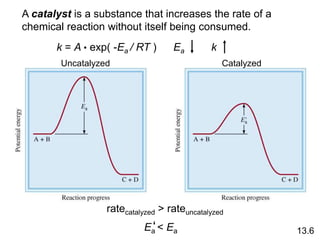
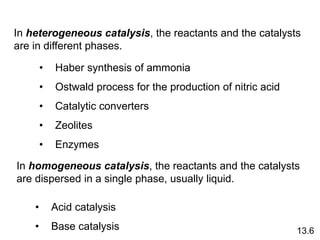
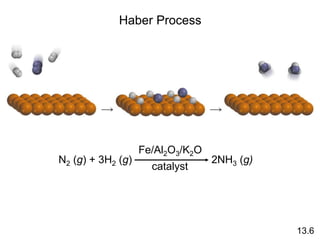
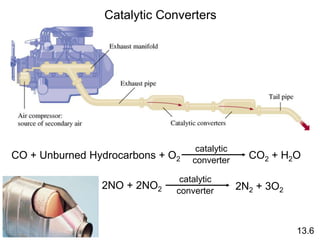
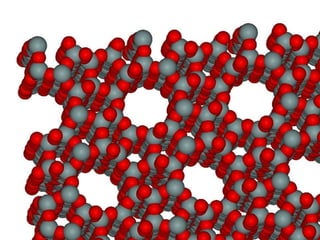
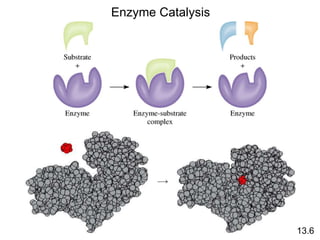
Chemical kinetics describes how fast chemical reactions occur. It examines the rates of reactions and what factors influence reaction rates. Reaction rates depend on temperature, concentration of reactants, and the presence of catalysts. Reaction mechanisms involve elementary steps that describe the molecular processes occurring in a reaction. The rate-determining step controls the overall rate. Catalysts lower the activation energy and speed up reactions without being consumed. Common examples of catalysis include industrial processes like the Haber process and catalytic converters, as well as enzyme catalysis in living systems.

![Chemical Kinetics
Thermodynamics – does a reaction take place?
Kinetics – how fast does a reaction proceed?
Reaction rate is the change in the concentration of a
reactant or a product with time (M /S).
A B
rate = -
D[A]
Dt
rate =
D[B]
Dt
D[A] = change in concentration of A over
time period Dt
D[B] = change in concentration of B over
time period Dt
Because [A] decreases with time, D[A] is negative.
13.1
Because [B] increases with time, D[B] is positive.](https://image.slidesharecdn.com/chapter13kinetics1-230630143536-091585d0/85/chapter_13_kinetics_1-ppt-2-320.jpg)
![A B
13.1
rate = -
D[A]
Dt
rate =
D[B]
Dt
time](https://image.slidesharecdn.com/chapter13kinetics1-230630143536-091585d0/85/chapter_13_kinetics_1-ppt-3-320.jpg)
![Br2 (aq) + HCOOH (aq) 2Br- (aq) + 2H+ (aq) + CO2 (g)
time
393 nm
light
Detector
D[Br2] a DAbsorption
13.1](https://image.slidesharecdn.com/chapter13kinetics1-230630143536-091585d0/85/chapter_13_kinetics_1-ppt-4-320.jpg)
![Br2 (aq) + HCOOH (aq) 2Br– (aq) + 2H+ (aq) + CO2 (g)
average rate = –
D[Br2]
Dt
= –
[Br2]final – [Br2]initial
tfinal - tinitial
slope of
tangent
slope of
tangent slope of
tangent
instantaneous rate = rate for specific instance in time
13.1](https://image.slidesharecdn.com/chapter13kinetics1-230630143536-091585d0/85/chapter_13_kinetics_1-ppt-5-320.jpg)
![rate a [Br2]
rate = k [Br2]
k =
rate
[Br2]
13.1
= rate constant
= 3.50 x 10⁻³ s–1](https://image.slidesharecdn.com/chapter13kinetics1-230630143536-091585d0/85/chapter_13_kinetics_1-ppt-6-320.jpg)
![Reaction Rates and Stoichiometry
13.1
2A B
Two moles of A disappear for each mole of B that is formed.
rate =
D[B]
Dt
rate = –
D[A]
Dt
1
2
aA + bB cC + dD
rate = –
D[A]
Dt
1
a
= –
D[B]
Dt
1
b
=
D[C]
Dt
1
c
=
D[D]
Dt
1
d](https://image.slidesharecdn.com/chapter13kinetics1-230630143536-091585d0/85/chapter_13_kinetics_1-ppt-7-320.jpg)
![Write the rate expression for the following reaction:
CH4 (g) + 2O2 (g) CO2 (g) + 2H2O (g)
rate = –
D[CH4]
Dt
= –
D[O2]
Dt
1
2
=
D[H2O]
Dt
1
2
=
D[CO2]
Dt
13.1](https://image.slidesharecdn.com/chapter13kinetics1-230630143536-091585d0/85/chapter_13_kinetics_1-ppt-8-320.jpg)
![The Rate Law
13.2
The rate law expresses the relationship of the rate of a reaction
to the rate constant and the concentrations of the reactants
raised to some powers.
aA + bB cC + dD
Rate = k [A]x[B]y
reaction is xth order in A
reaction is yth order in B
reaction is (x + y)th order overall](https://image.slidesharecdn.com/chapter13kinetics1-230630143536-091585d0/85/chapter_13_kinetics_1-ppt-9-320.jpg)
![F2 (g) + 2ClO2 (g) 2FClO2 (g)
Determine x and y in the rate law Rate = k [F2]x[ClO2]y
Double [F2] with [ClO2] held constant:
The rate doubles
Therefore, x = 1
Quadruple [ClO2] with [F2] held constant:
The rate quadruples
Therefore, y = 1 The rate law is
Rate = k [F2]1[ClO2]1
13.2](https://image.slidesharecdn.com/chapter13kinetics1-230630143536-091585d0/85/chapter_13_kinetics_1-ppt-10-320.jpg)
![F2 (g) + 2ClO2 (g) 2FClO2 (g)
rate = k [F2][ClO2]
Rate Laws
• Rate laws are always determined experimentally.
• Reaction order is always defined in terms of reactant
(not product) concentrations.
• The order of a reactant is not related to the
stoichiometric coefficient of the reactant in the balanced
chemical equation.
1
13.2](https://image.slidesharecdn.com/chapter13kinetics1-230630143536-091585d0/85/chapter_13_kinetics_1-ppt-11-320.jpg)
![Determine the rate law and calculate the rate constant for
the following reaction from the following data:
S2O8
2– (aq) + 3I– (aq) 2SO4
2– (aq) + I3
– (aq)
Experiment [S2O8
2 – ] [I – ]
Initial Rate
(M/s)
1 0.08 0.034 2.2 x 10⁻⁴
2 0.08 0.017 1.1 x 10⁻⁴
3 0.16 0.017 2.2 x 10⁻⁴
rate = k [S2O8
2–]x[I–]y
Double [I–], rate doubles (experiment 1 & 2)
y = 1
Double [S2O8
2–], rate doubles (experiment 2 & 3)
x = 1
k =
rate
[S2O8
2–][I–]
=
2.2 x 10⁻⁴ M /S
(0.08 M)(0.034 M)
= 0.08/M•s
13.2
rate = k [S2O8
2–][I–]](https://image.slidesharecdn.com/chapter13kinetics1-230630143536-091585d0/85/chapter_13_kinetics_1-ppt-12-320.jpg)
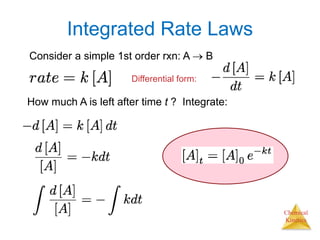
![Chemical
Kinetics
Integrated Rate Laws
The integrated form of first order rate law:
Can be rearranged to give:
[A]0 is the initial concentration of A (t =0).
[A]t is the concentration of A at some time, t,
during the course of the reaction.](https://image.slidesharecdn.com/chapter13kinetics1-230630143536-091585d0/85/chapter_13_kinetics_1-ppt-14-320.jpg)
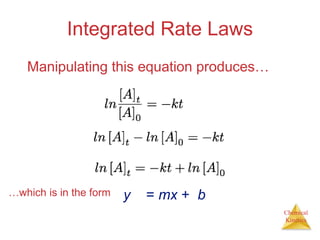
![First-Order Reactions
13.3
[A] = [A]0exp(–kt) ln[A] = ln[A]0 – kt](https://image.slidesharecdn.com/chapter13kinetics1-230630143536-091585d0/85/chapter_13_kinetics_1-ppt-16-320.jpg)
![The reaction 2A B is first order in A with a rate
constant of 2.8 x 10⁻² s–1 at 800C. How long will it take for
A to decrease from 0.88 M to 0.14 M ?
ln[A]t = ln[A]0 – kt
kt = ln[A]0 – ln[A]
t =
ln[A]0 – ln[A]
k
= 66 s
[A]0 = 0.88 M
[A]t = 0.14 M
ln
[A]0
[A]
k
=
ln
0.88 M
0.14 M
2.8 x 10⁻² s–1
=
13.3](https://image.slidesharecdn.com/chapter13kinetics1-230630143536-091585d0/85/chapter_13_kinetics_1-ppt-18-320.jpg)
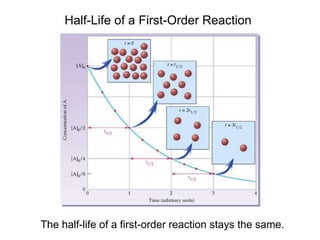
![Half-Life of First-Order Reactions
13.3
The half-life, t½, is the time required for the concentration of a
reactant to decrease to half of its initial concentration.
t½ = t when [A] = [A]0/2
ln
[A]0
[A]0/2
k
=
t½
ln2
k
=
0.693
k
=
What is the half-life of N2O5 if it decomposes with a rate
constant of 5.7 x 10⁻⁴ s–1?
t½
ln2
k
=
0.693
5.7 x 10⁻⁴ s–1
= = 1200 s = 20 minutes
How do you know decomposition is first order?
units of k (s-1)](https://image.slidesharecdn.com/chapter13kinetics1-230630143536-091585d0/85/chapter_13_kinetics_1-ppt-19-320.jpg)
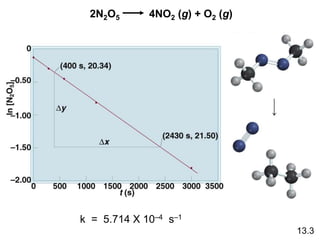
![Comparison of Graphs for a First-Order Reaction
A straight line is obtained from a graph of ln[A] vs. time,
characteristic of a first-order reaction.](https://image.slidesharecdn.com/chapter13kinetics1-230630143536-091585d0/85/chapter_13_kinetics_1-ppt-21-320.jpg)
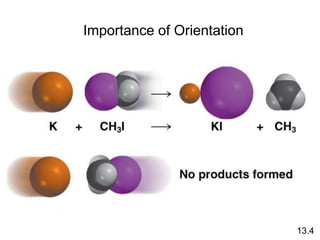
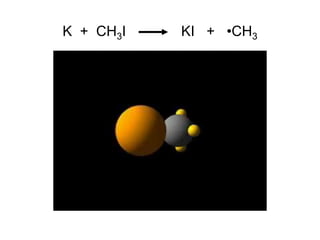
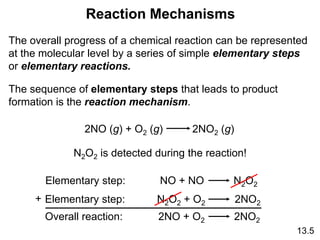
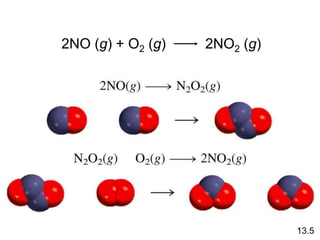
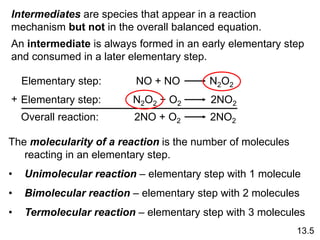
![Unimolecular reaction A products rate = k [A]
Bimolecular reaction A + B products rate = k [A][B]
Bimolecular reaction A + A products rate = k [A]2
Rate Laws and Elementary Steps
13.5
Writing plausible reaction mechanisms:
• The sum of the elementary steps must give the overall
balanced equation for the reaction.
• The rate-determining step should predict the same rate
law that is determined experimentally.
The rate-determining step is the slowest step in the
sequence of steps leading to product formation.](https://image.slidesharecdn.com/chapter13kinetics1-230630143536-091585d0/85/chapter_13_kinetics_1-ppt-30-320.jpg)
![The experimental rate law for the reaction between NO2
and CO to produce NO and CO2 is rate = k[NO2]2. The
reaction is believed to occur via two steps:
Step 1: NO2 + NO2 NO + NO3
Step 2: NO3 + CO NO2 + CO2
What is the equation for the overall reaction?
NO2+ CO NO + CO2
What is the intermediate?
NO3
What can you say about the relative rates of steps 1 and 2?
rate = k[NO2]2 is the rate law for step 1 so
step 1 must be slower than step 2
13.5](https://image.slidesharecdn.com/chapter13kinetics1-230630143536-091585d0/85/chapter_13_kinetics_1-ppt-31-320.jpg)


![제 23회 보아즈(BOAZ) 빅데이터 컨퍼런스 - [MBOAX] : ABSA를 활용한 소비자 반응 분석 기반 운영 효율화 대시보드 설계](https://cdn.slidesharecdn.com/ss_thumbnails/3-1boaz23rdconferencemboax-260203102709-9d519923-thumbnail.jpg?width=640&height=640&fit=bounds)


