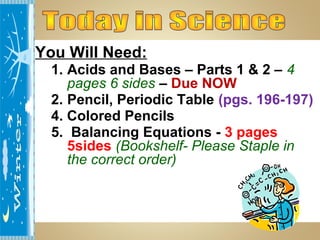
You Will Need:
1. Acids and Bases – Parts 1 & 2 – 4
pages 6 sides – Due NOW
2. Pencil, Periodic Table (pgs. 196-197)
4. Colored Pencils
5. Balancing Equations - 3 pages
5sides (Bookshelf- Please Staple in
the correct order)
Located on-line
1. Signed Grade Print out after Monday
1/13/14- 25pts.
2. Binder Check #4- 210 points
3. ½ page of notes – front side only,
done by hand
4. Please Check Your Grades for
accuracy and any missing work.
Balancing a chemical equations is
much like the work of an
accountant who has to show
where every penny has come
from and where it has gone to.
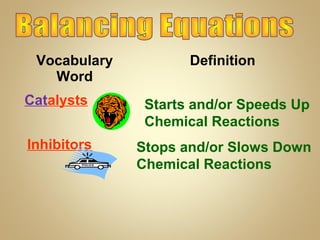
Vocabulary
Word

Definition

Catalysts

Starts and/or Speeds Up
Chemical Reactions

Inhibitors

Stops and/or Slows Down
Chemical Reactions
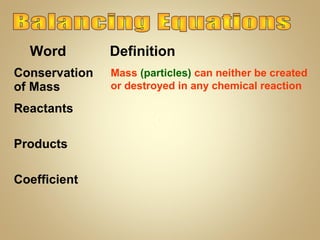
Word
Conservation
of Mass
Reactants
Products
Coefficient

Definition
Mass (particles) can neither be created
or destroyed in any chemical reaction
2 NaOH + H2SO4

Na2SO4 + 2 H2O

Conservation of Mass = the same number
of atoms of each element on each side of
the equation.
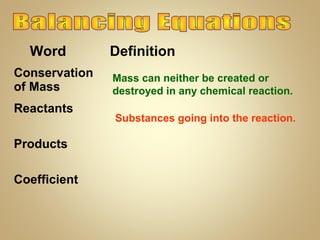
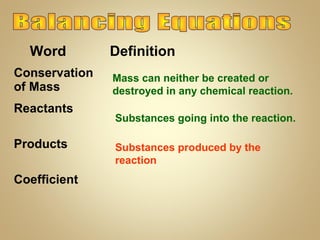
Word
Conservation
of Mass
Reactants
Products
Coefficient

Definition
Mass can neither be created or
destroyed in any chemical reaction.
Substances going into the reaction.
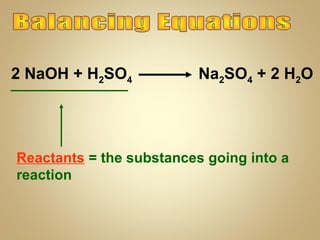
2 NaOH + H2SO4

Na2SO4 + 2 H2O

Reactants = the substances going into a
reaction
Word
Conservation
of Mass
Reactants
Products
Coefficient

Definition
Mass can neither be created or
destroyed in any chemical reaction.
Substances going into the reaction.
Substances produced by the
reaction
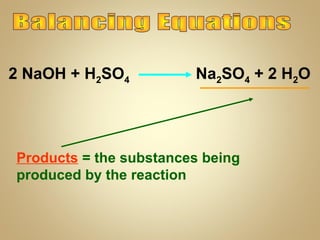
2 NaOH + H2SO4

Na2SO4 + 2 H2O

Products = the substances being
produced by the reaction
Word
Conservation
of Mass
Reactants

Definition
Mass can neither be created or
destroyed in any chemical reaction.
Substances going into the reaction.

Products

Substances produced by the
reaction

Coefficient

The number in front of the formula
indicating how many molecules
2 NaOH + H2SO4

Na2SO4 + 2 H2O

Coefficient = The number in front of each
formula or element indicating how many
molecules
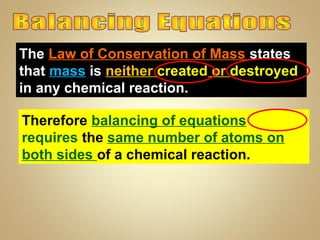
The Law of Conservation of Mass states
that mass is neither created or destroyed
in any chemical reaction.
Therefore balancing of equations
requires the same number of atoms on
both sides of a chemical reaction.
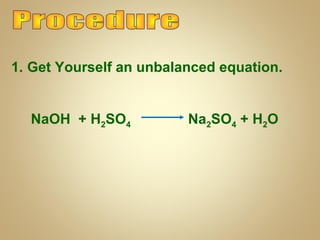
1. Get Yourself an unbalanced equation.

NaOH + H2SO4

Na2SO4 + H2O
1. Get Yourself an unbalanced equation.
2. Draw boxes around all the chemical
formulas.
NaOH + H2SO4

Na2SO4 + H2O
3. Make an element inventory.
NaOH + H2SO4

Na2SO4 + H2O

Element

Before

After

Na=Sodium

1

2

O= Oxygen

5

5

H= Hydrogen

3

2

S= Sulfur

1

1
4. Write the numbers in front of each of the boxes until
the inventory for each element is the same both
before and after the reaction.

NaOH + H2SO4

Na2SO4 +

Element

Before

After

Sodium

1

2

Oxygen

5

5

Hydrogen

3

2

Sulfur

1

1

H2O
4. Write the numbers in front of each of the boxes until
the inventory for each element is the same both
before and after the reaction.

2

NaOH + H2SO4
Element
Na

Na2SO4 +
Before

After
2

O

1 2
5 6

H

3 4

2

S

1

1

5

H2O
4. Write the numbers in front of each of the boxes until
the inventory for each element is the same both
before and after the reaction.

2

NaOH + H2SO4

Na2SO4 +

Element

Before

After

Na

2

2

O

6

5

H

4

2

S

1

1

H2O
4. Write the numbers in front of each of the boxes until
the inventory for each element is the same both
before and after the reaction.

2

NaOH + H2SO4

Na2SO4 +

Element

Before

After

Na

2

2

O

6

5

6

H

4

2

4

S

1

1

2

H2O
•You have 11 problems to balance…
Due by the end of the period on
Monday
•Do TWO and get them checked before
you complete them all.
•Ask questions when you don’t
understand
•Last Page is Bohr Model and Lewis
Dot Review.
HOMEWORK:
1. Balancing Equations – Due by the
end of the period on Monday
2. Target Concepts and Table of
Contents – on-line
3. Final Exams start Tuesday.
4. Check your updated grades for
accuracy or missing assignments.

Balancing Equations Day 1. 2014

  • 1.
    You Will Need: 1.Acids and Bases – Parts 1 & 2 – 4 pages 6 sides – Due NOW 2. Pencil, Periodic Table (pgs. 196-197) 4. Colored Pencils 5. Balancing Equations - 3 pages 5sides (Bookshelf- Please Staple in the correct order)
  • 2.
    Located on-line 1. SignedGrade Print out after Monday 1/13/14- 25pts. 2. Binder Check #4- 210 points 3. ½ page of notes – front side only, done by hand 4. Please Check Your Grades for accuracy and any missing work.
  • 3.
    Balancing a chemicalequations is much like the work of an accountant who has to show where every penny has come from and where it has gone to.
  • 4.
    Vocabulary Word Definition Catalysts Starts and/or SpeedsUp Chemical Reactions Inhibitors Stops and/or Slows Down Chemical Reactions
  • 5.
    Word Conservation of Mass Reactants Products Coefficient Definition Mass (particles)can neither be created or destroyed in any chemical reaction
  • 6.
    2 NaOH +H2SO4 Na2SO4 + 2 H2O Conservation of Mass = the same number of atoms of each element on each side of the equation.
  • 7.
    Word Conservation of Mass Reactants Products Coefficient Definition Mass canneither be created or destroyed in any chemical reaction. Substances going into the reaction.
  • 8.
    2 NaOH +H2SO4 Na2SO4 + 2 H2O Reactants = the substances going into a reaction
  • 9.
    Word Conservation of Mass Reactants Products Coefficient Definition Mass canneither be created or destroyed in any chemical reaction. Substances going into the reaction. Substances produced by the reaction
  • 10.
    2 NaOH +H2SO4 Na2SO4 + 2 H2O Products = the substances being produced by the reaction
  • 11.
    Word Conservation of Mass Reactants Definition Mass canneither be created or destroyed in any chemical reaction. Substances going into the reaction. Products Substances produced by the reaction Coefficient The number in front of the formula indicating how many molecules
  • 12.
    2 NaOH +H2SO4 Na2SO4 + 2 H2O Coefficient = The number in front of each formula or element indicating how many molecules
  • 13.
    The Law ofConservation of Mass states that mass is neither created or destroyed in any chemical reaction. Therefore balancing of equations requires the same number of atoms on both sides of a chemical reaction.
  • 14.
    1. Get Yourselfan unbalanced equation. NaOH + H2SO4 Na2SO4 + H2O
  • 15.
    1. Get Yourselfan unbalanced equation. 2. Draw boxes around all the chemical formulas. NaOH + H2SO4 Na2SO4 + H2O
  • 16.
    3. Make anelement inventory. NaOH + H2SO4 Na2SO4 + H2O Element Before After Na=Sodium 1 2 O= Oxygen 5 5 H= Hydrogen 3 2 S= Sulfur 1 1
  • 17.
    4. Write thenumbers in front of each of the boxes until the inventory for each element is the same both before and after the reaction. NaOH + H2SO4 Na2SO4 + Element Before After Sodium 1 2 Oxygen 5 5 Hydrogen 3 2 Sulfur 1 1 H2O
  • 18.
    4. Write thenumbers in front of each of the boxes until the inventory for each element is the same both before and after the reaction. 2 NaOH + H2SO4 Element Na Na2SO4 + Before After 2 O 1 2 5 6 H 3 4 2 S 1 1 5 H2O
  • 19.
    4. Write thenumbers in front of each of the boxes until the inventory for each element is the same both before and after the reaction. 2 NaOH + H2SO4 Na2SO4 + Element Before After Na 2 2 O 6 5 H 4 2 S 1 1 H2O
  • 20.
    4. Write thenumbers in front of each of the boxes until the inventory for each element is the same both before and after the reaction. 2 NaOH + H2SO4 Na2SO4 + Element Before After Na 2 2 O 6 5 6 H 4 2 4 S 1 1 2 H2O
  • 21.
    •You have 11problems to balance… Due by the end of the period on Monday •Do TWO and get them checked before you complete them all. •Ask questions when you don’t understand •Last Page is Bohr Model and Lewis Dot Review.
  • 22.
    HOMEWORK: 1. Balancing Equations– Due by the end of the period on Monday 2. Target Concepts and Table of Contents – on-line 3. Final Exams start Tuesday. 4. Check your updated grades for accuracy or missing assignments.