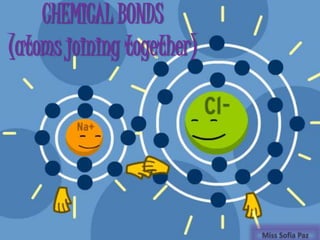
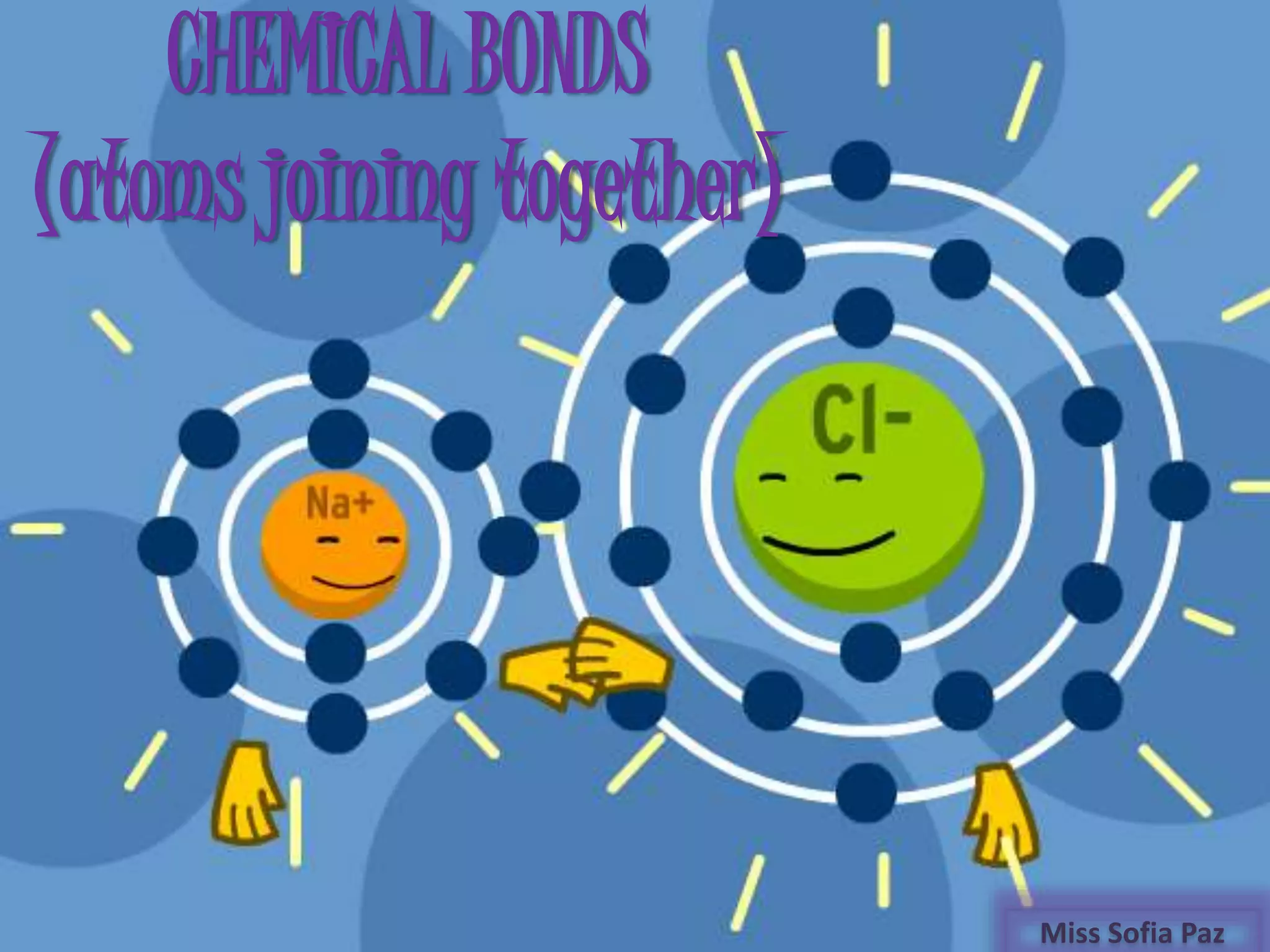
CHEMICAL BONDS
(atoms joining together)
Miss Sofia Paz
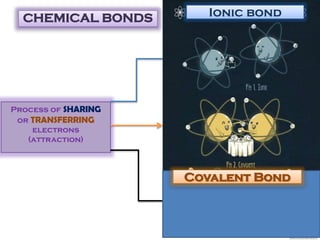
CHEMICAL BONDS
Process of SHARING
or TRANSFERRING
electrons
(attraction)
Ionic bond
Covalent Bond
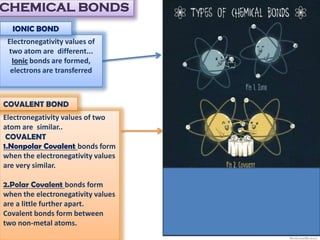
CHEMICAL BONDS
Electronegativity values of
two atom are different...
Ionic bonds are formed,
electrons are transferred
Electronegativity values of two
atom are similar..
COVALENT
1.Nonpolar Covalent bonds form
when the electronegativity values
are very similar.
2.Polar Covalent bonds form
when the electronegativity values
are a little further apart.
Covalent bonds form between
two non-metal atoms.
IONIC BOND
COVALENT BOND
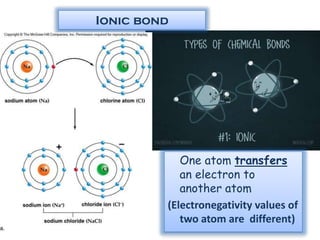
Ionic bond
One atom transfers
an electron to
another atom
(Electronegativity values of
two atom are different)
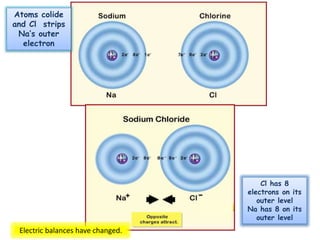
Atoms colide
and Cl strips
Na’s outer
electron
Cl has 8
electrons on its
outer level
Na has 8 on its
outer level
Electric balances have changed.
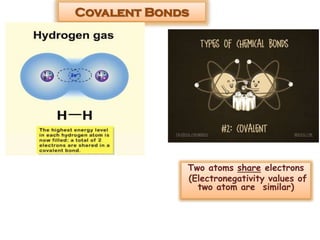
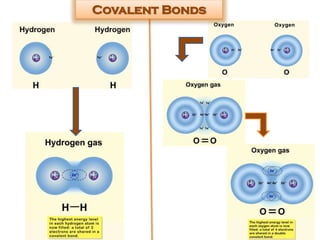
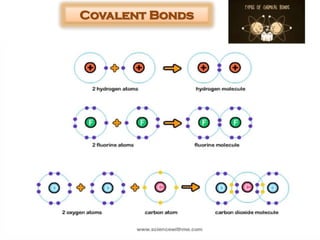
Two atoms share electrons
(Electronegativity values of
two atom are similar)
Covalent Bonds
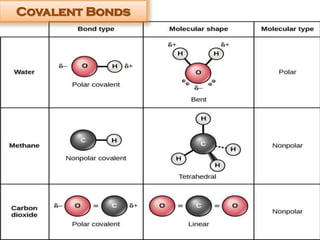
Covalent Bonds
Covalent Bonds
Covalent Bonds
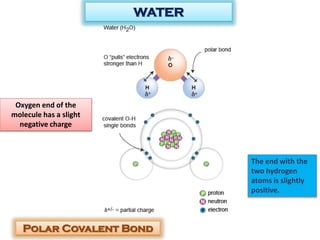
WATER
Polar Covalent Bond
Oxygen end of the
molecule has a slight
negative charge
The end with the
two hydrogen
atoms is slightly
positive.
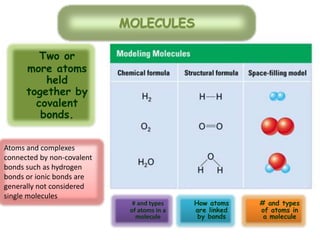
Two or
more atoms
held
together by
covalent
bonds.
# and types
of atoms in a
molecule
# and types
of atoms in
a molecule
How atoms
are linked
by bonds
MOLECULES
Atoms and complexes
connected by non-covalent
bonds such as hydrogen
bonds or ionic bonds are
generally not considered
single molecules
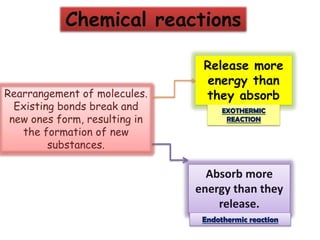
Chemical reactions
Rearrangement of molecules.
Existing bonds break and
new ones form, resulting in
the formation of new
substances.
Release more
energy than
they absorb
Absorb more
energy than they
release.
EXOTHERMIC
REACTION
Endothermic reaction
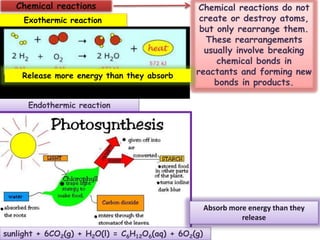
Chemical reactions do not
create or destroy atoms,
but only rearrange them.
These rearrangements
usually involve breaking
chemical bonds in
reactants and forming new
bonds in products.
Exothermic reaction
Endothermic reaction
sunlight + 6CO2(g) + H2O(l) = C6H12O6(aq) + 6O2(g)
Release more energy than they absorb
Absorb more energy than they
release
Chemical reactions
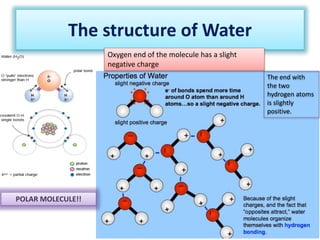
The structure of Water
The end with
the two
hydrogen atoms
is slightly
positive.
Oxygen end of the molecule has a slight
negative charge
POLAR MOLECULE!!
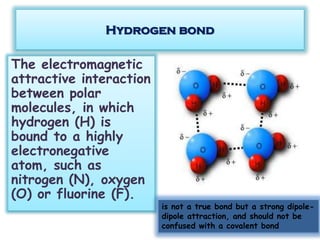
The electromagnetic
attractive interaction
between polar
molecules, in which
hydrogen (H) is
bound to a highly
electronegative
atom, such as
nitrogen (N), oxygen
(O) or fluorine (F).
Hydrogen bond
is not a true bond but a strong dipole-
dipole attraction, and should not be
confused with a covalent bond
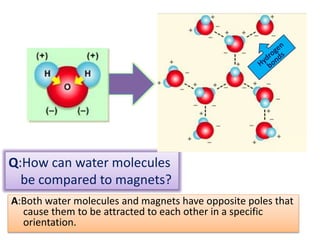
Q:How can water molecules
be compared to magnets?
A:Both water molecules and magnets have opposite poles that
cause them to be attracted to each other in a specific
orientation.
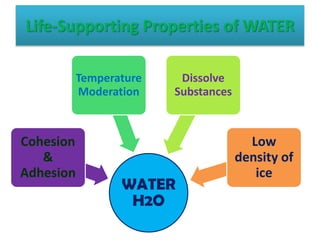
Life-Supporting Properties of WATER
WATER
H2O
Cohesion
&
Adhesion
Temperature
Moderation
Dissolve
Substances
Low
density of
ice
Life-Supporting Properties of WATER
WATER
H2O
Cohesion
&
Adhesion
Temperature
Moderation
Dissolve
Substances
Low
density of
ice
• http://www.youtube.com/watch?v=WbadROu
9umc
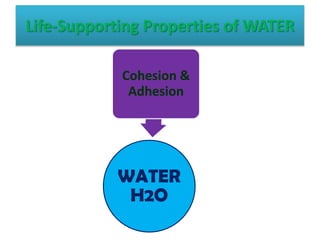
Life-Supporting Properties of WATER
WATER
H2O
Cohesion &
Adhesion
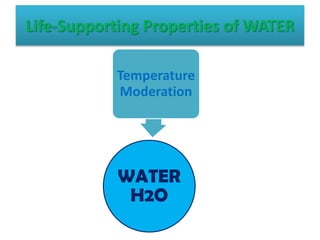
Life-Supporting Properties of WATER
WATER
H2O
Temperature
Moderation
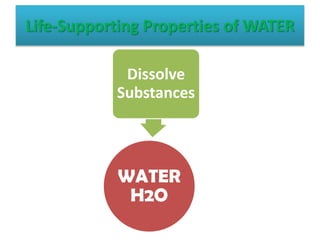
Life-Supporting Properties of WATER
WATER
H2O
Dissolve
Substances
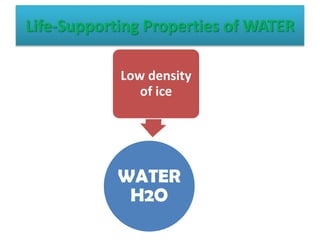
Life-Supporting Properties of WATER
WATER
H2O
Low density
of ice
CHEMICAL BONDS AND WATER

CHEMICAL BONDS AND WATER

  • 1.
    CHEMICAL BONDS (atoms joiningtogether) Miss Sofia Paz
  • 2.
    CHEMICAL BONDS Process ofSHARING or TRANSFERRING electrons (attraction) Ionic bond Covalent Bond
  • 3.
    CHEMICAL BONDS Electronegativity valuesof two atom are different... Ionic bonds are formed, electrons are transferred Electronegativity values of two atom are similar.. COVALENT 1.Nonpolar Covalent bonds form when the electronegativity values are very similar. 2.Polar Covalent bonds form when the electronegativity values are a little further apart. Covalent bonds form between two non-metal atoms. IONIC BOND COVALENT BOND
  • 4.
    Ionic bond One atomtransfers an electron to another atom (Electronegativity values of two atom are different)
  • 6.
    Atoms colide and Clstrips Na’s outer electron Cl has 8 electrons on its outer level Na has 8 on its outer level Electric balances have changed.
  • 7.
    Two atoms shareelectrons (Electronegativity values of two atom are similar) Covalent Bonds
  • 8.
  • 9.
  • 10.
  • 11.
    WATER Polar Covalent Bond Oxygenend of the molecule has a slight negative charge The end with the two hydrogen atoms is slightly positive.
  • 12.
    Two or more atoms held togetherby covalent bonds. # and types of atoms in a molecule # and types of atoms in a molecule How atoms are linked by bonds MOLECULES Atoms and complexes connected by non-covalent bonds such as hydrogen bonds or ionic bonds are generally not considered single molecules
  • 13.
    Chemical reactions Rearrangement ofmolecules. Existing bonds break and new ones form, resulting in the formation of new substances. Release more energy than they absorb Absorb more energy than they release. EXOTHERMIC REACTION Endothermic reaction
  • 14.
    Chemical reactions donot create or destroy atoms, but only rearrange them. These rearrangements usually involve breaking chemical bonds in reactants and forming new bonds in products. Exothermic reaction Endothermic reaction sunlight + 6CO2(g) + H2O(l) = C6H12O6(aq) + 6O2(g) Release more energy than they absorb Absorb more energy than they release Chemical reactions
  • 15.
    The structure ofWater The end with the two hydrogen atoms is slightly positive. Oxygen end of the molecule has a slight negative charge POLAR MOLECULE!!
  • 16.
    The electromagnetic attractive interaction betweenpolar molecules, in which hydrogen (H) is bound to a highly electronegative atom, such as nitrogen (N), oxygen (O) or fluorine (F). Hydrogen bond is not a true bond but a strong dipole- dipole attraction, and should not be confused with a covalent bond
  • 17.
    Q:How can watermolecules be compared to magnets? A:Both water molecules and magnets have opposite poles that cause them to be attracted to each other in a specific orientation.
  • 18.
    Life-Supporting Properties ofWATER WATER H2O Cohesion & Adhesion Temperature Moderation Dissolve Substances Low density of ice
  • 19.
    Life-Supporting Properties ofWATER WATER H2O Cohesion & Adhesion Temperature Moderation Dissolve Substances Low density of ice
  • 20.
  • 21.
    Life-Supporting Properties ofWATER WATER H2O Cohesion & Adhesion
  • 22.
    Life-Supporting Properties ofWATER WATER H2O Temperature Moderation
  • 23.
    Life-Supporting Properties ofWATER WATER H2O Dissolve Substances
  • 24.
    Life-Supporting Properties ofWATER WATER H2O Low density of ice