
BT-202 Biochemistry
What is Biochemistry?Biological chemistry or study of chemical processes in living organisms.
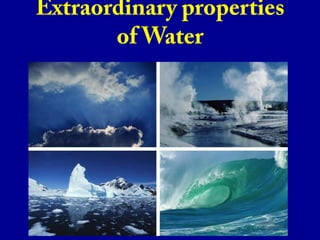
Extraordinary properties of Water
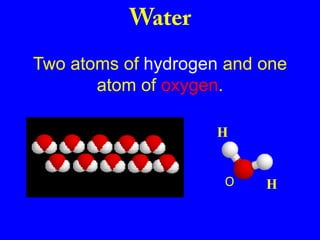
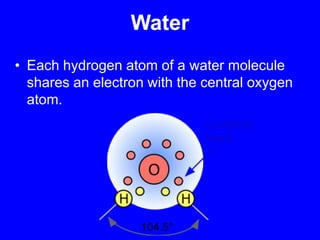
HHWaterTwo atoms of hydrogen and one atom of oxygen.O
WaterEach hydrogen atom of a water molecule shares an electron with the central oxygen atom.
Geometry of waterWater has a tetrahedral geometry .Geometry of a molecule is determined by the the shapes of outer electron orbitals. In water it is same as in carbon (sp3). Water is not a perfect tetrahedron and hence it’s bond angle is 104.5° instead of 109.5°.
The extraordinary properties of water are due to the polar nature of the water molecule.
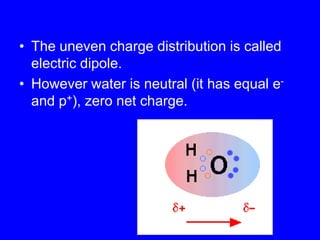
Water is a polar moleculeIn each water molecule the oxygen atom attracts more than its “fair share” of electrons.The oxygen atom “acts” as negative or is electronegative.Hydrogen atom “acts” as positive and is electropositive. This causes the water molecule to be polar.
The uneven charge distribution is called electric dipole.However water is neutral (it has equal e- and p+), zero net charge.
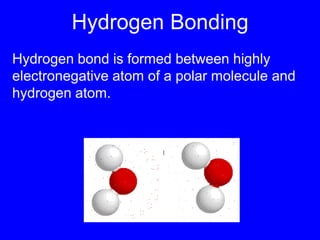
Hydrogen BondingHydrogen bond is formed between highly electronegative atom of a polar molecule and hydrogen atom.
Hydrogen bonds are weak bonds about 1/20th the strength of covalent bond. Bond dissociation energy of water (liq.) is very low.They form, break, and reform withhigh frequency. Lifetime of each hydrogen bond is 1 to 20 picoseconds. And a new hydrogen bond is formed is formed within0.1ps. One hydrogen bond is weak but many put together are strong.
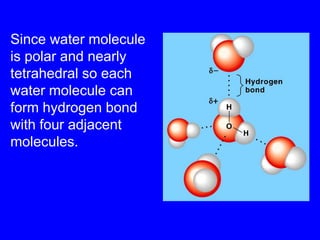
Since water molecule is polar and nearly tetrahedral so each water molecule can form hydrogen bond with four adjacent molecules.
Properties of waterCohesion. Adhesion.High Specific heat.Density greatest at 4°C.Universal solvent of life.
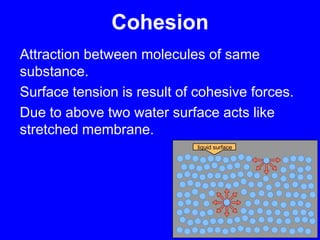
CohesionAttraction between molecules of same substance.Surface tension is result of cohesive forces.Due to above two water surface acts like stretched membrane.
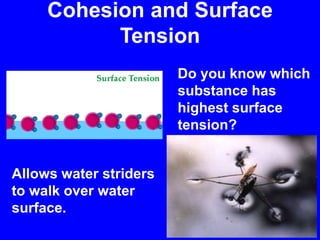
Cohesion and Surface TensionDo you know which substance has highest surface tension?Allows water striders to walk over water surface.
AdhesionAttraction between two different substances.Water will make hydrogen bonds with other surfaces such as glass, soil, plant tissues, and cotton.
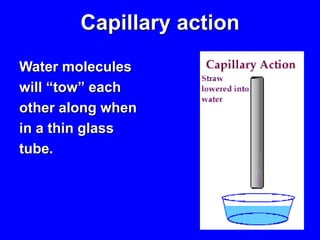
Capillary actionWater molecules will “tow”eachother along whenin a thin glasstube.
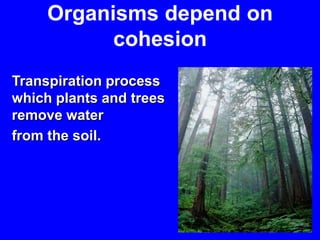
Organisms depend on cohesionTranspiration process which plants and trees remove waterfrom the soil.
High Specific HeatAmount of heat that must be absorbed or lost for 1g of a substance to  change its temperature by 1°C. Water can absorb or release large amounts of heat energy with little change in actual temperature.
Three-fourths of the earth is covered by water.  The water serves as a large heat sink responsible for:Prevention of temperature fluctuations that are outside the range suitable for life. Moderate temperatures on earth.
High Heat of VaporizationAmount of energy to convert 1g of a substance from liquid to gas.For water to evaporate hydrogen bonds are broken.While evaporation water removes lot of heat.Water’s heat of vaporization is 540 cal/g.
Cooling Effect …..In order to evaporate each gram must absorb 540 calories. (The temperature remains the same @ 100 °C.Moderating earth’s climate. Stabilizes  temperature in aquatic ecosystems. Preventing organisms from overheating.
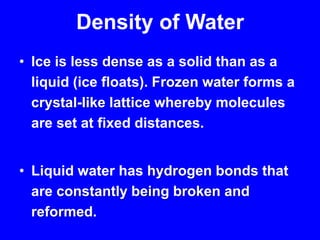
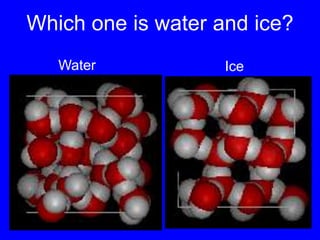
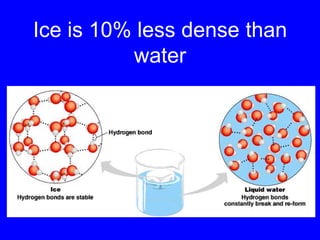
Density of WaterIce is less dense as a solid than as a liquid (ice floats). Frozen water forms a crystal-like lattice whereby molecules are set at fixed distances.
Liquid water has hydrogen bonds that are constantly being broken and reformed.Which one is water and ice?WaterIce
Water is most dense at 4°CAt 0°C water becomes locked into a crystalline lattice where each water molecule is bonded to 4 other molecules.As ice melts, hydrogen bond break and some water molecules can slip closer to each other since they are in continuous motion. In liquid water one molecule forms hydrogen bond with 3.4 other molecules.
Ice is 10% less dense than water
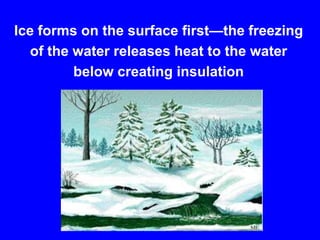
Ice forms on the surface first—the freezingof the water releases heat to the water below creating insulation
Water as Universal Solvent for Life
Solutions and SuspensionsWater is usually a part of a mixture.There are two kinds of mixture:-Solution.-Suspension.
SolutionSOLUTE	- Substance that is being dissolved.SOLVENT	-substance into which the solute is dissolved.
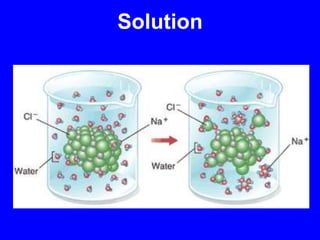
Solution
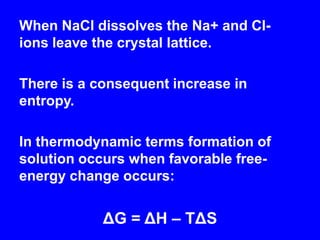
When NaCl dissolves the Na+ and Cl- ions leave the crystal lattice.There is a consequent increase in entropy.In thermodynamic terms formation of solution occurs when favorable free-energy change occurs:ΔG = ΔH – TΔS
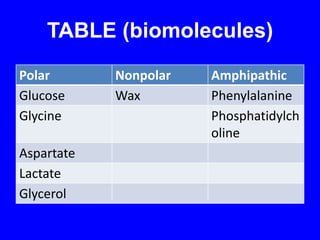
TABLE (biomolecules)
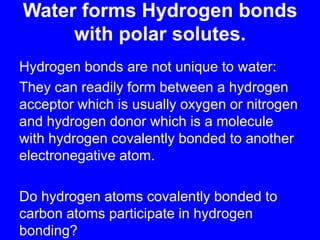
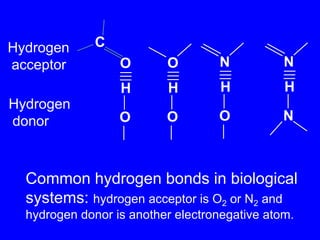
Water forms Hydrogen bonds with polar solutes.Hydrogen bonds are not unique to water:They can readily form between a hydrogen acceptor which is usually oxygen or nitrogen and hydrogen donor which is a molecule with hydrogen covalently bonded to another electronegative atom.Do hydrogen atoms covalently bonded to carbon atoms participate in hydrogen bonding?
CHydrogen acceptorNNOOHHHHHydrogen donorNOOOCommon hydrogen bonds in biological systems: hydrogen acceptor is O2 or N2 and hydrogen donor is another electronegative atom.
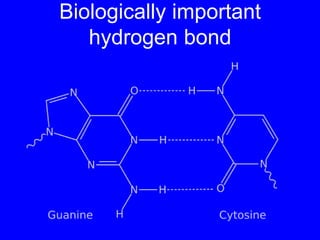
Biologically important hydrogen bond
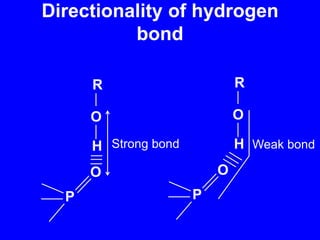
Directionality of hydrogen bondRROOHStrong bondWeak bondHOOPP
This is very important property because it confers very precise 3D structures on protein and nucleic acid molecules.
Water interacts with charged solutesWater also readily dissolve charged biomolecules same way it dissolves ionic compunds like NaCl.eg : carboxylic acid (-COO-), protonated amines (-NH3+).Water replaces the solute-solute hydrogen bonds with solute-water hydrogen bonds.
Hydrophilic: freely dissolve in water such biomolecules are charged or polar. Eg waterHydrophobic: dissolve freely in nonpolar solvents like Benzene, and Chloroform.
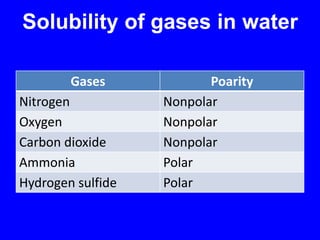
Solubility of gases in water
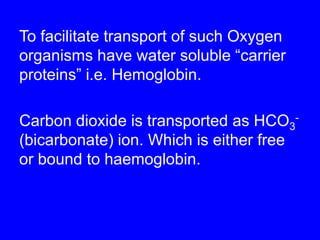
To facilitate transport of such Oxygen organisms have water soluble “carrier proteins”i.e. Hemoglobin.Carbon dioxide is transported as HCO3-  (bicarbonate) ion. Which is either free or bound to haemoglobin.
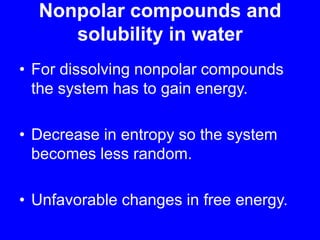
Nonpolar compounds and solubility in waterFor dissolving nonpolar compounds the system has to gain energy. Decrease in entropy so the system becomes less random.Unfavorable changes in free energy.
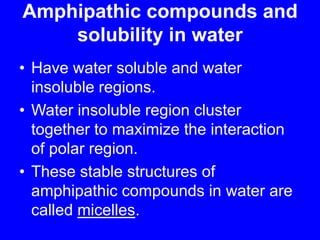
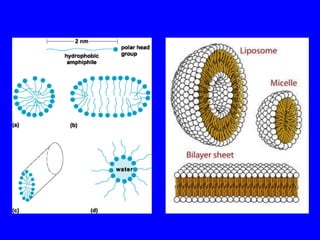
Amphipathic compounds and solubility in waterHave water soluble and water insoluble regions.Water insoluble region cluster together to maximize the interaction of polar region.These stable structures of amphipathic compounds in water are called micelles.
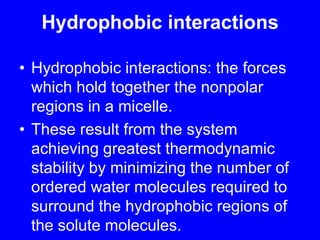
Hydrophobic interactions Hydrophobic interactions: the forces which hold together the nonpolar regions in a micelle. These result from the system achieving greatest thermodynamic stability by minimizing the number of ordered water molecules required to surround the hydrophobic regions of the solute molecules.
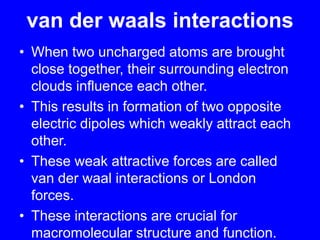
van der waals interactionsWhen two uncharged atoms are brought close together, their surrounding electron clouds influence each other. This results in formation of two opposite electric dipoles which weakly attract each other.These weak attractive forces are called van der waal interactions or London forces.These interactions are crucial for macromolecular structure and function.
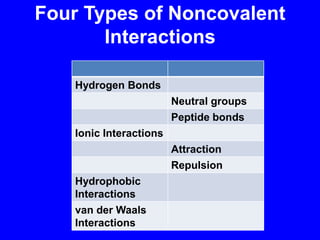
Four Types of Noncovalent Interactions
Solute Affects the Colligative Properties of Aqueous SolutionPhysical properties of solvent, water : vapor pressure, boiling point, melting point (freezing point), and osmotic pressure.The effect depends on the number of solute particles in given amount of water.
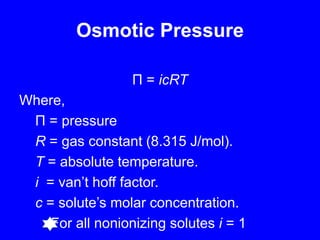
Osmotic PressureΠ = icRTWhere,Π = pressure	R = gas constant (8.315 J/mol).	T = absolute temperature.i  = van’thoff factor.	c = solute’s molar concentration.         For all nonionizing solutes i= 1
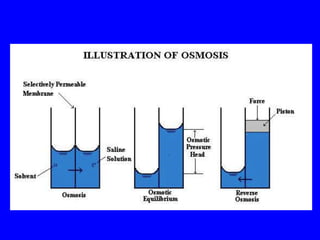
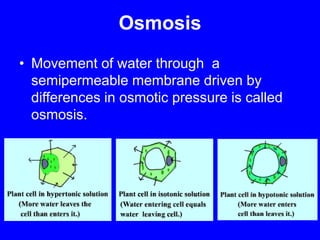
OsmosisMovement of water through  a semipermeable membrane driven by differences in osmotic pressure is called osmosis.
Big question??In bacteria and plants, plasma membrane is surrounded by nonexpandable cell wall.Freshwater protists have contractile vacoules to pump out water out of the cell.Multicellular animals have plasma and blood maintained at same osmolarity as cytoplasm also they pump out Na+.

Bt 202 water

  • 1.
  • 3.
    What is Biochemistry?Biologicalchemistry or study of chemical processes in living organisms.
  • 4.
  • 5.
    HHWaterTwo atoms ofhydrogen and one atom of oxygen.O
  • 6.
    WaterEach hydrogen atomof a water molecule shares an electron with the central oxygen atom.
  • 7.
    Geometry of waterWaterhas a tetrahedral geometry .Geometry of a molecule is determined by the the shapes of outer electron orbitals. In water it is same as in carbon (sp3). Water is not a perfect tetrahedron and hence it’s bond angle is 104.5° instead of 109.5°.
  • 8.
    The extraordinary propertiesof water are due to the polar nature of the water molecule.
  • 9.
    Water is apolar moleculeIn each water molecule the oxygen atom attracts more than its “fair share” of electrons.The oxygen atom “acts” as negative or is electronegative.Hydrogen atom “acts” as positive and is electropositive. This causes the water molecule to be polar.
  • 10.
    The uneven chargedistribution is called electric dipole.However water is neutral (it has equal e- and p+), zero net charge.
  • 11.
    Hydrogen BondingHydrogen bondis formed between highly electronegative atom of a polar molecule and hydrogen atom.
  • 12.
    Hydrogen bonds areweak bonds about 1/20th the strength of covalent bond. Bond dissociation energy of water (liq.) is very low.They form, break, and reform withhigh frequency. Lifetime of each hydrogen bond is 1 to 20 picoseconds. And a new hydrogen bond is formed is formed within0.1ps. One hydrogen bond is weak but many put together are strong.
  • 13.
    Since water moleculeis polar and nearly tetrahedral so each water molecule can form hydrogen bond with four adjacent molecules.
  • 14.
    Properties of waterCohesion.Adhesion.High Specific heat.Density greatest at 4°C.Universal solvent of life.
  • 15.
    CohesionAttraction between moleculesof same substance.Surface tension is result of cohesive forces.Due to above two water surface acts like stretched membrane.
  • 16.
    Cohesion and SurfaceTensionDo you know which substance has highest surface tension?Allows water striders to walk over water surface.
  • 17.
    AdhesionAttraction between twodifferent substances.Water will make hydrogen bonds with other surfaces such as glass, soil, plant tissues, and cotton.
  • 18.
    Capillary actionWater moleculeswill “tow”eachother along whenin a thin glasstube.
  • 19.
    Organisms depend oncohesionTranspiration process which plants and trees remove waterfrom the soil.
  • 20.
    High Specific HeatAmountof heat that must be absorbed or lost for 1g of a substance to change its temperature by 1°C. Water can absorb or release large amounts of heat energy with little change in actual temperature.
  • 21.
    Three-fourths of theearth is covered by water. The water serves as a large heat sink responsible for:Prevention of temperature fluctuations that are outside the range suitable for life. Moderate temperatures on earth.
  • 22.
    High Heat ofVaporizationAmount of energy to convert 1g of a substance from liquid to gas.For water to evaporate hydrogen bonds are broken.While evaporation water removes lot of heat.Water’s heat of vaporization is 540 cal/g.
  • 23.
    Cooling Effect …..Inorder to evaporate each gram must absorb 540 calories. (The temperature remains the same @ 100 °C.Moderating earth’s climate. Stabilizes temperature in aquatic ecosystems. Preventing organisms from overheating.
  • 24.
    Density of WaterIceis less dense as a solid than as a liquid (ice floats). Frozen water forms a crystal-like lattice whereby molecules are set at fixed distances.
  • 25.
    Liquid water hashydrogen bonds that are constantly being broken and reformed.Which one is water and ice?WaterIce
  • 26.
    Water is mostdense at 4°CAt 0°C water becomes locked into a crystalline lattice where each water molecule is bonded to 4 other molecules.As ice melts, hydrogen bond break and some water molecules can slip closer to each other since they are in continuous motion. In liquid water one molecule forms hydrogen bond with 3.4 other molecules.
  • 27.
    Ice is 10%less dense than water
  • 28.
    Ice forms onthe surface first—the freezingof the water releases heat to the water below creating insulation
  • 29.
    Water as UniversalSolvent for Life
  • 30.
    Solutions and SuspensionsWateris usually a part of a mixture.There are two kinds of mixture:-Solution.-Suspension.
  • 31.
    SolutionSOLUTE - Substance thatis being dissolved.SOLVENT -substance into which the solute is dissolved.
  • 32.
  • 33.
    When NaCl dissolvesthe Na+ and Cl- ions leave the crystal lattice.There is a consequent increase in entropy.In thermodynamic terms formation of solution occurs when favorable free-energy change occurs:ΔG = ΔH – TΔS
  • 34.
  • 35.
    Water forms Hydrogenbonds with polar solutes.Hydrogen bonds are not unique to water:They can readily form between a hydrogen acceptor which is usually oxygen or nitrogen and hydrogen donor which is a molecule with hydrogen covalently bonded to another electronegative atom.Do hydrogen atoms covalently bonded to carbon atoms participate in hydrogen bonding?
  • 36.
    CHydrogen acceptorNNOOHHHHHydrogen donorNOOOCommonhydrogen bonds in biological systems: hydrogen acceptor is O2 or N2 and hydrogen donor is another electronegative atom.
  • 37.
  • 38.
    Directionality of hydrogenbondRROOHStrong bondWeak bondHOOPP
  • 39.
    This is veryimportant property because it confers very precise 3D structures on protein and nucleic acid molecules.
  • 40.
    Water interacts withcharged solutesWater also readily dissolve charged biomolecules same way it dissolves ionic compunds like NaCl.eg : carboxylic acid (-COO-), protonated amines (-NH3+).Water replaces the solute-solute hydrogen bonds with solute-water hydrogen bonds.
  • 41.
    Hydrophilic: freely dissolvein water such biomolecules are charged or polar. Eg waterHydrophobic: dissolve freely in nonpolar solvents like Benzene, and Chloroform.
  • 42.
  • 43.
    To facilitate transportof such Oxygen organisms have water soluble “carrier proteins”i.e. Hemoglobin.Carbon dioxide is transported as HCO3- (bicarbonate) ion. Which is either free or bound to haemoglobin.
  • 44.
    Nonpolar compounds andsolubility in waterFor dissolving nonpolar compounds the system has to gain energy. Decrease in entropy so the system becomes less random.Unfavorable changes in free energy.
  • 45.
    Amphipathic compounds andsolubility in waterHave water soluble and water insoluble regions.Water insoluble region cluster together to maximize the interaction of polar region.These stable structures of amphipathic compounds in water are called micelles.
  • 47.
    Hydrophobic interactions Hydrophobicinteractions: the forces which hold together the nonpolar regions in a micelle. These result from the system achieving greatest thermodynamic stability by minimizing the number of ordered water molecules required to surround the hydrophobic regions of the solute molecules.
  • 48.
    van der waalsinteractionsWhen two uncharged atoms are brought close together, their surrounding electron clouds influence each other. This results in formation of two opposite electric dipoles which weakly attract each other.These weak attractive forces are called van der waal interactions or London forces.These interactions are crucial for macromolecular structure and function.
  • 49.
    Four Types ofNoncovalent Interactions
  • 50.
    Solute Affects theColligative Properties of Aqueous SolutionPhysical properties of solvent, water : vapor pressure, boiling point, melting point (freezing point), and osmotic pressure.The effect depends on the number of solute particles in given amount of water.
  • 52.
    Osmotic PressureΠ =icRTWhere,Π = pressure R = gas constant (8.315 J/mol). T = absolute temperature.i = van’thoff factor. c = solute’s molar concentration. For all nonionizing solutes i= 1
  • 53.
    OsmosisMovement of waterthrough a semipermeable membrane driven by differences in osmotic pressure is called osmosis.
  • 54.
    Big question??In bacteriaand plants, plasma membrane is surrounded by nonexpandable cell wall.Freshwater protists have contractile vacoules to pump out water out of the cell.Multicellular animals have plasma and blood maintained at same osmolarity as cytoplasm also they pump out Na+.