LECTURE PRESENTATIONS
                                    For CAMPBELL BIOLOGY, NINTH EDITION
                Jane B. Reece, Lisa A. Urry, Michael L. Cain, Steven A. Wasserman, Peter V. Minorsky, Robert B. Jackson


Chapter 3

Water and Life


                                                                                                                    Lectures by
                                                                                                                    Erin Barley
                                                                                                            Kathleen Fitzpatrick

© 2011 Pearson Education, Inc.
Overview: The Molecule That Supports
All of Life
     • Water is the biological medium on Earth
     • All living organisms require water more than any
       other substance
     • Most cells are surrounded by water, and cells
       themselves are about 70–95% water
     • The abundance of water is the main reason the
       Earth is habitable


© 2011 Pearson Education, Inc.
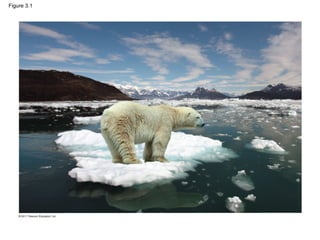
Figure 3.1
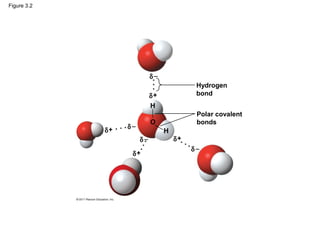
Polar covalent bonds in water molecules
result in hydrogen bonding
     • The water molecule is a polar molecule: the
       opposite ends have opposite charges
     • Polarity allows water molecules to form hydrogen
       bonds with each other


© 2011 Pearson Education, Inc.
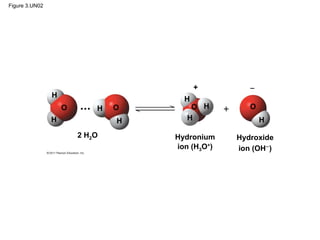
Figure 3.2


                            δ−
                                       Hydrogen
                            δ+         bond


                                       Polar covalent
                                       bonds
                  δ−
             δ+
                       δ−        δ+
                                      δ−
                   δ+
Four emergent properties of water
contribute to Earth’s suitability for life

     • Four of water’s properties that facilitate an
       environment for life are
        – Cohesive behavior
        – Ability to moderate temperature
        – Expansion upon freezing
        – Versatility as a solvent


© 2011 Pearson Education, Inc.
Cohesion of Water Molecules
     • Collectively, hydrogen bonds hold water
       molecules together, a phenomenon called
       cohesion
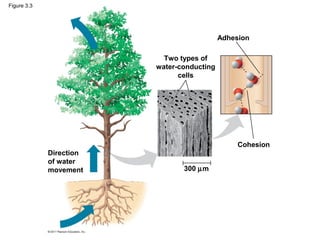
     • Cohesion helps the transport of water against
       gravity in plants
     • Adhesion is an attraction between different
       substances, for example, between water and
       plant cell walls
     • Adhesion also helps with the transport of water
       in plants to counter gravity

© 2011 Pearson Education, Inc.
Figure 3.3


                                            Adhesion

                           Two types of
                         water-conducting
                               cells


                                                 Cohesion
             Direction
             of water
             movement           300 µm
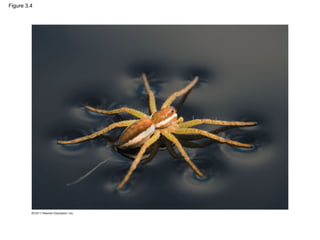
• Surface tension is a measure of how hard it is
       to break the surface of a liquid
     • Surface tension is related to cohesion
     • The ability of water molecules to form hydrogen
       bonds with each other results in the high
       surface tension of water


© 2011 Pearson Education, Inc.
Figure 3.4
Moderation of Temperature by Water
     • Water absorbs heat from warmer air and
       releases stored heat to cooler air
     • Water can absorb or release a large amount of
       heat with only a slight change in its own
       temperature
     • Water has a high heat of fusion compared to
       other substances, 80 cal/gram
           – This is the amount of heat that has to be added
             or removed to make ice melt or water freeze


© 2011 Pearson Education, Inc.
Heat and Temperature
     • Kinetic energy is the energy of motion
     • Heat is a measure of the total amount of kinetic
       energy due to molecular motion
     • Temperature measures the intensity of heat
       due to the average kinetic energy of molecules


© 2011 Pearson Education, Inc.
Water’s High Specific Heat

    • Water resists changing its temperature because of
      its high specific heat
    • The specific heat of a substance is the amount of
      heat that must be absorbed or lost for 1 gram of
      that substance to change its temperature by 1°C
    • A calorie (cal) is the amount of heat required to
      raise the temperature of 1 g of water by 1°C, so
      water’s specific heat is 1 cal/g °C


© 2011 Pearson Education, Inc.
• Water’s high specific heat can be traced to
       hydrogen bonding
                – Heat is absorbed when hydrogen bonds break
                – Heat is released when hydrogen bonds form
     • The high specific heat of water minimizes
       temperature fluctuations to within limits that permit
       life


© 2011 Pearson Education, Inc.
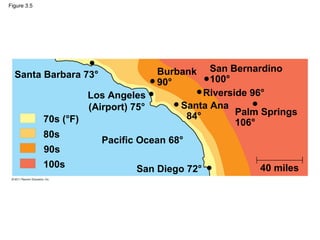
Figure 3.5


                                        Burbank   San Bernardino
  Santa Barbara 73°                               100°
                                        90°
                        Los Angeles              Riverside 96°
                        (Airport) 75°       Santa Ana
                                             84°        Palm Springs
             70s (°F)                                   106°
             80s
                           Pacific Ocean 68°
             90s
             100s                 San Diego 72°             40 miles
Evaporative Cooling
     • Evaporation is transformation of a substance from
       liquid to gas
     • Heat of vaporization is the heat a liquid must
       absorb for 1 g to be converted to gas
           – For water, 540 cal/gram
     • As a liquid evaporates, its remaining surface
       cools, a process called evaporative cooling
     • Evaporative cooling of water helps stabilize
       temperatures in organisms and bodies of water


© 2011 Pearson Education, Inc.
Floating of Ice on Liquid Water

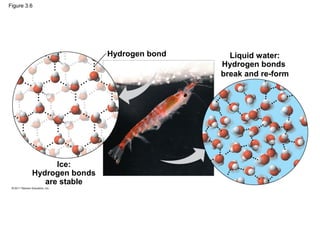
     • Ice floats in liquid water because hydrogen bonds
       in ice are more “ordered,” making ice less dense
     • Water reaches its greatest density at 4°C
     • If ice sank, all bodies of water would eventually
       freeze solid, making life impossible on Earth


© 2011 Pearson Education, Inc.
Figure 3.6


                          Hydrogen bond     Liquid water:
                                          Hydrogen bonds
                                          break and re-form


               Ice:
         Hydrogen bonds
            are stable
Water: The Solvent of Life
     • A solution is a liquid that is a homogeneous
       mixture of substances
     • A solvent is the dissolving agent of a solution
     • The solute is the substance that is dissolved
     • An aqueous solution is one in which water is
       the solvent


© 2011 Pearson Education, Inc.
• Water is a versatile solvent due to its polarity,
       which allows it to form hydrogen bonds easily
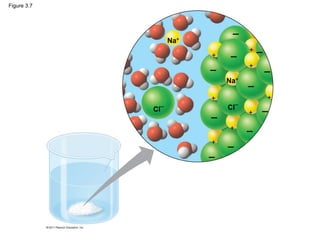
     • When an ionic compound is dissolved in water,
       each ion is surrounded by a sphere of water
       molecules called a hydration shell


© 2011 Pearson Education, Inc.
Figure 3.7


                     +
                              −
                   Na
                         +   −
                                     +
                                         −
                                     +
                         −                   −
                                 +
                             Na
                                     −
                         +                   +

             Cl−             Cl−
                                     +   −
                         −
                             +
                                     −
                         +
                             −
                         −
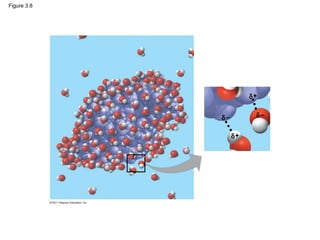
• Water can also dissolve compounds made of
       nonionic polar molecules
     • Even large polar molecules such as proteins can
       dissolve in water if they have ionic and polar
       regions


© 2011 Pearson Education, Inc.
Figure 3.8


                       δ+


             δ−         δ−


                  δ+
Hydrophilic and Hydrophobic Substances

      • A hydrophilic substance is one that has an
        affinity for water
      • A hydrophobic substance is one that does not
        have an affinity for water
      • Oil molecules are hydrophobic because they
        have relatively nonpolar bonds


© 2011 Pearson Education, Inc.
Solute Concentration in Aqueous Solutions
     • Most biochemical reactions occur in water
     • Chemical reactions depend on collisions of
       molecules and therefore on the concentration of
       solutes in an aqueous solution


© 2011 Pearson Education, Inc.
• Molecular mass is the sum of all masses of all
       atoms in a molecule
     • Numbers of molecules are usually measured in
       moles, where 1 mole (mol) = 6.02 x 10²³ molecules
     • Avogadro’s number and the unit dalton were
       defined such that 6.02 x 10²³ daltons = 1 g
     • Molarity (M) is the number of moles of solute per
       liter of solution


© 2011 Pearson Education, Inc.
Acidic and basic conditions affect living
organisms
     • A hydrogen atom in a hydrogen bond between
       two water molecules can shift from one to the
       other
                – The hydrogen atom leaves its electron behind
                  and is transferred as a proton, or hydrogen
                  ion (H+)
                – The molecule with the extra proton is now a
                  hydronium ion (H3O+), though it is often
                  represented as H+
                – The molecule that lost the proton is now a
                  hydroxide ion (OH–)
© 2011 Pearson Education, Inc.
Figure 3.UN02


                             +           −


                2 H 2O   Hydronium    Hydroxide
                         ion (H3O+)   ion (OH− )
• Though statistically rare, the dissociation of
       water molecules has a great effect on
       organisms
     • Changes in concentrations of H+ and OH– can
       drastically affect the chemistry of a cell


© 2011 Pearson Education, Inc.
• Concentrations of H+ and OH– are equal in pure
       water
     • Adding certain solutes, called acids and bases,
       modifies the concentrations of H+ and OH–
     • Biologists use something called the pH scale to
       describe whether a solution is acidic or basic
       (the opposite of acidic)


© 2011 Pearson Education, Inc.
Acids and Bases
     • An acid is any substance that increases the H+
       concentration of a solution
     • A base is any substance that reduces the H+
       concentration of a solution


© 2011 Pearson Education, Inc.
The pH Scale
     • In any aqueous solution at 25°C the product of
       H+ and OH– is constant and can be written as
                                    [H+][OH–] = 10–14

     • The pH of a solution is defined by the negative
       logarithm of H+ concentration, written as


                       pH = –log [H+]
     • For a neutral aqueous solution


© 2011 Pearson Education, Inc.   [H+] is 10–7 = –(–7) = 7
• Acidic solutions have pH values less than 7
     • Basic solutions have pH values greater than 7
     • Most biological fluids have pH values in the range
       of 6 to 8


© 2011 Pearson Education, Inc.
Figure 3.10
                                                         pH Scale
                                                            0

                                                           1   Battery acid


                                   Increasingly Acidic
                                                           2   Gastric juice, lemon juice
                      +
                     H


                                       [H+] > [OH− ]
               H+
                       +
                    − H                                        Vinegar, wine,
              H+ OH                                        3
                     +
              OH− H H+                                         cola
                H+ H+

               Acidic                                      4   Tomato juice
                                                               Beer
              solution                                         Black coffee
                                                           5
                                                               Rainwater
                                                           6   Urine
                         −
                    OH                                         Saliva
               OH−              Neutral
              H +
                   H+ OH
                          −
                                                           7   Pure water
               OH − OH−
                        +
                              [H+] = [OH− ]                    Human blood, tears
              H+ H+ H
                                                           8   Seawater
              Neutral
                                                               Inside of small intestine
              solution
                                   Increasingly Basic


                                                           9
                                      [H+] < [OH− ]


                                                          10
                                                               Milk of magnesia
               OH−
                     OH−
              OH− H+ OH−
                                                          11
              OH− OH
                     −                                         Household ammonia
                 H + OH−
                                                          12
               Basic
              solution                                         Household
                                                          13   bleach
                                                               Oven cleaner
                                                          14
Buffers
     • The internal pH of most living cells must remain
       close to pH 7
     • Buffers are substances that minimize changes
       in concentrations of H+ and OH– in a solution
     • Most buffers consist of an acid-base pair that
       reversibly combines with H+


© 2011 Pearson Education, Inc.

03 water and life

  • 1.
    LECTURE PRESENTATIONS For CAMPBELL BIOLOGY, NINTH EDITION Jane B. Reece, Lisa A. Urry, Michael L. Cain, Steven A. Wasserman, Peter V. Minorsky, Robert B. Jackson Chapter 3 Water and Life Lectures by Erin Barley Kathleen Fitzpatrick © 2011 Pearson Education, Inc.
  • 2.
    Overview: The MoleculeThat Supports All of Life • Water is the biological medium on Earth • All living organisms require water more than any other substance • Most cells are surrounded by water, and cells themselves are about 70–95% water • The abundance of water is the main reason the Earth is habitable © 2011 Pearson Education, Inc.
  • 3.
  • 4.
    Polar covalent bondsin water molecules result in hydrogen bonding • The water molecule is a polar molecule: the opposite ends have opposite charges • Polarity allows water molecules to form hydrogen bonds with each other © 2011 Pearson Education, Inc.
  • 5.
    Figure 3.2 δ− Hydrogen δ+ bond Polar covalent bonds δ− δ+ δ− δ+ δ− δ+
  • 6.
    Four emergent propertiesof water contribute to Earth’s suitability for life • Four of water’s properties that facilitate an environment for life are – Cohesive behavior – Ability to moderate temperature – Expansion upon freezing – Versatility as a solvent © 2011 Pearson Education, Inc.
  • 7.
    Cohesion of WaterMolecules • Collectively, hydrogen bonds hold water molecules together, a phenomenon called cohesion • Cohesion helps the transport of water against gravity in plants • Adhesion is an attraction between different substances, for example, between water and plant cell walls • Adhesion also helps with the transport of water in plants to counter gravity © 2011 Pearson Education, Inc.
  • 8.
    Figure 3.3 Adhesion Two types of water-conducting cells Cohesion Direction of water movement 300 µm
  • 9.
    • Surface tensionis a measure of how hard it is to break the surface of a liquid • Surface tension is related to cohesion • The ability of water molecules to form hydrogen bonds with each other results in the high surface tension of water © 2011 Pearson Education, Inc.
  • 10.
  • 11.
    Moderation of Temperatureby Water • Water absorbs heat from warmer air and releases stored heat to cooler air • Water can absorb or release a large amount of heat with only a slight change in its own temperature • Water has a high heat of fusion compared to other substances, 80 cal/gram – This is the amount of heat that has to be added or removed to make ice melt or water freeze © 2011 Pearson Education, Inc.
  • 12.
    Heat and Temperature • Kinetic energy is the energy of motion • Heat is a measure of the total amount of kinetic energy due to molecular motion • Temperature measures the intensity of heat due to the average kinetic energy of molecules © 2011 Pearson Education, Inc.
  • 13.
    Water’s High SpecificHeat • Water resists changing its temperature because of its high specific heat • The specific heat of a substance is the amount of heat that must be absorbed or lost for 1 gram of that substance to change its temperature by 1°C • A calorie (cal) is the amount of heat required to raise the temperature of 1 g of water by 1°C, so water’s specific heat is 1 cal/g °C © 2011 Pearson Education, Inc.
  • 14.
    • Water’s highspecific heat can be traced to hydrogen bonding – Heat is absorbed when hydrogen bonds break – Heat is released when hydrogen bonds form • The high specific heat of water minimizes temperature fluctuations to within limits that permit life © 2011 Pearson Education, Inc.
  • 15.
    Figure 3.5 Burbank San Bernardino Santa Barbara 73° 100° 90° Los Angeles Riverside 96° (Airport) 75° Santa Ana 84° Palm Springs 70s (°F) 106° 80s Pacific Ocean 68° 90s 100s San Diego 72° 40 miles
  • 16.
    Evaporative Cooling • Evaporation is transformation of a substance from liquid to gas • Heat of vaporization is the heat a liquid must absorb for 1 g to be converted to gas – For water, 540 cal/gram • As a liquid evaporates, its remaining surface cools, a process called evaporative cooling • Evaporative cooling of water helps stabilize temperatures in organisms and bodies of water © 2011 Pearson Education, Inc.
  • 17.
    Floating of Iceon Liquid Water • Ice floats in liquid water because hydrogen bonds in ice are more “ordered,” making ice less dense • Water reaches its greatest density at 4°C • If ice sank, all bodies of water would eventually freeze solid, making life impossible on Earth © 2011 Pearson Education, Inc.
  • 18.
    Figure 3.6 Hydrogen bond Liquid water: Hydrogen bonds break and re-form Ice: Hydrogen bonds are stable
  • 19.
    Water: The Solventof Life • A solution is a liquid that is a homogeneous mixture of substances • A solvent is the dissolving agent of a solution • The solute is the substance that is dissolved • An aqueous solution is one in which water is the solvent © 2011 Pearson Education, Inc.
  • 20.
    • Water isa versatile solvent due to its polarity, which allows it to form hydrogen bonds easily • When an ionic compound is dissolved in water, each ion is surrounded by a sphere of water molecules called a hydration shell © 2011 Pearson Education, Inc.
  • 21.
    Figure 3.7 + − Na + − + − + − − + Na − + + Cl− Cl− + − − + − + − −
  • 22.
    • Water canalso dissolve compounds made of nonionic polar molecules • Even large polar molecules such as proteins can dissolve in water if they have ionic and polar regions © 2011 Pearson Education, Inc.
  • 23.
    Figure 3.8 δ+ δ− δ− δ+
  • 24.
    Hydrophilic and HydrophobicSubstances • A hydrophilic substance is one that has an affinity for water • A hydrophobic substance is one that does not have an affinity for water • Oil molecules are hydrophobic because they have relatively nonpolar bonds © 2011 Pearson Education, Inc.
  • 25.
    Solute Concentration inAqueous Solutions • Most biochemical reactions occur in water • Chemical reactions depend on collisions of molecules and therefore on the concentration of solutes in an aqueous solution © 2011 Pearson Education, Inc.
  • 26.
    • Molecular massis the sum of all masses of all atoms in a molecule • Numbers of molecules are usually measured in moles, where 1 mole (mol) = 6.02 x 10²³ molecules • Avogadro’s number and the unit dalton were defined such that 6.02 x 10²³ daltons = 1 g • Molarity (M) is the number of moles of solute per liter of solution © 2011 Pearson Education, Inc.
  • 27.
    Acidic and basicconditions affect living organisms • A hydrogen atom in a hydrogen bond between two water molecules can shift from one to the other – The hydrogen atom leaves its electron behind and is transferred as a proton, or hydrogen ion (H+) – The molecule with the extra proton is now a hydronium ion (H3O+), though it is often represented as H+ – The molecule that lost the proton is now a hydroxide ion (OH–) © 2011 Pearson Education, Inc.
  • 28.
    Figure 3.UN02 + − 2 H 2O Hydronium Hydroxide ion (H3O+) ion (OH− )
  • 29.
    • Though statisticallyrare, the dissociation of water molecules has a great effect on organisms • Changes in concentrations of H+ and OH– can drastically affect the chemistry of a cell © 2011 Pearson Education, Inc.
  • 30.
    • Concentrations ofH+ and OH– are equal in pure water • Adding certain solutes, called acids and bases, modifies the concentrations of H+ and OH– • Biologists use something called the pH scale to describe whether a solution is acidic or basic (the opposite of acidic) © 2011 Pearson Education, Inc.
  • 31.
    Acids and Bases • An acid is any substance that increases the H+ concentration of a solution • A base is any substance that reduces the H+ concentration of a solution © 2011 Pearson Education, Inc.
  • 32.
    The pH Scale • In any aqueous solution at 25°C the product of H+ and OH– is constant and can be written as [H+][OH–] = 10–14 • The pH of a solution is defined by the negative logarithm of H+ concentration, written as pH = –log [H+] • For a neutral aqueous solution © 2011 Pearson Education, Inc. [H+] is 10–7 = –(–7) = 7
  • 33.
    • Acidic solutionshave pH values less than 7 • Basic solutions have pH values greater than 7 • Most biological fluids have pH values in the range of 6 to 8 © 2011 Pearson Education, Inc.
  • 34.
    Figure 3.10 pH Scale 0 1 Battery acid Increasingly Acidic 2 Gastric juice, lemon juice + H [H+] > [OH− ] H+ + − H Vinegar, wine, H+ OH 3 + OH− H H+ cola H+ H+ Acidic 4 Tomato juice Beer solution Black coffee 5 Rainwater 6 Urine − OH Saliva OH− Neutral H + H+ OH − 7 Pure water OH − OH− + [H+] = [OH− ] Human blood, tears H+ H+ H 8 Seawater Neutral Inside of small intestine solution Increasingly Basic 9 [H+] < [OH− ] 10 Milk of magnesia OH− OH− OH− H+ OH− 11 OH− OH − Household ammonia H + OH− 12 Basic solution Household 13 bleach Oven cleaner 14
  • 35.
    Buffers • The internal pH of most living cells must remain close to pH 7 • Buffers are substances that minimize changes in concentrations of H+ and OH– in a solution • Most buffers consist of an acid-base pair that reversibly combines with H+ © 2011 Pearson Education, Inc.

Editor's Notes

  • #4 Figure 3.1 How does the habitat of a polar bear depend on the chemistry of water?
  • #6 Figure 3.2 Hydrogen bonds between water molecules.
  • #9 Figure 3.3 Water transport in plants.
  • #11 Figure 3.4 Walking on water.
  • #16 Figure 3.5 Effect of a large body of water on climate.
  • #19 Figure 3.6 Ice: crystalline structure and floating barrier.
  • #22 Figure 3.7 Table salt dissolving in water.
  • #24 Figure 3.8 A water-soluble protein.
  • #29 Figure 3.UN02 In-text figure, p. 53
  • #35 Figure 3.10 The pH scale and pH values of some aqueous solutions.