ark434/jsb154/srsa/july2009
Matter is anything that has mass and occupies space. Mass: is an actual measurement of the amount of matter present. ark434/jsb154/srsa/july2009
Physical properties: Properties of matter that can be observed or measured without trying to change the composition of the matter being studied. Chemical properties: Properties matter demonstrates when attempts are made to change it into new substances. Physical changes: Changes matter undergoes without changing composition. Chemical changes: Changes matter undergoes that involves changes in composition. ark434/jsb154/srsa/july2009
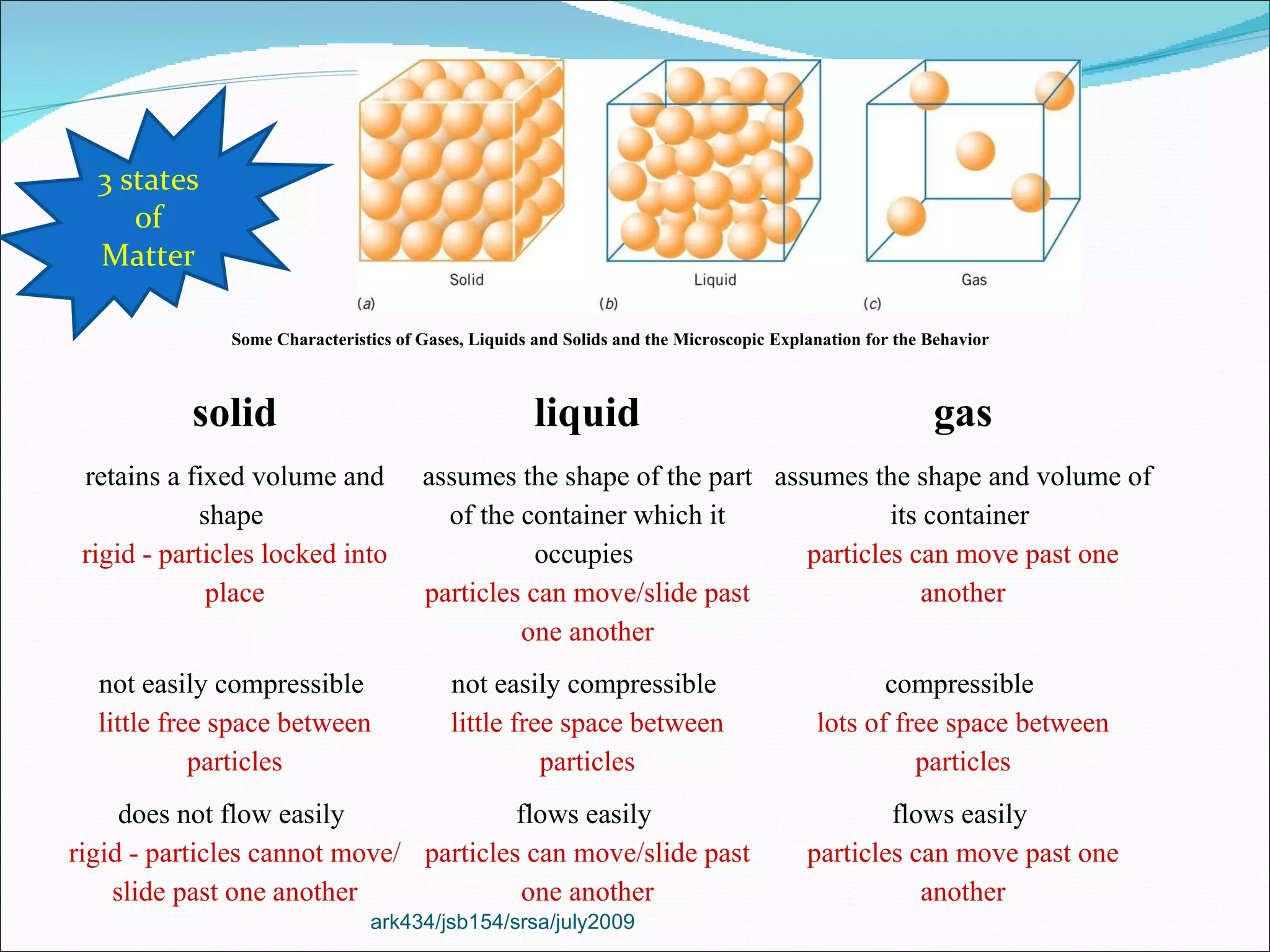
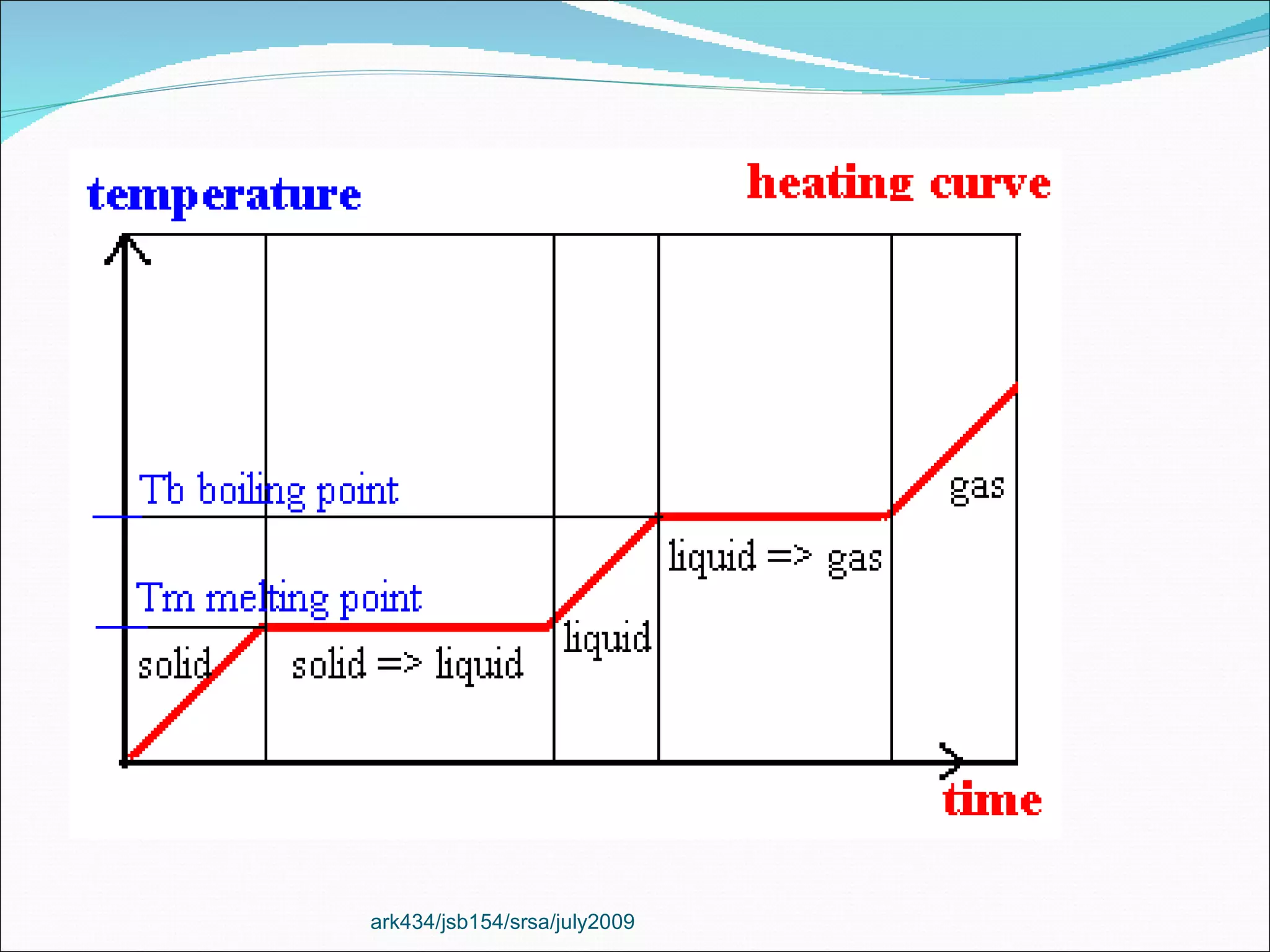
ark434/jsb154/srsa/july2009 3 states of Matter Some Characteristics of Gases, Liquids and Solids and the Microscopic Explanation for the Behavior solid liquid gas retains a fixed volume and shape  rigid - particles locked into place assumes the shape of the part of the container which it occupies  particles can move/slide past one another assumes the shape and volume of its container  particles can move past one another not easily compressible  little free space between particles not easily compressible  little free space between particles compressible  lots of free space between particles does not flow easily  rigid - particles cannot move/slide past one another flows easily  particles can move/slide past one another flows easily  particles can move past one another
ark434/jsb154/srsa/july2009
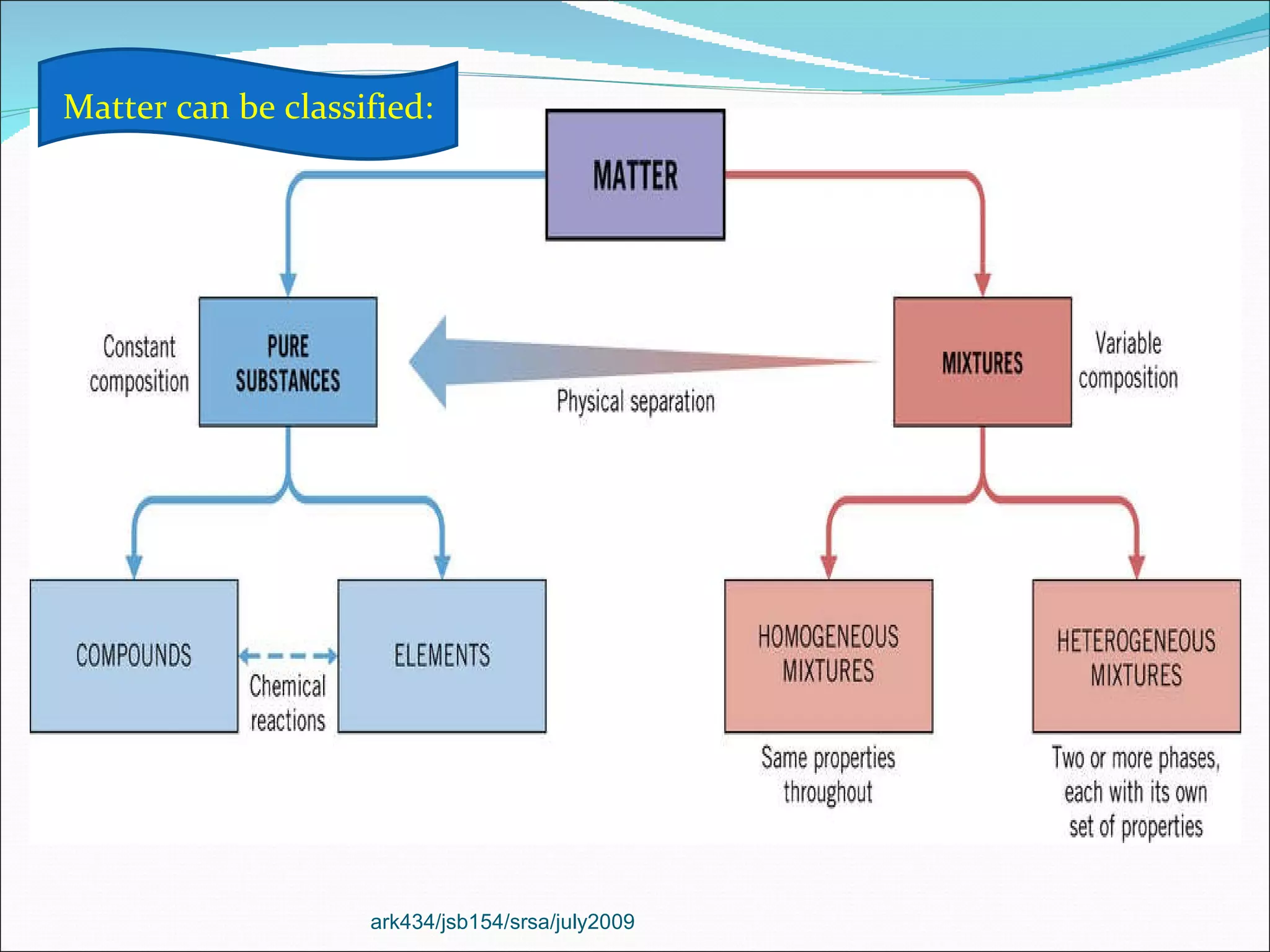
ark434/jsb154/srsa/july2009 Matter can be classified:
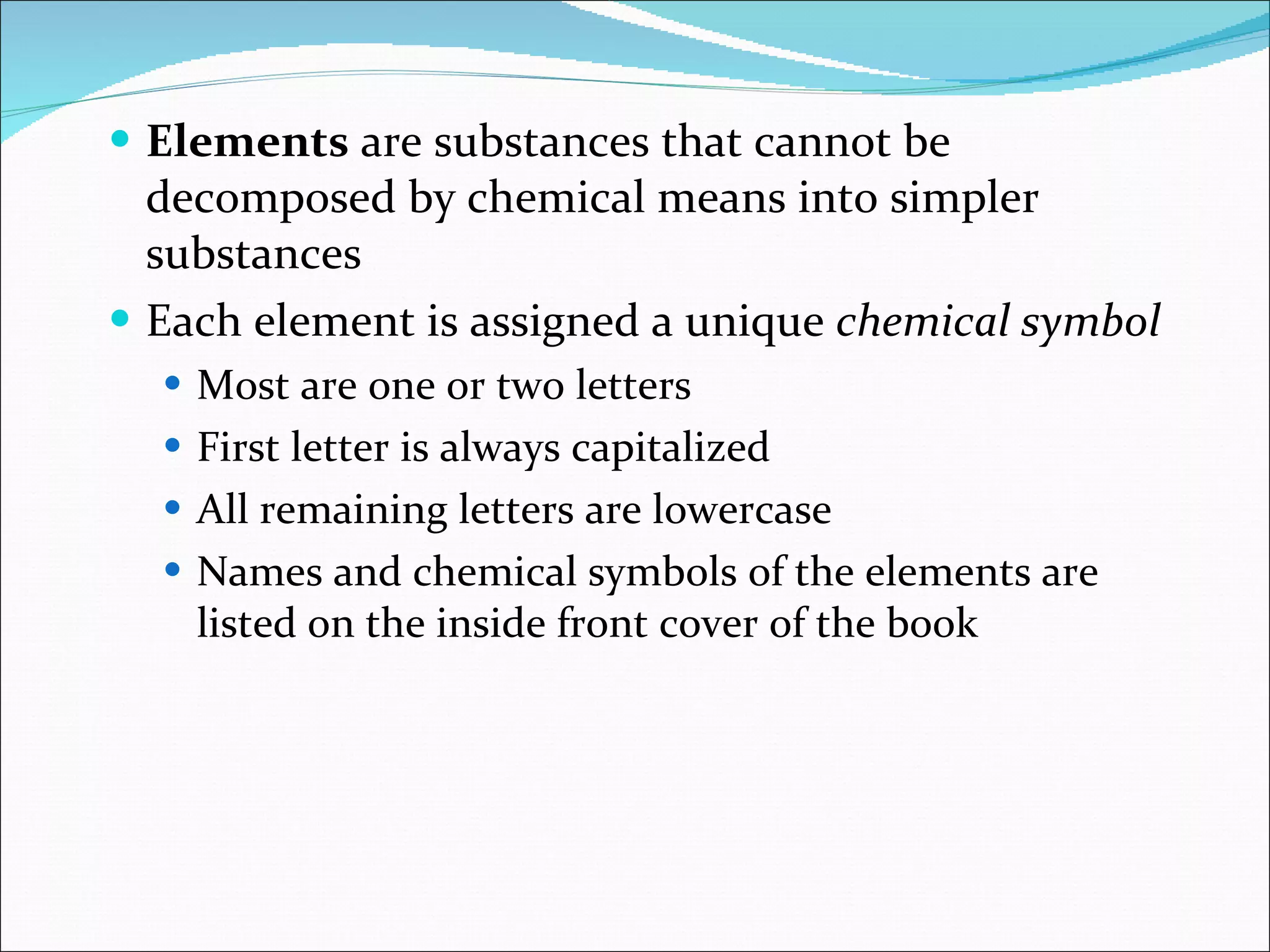
Elements  are substances that cannot be decomposed by chemical means into simpler substances Each element is assigned a unique  chemical symbol Most are one or two letters First letter is always capitalized All remaining letters are lowercase Names and chemical symbols of the elements are listed on the inside front cover of the book
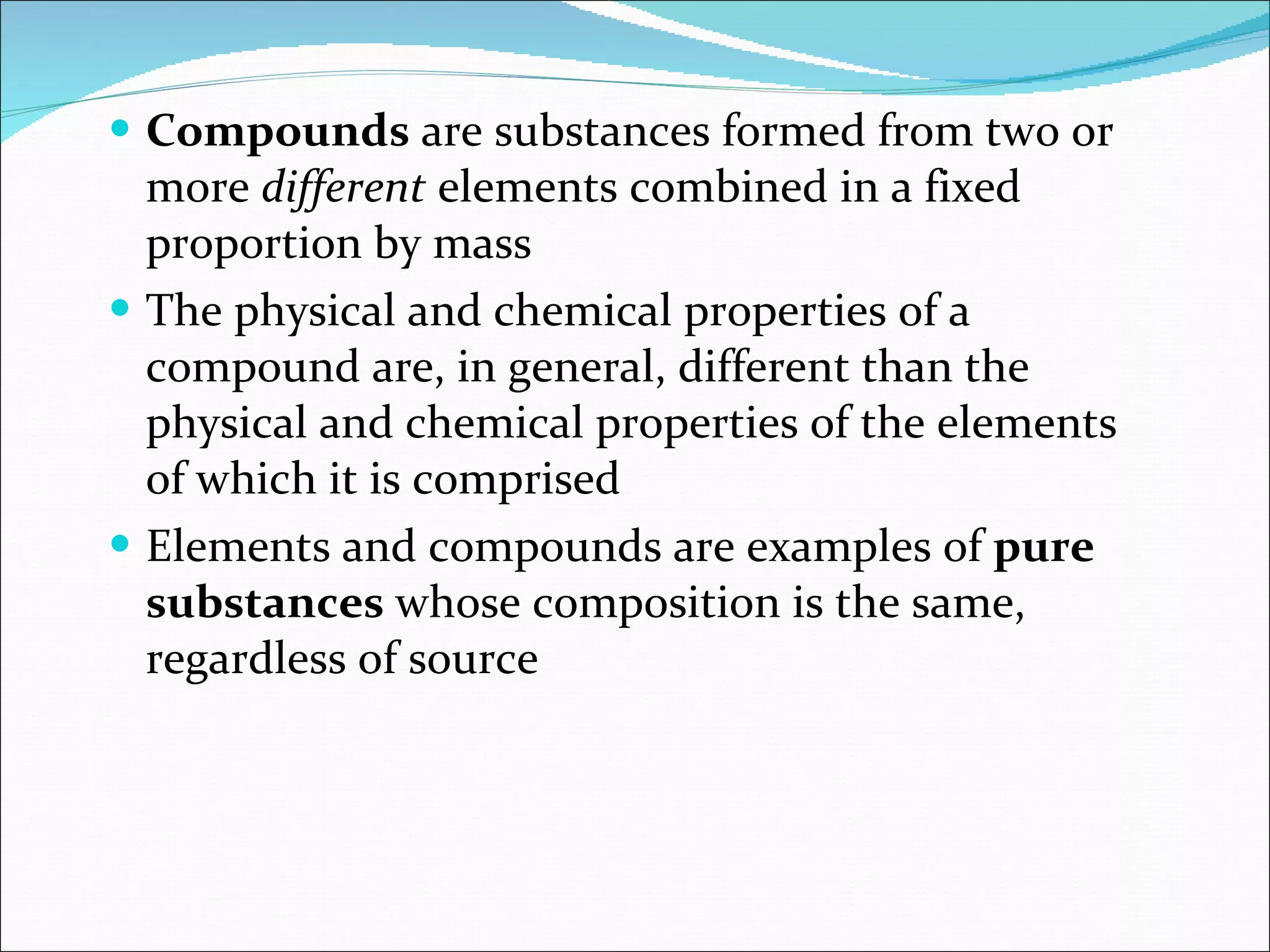
Compounds  are substances formed from two or more  different  elements combined in a fixed proportion by mass The physical and chemical properties of a compound are, in general, different than the physical and chemical properties of the elements of which it is comprised Elements and compounds are examples of  pure substances  whose composition is the same, regardless of source
A  mixture  consists of varying amounts of two or more elements or compounds Homogeneous mixtures  or  solutions  have the same properties throughout the sample Heterogeneous mixtures  consist of two or more phases

States of matter ppt

  • 1.
  • 2.
    Matter is anythingthat has mass and occupies space. Mass: is an actual measurement of the amount of matter present. ark434/jsb154/srsa/july2009
  • 3.
    Physical properties: Propertiesof matter that can be observed or measured without trying to change the composition of the matter being studied. Chemical properties: Properties matter demonstrates when attempts are made to change it into new substances. Physical changes: Changes matter undergoes without changing composition. Chemical changes: Changes matter undergoes that involves changes in composition. ark434/jsb154/srsa/july2009
  • 4.
    ark434/jsb154/srsa/july2009 3 statesof Matter Some Characteristics of Gases, Liquids and Solids and the Microscopic Explanation for the Behavior solid liquid gas retains a fixed volume and shape rigid - particles locked into place assumes the shape of the part of the container which it occupies particles can move/slide past one another assumes the shape and volume of its container particles can move past one another not easily compressible little free space between particles not easily compressible little free space between particles compressible lots of free space between particles does not flow easily rigid - particles cannot move/slide past one another flows easily particles can move/slide past one another flows easily particles can move past one another
  • 5.
  • 6.
  • 7.
    Elements aresubstances that cannot be decomposed by chemical means into simpler substances Each element is assigned a unique chemical symbol Most are one or two letters First letter is always capitalized All remaining letters are lowercase Names and chemical symbols of the elements are listed on the inside front cover of the book
  • 8.
    Compounds aresubstances formed from two or more different elements combined in a fixed proportion by mass The physical and chemical properties of a compound are, in general, different than the physical and chemical properties of the elements of which it is comprised Elements and compounds are examples of pure substances whose composition is the same, regardless of source
  • 9.
    A mixture consists of varying amounts of two or more elements or compounds Homogeneous mixtures or solutions have the same properties throughout the sample Heterogeneous mixtures consist of two or more phases